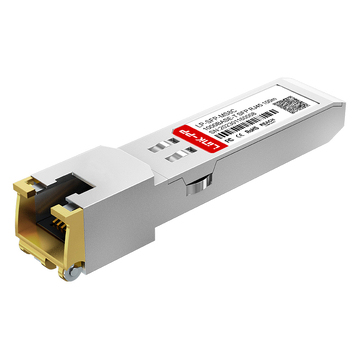






























Gigabit Ethernet networks continue to rely heavily on copper-based connectivity for access-layer deployments, server connections, and enterprise network expansion. Among Cisco's most widely deployed copper transceivers, the Cisco GLC-T and Cisco GLC-TE have become common choices for providing 1000BASE-T connectivity over standard Cat5e and Cat6 cabling. Although both modules serve a similar purpose, their technical characteristics and platform compatibility can influence deployment decisions.
When comparing Cisco GLC-T vs GLC-TE, many network administrators want to know whether the two modules can be used interchangeably, what differences exist in power consumption and hardware design, and which option is better suited for modern Cisco environments. Understanding these distinctions is essential for maintaining compatibility, improving operational efficiency, and supporting long-term network planning.
This article explores several key aspects of the GLC-T vs GLC-TE comparison, including:
-
Technical specifications and feature differences
-
Performance, power consumption, and reliability
-
Cisco platform compatibility considerations
-
Typical deployment scenarios and use cases
-
Selection guidance and compatible alternatives
By the end of this guide, you will have a clear understanding of how these Cisco copper SFP modules compare and which option aligns best with your network requirements.
🔩 What Are Cisco GLC-T and GLC-TE?
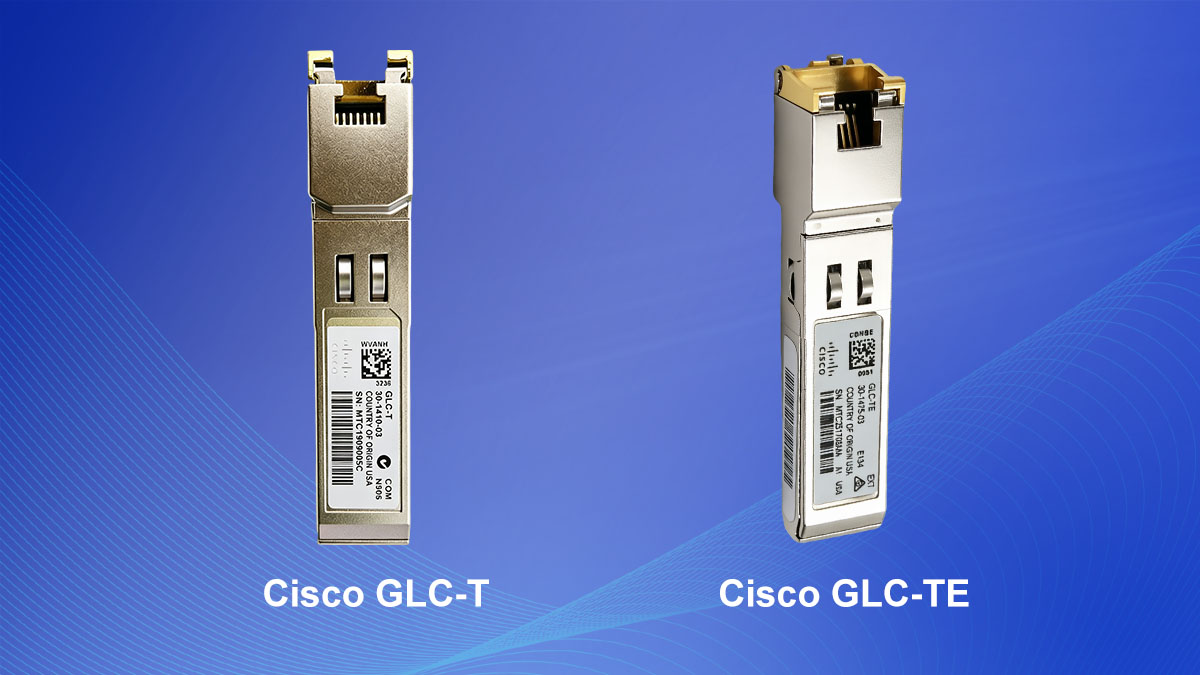
Cisco GLC-T and GLC-TE are both 1000BASE-T copper SFP transceivers designed to deliver Gigabit Ethernet connectivity over standard twisted-pair copper cabling. While the two modules share many core specifications, Cisco introduced the GLC-TE as an enhanced version of the earlier GLC-T, offering improved compatibility and efficiency for newer networking environments. Understanding the purpose and evolution of these modules provides the foundation for a meaningful Cisco GLC-T vs GLC-TE comparison.
Overview of Cisco GLC-T
The Cisco GLC-T is a Gigabit Ethernet copper SFP module that enables network devices to transmit data over conventional Ethernet cabling rather than fiber optics. It has been widely deployed in enterprise, campus, and branch office networks where copper infrastructure is already available.
Key characteristics of the Cisco GLC-T include:
- Support for the IEEE 802.3ab 1000BASE-T standard
- Data transmission rates up to 1Gbps
- RJ-45 connector interface
- Compatibility with Cat5e, Cat6, and higher-grade copper cables
- Maximum transmission distance of 100m
- Hot-swappable SFP form factor
These features make the GLC-T a practical option for connecting switches, servers, routers, and network appliances without requiring fiber cabling.
Overview of Cisco GLC-TE
The Cisco GLC-TE is an updated copper SFP transceiver designed to provide the same 1000BASE-T functionality while improving operational efficiency and platform support. From a network perspective, it performs the same primary role as the GLC-T, enabling Gigabit Ethernet transmission over RJ-45 copper connections.
The main characteristics of the Cisco GLC-TE include:
- Compliance with IEEE 802.3ab standards
- 1Gbps Gigabit Ethernet connectivity
- RJ-45 copper interface
- Support for transmission distances up to 100m
- SFP hot-pluggable design
- Optimized hardware architecture for newer Cisco platforms
In many deployments, network administrators view the GLC-TE as the successor to the original GLC-T because it maintains identical network functionality while addressing evolving hardware requirements.
Why Cisco Introduced GLC-TE
Cisco introduced the GLC-TE to address changing network infrastructure requirements while preserving the familiar functionality of copper Gigabit Ethernet SFP modules. Rather than redefining the technology, Cisco focused on refining the design to better align with newer switch architectures and operational expectations.
Several factors contributed to the introduction of the GLC-TE:
- Improved support for newer Cisco Catalyst and Nexus platforms
- Enhanced energy efficiency compared with earlier generations
- Better thermal characteristics in dense networking environments
- Simplified long-term lifecycle management
- Continued support for standard 1000BASE-T copper connectivity
These improvements allowed Cisco to maintain full Gigabit Ethernet functionality while providing a module better suited to modern enterprise networks.
🔩 Cisco GLC-T vs GLC-TE Specifications Comparison
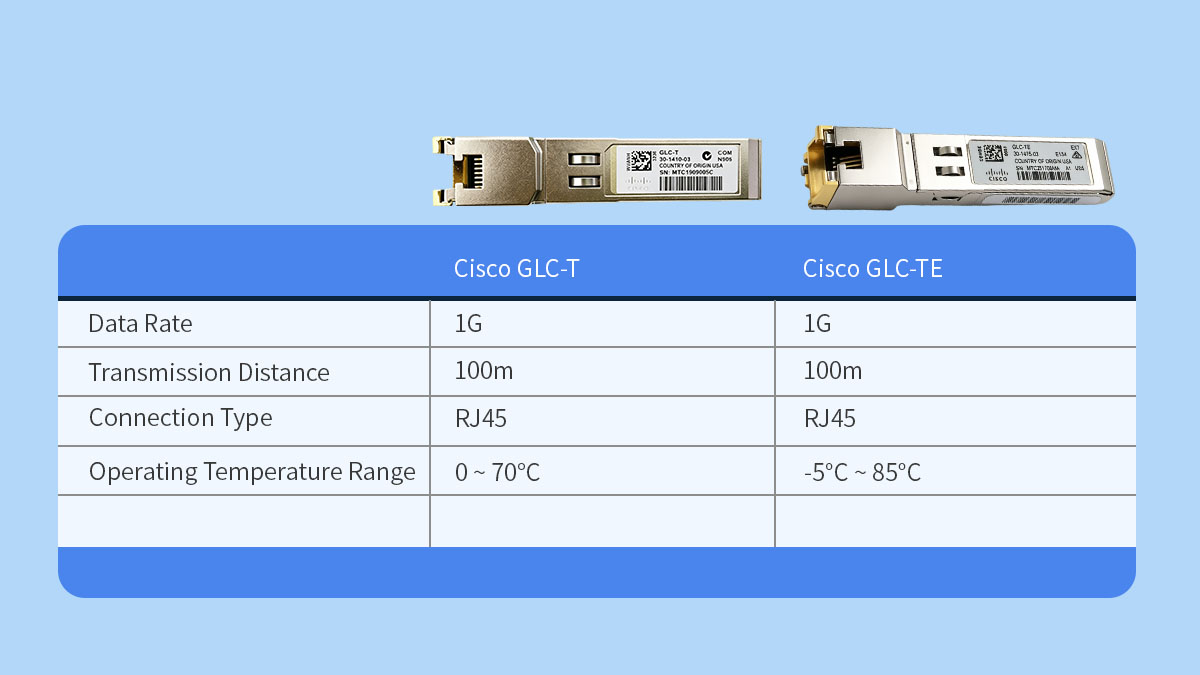
When evaluating Cisco GLC-T vs GLC-TE, it is important to understand that both modules deliver the same Gigabit Ethernet connectivity over copper cabling. However, they are not identical products. Beyond power optimization and platform support, one of the most significant differences is their operating temperature range. The Cisco GLC-TE is designed for an extended temperature environment, while the Cisco GLC-T is intended for standard commercial operating conditions.
Technical Specifications Side-by-Side
The following comparison highlights the key specifications of both Cisco copper SFP modules and identifies where meaningful differences exist.
| Specification | Cisco GLC-T | Cisco GLC-TE |
|---|---|---|
| Ethernet Standard | IEEE 802.3ab 1000BASE-T | IEEE 802.3ab 1000BASE-T |
| Data Rate | 1Gbps | 1Gbps |
| Connector Type | RJ-45 | RJ-45 |
| Maximum Distance | 100m | 100m |
| Cable Type | Cat5e/Cat6 or better | Cat5e/Cat6 or better |
| Form Factor | Hot-swappable SFP | Hot-swappable SFP |
| Duplex Mode | Full Duplex | Full Duplex |
| Auto-Negotiation | Supported | Supported |
| Operating Temperature | Commercial Temperature Range (0°C to 70°C) | Extended Temperature Range (-5°C to 85°C) |
| Power Consumption | Higher | Lower |
| Hardware Generation | Earlier Design | Enhanced Design |
| Platform Compatibility | Legacy and Current Platforms | Optimized for Newer Cisco Platforms |
This comparison shows that network performance specifications remain virtually identical. The primary differences are found in environmental tolerance, power efficiency, and hardware optimization. Among these factors, operating temperature is often overlooked but can be critical in certain deployment scenarios.
Similarities Between GLC-T and GLC-TE
From a networking perspective, both modules provide the same Gigabit Ethernet functionality. Organizations upgrading from GLC-T to GLC-TE generally do not need to modify network architecture, cabling infrastructure, or link configurations.
The major similarities include:
- Compliance with IEEE 802.3ab 1000BASE-T standards
- 1Gbps Gigabit Ethernet transmission speed
- RJ-45 copper interface
- Support for Cat5e and Cat6 cabling
- Maximum transmission distance of 100m
- Hot-swappable SFP form factor
- Auto-negotiation support
- Full-duplex operation
Because of these shared characteristics, both modules are commonly used in campus networks, enterprise access layers, branch offices, and server connectivity applications.
Key Technical Differences
Although the network-facing specifications are nearly identical, several technical distinctions separate the two modules and influence deployment decisions.
The following table summarizes the most important differences.
| Category | Cisco GLC-T | Cisco GLC-TE |
| Temperature Classification | Commercial Grade | Extended Temperature Grade |
| Operating Range | 0°C to 70°C | -5°C to 85°C |
| Power Efficiency | Standard | Improved |
| Thermal Performance | Higher Heat Generation | Lower Heat Generation |
| Platform Optimization | Earlier Cisco Platforms | Newer Cisco Platforms |
| Lifecycle Positioning | Legacy Deployment Focus | Preferred Modern Alternative |
Among these differences, temperature tolerance is often the deciding factor in industrial, outdoor-adjacent, or poorly conditioned environments.
🔩 Performance Comparison: GLC-T vs GLC-TE
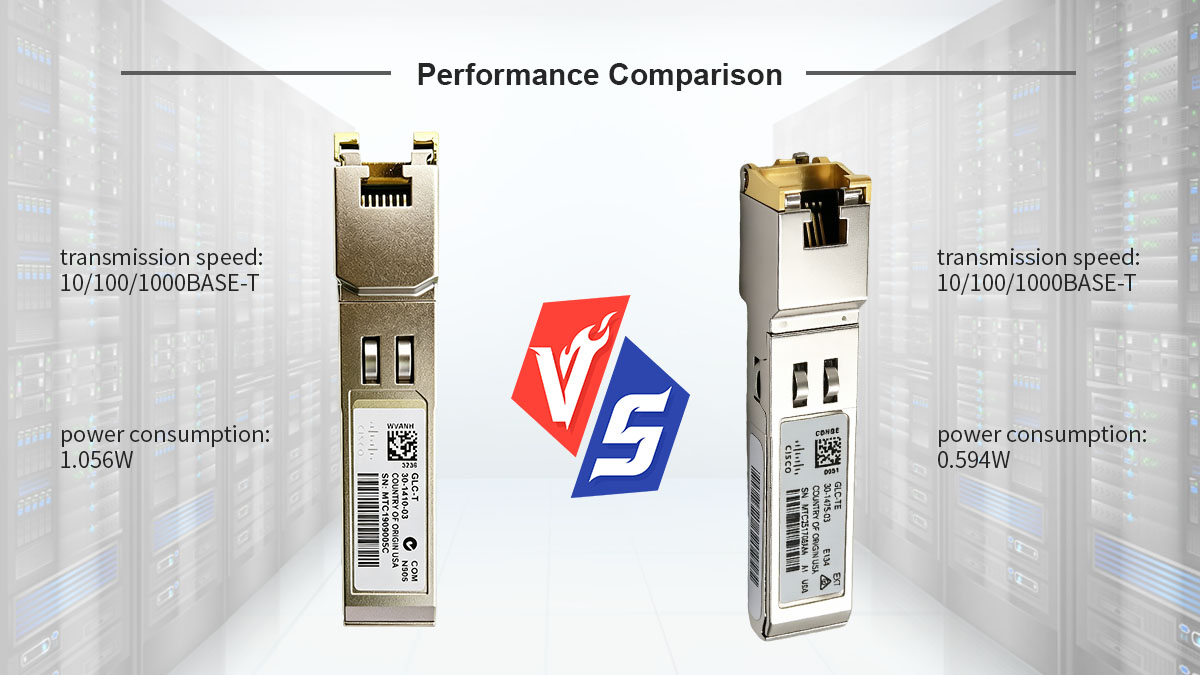
From a pure networking perspective, the performance difference between Cisco GLC-T and GLC-TE is relatively small because both modules are based on the same IEEE 802.3ab 1000BASE-T standard. They deliver identical Gigabit Ethernet speeds and support the same copper cabling infrastructure. However, differences in power efficiency, thermal behavior, and environmental tolerance can influence overall operational performance, particularly in large-scale deployments.
Network Throughput and Speed
When evaluating throughput, there is no meaningful advantage of one module over the other. Both the Cisco GLC-T and Cisco GLC-TE are designed to provide stable 1Gbps Ethernet connectivity across standard copper networks.
Key performance characteristics shared by both modules include:
- 1Gbps line-rate Ethernet transmission
- IEEE 802.3ab 1000BASE-T compliance
- Full-duplex communication
- Auto-negotiation support
- Support for Cat5e and Cat6 cabling
- Maximum transmission distance of 100m
Because both transceivers operate under the same Ethernet standard, users should expect similar bandwidth performance under normal operating conditions.
In practical deployments, network speed is more likely to be affected by switch architecture, cable quality, network congestion, and endpoint capabilities than by choosing between GLC-T and GLC-TE.
Power Consumption Analysis
One area where the Cisco GLC-TE typically demonstrates an advantage is power efficiency. Cisco introduced the GLC-TE with hardware improvements intended to reduce power requirements while maintaining the same network functionality.
The operational benefits of lower power consumption include:
- Reduced energy usage per port
- Lower heat generation inside switches
- Improved cooling efficiency
- Better suitability for high-density switch deployments
- Reduced stress on switch power budgets
These advantages become increasingly important as the number of installed copper SFP modules grows.
Reliability and Stability
Both GLC-T and GLC-TE are designed for enterprise-class networking environments and provide reliable Gigabit Ethernet connectivity when used within their specified operating conditions. The most significant distinction is how each module handles environmental challenges.
Several factors contribute to long-term operational stability:
- Cisco qualification and interoperability testing
- Compliance with industry Ethernet standards
- Support for continuous network operation
- Stable link establishment and auto-negotiation
- Compatibility with Cisco switching platforms
While both modules are highly reliable, the GLC-TE offers additional resilience because of its extended operating temperature range.
Key environmental differences include:
- GLC-T operating range: 0°C to 70°C
- GLC-TE operating range: -5°C to 85°C
This wider temperature tolerance allows the GLC-TE to maintain stable operation in environments where temperatures fluctuate beyond traditional office conditions.
🔩 Compatibility Differences Between GLC-T and GLC-TE
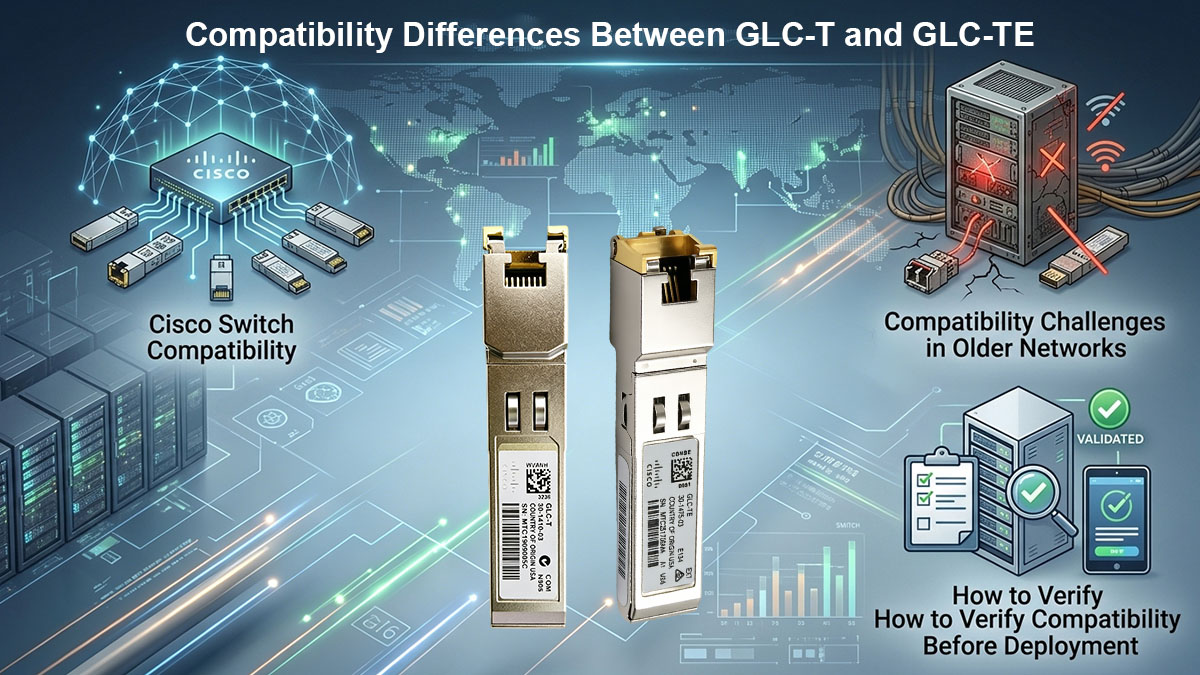
Compatibility is one of the most important factors when comparing Cisco GLC-T vs GLC-TE because, although both modules provide identical Gigabit Ethernet functionality, they do not always behave the same way across different Cisco hardware platforms. The differences are mainly driven by Cisco platform evolution, hardware validation policies, and power/thermal design requirements.
Cisco Switch Compatibility
Both GLC-T and GLC-TE are designed to work within Cisco Catalyst and Cisco Nexus ecosystems, but actual support depends heavily on the specific switch model and software version.
In practical deployment terms:
- GLC-T is widely supported on older Cisco Catalyst switches
- GLC-TE is more consistently supported on newer Cisco hardware generations
- Some modern platforms may prefer or explicitly recommend GLC-TE due to updated validation requirements
Key compatibility considerations include:
- Cisco switch model generation (legacy vs modern architectures)
- IOS / IOS-XE / NX-OS software version
- Module certification lists defined by Cisco
- Hardware power budget per SFP port
- Thermal design constraints of the switch chassis
Because Cisco continuously updates its supported optics matrix, compatibility should always be verified against the exact switch model rather than assumed based on module type alone.
Compatibility Differences in Legacy and Modern Networks
The gap between GLC-T and GLC-TE becomes more noticeable when deployed across mixed-generation networks. While both modules deliver the same 1000BASE-T connectivity, their behavior in older and newer systems can differ due to platform validation rules.
Typical compatibility patterns include:
- Legacy environments:
- GLC-T is often fully supported and widely deployed
- GLC-TE may function but is not always explicitly listed in older compatibility guides
- Firmware limitations can affect module recognition
- Modern environments:
- GLC-TE is more frequently validated and recommended
- Better alignment with updated Cisco power management policies
- Improved interoperability with newer Catalyst series switches
Common compatibility challenges include:
- Module not recognized by switch IOS version
- "Unsupported transceiver" warnings in strict mode configurations
- Power allocation restrictions per SFP slot
- Software licensing or feature-set limitations affecting third-party or newer modules
In many cases, these issues are not caused by the electrical interface itself, but by Cisco's platform-level validation rules.
How to Verify Compatibility Before Deployment
To avoid deployment issues, compatibility should always be confirmed through structured verification rather than assumptions. Since GLC-T and GLC-TE differences are platform-dependent, proper validation ensures stable network operation.
A recommended compatibility verification process includes:
- Checking Cisco official hardware compatibility documentation for the specific switch model
- Reviewing IOS / IOS-XE / NX-OS release notes for supported transceivers
- Confirming SFP module support in the platform's transceiver matrix
- Verifying available power budget per SFP slot in high-density deployments
- Testing in a controlled lab environment before large-scale rollout
Additional best practices include:
- Standardizing on a single module type (GLC-T or GLC-TE) within the same network segment when possible
- Avoiding mixed deployment in strict compatibility environments unless validated
- Monitoring switch logs for transceiver-related warnings after installation
- Ensuring firmware consistency across switch clusters
Ultimately, while both modules share the same Gigabit Ethernet functionality, GLC-TE provides a more future-aligned compatibility profile in modern Cisco networks, whereas GLC-T remains strongly tied to established legacy environments. This distinction plays a critical role when planning upgrades, expansions, or multi-generational network integrations.
🔩 Deployment Scenarios for GLC-T and GLC-TE
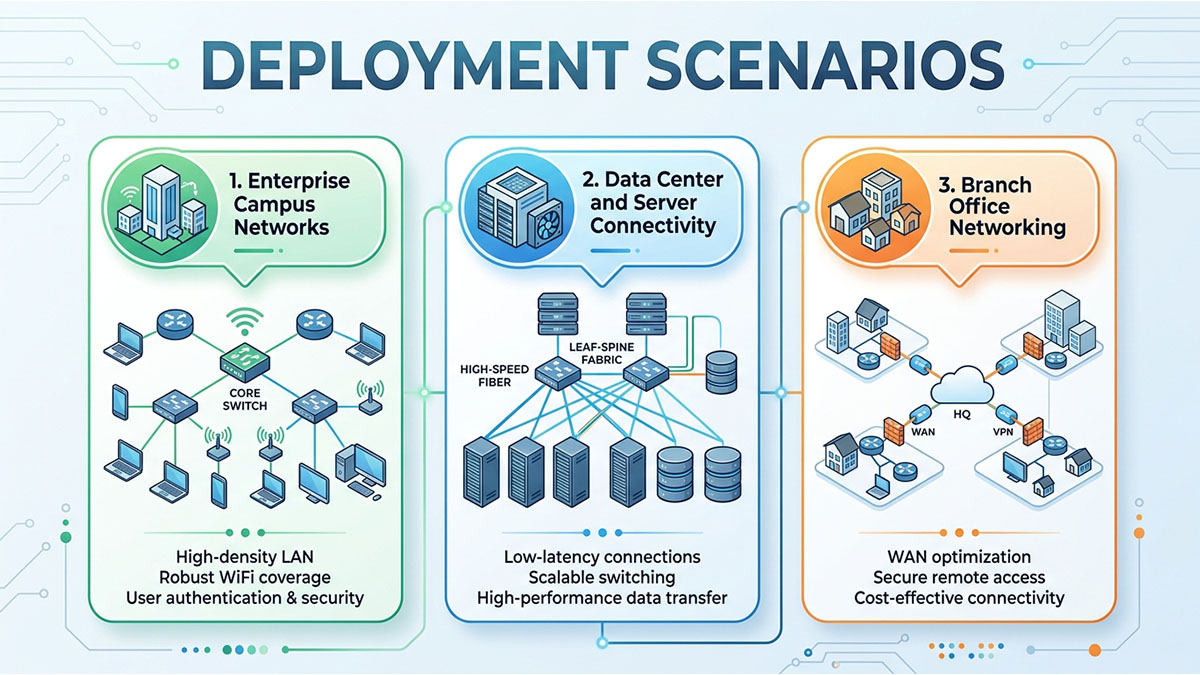
When comparing Cisco GLC-T vs GLC-TE in real-world environments, the most practical differences appear in how each module is deployed rather than in raw network performance. Since both support identical 1000BASE-T Gigabit Ethernet functionality, deployment decisions are usually driven by environment type, switch generation, power constraints, and long-term infrastructure planning.
Enterprise Campus Networks
In enterprise campus environments, both GLC-T and GLC-TE are widely used for access-layer connectivity where copper cabling is already deployed. These environments typically prioritize simplicity, cost efficiency, and ease of expansion.
Typical usage characteristics include:
- Switch-to-endpoint connectivity in office floors
- Access-layer uplinks using existing copper infrastructure
- Standardized Gigabit Ethernet connections across departments
- Moderate port density with controlled environmental conditions
In such deployments:
- GLC-T is often sufficient for legacy campus switches already installed
- GLC-TE is preferred in newer campus refresh projects due to better efficiency and platform alignment
Because campus networks are usually climate-controlled, temperature tolerance differences are less critical, and selection is often based on switch compatibility and lifecycle planning.
Data Center and Server Connectivity
In data center environments, copper SFP modules like GLC-T and GLC-TE are typically used for short-distance connections where fiber is not required, especially for management networks or server adjacency links.
Common deployment use cases include:
- Server-to-top-of-rack switch connections (short copper runs)
- Management network connectivity for servers and appliances
- Temporary or auxiliary network paths
- Rack-level interconnectivity in compact zones
Key considerations in this environment:
- High port density increases power and heat sensitivity
- Thermal management becomes more important
- Switch power budgets can be a limiting factor
In this context:
- GLC-TE is generally preferred due to lower power consumption and reduced thermal output
- GLC-T may still be used in existing deployments where hardware compatibility is already established
As rack density increases, even small efficiency improvements at the transceiver level can contribute to overall system stability.
Branch Office Networking
Branch office environments often rely on simplified infrastructure designs where copper cabling is the primary medium for all networking layers. Both modules are commonly used in these scenarios due to their straightforward deployment model.
Typical applications include:
- Small office switch interconnection
- WAN edge device connectivity
- Local access network expansion
- Integration with existing structured cabling systems
Key characteristics of branch deployments:
- Limited IT infrastructure support on-site
- Standardized equipment across multiple locations
- Emphasis on reliability and ease of replacement
In this environment:
- GLC-T remains widely used due to its long-established presence
- GLC-TE is increasingly selected for new branch deployments for better long-term consistency across Cisco platforms
Since environmental conditions vary widely in branch offices, the extended temperature capability of GLC-TE can provide additional operational flexibility in non-ideal installations.
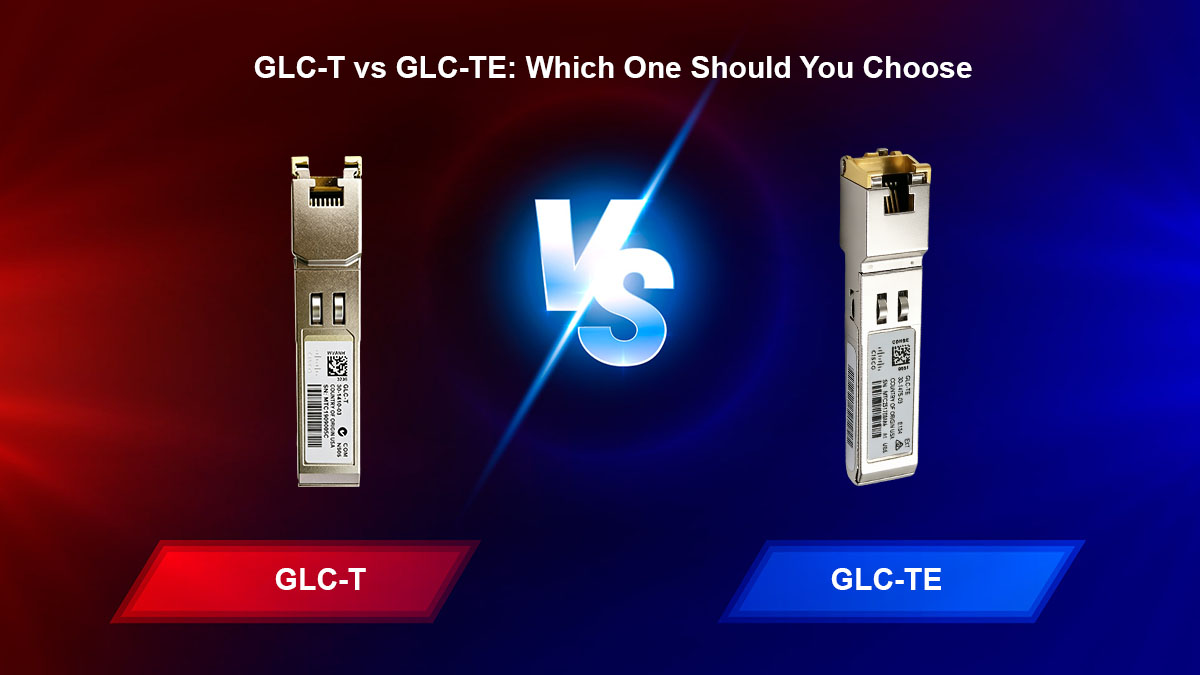
🔩 GLC-T vs GLC-TE: Which One Should You Choose?
Choosing between Cisco GLC-T and GLC-TE is less about performance differences and more about aligning the module with your network environment, Cisco platform generation, and long-term operational requirements. Since both modules deliver identical 1000BASE-T Gigabit Ethernet functionality, the decision typically comes down to compatibility, efficiency, and deployment context.
When GLC-T May Be Suitable
GLC-T is still a practical choice in environments where legacy infrastructure and established Cisco platforms are already in place. In these cases, replacing or standardizing on GLC-T may be more cost-effective and operationally simpler.
GLC-T is typically suitable in the following situations:
- Existing networks already standardized on GLC-T modules
- Older Cisco Catalyst switches with validated GLC-T support
- Stable indoor enterprise environments with controlled temperature conditions
- Maintenance or replacement of existing installed base
- Networks where power efficiency is not a primary constraint
In these deployments, GLC-T continues to deliver reliable Gigabit connectivity without requiring architectural changes or platform upgrades.
When GLC-TE Is the Better Option
GLC-TE is better suited for modern network environments where efficiency, compatibility, and scalability are key considerations. It is commonly selected in new deployments and infrastructure upgrades.
GLC-TE is typically the preferred option in the following cases:
- New Cisco switch deployments or network refresh projects
- Environments requiring lower power consumption per port
- High-density switch configurations where thermal management matters
- Mixed or newer Cisco hardware platforms with updated transceiver validation
- Installations in environments with variable or extended temperature conditions
Key advantages in these scenarios include:
- Improved energy efficiency across multiple ports
- Better thermal behavior in dense installations
- Stronger alignment with newer Cisco platform requirements
- Greater flexibility for long-term infrastructure planning
Because of these factors, GLC-TE is often viewed as the more future-oriented choice in Cisco copper SFP deployments.
Decision-Making Checklist
To simplify the selection process, it is helpful to evaluate both modules against a consistent set of operational criteria. This helps ensure that the chosen module aligns with both current requirements and future scalability needs.
Key decision factors include:
- Cisco switch model and software compatibility
- Existing installed base of optical or copper SFP modules
- Power budget availability per switch
- Environmental conditions (standard vs extended temperature needs)
- Port density and thermal constraints
- Long-term network expansion plans
A simplified interpretation of these factors:
- If maintaining an existing stable environment → GLC-T may remain appropriate
- If designing or upgrading a modern network → GLC-TE is generally more suitable
- If operating in mixed or evolving infrastructure → GLC-TE provides greater flexibility
Ultimately, both modules fulfill the same fundamental role in delivering Gigabit Ethernet over copper. The key distinction lies in how well each aligns with modern Cisco hardware evolution and operational efficiency requirements, with GLC-TE typically offering broader applicability in forward-looking network designs.
🔩 FAQs

What is the main difference between Cisco GLC-T and GLC-TE?
The main difference is that GLC-TE is optimized for newer Cisco platforms with lower power consumption and extended temperature support, while GLC-T is a standard commercial-grade 1000BASE-T module.
Are GLC-T and GLC-TE interchangeable?
They can be interchangeable in many cases because both support 1000BASE-T Gigabit Ethernet over RJ-45, but actual compatibility depends on the Cisco switch model and software version.
Does GLC-TE perform faster than GLC-T?
No. Both modules support the same 1Gbps Ethernet speed. Performance differences are related to power efficiency and environmental tolerance, not throughput.
Which module consumes less power?
GLC-TE generally consumes less power due to hardware optimization, which can also reduce heat generation in high-density switch deployments.
What temperature range do GLC-T and GLC-TE support?
GLC-T is designed for commercial environments, while GLC-TE supports an extended temperature range, making it suitable for harsher operating conditions.
Can GLC-T still be used in modern Cisco switches?
Yes, but compatibility depends on the specific switch model and firmware. Some newer platforms may prefer or officially support GLC-TE instead.
Is there any difference in cabling requirements?
No. Both modules use standard RJ-45 copper connections and support Cat5e or Cat6 cabling up to 100 meters.
Why do some Cisco switches prefer GLC-TE?
Because GLC-TE aligns better with newer Cisco hardware policies, offering improved efficiency, thermal behavior, and broader platform validation.
🔩 Conclusion
The comparison of Cisco GLC-T vs GLC-TE shows that both modules deliver identical 1000BASE-T Gigabit Ethernet performance over copper cabling, but differ mainly in platform compatibility, power efficiency, and operating temperature range. While GLC-T remains widely used in established enterprise networks, GLC-TE represents a more optimized evolution designed for modern Cisco switching environments and broader deployment conditions.
A clear summary of the most important points:
- Both GLC-T and GLC-TE support 1Gbps Gigabit Ethernet over RJ-45 copper up to 100m
- GLC-TE offers lower power consumption and improved thermal efficiency
- GLC-TE supports an extended temperature range compared to the commercial-grade GLC-T
- GLC-T is more commonly found in legacy Cisco infrastructure
- GLC-TE provides better alignment with newer Cisco platforms and future network scaling needs
- Performance is identical; differences are primarily operational and environmental
In real-world network planning, selecting between GLC-T and GLC-TE is ultimately about matching the module to infrastructure generation and environmental demands rather than choosing based on speed. For organizations upgrading or standardizing Cisco environments, ensuring compatibility and long-term operational efficiency is critical for stable network performance.
For more Cisco-compatible transceiver solutions and high-quality optical networking modules, you can explore the LINK-PP Official Store, which provides a wide range of reliable alternatives designed for enterprise and data center connectivity needs.