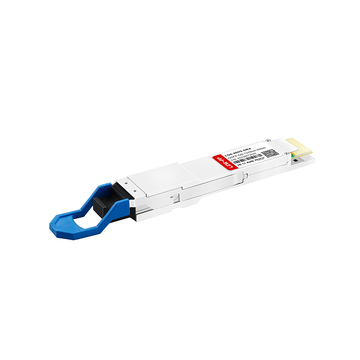
The rapid growth of cloud computing, artificial intelligence workloads, and hyperscale data centers has significantly increased the demand for higher bandwidth and more efficient optical interconnects. Network operators are now under constant pressure to scale capacity while minimizing rack space, power consumption, and operational complexity. In this context, optical transceiver form factors have become a critical design factor in modern network architecture.
CFP4 was introduced as a compact 100G optical module designed specifically to address limitations in earlier CFP and CFP2 solutions. By reducing physical size while maintaining high-speed transmission capability, CFP4 enables better port density and more efficient use of front-panel space in switches and routers. This shift directly supports the industry’s transition toward high-density networking environments where space and scalability are equally important.
This article explores CFP4 from the perspective of form factor optimization and high-density deployment, focusing on its architectural advantages and system-level impact. Key areas include:
- How CFP4 achieves compact form factor design improvements
- The role of CFP4 in increasing port density and rack efficiency
- Its contribution to modern data center and carrier network scaling
These insights help clarify why CFP4 remains relevant in high-density optical networking design strategies today.
🧭 What Is CFP4 and Why Was It Developed?
CFP4 is a compact 100G optical transceiver form factor designed to deliver high-speed data transmission while significantly reducing module size compared to earlier CFP generations. It was developed to improve port density, lower power consumption per gigabit, and enable more scalable front-panel designs in modern networking equipment where space and bandwidth demand must be balanced efficiently.
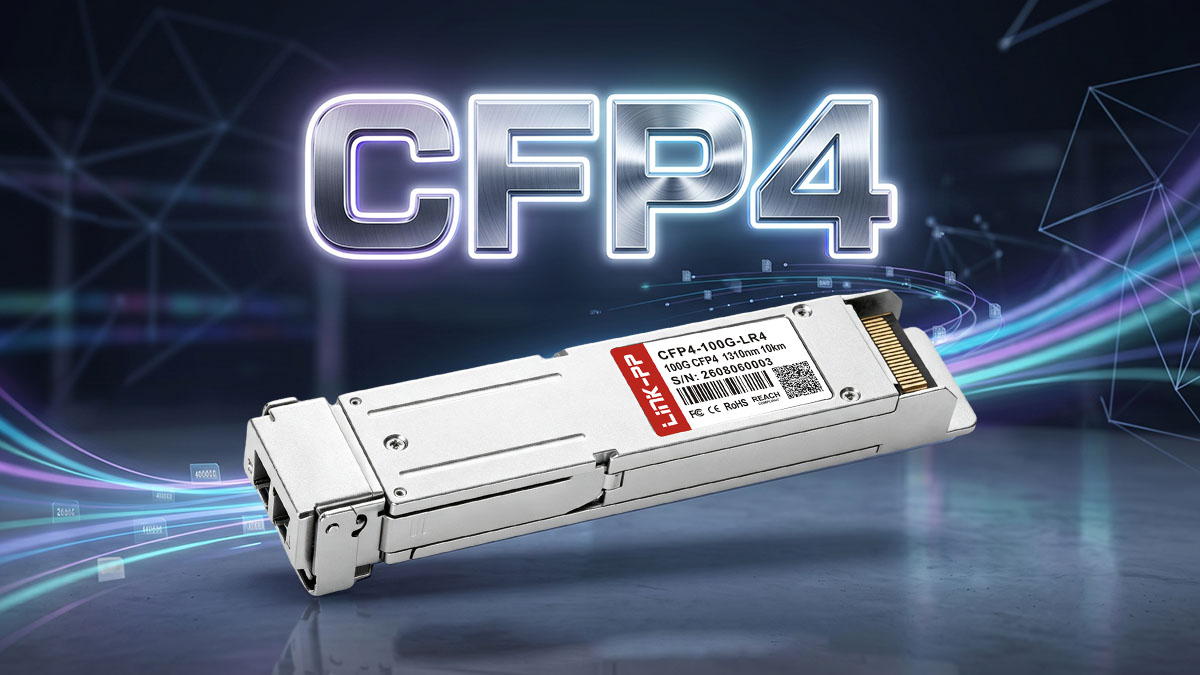
Evolution from CFP to CFP2 and CFP4
The evolution from CFP to CFP4 reflects a continuous industry shift toward smaller form factors, higher port density, and improved power efficiency in 100G optical networking systems. Each generation of CFP modules was developed to address the physical and electrical limitations of the previous one, enabling network operators to scale bandwidth without proportionally increasing rack space or power consumption.
This progression can be clearly understood by comparing the three generations across key design and deployment factors:
| Feature | CFP | CFP2 | CFP4 |
|---|---|---|---|
| Form Factor Size | Largest early 100G module | Reduced footprint vs CFP | Compact, high-density optimized design |
| Power Efficiency | Relatively high power consumption | Improved efficiency | Optimized low-power architecture |
| Port Density | Limited due to size | Moderate improvement | High-density deployment capability |
| Typical Deployment | Early 100G backbone systems | Transitional network platforms | Modern high-density switches and routers |
From this comparison, it is clear that CFP was primarily designed for functionality at scale, while CFP2 introduced meaningful improvements in size and efficiency. CFP4 represents a further step forward, focusing heavily on maximizing port density and enabling compact front-panel designs in modern networking equipment.
CFP4 Standard Specifications
CFP4 defines a smaller footprint optical module while still supporting 100G transmission using a parallel electrical interface architecture. It is engineered to maintain compatibility with high-speed networking standards while optimizing physical and electrical efficiency.
Key specification characteristics include:
- Compact physical size approximately half of CFP2
- 4-lane electrical interface supporting 25Gbps per lane
- Support for 100G Ethernet transmission modes such as 100GBASE-SR4 and LR4
- Reduced power envelope compared to earlier CFP variants
These specifications allow CFP4 to fit into denser switch and router designs while maintaining full 100G performance capability.
Key Design Objectives of CFP4
CFP4 was specifically engineered to solve space, power, and scalability constraints in high-density networking environments. Its design objectives focus on maximizing bandwidth delivery per unit of physical space while minimizing operational inefficiencies.
The core design goals include:
- Reducing front-panel footprint for higher port density
- Improving power efficiency per 100G interface
- Enabling scalable deployment in compact switching platforms
- Supporting data center and carrier-grade density requirements
By achieving these objectives, CFP4 directly addresses the limitations of earlier optical form factors and aligns with modern high-density network architecture requirements.
🧭 CFP4 Form Factor Architecture Explained
CFP4’s architecture is designed to maximize optical and electrical integration within a significantly reduced footprint, enabling higher port density without compromising 100G performance. At its core, CFP4 achieves this by tightly coupling optical engines, high-speed electrical interfaces, and optimized mechanical packaging into a compact module structure suitable for dense switching and routing platforms.
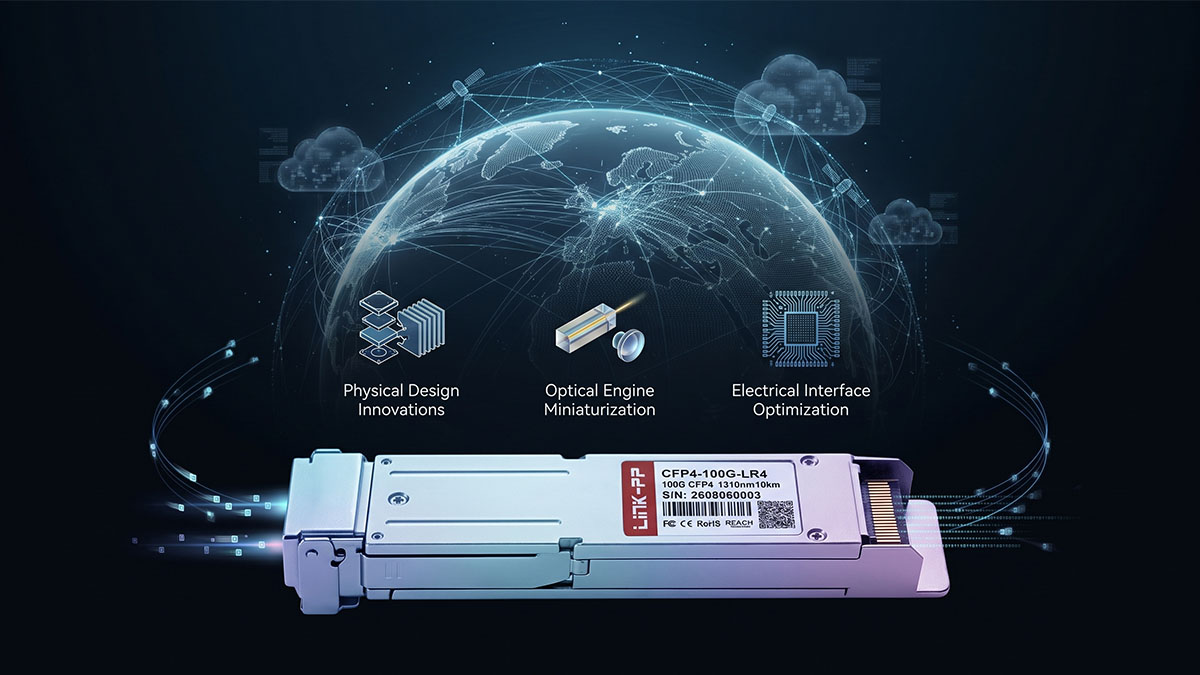
Physical Design Innovations
CFP4’s physical design focuses on reducing size while maintaining structural integrity and thermal stability in high-density environments. The module adopts a compact enclosure that allows more ports to be placed on a single front panel, directly supporting density-driven network architectures.
The key physical design characteristics include:
- Reduced module footprint compared to CFP2
- Optimized mechanical layout for front-panel stacking
- High-density connector alignment for improved port utilization
- Reinforced structure to support continuous high-speed operation
These design choices ensure that CFP4 can be deployed in space-constrained systems where every rack unit must deliver maximum bandwidth capacity.
Optical Engine Miniaturization
CFP4 integrates advanced optical engine designs that significantly reduce internal component size while maintaining signal integrity for 100G transmission. This miniaturization is a core factor enabling its high-density positioning.
The optical architecture improvements include:
- Integration of multiple optical components into compact assemblies
- Reduced internal optical path complexity to improve efficiency
- Advanced packaging techniques for lasers and photodiodes
- Improved alignment precision to maintain signal quality in smaller space
By compressing optical functionality into smaller modules, CFP4 allows system designers to increase port counts without increasing chassis size.
Electrical Interface Optimization
CFP4 uses a streamlined electrical interface architecture designed to support high-speed data transmission while minimizing complexity and power overhead. The interface typically operates using multiple high-speed lanes to distribute 100G traffic efficiently.
Key electrical optimization elements include:
- 4-lane electrical architecture supporting 25Gbps per lane
- Improved signal integrity through optimized PCB routing
- Reduced electrical trace length for lower loss and latency
- Efficient host-side integration for high-density switching platforms
This optimized interface design ensures CFP4 maintains stable performance even when deployed in densely packed system environments, where electrical interference and thermal constraints are more challenging.
🧭 Form Factor Optimization Benefits of CFP4
CFP4 delivers significant advantages in form factor optimization by reducing module size while maintaining 100G transmission capability. This optimization directly improves how network equipment is designed, deployed, and scaled, especially in environments where space, power, and port availability are tightly constrained. The result is a more efficient use of hardware resources without sacrificing network performance.
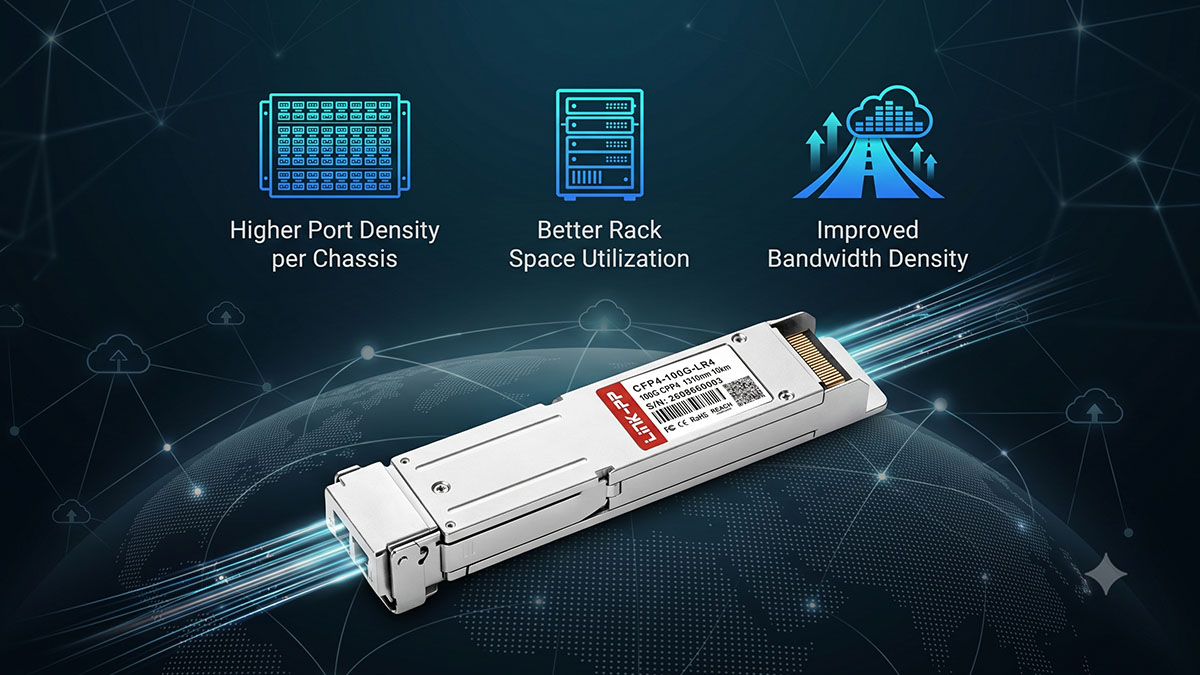
Higher Port Density per Chassis
CFP4 enables network platforms to support more optical interfaces within the same physical chassis footprint. By reducing the module size compared to earlier CFP generations, system designers can increase the number of 100G ports on a single line card or switch front panel.
This improvement translates into:
- More 100G interfaces per rack unit
- Increased switching capacity within existing hardware
- Better scalability for high-performance network architectures
- Reduced need for additional chassis expansion
In practice, this allows data centers and carrier systems to scale bandwidth without proportionally increasing physical infrastructure.
Better Rack Space Utilization
CFP4 improves rack-level efficiency by minimizing the physical space required per optical port. This is particularly important in environments where rack space is expensive or limited, such as hyperscale data centers and centralized network hubs.
Key advantages include:
- Reduced front-panel footprint per transceiver
- Higher bandwidth concentration per rack unit
- Improved equipment consolidation opportunities
- More efficient use of existing rack infrastructure
As a result, operators can achieve higher throughput without expanding physical facility space.
Improved Bandwidth Density
CFP4 significantly increases bandwidth density, meaning more data can be transmitted per unit of physical space. This metric is critical in modern network design, where efficiency is measured not only by total capacity but also by how compactly that capacity can be delivered.
This improvement is reflected in:
- Higher bandwidth per rack unit
- Increased throughput per switch chassis
- More efficient use of optical interfaces
- Better scaling efficiency in dense deployments
Bandwidth density improvements allow network architects to design systems that are both compact and highly performant.
Reduced Infrastructure Expansion Requirements
By increasing port and bandwidth density, CFP4 reduces the need for frequent infrastructure expansion. Existing systems can support higher traffic loads without immediate upgrades to additional racks or hardware platforms.
This leads to:
- Delayed capital expenditure on new hardware
- Extended lifecycle of existing network infrastructure
- More efficient utilization of installed systems
- Simplified capacity planning and scaling strategies
In high-growth network environments, this benefit is particularly valuable as it allows capacity to scale logically rather than physically.
🧭 High-Density Network Design with CFP4
CFP4 plays a critical role in enabling high-density network design by allowing more 100G interfaces to be integrated into compact switching and routing platforms. This directly supports modern architectures where bandwidth scaling must be achieved without increasing rack space or hardware footprint. In high-density environments, CFP4 helps optimize how ports are distributed, how traffic is aggregated, and how physical space is utilized across network systems.
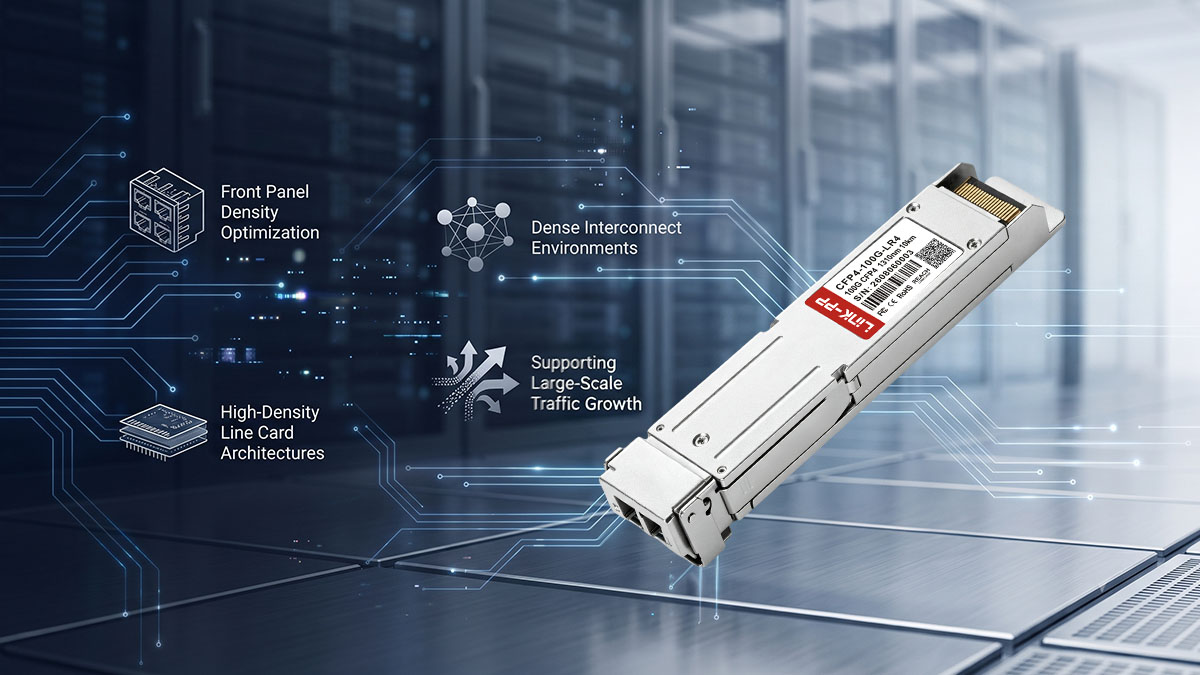
Front Panel Density Optimization
CFP4 improves front panel density by reducing the physical space required per optical transceiver, allowing designers to pack more ports into the same line card or switch chassis faceplate. This is a key factor in maximizing interface availability in modern high-capacity systems.
Key aspects of front panel optimization include:
- Increased number of 100G ports per front panel area
- Compact port spacing enabled by smaller module footprint
- Improved layout flexibility for switch and router design
- Better utilization of limited chassis faceplate space
In practice, this enables network equipment to deliver significantly higher throughput without expanding physical dimensions.
High-Density Line Card Architectures
CFP4 supports the development of high-density line cards that aggregate large amounts of traffic within a single modular unit. This is especially important in carrier-grade and data center switching platforms where scalability is a primary requirement.
Key design advantages include:
- Higher port counts per line card design
- Improved bandwidth aggregation within a single module
- Efficient integration into modular chassis systems
- Scalable architecture for future capacity expansion
These capabilities allow network operators to build systems that can evolve with traffic demand while maintaining a compact physical footprint.
Dense Interconnect Environments
CFP4 is widely used in dense interconnect environments such as data center aggregation points, exchange facilities, and core network hubs. In these scenarios, maximizing connectivity within limited space is a critical design requirement.
Key characteristics include:
- High concentration of optical links in centralized locations
- Efficient use of cross-connect infrastructure
- Support for large-scale east-west traffic flows
- Reduced physical cabling footprint per bandwidth unit
This makes CFP4 particularly effective in environments where both space and fiber management complexity must be minimized.
Supporting Large-Scale Traffic Growth
As network traffic continues to grow due to cloud computing, video streaming, and distributed applications, CFP4 helps ensure that infrastructure can scale efficiently. Its high-density design allows operators to increase capacity without proportional increases in hardware deployment.
Key benefits include:
- Scalable bandwidth expansion within existing platforms
- Reduced need for additional switching chassis
- Improved long-term capacity planning efficiency
- More predictable infrastructure scaling models
Overall, CFP4 enables network architectures to evolve in a controlled and space-efficient manner while supporting continuous traffic growth demands.
🧭 CFP4 Power Efficiency and Thermal Optimization
CFP4 improves power efficiency and thermal performance by reducing module size, integrating optical and electrical components more tightly, and optimizing signal processing requirements. In high-density networking systems, these improvements are essential because power consumption and heat dissipation scale quickly as port density increases. CFP4 is designed to maintain stable operation while minimizing both energy usage and thermal stress at the system level.
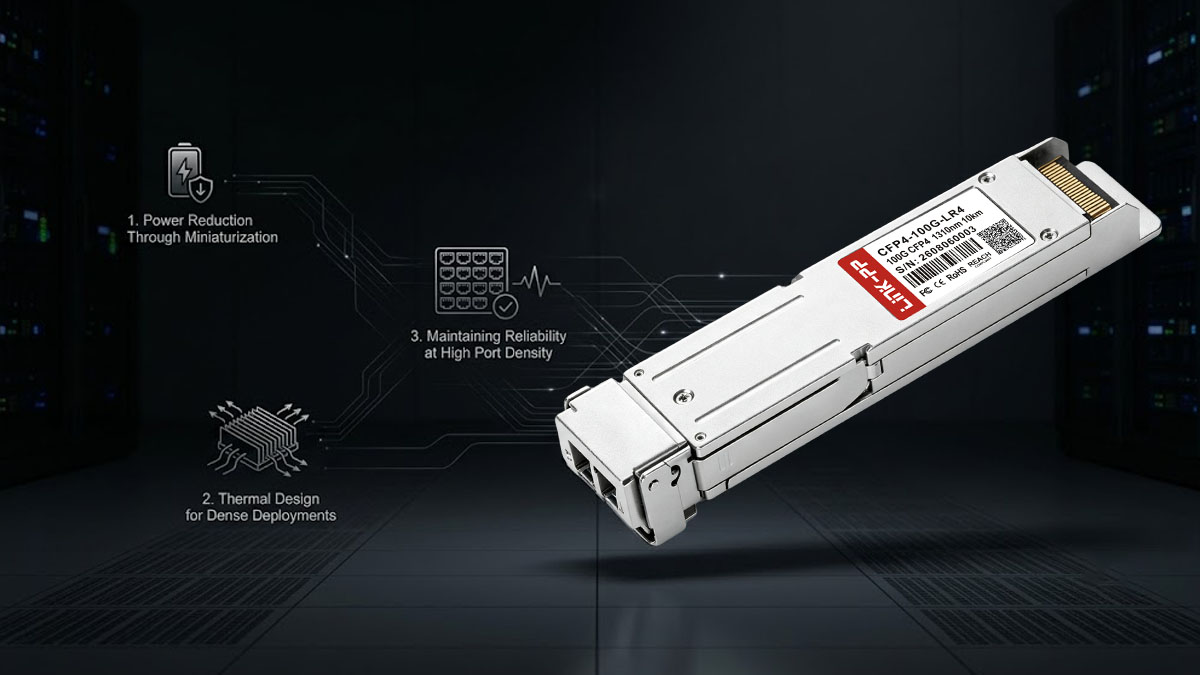
Power Reduction Through Miniaturization
CFP4 achieves lower power consumption primarily through form factor miniaturization and architectural simplification. By reducing internal component footprint and improving integration, the module requires less energy to support 100G transmission compared to earlier CFP designs.
Key power efficiency characteristics include:
- Reduced component count through higher integration
- Lower per-port power consumption in dense deployments
- More efficient electrical signal processing pathways
- Optimized 100G operation with improved energy-to-bandwidth ratio
This reduction in power demand allows network operators to scale port density without proportionally increasing power infrastructure requirements.
Thermal Design for Dense Deployments
Thermal management is a critical consideration in high-density environments, and CFP4 is engineered to operate within constrained airflow conditions typical of modern switch and router chassis. Its compact design helps reduce localized heat generation while supporting consistent performance.
Key thermal optimization elements include:
- Compact heat distribution across integrated components
- Improved airflow compatibility in dense front-panel layouts
- Reduced thermal hotspots due to efficient internal layout
- System-level heat dissipation alignment with chassis cooling design
These characteristics help ensure stable operation even when multiple CFP4 modules are deployed in tightly packed configurations.
Maintaining Reliability at High Port Density
As port density increases, maintaining long-term reliability becomes more challenging due to cumulative heat and power stress. CFP4 addresses this by balancing performance and thermal output, ensuring that dense deployments remain stable under sustained load.
Key reliability-focused advantages include:
- Stable operation under continuous high-throughput conditions
- Reduced thermal strain on adjacent modules
- Improved consistency in dense chassis environments
- Better long-term performance stability in high-load scenarios
Overall, CFP4’s power and thermal optimization enables it to support high-density networking architectures without compromising system reliability or operational efficiency.
🧭 CFP4's Role in Data Center Density Optimization
CFP4 plays an important role in modern data center design by enabling higher bandwidth delivery within a smaller physical footprint. As data centers evolve toward hyperscale architectures, the ability to increase port density without expanding rack space becomes a key design requirement. CFP4 addresses this need by combining compact form factor design with efficient power and thermal characteristics, making it well-suited for density-optimized environments.
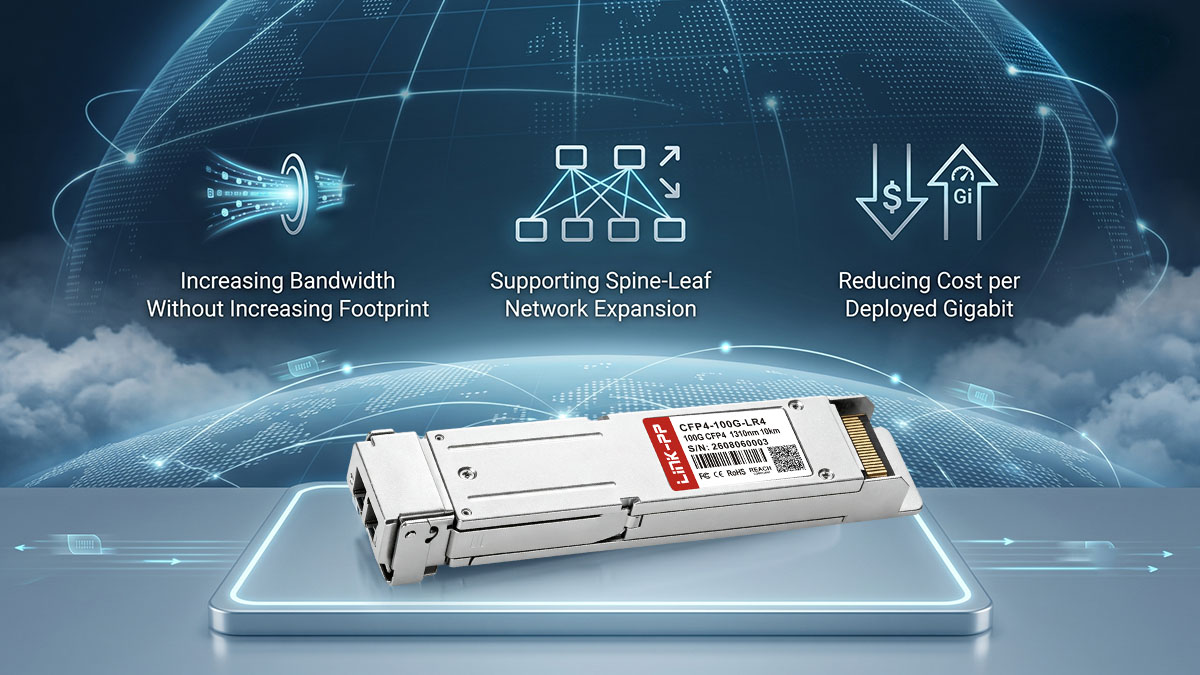
Increasing Bandwidth Without Increasing Footprint
CFP4 allows data centers to significantly increase network capacity while maintaining the same physical infrastructure footprint. This is achieved by reducing module size and improving front-panel port utilization in switches and routers.
Key advantages include:
- Higher 100G port counts per rack unit
- Increased aggregate bandwidth without additional hardware expansion
- More efficient use of switch chassis front-panel space
- Reduced physical growth requirements for scaling networks
In practical deployments, this enables operators to scale capacity horizontally within existing infrastructure constraints rather than expanding data hall space.
Supporting Spine-Leaf Network Expansion
Modern data centers widely adopt spine-leaf architectures, where traffic flows heavily between servers (east-west traffic). CFP4 supports this model by enabling dense high-speed interconnects between leaf and spine switches.
Key contributions include:
- High-density 100G links for spine-to-leaf connectivity
- Improved scalability of leaf switch aggregation layers
- Efficient handling of east-west traffic growth
- Reduced oversubscription in large-scale fabrics
This makes CFP4 a strong fit for cloud environments where low-latency, high-bandwidth connectivity is essential.
Reducing Cost per Deployed Gigabit
CFP4 improves infrastructure efficiency by increasing the amount of bandwidth delivered per unit of physical and operational resource. This leads to a lower effective cost per deployed gigabit when viewed across the entire system lifecycle.
Key efficiency factors include:
- More bandwidth per rack unit of space
- Improved utilization of existing switching infrastructure
- Reduced need for additional racks and supporting equipment
- Better long-term return on infrastructure investment
By optimizing density, CFP4 helps data centers achieve higher throughput without proportional increases in physical infrastructure cost.
Simplifying Future Capacity Upgrades
CFP4 also supports smoother long-term capacity planning by allowing incremental scaling within existing hardware platforms. This reduces the complexity of future upgrades and supports predictable growth models.
Key benefits include:
- Incremental scaling of network capacity within existing chassis
- Reduced disruption during infrastructure upgrades
- Extended lifecycle of deployed switching platforms
- More flexible planning for future bandwidth growth
Overall, CFP4 contributes to a more sustainable and scalable data center architecture by aligning physical density with evolving bandwidth demands.
🧭 CFP4 in Carrier and Transport Network Density Strategies
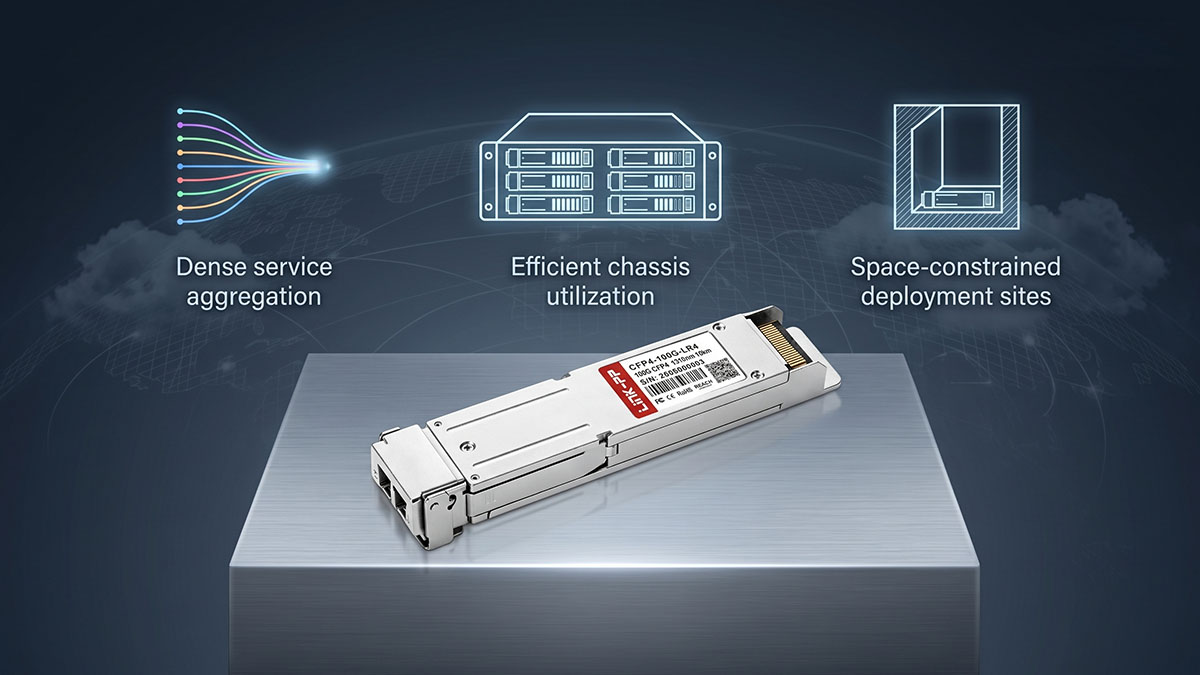
CFP4 is widely used in carrier and transport networks where space efficiency and bandwidth scalability are critical. In these environments, operators must deliver large-scale capacity upgrades within existing central offices, metro hubs, and aggregation sites. CFP4 supports this requirement by enabling higher 100G port density in compact platforms, helping carriers expand services without proportional increases in footprint or power infrastructure.
Metro Aggregation Applications
CFP4 is well-suited for metro aggregation networks, where traffic from multiple access nodes is consolidated before being forwarded to core networks. In these space-constrained facilities, maximizing bandwidth per rack unit is essential for efficient operations.
Key advantages include:
- Higher concentration of 100G links in aggregation switches
- Efficient use of limited central office rack space
- Improved scalability for growing metro traffic demands
- Reduced equipment footprint per service area
This makes CFP4 particularly valuable in metro environments where physical expansion is often restricted by facility limitations.
Core Network Bandwidth Scaling
In core transport networks, CFP4 supports bandwidth scaling by increasing the number of high-speed interfaces within existing routing and switching platforms. This allows carriers to meet exponential traffic growth driven by cloud services, video streaming, and enterprise connectivity.
Key contributions include:
- Dense 100G interface deployment in core routers
- Improved capacity scaling without additional chassis expansion
- Better utilization of backbone infrastructure resources
- Enhanced support for long-term traffic growth trends
By improving port density, CFP4 helps core networks scale more efficiently while maintaining operational stability.
Equipment Consolidation Initiatives
Carriers increasingly focus on consolidating network equipment to reduce operational complexity and improve efficiency. CFP4 enables this strategy by allowing more capacity to be integrated into fewer physical systems.
Key benefits include:
- Reduction in the number of required switching platforms
- Simplified network topology and management
- Lower operational overhead for maintenance and power
- Improved space utilization in central offices
This consolidation trend directly benefits from CFP4’s ability to deliver high bandwidth density in compact form factors.
Maximizing Capacity per Network Node
CFP4 increases the amount of traffic that can be supported by a single network node, making each site more powerful and efficient. This is particularly important in distributed transport architectures where each node must handle significant traffic loads.
Key outcomes include:
- Higher bandwidth per individual network node
- Improved efficiency of backbone and aggregation points
- Reduced need for frequent hardware expansion
- Better alignment between physical infrastructure and traffic demand
Overall, CFP4 enables carrier networks to evolve toward more compact, high-capacity architectures that prioritize density, scalability, and operational efficiency.
🧭 Deployment Considerations for High-Density CFP4 Environments
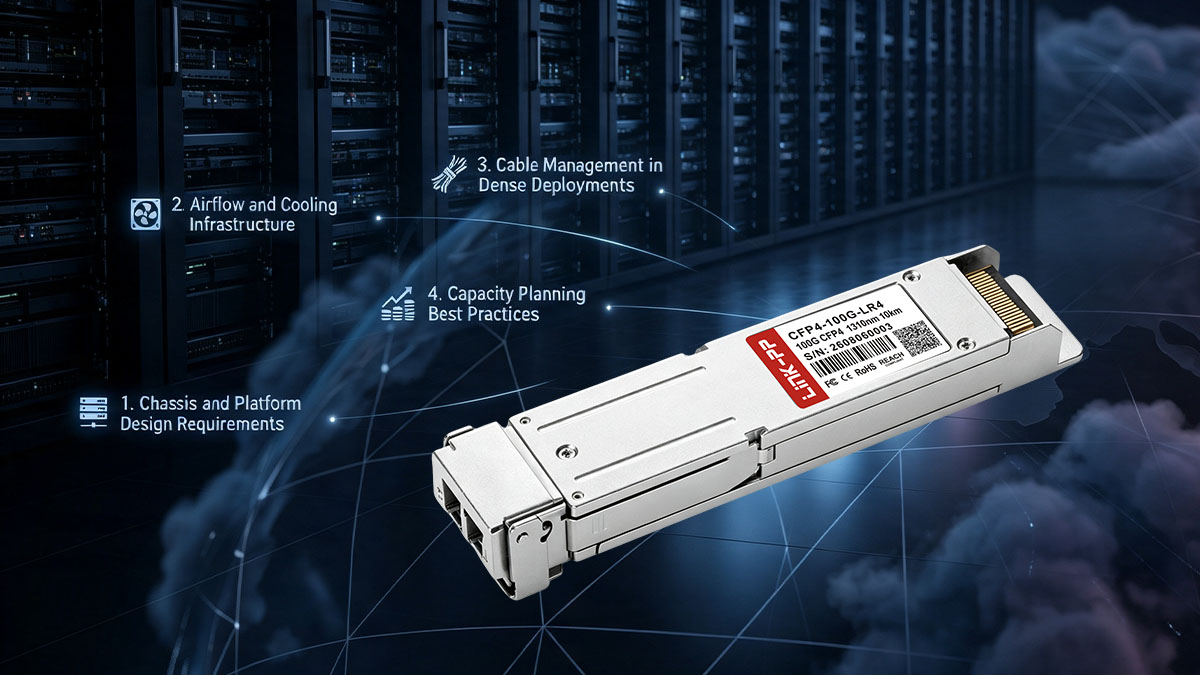
Deploying CFP4 in high-density environments requires careful planning across hardware compatibility, thermal design, cabling layout, and long-term capacity strategy. While CFP4 improves port density and bandwidth efficiency, these benefits can only be fully realized when system-level constraints such as airflow, rack design, and fiber management are properly addressed. In practice, deployment success depends on balancing density gains with operational stability.
Chassis and Platform Design Requirements
CFP4 deployment starts with ensuring that the underlying switch or router platform is designed to support high-density optical modules. Not all systems are optimized for CFP4 integration, especially in terms of front-panel layout and electrical backplane design.
Key considerations include:
- Compatibility with CFP4 module form factor and interface standards
- Sufficient slot density on line cards and chassis front panels
- Electrical backplane capability for high-speed 100G lanes
- Vendor-specific implementation differences in CFP4 support
These factors determine whether CFP4 can be fully leveraged for maximum port density and system scalability.
Airflow and Cooling Infrastructure
In high-density CFP4 deployments, thermal management becomes a critical system-level constraint. As port density increases, so does localized heat generation, making efficient airflow design essential for stable operation.
Key thermal planning elements include:
- Front-to-back or side-to-side airflow alignment with chassis design
- Adequate cooling capacity for densely populated line cards
- Avoidance of airflow obstruction from cable congestion
- Thermal zoning strategies for high-power switch environments
Proper cooling design ensures that increased density does not lead to performance degradation or reduced hardware lifespan.
Cable Management in Dense Deployments
As CFP4 increases the number of ports per chassis, fiber cabling complexity also increases significantly. Without proper planning, dense deployments can lead to congestion that impacts airflow and maintenance efficiency.
Key cable management considerations include:
- Efficient fiber routing to minimize physical clutter
- Use of structured cabling systems for high-port-density panels
- Accessibility planning for maintenance and replacement
- Separation of signal paths to reduce interference and confusion
Effective cable management is essential not only for performance but also for operational reliability in large-scale environments.
Capacity Planning Best Practices
CFP4 enables significant bandwidth scaling, but this must be aligned with long-term capacity planning to avoid underutilization or bottlenecks. Network architects must forecast traffic growth and design infrastructure accordingly.
Key planning practices include:
- Forecasting traffic growth based on application demand trends
- Balancing port utilization across chassis and line cards
- Planning incremental expansion without disrupting existing services
- Aligning hardware lifecycle with expected bandwidth growth cycles
By integrating CFP4 into a forward-looking capacity strategy, operators can maximize infrastructure efficiency while maintaining flexibility for future scaling.
🧭 Conclusion
CFP4 represents a key milestone in form factor optimization for 100G optical networking, delivering a compact design that significantly improves high-density use in modern data center and carrier infrastructures. By reducing module size while maintaining full 100G capability, CFP4 enables higher port density, better bandwidth efficiency, and more scalable network architectures. Its design philosophy continues to influence how optical modules are engineered for space-constrained and performance-driven environments.
To summarize the most important takeaways:
- CFP4 improves network efficiency through compact form factor optimization
- It enables significantly higher port density per chassis and rack unit
- It supports scalable high-density deployments in data centers and carrier networks
- It balances power consumption, thermal performance, and bandwidth requirements
- Its design principles continue to shape modern optical module evolution
For network operators and infrastructure planners, understanding CFP4 is essential for designing efficient, scalable, and high-density optical networks. For more technical resources, module solutions, and optical networking insights, you can explore the LINK-PP Official Store for additional information and product references aligned with modern data center and carrier deployment needs.