In modern data centers and enterprise networks, achieving high-speed connectivity with reliability and efficiency is crucial. The PAN SFP-PLUS-CU-5M, a 10G SFP+ direct attach copper cable, has become a popular choice for short-distance connections, offering low latency, low power consumption, and straightforward deployment. Understanding its applications, advantages, and limitations is essential for network architects and IT professionals planning 10G network deployments. This guide explores key scenarios, technical characteristics, and best practices for integrating PAN SFP-PLUS-CU-5M into various 10G network architectures.
? Understanding PAN SFP-PLUS-CU-5M Basics
The PAN SFP-PLUS-CU-5M is a high-performance 10G direct attach copper (DAC) solution designed for short-range network connections. It offers low latency, low power consumption, and plug-and-play deployment, making it ideal for high-density data centers, server racks, and enterprise networks. Understanding its technical features, specifications, and comparisons with optical transceivers helps network planners determine when it is the optimal choice.
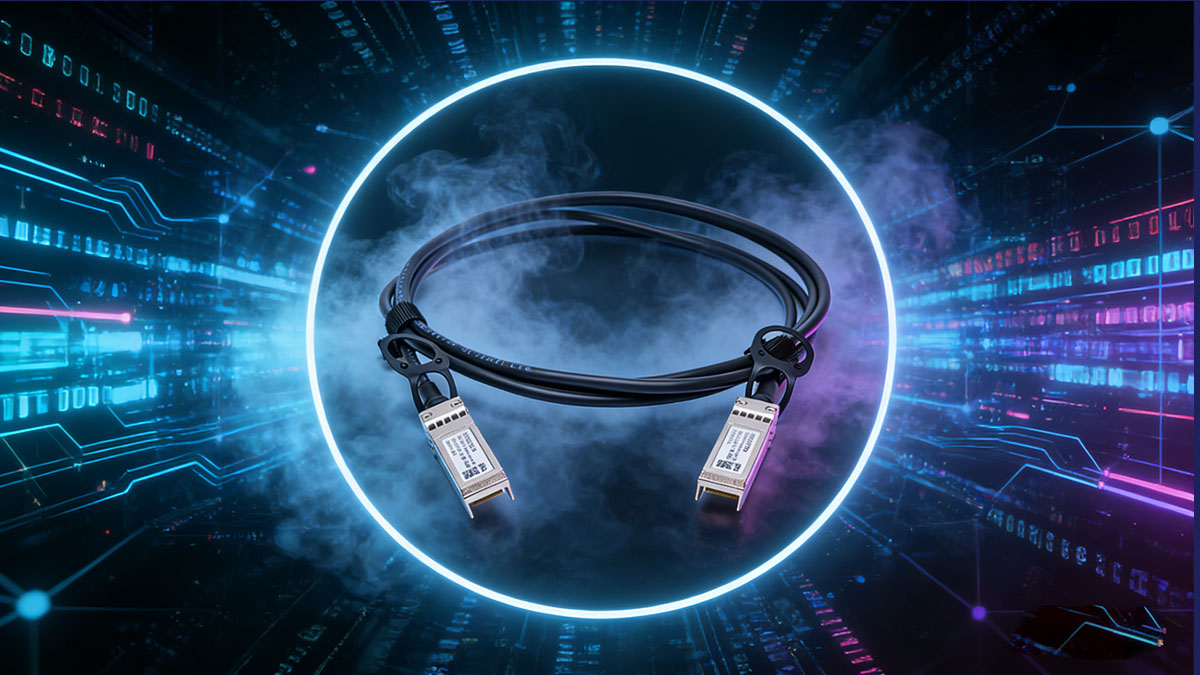
What is PAN SFP-PLUS-CU-5M
PAN SFP-PLUS-CU-5M is a 5-meter SFP+ twinax cable that directly connects network devices such as switches and servers without the need for separate optical modules or fiber cables. Its primary purpose is to provide high-speed 10G Ethernet connectivity over short distances, typically within the same rack or adjacent racks.
Key points:
- It is a passive DAC cable, meaning it requires no additional power for signal transmission.
- Supports 10Gbps data rate with minimal signal degradation over its 5-meter length.
- Designed for SFP+ ports, ensuring compatibility with most 10G-ready switches and network interface cards (NICs).
This direct-connect approach simplifies network design by eliminating the need for separate transceiver modules and fiber, reducing both capital and operational costs.
Key Technical Characteristics
The PAN SFP-PLUS-CU-5M stands out for its combination of performance and efficiency. Its key characteristics make it particularly suitable for high-density environments where low latency and reduced power usage are critical.
- Low latency: Ensures minimal delay in high-performance computing and storage traffic.
- Low power consumption: Consumes significantly less power than comparable optical SFP+ modules.
- Plug-and-play: Easy installation without configuration, reducing deployment time.
- Industry-standard compliance: Compatible with 10G Ethernet and SFP+ standards, ensuring interoperability with various vendors’ devices.
The following table summarizes the primary technical specifications:
| Parameter |
Specification |
Description |
| Data Rate |
10Gbps |
Supports full 10G Ethernet throughput |
| Length |
5 meters |
Optimal for same-rack or adjacent-rack connections |
| Cable Type |
Twinax copper |
Passive SFP+ DAC, no additional power required |
| Connector |
SFP+ |
Standardized connector for switch and NIC ports |
These specifications highlight the PAN SFP-PLUS-CU-5M as a reliable, high-performance option for short-reach 10G connections, with predictable performance and low operational overhead.
Comparison with Optical Transceivers
While optical SFP+ modules (e.g., SFP-10G-SR / SFP-10G-LR) are essential for long-distance or structured cabling, DAC cables like PAN SFP-PLUS-CU-5M excel in short-reach scenarios.
Key differences include:
- Cost: DAC cables are generally more cost-effective for distances up to 5 meters.
- Power: DAC consumes less energy than optical transceivers, contributing to lower heat output.
- Deployment: Plug-and-play installation reduces complexity, unlike optical modules that may require fiber termination and cleaning.
- Distance: Optical SFP+ (like Aruba J9150D) can reach hundreds of meters, whereas DAC is limited to a few meters.
Comparison table:
| Feature |
PAN SFP-PLUS-CU-5M |
Optical SFP+ (10GBASE-R) |
| Maximum Distance |
5 meters |
300 meters (multimode) |
| Power Consumption |
~0.1W |
~1W per module |
| Installation |
Plug-and-play |
Requires fiber cabling and connectors |
| Cost |
Lower |
Higher, includes fiber + transceiver |
This comparison illustrates that PAN SFP-PLUS-CU-5M is optimal for short-distance, cost-sensitive, and energy-efficient 10G network deployments, while optical modules remain necessary for long-reach connectivity or structured cabling environments.
? Role of PAN SFP-PLUS-CU-5M in 10G Network Architectures
The PAN SFP-PLUS-CU-5M plays a critical role in modern 10G network architectures by enabling efficient, low-latency, and cost-effective short-range connectivity. It is particularly valuable in environments where high port density and predictable performance are required, such as data centers and enterprise network cores. Its integration into architectural designs helps reduce reliance on optical modules for short links while maintaining high throughput.

Short-Reach Connectivity in Data Centers
PAN SFP-PLUS-CU-5M is primarily used for short-reach connections within data centers, where most links fall within a few meters. It provides a direct, high-performance alternative to optical fiber for intra-rack and adjacent-rack connectivity.
In typical data center topologies, it is widely deployed in the following scenarios:
This approach reduces both cost and complexity by eliminating the need for optical transceivers in short-distance links.
The following table highlights its role compared to optical solutions in short-reach scenarios:
| Deployment Type |
Preferred Medium |
Reason |
| Same rack (≤3m) |
DAC (PAN SFP-PLUS-CU-5M) |
Lowest cost and latency |
| Adjacent rack (≤5m) |
DAC (PAN SFP-PLUS-CU-5M) |
Simplified deployment |
| Cross-row (>5m) |
Optical fiber |
Distance scalability |
In practice, using DAC cables for these short links allows data centers to optimize both performance and operational efficiency without sacrificing reliability.
High-Density Rack Environments
PAN SFP-PLUS-CU-5M is highly suitable for high-density rack environments where space, power, and thermal efficiency are critical constraints. It reduces the overall hardware footprint by integrating cable and transceiver into a single assembly.
Key advantages in dense deployments include:
- Reduced power consumption per port, lowering total rack energy usage
- Lower heat generation, improving thermal management
- Fewer components compared to fiber + transceiver setups
However, cable thickness must be considered when managing large numbers of connections.
A comparison of physical and operational characteristics is shown below:
| Aspect |
DAC Cable |
Optical Solution |
| Cable Thickness |
Thicker |
Thinner fiber |
| Heat Output |
Lower |
Higher (due to optics) |
| Component Count |
Single unit |
Cable + transceivers |
| Rack Density Impact |
Moderate |
High flexibility |
Although DAC cables are slightly bulkier, their reduced power and component simplicity often outweigh cable management challenges in controlled rack environments.
Enterprise Network Deployments
In enterprise networks, PAN SFP-PLUS-CU-5M serves as a practical solution for short-distance 10G interconnections, especially during network upgrades or when deploying high-speed aggregation layers.
It is commonly used in the following scenarios:
- Switch-to-switch connections within network cabinets
- Short-distance uplinks between access and aggregation layers
- Interconnections in server rooms or edge data centers
For enterprises transitioning from 1G to 10G, DAC cables provide a straightforward upgrade path without requiring major changes to cabling infrastructure.
Typical decision points for using PAN SFP-PLUS-CU-5M in enterprise environments include:
- Distance is within 5 meters
- High bandwidth with low latency is required
- Budget constraints favor minimizing hardware costs
- Deployment speed and simplicity are priorities
These characteristics make PAN SFP-PLUS-CU-5M an effective building block in hybrid 10G architectures, where DAC and optical solutions are combined to meet both short- and long-distance connectivity requirements.
? Typical Deployment Scenarios for PAN SFP-PLUS-CU-5M
PAN SFP-PLUS-CU-5M is best suited for short-distance 10G connections where simplicity, low latency, and cost efficiency are priorities. Its deployment is most effective in controlled environments such as data centers, network racks, and testing setups where link distances do not exceed 5 meters. Understanding these typical scenarios helps ensure optimal performance and resource utilization.

Data Center Server Connectivity
PAN SFP-PLUS-CU-5M is widely used for direct server-to-switch connectivity within data centers, especially in Top-of-Rack (ToR) architectures. It provides a reliable and efficient way to connect servers to switches without requiring optical modules or fiber cabling.
This deployment model is ideal when:
- Servers and switches are located within the same rack
- Cable distance is within 5 meters
- High throughput and low latency are required for east-west traffic
Typical connection structure:
- Server NIC (SFP+ port) → DAC cable → ToR switch port
The following table summarizes its suitability for server connectivity:
| Scenario |
Suitability |
Key Benefit |
| Same rack server connection |
High |
Lowest latency and cost |
| Adjacent rack server connection |
Medium-High |
Simple deployment within 5m |
| Cross-row server connection |
Low |
Distance limitation |
This scenario eliminates the need for separate transceivers and fiber patch cords, reducing both failure points and maintenance requirements.
Network Switch Stacking
PAN SFP-PLUS-CU-5M is commonly used for switch stacking or direct inter-switch links within the same rack or between adjacent racks. It ensures high-bandwidth communication between switches while maintaining low latency and stable link performance.
It is particularly effective in the following cases:
- Stacking access switches in enterprise networks
- Interconnecting leaf switches in compact data center designs
- Providing redundancy links between switches
Key advantages of using DAC for switch stacking include:
- Consistent 10Gbps throughput without additional configuration
- Reduced hardware complexity compared to optical setups
- Faster deployment with fewer compatibility concerns
A comparison of stacking approaches:
| Method |
Medium |
Complexity |
| DAC stacking |
PAN SFP-PLUS-CU-5M |
Low |
| Optical stacking |
Fiber + SFP+ modules |
Medium |
| Dedicated stacking cables |
Vendor-specific |
Low |
This makes PAN SFP-PLUS-CU-5M a flexible and widely compatible option for switch interconnection without relying on proprietary stacking solutions.
Lab and Test Environments
PAN SFP-PLUS-CU-5M is highly suitable for lab environments and temporary network setups where flexibility and rapid deployment are essential. It allows engineers to quickly establish 10G links without the need for fiber infrastructure.
Typical use cases include:
- Network performance testing and validation
- Temporary lab topologies for development
- Troubleshooting and diagnostics in controlled environments
Key reasons for its effectiveness in labs:
- Immediate plug-and-play connectivity
- No need for fiber cleaning or handling procedures
- Easy reconfiguration and redeployment
Deployment considerations in lab scenarios:
- Keep cable routing simple to avoid physical strain
- Use labeled connections for repeated testing cycles
- Replace cables if physical wear affects signal stability
This scenario highlights the versatility of PAN SFP-PLUS-CU-5M beyond production environments, making it a practical tool for both operational and experimental network setups.
? Advantages of Using PAN SFP-PLUS-CU-5M
PAN SFP-PLUS-CU-5M provides clear advantages in short-range 10G deployments by reducing cost, lowering power consumption, and simplifying installation. It is particularly effective in environments where high performance is required within limited distances, making it a preferred option for data centers and enterprise networks.

Cost Efficiency in Short Distances
PAN SFP-PLUS-CU-5M significantly reduces deployment costs for short-distance 10G links by integrating cable and transceiver into a single unit. This eliminates the need for separate optical modules and fiber patch cords.
It is most cost-effective when:
- Link distance is within 5 meters
- High port density requires minimizing per-port cost
- Large-scale deployments amplify savings across hundreds of links
The following table compares cost structure components:
| Cost Component |
DAC (PAN SFP-PLUS-CU-5M) |
Optical Solution |
| Transceiver |
Not required |
Required (2 units) |
| Cable |
Included |
Fiber patch cord needed |
| Installation |
Simple |
Moderate complexity |
| Total Cost |
Lower |
Higher |
By consolidating components, DAC cables reduce both upfront investment and ongoing operational expenses, especially in dense network environments.
Energy Efficiency and Thermal Benefits
PAN SFP-PLUS-CU-5M consumes significantly less power than optical transceivers, which directly contributes to improved energy efficiency and reduced heat generation in network racks.
This advantage becomes critical in high-density deployments where power and cooling are major constraints.
Key benefits include:
- Lower per-port power consumption, reducing overall energy usage
- Minimal heat output, easing cooling requirements
- Improved equipment lifespan due to lower thermal stress
A comparison of power and thermal characteristics:
| Parameter |
DAC Cable |
Optical SFP+ |
| Power Consumption |
~0.1W |
~1W |
| Heat Generation |
Low |
Moderate to high |
| Cooling Requirement |
Minimal |
Higher |
| Energy Efficiency |
High |
Moderate |
Reducing power consumption across hundreds of ports can lead to substantial energy savings, making DAC cables an efficient choice for sustainable data center operations.
Ease of Deployment and Maintenance
PAN SFP-PLUS-CU-5M simplifies both installation and ongoing maintenance by minimizing the number of components and eliminating the need for fiber handling.
It is particularly advantageous in fast-paced deployment environments where time and reliability are critical.
Key operational advantages:
- Plug-and-play installation with no configuration required
- Reduced risk of installation errors compared to fiber connections
- No need for fiber cleaning or inspection tools
- Faster troubleshooting due to fewer connection points
Typical deployment workflow:
- Insert SFP+ connectors into switch and NIC ports
- Verify link status through device interface
- Begin traffic transmission immediately
This streamlined process reduces deployment time and lowers the technical barrier for installation, making PAN SFP-PLUS-CU-5M an efficient and practical solution for short-range 10G connectivity.
? Limitations and Considerations
PAN SFP-PLUS-CU-5M is highly efficient for short-distance 10G connectivity, but it is not universally suitable for all network scenarios. Its physical and technical constraints must be carefully evaluated to avoid performance limitations or deployment challenges in larger or more complex network environments.
Distance Constraints
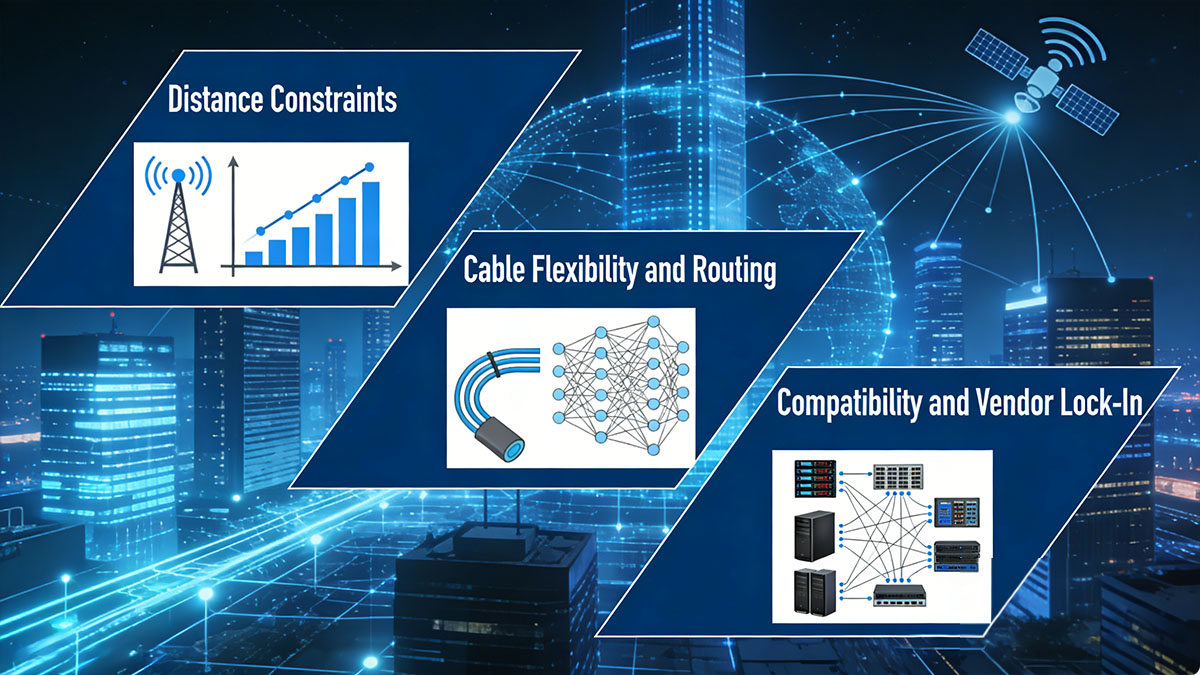
PAN SFP-PLUS-CU-5M is strictly limited to short-range connections, with a maximum supported distance of 5 meters. It is not suitable for structured cabling, cross-room, or long-distance interconnections where optical solutions are required.
It is most appropriate when:
- Devices are located within the same rack or adjacent racks
- Link distance does not exceed 5 meters
- Predictable, low-latency performance is required
The following table outlines distance suitability:
| Distance Range |
Recommended Medium |
Reason |
| 0–3 meters |
DAC (PAN SFP-PLUS-CU-5M) |
Optimal performance and cost |
| 3–5 meters |
DAC (PAN SFP-PLUS-CU-5M) |
Acceptable within limits |
| >5 meters |
Optical fiber |
Required for signal integrity |
Because of this limitation, network designs often combine DAC and optical solutions to achieve both short- and long-range connectivity.
Cable Flexibility and Routing
PAN SFP-PLUS-CU-5M uses twinax copper cabling, which is thicker and less flexible than fiber optic cables. This can create challenges in high-density environments where cable routing and airflow management are critical.
Key considerations include:
- Larger bend radius compared to fiber cables
- Increased cable bulk in high-port-density racks
- Potential obstruction of airflow if not properly managed
Typical routing challenges and mitigation strategies:
- Use structured cable management trays to organize DAC bundles
- Avoid sharp bends to maintain signal integrity
- Plan port layout to minimize cable crossing and congestion
While these issues are manageable, they require more careful planning than fiber-based deployments, especially in large-scale data centers.
Compatibility and Vendor Lock-In
PAN SFP-PLUS-CU-5M must be compatible with the target network devices, and in some cases, vendor-specific coding or firmware validation may be required. Not all switches or network interface cards accept third-party DAC cables without verification.
Key compatibility considerations:
- Vendor coding (e.g., compatibility with specific network equipment brands)
- Firmware restrictions that may block unsupported modules
- Need for validated or certified DAC cables in production environments
A comparison of compatibility factors:
| Factor |
DAC Cable |
Optical Transceiver |
| Vendor Coding |
Often required |
Often required |
| Firmware Sensitivity |
Moderate |
Moderate |
| Interoperability |
Varies by vendor |
Generally higher |
| Flexibility |
Lower |
Higher |
To ensure stable operation, it is important to verify compatibility with target devices before deployment and use cables that are properly coded and tested for the intended network environment.
? When to Choose DAC vs Optical Solutions
Choosing between PAN SFP-PLUS-CU-5M (DAC) and optical SFP+ solutions depends primarily on distance, deployment environment, cost constraints, and scalability requirements. DAC is optimal for short-range, high-efficiency connections, while optical modules are better suited for longer distances and structured cabling systems. A clear understanding of these decision factors ensures optimal network design and performance.

Ideal Scenarios for PAN SFP-PLUS-CU-5M
PAN SFP-PLUS-CU-5M is the preferred choice when short-distance connectivity, low latency, and cost efficiency are the primary goals. It performs best in controlled environments where cable length does not exceed 5 meters.
It is most suitable in the following scenarios:
- Same-rack or adjacent-rack connections
- High-density data center deployments
- Server-to-switch or switch-to-switch short links
- Environments requiring minimal power consumption
- Rapid deployment with plug-and-play simplicity
Typical decision conditions:
- Distance ≤ 5 meters
- No need for structured cabling infrastructure
- Focus on reducing capital and operational costs
In these cases, DAC provides a streamlined and highly efficient solution without the overhead of optical components.
When Optical Modules Are Better
Optical SFP+ modules are more appropriate when distance, flexibility, and scalability are critical requirements. They are essential for structured cabling and long-range connectivity across data centers or campus environments.
They are preferred in the following situations:
- Connections beyond 5 meters
- Cross-room, cross-floor, or inter-building links
- Environments requiring lightweight and flexible cabling
- Long-term scalable network infrastructure
The following table highlights when optical solutions become necessary:
| Requirement |
Recommended Solution |
Reason |
| Distance > 5m |
Optical SFP+ |
Signal integrity over longer range |
| Structured cabling |
Optical SFP+ |
Standardized infrastructure |
| High flexibility routing |
Optical fiber |
Easier cable management |
| Future scalability |
Optical SFP+ |
Supports longer upgrades |
Optical modules provide the flexibility and reach that DAC cables cannot, making them indispensable in larger and more distributed network designs.
Hybrid Deployment Strategies
In most real-world networks, combining DAC and optical solutions provides the best balance between cost, performance, and scalability. Hybrid deployment allows each technology to be used where it is most effective.
A typical hybrid strategy includes:
- Using PAN SFP-PLUS-CU-5M for intra-rack and short inter-rack links
- Using optical SFP+ modules for aggregation and long-distance connections
- Designing network layers based on distance and traffic patterns
Common hybrid deployment model:
- Access layer (servers to ToR): DAC
- Aggregation layer (rack-to-row): Mix of DAC and optics
- Core layer (long-distance links): Optical fiber
Benefits of a hybrid approach:
- Optimized cost structure across the network
- Efficient power and thermal management
- Scalability for future expansion
- Flexibility in adapting to different physical layouts
This balanced strategy ensures that PAN SFP-PLUS-CU-5M is used where it delivers maximum value, while optical solutions handle scenarios that require greater reach and flexibility.
? Best Practices for Deploying PAN SFP-PLUS-CU-5M
Deploying PAN SFP-PLUS-CU-5M effectively requires proper planning in cable management, compatibility verification, and operational monitoring. Following best practices ensures stable performance, reduces failure risks, and maximizes the lifespan of the DAC infrastructure in 10G environments.
Proper Cable Management
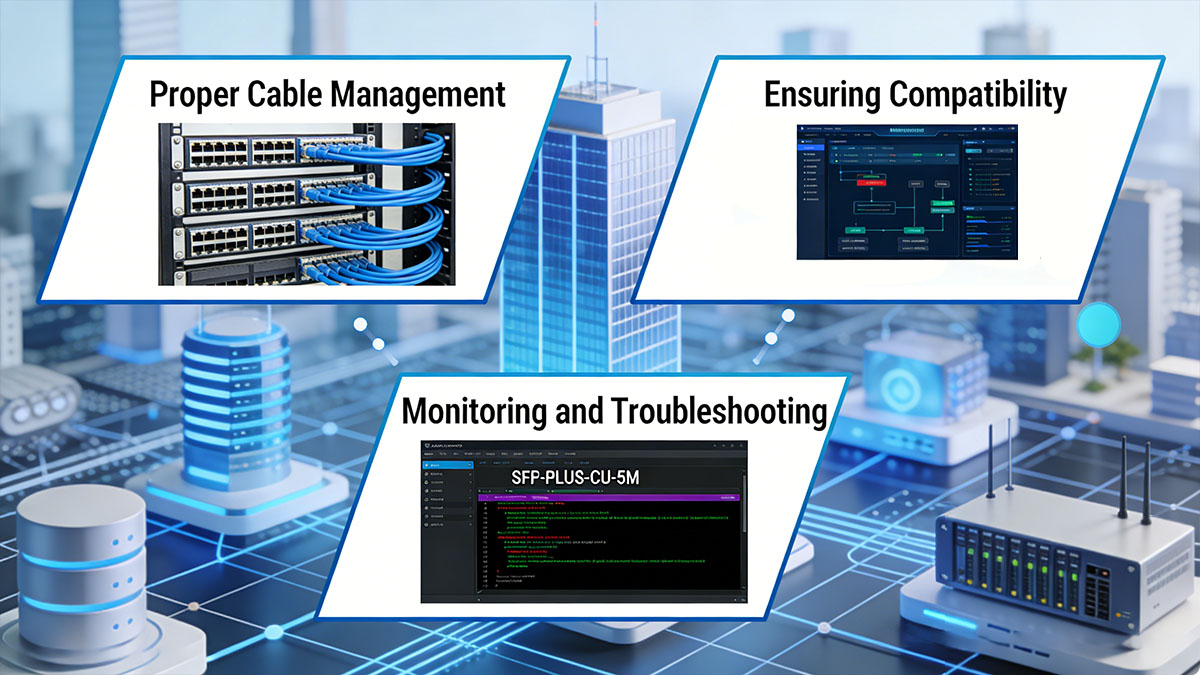
Effective cable management is essential to maintain signal integrity, airflow, and operational efficiency when using PAN SFP-PLUS-CU-5M. Due to the thicker nature of twinax cables, poor routing can lead to congestion and thermal issues.
Key practices include:
- Maintain appropriate bend radius to prevent signal degradation
- Use horizontal and vertical cable organizers to reduce clutter
- Separate power and data cables to minimize interference
- Avoid excessive cable bundling in high-density racks
The following table summarizes key cable management factors:
| Factor |
Recommendation |
Impact |
| Bend Radius |
Avoid tight bends |
Preserves signal quality |
| Cable Routing |
Use structured paths |
Improves airflow |
| Cable Density |
Limit bundling |
Reduces heat buildup |
| Labeling |
Clearly identify links |
Simplifies maintenance |
Proper cable organization not only improves reliability but also makes future upgrades and troubleshooting significantly easier.
Ensuring Compatibility
Ensuring compatibility between PAN SFP-PLUS-CU-5M and network equipment is critical for stable operation. Mismatched or unsupported DAC cables can lead to link failures or degraded performance.
Key verification steps:
- Confirm that switches and NICs support SFP+ DAC cables
- Check vendor compatibility requirements or coding standards
- Validate firmware versions to ensure support for third-party cables
- Use tested and certified DAC cables for production environments
Typical compatibility checklist:
- Identify device model and supported transceiver types
- Verify DAC support in vendor documentation
- Confirm cable coding matches device requirements
- Test link functionality before full deployment
Taking these steps minimizes the risk of interoperability issues and ensures consistent network performance.
Monitoring and Troubleshooting
Ongoing monitoring and proactive troubleshooting are essential to maintain reliable operation of PAN SFP-PLUS-CU-5M connections. Although DAC cables are generally stable, physical wear or compatibility issues can still occur.
Key monitoring practices:
- Regularly check link status and error counters on switches
- Monitor latency and throughput for performance consistency
- Inspect cables for physical damage or connector wear
Common troubleshooting steps:
- Re-seat connectors to resolve intermittent link issues
- Replace cables if persistent errors are detected
- Verify firmware and compatibility if links fail to establish
The following table outlines common issues and resolutions:
| Issue |
Possible Cause |
Resolution |
| Link down |
Compatibility issue |
Verify coding and support |
| Intermittent errors |
Loose connection |
Re-seat connectors |
| Performance drop |
Cable damage |
Replace DAC cable |
| No detection |
Firmware restriction |
Update or validate firmware |
Consistent monitoring and quick response to issues help maintain network stability and ensure that PAN SFP-PLUS-CU-5M continues to deliver reliable 10G connectivity in production environments.
? Conclusion
PAN SFP-PLUS-CU-5M stands out as a practical and efficient solution for short-range 10G connectivity, especially in data centers and enterprise environments where performance, cost control, and deployment simplicity are key priorities. By delivering low latency, low power consumption, and plug-and-play usability, it effectively addresses the demands of high-density network architectures within limited distances.
At the same time, its limitations—particularly in reach and cable flexibility—highlight the importance of selecting the right solution based on specific deployment scenarios. In most modern networks, combining DAC cables like PAN SFP-PLUS-CU-5M with optical transceivers enables a balanced approach that optimizes both performance and scalability.
For network professionals planning or upgrading 10G infrastructure, understanding when and how to deploy PAN SFP-PLUS-CU-5M is essential to achieving an efficient and future-ready design. To explore more technical insights and compatible networking solutions, visit the LINK-PP Official Store for detailed resources and product information.