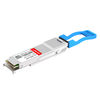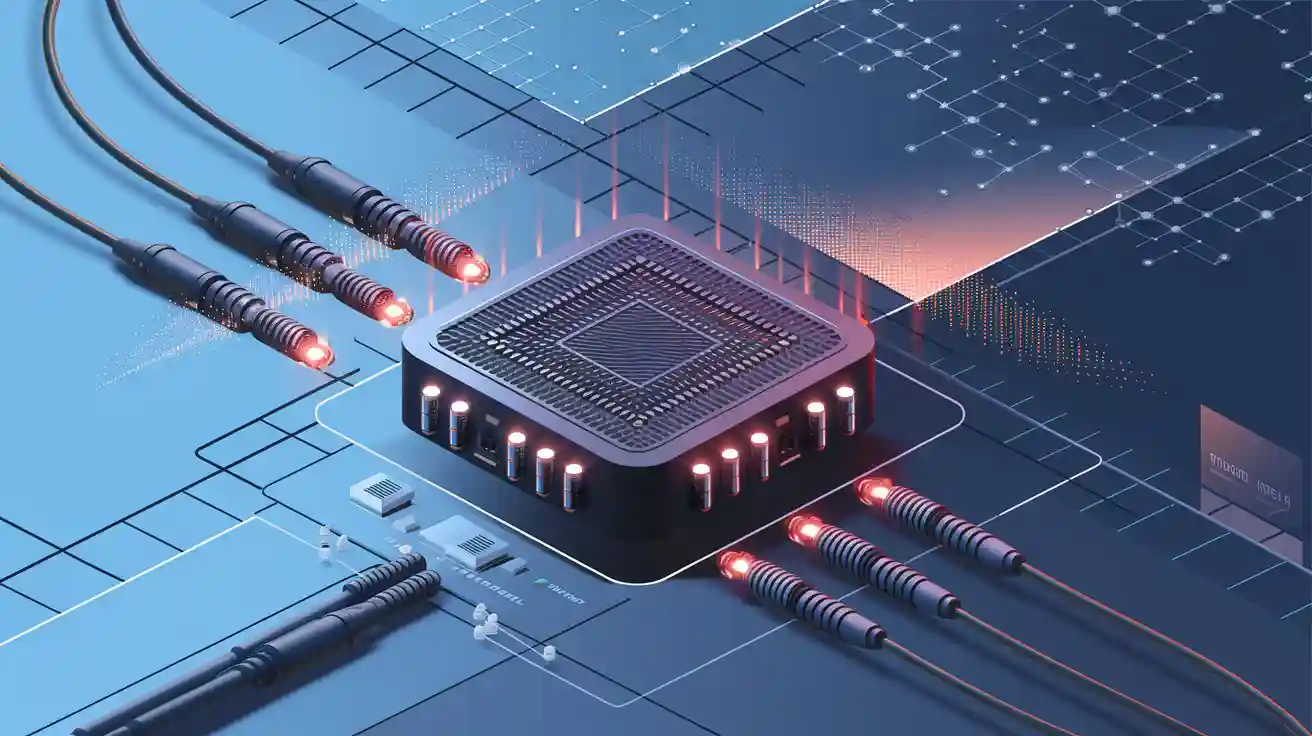
Modern enterprise networks and data centers rely on high-speed optical connectivity to support increasing traffic, virtualization, and cloud-based workloads. In many 10GbE deployments, short-distance links between servers, switches, and storage systems are extremely common, which makes SFP+ short-reach optical modules an essential component of the infrastructure. Among these modules, the 10G-SFPP-USR is widely used in Brocade networking environments to deliver reliable 10Gbps multimode fiber connectivity.
The 10G-SFPP-USR is a 10GBASE-SR SFP+ optical transceiver designed for short-range data transmission over multimode fiber. Operating at 850nm and supporting distances of up to 300m on OM3 fiber and 400m on OM4 fiber, it provides a practical solution for high-density switching environments such as data centers, enterprise campuses, and high-performance computing networks. Its compact SFP+ form factor, hot-pluggable design, and compatibility with Brocade platforms make it suitable for modern network architectures that require scalable 10GbE connectivity.
Understanding the specifications, fiber compatibility, and typical deployment scenarios of the 10G-SFPP-USR helps network engineers design efficient optical links while ensuring stable performance. This guide explains what the 10G-SFPP-USR is, its key technical characteristics, supported fiber types, common applications, and how it compares with other 10G SFP+ optical transceivers used in enterprise and data center networks.
? What Is 10G-SFPP-USR?
The 10G-SFPP-USR is a 10GbE SFP+ module designed for short-range data transmission over multimode fiber. It follows the 10GBASE-SR standard and is commonly used in Brocade switching platforms to provide reliable 10Gbps connectivity within data centers and enterprise networks. Operating at an 850nm wavelength and using a compact SFP+ form factor, the module enables high-speed optical links between servers, switches, and storage systems over relatively short distances.
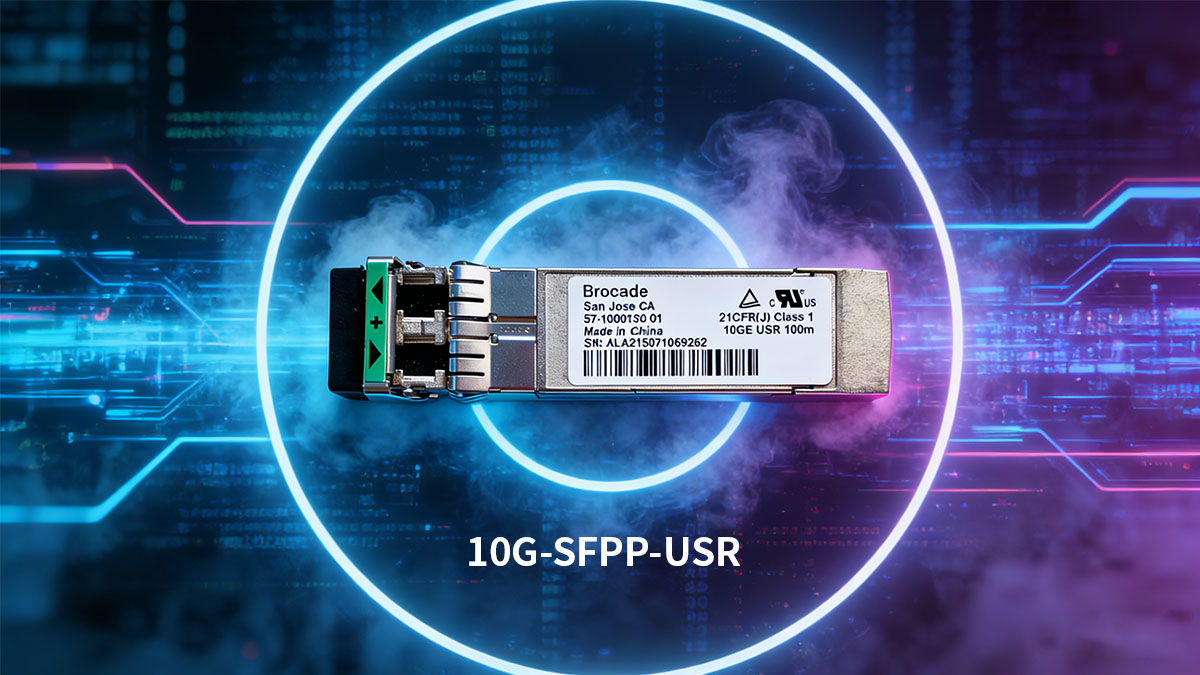
Definition of the 10G-SFPP-USR Module
The 10G-SFPP-USR is essentially a short-reach 10GbE optical module optimized for high-density networking environments where links typically remain within a single room or building.
| Parameter |
Specification |
Description |
| Data Rate |
10Gbps |
Supports 10G Ethernet transmission |
| Optical Standard |
10GBASE-SR |
IEEE short-range multimode fiber standard |
| Wavelength |
850nm |
Uses VCSEL laser technology |
| Connector Type |
Duplex LC |
Standard optical interface |
This specification profile allows the module to deliver stable short-distance connectivity while maintaining low power consumption and high port density. The use of VCSEL (Vertical Cavity Surface Emitting Laser) technology makes it well suited for multimode fiber environments commonly found in structured cabling systems.
Key Purpose in 10GbE Network Infrastructure
The primary function of the 10G-SFPP-USR is to provide high-speed optical connectivity for short-distance links within modern network architectures. Compared with copper connections, optical SR transceiver support higher bandwidth with lower electromagnetic interference.
Typical roles of the module in a network include:
- Server-to-switch connections in Top-of-Rack (ToR) architectures
- Switch-to-switch uplinks within the same data center row
- Aggregation links inside enterprise campus networks
- High-bandwidth connectivity for storage networks and virtualization clusters
Because most internal data center links are shorter than a few hundred meters, short-reach SFP+ modules like the 10G-SFPP-USR are widely deployed. They provide a balance between performance, fiber infrastructure compatibility, and scalability for 10GbE networks.
? Key Specifications of the 10G-SFPP-USR
The 10G-SFPP-USR is designed to deliver high-speed optical connectivity for short distances, with specifications optimized for data center and enterprise network environments. Understanding its technical characteristics helps ensure proper deployment and compatibility with Brocade switches and multimode fiber infrastructure.
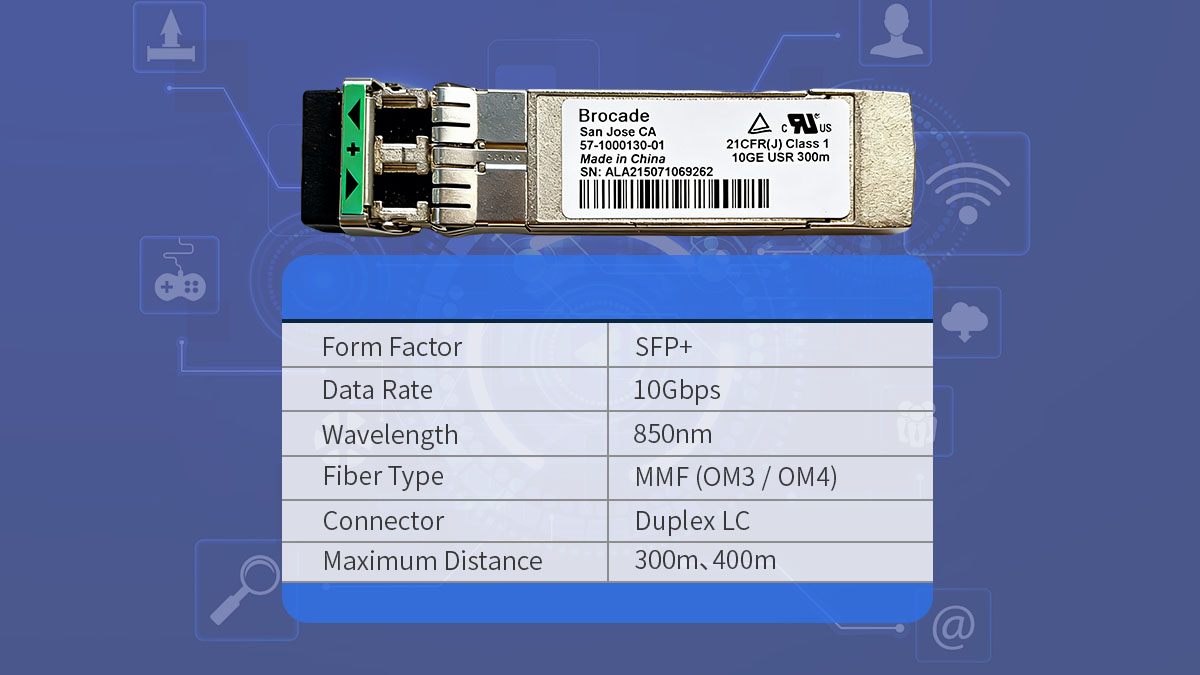
Core Technical Parameters
The 10G-SFPP-USR supports 10Gbps data transmission over multimode fiber, providing reliable short-range connectivity. Its core specifications are summarized below:
| Parameter |
Specification |
Notes |
| Data Rate |
10Gbps |
Full 10 Gigabit Ethernet speed |
| Wavelength |
850nm |
VCSEL laser optimized for multimode fiber |
| Fiber Type |
OM3 / OM4 MMF |
Supports short-range multimode fiber links |
| Connector |
Duplex LC |
Standard optical interface |
| Maximum Distance |
OM3: 300m
OM4: 400m |
Distance depends on fiber type and quality |
These parameters make the module suitable for short-reach connections where high bandwidth and low latency are critical, such as server-to-switch links or high-density switch uplinks.
Optical and Electrical Characteristics
The 10G-SFPP-USR also includes features that enhance network performance and monitoring:
- Hot-pluggable SFP+ form factor: Allows easy insertion or removal without powering down equipment
- Digital Optical Monitoring (DOM/DDM): Provides real-time data on optical power, temperature, and voltage
- Low power consumption: Typically below 1W, reducing heat load in high-density racks
- VCSEL technology: Provides stable optical signals for multimode fiber
These characteristics help maintain reliable links and simplify network diagnostics in complex environments.
Compliance and Standards
The module adheres to widely accepted industry standards, ensuring interoperability and compliance:
| Standard |
Relevance |
| IEEE 10GBASE-SR |
Defines short-range 10GbE over multimode fiber |
| SFP+ MSA |
Ensures compatibility across SFP+ modules and ports |
| RoHS |
Environmentally compliant, free of hazardous substances |
By conforming to these standards, the 10G-SFPP-USR integrates seamlessly into Brocade and other MSA-compliant switches, supporting high-performance 10GbE networks with predictable behavior and certified reliability.
? Typical Applications of 10G-SFPP-USR
The 10G-SFPP-USR is optimized for short-distance, high-bandwidth connections, making it a versatile choice in multiple networking scenarios. Its primary role is to deliver reliable 10GbE links over multimode fiber where cable runs are relatively short. Below are the most common deployment contexts.
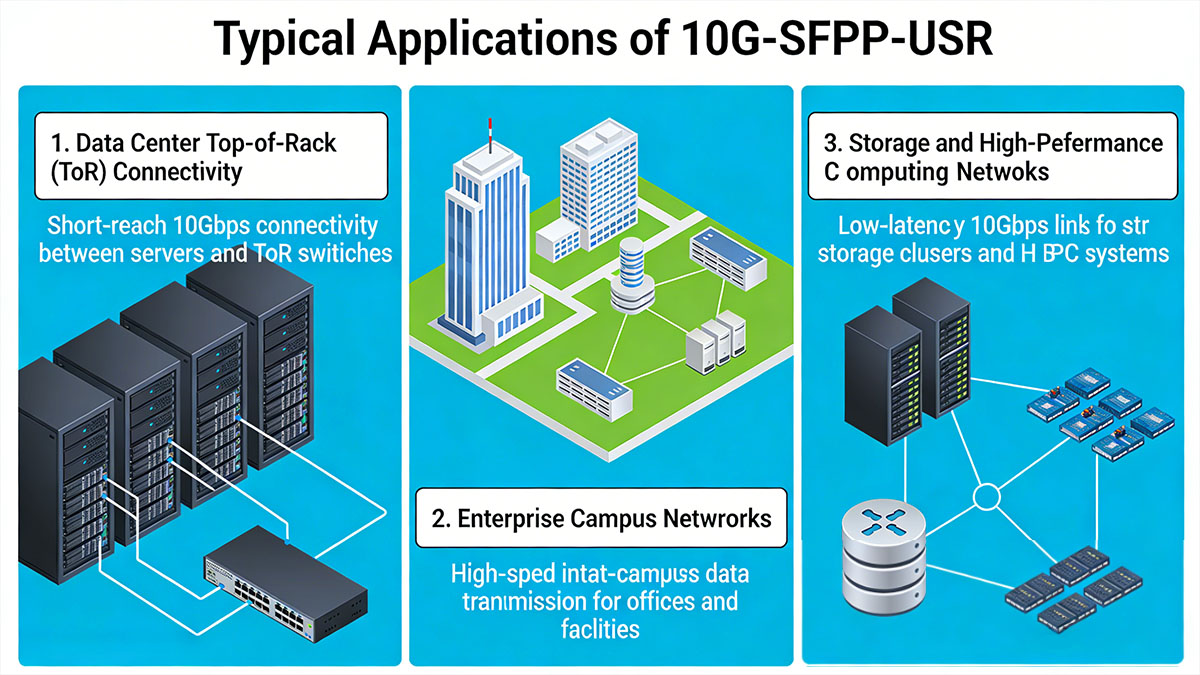
Data Center Top-of-Rack (ToR) Connectivity
For modern data centers, the 10G-SFPP-USR is ideal for ToR architectures where servers connect directly to the top-of-rack switches:
- High-density server racks with multiple 10GbE servers
- Short-distance uplinks (typically under 300–400 meters)
- Minimizes latency between servers and aggregation switches
- Simplifies cabling in confined rack environments
By using the 10G-SFPP-USR in ToR deployments, network engineers can maintain high throughput while reducing heat and power consumption.
Enterprise Campus Networks
In enterprise networks, short-range SFP+ transceiver provide efficient connectivity within buildings or between nearby floors:
- Aggregation switch uplinks in campus networks
- Inter-building fiber links within a single site
- Support for structured multimode fiber cabling infrastructure
- Quick deployment and easy replacement without network downtime
These modules help enterprises scale 10GbE backbone connectivity without requiring expensive long-range single-mode fiber infrastructure.
Storage and High-Performance Computing Networks
High-bandwidth applications, such as storage area network (SAN) and HPC clusters, benefit from short-reach SFP+ transceivers:
- SAN connections between storage arrays and servers
- HPC cluster node interconnects requiring low latency
- Short-reach multimode links that balance cost and performance
- Environments where dense port configurations are required
The 10G-SFPP-USR’s low power, compact form factor, and reliable 10Gbps speed make it suitable for both storage and compute-intensive environments where performance and stability are critical.
? Fiber Compatibility and Distance Capabilities
The 10G-SFPP-USR is engineered for short-range 10GbE links over multimode fiber (MMF). Its performance depends not only on the fiber type but also on physical characteristics such as modal bandwidth, attenuation, and installation quality. Understanding these factors is critical for network designers aiming for predictable, high-performance connectivity.
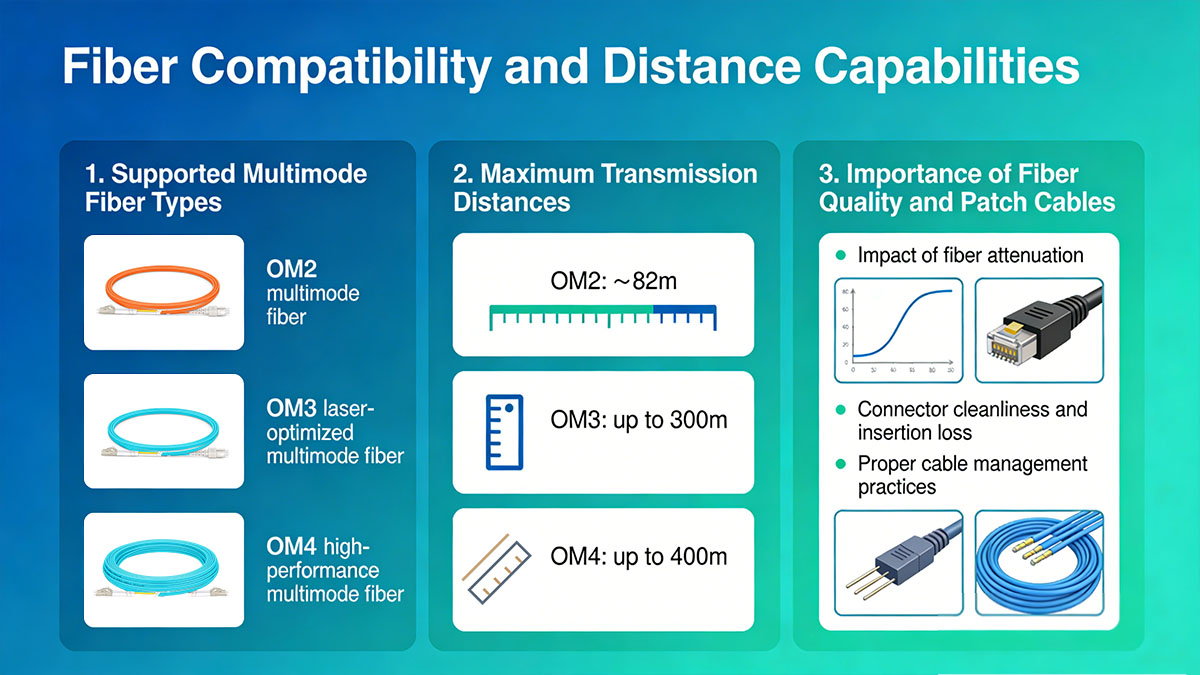
Supported Multimode Fiber Types
The module supports several types of multimode fiber commonly used in data centers and enterprise networks:
- OM2 – Legacy multimode fiber with 500MHz·km modal bandwidth at 850nm. Suitable for short intra-rack links but limited in longer deployments.
- OM3 – Laser-optimized multimode fiber (OM3) with 2000MHz·km bandwidth, designed for 10GbE short-range applications. Ideal for intra-rack and row-level connections.
- OM4 – Enhanced OM3 fiber with 4700MHz·km bandwidth, providing additional distance margin and improved signal integrity for high-density 10GbE deployments.
Higher modal bandwidth in OM3/OM4 reduces modal dispersion, allowing the 10G-SFPP-USR to maintain low bit-error rates over longer short-reach links.
Maximum Transmission Distances
The maximum reach is dictated by fiber type, modal bandwidth, and the quality of optical links:
| Fiber Type |
Maximum Distance |
Key Factors |
| OM2 |
82m |
Limited by modal dispersion and attenuation |
| OM3 |
300m |
Standard reach for most 10GbE data center links |
| OM4 |
400m |
Extended reach due to higher modal bandwidth |
Explanation: Modal dispersion causes pulse broadening, limiting distance in MMF. OM4 fiber mitigates this effect, allowing longer reach without signal degradation. Attenuation (typically 2.3dB/km at 850nm for OM3) also contributes to maximum link length.
Fiber Quality, Installation, and Signal Integrity
Even with the correct fiber type, several factors affect the actual performance:
- Connector cleanliness: Dust, scratches, or oil on LC connectors can reduce optical power by 0.5–1dB or more.
- Bend radius: Exceeding the minimum bend radius (typically 30mm for OM3/OM4) introduces microbending losses.
- Splices and patch panels: Each connection can add 0.3–0.5dB insertion loss, cumulatively reducing effective distance.
- Cable aging: Over time, fiber attenuation can increase, especially in high-density installations.
By accounting for these factors and using OM3 or OM4 fiber, network engineers can ensure the 10G-SFPP-USR achieves reliable 10GbE links with minimal error rates, even in high-density or mission-critical deployments.
? Compatibility with Brocade Networking Equipment
The 10G-SFPP-USR is engineered to integrate seamlessly with Brocade networking platforms, ensuring reliable 10GbE connectivity while maintaining system stability and performance. Its design follows industry standards while also accounting for vendor-specific requirements, which is critical for high-density deployments in data centers and enterprise networks.
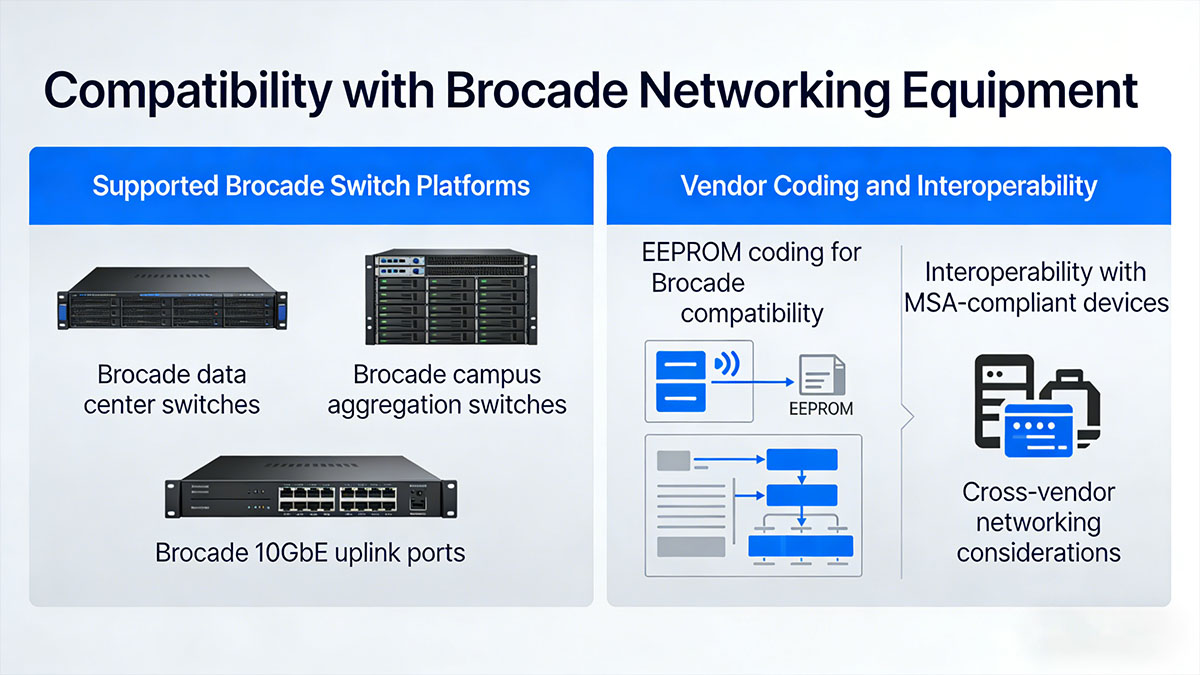
Supported Brocade Switch Platforms
The module is compatible with a range of Brocade switches used in data center and campus environments:
- Data Center Switches – High-performance 10GbE switches providing top-of-rack or end-of-row aggregation.
- Campus Aggregation Switches – Designed for high-speed uplinks between buildings or floors.
- 10GbE Uplink Ports – Available on Brocade access and core switches for connecting multiple network segments.
This broad compatibility ensures that network architects can deploy 10G-SFPP-USR modules without worrying about link failures due to hardware mismatches.
Vendor Coding and Interoperability
Brocade switches verify the presence of compatible optical modules via EEPROM coding. The 10G-SFPP-USR adheres to the required coding standards, ensuring:
| Feature |
Description |
Impact |
| EEPROM Identification |
Pre-programmed vendor and module information |
Ensures the switch recognizes the module as compatible |
| MSA Compliance |
Follows SFP+ Multi-Source Agreement |
Enables interoperability with other MSA-compliant switches and transceivers |
| Firmware Compatibility |
Tested with Brocade OS versions |
Prevents firmware rejection or degraded link performance |
By meeting these coding and compliance requirements, the 10G-SFPP-USR can operate at full 10GbE speeds, supporting features like Digital Optical Monitoring (DOM) for real-time diagnostics.
Cross-Vendor Considerations
While the module is optimized for Brocade equipment, it can also work with other MSA-compliant switches. However, network engineers should consider:
- EEPROM recognition: Some vendors enforce stricter module verification that may require updates or overrides.
- Link negotiation: Ensure both ends of the link support 10GBASE-SR over multimode fiber.
- Monitoring features: DOM may not be fully supported on non-Brocade platforms.
Careful verification and testing during deployment minimize potential interoperability issues, ensuring the 10G-SFPP-USR delivers reliable 10GbE connectivity in multi-vendor environments.
? 10G-SFPP-USR vs Other 10G SFP+ Optical Modules
Choosing the right 10GbE optical modules requires understanding the differences between SR (Short Reach), LR (Long Reach), and LRM transceiver (Long Reach Multimode). The 10G-SFPP-USR is an SR-class module optimized for short-distance multimode fiber links, but its selection should be informed by deployment requirements, fiber infrastructure, and distance needs.
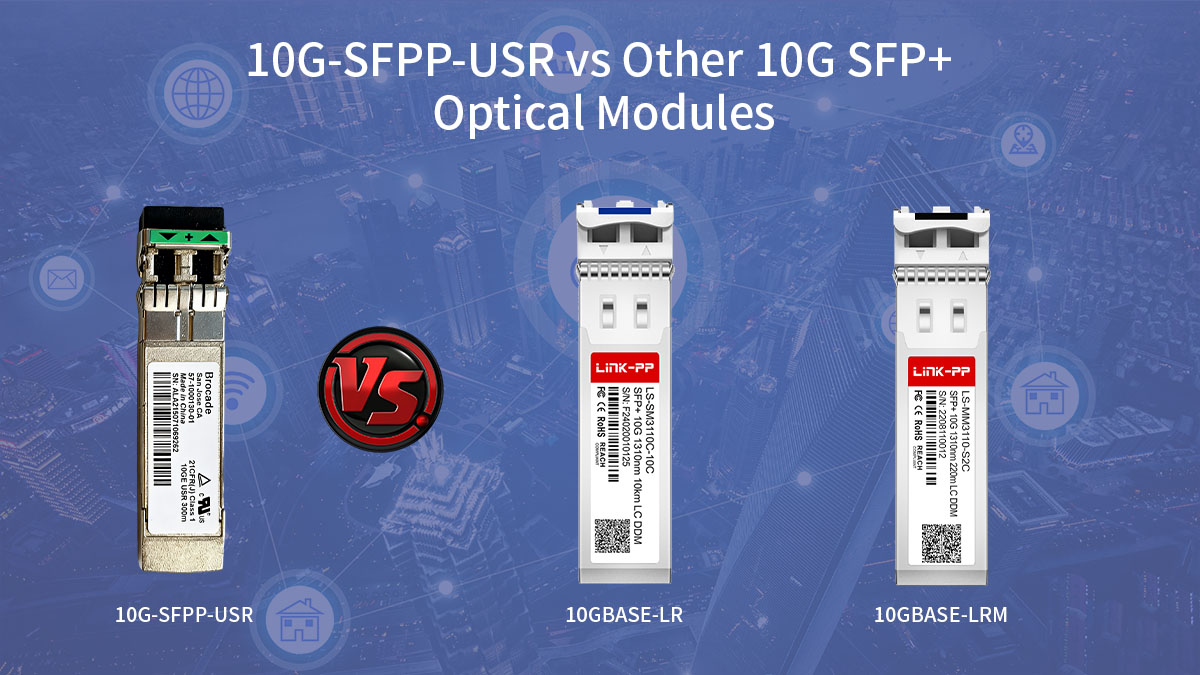
10G-SFPP-USR vs 10GBASE-LR
The primary difference between SR and LR optics lies in fiber type and transmission distance:
| Feature |
10G-SFPP-USR (SR) |
10GBASE-LR |
| Fiber Type |
Multimode (OM3/OM4) |
Single-mode (OS1/OS2) |
| Wavelength |
850nm |
1310nm |
| Maximum Distance |
300m (OM3), 400m (OM4) |
10km |
| Typical Deployment |
Intra-rack, data center rows |
Inter-building or campus links |
| Cost Consideration |
Lower fiber infrastructure cost |
Higher cost due to single-mode deployment |
Analysis: SR modules like 10G-SFPP-USR are ideal when short intra-rack or intra-row links dominate. LR transceiver is necessary for long-distance campus or metro links but require single-mode fiber, which is more expensive to deploy in dense environments.
10G-SFPP-USR vs 10GBASE-LRM
LRM modules are designed to support legacy multimode fibers (OM1/OM2) while extending reach beyond SR capabilities:
| Feature |
10G-SFPP-USR (SR) |
10GBASE-LRM |
| Fiber Type |
OM3/OM4 |
OM1/OM2 |
| Wavelength |
850nm |
1310nm |
| Maximum Distance |
300–400m |
~220m (OM1/OM2) |
| Modal Bandwidth |
High (OM3/OM4) |
Lower (legacy MMF) |
| Use Case |
Modern 10GbE deployments |
Upgrading older multimode networks |
Analysis: LRM module address backward compatibility but cannot match the distance or performance of SR on modern fiber. For new installations with OM3/OM4, 10G-SFPP-USR offers better reliability, lower latency, and higher data integrity.
When SR Modules Are the Best Choice
For most modern data center and enterprise deployments, SR module like 10G-SFPP-USR are preferred due to:
- Compatibility with high-bandwidth OM3/OM4 multimode fiber
- Low power consumption and heat generation in dense racks
- Ease of deployment and replacement in high-density switch ports
- Sufficient reach for intra-rack or intra-row links without additional single-mode fiber costs
Conclusion: While LR and LRM modules have specialized use cases (long-distance links or legacy networks), 10G-SFPP-USR provides an optimal balance of cost, performance, and compatibility for short-range 10GbE links, particularly in Brocade and other MSA-compliant environments.
? Installation and Deployment Best Practices
Proper installation and deployment of the 10G-SFPP-USR are critical to ensure reliable 10GbE connectivity, maintain low error rates, and maximize the performance of multimode fiber networks. This section outlines step-by-step procedures, performance optimization strategies, and monitoring recommendations for high-density Brocade and MSA-compliant environments.
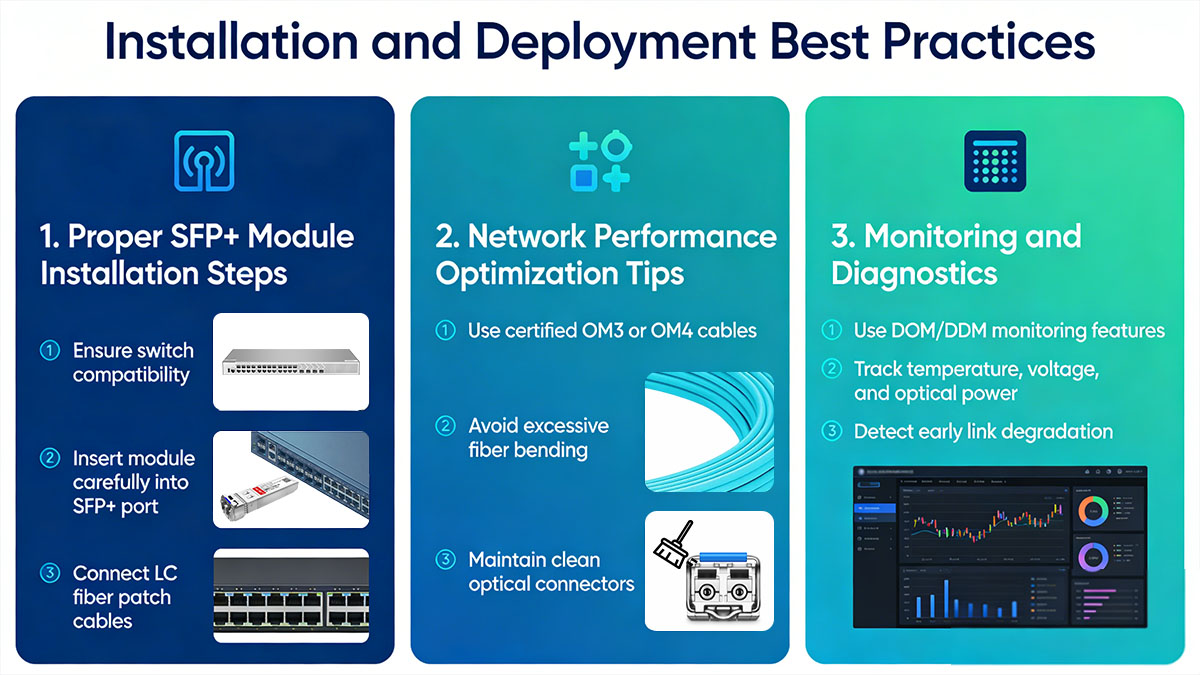
Proper SFP+ Module Installation Steps
Ensuring a stable link starts with correct module installation:
- Verify Switch Compatibility
- Check that the Brocade switch or other MSA-compliant device supports 10G-SFPP-USR modules.
- Confirm firmware version compatibility; some switches may reject modules with outdated or unrecognized EEPROM coding.
- Inspect the Module and Fiber
- Check the SFP+ module for physical damage or contamination.
- Clean LC connectors on both ends using fiber-optic cleaning tools.
- Ensure multimode fiber type (OM3/OM4) matches module specifications.
- Insert the SFP+ Module
- Align the module with the SFP+ port.
- Insert gently until it clicks into place.
- Avoid excessive force to prevent damage to connectors or switch ports.
- Connect Fiber Patch Cables
- Maintain proper polarity (TX ↔ RX).
- Use high-quality OM3/OM4 patch cables with minimal bends.
- Avoid exceeding the recommended bend radius (typically ≥30mm).
- Confirm Link Status
- Check switch port LEDs and console logs for link establishment.
- Use switch commands or monitoring software to verify 10Gbps operation.
Network Performance Optimization Tips
To achieve optimal performance and maintain signal integrity:
- Minimize Fiber Loss: Each connector, splice, or patch panel introduces insertion loss; plan the fiber path to reduce unnecessary connections.
- Maintain Clean Connections: Contaminants on LC connectors can cause power loss, reflected signals, and link instability.
- Monitor Environmental Factors: High temperatures and dust in racks can degrade optical performance; ensure proper airflow.
- Use Proper Cable Management: Avoid sharp bends, tangling, or excessive strain on fibers, which can increase attenuation and reduce the maximum effective distance.
- Plan for Redundancy: In high-availability deployments, consider redundant links or parallel fibers to maintain uptime in case of a single link failure.
Monitoring and Diagnostics
The 10G-SFPP-USR supports Digital Optical Monitoring (DOM/DDM), allowing real-time insight into optical link health:
| Parameter |
Typical Threshold |
Importance |
| Optical Transmit Power |
-6 to 0 dBm |
Ensures sufficient signal strength for 10GbE |
| Optical Receive Power |
-11 to 0 dBm |
Detects weak signals that may cause errors |
| Module Temperature |
0–70°C |
Prevents thermal degradation |
| Supply Voltage |
3.1–3.5 V |
Maintains electrical stability |
Monitoring these parameters allows network engineers to:
- Detect early signs of fiber degradation or connector contamination
- Identify modules that may require replacement before link failure
- Maintain predictable 10GbE performance in high-density or mission-critical environments
Conclusion: Following proper installation, fiber management, and monitoring practices ensures that the 10G-SFPP-USR delivers reliable 10GbE performance. Attention to detail during deployment—especially in high-density Brocade or enterprise environments—reduces downtime, optimizes link quality, and extends the operational lifespan of both modules and fiber infrastructure.
? Common Issues and Troubleshooting
Even with proper installation, 10G-SFPP-USR modules can encounter operational issues due to fiber quality, connector problems, or network configuration. Understanding common failure scenarios and their solutions helps maintain high availability and performance in Brocade and other 10GbE networks.
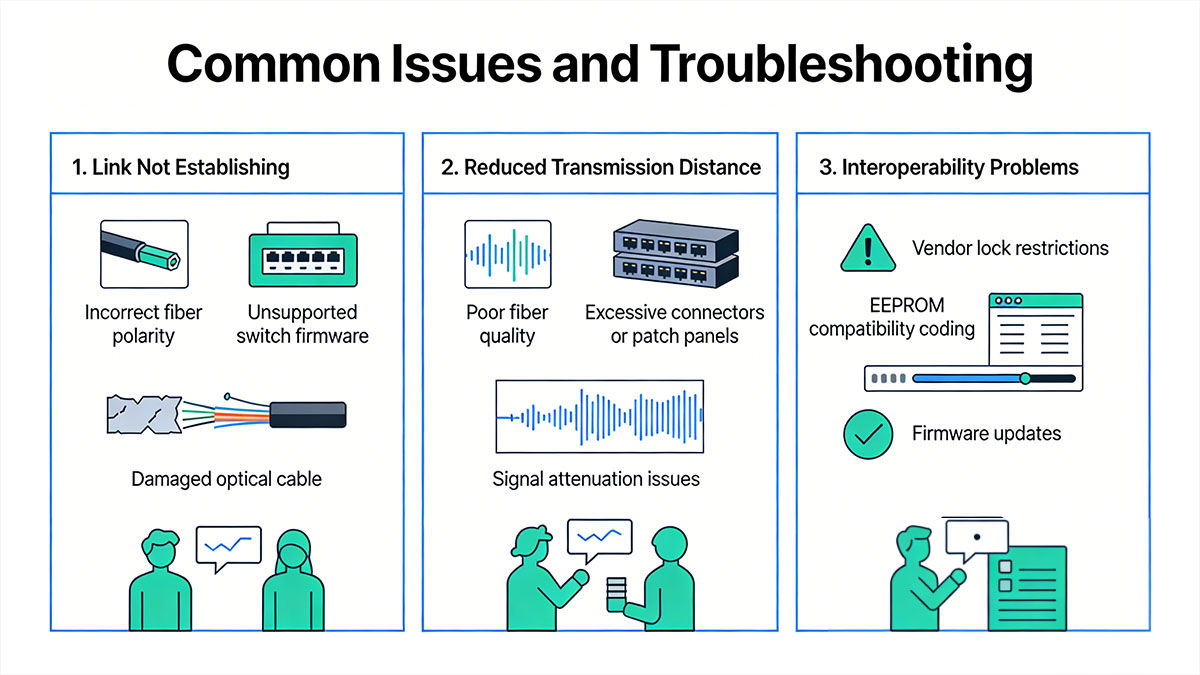
Link Not Establishing
A common problem is that the module fails to establish a link:
Causes and Solutions:
- Incorrect Fiber Polarity: TX/RX mismatches prevent communication.
- Solution: Verify fiber patch cable polarity and ensure transmit ports connect to receive ports.
- Unsupported Switch Firmware: Some switches reject modules if firmware is outdated or EEPROM is unrecognized.
- Solution: Update switch firmware or verify compatibility with module coding.
- Physical Damage: Damaged connectors or SFP+ module can prevent link.
- Solution: Inspect module and connectors; replace if necessary.
Reduced Transmission Distance
Sometimes the link operates but cannot reach the intended distance:
| Issue |
Potential Cause |
Recommended Action |
| Short link reach |
Fiber attenuation too high |
Use certified OM3/OM4 fibers, reduce splices |
| Excessive patch panels |
Each panel adds insertion loss |
Minimize intermediate connections |
| Fiber bending |
Below minimum bend radius |
Re-route fiber, avoid sharp bends |
| Connector contamination |
Dust or scratches |
Clean connectors using fiber cleaning kits |
Analysis: MMF links are sensitive to modal dispersion and insertion loss. Even small errors in cabling or fiber handling can reduce effective transmission distance below the 300–400m specification of 10G-SFPP-USR.
Interoperability Problems
Although the module is MSA-compliant, multi-vendor environments can pose challenges:
- EEPROM Compatibility: Non-Brocade switches may not recognize the module, disabling link or monitoring features.
- Solution: Verify switch vendor policy on third-party modules; some allow manual override or firmware updates.
- DOM/DDM Limitations: Some switches cannot read module diagnostics.
- Solution: Use switch or monitoring tools compatible with the 10G-SFPP-USR DOM standard.
- Link Negotiation Mismatch: If the connected device does not support 10GBASE-SR, the link may fail.
- Solution: Confirm both ends support SR over multimode fiber.
Best Practices for Troubleshooting
- Inspect fiber and SFP+ modules for damage or contamination.
- Verify correct fiber type (OM3/OM4) and cable length.
- Check switch port configuration, firmware, and compatibility.
- Use DOM monitoring to detect low optical power or high temperature.
- Replace suspected faulty modules systematically to isolate issues.
By systematically identifying root causes, network engineers can restore 10GbE links efficiently, maintain low error rates, and ensure consistent performance across Brocade and other MSA-compliant switches.
? Frequently Asked Questions About 10G-SFPP-USR
What fiber cable is required for 10G-SFPP-USR?
The module requires OM3 or OM4 multimode fiber for optimal 10GbE performance. OM2 can work only for very short links and is generally not recommended.
Is 10G-SFPP-USR compatible with standard SFP ports?
No, it requires SFP+ ports. Standard 1Gb SFP ports do not support 10Gbps speeds and will prevent the link from establishing.
What is the maximum distance supported by 10G-SFPP-USR?
The maximum reach is 300 meters on OM3 fiber and 400 meters on OM4 fiber, assuming clean connectors and proper installation.
Does the 10G-SFPP-USR support Digital Optical Monitoring (DOM)?
Yes, it supports DOM/DDM, allowing real-time monitoring of optical power, temperature, and voltage for proactive network maintenance.
Can 10G-SFPP-USR be used in multi-vendor networks?
It can work with other MSA-compliant switches, but some non-Brocade platforms may limit link recognition or disable DOM features. Compatibility verification is recommended.
How do environmental factors affect 10G-SFPP-USR performance?
High temperatures, dust, or excessive fiber bending can reduce optical power and link stability. Proper airflow, clean connectors, and careful cable management are essential.
? Conclusion
The 10G-SFPP-USR is a reliable and high-performance short-reach 10GbE sfp, designed for modern data centers, enterprise networks, and high-density Brocade deployments. Its compatibility with OM3 and OM4 multimode fiber, support for Digital Optical Monitoring, and adherence to 10GBASE-SR and SFP+ standards make it an ideal solution for intra-rack, intra-row, and campus short-distance links. Proper installation, fiber management, and monitoring ensure stable performance, low error rates, and long-term network reliability.
For engineers and network professionals looking to deploy or replace 10G-SFPP-USR modules, LINK-PP Official Store provides fully compatible, quality-tested optical transceivers that meet industry standards and deliver consistent 10GbE performance across Brocade and MSA-compliant platforms.