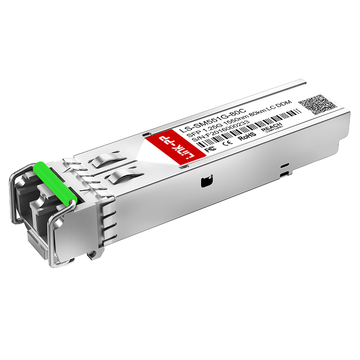
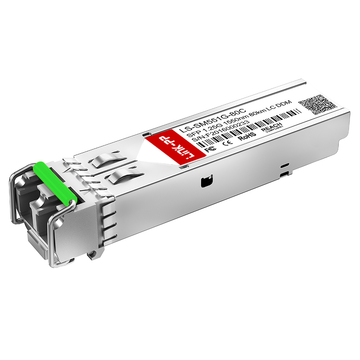
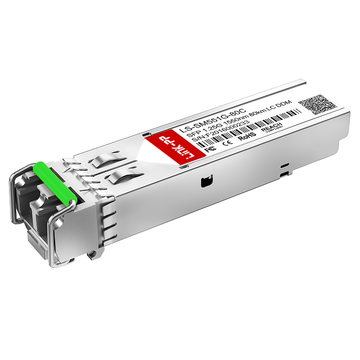
Long-distance fiber connectivity plays an essential role in modern network infrastructure, particularly in environments where nodes must communicate across metropolitan areas or geographically distributed facilities. Among the optical solutions designed for extended reach, SFP 80km modules are widely used to support stable Gigabit Ethernet transmission over single-mode fiber across long spans without intermediate amplification.
An SFP 80km optical transceiver is engineered to deliver reliable 1Gbps connectivity across distances of up to 80km. These modules typically operate in the 1550nm wavelength range and rely on high-power laser transmitters combined with highly sensitive receivers to maintain signal integrity over long fiber routes. Compared with short-reach or mid-range optics, long-reach SFP modules are designed with a significantly higher optical power budget, allowing them to compensate for fiber attenuation and other transmission losses.
Because of their extended reach and compatibility with standard SFP interfaces, 80km optical modules are commonly deployed in metropolitan area networks, telecom access networks, and enterprise backbone links that span multiple sites. They enable network architects to connect distant switching nodes, aggregation layers, or regional data facilities without introducing excessive infrastructure complexity.
Understanding how SFP 80km modules work—and what performance characteristics define premium long-haul optics—helps network engineers evaluate whether these transceivers are suitable for specific fiber environments. The following sections examine the key technologies, performance metrics, deployment considerations, and practical applications that shape the performance of modern 80km SFP optical modules.
⛅What Are SFP 80km Optical Modules
SFP 80km optical modules are long-reach fiber optic transceivers designed to transmit Gigabit Ethernet signals over single-mode fiber across distances of up to 80km. They operate within the standard SFP form factor and are typically used in scenarios where network nodes are separated by large geographic distances, such as metropolitan networks or remote infrastructure connections.
These modules achieve extended transmission distance through higher optical output power, improved receiver sensitivity, and operation in the 1550nm wavelength range where fiber attenuation is lower. As a result, they can maintain stable signal integrity across long fiber spans without requiring intermediate repeaters in many deployments.

Definition and Basic Function
An SFP 80km module functions as an optical interface that converts electrical signals from networking equipment into optical signals for transmission through fiber, and then converts incoming optical signals back into electrical data at the receiving end.
The core working process typically includes the following stages:
-
Electrical-to-optical conversion at the transmitter using a high-power laser source
-
Transmission of optical signals through single-mode fiber
-
Optical signal detection by a high-sensitivity photodiode receiver
-
Optical-to-electrical conversion before data is processed by the switch or router
This conversion mechanism enables Ethernet frames generated by network devices to travel over long fiber infrastructure while maintaining data integrity and low error rates.
Because of their long reach, these modules are often categorized as long-haul Gigabit SFP modules, bridging the gap between standard enterprise connectivity and carrier-grade fiber transmission.
Key Technical Specifications
SFP 80km modules share a number of standardized characteristics that allow them to integrate easily with networking equipment while supporting long-distance optical transmission.
The most common technical parameters are summarized below.
| Parameter | Typical Value | Description |
|---|---|---|
| Data Rate | 1Gbps | Supports Gigabit Ethernet transmission |
| Wavelength | 1550nm | Optimized for low attenuation over long fiber spans |
| Connector Type | LC Duplex | Standard fiber transceivers for SFP interfaces |
| Maximum Distance | Up to 80km | Designed for long-distance single-mode fiber links |
These specifications allow SFP 80km modules to operate reliably in long-haul fiber environments where signal attenuation, dispersion, and environmental factors must be carefully managed.
In addition to the basic parameters above, many modern modules also support Digital Diagnostics Monitoring (DDM), enabling real-time monitoring of optical power levels, temperature, and voltage for improved operational visibility.
Typical Network Environments
SFP 80km optical transceiver module is commonly deployed in networks where fiber links must span long distances between infrastructure points while maintaining stable Gigabit connectivity.
Typical deployment environments include:
-
Metropolitan Area Networks (MAN)
Connecting aggregation switches or regional nodes across city-wide fiber infrastructure. -
Telecommunications access networks
Supporting long-distance backhaul connections between base stations, access nodes, and central offices. -
Enterprise and campus backbone networks
Linking geographically separated buildings, campuses, or remote data facilities. -
Utility and industrial communication networks
Providing reliable long-distance fiber connectivity for monitoring systems, substations, or infrastructure control networks.
In these scenarios, long distance SFP modules allow network designers to extend connectivity far beyond the reach of standard short-range optics while maintaining compatibility with existing SFP-based switching platforms.
⛅Core Technologies Behind 80km Long-Reach Optics
SFP 80km modules achieve long-distance optical transmission through a combination of advanced laser technology, highly sensitive receivers, and real-time monitoring capabilities. These technologies work together to maintain signal quality over extended fiber spans where attenuation, dispersion, and environmental variations could otherwise degrade performance.
Unlike short-reach optical modules, long-reach optical modules must deliver higher optical power and detect extremely weak incoming signals. As a result, the internal design of 80km SFP transceivers places greater emphasis on laser stability, receiver sensitivity, and link diagnostics.

High-Power Laser Sources
Long-distance transceiver relies on stable, high-power laser transmitters to ensure that optical signals remain detectable after traveling tens of kilometers through fiber.
Most SFP 80km modules use Distributed Feedback (DFB) lasers operating around the 1550nm wavelength range. This laser type offers a narrow spectral linewidth and stable output characteristics, which are essential for minimizing signal degradation during long-distance transmission.
| Laser Type | Typical Wavelength | Key Advantage |
|---|---|---|
| FP Laser | 1310nm | Suitable for short or medium distances |
| DFB Laser | 1550nm | Stable output for long-distance transmission |
| EML Laser | 1550nm | Used in higher-speed long-haul optics |
DFB lasers are particularly well suited for long-reach SFP optics because they maintain consistent wavelength stability and power output. These characteristics help reduce dispersion effects and allow signals to remain distinguishable even after traveling through many kilometers of fiber.
Optical Amplification and Receiver Sensitivity
Another critical factor in achieving 80km transmission is the ability of the receiver to detect very weak optical signals. As optical signals travel through fiber, they gradually lose power due to attenuation, connector loss, and splice loss.
Long-reach SFP modules are designed with highly sensitive photodiode receivers and optimized signal processing circuits that allow them to detect low-level optical input signals while maintaining acceptable bit error rates.
The relationship between transmission distance and optical power budget can be summarized as follows.
| Factor | Typical Value | Impact on Link |
|---|---|---|
| Fiber attenuation | ~0.25 dB/km | Primary source of signal loss |
| Connector loss | 0.2–0.5 dB | Occurs at patch panels and connectors |
| Receiver sensitivity | Very high | Enables detection of weak signals |
Because an 80km fiber span can introduce significant cumulative loss, both transmitter output power and receiver sensitivity must be carefully balanced to maintain a stable link.
Digital Diagnostics Monitoring (DDM)
Modern SFP 80km modules often include Digital Diagnostics Monitoring (DDM), a feature that allows network devices to monitor the internal operating conditions of the optical module in real time.
DDM provides visibility into several important parameters that influence link performance.
Typical monitored metrics include:
-
Transmit optical power (TX power)
-
Received optical power (RX power)
-
Module temperature
-
Supply voltage
-
Laser bias current
These diagnostics help network operators identify potential issues such as fiber degradation, connector contamination, or abnormal temperature conditions before they cause link failures.
In long-distance optical deployments where troubleshooting can be complex, real-time diagnostics significantly improve operational reliability and simplify network maintenance.
⛅Key Performance Metrics for SFP 80km Modules
Evaluating the performance of SFP 80km modules requires understanding several key metrics that directly influence long-distance optical transmission. Because these modules operate across extended fiber spans, factors such as optical power budget, bit error rate, and signal stability become critical to maintaining reliable connectivity.
These performance indicators help network engineers determine whether a long-reach SFP module can sustain stable data transmission under real-world fiber conditions.

Optical Power Budget
The optical power budget determines whether a fiber link can support the intended transmission distance. For an 80km fiber optic transceiver, the power budget represents the difference between the transmitter output power and the minimum receiver sensitivity required to detect the signal.
A higher optical budget allows the signal to tolerate more fiber attenuation, connector losses, and splicing losses along the link.
| Parameter | Typical Range | Role in Transmission |
|---|---|---|
| Transmit Optical Power | +3 to +7 dBm | Determines signal strength entering the fiber |
| Receiver Sensitivity | -24 to -28 dBm | Minimum detectable optical signal |
| Optical Power Budget | ~27–32 dB | Maximum allowable link loss |
In practical deployments, the available optical budget must account for multiple loss sources, including fiber attenuation, connectors, patch panels, and splicing points. Proper power budget planning ensures that the total link loss remains within the supported range of the optical module.
Bit Error Rate (BER)
Bit Error Rate measures how frequently errors occur during data transmission across a fiber link. For long-distance optical connections, maintaining a low BER is essential to ensure reliable communication between network devices.
SFP 80km modules are designed to support extremely low error rates by combining stable laser output with sensitive receiver detection.
Typical BER targets for Gigabit Ethernet optical modules include:
-
Standard performance threshold: 10⁻¹²
-
Equivalent to approximately one bit error per trillion transmitted bits
-
Required to maintain stable network communication
Maintaining a low BER becomes increasingly important over long fiber spans, where dispersion and signal attenuation can gradually distort optical signals.
Signal Stability Over Long Distances
Signal stability refers to the ability of an optical module to maintain consistent signal quality over extended fiber routes. As distance increases, several physical factors can affect the integrity of optical transmission.
The most important factors influencing long-distance signal stability include:
-
Fiber attenuation
Optical signals gradually weaken as they travel through fiber, particularly across tens of kilometers. -
Chromatic dispersion
Different wavelengths of light travel at slightly different speeds within the fiber, potentially causing pulse spreading. -
Environmental conditions
Temperature fluctuations can affect laser wavelength stability and receiver sensitivity.
Long-reach SFP fiber module is designed to mitigate these challenges through stable laser sources, optimized receiver circuits, and carefully calibrated optical power levels. Together, these characteristics allow 80km optical modules to maintain reliable performance even across extended fiber infrastructure.
⛅Advantages of Premium SFP 80km Optical Modules
Premium SFP 80km sfp transceiver module provides several technical and operational advantages in long-distance fiber deployments. By combining higher optical output power, improved receiver sensitivity, and stable optical components, these modules enable reliable Gigabit Ethernet connectivity across extended fiber spans.
Compared with SR optics, LR SFP modules are specifically designed to maintain signal quality over long distances while remaining compatible with standard SFP interfaces. This makes them a practical solution for networks that require stable long-distance links without introducing excessive infrastructure complexity.

Extended Transmission Distance
One of the most significant advantages of SFP 80km modules is their ability to support long-distance transmission over single-mode fiber without requiring intermediate repeaters or optical amplification in many cases.
LR optics operate in the 1550nm wavelength range, where fiber attenuation is lower compared with shorter wavelengths. This allows optical signals to travel longer distances before becoming too weak for reliable detection.
| Optical Module Type | Typical Distance | Common Wavelength |
|---|---|---|
| Standard SFP | Up to 10km | 1310nm |
| ER SFP | Up to 40km | 1550nm |
| LR SFP | Up to 80km | 1550nm |
Because of this extended reach capability, 80km SFP modules are frequently used in metropolitan and regional fiber networks where network nodes are separated by large geographic distances.
High Reliability for Critical Infrastructure
Long-distance fiber links are often deployed in environments where stable connectivity is essential for network operations. Premium SFP 80km modules are typically designed with higher-grade optical components that support consistent performance under varying operating conditions.
Several design characteristics contribute to this reliability:
-
Stable DFB laser transmitters that maintain consistent wavelength output
-
High-sensitivity receivers capable of detecting weak signals after long fiber transmission
-
Thermal control mechanisms that stabilize module performance across temperature variations
These characteristics help maintain consistent signal quality and reduce the likelihood of transmission errors in long-haul fiber connections.
Long-Term Network Scalability
Another advantage of SFP 80km modules is their compatibility with widely deployed SFP interfaces across enterprise and telecom networking equipment. Because the SFP form factor is standardized, these modules can often be integrated into existing switching and routing platforms without requiring hardware upgrades.
This compatibility supports long-term scalability in several ways:
-
Existing SFP ports can support long-distance fiber connections without replacing equipment
-
Network designers can extend connectivity between distant nodes while maintaining consistent interface standards
-
Infrastructure expansion can occur incrementally as network coverage grows
As a result, SFP 80km optics provide a flexible option for extending fiber connectivity across large geographic areas while preserving compatibility with established network architectures.
⛅Deployment Considerations for 80km SFP Optics
Deploying SFP 80km fiber module requires careful planning to ensure that long-distance fiber links remain stable and within the supported optical parameters of the transceiver. Because these modules operate close to the limits of Gigabit Ethernet transmission distance, factors such as fiber quality, link loss, and equipment compatibility play a critical role in overall performance.
Proper deployment planning helps ensure that the optical power budget is sufficient, the fiber infrastructure meets required standards, and the network equipment can reliably support long-reach optical transceivers.

Fiber Infrastructure Requirements
SFP 80km modules are designed to operate over OS2 single-mode fiber, which provides lower attenuation and reduced dispersion compared with multimode fiber. For long-distance deployments, the type and quality of the fiber infrastructure can significantly influence link stability.
The most common fiber types used with 80km optics are shown below.
| Fiber Type | Typical Use | Key Characteristic |
|---|---|---|
| OS1 | Indoor backbone fiber | Higher attenuation than outdoor fiber |
| OS2 | Outdoor long-distance fiber | Lower attenuation for long spans |
| G.652 fiber | Standard single-mode fiber | Widely used in telecom networks |
For links approaching the maximum supported distance, lower attenuation fiber such as OS2 is typically preferred. High-quality fiber infrastructure helps minimize signal loss and ensures that the available optical power budget can support the required transmission distance.
Power Budget Planning
Power budget planning is essential when deploying long-reach optical modules because multiple sources of signal loss accumulate along the fiber path. The total link loss must remain within the supported optical power budget of the SFP module.
The total link loss is typically calculated by considering several components:
-
Fiber attenuation over the total distance
-
Connector insertion loss at patch panels
-
Splice loss along the fiber route
-
Additional margin for aging and environmental variation
A simplified planning process often follows these steps:
-
Estimate total fiber distance between endpoints
-
Calculate expected fiber attenuation per kilometer
-
Add connector and splice losses
-
Reserve a safety margin for long-term operation
If the calculated total loss approaches the maximum supported optical budget, the link may require design adjustments such as improved fiber quality, reduced connector count, or alternative optical modules.
Compatibility With Network Equipment
Although SFP optical transceiver follows standardized form factors, compatibility with specific network equipment is still an important deployment consideration. Different switch and router vendors may implement firmware checks or require vendor-qualified optical modules.
When planning deployments, network administrators typically verify the following factors:
-
SFP interface compatibility with the target switch or router platform
-
Firmware support for long-reach optical modules
-
Availability of Digital Diagnostics Monitoring (DDM) support
-
Vendor interoperability in mixed networking environments
Ensuring compatibility between optical modules and network equipment helps prevent issues such as link initialization failures, incorrect optical readings, or limited monitoring capabilities.
Careful verification of these factors helps maintain stable operation in long-distance fiber networks where troubleshooting physical infrastructure can be more complex.
⛅SFP 80km vs Other Long-Reach Optical Modules
SFP 80km modules are designed for long-distance Gigabit Ethernet transmission, but they are not the only option for extended fiber connectivity. Network engineers often compare them with other LR optical modules to determine the most suitable solution based on distance, bandwidth requirements, and infrastructure design.
Understanding the differences between various long-distance optical standards helps clarify when an 80km SFP module is the most appropriate choice and when alternative technologies may offer advantages.

SFP 40km vs SFP 80km
SFP 40km and SFP 80km modules share similar design principles but differ in transmission reach and optical power characteristics. Both are commonly used for long-distance Gigabit Ethernet over single-mode fiber.
The main differences are related to optical output power and receiver sensitivity.
| Parameter | SFP 40km | SFP 80km |
|---|---|---|
| Maximum Distance | Up to 40km | Up to 80km |
| Typical Wavelength | 1550nm | 1550nm |
| Optical Power Budget | Moderate | Higher |
| Deployment Scenario | Regional fiber links | Long-haul metropolitan links |
Because 80km modules support a larger optical budget, they can compensate for greater fiber attenuation. This makes them suitable for longer fiber spans or networks where the physical distance between nodes exceeds the reach of 40km SFP.
SFP 80km vs SFP+ Long-Reach Modules
SFP 80km modules primarily support Gigabit Ethernet, while long-reach SFP+ modules are designed for higher data rates such as 10Gbps. The main difference between these transceivers lies in bandwidth capacity rather than transmission distance alone.
| Parameter | SFP 80km | SFP+ Long-Reach |
|---|---|---|
| Data Rate | 1Gbps | 10Gbps |
| Form Factor | SFP | SFP+ |
| Typical Distance | Up to 80km | Typically 10–40km |
| Primary Use | Long-distance Gigabit links | High-speed backbone links |
In networks where bandwidth requirements increase, operators may transition from long-distance Gigabit optics to higher-speed optical standards. However, in many infrastructure environments where bandwidth demand is moderate but distance is significant, 80km SFP modules remain a practical solution.
SFP 80km vs DWDM Solutions
Dense Wavelength Division Multiplexing (DWDM) technology is another option for long-distance fiber transmission, particularly in carrier-grade networks. Unlike single-channel SFP optics, DWDM systems allow multiple optical channels to be transmitted simultaneously over the same fiber pair.
| Technology | Transmission Method | Typical Use Case |
|---|---|---|
| SFP 80km | Single wavelength link | Dedicated long-distance fiber connections |
| CWDM | Multiple wavelengths (coarse spacing) | Regional multi-channel networks |
| DWDM | Dense wavelength multiplexing | High-capacity carrier networks |
DWDM module are commonly used when multiple high-capacity channels must share the same fiber infrastructure. However, they typically involve more complex equipment and network design. For single-channel long-distance connections where simplicity is preferred, SFP 80km modules provide a straightforward and widely supported optical solution.
⛅Common Applications of SFP 80km Modules
SFP 80km modules are typically deployed in networks where long-distance fiber connectivity is required but the bandwidth demand remains within Gigabit Ethernet capacity. Their ability to support stable transmission across extended single-mode fiber spans makes them suitable for infrastructure environments where nodes are geographically dispersed.
These modules are commonly used in metropolitan networks, telecom infrastructure, and distributed enterprise environments where reliability and distance are more critical than extremely high data rates.

Metropolitan Area Networks (MAN)
One of the most common use cases for SFP 80km modules is within metropolitan area networks. In these environments, network nodes such as aggregation switches, regional data centers, or service provider points of presence may be separated by tens of kilometers.
SFP 80km optics allow network operators to establish stable city-scale fiber connections without requiring additional amplification equipment for many links.
Typical MAN connectivity scenarios include:
-
Interconnection of regional aggregation switches
-
Linking city-level network nodes across long fiber routes
-
Extending connectivity between distributed data facilities within a metropolitan area
Because metropolitan fiber routes often include multiple patch points and splices, the larger optical power budget of 80km modules helps maintain stable link performance.
Telecom Access Networks
Telecommunications access networks often require long-distance connectivity between central offices and remote infrastructure sites. These links may span suburban areas, rural regions, or distributed access points.
SFP 80km modules support these deployments by enabling long-distance Gigabit connectivity for access and backhaul networks.
Common telecom scenarios include:
-
Connecting remote access nodes to central switching facilities
-
Long-distance fiber backhaul for network access equipment
-
Linking infrastructure sites located outside major urban centers
The extended reach of 80km optics allows operators to reduce the number of intermediate network elements required along the fiber path.
Enterprise and Campus Backbone Links
Large enterprises and multi-campus institutions frequently operate network infrastructures that span multiple locations across large geographic areas. In such environments, reliable backbone connectivity between sites is essential for data communication, application access, and centralized IT services.
SFP 80km modules provide a practical solution for connecting distant facilities while maintaining compatibility with standard Gigabit Ethernet interfaces.
Typical enterprise deployment scenarios include:
-
Linking headquarters and remote office campuses
-
Connecting distributed buildings across industrial parks
-
Supporting long-distance monitoring networks for utilities or infrastructure
For organizations with existing single-mode fiber infrastructure, LR SFP module make it possible to extend connectivity across large distances without redesigning the entire network architecture.
⛅Future Trends in Long-Distance SFP Optical Technologies
Long-distance SFP optical modules continue to evolve as network infrastructure expands and new performance requirements emerge. Although many modern networks are transitioning toward higher data rates, long-reach Gigabit optics still play an important role in infrastructure where transmission distance, reliability, and compatibility are key considerations.
Several technological trends are shaping the future development of long-distance SFP modules, focusing on improved efficiency, enhanced monitoring capabilities, and integration with evolving network architectures.

Improved Power Efficiency
One emerging trend in optical module design is the improvement of power efficiency. As networks deploy large numbers of optical transceivers, reducing the power consumption of each module becomes increasingly important for lowering operational costs and managing thermal conditions within networking equipment.
Advances in semiconductor design and laser efficiency are helping long-reach SFP modules operate with lower power consumption while maintaining stable optical output.
Typical areas of improvement include:
-
More efficient laser driver circuits
-
Reduced power consumption in receiver amplification components
-
Improved thermal management within the transceiver housing
These developments help ensure that long-distance optical modules remain suitable for high-density networking environments where energy efficiency is a growing priority.
Integration With Higher-Speed Standards
Although SFP 80km modules are primarily associated with Gigabit Ethernet, the broader optical networking industry continues to transition toward higher-speed standards. Many network architectures are gradually integrating higher bandwidth technologies such as 10Gbps, 25Gbps, and beyond.
The evolution of optical interfaces has introduced several form factors designed to support these higher speeds.
| Optical Interface | Typical Data Rate | Common Application |
|---|---|---|
| SFP | 1Gbps | Long-distance Gigabit Ethernet |
| SFP+ | 10Gbps | High-speed enterprise backbones |
| SFP28 | 25Gbps | Data center and aggregation networks |
| QSFP family | 40Gbps–400Gbps | Large-scale data center interconnects |
Despite the growth of higher-speed interfaces, long-distance Gigabit sfp transceiver remain relevant in infrastructure environments where bandwidth requirements are moderate but fiber distance remains significant.
Smarter Optical Monitoring
Another important trend is the expansion of intelligent monitoring features within optical transceivers. Modern network management systems increasingly rely on detailed operational data to maintain stable infrastructure.
Future long-distance SFP connectors are expected to provide enhanced monitoring capabilities beyond basic Digital Diagnostics Monitoring functions.
Potential improvements include:
-
More precise optical power measurement accuracy
-
Extended diagnostic parameters for predictive maintenance
-
Improved integration with network telemetry systems
-
Automated alerting for abnormal optical conditions
These monitoring capabilities allow network operators to detect potential fiber issues earlier, improve link visibility, and simplify troubleshooting across large fiber infrastructures.
⛅Conclusion
SFP 80km modules remain an important solution for networks that require reliable long-distance fiber connectivity while maintaining compatibility with standard Gigabit Ethernet interfaces. By combining high-power 1550nm laser transmission, sensitive receiver detection, and stable optical design, these long-reach modules can support fiber links that extend across metropolitan areas, telecom access networks, and geographically distributed enterprise environments.
Understanding the core technologies, performance metrics, and deployment considerations behind 80km optical modules helps network engineers design fiber links that remain stable even across extended distances. Careful planning of the optical power budget, fiber infrastructure quality, and equipment compatibility ensures that long-reach SFP optics deliver consistent performance in real-world network deployments.
As fiber networks continue to expand and diversify, long-distance Gigabit optics still provide a practical option for infrastructure environments where transmission distance is a primary requirement. For organizations evaluating reliable long-reach optical connectivity solutions, the LINK-PP Official Store offers a range of SFP optical modules designed to support stable and efficient fiber network deployments.