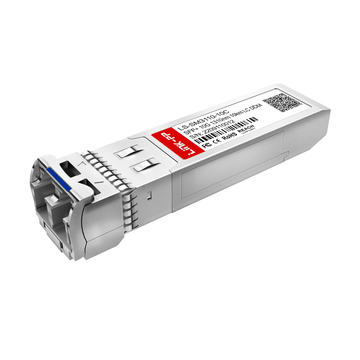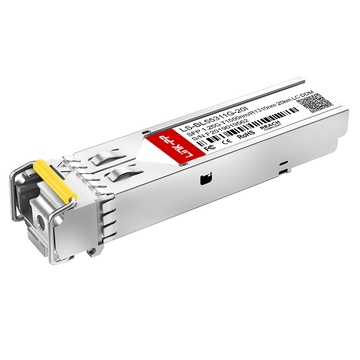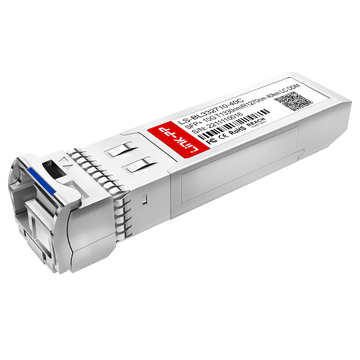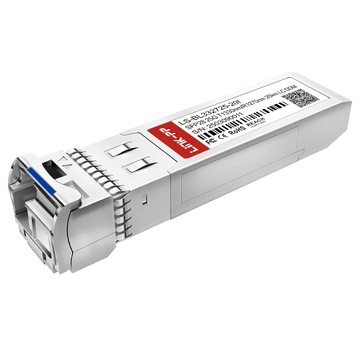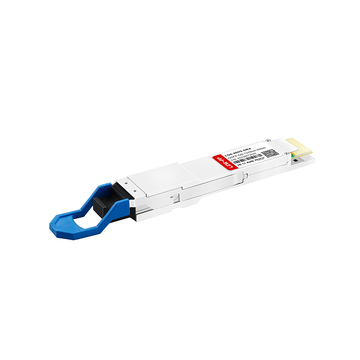
Simplex fiber uses one optical strand, while duplex fiber uses two paired strands for two-way transmission. In practice, simplex is most often associated with bidirectional optics or single-fiber links, while duplex is the standard choice for transmit/receive Ethernet connections because it separates the outbound and return paths cleanly. The key decision is not just cable count; it is whether your link design, optics, and polarity plan are built for one fiber or two.
That difference matters because simplex and duplex describe link architecture, not fiber grade. A duplex cable can be built from two simplex fibers placed side by side, while multimode and singlemode describe the transmission medium itself. In other words, duplex is not the same thing as multimode, and OM1 or OM2 classification is a separate question tied to core size and wavelength behavior.
For network teams, the real buying question is simple: should you optimize for strand efficiency or for operational simplicity? Simplex can reduce strand usage in constrained builds, but duplex usually wins in standard deployments because it is easier to document, test, and maintain at scale. The sections below compare performance, compatibility, and procurement cost so you can choose the right fiber type with confidence.
🟩 What Is Simplex Fiber?
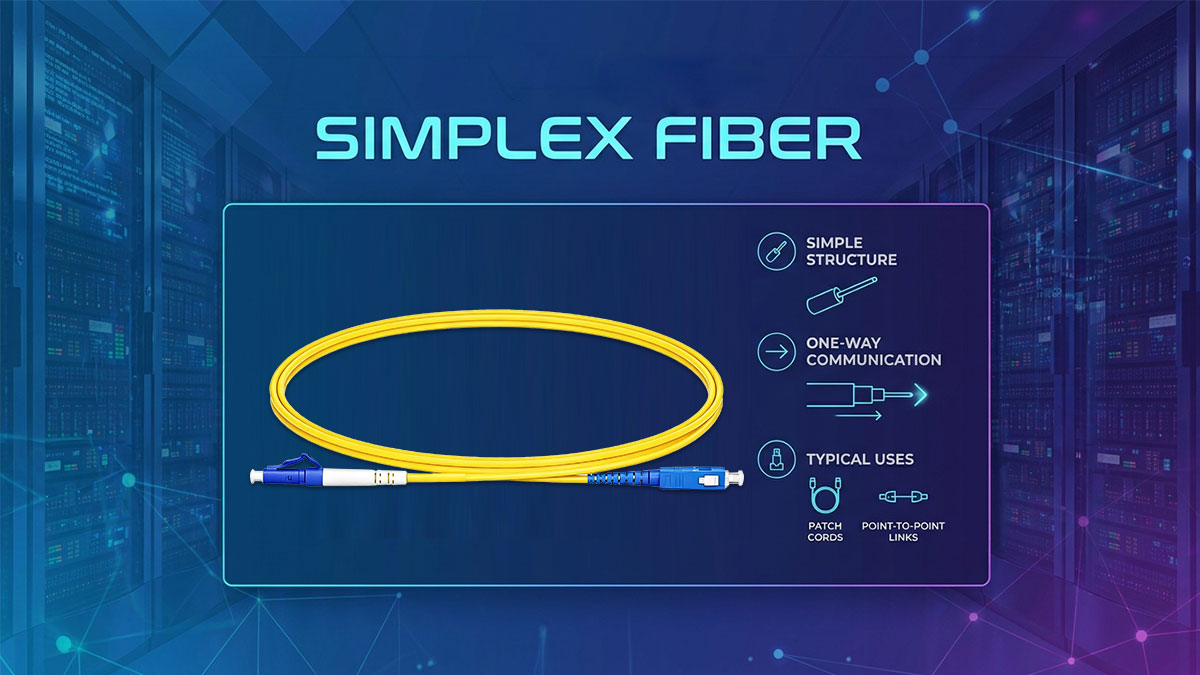
Simplex fiber is a fiber-optic link that uses a single optical strand for communication. In modern networks, it is typically paired with bidirectional (BiDi) transceivers, which transmit and receive data simultaneously over the same fiber using different wavelengths. The main advantage of simplex fiber is maximizing fiber utilization when available strands are limited.
How Does Simplex Fiber Work?
A simplex fiber cable contains one optical fiber. Unlike duplex fiber, which uses separate transmit (Tx) and receive (Rx) fibers, simplex links rely on Wavelength Division Multiplexing (WDM) technology.
For example:
| End A |
End B |
| Tx 1310 nm / Rx 1490 nm |
Tx 1490 nm / Rx 1310 nm |
By transmitting and receiving on different wavelengths, both devices can communicate over a single fiber strand.
Common Applications of Simplex Fiber
Simplex fiber is commonly used in:
- FTTH networks using GPON, XG-PON, and XGS-PON
- Campus and metropolitan networks with limited spare fibers
- Building-to-building connections where adding new fiber is costly
- Industrial and utility networks requiring efficient fiber utilization
Advantages and Limitations
Advantages
- Reduces fiber strand requirements by up to 50%
- Saves conduit and cable space
- Extends the usability of existing fiber infrastructure
Limitations
- Requires matched BiDi transceiver pairs
- More complex optics inventory management
- BiDi modules may cost more than standard duplex optics
Key Takeaway:Simplex fiber is ideal when fiber availability is limited and infrastructure expansion is expensive. While it can support full-duplex communication through BiDi optics, it is primarily a fiber-saving solution rather than a performance enhancement. For most standard Ethernet deployments, duplex fiber remains the more common choice.
🟩 What Is Duplex Fiber?
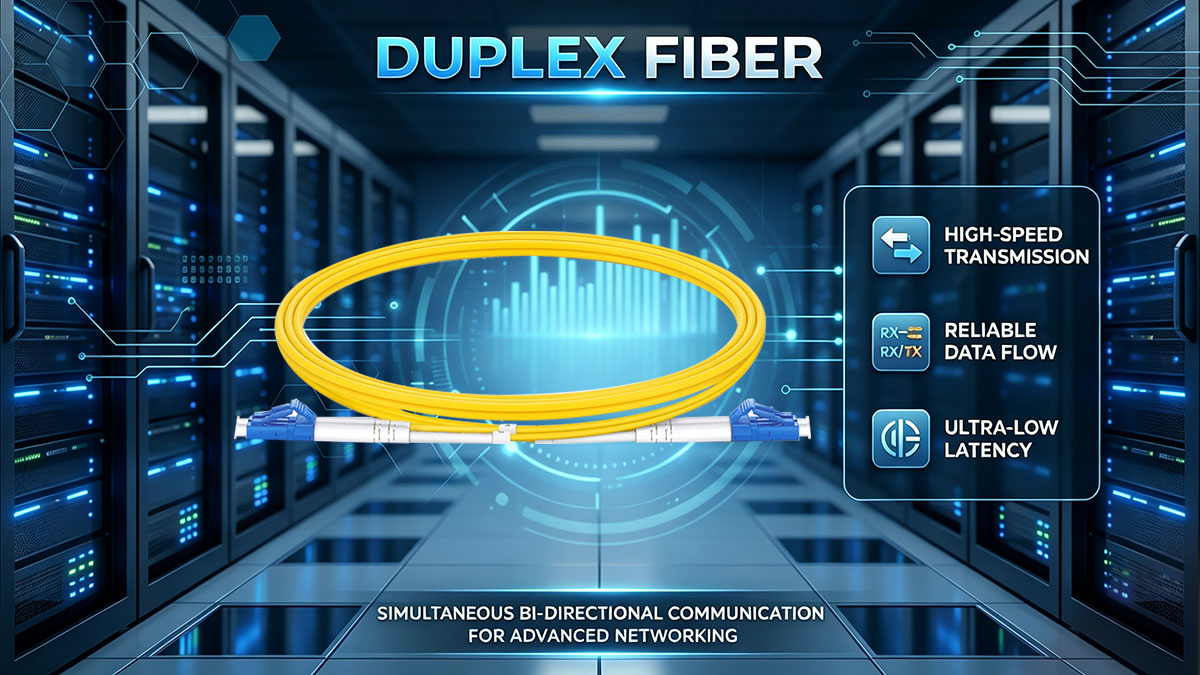
Duplex fiber is a two-fiber optical link that separates transmission and reception onto different strands. One fiber carries data from device A to device B, and the second fiber carries data back from device B to device A. This is the most common fiber layout in Ethernet networks because it matches standard transceiver design, simplifies link setup, and avoids wavelength-pairing requirements.
How the Two-Fiber Transmit/Receive Model Works
A duplex connection uses one strand for Tx and one strand for Rx. Each end of the link is crossed so the transmit lane on one side connects to the receive lane on the other.
| End A |
End B |
| Tx fiber → |
← Rx fiber |
| Rx fiber ← |
→ Tx fiber |
This design supports full-duplex communication, meaning both directions can operate at the same time without sharing the same optical path. In most deployments, duplex fiber is used with standard SFP, SFP+, SFP28, and similar transceivers.
Common Deployment Scenarios
Duplex fiber is widely used in:
- Enterprise LANs and campus networks
- Data centers and server interconnects
- Switch-to-switch and switch-to-server links
- Singlemode and multimode structured cabling
- Any environment using standard duplex optics
It is especially common where network teams want straightforward installation, simple troubleshooting, and broad compatibility with common optical modules and patch panels.
Why Duplex Fiber Is So Common
Duplex fiber is the default choice for most network links because it is operationally simple. There is no need to coordinate wavelength pairs, and standard optics are designed for two-fiber transmit/receive operation. That makes duplex easier to deploy, easier to document, and easier to scale across larger networks.
Key Takeaway: Duplex fiber is the standard two-strand model for full-duplex optical communication. It remains the preferred option for most Ethernet and data center environments because it offers reliable performance, broad compatibility, and simpler network operations than single-fiber designs.
🟩 Simplex vs. Duplex Fiber: The Core Differences
Simplex and duplex fiber are not different speed grades; they are different link structures. Simplex uses one optical strand, usually paired with BiDi optics in modern Ethernet designs, while duplex uses two strands, one for transmit and one for receive. In practice, duplex is the default for most standard SFP-based links because it is simpler to deploy, easier to document, and broadly compatible with common transceivers and patching workflows.
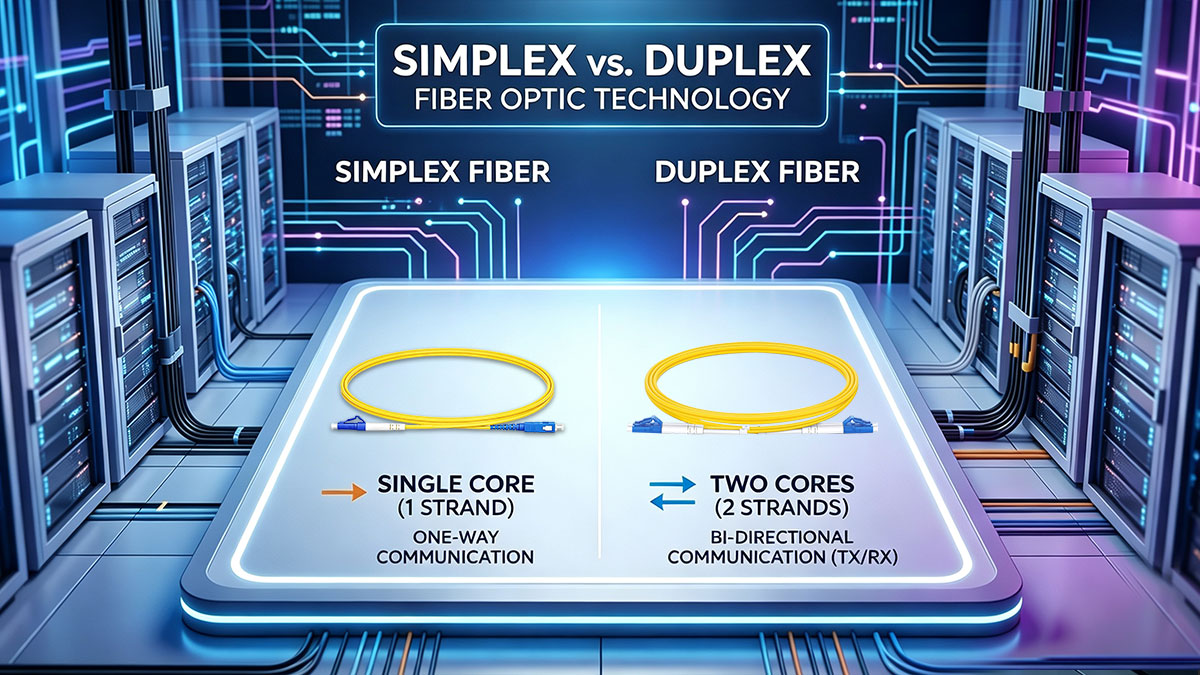
Detailed comparison table
| Aspect |
Simplex Fiber |
Duplex Fiber |
| Fiber count |
1 strand |
2 strands |
| Traffic model |
One strand carries both directions through BiDi or is used for one-way transmission |
One strand carries Tx, the other carries Rx |
| Optics required |
Matched BiDi transceivers with complementary wavelengths |
Standard duplex transceivers |
| Cable design |
Single-fiber patch cord or single-strand link |
Two fibers bundled together as a pair |
| Typical connectors |
LC simplex, SC simplex |
LC duplex, SC duplex |
| Installation complexity |
Lower strand usage, but stricter optic pairing |
Easier polarity handling and broader compatibility |
| Best fit |
Fiber-constrained links, legacy plant reuse, FTTH, some metro links |
Enterprise LAN, data center, campus backbone, standard Ethernet |
| Operational tradeoff |
Saves strands, but adds wavelength matching and inventory complexity |
Uses more fiber, but is operationally simpler |
Strand count and cabling structure
The most obvious difference is physical: simplex uses one fiber, duplex uses two. Duplex cables are typically built as two fibers joined side by side, which makes them suitable for standard full-duplex networking. Simplex cables are lighter in strand usage, but they only become practical for modern Ethernet when the optics are designed to send and receive over a single fiber using different wavelengths.
Directionality and link behavior
Duplex fiber separates transmit and receive onto different strands. That separation makes the link behavior easy to understand and troubleshoot: one lane sends, one lane returns. Simplex fiber does not do that by default. In current network deployments, it usually depends on BiDi optics, which combine two directions on one strand by using wavelength pairing. That is why simplex is often a deliberate design choice, not a drop-in replacement for duplex.
Optical compatibility
This is one of the most important practical differences. Duplex fiber works with standard SFP-family optics, which are widely deployed and straightforward to source. Simplex fiber requires matched BiDi modules, and the transceivers must be paired correctly so each end transmits and receives on complementary wavelengths. Cisco’s transceiver guidance reflects this standard duplex-versus-BiDi distinction.
Deployment scenarios
Duplex fiber is the default choice in enterprise LANs, data centers, and campus environments because it aligns with common Ethernet optics and keeps network operations simple. Simplex fiber is more specialized and is typically used when fiber strands are limited, when legacy infrastructure must be reused, or when reducing strand count has a larger business value than keeping the design conventional. Community discussions from network engineers repeatedly frame simplex as a strand-conservation strategy rather than a universal replacement for duplex.
Practical conclusion: Simplex is better when fiber is the constraint; duplex is better when simplicity is the constraint. If the network must conserve strand count, simplex plus BiDi optics is often the right answer. If the goal is maximum compatibility, easier provisioning, and fewer operational surprises, duplex remains the safer default.
🟩 Which One Performs Better for Ethernet and SFP Links?
Neither simplex nor duplex is automatically “faster.” For a like-for-like Ethernet speed, the link rate is determined mainly by the transceiver standard, optics, and link budget, not by whether the cable uses one fiber or two. In practice, duplex is the default for most Ethernet and SFP deployments because standard SFP-family optics are designed for separate Tx/Rx paths, while simplex usually requires matched BiDi modules with complementary wavelengths.
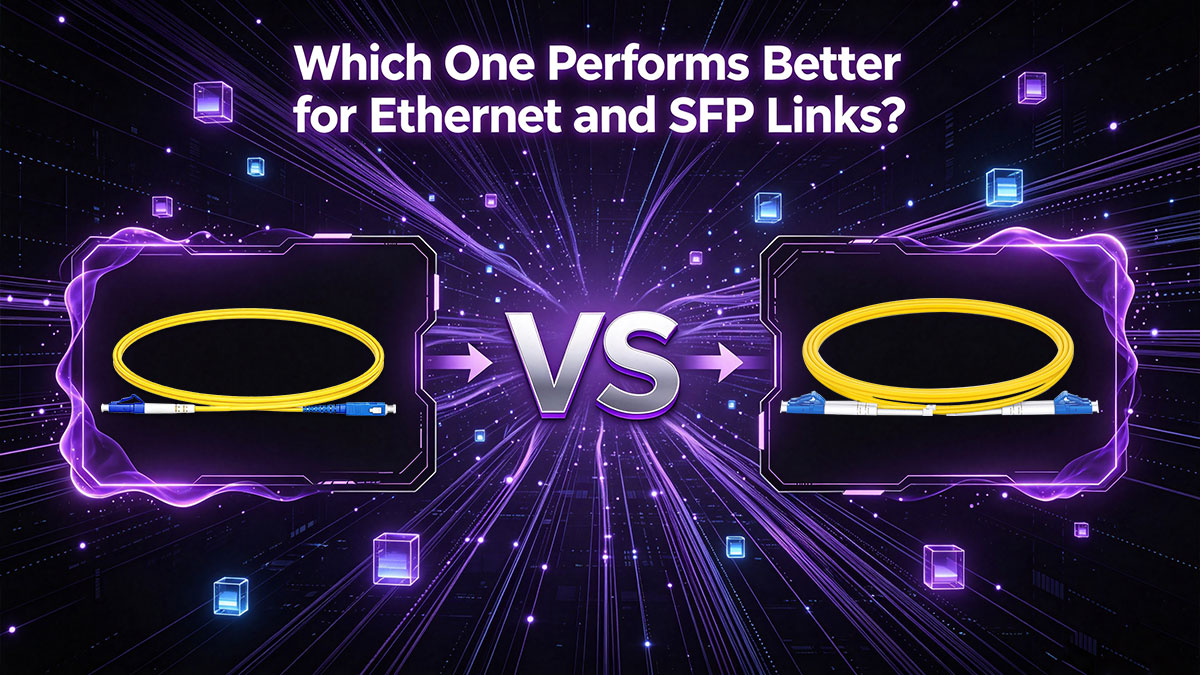
Practical comparison
| Factor |
Simplex Fiber |
Duplex Fiber |
| Link performance |
Can match the same nominal Ethernet speed when paired with BiDi optics |
Standard choice for common SFP/SFP+ links |
| Compatibility |
Requires wavelength-matched BiDi transceivers |
Broadest compatibility with standard optics and patching |
| Installation |
Fewer strands, but stricter module pairing |
Easier to deploy and troubleshoot |
| Default choice |
Specialized deployments |
Most Ethernet and data center links |
Why duplex remains the default
Duplex fiber aligns with the normal transmit/receive model used by most SFP modules: one strand carries transmit, the other carries receive. Cisco’s SFP guidance and transceiver datasheets show this as the standard approach, while single-fiber operation is presented as a specialized BiDi mode that depends on paired optics and complementary wavelengths. That makes duplex the safer default for enterprise LANs, campus networks, and data center links.
When simplex can be the better fit
Simplex can perform just as well at the same data rate when the application is built for it. Cisco documents 1G and 100G single-fiber BiDi transceivers that deliver full-duplex connectivity over one strand, but they must be used in matched pairs and may require additional link considerations such as FEC at higher speeds. That makes simplex a strong choice when fiber is scarce, but not the simplest option for general-purpose Ethernet.
Bottom line: Duplex is usually the better choice for Ethernet and SFP links overall because it is simpler, more universal, and easier to operate at scale. Simplex is the better choice when strand conservation matters more than plug-and-play compatibility. If the network already supports BiDi optics, simplex can deliver the same nominal throughput with fewer fibers; if not, duplex remains the more practical default.
🟩 When Does Simplex Fiber Make More Sense?
Simplex fiber makes more sense when fiber strands are scarce, adding new cable is costly, or the network is designed around BiDi optics. In those cases, a single fiber can carry full-duplex traffic with matched bidirectional transceivers, making simplex a practical capacity-expansion choice rather than a performance upgrade.
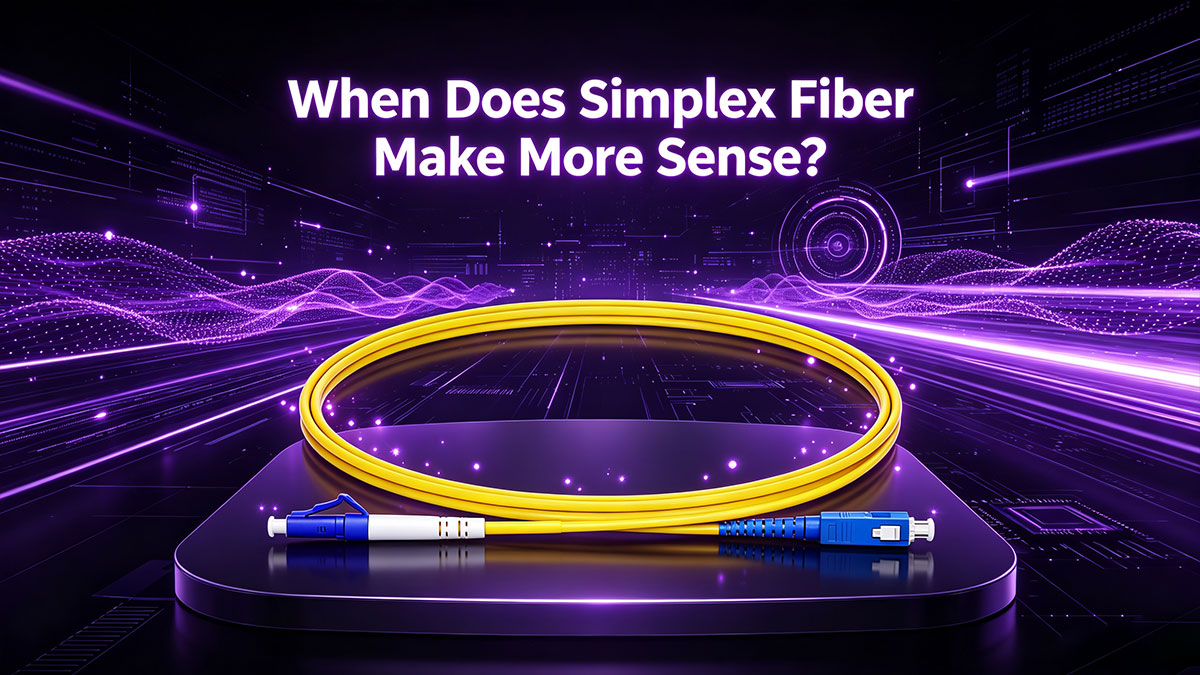
The main use cases
| Situation |
Why simplex fits |
| BiDi optics are already in use |
Single-fiber links are designed for BiDi transceivers, which send and receive over one strand using complementary wavelengths. |
| Fiber strands are scarce |
Simplex cuts strand use in half compared with duplex, which matters when conduits or spare fibers are limited. |
| Legacy plant needs reuse |
It can extend the life of existing infrastructure without pulling new cable. |
| Project cost is driven by installation |
When construction, labor, or downtime outweigh optic cost, simplex can lower total deployment cost. |
What to keep in mind
Simplex is not the default for most Ethernet links. Standard duplex optics remain more common because they are easier to deploy and manage, while simplex requires matched BiDi pairs and careful compatibility planning. That tradeoff is why experienced network teams usually choose simplex only when strand savings are more valuable than simplicity.
Key takeaway: Choose simplex fiber when the network is constrained by fiber availability or installation cost, not when you are looking for a generic replacement for duplex. For standard point-to-point Ethernet, duplex still remains the safer default; simplex becomes the better answer when BiDi optics and fiber conservation are the real design goals.
🟩 When Is Duplex Fiber the Better Choice?
Duplex fiber is the better choice for most standard Ethernet deployments because it uses the familiar two-strand Tx/Rx model, aligns with common transceiver designs, and is easier to manage at scale. In Cisco’s transceiver ordering guides, the mainstream 100G options for SMF and MMF are presented as duplex LC-based solutions, which reflects how broadly duplex still fits normal network designs.
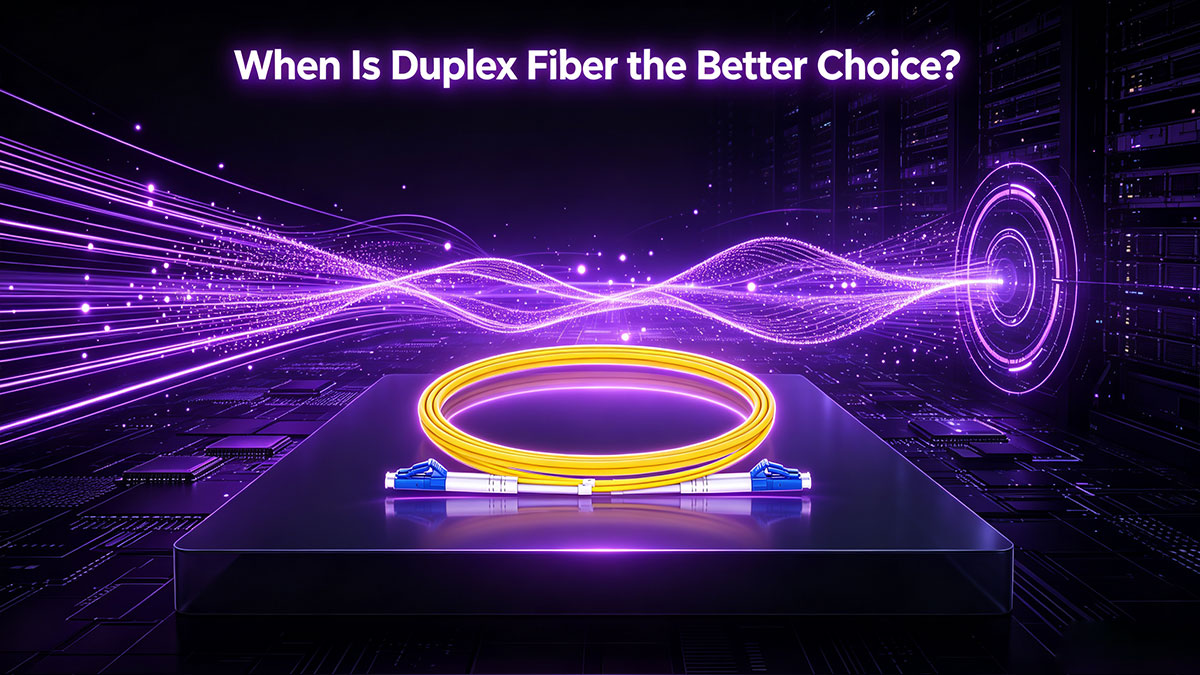
| Situation |
Why duplex is the better fit |
| Standard Ethernet deployments |
Matches the default transmit/receive structure used by common optics and patching workflows. |
| Operations and troubleshooting |
Easier to document, test, and maintain because each direction has its own strand. |
| Spare planning |
Simpler inventory planning because standard duplex patching and optics are widely used across many link types. |
| Future scalability |
Duplex LC connectivity is well suited to high-density panel designs and incremental growth. |
Standard deployments
Duplex is the default choice when you are building or upgrading an enterprise LAN, campus backbone, or data center link. Cisco’s documentation for transceiver selection and fiber troubleshooting repeatedly centers on conventional duplex cabling patterns, which is a strong signal that duplex remains the baseline architecture for mainstream Ethernet optics.
Easier operations
A duplex link is easier to operationalize because transmit and receive paths are physically separated. That simplifies patching, documentation, and polarity management in structured cabling environments, especially when multiple teams will support the network over time. Cisco’s cabling guidance highlights the importance of maintaining send/receive polarity in duplex fiber links, which is exactly why duplex is usually the simpler day-to-day option.
Spare planning and scalability
Duplex is also attractive when you want a cleaner spare strategy. Because the architecture is familiar and widely supported, it is easier to keep compatible patch cords, optics, and spare strands in inventory. For future growth, high-density LC duplex panels can support large fiber counts in a small footprint, which makes duplex a strong fit for networks expected to expand. Cisco’s 1RU panel example with 72 LC duplex connectors shows how well duplex scales in dense environments.
Key takeaway: Choose duplex fiber when you want the safest default: broad compatibility, simpler operations, easier spare management, and a cleaner path to future expansion. Simplex is a specialist choice for fiber-constrained designs, but duplex remains the more practical option for most standard Ethernet and SFP-based deployments.
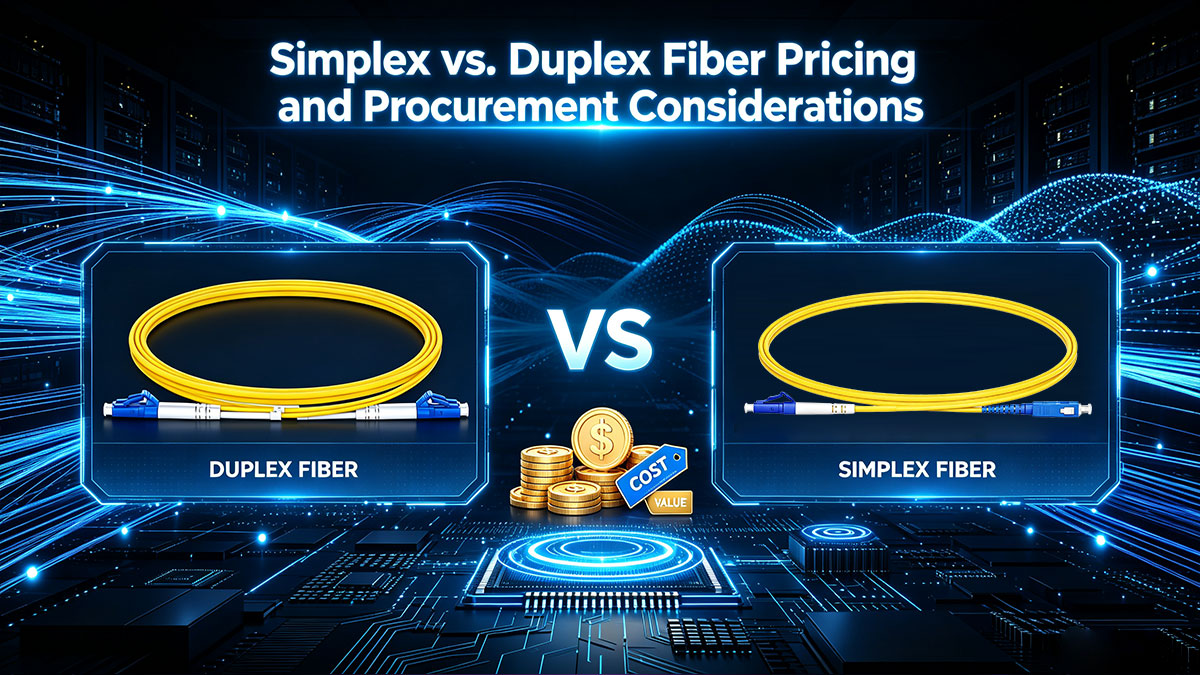
🟩 Simplex vs. Duplex Fiber Pricing and Procurement Considerations
The cheapest option depends on what drives your project cost. Simplex fiber typically reduces cable and infrastructure requirements, while duplex fiber usually offers lower optics costs, simpler inventory management, and easier long-term operations. As a result, procurement decisions should focus on total cost of ownership (TCO) rather than cable price alone.
Cost Comparison Overview
| Cost Factor |
Simplex Fiber |
Duplex Fiber |
| Cable Cost |
Lower (1 fiber) |
Slightly higher (2 fibers) |
| Optics Cost |
Higher (BiDi transceivers) |
Lower (standard optics) |
| Installation Cost |
Lower when fiber space is limited |
Higher if new fibers must be installed |
| Inventory Management |
More complex |
Simpler |
| Scalability |
Good for fiber-constrained environments |
Better for standard network growth |
| Overall TCO |
Better when fiber construction is expensive |
Better for most enterprise deployments |
Cable Cost
At the cable level, simplex fiber is generally less expensive because it contains only one optical strand. It also occupies less pathway and conduit space, which can be valuable in crowded cable trays or legacy infrastructure.
However, cable cost often represents only a small portion of the total project budget, especially in enterprise and campus deployments.
Optics Cost
The cost equation changes when transceivers are included.
- Simplex links require BiDi optics
- Duplex links use standard SFP, SFP+, SFP28, or QSFP modules
Standard duplex optics are typically more widely available and easier to source from multiple vendors. BiDi transceivers may carry a price premium due to their wavelength-specific design.
Labor and Deployment Costs
Installation costs can outweigh hardware costs, especially for outdoor or long-distance links.
Simplex often becomes attractive when:
- Conduits are full
- No spare fibers are available
- New cable installation requires trenching or permitting
- Service interruptions must be minimized
In these cases, upgrading to BiDi optics can be significantly cheaper than deploying new fiber infrastructure.
Inventory Simplicity
From an operations perspective, duplex is easier to manage.
Duplex inventory:
- Standard optics
- Standard patch cords
- Universal spare strategy
Simplex inventory:
- Matched BiDi transceiver pairs
- Wavelength-specific spare modules
- Additional compatibility tracking
For large enterprises and data centers, this operational simplicity often reduces ongoing support costs.
Total Cost of Ownership (TCO)
The best choice depends on the cost driver.
Choose simplex when:
- Fiber availability is the primary constraint
- New cable installation is expensive
- Existing infrastructure must be reused
Choose duplex when:
- Building a new network
- Standardization is important
- Long-term operational efficiency is a priority
Procurement Recommendation:
For most enterprise LANs, campus networks, and data centers, duplex fiber delivers the lowest long-term operational cost and the simplest procurement strategy. However, when fiber construction costs are high or spare strands are limited, simplex fiber combined with BiDi optics can provide a lower overall project cost despite the higher price of the transceivers.
Rule of thumb: If the cost of installing new fiber exceeds the cost premium of BiDi optics, simplex is often the more economical solution. If fiber is readily available, duplex remains the better long-term investment.
🟩 Simplex vs. Duplex Fiber FAQ
1. What is the difference between simplex and duplex fiber?
Simplex fiber uses one optical strand, while duplex fiber uses two. Simplex links typically use BiDi transceivers to send and receive data over the same fiber, whereas duplex links use separate fibers for Tx and Rx.
| Feature |
Simplex |
Duplex |
| Fiber Count |
1 |
2 |
| Transmission |
BiDi or one-way |
Separate Tx/Rx |
| Common Use |
FTTH, BiDi links |
Ethernet, data centers |
2. Is duplex the same as multimode?
No. Duplex describes the link architecture, while multimode describes the fiber type. A fiber link can be either simplex or duplex regardless of whether it is singlemode or multimode.
3. How do I tell if fiber is OM1 or OM2?
Check the cable markings or datasheet.
- OM1: 62.5/125 μm core
- OM2: 50/125 μm core
Because both are often orange, jacket color alone is not a reliable identifier.
4. What are the 3 C's of fiber?
The commonly used 3 C's are:
- Clean – Inspect and clean connectors.
- Connect – Ensure proper mating and polarity.
- Check – Verify link performance through testing.
5. Can simplex fiber provide the same speed as duplex fiber?
Yes. Speed depends on the transceiver and network standard, not the number of fibers. A properly matched BiDi link can deliver the same Ethernet data rate as a duplex link.
6. Should I choose simplex or duplex fiber?
- Choose simplex when fiber strands are limited or BiDi optics are required.
- Choose duplex for standard Ethernet networks, easier management, and maximum compatibility.
For most enterprise and data center deployments, duplex remains the default choice.
🟩 How to Choose the Right Fiber Type for Your Network
The best choice depends on your available fiber infrastructure, transceiver requirements, budget, and future expansion plans. Simplex fiber is ideal when conserving fiber strands is a priority, while duplex fiber remains the preferred option for most Ethernet networks due to its simplicity, compatibility, and scalability.
Quick Decision Matrix
| Consideration |
Choose Simplex Fiber |
Choose Duplex Fiber |
| Available Fiber Strands |
Limited or fully utilized |
Plenty of spare fibers |
| Transceiver Type |
BiDi SFP/SFP+/SFP28 |
Standard SFP/SFP+/QSFP modules |
| Deployment Cost |
New fiber installation is expensive |
Fiber infrastructure already exists |
| Network Complexity |
Small to medium deployments |
Enterprise and data center environments |
| Future Expansion |
Fiber conservation is critical |
Scalability and standardization are priorities |
| Operations & Maintenance |
Requires BiDi management |
Easier troubleshooting and inventory control |
1. Consider Link Distance
Distance should always be evaluated together with the transceiver specification.
- Short-range multimode links inside buildings typically use duplex fiber with SR optics.
- Long-distance singlemode links can use either duplex LR/ER optics or simplex BiDi modules.
- Metropolitan and campus networks often benefit from simplex links when spare fibers are limited.
The fiber architecture itself does not determine distance; the optical module and link budget do.
2. Verify Transceiver Compatibility
Before selecting a cable type, confirm the optics supported by your switches, routers, and network equipment.
- Standard Ethernet optics generally require duplex fiber.
- BiDi transceivers are designed specifically for simplex fiber operation.
- Some platforms support both options, providing deployment flexibility.
If you are sourcing compatible SFP, SFP+, SFP28, QSFP28, or BiDi optical transceivers, the LINK-PP Official Store offers a wide range of enterprise and telecom-grade optical modules for data centers, campus networks, FTTH, and industrial applications.
3. Evaluate Infrastructure Constraints
Infrastructure often has a greater impact on procurement decisions than hardware cost.
Choose simplex when:
- No spare fiber strands are available
- Conduits are at capacity
- Pulling new fiber would require construction work
Choose duplex when:
- New cabling is being installed
- Fiber resources are abundant
- Standardization is a key objective
4. Compare Total Project Costs
Do not focus solely on cable pricing.
A successful evaluation should include:
- Fiber cable costs
- Optical transceiver costs
- Installation labor
- Maintenance requirements
- Future upgrade expenses
In many cases, a higher-priced BiDi transceiver can be less expensive than installing additional fiber infrastructure.
5. Plan for Future Growth
If your network is expected to scale significantly over the next five to ten years, duplex fiber often provides the most straightforward upgrade path.
However, if fiber availability is already a limiting factor, simplex architecture can preserve valuable strand capacity for future services without requiring immediate infrastructure expansion.
Final Recommendation
Choose simplex fiber when fiber availability is limited and maximizing existing infrastructure is the primary goal.
Choose duplex fiber when you want the broadest compatibility, simpler operations, and the most scalable architecture for Ethernet networking.
For most enterprise LANs, campus networks, and data centers, duplex remains the default recommendation. For fiber-constrained FTTH, metro, and legacy infrastructure environments, simplex fiber paired with BiDi optics can deliver substantial cost and capacity advantages.