


























Gigabit fiber connectivity remains widely used in enterprise and campus networks where stable short-distance transmission is required. The H3C SFP GE SX MM850 A is a common Gigabit Ethernet SFP module designed for multimode fiber links operating at 850nm. It enables reliable 1Gbps optical connections between switches, servers, and other networking devices, making it suitable for switch-to-switch interconnects, access layer deployments, and data center rack connectivity.
In many operational environments, network administrators may need to evaluate compatible replacement options for this module. Reasons can include network expansion, hardware lifecycle changes, or the need to standardize optical components across multi-vendor infrastructures. In these cases, selecting a module that matches the 1000BASE-SX specification, multimode fiber compatibility, and switch interoperability requirements is essential for maintaining stable network performance.
This guide explains the specifications, typical applications, and deployment considerations of H3C SFP GE SX MM850 A modules. It also explores how compatible optical transceivers can provide equivalent functionality while supporting interoperability with H3C networking platforms and other industry-standard Gigabit Ethernet environments.
? Overview of H3C SFP GE SX MM850 A
The H3C SFP GE SX MM850 A is a Gigabit Ethernet SFP optical module designed for short-range fiber connections using multimode fiber. It operates at 850nm and supports the 1000BASE-SX standard, enabling up to 1Gbps transmission for distances typically reaching 550m depending on the fiber type. These characteristics make it suitable for enterprise campus networks, switch uplinks, and short-distance data center interconnection.

What Is the H3C SFP GE SX MM850 A
The H3C SFP GE SX MM850 A is a small form-factor pluggable (SFP) optical transceiver used to provide Gigabit Ethernet fiber connectivity. Installed in SFP ports on switches or routers, it converts electrical signals from network equipment into optical signals transmitted through multimode fiber.
This type of module is widely used in enterprise network infrastructure where copper Ethernet links are insufficient for distance or electromagnetic interference concerns. Because it follows the 1000BASE-SX optical standard, it is designed specifically for short-distance fiber links using multimode fiber cabling.
Another important feature is hot-swappable operation. Network administrators can insert or remove the module without powering down the switch, which simplifies network maintenance and hardware replacement.
Key Technical Specifications
The H3C SFP GE SX MM850 A follows standard Gigabit Ethernet optical parameters used in 1000BASE-SX deployments.
| Parameter | Specification |
|---|---|
| Data Rate | 1Gbps |
| Optical Standard | 1000BASE-SX |
| Wavelength | 850nm |
| Connector Type | Duplex LC |
| Maximum Distance | Up to 550m (MMF) |
These parameters determine how the module interacts with the fiber infrastructure. Multimode fiber types such as OM2, OM3, and OM4 can be used, with higher-grade fiber typically supporting longer transmission distances and better signal stability.
Because the module complies with industry standards, it can integrate into many Gigabit Ethernet fiber environments that support SX optical interfaces.
Typical Network Equipment Compatibility
The H3C SFP GE SX MM850 A is commonly used in networking equipment that provides SFP ports for Gigabit Ethernet fiber connectivity.
Typical device categories include:
-
Enterprise access switches connecting end-user network segments
-
Aggregation switches linking multiple access switches
-
Data center switches used for short-distance server connectivity
-
Routers with SFP uplink interfaces
These modules are often deployed in internal fiber links where stable short-range connectivity is required. Their compatibility with standard multimode fiber infrastructure allows organizations to expand or reorganize network connections without changing existing cabling systems.
? Common Use Cases for H3C SFP GE SX MM850 A
The H3C SFP GE SX MM850 A is primarily used in short-distance fiber connections within enterprise and data center environments. Because it supports 1Gbps transmission over multimode fiber at 850nm wavelength, the module is well suited for switch interconnections, access layer uplinks, and internal backbone links where distances typically remain under 550m.
These characteristics make the module a practical option for network segments that require stable optical connectivity but do not need long-range single-mode transmission.

Enterprise Campus Networks
In campus environments, Gigabit multimode optical modules are commonly deployed to connect access switches with aggregation or distribution switches across buildings or equipment rooms.
Typical campus network scenarios include:
-
Uplink connections from access switches to aggregation switches
-
Inter-building fiber connections within the same campus
-
Network backbone links between wiring closets
Multimode fiber infrastructure is widely installed in enterprise buildings, which allows SX modules to support reliable fiber connectivity without requiring new cabling deployments.
Data Center Interconnections
Inside data centers, the H3C SFP GE SX MM850 A is often used for short-range optical connections between networking equipment and server infrastructure.
Common data center uses include:
-
Switch-to-switch connections inside racks or rows
-
Server access connections using fiber network interface cards
-
Storage network links within the same data hall
The relatively short transmission distances inside data centers make 1000BASE-SX transceiver a practical solution for maintaining stable Gigabit connectivity across racks and network segments.
Industrial and Infrastructure Networks
Industrial environments and infrastructure facilities may also deploy multimode Gigabit optical module to support reliable network communication in electrically noisy environments.
Typical deployments include:
-
Manufacturing automation networks
-
Security monitoring systems
-
Building management systems
-
Campus surveillance infrastructure
Fiber connections provide advantages in these environments because they are immune to electromagnetic interference and can support stable data transmission across equipment areas.
Short-Distance Fiber Deployment Scenarios
In practice, the module is most suitable for network segments where the required distance falls within the capabilities of multimode fiber. The typical reach depends on the fiber type used in the installation.
| Fiber Type | Typical Distance | Common Environment |
|---|---|---|
| OM2 | Up to 550m | Campus buildings |
| OM3 | Up to 550m+ | Data centers |
| OM4 | Up to 550m+ | High-density infrastructure |
Higher-grade multimode fiber generally provides improved bandwidth performance and signal quality, particularly in environments with high port density or dense cabling infrastructure.
Selecting the appropriate fiber type ensures that the optical link maintains stable signal transmission and minimizes potential packet loss or link instability.
? Why Organizations Look for Compatible Replacements
In many network environments, administrators consider compatible alternatives to the H3C SFP GE SX MM850 A when expanding or maintaining fiber infrastructure. A compatible module that follows the same 1000BASE-SX optical specifications can provide equivalent functionality while supporting interoperability with existing switches and multimode fiber cabling.
Several operational and technical factors commonly lead organizations to evaluate replacement modules.
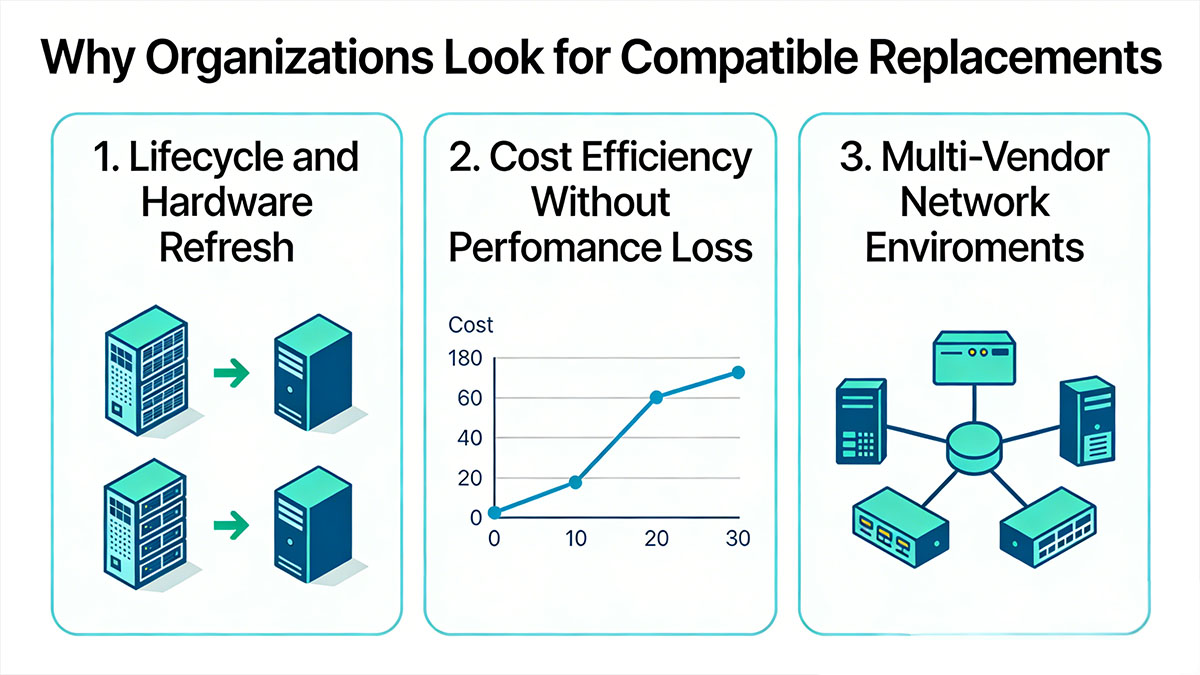
Hardware Lifecycle and Availability
Networking hardware components often follow product lifecycle stages such as active support, limited availability, and eventual discontinuation. When a specific optical module model becomes harder to source, organizations may look for compatible replacements that maintain the same technical parameters.
Typical lifecycle-related situations include:
-
Replacement of failed or aging transceivers
-
Network expansion requiring additional optical modules
-
Device upgrades that continue to use Gigabit fiber interfaces
As long as the replacement module follows the same optical standards and interface specifications, it can function in the same network role as the original module.
Cost Efficiency in Large Deployments
Large campus networks and data center may deploy dozens or even hundreds of optical transceivers. In these environments, the cost difference between original modules and compatible alternatives can significantly affect infrastructure budgets.
Compatible modules are often considered when organizations aim to:
-
Expand fiber connectivity across multiple switches
-
Maintain spare modules for operational continuity
-
Standardize transceiver types across network segments
A compatible module designed for the same wavelength, data rate, and fiber type can provide equivalent network performance for these deployments.
Multi-Vendor Network Environments
Modern enterprise networks frequently integrate equipment from multiple networking vendors. While switches may come from different manufacturers, optical interfaces are often based on standardized protocols.
Because the H3C SFP GE SX MM850 A operates under the 1000BASE-SX specification defined by the Institute of Electrical and Electronics Engineers in the IEEE 802.3z, modules that comply with these standards can operate in many Gigabit Ethernet fiber environments.
In multi-vendor networks, compatible optics can help organizations:
-
Maintain interoperability across different switch platforms
-
Simplify transceiver inventory management
-
Deploy standardized Gigabit fiber connectivity
By selecting modules that follow industry optical specifications and SFP interface standards, network operators can maintain reliable fiber links while keeping infrastructure flexible and scalable.
? LINK-PP Compatible Replacement for H3C SFP GE SX MM850 A
Organizations that need to maintain or expand Gigabit fiber networks often consider compatible optical modules that follow the same specifications as the H3C SFP GE SX MM850 A. A compatible module designed for the same wavelength, data rate, and fiber type can operate in the same network role while supporting interoperability with existing switches and multimode fiber infrastructure.
One example of such a solution is provided by LINK-PP, which develops optical transceivers for enterprise networks, data centers, and telecommunications environments.
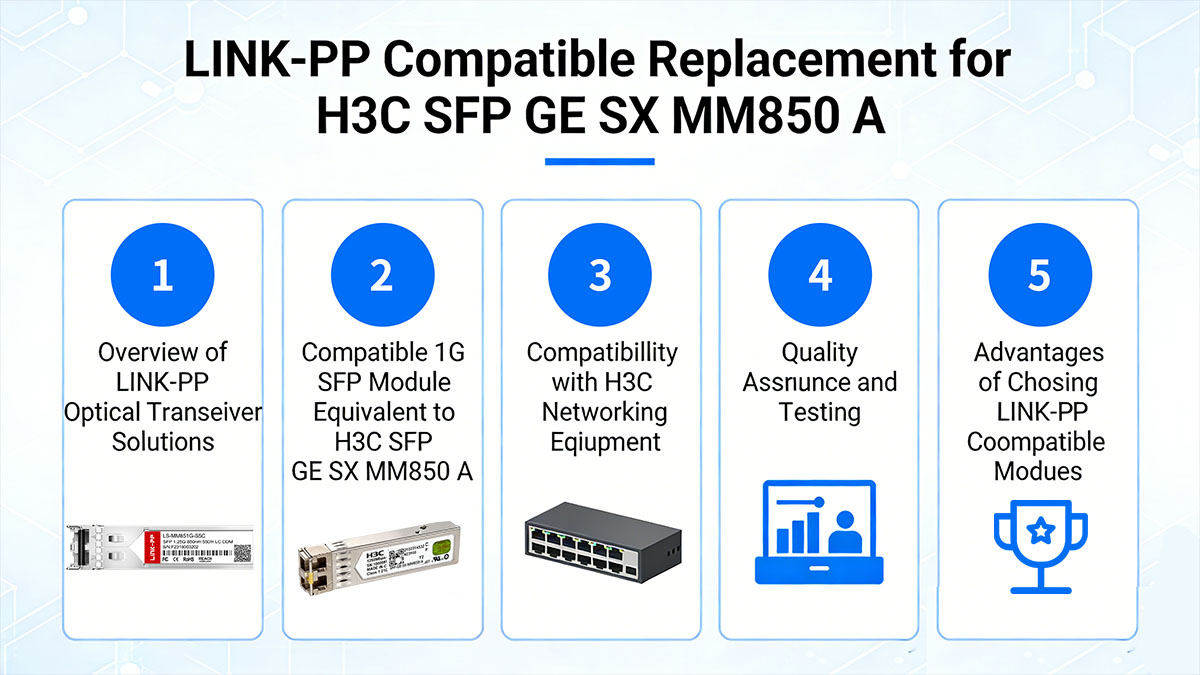
Overview of LINK-PP Optical Transceiver Solutions
LINK-PP is a global manufacturer specializing in network connectivity components like optical transceivers. The company provides solutions for enterprise networking, telecom systems, and data center infrastructure.
Its optical transceiver portfolio covers a wide range of speeds and form factors:
-
SFP modules for 1G applications
-
SFP+ modules for 10G Ethernet
-
SFP28 module for 25G networking
-
QSFP and QSFP28 transceiver for 40G and 100G deployments
-
QSFP-DD and OSFP modules for 200G–800G networks
These modules are designed for both multimode and single-mode fiber environments and support various network protocols including Ethernet, Fibre Channel, and SONET SDH.
Equivalent 1G SFP Module Specifications
A compatible LINK-PP SFP module designed to replace H3C SFP GE SX MM850 A typically follows the same core technical parameters used in 1000BASE-SX deployments.
| Parameter | H3C SFP GE SX MM850 A | LINK-PP Compatible Module |
|---|---|---|
| Data Rate | 1Gbps | 1Gbps |
| Optical Standard | 1000BASE-SX | 1000BASE-SX |
| Wavelength | 850nm | 850nm |
| Connector | Duplex LC | Duplex LC |
| Fiber Type | Multimode Fiber | Multimode Fiber |
Because these specifications align with standard Gigabit Ethernet SX optics, the module can operate within the same multimode fiber infrastructure used in enterprise or campus networks.
Matching these parameters ensures that both ends of a fiber link use the same transmission standard and wavelength, which is required for stable optical communication.
Compatibility with H3C Switch Platforms
Compatible modules must follow industry interface standards to operate correctly in networking equipment. Many third-party optical transceivers are designed according to the SFP Multi-Source Agreement (MSA) and IEEE Ethernet standards, which define electrical interfaces, form factors, and optical characteristics.
Modules developed under these specifications can support interoperability with many networking platforms when properly coded. LINK-PP optical transceivers are designed for compatibility with a variety of OEM systems used in enterprise networking environments.
Typical deployment environments include:
-
Enterprise access switches with SFP uplink ports
-
Aggregation switches connecting multiple network segments
-
Data center switches used for short-distance fiber links
-
Router uplinks requiring Gigabit optical connectivity
Quality Assurance and Manufacturing Standards
Reliable optical modules require consistent manufacturing and testing processes to ensure stable performance across different network environments.
LINK-PP transceivers undergo several validation procedures before shipment:
-
Optical signal testing for transmit and receive performance
-
Electrical interface verification for SFP compliance
-
Temperature and environmental testing
-
Interoperability validation with multiple networking platforms
The modules are engineered to comply with industry standards such as IEEE Ethernet specifications and SFP MSA guidelines, which help maintain interoperability across networking equipment vendors.
Advantages of Using Compatible Optical Modules
Compatible SFP modules are often used in enterprise networks because they can provide the same operational capabilities as original modules when specifications match.
Common operational advantages include:
-
Maintaining consistent 1Gbps fiber connectivity across network devices
-
Supporting multimode fiber infrastructure already installed in buildings
-
Enabling scalable deployment of optical interfaces across large networks
-
Simplifying inventory management when multiple switches use SFP interfaces
When the replacement module follows the same optical parameters as the original transceiver, it can typically operate in the same network role while maintaining stable Gigabit Ethernet connectivity.
? Key Features of a Compatible Replacement for H3C SFP GE SX MM850 A
A compatible module intended to replace the H3C SFP GE SX MM850 A must replicate the essential optical and interface characteristics used by the original module. Matching transmission wavelength, data rate, and interface standards ensures that the replacement module can operate within the same multimode fiber infrastructure and function reliably in H3C switch environments.
Several technical features determine whether a compatible module can provide equivalent functionality.
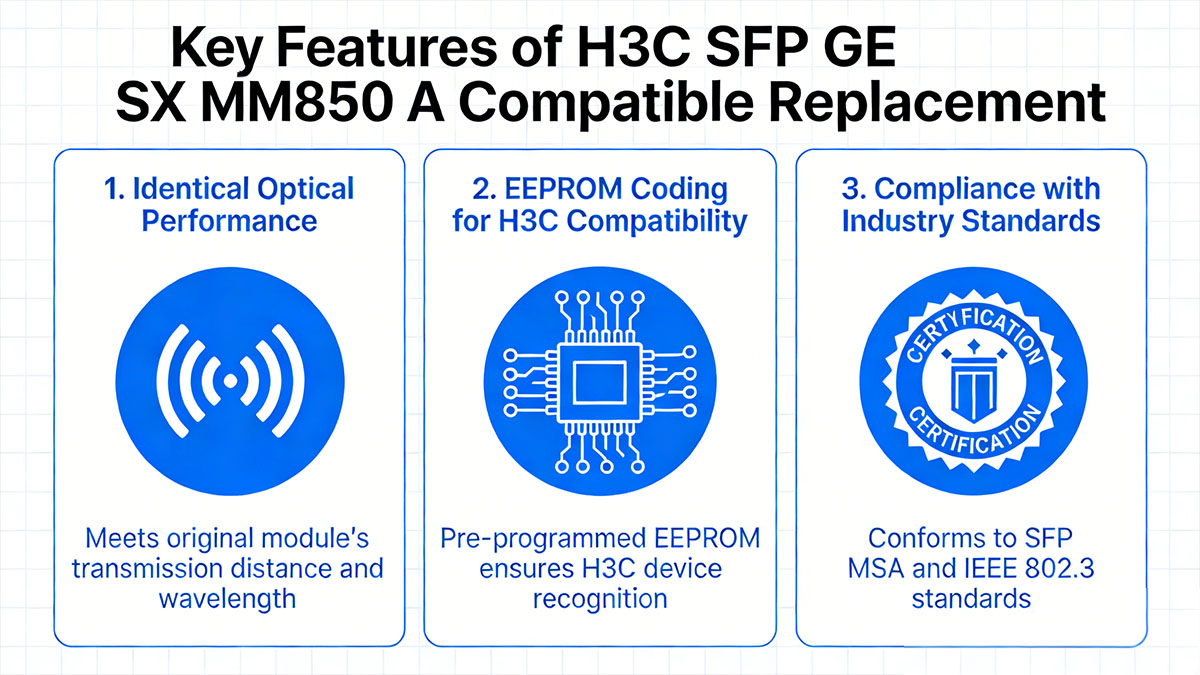
Identical Optical Performance
A replacement module must deliver the same optical transmission characteristics as the original 1000BASE-SX transceiver. Matching the wavelength and data rate ensures that the optical signals transmitted across the fiber link can be correctly received and interpreted by the connected networking device.
The following parameters typically need to remain consistent.
| Parameter | H3C SX Module | Compatible Module |
|---|---|---|
| Optical Standard | 1000BASE-SX | 1000BASE-SX |
| Wavelength | 850nm | 850nm |
| Data Rate | 1Gbps | 1Gbps |
| Maximum Distance | Up to 550m (MMF) | Up to 550m (MMF) |
Because both modules operate at 850nm and support the same Gigabit Ethernet SX signaling format, they can use the same multimode fiber infrastructure, including OM2, OM3, or OM4 cabling. Maintaining identical optical characteristics helps ensure stable link establishment and consistent network performance.
EEPROM Coding for H3C Compatibility
In addition to optical parameters, compatibility also depends on how the module identifies itself to the host device. SFP transceivers contain a small EEPROM memory chip that stores vendor identification information, module specifications, and diagnostic data.
Networking switches read this information when a module is inserted. Vendor-specific EEPROM coding allows a module to be recognized by the switch firmware and treated as a supported transceiver.
Key aspects of EEPROM-based compatibility include:
-
Vendor identification fields programmed for H3C recognition
-
Proper formatting of module capability information
-
Accurate reporting of optical parameters and diagnostics
When this coding is correctly implemented, the switch can identify the module and enable the optical interface without compatibility warnings. This mechanism helps maintain seamless interoperability between the module and the networking platform.
Compliance with Industry Standards
Reliable interoperability also depends on adherence to widely adopted optical interface standards. Compatible SFP modules are typically designed according to the Gigabit Ethernet specification defined by the IEEE 802.3z and the mechanical and electrical interface defined by the SFP Multi-Source Agreement.
These standards define essential parameters such as:
-
Optical signaling requirements for 1000BASE-SX transmission
-
Electrical interface behavior between the module and host device
-
Mechanical form factor of the SFP transceiver
-
Communication interface used for module monitoring and identification
Modules designed according to these specifications can operate within standard Gigabit Ethernet environments, allowing network operators to deploy compatible optics while maintaining interoperability across different networking devices.
? Technical Comparison: Original vs Compatible Modules
When evaluating a replacement for the H3C SFP GE SX MM850 A, the most important consideration is whether the compatible module delivers equivalent technical characteristics. If key parameters such as wavelength, data rate, and interface standards match the original module, the replacement can typically operate in the same network environment without affecting link performance.
A comparison of optical performance, transmission capability, and environmental reliability helps illustrate how original and compatible modules function in practical deployments.
Performance and Transmission Distance
For Gigabit multimode SFP, transmission performance primarily depends on the optical standard and fiber type used. Modules designed for the 1000BASE-SX specification operate at the same wavelength and data rate, allowing them to support similar link distances.
| Parameter | Original H3C Module | Compatible Module |
|---|---|---|
| Optical Standard | 1000BASE-SX | 1000BASE-SX |
| Data Rate | 1Gbps | 1Gbps |
| Wavelength | 850nm | 850nm |
| Maximum Distance | Up to 550m (MMF) | Up to 550m (MMF) |
Because both modules follow the same optical transmission standard, they can function across the same multimode fiber infrastructure. The actual transmission distance depends on the fiber type installed in the network, such as OM2, OM3, or OM4 cabling.
Maintaining identical optical signaling ensures that both ends of the fiber link can establish a stable Gigabit Ethernet connection.
Optical Power and Sensitivity
Optical performance is also influenced by transmitter power and receiver sensitivity. These parameters determine how effectively the module can transmit signals and detect incoming optical data across the fiber link.
Typical characteristics include:
-
Transmit optical power suitable for short-range multimode fiber
-
Receiver sensitivity capable of detecting low-level optical signals
-
Stable signal integrity across the supported transmission distance
Modules designed according to the IEEE 802.3z specification generally operate within defined optical power ranges. When compatible modules follow these parameters, they can maintain the same link reliability expected from the original module.
Thermal and Environmental Performance
Networking hardware is often deployed in environments with varying temperatures and operating conditions. Optical modules therefore need to maintain consistent performance across defined temperature ranges.
Typical environmental characteristics include:
-
Standard operating temperature ranges suitable for enterprise equipment rooms
-
Thermal stability that prevents signal degradation under load
-
Compliance with industry reliability and manufacturing standards
Most enterprise optical transceivers are designed to operate within standard commercial temperature ranges used in network equipment. When a compatible module follows similar design and testing standards, it can operate reliably in the same infrastructure as the original module.
Overall, when key technical specifications align—including optical standard, wavelength, interface design, and environmental tolerance—compatible SFP modules can perform the same networking role as the original H3C module in Gigabit multimode fiber deployments.
? Deployment Considerations for Compatible Modules
When deploying a compatible replacement for the H3C SFP GE SX MM850 A, proper network planning helps ensure stable optical links and long-term reliability. Even when the module specifications match the original device, factors such as fiber infrastructure, switch firmware, and installation practices can influence overall link performance.
Understanding these deployment considerations helps network administrators maintain consistent Gigabit fiber connectivity across enterprise environments.
Fiber Type and Cable Quality
The performance of a 1000BASE-SX optical link is closely related to the type and quality of multimode fiber used in the network. Different multimode fiber categories support varying bandwidth capabilities and transmission stability.
| Fiber Type | Typical Distance | Common Deployment |
|---|---|---|
| OM2 | Up to 550m | Legacy campus cabling |
| OM3 | Up to 550m+ | Modern enterprise networks |
| OM4 | Up to 550m+ | High-density data centers |
Higher-grade multimode fiber generally offers improved bandwidth and reduced signal dispersion. In practical deployments, OM3 and OM4 fiber are often preferred for new installations because they provide better performance margins for Gigabit and higher-speed Ethernet connections.
Maintaining clean connectors and minimizing excessive patch panel connections can also help reduce signal loss along the optical path.
Switch Firmware Compatibility
Networking switches rely on firmware to identify and manage installed SFP modules. When a module is inserted, the switch reads information stored in the module's EEPROM memory to determine its specifications and vendor identification.
Several firmware-related factors may affect compatibility:
-
Firmware policies that verify module vendor identification
-
Interface recognition of SFP transceivers
-
Monitoring of optical diagnostics and link status
Keeping switch firmware updated can help maintain stable operation and ensure proper recognition of installed optical modules. In many cases, firmware updates improve compatibility with a broader range of SFP transceivers.
Proper Installation and Handling
Optical modules are sensitive electronic components, so correct handling during installation helps prevent damage and signal degradation.
Recommended installation practices include:
-
Using anti-static protection when handling modules
-
Cleaning LC connectors before inserting fiber cables
-
Avoiding excessive bending of fiber patch cords
-
Ensuring the module is fully seated in the SFP port
After installation, administrators typically verify link status through the switch interface to confirm that the optical connection has been successfully established.
Following these deployment guidelines helps ensure that compatible SFP modules operate reliably within existing fiber network infrastructure.
? Advantages of Using Compatible H3C Optical Modules
Compatible optical modules designed for H3C networking environments can provide the same functional role as the H3C SFP GE SX MM850 A when they follow the same technical specifications and interface standards. In many enterprise networks, these modules are used to maintain or expand fiber connectivity while ensuring interoperability with existing switches and multimode fiber infrastructure.
Several operational advantages make compatible modules a practical option in large-scale network deployments.
Network Scalability
One important advantage is the ability to scale fiber connectivity across growing network infrastructures. As organizations expand campus networks, data centers, or branch connectivity, additional optical interfaces are often required.
Compatible SFP modules help support this expansion by enabling:
-
Deployment of additional Gigabit fiber links between switches
-
Expansion of access and aggregation network layers
-
Flexible optical uplinks across multiple network segments
Because these modules follow the same 1000BASE-SX transmission standard, they can integrate into existing multimode fiber networks without requiring changes to cabling infrastructure.
Operational Flexibility
Enterprise networks often evolve over time as new devices are introduced and older equipment remains in service. Compatible optical modules can support this mixed environment by working with different generations of networking hardware.
Operational flexibility may include:
-
Interconnecting switches from different deployment periods
-
Supporting upgrades while maintaining existing fiber infrastructure
-
Simplifying network planning when multiple device models are used
By relying on standardized optical interfaces defined by the IEEE 802.3z, compatible modules can operate across many Gigabit Ethernet environments.
Availability and Supply Stability
Optical transceivers are critical components in network infrastructure, and maintaining availability of replacement modules is important for operational continuity.
Compatible modules can help organizations maintain consistent supply by providing:
-
Additional sourcing options for Gigabit SFP optics
-
Availability for network expansion or maintenance needs
-
Replacement modules for aging or discontinued hardware
When the replacement module matches the required optical parameters—such as 850nm wavelength, 1Gbps data rate, and multimode fiber support—it can typically perform the same networking role as the original module while maintaining reliable fiber connectivity.
? FAQs About H3C SFP GE SX MM850 A
What fiber type is required for H3C SFP GE SX MM850 A?
The H3C SFP GE SX MM850 A is designed for multimode fiber (MMF), commonly using OM2, OM3, or OM4 fiber cables with LC connectors.
Can H3C SFP GE SX MM850 A work with standard 1000BASE-SX ports?
Yes. Since the module follows the IEEE 802.3z 1000BASE-SX standard, it can operate in networking devices that support SX Gigabit Ethernet SFP interfaces.
What is the maximum transmission distance of this module?
The typical maximum distance is up to 550m over multimode fiber, although the actual reach depends on the fiber grade and installation quality.
How can you verify whether an SFP module is compatible with an H3C switch?
Compatibility can usually be verified by checking the module specifications, ensuring proper EEPROM coding, and confirming that the module supports the required 1000BASE-SX optical standard.
Do compatible modules support hot-swappable installation?
Yes. Most SFP transceivers designed according to the SFP Multi-Source Agreement support hot-swapping, allowing installation or replacement without powering down the network device.
? Conclusion
The H3C SFP GE SX MM850 A plays an important role in many enterprise and campus networks that rely on short-distance multimode fiber connections. With support for the 1000BASE-SX standard, 850nm wavelength, and up to 1Gbps transmission, it enables reliable switch interconnections and internal backbone links across a wide range of network environments.
For organizations maintaining or expanding existing Gigabit fiber infrastructure, compatible modules that match these technical specifications can provide the same operational functionality. When a replacement module supports the same optical parameters, industry standards, and interface design, it can integrate into the same multimode fiber networks while maintaining stable connectivity and interoperability with H3C switching platforms.
Solutions from LINK-PP offer compatible optical modules designed to align with these requirements, helping organizations deploy scalable and reliable fiber connections in enterprise networks and data center environments. To explore detailed specifications and available compatible transceivers, you can visit the LINK-PP Official Store for more information about supported optical module solutions.