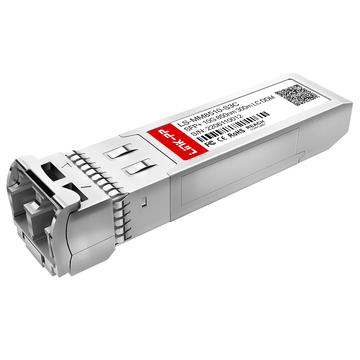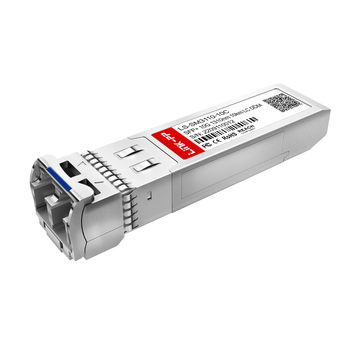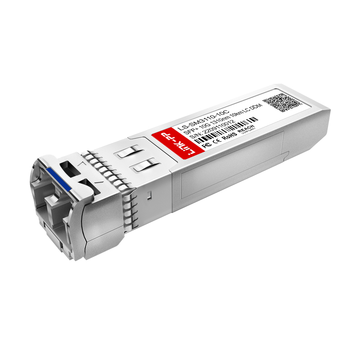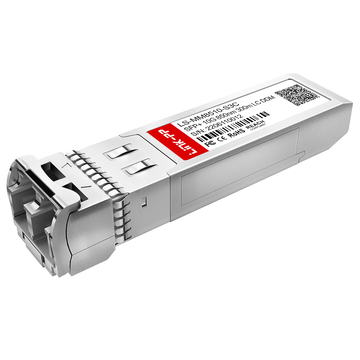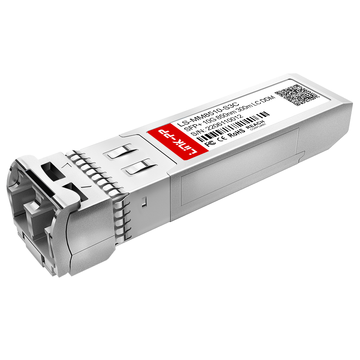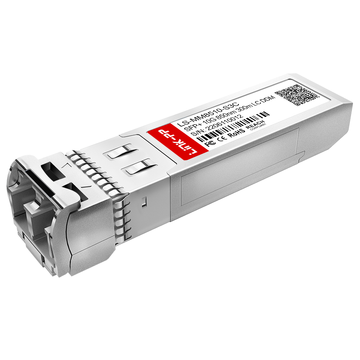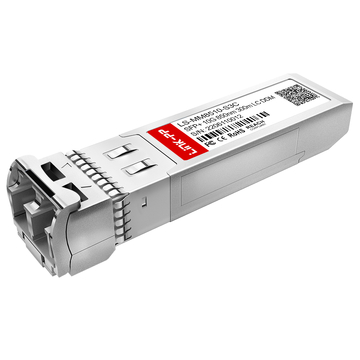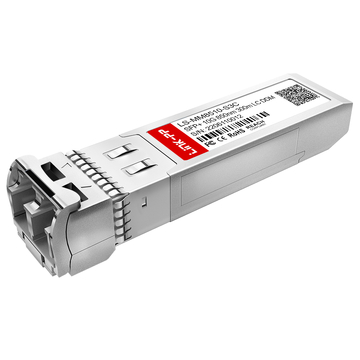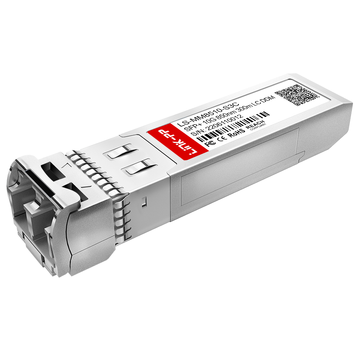
Modern enterprise networks increasingly rely on 10GbE connectivity to support growing data traffic, virtualization platforms, and high-speed application delivery. In many campus and data center environments, short-distance fiber links are commonly built using the Aruba 10G SFP+ LC SR 300m MMF Transceiver, a module designed for reliable 10Gbps transmission over multimode fiber. With its compact SFP+ form factor, 850nm wavelength, and support for distances up to 300m on OM3 fiber, this optical transceiver has become a widely deployed solution for switch uplinks, aggregation links, and high-bandwidth server connections.
As networks scale and infrastructure expands, organizations often evaluate compatible optical modules that deliver the same technical specifications and interoperability with Aruba switching platforms. A well-designed replacement can maintain stable 10Gbps performance while providing greater flexibility for network expansion, maintenance, and hardware lifecycle management. Understanding the module’s specifications, compatibility considerations, and deployment requirements is therefore essential before selecting an alternative.
This guide explains the key characteristics of the Aruba 10G SFP+ LC SR 300m MMF Transceiver, including its technical specifications, typical deployment scenarios, and important factors to consider when choosing a compatible replacement. It also outlines best practices for installation and highlights how compatible solutions can support reliable short-range 10GbE connectivity in modern enterprise networks.
⏩ Overview of Aruba 10G SFP+ LC SR 300m MMF Transceiver
The Aruba 10G SFP+ LC SR 300m MMF Transceiver is designed to deliver high-speed 10GbE connectivity over multimode fiber in short-range networking environments. It follows the IEEE 10GBASE-SR optical standard and uses an 850nm VCSEL laser to transmit data efficiently across OM3 or OM4 multimode fiber. Because of its compact SFP+ form factor and hot-swappable design, the module can be easily deployed in Aruba switches for high-density network ports without interrupting existing operations.
This type of optical transceiver is commonly used for switch uplinks, aggregation links, and server connectivity in enterprise campus networks and data centers. Its short-reach design makes it particularly suitable for rack-to-rack or floor-to-floor fiber connections where transmission distances typically remain within a few hundred meters.
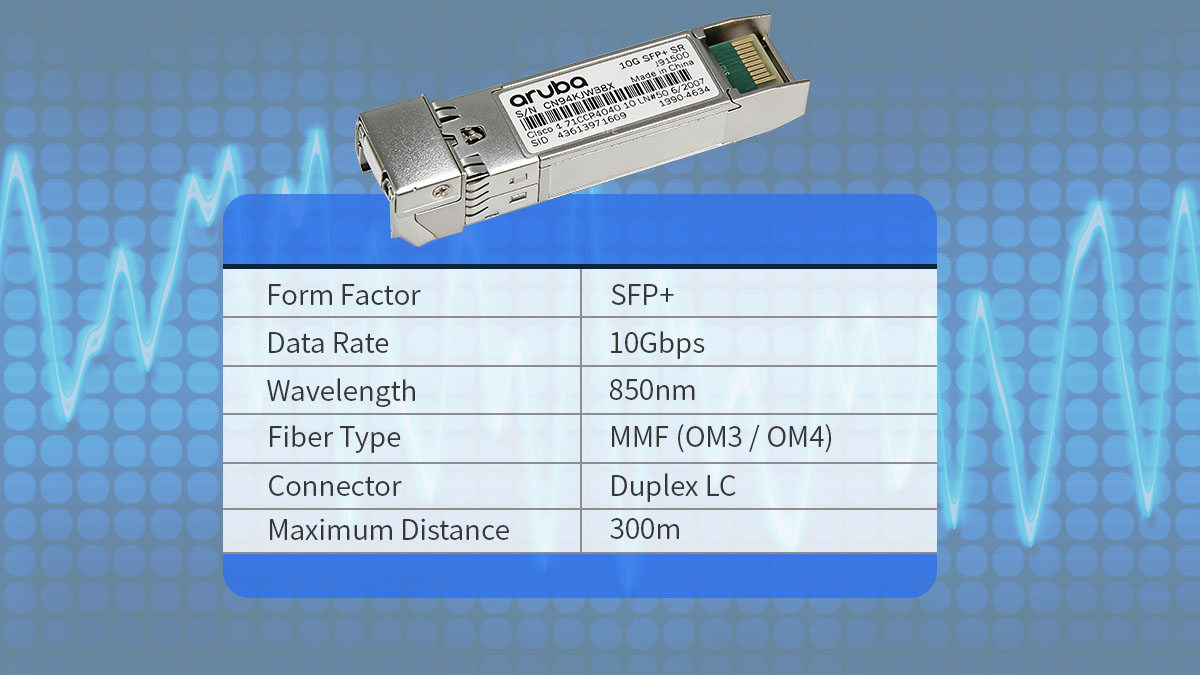
Core Technical Specifications
The Aruba 10G SFP+ SR transceiver follows standardized optical parameters used across most 10GbE multimode deployments.
| Parameter | Specification |
|---|---|
| Form Factor | SFP+ |
| Data Rate | 10Gbps |
| Wavelength | 850nm |
| Connector Type | Duplex LC |
| Fiber Type | OM3 / OM4 MMF |
| Maximum Distance | 300m (OM3) / 400m (OM4) |
These specifications allow the module to integrate seamlessly with common multimode fiber infrastructure used in modern enterprise networks. The 850nm wavelength and VCSEL laser technology also provide efficient short-range transmission with low power consumption.
Supported Aruba Switch Platforms
The Aruba 10G SFP+ LC SR 300m MMF transceiver is designed to operate with Aruba switching platforms that support SFP+ optical interfaces. In practice, it is frequently deployed across multiple network layers.
Common supported environments include:
-
Aruba access switches used in enterprise campus networks
-
Aggregation switches that consolidate multiple access-layer connections
-
Data center switching platforms requiring high-density 10GbE ports
-
Stacked switch environments where uplink bandwidth is critical
In these deployments, the module enables reliable 10Gbps fiber links between network devices while maintaining compatibility with Aruba firmware and monitoring tools.
Typical Network Deployment Scenarios
Short-range 10G optics such as the Aruba 10G SFP+ SR module are widely used in environments where fiber distances remain within several hundred meters.
Typical deployment scenarios include:
-
Data center top-of-rack (ToR) connectivity
Linking servers and storage systems to access or aggregation switches. -
Switch-to-switch uplinks
Providing high-bandwidth interconnection between access and distribution layers. -
Enterprise campus backbone links
Connecting wiring closets or building network segments. -
High-speed server networking
Supporting virtualization clusters, database systems, and cloud workloads.
Because these applications often involve dense port configurations and relatively short fiber runs, the Aruba 10G SFP+ SR module offers an efficient and widely adopted solution for building scalable 10GbE infrastructure.
⏩ Why Consider an Aruba 10G SFP+ SR Compatible Replacement
Many enterprise networks deploy large numbers of 10GbE optical modules to support uplinks, aggregation links, and high-speed server connectivity. When expanding or maintaining this infrastructure, organizations often evaluate Aruba 10G SFP+ SR compatible replacements that deliver equivalent optical performance while maintaining interoperability with Aruba switching platforms.
A well-tested compatible module can operate under the same 10GBASE-SR specifications, ensuring stable short-range fiber connectivity across existing multimode infrastructure.
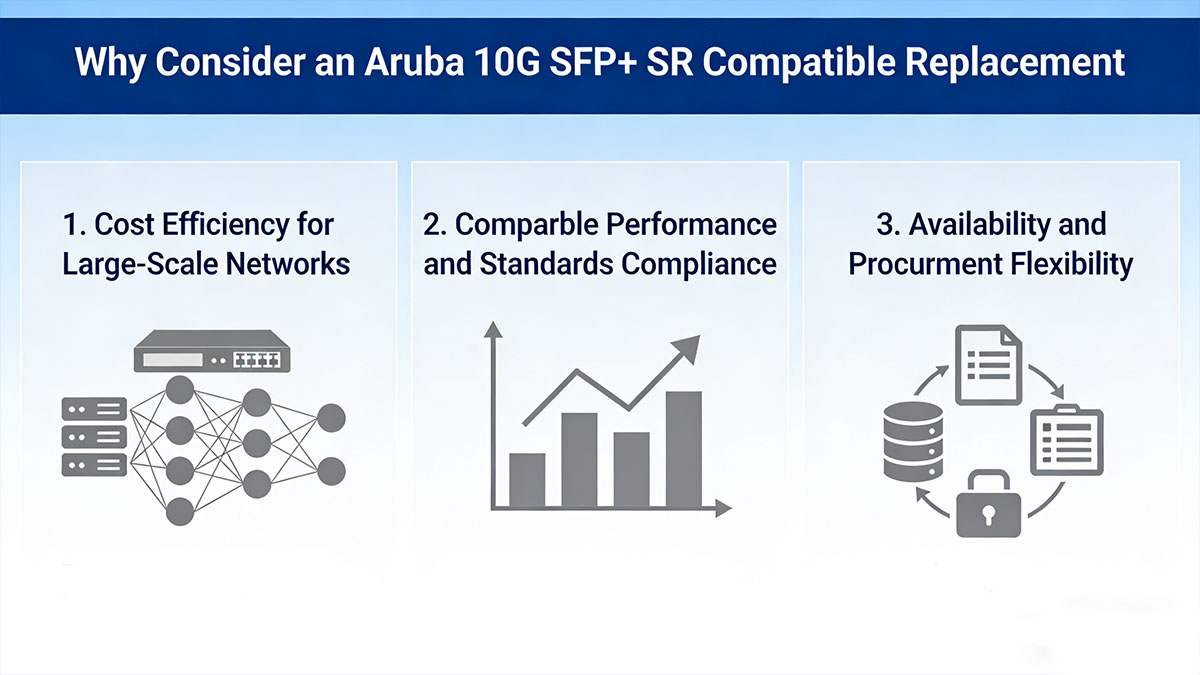
Cost Efficiency for Large-Scale Network Deployments
In networks with dozens or hundreds of optical ports, the cost of transceivers can represent a significant portion of infrastructure investment. Compatible SFP+ modules provide a practical option for controlling deployment costs while maintaining required network performance.
| Deployment Factor | OEM Optical Modules | Compatible Modules |
|---|---|---|
| Initial hardware cost | Typically higher | More budget-efficient |
| Scalability for large deployments | Higher capital impact | Easier to scale across many ports |
| Replacement and maintenance | Higher spare inventory cost | Flexible inventory management |
In high-density switch environments such as data centers or large campus networks, this cost difference becomes more noticeable as the number of 10GbE links increases.
Comparable Performance and Standards Compliance
A reliable Aruba-compatible module should follow the same industry standards as the original optical transceiver. This ensures consistent link performance and interoperability within existing fiber networks.
Key technical characteristics generally include:
-
Compliance with IEEE 10GBASE-SR optical standards
-
10Gbps transmission over multimode fiber (OM3 / OM4)
-
850nm VCSEL laser technology for short-reach optical links
-
Duplex LC interface for standard fiber patch cables
-
Support for Digital Optical Monitoring (DOM/DDM)
Because these specifications match those used by the original Aruba module, compatible alternatives can integrate into existing 10GbE network environments without requiring changes to fiber infrastructure.
Availability and Procurement Flexibility
Another factor driving the adoption of compatible optical modules is deployment flexibility. Network upgrades, expansions, or hardware replacements often require optical modules to be available quickly and in larger quantities.
Compatible transceivers can support these scenarios by offering:
-
Faster supply availability for network expansion projects
-
Flexible quantities for scaling infrastructure across multiple switches
-
Convenient spare inventory for maintenance or hardware replacement
-
Simplified procurement planning when upgrading existing networks
For organizations operating large switching environments, maintaining a flexible supply of compatible optical modules helps ensure that infrastructure upgrades and maintenance tasks can proceed without delays.
Overall, evaluating Aruba 10G SFP+ SR compatible replacements allows network operators to maintain stable 10Gbps short-range connectivity while supporting scalable infrastructure growth and efficient network management.
⏩ Key Specifications to Verify Before Choosing a Replacement
Selecting a compatible replacement for the Aruba 10G SFP+ LC SR 300m MMF Transceiver requires verifying several technical parameters to ensure reliable operation in an existing 10GbE network. Even when modules follow the same 10GBASE-SR standard, factors such as optical characteristics, interface compatibility, and fiber infrastructure can influence link stability.
Before deploying a replacement module, network engineers typically confirm the following key specifications.
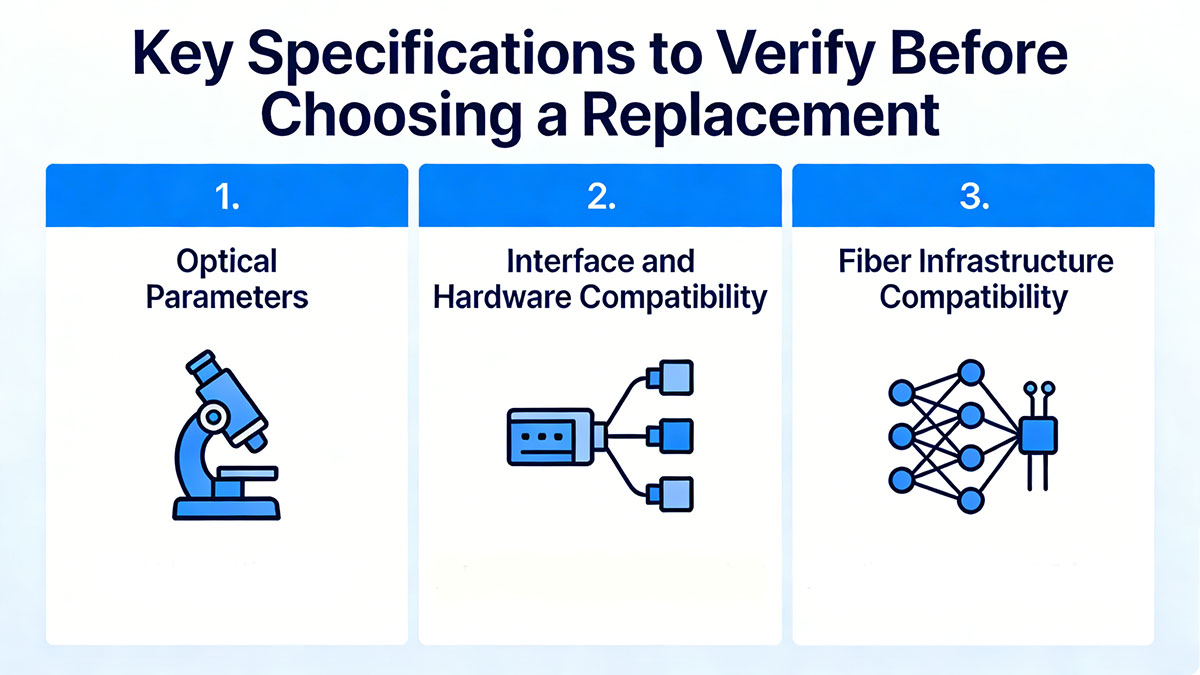
Optical Parameters
A compatible transceiver should match the optical characteristics defined by the 10GBASE-SR standard. These parameters determine how effectively the module transmits signals over multimode fiber and whether the link can reach the expected distance.
| Optical Parameter | Typical Value |
|---|---|
| Optical Standard | 10GBASE-SR |
| Wavelength | 850nm |
| Laser Type | VCSEL |
| Maximum Distance | 300m (OM3) / 400m (OM4) |
| Transmission Medium | Multimode Fiber |
These parameters ensure that the replacement module operates within the same optical performance range as the original Aruba transceiver. Matching wavelength and laser technology is particularly important for maintaining signal integrity in short-range multimode fiber environments.
Interface and Hardware Compatibility
Even when optical specifications match, the module must also be compatible with the SFP+ interface and the target Aruba switch platform. Switches often identify optical modules through EEPROM coding, which allows the system to recognize supported transceivers.
When verifying compatibility, key factors include:
-
SFP+ form factor compliance with Multi-Source Agreement (MSA) standards
-
EEPROM coding designed for Aruba switches to ensure proper recognition
-
Hot-swappable capability for installation without powering down equipment
-
Support for Digital Optical Monitoring (DOM/DDM) for real-time diagnostics
-
Firmware interoperability with Aruba switching software
Ensuring these elements are supported helps avoid issues such as link initialization failures or unrecognized modules.
Fiber Infrastructure Compatibility
The performance of a 10GBASE-SR optical module also depends on the characteristics of the deployed fiber infrastructure. Even a fully compatible transceiver may experience reduced performance if the fiber type or link loss exceeds recommended limits.
| Fiber Type | Maximum Distance |
|---|---|
| OM2 MMF | up to 82m |
| OM3 MMF | up to 300m |
| OM4 MMF | up to 400m |
To maintain stable 10GbE connectivity, network administrators typically verify:
-
The type of multimode fiber used in the link (OM3 or OM4 recommended)
-
The quality and cleanliness of LC connectors
-
The total link attenuation, including patch panels and connectors
-
The overall cable distance within supported limits
By confirming these infrastructure conditions, compatible 10G SFP+ SR modules can deliver the same short-range fiber performance expected from the original Aruba transceiver.
⏩ Aruba 10G SFP+ SR vs Other 10G Optical Modules
The Aruba 10G SFP+ SR module belongs to the short-reach category of 10GbE optics and is optimized for high-speed transmission over multimode fiber within data centers and enterprise networks. However, several other 10G connectivity options exist, including 10GBASE-LR SFP module, DAC cables, and AOC cables. Each option differs in transmission medium, supported distance, and deployment scenarios.
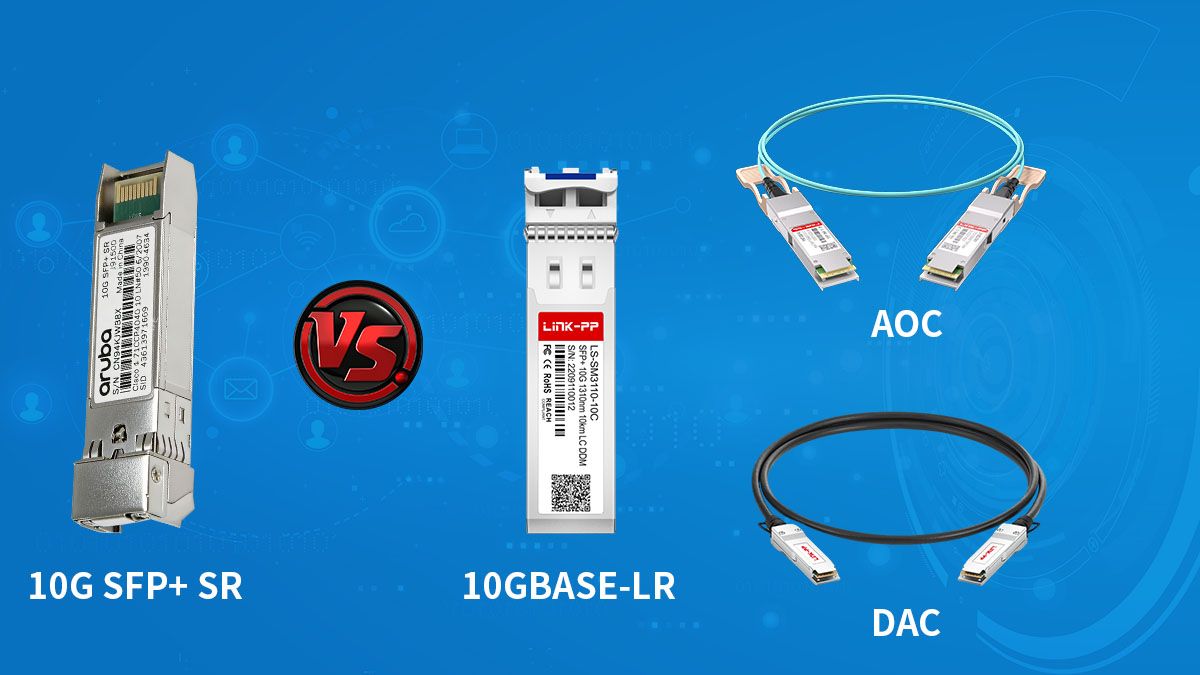
Understanding these differences helps determine whether a short-range SR transceiver or another 10G connectivity option is better suited for a specific network architecture.
10GBASE-SR vs 10GBASE-LR
Although both modules deliver the same 10Gbps data rate and share the SFP+ form factor, their optical design and deployment environments differ significantly.
| Parameter | 10GBASE-SR | 10GBASE-LR |
|---|---|---|
| Fiber Type | Multimode Fiber (OM3/OM4) | Single-Mode Fiber |
| Wavelength | 850nm | 1310nm |
| Maximum Distance | 300–400m | Up to 10km |
| Typical Deployment | Data centers, intra-building links | Campus backbone, inter-building links |
10GBASE-SR optics use an 850nm VCSEL laser optimized for multimode fiber, making them cost-efficient and well suited for short-range connections inside buildings or data halls. In contrast, 10GBASE-LR modules operate at 1310nm over single-mode fiber and support links up to 10km, making them suitable for campus or metropolitan network connectivity.
As a result, SR module is typically preferred for short intra-data-center links, while LR transceiver is used when longer transmission distances are required.
10GBASE-SR vs DAC Cables
DAC cables provide another option for 10GbE connectivity, particularly for very short connections between devices located in the same rack.
| Feature | 10GBASE-SR | DAC Cable |
|---|---|---|
| Medium | Multimode Fiber | Twinax Copper |
| Maximum Distance | 300–400m | 1–7m (passive) |
| Cable Flexibility | Modular fiber cabling | Fixed cable length |
| Deployment Scope | Inter-rack / building links | Intra-rack connections |
DAC cables connect directly to SFP+ ports without requiring separate transceivers. They offer very low power consumption and minimal latency, but their extremely limited distance makes them suitable mainly for server-to-switch or intra-rack connectivity.
For connections that extend beyond a few meters, optical modules such as 10GBASE-SR become the more practical solution.
10GBASE-SR vs AOC
Active Optical Cables (AOC) combine optical fiber and transceiver components into a single integrated cable assembly. They are commonly used in high-density data center environments where cable management simplicity is important.
| Feature | 10GBASE-SR | AOC |
|---|---|---|
| Design | Modular transceiver + fiber cable | Integrated cable assembly |
| Distance Range | Up to 300–400m | Typically up to 100m |
| Maintenance | Replaceable optics and cable | Entire cable replaced |
| Flexibility | High | Limited to fixed cable length |
AOC solutions can support longer distances than copper DAC cables while maintaining lightweight cabling and good electromagnetic immunity. However, unlike SFP+ SR optics, AOC cables cannot separate the transceiver and fiber, which reduces flexibility during upgrades or maintenance.
Overall, 10GBASE-SR modules remain one of the most widely used options for short-range 10GbE fiber connectivity because they balance cost, flexibility, and transmission distance. They are particularly suitable for data center switching fabrics, aggregation links, and enterprise network infrastructure where fiber runs typically remain under a few hundred meters.
⏩ Deployment Best Practices for 10G SFP+ SR Modules
Proper deployment of 10G SFP+ SR transceiver helps ensure stable link performance, low signal loss, and long-term network reliability. Although these optical transceivers follow standardized 10GBASE-SR specifications, real-world performance still depends on factors such as fiber quality, connector condition, and installation practices.
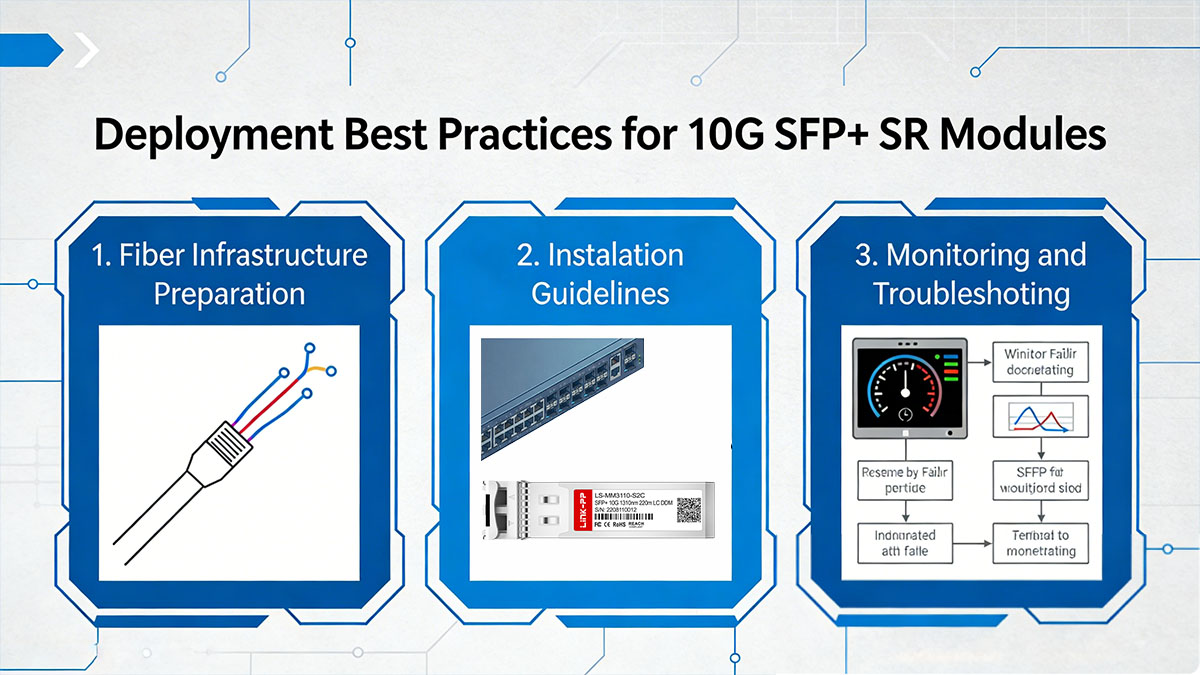
Before deploying or replacing an Aruba 10G SFP+ LC SR 300m MMF transceiver, network administrators typically verify the fiber infrastructure and follow recommended installation procedures to minimize potential link issues.
Fiber Infrastructure Preparation
Reliable 10GbE short-range connectivity requires appropriate multimode fiber and controlled link attenuation. Ensuring the correct fiber type and maintaining clean connectors are essential steps before installing optical modules.
| Infrastructure Factor | Recommended Practice |
|---|---|
| Fiber Type | Use OM3 or OM4 multimode fiber |
| Connector Type | Duplex LC connectors |
| Link Distance | Within 300m (OM3) or 400m (OM4) |
| Connector Cleanliness | Inspect and clean before installation |
Using OM3 or OM4 fiber ensures that the link can support the full transmission distance defined by the 10GBASE-SR standard. Fiber inspection and cleaning tools are commonly used to remove dust or contamination that could increase insertion loss.
In addition, verifying the overall optical link budget—including patch panels and intermediate connectors—helps prevent signal degradation in longer multimode fiber runs.
Installation Guidelines
10G SFP+ SR modules are designed with a hot-swappable SFP+ interface, allowing installation or replacement without powering down the switch. However, careful handling is still important to protect both the module and the fiber interface.
Typical installation practices include:
-
Insert the SFP+ module gently into the switch port until it locks into place
-
Avoid touching the optical connector end to prevent contamination
-
Use ESD protection when handling optical modules
-
Connect the LC fiber patch cable securely to ensure proper alignment
-
Verify that the switch recognizes the module after insertion
Following these steps helps maintain stable optical connections and prevents physical damage to the transceiver interface.
Monitoring and Troubleshooting
After deployment, monitoring optical parameters can help detect potential link issues early. Many SFP+ SR modules support Digital Optical Monitoring (DOM/DDM), which allows switches to track real-time performance metrics.
Common monitoring indicators include:
-
Transmit optical power (Tx power)
-
Receive optical power (Rx power)
-
Module temperature
-
Supply voltage and laser bias current
If a link fails to establish or experiences unstable performance, administrators typically check the following conditions:
-
Confirm the fiber polarity between the two devices
-
Verify that the fiber type supports the required distance
-
Inspect connectors for contamination or damage
-
Check switch logs for module recognition or compatibility alerts
By combining proper installation procedures with ongoing monitoring, organizations can maintain reliable 10GbE short-range fiber connectivity and reduce the likelihood of operational interruptions.
⏩ How to Select a Reliable Aruba-Compatible 10G SFP+ SR Module
Selecting a reliable Aruba-compatible 10G SFP+ SR module requires more than matching basic optical specifications. Compatibility with switch firmware, manufacturing quality, and long-term reliability all influence whether the module can maintain stable 10GbE connectivity in production networks.
Network engineers typically evaluate compatibility validation, component quality, and vendor support when selecting a replacement module for the Aruba 10G SFP+ LC SR 300m MMF transceiver.
Vendor Compatibility Testing
The most critical factor is whether the module has been properly tested with Aruba switching platforms. Compatible modules must be recognized by the switch operating system and operate normally across firmware versions.
| Compatibility Aspect | What to Verify |
|---|---|
| EEPROM Coding | Encoded for Aruba platform recognition |
| Interface Standard | SFP+ MSA compliant |
| Switch Interoperability | Tested with Aruba switches |
| Monitoring Support | DOM/DDM compatibility |
A module that meets these conditions can generally operate as a plug-and-play transceiver, allowing switches to recognize and monitor the optical interface without additional configuration.
In many enterprise deployments, compatibility testing is performed using common Aruba switch models to ensure the module works correctly with interface diagnostics and port management functions.
Quality and Reliability Standards
Optical modules operate continuously in network infrastructure, so the reliability of internal components and manufacturing processes plays an important role in long-term stability.
Several quality indicators are commonly evaluated when selecting a compatible module:
-
Industrial-grade optical components, including VCSEL lasers and photodiodes
-
Compliance with SFP+ Multi-Source Agreement (MSA) standards
-
Environmental testing, such as temperature and vibration tolerance
-
Optical performance verification, including transmit and receive power measurements
-
Burn-in testing to confirm stability before shipment
Modules produced under controlled manufacturing processes tend to maintain more consistent optical performance and reduce the risk of unexpected link failures.
Warranty and Technical Support
Reliable vendor support can also influence the long-term usability of compatible optical modules. Network teams often consider warranty coverage and available technical documentation when evaluating suppliers.
Key support factors typically include:
-
Product warranty coverage for hardware defects
-
Technical documentation, including specifications and compatibility lists
-
Firmware interoperability guidance for different Aruba switch models
-
Technical support availability for troubleshooting deployment issues
Access to these resources can simplify network maintenance and help resolve potential interoperability issues during large-scale deployments.
By confirming compatibility validation, component quality, and vendor support capabilities, organizations can confidently deploy Aruba-compatible 10G SFP+ SR modules while maintaining reliable short-range 10GbE network performance.
⏩ LINK-PP Compatible Replacement for Aruba 10G SFP+ LC SR 300m MMF Transceiver
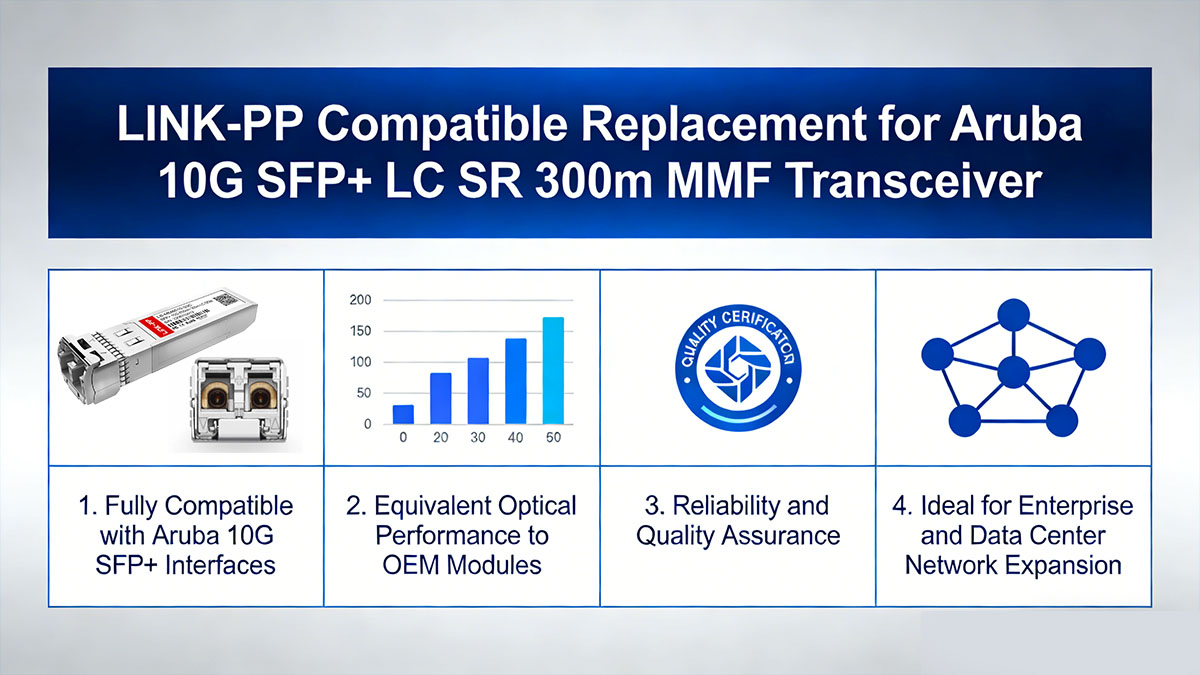
A compatible module from LINK-PP provides a practical replacement option for the Aruba 10G SFP+ LC SR 300m MMF Transceiver in networks that rely on short-range 10GbE fiber connectivity. Designed according to the same 10GBASE-SR optical specifications, the module supports 10Gbps transmission over multimode fiber while maintaining interoperability with Aruba switching platforms.
Because it follows standardized SFP+ interface and multimode optical parameters, the LINK-PP replacement module can integrate into existing network infrastructure without requiring changes to fiber cabling or switch hardware. This makes it suitable for both new deployments and incremental network expansion.
Fully Compatible with Aruba 10G SFP+ Interfaces
Compatibility with Aruba switches is one of the primary requirements when selecting a replacement optical module. LINK-PP compatible SFP+ SR modules are designed to align with Aruba interface standards and identification mechanisms.
| Compatibility Aspect | Implementation |
|---|---|
| Form Factor | SFP+ MSA compliant |
| Interface Type | Duplex LC optical interface |
| Platform Recognition | Encoded for Aruba switch compatibility |
| Hot-Swap Support | Yes |
These characteristics allow the module to operate as a plug-and-play optical transceiver in Aruba switches that support SFP+ ports. After insertion, the switch can recognize the module and establish a 10GbE link without additional configuration.
Equivalent Optical Performance to OEM Modules
A reliable replacement module must deliver the same optical transmission characteristics as the original Aruba SR transceiver. LINK-PP compatible modules follow the 10GBASE-SR standard, enabling consistent short-range fiber performance.
| Optical Parameter | Specification |
|---|---|
| Data Rate | 10Gbps |
| Wavelength | 850nm |
| Fiber Type | OM3 / OM4 multimode fiber |
| Connector | Duplex LC |
| Maximum Distance | 300m (OM3) / 400m (OM4) |
These parameters match the operating characteristics commonly used in Aruba 10GbE multimode fiber deployments. As a result, the replacement module can support the same rack-to-rack or switch-to-switch connections typically found in enterprise networks and data centers.
Reliability and Quality Assurance
Optical transceivers operate continuously in network equipment, making reliability an important factor in large-scale deployments. LINK-PP compatible modules are produced using standardized manufacturing and testing procedures to ensure stable optical performance.
Quality assurance measures typically include:
-
Component verification, including VCSEL transmitters and photodiode receivers
-
Optical power calibration to maintain stable transmit and receive levels
-
Temperature and environmental testing to confirm operating stability
-
Functional compatibility testing with supported switching platforms
-
Pre-shipment performance validation
These testing procedures help ensure that each module maintains consistent signal quality during long-term operation.
Ideal for Enterprise and Data Center Network Expansion
10GbE Short-range transceiver is widely used in network environments where high bandwidth is required within relatively short fiber distances. LINK-PP compatible SR modules can support many of the same deployment scenarios as original Aruba optics.
Common deployment environments include:
-
Data center top-of-rack switch connectivity
-
Aggregation links between access and distribution switches
-
High-speed server and storage network connections
-
Campus network uplinks within a building
Because the modules follow the standard 10GBASE-SR multimode fiber specification, they can operate within existing OM3 or OM4 fiber infrastructures commonly used in enterprise network architectures.
⏩ FAQs About Aruba 10G SFP+ LC SR 300m MMF Transceiver
What fiber type is required for an Aruba 10G SFP+ SR transceiver?
The Aruba 10G SFP+ SR module is designed for multimode fiber (MMF) connections, typically using OM3 or OM4 fiber. These fiber types support high-speed 10GbE transmission over short distances commonly found in data centers and enterprise networks.
What is the maximum transmission distance of a 10G SFP+ SR module?
A standard 10GBASE-SR transceiver supports up to 300m on OM3 multimode fiber and up to 400m on OM4 multimode fiber. The actual distance may vary depending on fiber quality, connector loss, and overall link attenuation.
Can a 10G SFP+ SR module work with single-mode fiber?
No. 10G SFP+ SR modules are designed specifically for multimode fiber at 850nm. For single-mode fiber links, a 10GBASE-LR transceiver operating at 1310nm is typically required.
Are Aruba-compatible SFP+ modules hot-swappable?
Yes. Most SFP+ optical modules, including Aruba-compatible SR transceivers, support hot-swappable operation, allowing installation or replacement without powering down the switch.
What connector type does the Aruba 10G SFP+ SR module use?
The module uses a duplex LC connector, which is the standard fiber interface for most SFP+ optical transceivers deployed in enterprise and data center networks.
How can you verify that a 10G SFP+ SR module is functioning correctly?
Network administrators typically check Digital Optical Monitoring (DOM) metrics such as transmit power, receive power, and module temperature through the switch management interface. These indicators help confirm whether the optical link is operating within normal parameters.
⏩ Conclusion
The Aruba 10G SFP+ LC SR 300m MMF Transceiver remains a widely used solution for building reliable short-range 10GbE fiber links in enterprise and data center networks. With support for 10Gbps transmission over OM3 or OM4 multimode fiber, it provides an efficient option for switch uplinks, aggregation connections, and high-speed server networking within distances of a few hundred meters.
When expanding or maintaining 10GbE infrastructure, selecting a compatible replacement requires careful verification of key factors such as optical specifications, Aruba interface compatibility, fiber infrastructure requirements, and module reliability. A well-designed compatible transceiver can deliver the same standardized 10GBASE-SR performance while integrating seamlessly with existing Aruba switching environments.
LINK-PP provides compatible modules engineered to match the specifications of Aruba 10G SFP+ SR optics, helping organizations maintain stable multimode fiber connectivity across campus and data center networks. For detailed product specifications and available compatible models, you can explore the LINK-PP Official Store to find solutions designed for Aruba 10GbE deployments.