





























As data centers and enterprise networks face rapidly growing bandwidth demands, network architectures are transitioning from 10G SFP+ to 25G SFP28 and even 100G QSFP28. This shift requires not only higher data transfer speeds but also scalable and cost-effective solutions. In practice, fully replacing existing hardware can be expensive and time-consuming, making flexible migration solutions a critical consideration for network engineers.
In this context, QSFP28 to SFP28 adapters have emerged as an essential tool for connecting 25G and 100G devices. These adapters split a single 100G QSFP28 port into four independent 25G SFP28 ports, enabling gradual upgrades without replacing switches or servers. This approach extends the life of existing equipment while providing flexible connectivity options in mixed-speed network environments.
This article provides an in-depth look at QSFP28 to SFP28 adapters, covering their technical principles, deployment scenarios, compatibility considerations, and performance optimization strategies. By examining these aspects, you will gain a clear understanding of the adapter’s value in 25G/100G migration and practical guidance for deploying it efficiently to upgrade bandwidth, reduce costs, and maintain network flexibility.
? Understanding QSFP28 to SFP28 Adapter Technology
QSFP28 to SFP28 adapters provide a practical solution for connecting 25G devices to 100G QSFP28 ports, enabling flexible network upgrades without replacing existing infrastructure. By splitting a single 100G port into multiple 25G lanes, these adapters ensure compatibility, maximize port utilization, and reduce migration costs.
What Is a QSFP28 to SFP28 Adapter?
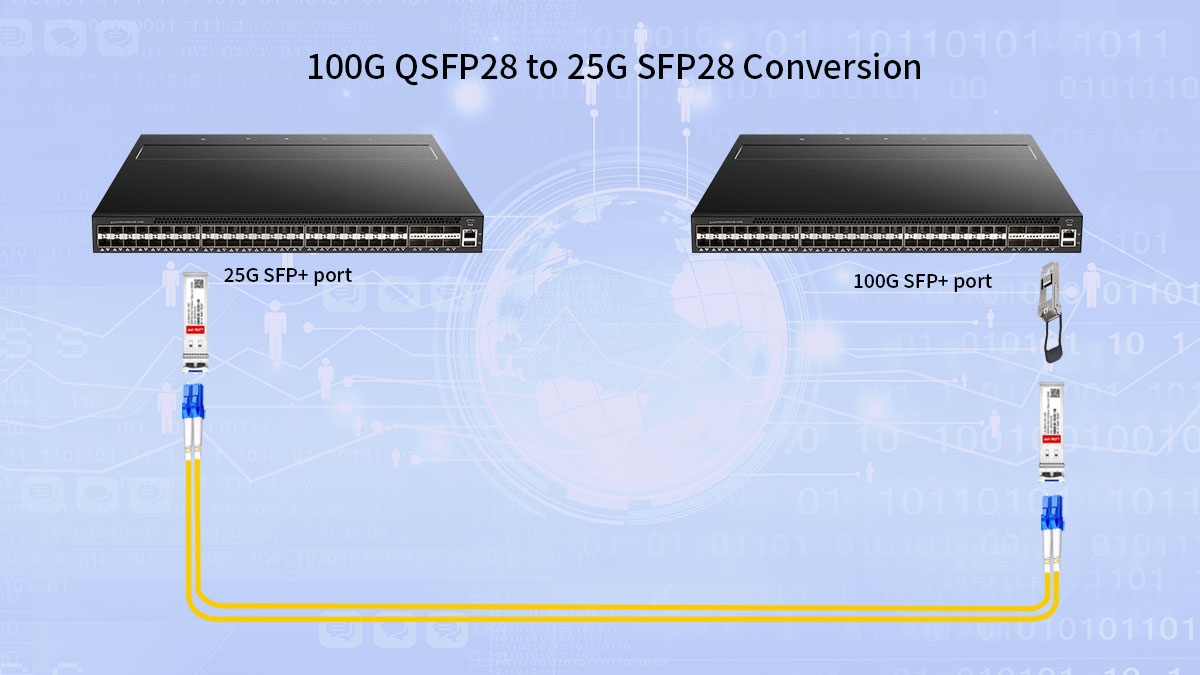
A QSFP28 to SFP28 adapter is a device that converts a 100G QSFP28 port into one or more independent 25G SFP28 ports. This allows legacy 25G devices to interoperate with modern 100G switches, providing a cost-effective path for network migration. The primary advantage is the ability to maintain existing infrastructure while supporting newer high-speed devices.
Key functions include:
- Electrical and mechanical conversion from QSFP28 to SFP28.
- Splitting four 25G lanes from a single 100G port.
- Compatibility with direct attach copper (DAC) and active optical cables (AOC).
These features ensure that a network can be upgraded incrementally, reducing downtime and capital expenditure.
How the Adapter Works in 25G/100G Environments
QSFP28 to SFP28 adapters operate by leveraging the four-lane structure of QSFP28 ports. Each QSFP28 port transmits data over four parallel 25G lanes. The adapter maps each lane to a separate SFP28 port, allowing a single 100G port to serve up to four 25G devices.
The benefits of this approach include:
- Efficient use of existing 100G ports.
- Seamless hybrid network deployment with mixed 25G and 100G devices.
- Minimal latency and signal degradation due to direct lane mapping.
Operational workflow:
- A 100G QSFP28 port transmits data over 4 lanes at 25G each.
- The adapter splits each lane to an individual SFP28 port.
- Each SFP28 port is recognized as a 25G interface by the connected device.
- DAC or AOC cables carry the signal to servers, switches, or other endpoints.
This mechanism ensures backward compatibility while allowing network operators to gradually scale from 25G to 100G without additional hardware investments.
Key Technical Specifications
QSFP28 to SFP28 adapters support 25Gbps per lane and adhere to QSFP28/SFP28 form factors, ensuring compatibility with standard network devices. Thermal and power considerations are designed to maintain network reliability while adding minimal overhead.
Below is a table summarizing typical technical specifications:
| Parameter | QSFP28 Port | SFP28 Port | Adapter Function |
|---|---|---|---|
| Data Rate | 100Gbps | 25Gbps per lane | Splits 100G into 4×25G |
| Lane Count | 4 lanes | 1 lane per port | Maps lanes individually |
| Connector Type | QSFP28 | SFP28 | Mechanical and electrical conversion |
| Supported Cable | DAC/AOC | DAC/AOC | Maintains full compatibility |
| Power Consumption | 3–5W | 0.5–1W | Minimal additional load |
This table illustrates how the adapter ensures each lane is independently maintained, while preserving energy efficiency and signal integrity. Proper thermal management and firmware support are critical to guarantee that all SFP28 ports operate reliably in high-density network environments.
? Role in 25G and 100G Network Migration
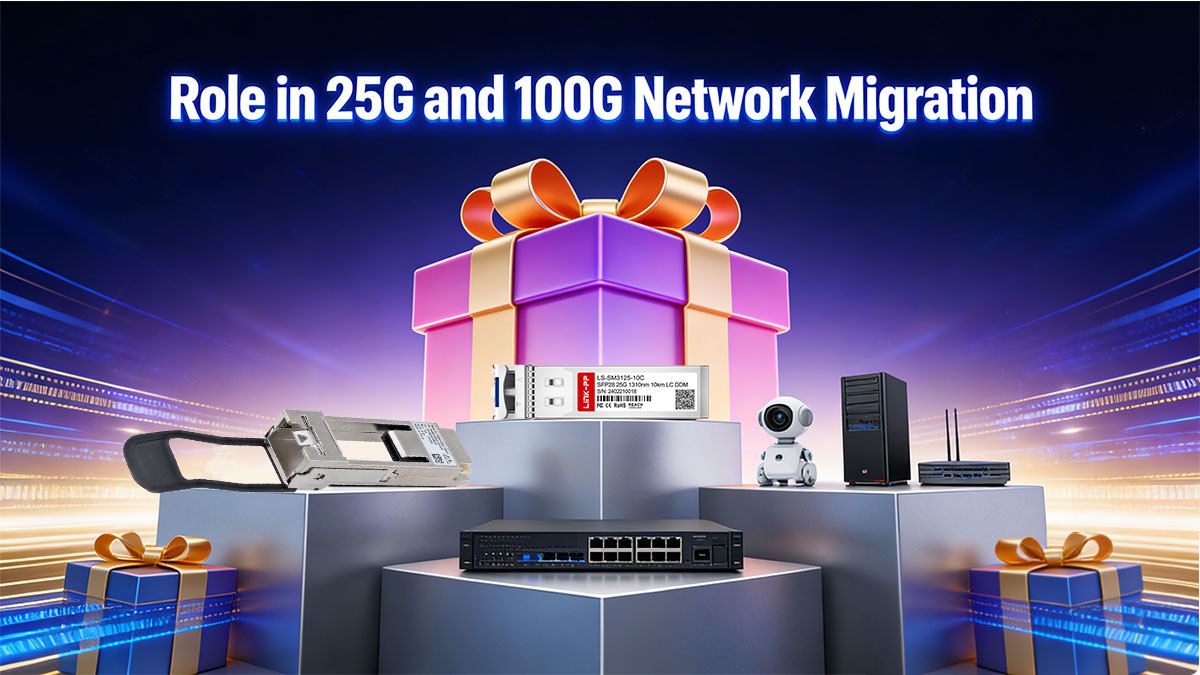
QSFP28 to SFP28 adapters play a critical role in 25G/100G network migration by enabling gradual upgrades, extending hardware lifespan, and maintaining network flexibility. They allow data centers to scale bandwidth incrementally without replacing entire switches or servers, reducing both cost and deployment risk.
Addressing the Transition from 10G to 25G
The primary challenge in moving from 10G SFP+ to 25G SFP28 is the need to support higher bandwidth without overhauling existing infrastructure. QSFP28 to SFP28 adapters allow 25G devices to connect to 100G-capable switches, providing a bridge between legacy and modern networks.
Benefits of this approach include:
- Incremental upgrades without service disruption.
- Efficient utilization of existing QSFP28 switch ports.
- Support for mixed-speed networks during the migration period.
Using these adapters, data centers can scale server connectivity from 10G to 25G per port while leveraging the higher bandwidth of 100G uplinks. This approach reduces immediate capital expenditure and allows a phased deployment strategy.
Supporting Hybrid 25G/100G Architectures
QSFP28 to SFP28 adapters enable hybrid network architectures where both 25G and 100G devices coexist on the same infrastructure. This is especially important in leaf-spine topologies, where switches need to handle varying speeds efficiently.
Key deployment scenarios:
- One 100G QSFP28 port connecting four 25G servers in top-of-rack (ToR) configurations.
- Combining 25G SFP28 uplinks with 100G QSFP28 spine connections.
- Gradual integration of new 100G servers while maintaining legacy 25G workloads.
This flexibility ensures that high-bandwidth backbones can coexist with lower-speed devices, avoiding unnecessary hardware upgrades while maintaining performance.
Extending the Lifecycle of Existing Hardware
QSFP28 to SFP28 adapters help extend the useful life of network equipment by enabling continued use of QSFP28 switches and line cards even when connecting lower-speed 25G devices. This maximizes ROI on existing hardware investments and avoids premature replacement.
Practical considerations for lifecycle extension include:
- Leveraging adapters to avoid early replacement of QSFP28 switches.
- Using breakout ports to support high-density 25G deployments.
- Aligning migration schedules with budget cycles for cost efficiency.
Implementing these strategies requires understanding how each factor contributes to overall network efficiency. By first assessing incremental deployment, port utilization, and flexibility, network engineers can determine where adapters provide the most value. The next table summarizes the key considerations and their benefits in extending hardware lifecycle.
| Consideration | Benefit | Notes |
|---|---|---|
| Incremental Deployment | Reduce CapEx | Deploy adapters on existing QSFP28 ports before replacing switches |
| Port Utilization | Maximize existing hardware | Split 100G ports into 4×25G to support more servers |
| Network Flexibility | Maintain mixed-speed connectivity | Supports hybrid environments with minimal disruption |
| ROI Extension | Delay full hardware replacement | Adapters preserve investment in QSFP28 switches |
By addressing these considerations, network operators can effectively integrate QSFP28 to SFP28 adapters, achieving both cost efficiency and operational flexibility during 25G to 100G migration.
? Deployment Scenarios and Use Cases
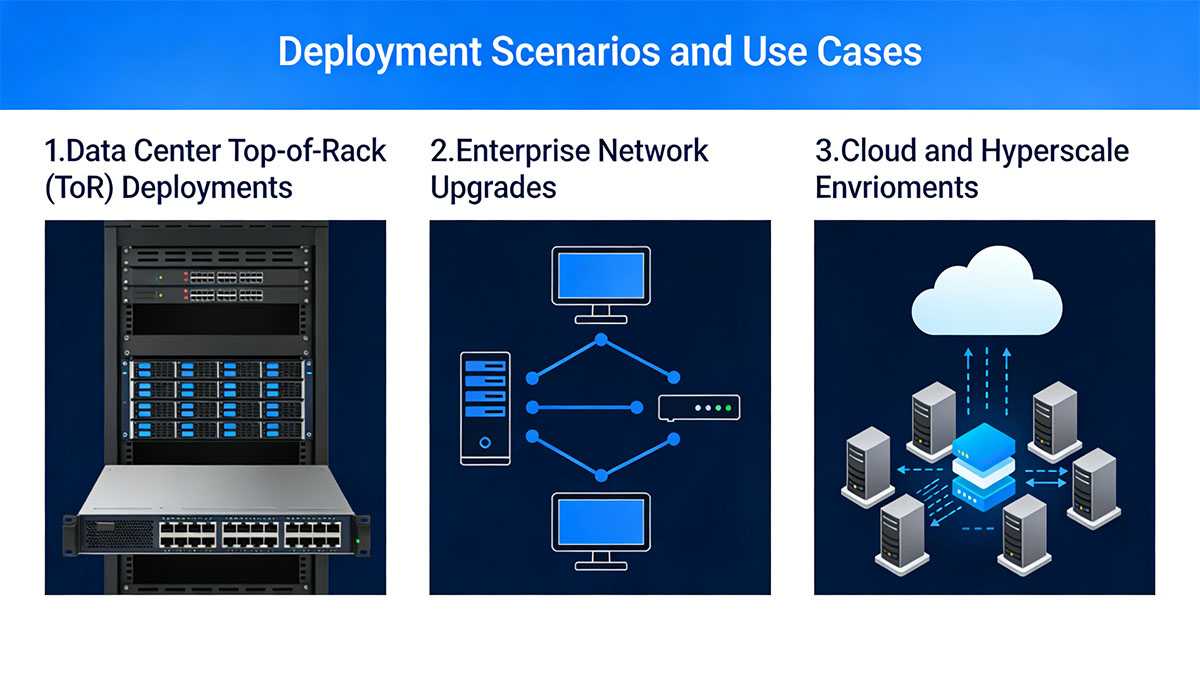
QSFP28 to SFP28 adapters are highly versatile and can be deployed in multiple network environments to optimize port utilization, enable gradual upgrades, and maintain connectivity between mixed-speed devices. They provide practical solutions for data centers, enterprise networks, and cloud environments where flexibility and cost efficiency are key.
Data Center Top-of-Rack (ToR) Deployments
QSFP28 to SFP28 adapters are particularly effective in top-of-rack (ToR) configurations, allowing a single 100G QSFP28 switch port to serve multiple 25G servers. This approach reduces the need for additional switch ports and simplifies cabling management while maintaining high throughput.
Typical advantages in ToR deployments:
- Connect up to four 25G servers to a single 100G switch port.
- Maximize port density in high-density racks.
- Simplify cable management and reduce overall cabling complexity.
In practical terms, deploying adapters in ToR racks enables network operators to consolidate connections, reduce switch requirements, and maintain high-performance east-west traffic between servers. Proper placement and labeling of adapters also help prevent port misconfiguration during upgrades.
Enterprise Network Upgrades
In enterprise environments, QSFP28 to SFP28 adapters facilitate incremental upgrades to 25G or 100G networks without replacing the entire switch infrastructure. They are particularly valuable for organizations that need to maintain service continuity while scaling bandwidth to support new applications or higher user density.
Key benefits include:
- Phased migration that aligns with budget constraints.
- Connectivity between legacy 25G devices and modern 100G switches.
- Reduction in network downtime during upgrades.
These adapters allow IT teams to plan a staged deployment, where critical servers or applications can be upgraded first, and additional devices can be connected as capacity grows. The flexibility reduces risk and ensures compatibility with existing network cabling and transceiver modules.
Cloud and Hyperscale Environments
QSFP28 to SFP28 adapters are increasingly used in cloud and hyperscale data centers due to their ability to support high-density, high-bandwidth deployments. They enable flexible port allocation, rapid provisioning of servers, and efficient use of spine-leaf architectures.
Deployment advantages in cloud environments:
- Rapid scaling of server connections without additional line cards.
- Efficient handling of east-west traffic across multiple 25G and 100G devices.
- Automation-friendly configuration, allowing dynamic allocation of breakout ports.
Adapters also help cloud operators optimize energy and space utilization by reducing the number of switch ports required for intermediate speeds. Proper monitoring ensures that high-traffic workloads maintain low latency and minimal packet loss.
| Deployment Scenario | Key Benefit | Implementation Note |
|---|---|---|
| Data Center ToR | High port density | Connect 4×25G servers per 100G QSFP28 port |
| Enterprise Upgrade | Phased migration | Maintain service continuity during bandwidth scaling |
| Cloud/Hyperscale | Flexible provisioning | Supports automated configuration and dynamic workloads |
By understanding these scenarios, network engineers can determine where QSFP28 to SFP28 adapters provide the greatest operational and cost advantages, ensuring that both existing and new devices are fully integrated into evolving network architectures.
? Compatibility and Interoperability Considerations
QSFP28 to SFP28 adapters are only effective if they are fully compatible with the network devices and optical transceiver they connect. Ensuring proper compatibility and interoperability is crucial to maintaining network performance, avoiding errors, and preventing downtime during 25G/100G migrations.

Switch and Vendor Compatibility
The primary factor in successful deployment is switch and vendor compatibility. QSFP28 to SFP28 adapters are designed to work across multiple switch platforms, but firmware, port configuration, and breakout mode support must be verified to ensure seamless operation.
Key considerations include:
- Confirming that the switch firmware supports 25G breakout mode.
- Verifying that the QSFP28 port can operate in split-lane mode without performance degradation.
- Ensuring the adapter is supported or certified by the network vendor.
Adapters that are not fully compatible with the switch or vendor may result in port errors, reduced throughput, or unrecognized SFP28 ports, highlighting the importance of pre-deployment validation.
Optical Modules and DAC/AOC Support
Compatibility extends beyond switches to the optical modules and cables used. QSFP28 to SFP28 adapters must work seamlessly with both DAC (direct attach copper) and AOC (active optical cables) to ensure reliable signal transmission and reach.
Considerations include:
- Matching the adapter with supported SFP28 transceivers.
- Ensuring DAC/AOC cables meet the distance and performance requirements.
- Verifying that cable type is compatible with the operating environment, such as high-density racks or long-reach connections.
A well-planned pairing of adapters and transceivers guarantees that network traffic maintains low latency and minimal packet loss across mixed-speed links.
Standards Compliance and MSA Alignment
QSFP28 to SFP28 adapters must comply with Multi-Source Agreements (MSAs) and IEEE standards to ensure interoperability, reliability, and predictable network performance. Compliance guarantees that devices from different vendors can work together without errors or degraded performance.
Key points for standards compliance:
- Adapters must meet QSFP28 and SFP28 form factor specifications.
- IEEE 802.3by (25G Ethernet) standard compliance ensures consistent lane performance.
- Non-compliant modules may cause errors, reduced reliability, or voided warranties.
Ensuring compliance involves multiple factors, such as verifying the adapter against MSA specifications, confirming IEEE standard alignment, and checking for certification from the network vendor. Proper validation allows network engineers to predict operational behavior and avoid unexpected failures.
The following table summarizes the critical compliance and interoperability factors, highlighting the recommended checks and the potential impact if not addressed:
| Compatibility Factor | Recommended Check | Impact of Non-Compliance |
|---|---|---|
| Switch Support | Firmware and breakout mode | Port errors, unrecognized interfaces |
| Transceiver Types | Verified SFP28/DAC/AOC | Signal degradation, link failure |
| Standards Compliance | QSFP28/SFP28 MSA, IEEE 802.3by | Reduced interoperability across vendors |
| Cable Length/Type | Match DAC/AOC spec | Latency, signal loss, limited reach |
By addressing these standards and MSA considerations systematically, network operators can deploy QSFP28 to SFP28 adapters with confidence, ensuring high interoperability and consistent performance across heterogeneous network environments.
? Performance and Efficiency Factors
QSFP28 to SFP28 adapters enable high-performance 25G/100G deployments while ensuring efficient utilization of ports, minimal latency, and manageable power and thermal loads. Proper planning and deployment maximize throughput, maintain signal integrity, and prevent unnecessary resource consumption.

Bandwidth Optimization
QSFP28 to SFP28 adapters allow a single 100G port to support multiple 25G connections, optimizing bandwidth use and preventing underutilization of high-speed ports. The conclusion is that lane-splitting with adapters provides both flexibility and efficiency in mixed-speed networks.
Key points for bandwidth optimization:
- Efficient use of 100G ports by connecting up to four 25G devices per QSFP28 port.
- Avoiding bandwidth underutilization by matching port capacity with actual traffic demand.
- Traffic distribution across lanes to prevent congestion and maximize link performance.
Proper planning of lane allocation ensures that each SFP28 port receives sufficient bandwidth for its applications, whether in ToR switches, enterprise upgrades, or cloud environments. This also reduces the risk of oversubscription and bottlenecks in high-density deployments.
Latency and Signal Integrity
QSFP28 to SFP28 adapters have minimal impact on latency and signal quality when deployed correctly, making them suitable for high-performance 25G/100G networks. Maintaining signal integrity is crucial for applications requiring low jitter and real-time data transmission.
Critical considerations include:
- Impact of adapters on latency is negligible due to direct lane mapping.
- Signal quality must be maintained through certified SFP28 transceivers and DAC/AOC cables.
- Best practices for maintaining performance include proper port configuration, monitoring error rates, and ensuring adequate cooling.
To ensure these considerations translate into reliable network performance, it is important to align the deployment environment with each factor. The following table summarizes key factors, recommended actions, and potential issues if they are not addressed. This provides a clear guide for maintaining both low latency and high signal integrity in mixed-speed deployments.
| Factor | Recommended Action | Potential Issue if Ignored |
|---|---|---|
| Latency | Use direct lane-mapping adapters | Increased delay and jitter |
| Signal Quality | Verify cable and transceiver certification | Packet loss, retransmissions |
| Error Rates | Monitor and correct configuration issues | Reduced network reliability |
| Best Practices | Align port speeds, maintain cooling | Performance degradation over time |
By carefully implementing these actions, network operators can achieve consistent throughput and minimal latency across both 25G and 100G links, ensuring reliable performance in high-density and latency-sensitive environments.
Power and Thermal Efficiency
QSFP28 to SFP28 adapters are energy-efficient but require proper thermal planning to prevent overheating in dense deployments. Effective management of power and heat ensures network stability and long-term equipment reliability.
Key considerations for power and thermal efficiency:
- Power consumption comparison shows each SFP28 port adds minimal load (~0.5–1W per port) compared to a full QSFP28 port.
- Heat dissipation challenges arise in high-density racks, where multiple adapters and breakout ports generate concentrated thermal loads.
- Data center cooling implications include maintaining airflow and spacing to prevent hotspots and ensure consistent adapter performance.
Using thermal-aware deployment strategies, such as spacing adapters appropriately and aligning airflow with rack design, prevents throttling and ensures stable operation even under full load.
? Advantages and Limitations of QSFP28 to SFP28 Adapters
QSFP28 to SFP28 adapters provide a practical solution for network migration and mixed-speed deployments, but they are not universally applicable. Understanding their advantages, potential limitations, and appropriate use cases allows network engineers to make informed deployment decisions.
Key Advantages
QSFP28 to SFP28 adapters offer a cost-effective, flexible approach to expanding 25G connectivity while utilizing existing 100G QSFP28 switch ports. They help organizations scale networks efficiently without significant infrastructure overhaul.
Core benefits include:
- Cost-effective migration path: Enables incremental upgrades from 25G to 100G without replacing entire switches.
- Flexibility in network design: Supports mixed-speed devices, including legacy 25G servers and 100G uplinks.
- Reduced capital expenditure: Maximizes existing hardware usage, minimizing immediate investment in new line cards or switches.
By leveraging these advantages, data centers and enterprises can implement phased network upgrades, maintain operational continuity, and optimize the utilization of high-speed ports.
Potential Limitations
Despite their benefits, QSFP28 to SFP28 adapters have limitations that can affect deployment choices and network performance. Awareness of these constraints is essential for proper planning.
Key considerations:
- Port configuration complexity: Breakout ports require correct switch firmware and configuration to function reliably.
- Limited to specific use cases: Best suited for environments needing mixed-speed connectivity; not optimal for uniform 100G deployments.
- Not a replacement for native ports in all scenarios: Native 25G ports may be necessary for high-density or long-reach deployments.
To illustrate these limitations, the following table summarizes potential challenges alongside their operational impact:
| Limitation | Description | Operational Impact |
|---|---|---|
| Port Configuration | Requires proper firmware and breakout setup | Misconfigured ports can lead to errors or unrecognized devices |
| Use Case Specific | Effective mainly in mixed-speed networks | May not deliver full benefits in pure 100G or pure 25G environments |
| Native Port Replacement | Cannot fully substitute for dedicated 25G ports | Performance or reach may be limited in some scenarios |
This overview helps network planners assess whether adapters align with their current infrastructure and upgrade strategy.
When to Use vs. When to Avoid
Understanding the ideal deployment conditions for QSFP28 to SFP28 adapters ensures they provide maximum value while avoiding scenarios where native ports are necessary.
Guidelines for deployment:
- Ideal deployment conditions: Mixed-speed networks, phased migration, and short- to medium-range connections using DAC or AOC cables.
- Scenarios requiring native 25G ports: High-density server racks, long-distance connections, or applications demanding full 25G per port without splitting a 100G uplink.
- Decision-making guidelines: Use adapters when flexibility and cost-efficiency are priorities; avoid them when uniform 25G bandwidth or long-reach connectivity is critical.
By applying these criteria, network engineers can determine the optimal placement and use of QSFP28 to SFP28 adapters, balancing performance, cost, and scalability.
? Best Practices for Deployment and Integration
QSFP28 to SFP28 adapters deliver maximum value only when deployed and integrated correctly. Following best practices ensures optimal performance, minimizes errors, and extends hardware lifecycle, particularly in mixed-speed 25G/100G networks.
Planning and Network Design
Effective planning and thoughtful network design are essential before deploying QSFP28 to SFP28 adapters. The main takeaway is that careful upfront design prevents port congestion, oversubscription, and costly retrofits.
Key planning considerations:
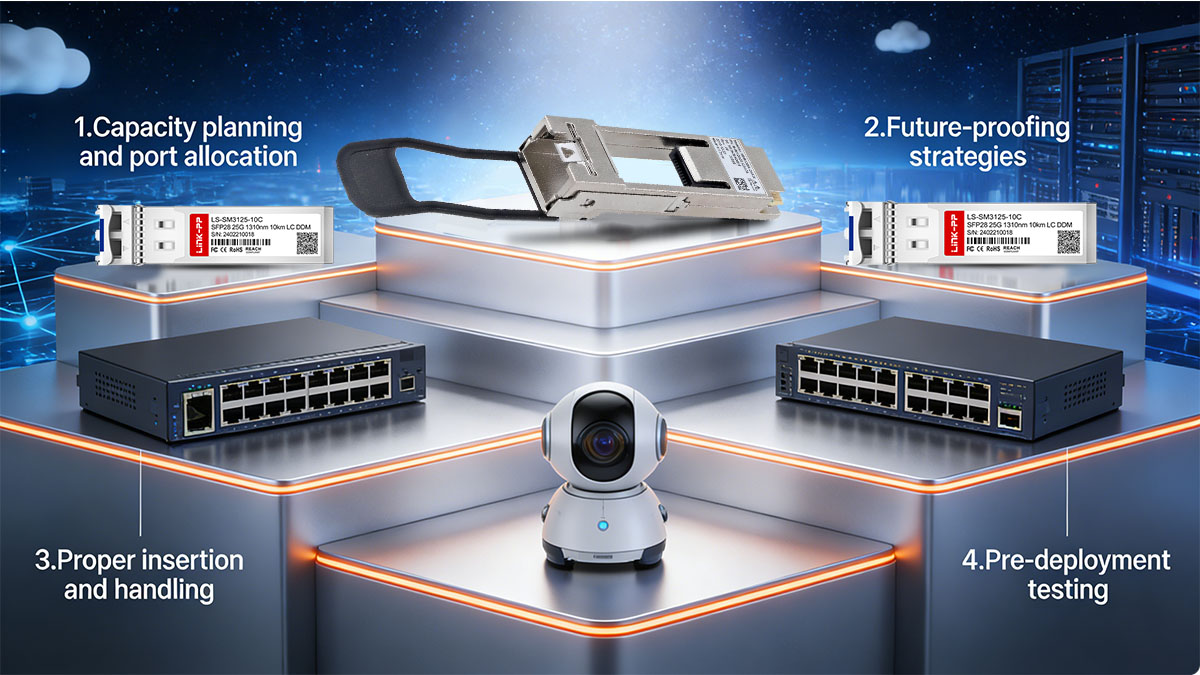
- Capacity planning and port allocation: Map existing 100G QSFP28 ports and determine how many 25G SFP28 devices each can support. This avoids overloading uplinks and ensures balanced traffic distribution.
- Future-proofing strategies: Anticipate future growth in bandwidth demands, ensuring adapters can accommodate additional devices or upgraded line cards without significant reconfiguration.
- Avoiding oversubscription: Ensure that multiple 25G devices sharing a single 100G uplink do not exceed the available bandwidth, which could degrade performance.
Proper planning aligns adapter deployment with network growth, traffic patterns, and operational requirements, minimizing risks and maximizing return on existing infrastructure.
Installation and Configuration Tips
Correct installation and configuration are critical to maintaining adapter performance, minimizing errors, and preserving signal integrity. The conclusion is that improper handling or misconfiguration can negate the benefits of using adapters.
Best practices include:
- Proper insertion and handling: Follow manufacturer guidelines for orientation and insertion to avoid port damage and signal degradation.
- Switch configuration (breakout mode): Ensure switches support and are correctly configured for QSFP28 breakout into multiple SFP28 lanes. Firmware validation is essential to prevent unrecognized ports.
- Monitoring and diagnostics: Immediately verify link status, traffic distribution, and error rates after installation to detect potential configuration issues early.
Attention to these details ensures each adapter operates as intended, enabling reliable connectivity between 25G and 100G devices.
Testing and Validation
Testing and validation are necessary steps to guarantee that the adapters function as expected before they are fully deployed. Pre-deployment testing reduces the risk of network disruptions and ensures performance benchmarks are met.
Key steps include:
- Pre-deployment testing: Validate link establishment, verify correct port recognition, and confirm that each SFP28 port receives proper bandwidth.
- Performance benchmarking: Measure throughput, latency, and error rates under expected traffic loads to confirm that the adapter and connected devices meet network requirements.
- Ongoing monitoring tools: Implement network monitoring solutions to continuously track port utilization, signal quality, and error rates for proactive maintenance.
| Stage | Recommended Actions | Purpose |
|---|---|---|
| Planning | Capacity mapping, future-proofing, avoid oversubscription | Optimize port allocation and scalability |
| Installation | Proper insertion, breakout mode configuration, diagnostics | Ensure reliable connectivity and prevent errors |
| Testing & Validation | Pre-deployment link testing, performance benchmarking, monitoring | Confirm performance and detect issues early |
By systematically planning, installing, configuring, and validating QSFP28 to SFP28 adapters, network operators can maintain high throughput, low latency, and operational reliability across mixed-speed environments.
? Common Challenges and Troubleshooting
QSFP28 to SFP28 adapters simplify 25G/100G network migration, but deployments can encounter compatibility and performance issues. Identifying common challenges and following structured troubleshooting strategies is critical for maintaining reliable network operation.
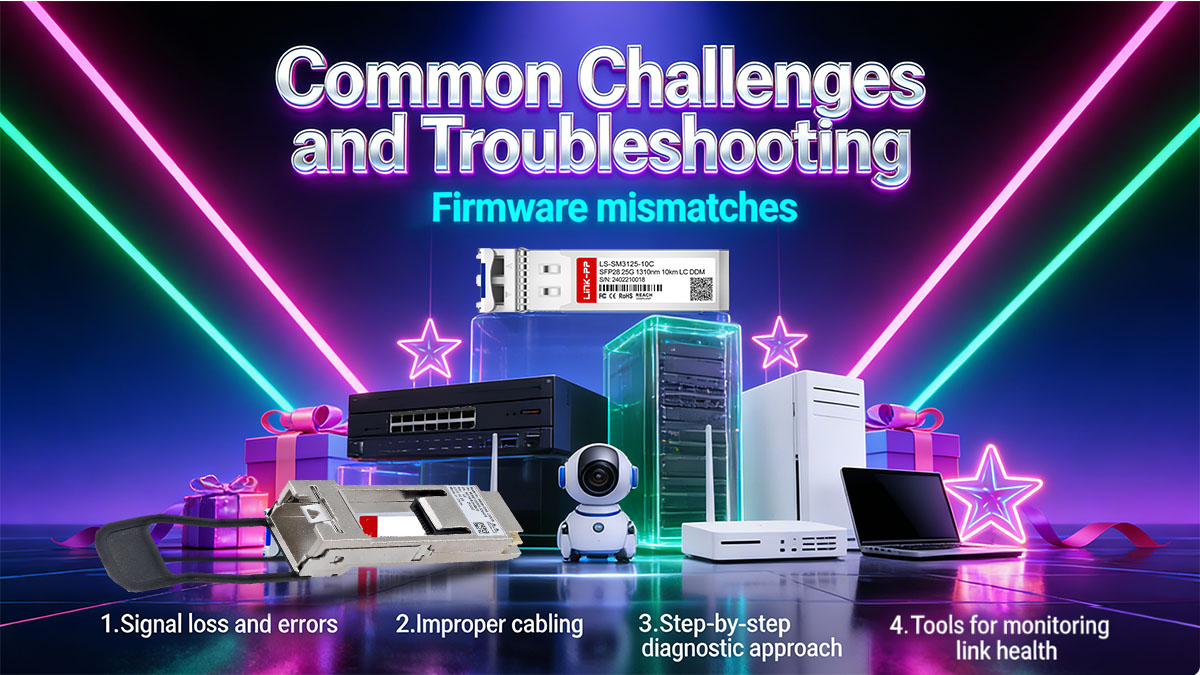
Compatibility Issues
Compatibility problems are among the most frequent obstacles when deploying QSFP28 to SFP28 adapters. The key conclusion is that verifying hardware, firmware, and vendor support before deployment can prevent most issues.
Common compatibility challenges include:
- Unsupported modules or adapters: Some SFP28 transceivers or QSFP28 adapters may not be recognized by certain switch models.
- Firmware mismatches: Switches with outdated firmware may not support breakout mode or the specific adapter model.
- Vendor lock-in challenges: Some vendors restrict the use of third-party adapters, limiting interoperability.
To address these challenges, it is important to cross-check module compatibility lists, confirm switch firmware versions, and adhere to MSA-compliant standards for adapters and transceivers.
Performance Degradation
Even when adapters are compatible, network performance can degrade due to cabling, signal, or configuration issues. The key insight is that proactive verification and proper deployment practices can mitigate most performance problems.
Factors causing performance degradation include:
- Signal loss and errors: Poor-quality DAC or AOC cables, or improperly seated adapters, can result in link errors.
- Improper cabling: Using incorrect cable types or exceeding recommended distances may cause latency or packet loss.
- Overloaded ports: Connecting too many devices to a single QSFP28 breakout can exceed bandwidth capacity, reducing effective throughput.
Correct cable selection, careful port allocation, and periodic monitoring are essential to maintain signal integrity and prevent bottlenecks.
Troubleshooting Strategies
A systematic troubleshooting approach ensures that issues are identified and resolved quickly. The conclusion is that combining step-by-step diagnostics, monitoring tools, and preventive practices maintains network reliability.
Best practices for troubleshooting include:
- Step-by-step diagnostic approach: Start with link status checks, verify port recognition, test each SFP28 port individually, and confirm firmware alignment.
- Tools for monitoring link health: Use switch diagnostics, SNMP monitoring, or specialized software to detect errors, latency spikes, and bandwidth bottlenecks.
- Preventive maintenance practices: Schedule periodic inspections, verify cable integrity, and monitor temperature and airflow in high-density racks.
| Challenge Area | Common Causes | Recommended Actions |
|---|---|---|
| Compatibility | Unsupported modules, firmware mismatch, vendor lock-in | Cross-check compatibility lists, update firmware, use MSA-compliant adapters |
| Performance | Signal loss, improper cabling, overloaded ports | Validate cables, limit port sharing, monitor traffic |
| Troubleshooting | Undefined errors or degraded performance | Stepwise diagnostics, monitoring tools, preventive maintenance |
By following these strategies, network engineers can maintain optimal performance, quickly resolve issues, and extend the reliability and lifespan of QSFP28 to SFP28 adapters in complex 25G/100G deployments.
? Future Trends in 25G/100G Connectivity
As data centers evolve, network demands are growing rapidly, driving innovations in speed, flexibility, and sustainability. QSFP28 to SFP28 adapters will continue to play a critical role in this evolution, supporting mixed-speed deployments and enabling cost-effective network upgrades.
Evolution Toward Higher Speeds
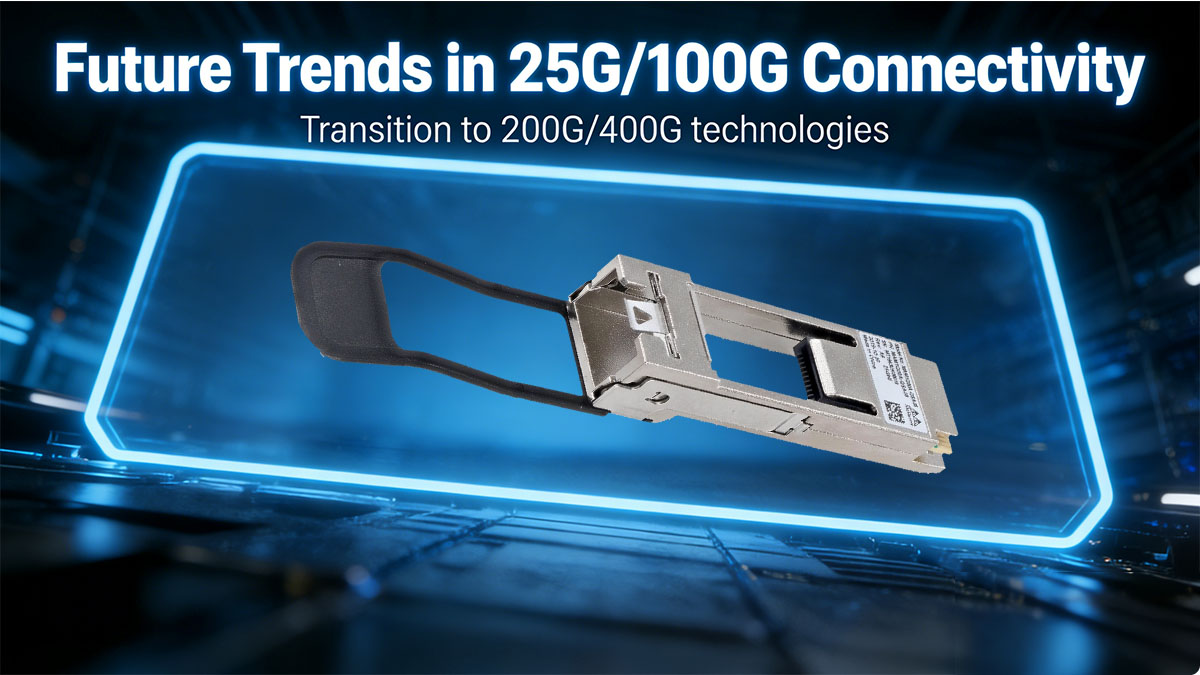
The future of connectivity is moving beyond 100G, with 200G, 400G, and even higher-speed technologies becoming increasingly common. The key conclusion is that while new high-speed standards emerge, QSFP28 to SFP28 adapters remain relevant for phased migration and backward compatibility.
Important trends include:
- Transition to 200G/400G technologies: Data centers are adopting higher-capacity switches and transceivers to support growing bandwidth requirements for AI, cloud, and hyperscale workloads.
- Role of QSFP56 and QSFP-DD: These next-generation modules provide higher-density connections and lane aggregation, complementing existing 25G/100G infrastructure.
- Continued relevance of adapters: QSFP28 to SFP28 adapters bridge legacy 25G devices with modern 100G infrastructure, enabling incremental upgrades without replacing all equipment at once.
Adapters serve as a practical tool to extend the utility of existing hardware while preparing networks for the next generation of high-speed connectivity.
Increasing Demand for Flexible Networking
Modern networks require adaptability to handle dynamic workloads, variable traffic patterns, and evolving application needs. The conclusion is that flexibility and modularity are central to future-proofing network architectures.
Key considerations:
- Software-defined networking (SDN): Enables dynamic management of traffic, allowing network operators to optimize performance across mixed-speed ports and adapters.
- Modular and scalable architectures: Rack- and pod-based designs facilitate incremental expansion, supporting QSFP28 to SFP28 adapters as needed without disrupting the overall network.
- On-demand bandwidth allocation: Adapters allow flexible distribution of available 100G uplink bandwidth among multiple 25G devices, ensuring efficient resource use.
By combining adaptive architectures with QSFP28 to SFP28 adapters, data centers can achieve operational flexibility while minimizing wasted capacity.
Sustainability and Cost Optimization
Sustainability and cost efficiency are becoming key priorities for network infrastructure. The conclusion is that intelligent use of adapters can reduce hardware waste, lower energy consumption, and simplify long-term infrastructure planning.
Strategies include:
- Reducing hardware waste: Reusing existing 100G QSFP28 ports to connect multiple 25G devices avoids unnecessary purchase of new switches or line cards.
- Energy-efficient networking: Adapters consume minimal power per port, reducing overall data center energy usage compared to deploying additional native 25G ports.
- Long-term infrastructure planning: Incremental upgrades supported by adapters allow organizations to phase investments, adapt to traffic growth, and plan for eventual 200G/400G adoption without large-scale disruption.
| Trend Area | Implications for QSFP28 to SFP28 Adapters | Benefits |
|---|---|---|
| Higher Speeds | Supports legacy 25G devices during 100G/200G migration | Cost-effective phased upgrades |
| Flexible Networking | Enables dynamic bandwidth allocation and SDN integration | Efficient port utilization and operational flexibility |
| Sustainability | Reduces hardware redundancy and energy use | Lower TCO, environmental benefits |
Through careful integration into evolving network architectures, QSFP28 to SFP28 adapters can remain a valuable tool for bridging current and future connectivity requirements.
? Conclusion
QSFP28 to SFP28 adapters provide an effective and flexible solution for bridging 25G and 100G network environments. They enable efficient port utilization, support incremental migration strategies, and maintain high performance with minimal latency and power impact. By understanding compatibility considerations, following best deployment practices, and proactively addressing potential challenges, network operators can maximize the value of existing infrastructure while preparing for future 200G and 400G QSFP-DD upgrades.
As data center demands continue to evolve, these adapters remain a practical tool for achieving cost-effective, scalable, and energy-efficient connectivity. For professionals looking to implement reliable 25G/100G migration solutions, QSFP28 to SFP28 adapters are an essential component of a well-planned network strategy.
Explore a wide range of certified adapters and supporting modules at the LINK-PP Official Store to ensure seamless integration and optimal network performance.