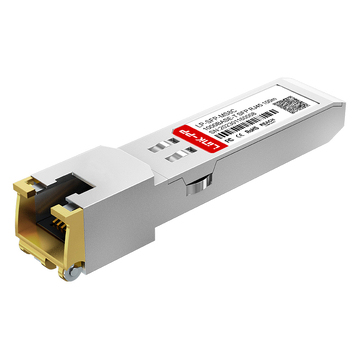
In modern enterprise and carrier-grade network environments, Gigabit Ethernet connectivity remains a foundational requirement for stable and efficient data transmission. As organizations continue to expand campus networks, data centers, and distributed IT infrastructures, multimode fiber solutions are widely adopted to balance performance and deployment cost. Within this context, standardized optical transceivers play a critical role in ensuring interoperability, scalability, and long-term network reliability.
The Allied Telesis AT-SPSX is a 1G SFP optical transceiver designed specifically for short-reach multimode fiber connections. Operating at an 850nm wavelength and supporting distances up to 550m, it is commonly used in environments where high-speed Gigabit connectivity is required over structured fiber cabling. Its compatibility with Allied Telesis switching platforms and adherence to SFP MSA standards make it a practical choice for enterprise access layers, aggregation networks, and controlled data center interconnects.
This article provides a detailed exploration of the Allied Telesis AT-SPSX from an application-focused perspective. It will break down its technical characteristics, examine how it is deployed across enterprise networks, data centers, industrial systems, and smart infrastructure, and highlight key considerations for real-world implementation. By the end, you will gain a clear understanding of where this transceiver fits within modern optical network architectures and how it supports efficient, scalable, and stable connectivity strategies.
📀 What Is Allied Telesis AT-SPSX and Why It Matters
The Allied Telesis AT-SPSX is a 1000BASE-SX Small Form-factor Pluggable (SFP) optical transceiver designed for Gigabit Ethernet communication over multimode fiber. In practical terms, it is a hot-swappable module that enables network switches and routers to transmit and receive data using optical fiber instead of copper cabling. Its main value lies in delivering stable 1Gbps connectivity over short distances with high immunity to electromagnetic interference, making it a widely used component in structured enterprise and data center networks.

Core Specifications Overview
The AT-SPSX is defined by a set of standardized optical and electrical characteristics that determine its compatibility and deployment range. These specifications make it suitable for short-reach fiber links in controlled environments.
Below is a summary of its key technical parameters:
| Parameter | Specification | Relevance |
|---|---|---|
| Data Rate | 1.25Gbps (1GbE) | Supports standard Gigabit Ethernet transmission |
| Wavelength | 850nm | Optimized for multimode fiber (VCSEL laser) |
| Fiber Type | Multimode Fiber (MMF) | Typically OM2/OM3/OM4 infrastructure |
| Transmission Distance | Up to 550m | Suitable for campus and intra-building links |
| Connector Type | LC Duplex | Industry-standard fiber connector |
These specifications ensure that the module can be deployed in most short-range fiber environments without requiring specialized infrastructure changes, which simplifies network planning and expansion.
Key Functional Advantages
Beyond its basic specifications, the AT-SPSX is widely adopted because of its operational advantages in real network environments. Its design focuses on reliability, compatibility, and ease of integration rather than complex configuration requirements.
Key advantages include:
- Stable short-range optical transmission
The module maintains consistent signal quality over multimode fiber, making it suitable for building-to-building or rack-to-rack connections. - Low electromagnetic interference sensitivity
Fiber-based transmission ensures reliable performance in environments with high electrical noise, such as industrial or densely packed server rooms. - Hot-swappable SFP modules design
Administrators can install or replace the module without shutting down network equipment, minimizing downtime during maintenance or upgrades. - Broad interoperability within SFP-compliant systems
While optimized for Allied Telesis hardware, it follows fiber optic SFP module MSA standards, allowing integration into many compatible networking platforms.
These advantages make the AT-SPSX a practical choice in scenarios where network stability and deployment flexibility are more important than long-distance transmission capability.
📀 Enterprise Network Applications of AT-SPSX
The Allied Telesis AT-SPSX is widely used in enterprise environments because it provides reliable Gigabit connectivity over multimode fiber at relatively low deployment complexity. In enterprise network architectures, its primary role is to support short-reach optical links between switches, access layers, and aggregation points, especially where copper cabling is insufficient in terms of distance, bandwidth stability, or electromagnetic resistance.

Campus Network Backbone Connectivity
In enterprise campus networks, the AT-SPSX is commonly deployed to build high-speed backbone links between buildings or network distribution points. Its 550m multimode fiber reach makes it suitable for inter-building connectivity without requiring long-haul optics or expensive single-mode infrastructure.
Typical deployment scenarios include:
- Connecting distribution switches across different office buildings
- Linking network closets in multi-building campuses
- Supporting centralized core-to-access architecture over fiber uplinks
- Enabling scalable backbone upgrades without redesigning physical layouts
This approach allows organizations to maintain a unified network architecture across geographically separated facilities while keeping latency low and throughput stable. Fiber-based backbone links also reduce signal degradation compared to copper-based alternatives, especially in electrically noisy environments.
Office LAN Fiber Expansion
Beyond backbone connectivity, the AT-SPSX is frequently used to extend fiber into enterprise LAN environments where copper Ethernet becomes a limitation. As office networks evolve to support high-bandwidth applications, fiber uplinks are increasingly preferred for reliability and future scalability.
Key use cases include:
- Upgrading copper uplinks between access switches and distribution switches
- Supporting bandwidth-intensive applications such as VoIP, video conferencing, and cloud-based collaboration tools
- Eliminating electromagnetic interference issues in dense office environments
- Extending network reach in large office floors or multi-zone corporate buildings
A structured fiber LAN design using AT-SPSX modules enables enterprises to reduce bottlenecks at the access layer while preparing infrastructure for other high-speed transceivers in the future.
📀 Data Center and Server Room Deployments
In data center and server room environments, the Allied Telesis AT-SPSX is primarily used to support short-reach, high-reliability Gigabit Ethernet connections between switching layers and server infrastructure. Its value in these scenarios comes from its ability to deliver stable optical performance over multimode fiber while maintaining low latency and predictable throughput in densely populated network environments.

Top-of-Rack (ToR) Switching Scenarios
In modern data center architectures, Top-of-Rack (ToR) switching is one of the most common deployment models for AT-SPSX. In this setup, each rack contains a dedicated switch that aggregates traffic from servers and forwards it to higher-level network layers.
Typical applications include:
- Connecting rack-mounted servers to ToR switches via multimode fiber uplinks
- Aggregating server traffic before transmission to aggregation or core switches
- Supporting virtualization platforms with consistent low-latency connectivity
- Reducing cable congestion inside server racks by replacing longer copper runs
This approach improves network efficiency by localizing traffic within each rack and minimizing the distance that high-volume data must travel before reaching aggregation points. It also simplifies troubleshooting and physical cable management in dense server environments.
Intra-Rack and Inter-Rack Connectivity
Beyond ToR architectures, the AT-SPSX is also used for both intra-rack and inter-rack communication, where short-reach fiber links are required between network components.
Common use cases include:
- Connecting switches located in adjacent racks within the same row
- Linking storage systems to compute clusters over fiber uplinks
- Establishing redundancy paths between redundant switching pairs
- Supporting modular infrastructure designs in scalable data centers
Fiber-based interconnects help reduce electromagnetic interference and improve airflow within racks, as optical cables are thinner and generate less heat compared to high-density copper alternatives. This is especially important in environments where thermal efficiency directly impacts operational costs.
Data Center Switching Layer Integration
In layered data center network architectures, the AT-SPSX plays a role in connecting access, aggregation, and core switching tiers. It is commonly used in environments that follow a leaf-spine or hierarchical design model.
A typical deployment structure includes:
- Access layer: Server-to-switch connections within racks
- Aggregation layer: Fiber uplinks between ToR and distribution switches
- Core layer: High-capacity switching fabric interconnects
This structure ensures predictable traffic flow and minimizes congestion by segmenting workloads across different switching layers. The AT-SPSX is particularly effective in the access and aggregation layers where multimode fiber distances are sufficient.
📀 Industrial and Manufacturing Use Cases
In industrial and manufacturing environments, the Allied Telesis AT-SPSX is valued for its ability to maintain stable Gigabit Ethernet communication in electrically noisy and physically demanding settings. Unlike copper-based Ethernet, fiber-optic transmission is inherently immune to electromagnetic interference (EMI), making it highly suitable for factory floors, production lines, and automation systems where electrical noise and equipment density are significant challenges.

Harsh Environment Networking Stability
Industrial facilities often contain heavy machinery, motors, and high-voltage equipment that generate strong electromagnetic fields. In such environments, network stability is a critical requirement for operational continuity.
The AT-SPSX is commonly deployed to:
- Establish EMI-resistant links between industrial switches
- Maintain stable communication in high-noise electrical zones
- Connect distributed control systems across production areas
- Ensure uninterrupted data transmission in automation-heavy facilities
By using multimode fiber instead of copper cabling, organizations significantly reduce the risk of signal degradation, packet loss, or intermittent connectivity caused by environmental interference. This improves overall system reliability in mission-critical operations.
Factory Automation and Control Systems
Modern manufacturing systems rely heavily on real-time communication between programmable logic controllers (PLCs), sensors, and industrial PCs. The AT-SPSX supports these requirements by enabling deterministic, low-latency fiber links within factory automation networks.
Typical applications include:
- Connecting PLCs to industrial Ethernet switches in control cabinets
- Linking robotic systems and production line controllers
- Supporting machine-to-machine (M2M) communication in automated workflows
- Integrating SCADA systems with distributed field devices
These deployments ensure that control signals and monitoring data are transmitted consistently, which is essential for maintaining synchronization across production lines. Even minor network delays in such environments can lead to production inefficiencies or system errors, making optical stability a key requirement.
Industrial Ethernet Network Architecture
In industrial networking designs, the AT-SPSX is often part of a layered Ethernet structure that separates control, management, and field-level communication. This architecture improves both reliability and scalability.
A typical industrial deployment includes:
- Field layer: Sensors and actuators connected via industrial switches
- Control layer: PLCs and automation controllers interconnected via fiber uplinks
- Supervisory layer: SCADA and monitoring systems aggregating production data
Fiber-based uplinks using AT-SPSX modules ensure that data from lower-level devices is transmitted reliably to supervisory systems without interference or signal loss. This is especially important in large-scale manufacturing plants where long cable runs are required.
📀 Smart City and Surveillance Applications
In smart city infrastructure and modern surveillance systems, the Allied Telesis AT-SPSX is widely used as a reliable optical connectivity component for transmitting high-bandwidth data over medium-distance fiber links. Its ability to deliver stable Gigabit Ethernet performance over multimode fiber makes it well-suited for distributed networks that require continuous data collection, real-time monitoring, and centralized video processing.

IP Surveillance System Connectivity
One of the most common applications of the AT-SPSX in smart city environments is IP-based video surveillance. These systems generate large volumes of data from high-definition cameras, requiring stable and low-latency transmission to control centers.
Typical deployment scenarios include:
- Connecting IP cameras via access switches to aggregation networks
- Linking surveillance clusters to centralized video management systems (VMS)
- Supporting continuous high-bandwidth video streaming over fiber backbones
- Ensuring stable transmission in high-density camera deployments
Fiber connectivity using AT-SPSX modules helps eliminate issues commonly associated with copper-based links, such as signal degradation over distance and susceptibility to electromagnetic interference. This ensures uninterrupted video feeds, which is critical for security monitoring and incident response.
Traffic Monitoring and Urban Infrastructure Systems
Beyond surveillance, the AT-SPSX is frequently deployed in intelligent transportation systems (ITS) and urban infrastructure monitoring networks. These systems require reliable data transmission between distributed sensors, controllers, and central traffic management platforms.
Key applications include:
- Connecting traffic signal control cabinets across intersections
- Linking roadside monitoring cameras to regional control centers
- Supporting real-time traffic flow analysis and congestion management systems
- Enabling data aggregation from distributed environmental and infrastructure sensors
In these scenarios, multimode fiber links provide the necessary bandwidth and stability for continuous data exchange, ensuring that traffic systems can respond dynamically to changing conditions such as congestion, accidents, or emergencies.
📀 Education and Healthcare Network Deployments
In education and healthcare environments, the Allied Telesis AT-SPSX is widely deployed to support reliable, high-speed Gigabit connectivity across campus-wide and facility-wide fiber networks. These sectors require consistent performance, predictable latency, and high availability, making multimode fiber SFP solutions a practical choice for structured network design.

Campus-Wide Connectivity in Educational Institutions
In universities, colleges, and large training campuses, the AT-SPSX is commonly used to build scalable backbone networks that interconnect multiple buildings and high-density user zones. These environments typically involve thousands of concurrent users accessing cloud services, learning platforms, and multimedia resources.
Typical applications include:
- Connecting academic buildings, dormitories, and administrative offices via fiber backbone
- Linking campus distribution switches to centralized core network systems
- Supporting high-bandwidth applications such as e-learning platforms and video lectures
- Enabling stable connectivity for Wi-Fi access point aggregation networks
By using AT-SPSX-based fiber uplinks, educational institutions can reduce network congestion at the access layer while maintaining consistent performance across large geographic campus layouts. This ensures that students and faculty experience stable access to digital resources regardless of physical location.
Hospital and Healthcare Network Infrastructure
In healthcare environments, network reliability is directly linked to patient care quality and operational efficiency. The AT-SPSX is often deployed in hospital networks to support secure, high-speed communication between medical systems, imaging devices, and centralized data platforms.
Common use cases include:
- Connecting medical imaging systems (such as MRI and CT scanners) to storage and processing servers
- Linking hospital departments including radiology, laboratories, and emergency units
- Supporting electronic medical record (EMR) systems with stable backend connectivity
- Ensuring continuous operation of monitoring and diagnostic equipment networks
Fiber-based connectivity using AT-SPSX modules helps minimize latency and eliminate electromagnetic interference from medical equipment, which is critical in environments with sensitive diagnostic instruments. This ensures that large medical datasets, such as imaging files, are transmitted reliably and without corruption.
📀 Advantages of AT-SPSX in Short-Reach Optical Networks
In short-reach optical network deployments, the Allied Telesis AT-SPSX is widely adopted because it delivers a balanced combination of performance stability, deployment simplicity, and infrastructure efficiency. Unlike long-haul optical modules designed for extended distances, the AT-SPSX is optimized specifically for multimode fiber environments where links typically exist within buildings, campuses, or controlled technical spaces.

Cost-Effective Fiber Deployment
One of the primary advantages of the AT-SPSX is its ability to support high-performance Gigabit connectivity over existing multimode fiber infrastructure, reducing the need for costly network redesigns.
Key practical benefits include:
- Utilization of existing OM2/OM3/OM4 fiber cabling in enterprise environments
- Reduced need for single-mode fiber installation in short-distance scenarios
- Lower overall deployment complexity compared to long-reach optical solutions
- Efficient upgrade path from copper-based uplinks to fiber-based connectivity
This makes it particularly suitable for organizations transitioning from legacy copper networks to fiber-based architectures while maintaining budget control and minimizing physical infrastructure changes.
Ease of Integration in Network Systems
The AT-SPSX is designed around the SFP transceiver Multi-Source Agreement (MSA) standard, which ensures broad compatibility and simplified deployment across supported networking platforms.
Typical integration advantages include:
- Plug-and-play installation with compatible SFP slots
- No complex configuration required for basic operation
- Compatibility with a wide range of Allied Telesis switching equipment
- Support for hot-swapping without network downtime
This level of interoperability reduces operational overhead for network administrators, especially in environments where rapid deployment or frequent maintenance is required.
📀 Limitations and Considerations
Although the Allied Telesis AT-SPSX is highly effective in short-reach multimode fiber networks, it is not a universal optical solution. Like all 1000BASE-SX transceiver modules, its performance and suitability are defined by specific distance, fiber type, and deployment constraints. Understanding these limitations is essential for ensuring stable network design and avoiding performance issues in real-world environments.

Distance Constraints in Multimode Fiber
The most important limitation of the AT-SPSX is its transmission distance, which is inherently tied to multimode fiber characteristics.
Key considerations include:
- Maximum reach of approximately 550m under optimal conditions
- Reduced effective distance when using lower-grade fiber (e.g., OM1 or OM2)
- Performance dependence on cable quality, connectors, and installation practices
- Unsuitability for metropolitan or long-haul network links
In practice, this means the AT-SPSX is best reserved for intra-building or campus-scale deployments rather than inter-city or long-distance backbone networks. When network spans exceed multimode fiber limitations, single-mode solutions are typically required.
Fiber Type Compatibility Requirements
Another important consideration is the strict dependency on multimode fiber infrastructure. The AT-SPSX is optimized for 850nm transmission, which is specifically designed for multimode optical characteristics.
Typical compatibility requirements include:
- Best performance with OM3 or OM4 multimode fiber
- Limited reach and efficiency when used with older OM1/OM2 cabling
- Sensitivity to fiber quality, bending radius, and connector cleanliness
- Need for proper polarity alignment in LC duplex connectors
Improper fiber selection or poor installation practices can significantly reduce link quality, even if the hardware itself is fully operational.
📀 Best Practices for Deploying AT-SPSX
To ensure stable performance and long-term reliability, the deployment of the Allied Telesis AT-SPSX should follow well-established optical networking practices. Although the module itself is designed for simplicity and interoperability, the overall link quality depends heavily on fiber infrastructure design, installation accuracy, and ongoing maintenance procedures.

Fiber Infrastructure Planning and Design
Effective deployment begins with proper planning of the fiber network layout. Since the AT-SPSX is optimized for short-reach multimode transmission, network designers should align physical topology with its operational range.
Recommended planning practices include:
- Designing links within the 550m multimode fiber limit
- Segmenting networks into access, distribution, and core layers for clarity
- Minimizing unnecessary intermediate connection points
- Ensuring redundancy paths for critical network segments
A well-planned fiber topology reduces signal loss risks and ensures consistent performance across all connected devices.
Selecting the Right Multimode Fiber Type
Fiber selection plays a critical role in determining how effectively the AT-SPSX performs in real-world deployments. Not all multimode fibers deliver the same level of optical efficiency.
Typical recommendations include:
- Use OM3 fiber for standard enterprise deployments
- Use OM4 fiber for higher-performance or longer-reach MMF links
- Avoid OM1/OM2 for new installations unless legacy constraints exist
- Ensure fiber cables meet industry standards for attenuation and bandwidth
Choosing higher-grade fiber improves signal integrity and provides additional margin for long-term scalability.
Installation and Physical Handling Practices
Proper installation techniques are essential to maintain optical signal quality and prevent physical damage to fiber components.
Best practices include:
- Maintaining minimum bend radius to avoid signal loss
- Avoiding excessive tension on fiber cables during installation
- Using proper cable management systems in racks and pathways
- Ensuring LC connectors are securely seated and properly aligned
Even small installation errors can introduce insertion loss or reflection issues that affect overall network stability.
Optical Cleanliness and Maintenance
Fiber optic systems are highly sensitive to contamination, making cleanliness a critical operational requirement in AT-SPSX deployments.
Recommended maintenance practices include:
- Regular inspection of fiber end faces before installation
- Using approved cleaning tools for LC connectors
- Avoiding direct contact with fiber tips during handling
- Implementing scheduled maintenance checks in high-density environments
Maintaining clean optical interfaces ensures consistent signal transmission and reduces the risk of intermittent connectivity issues.
Network Performance Monitoring
Ongoing monitoring is essential to ensure that AT-SPSX-based links continue to operate within optimal parameters over time. Optical performance can degrade due to environmental changes, physical stress, or aging infrastructure.
Key monitoring practices include:
- Tracking optical power levels across active links
- Monitoring link errors and retransmission rates
- Using network management systems for real-time visibility
- Identifying early signs of fiber degradation or connector wear
Proactive monitoring helps prevent unexpected downtime and supports long-term network stability.
📀 FAQs about Allied Telesis AT-SPSX
What is the Allied Telesis AT-SPSX used for?
The AT-SPSX is used to provide 1Gbps Gigabit Ethernet connectivity over multimode fiber. It is commonly deployed in enterprise networks, data centers, and industrial environments for short-range optics.
What type of fiber does AT-SPSX support?
It supports multimode fiber (MMF), typically OM3 or OM4, operating at an 850nm wavelength for optimized short-distance transmission performance.
What is the maximum transmission distance of AT-SPSX?
The AT-SPSX can support distances up to approximately 550m under optimal conditions using high-quality multimode fiber.
Is AT-SPSX compatible with non-Allied Telesis switches?
Yes, it generally follows the SFP Multi-Source Agreement (MSA) standard, which allows compatibility with many SFP-capable networking devices, depending on vendor restrictions.
Can AT-SPSX be used in data centers?
Yes, it is commonly used in data centers for Top-of-Rack (ToR) switching, server connectivity, and short-range inter-rack communication.
What is the operating wavelength of AT-SPSX?
It operates at 850nm, which is standard for short-range multimode fiber Gigabit Ethernet applications.
What are the main limitations of AT-SPSX?
Its main limitations include a maximum reach of about 550m and dependency on multimode fiber infrastructure, making it unsuitable for long-distance transmission.
Is AT-SPSX suitable for industrial environments?
Yes, it is suitable due to its fiber-based transmission, which provides strong resistance to electromagnetic interference (EMI) in industrial settings.
What factors affect AT-SPSX performance?
Performance depends on fiber quality (OM3/OM4), connector cleanliness, optical power budget, and proper installation practices.
📀 Conclusion
The Allied Telesis AT-SPSX is a 1000BASE-SX multimode SFP optical transceiver designed for reliable short-reach Gigabit Ethernet connectivity, making it a practical solution for enterprise networks, data centers, industrial systems, and smart infrastructure deployments. Its strength lies in delivering stable 1Gbps performance over multimode fiber while maintaining compatibility, simplicity, and operational efficiency in structured network environments.
Across different application scenarios, its value can be summarized through a few key takeaways:
- Provides stable short-distance optical transmission up to 550m over OM3/OM4 multimode fiber
- Supports a wide range of use cases, including campus backbones, server interconnects, and industrial automation networks
- Ensures low-latency, EMI-resistant connectivity suitable for mission-critical environments
- Enables scalable network expansion through standardized SFP (MSA-compliant) architecture
- Requires proper fiber selection, installation quality, and maintenance to achieve optimal performance
As network infrastructures continue to evolve toward higher density, greater bandwidth demand, and more distributed architectures, reliable optical modules like the AT-SPSX remain essential building blocks for stable connectivity at the access and aggregation layers.
For organizations planning new deployments or optimizing existing fiber networks, selecting compatible and high-quality optical transceivers is critical to long-term performance and reliability. To explore more optical connectivity solutions and enterprise-grade transceiver options, you can visit the LINK-PP Official Store for additional product resources and network deployment support.