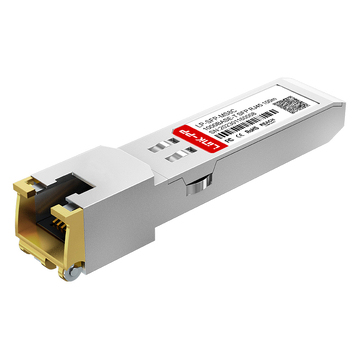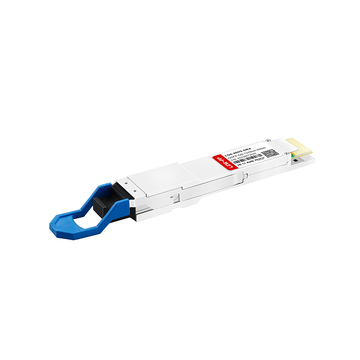
In modern data center and enterprise network environments, the demand for high-speed, low-latency connectivity continues to grow as applications such as cloud computing, virtualization, and big data analytics become increasingly bandwidth-intensive. Among various 10Gbps optical solutions, short-reach SFP+ modules have become a standard choice for efficient intra-data center communication due to their balance of performance, cost, and energy efficiency.
The Intel E10GSFPSR is a widely adopted 10GBASE-SR SFP+ transceiver designed specifically for short-distance transmission over multimode fiber. While it may appear straightforward at first glance, its specifications—such as wavelength, transmission distance, optical power levels, and compatibility—play a critical role in determining real-world network performance and stability. Understanding these parameters is essential for making informed deployment decisions and avoiding common configuration issues.
This article provides a detailed breakdown of the Intel E10GSFPSR specifications, explaining not only what each parameter means but also how it impacts practical network design. It also explores compatibility considerations, performance optimization strategies, and comparisons with alternative 10G solutions, helping network professionals build more reliable and efficient high-speed optical links.
⏳ Overview of Intel E10GSFPSR
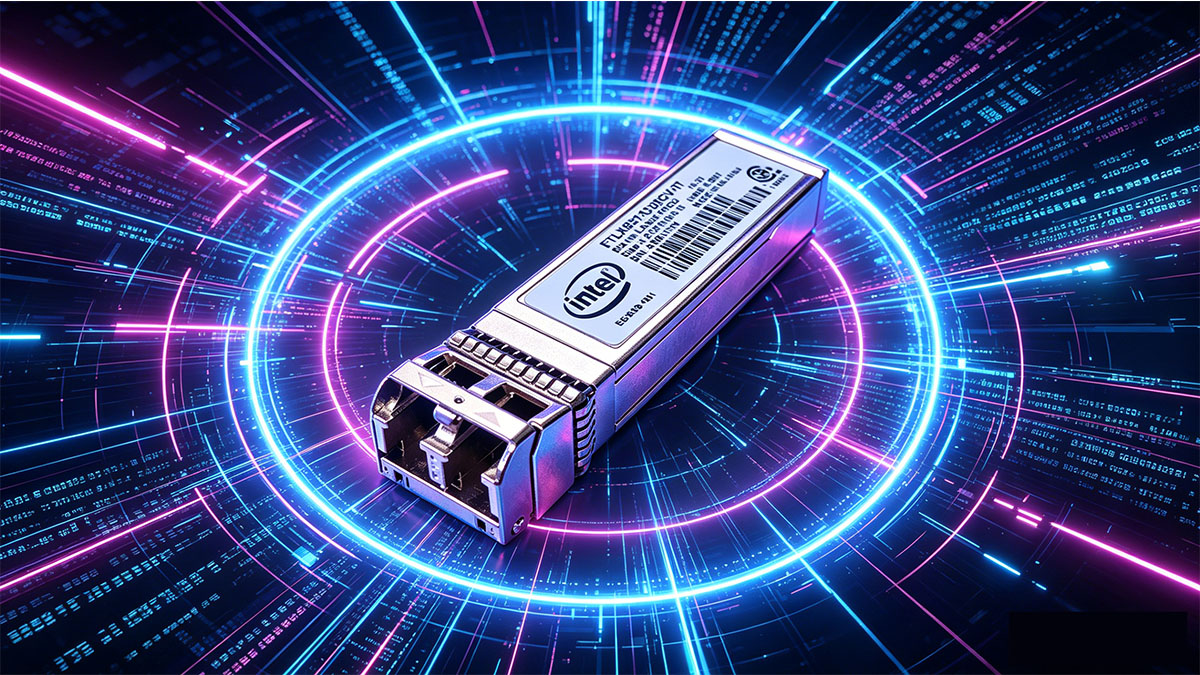
The Intel E10GSFPSR is a short-range 10Gbps SFP+ optical transceiver designed for multimode fiber, primarily used for high-speed connections within data centers. It delivers a balance of performance, cost efficiency, and low power consumption, making it a standard choice for intra-rack and inter-rack networking.
What is Intel E10GSFPSR
The Intel E10GSFPSR is a 10GBASE-SR SFP+ optical module that enables high-speed data transmission over short distances using multimode fiber.
It operates based on the 10GBASE-SR standard and uses an 850nm VCSEL (Vertical-Cavity Surface-Emitting Laser) to deliver reliable high-speed connectivity within racks or between nearby network devices. As a hot-pluggable module, it allows flexible deployment and easy upgrades without interrupting network operations.
To better understand its core identity, the following table summarizes its key characteristics:
| Parameter | Value | Description |
|---|---|---|
| Form Factor | SFP+ | Hot-pluggable transceiver module |
| Data Rate | 10Gbps | Supports 10 Gigabit Ethernet |
| Wavelength | 850nm | VCSEL-based short-range optics |
| Fiber Type | MMF | Optimized for multimode fiber |
| Connector | LC Duplex | Standard optical interface |
These characteristics position it as a practical solution for short-distance, high-speed optical links where simplicity and performance are both required.
Key Application Scenarios
The Intel E10GSFPSR is mainly used in short-distance, high-bandwidth environments such as data centers, where low latency and efficient cabling are essential.
Typical deployment scenarios include:
- Top-of-Rack (ToR) switching, connecting servers within the same rack
- Server-to-switch links in enterprise or cloud infrastructure
- Spine-leaf architectures requiring fast east-west traffic flow
- High-density network environments where space and power efficiency matter
These scenarios share a common requirement: stable, high-speed connectivity over relatively short distances, where multimode fiber provides a cost-effective and easy-to-manage solution.
In practice, the module is especially valuable in reducing latency and simplifying cabling in dense deployments, where long-reach optics would be unnecessary and inefficient.
Position in Intel Optical Portfolio
The Intel E10GSFPSR is positioned as a short-range optical solution within Intel's 10G portfolio, bridging the gap between ultra-short copper connections and long-distance single mode transceivers.
To clarify its role, the following comparison highlights how it differs from other common 10G solutions:
| Transceiver Types | Medium | Typical Distance | Use Case |
|---|---|---|---|
| SR (E10GSFPSR) | MMF | ≤300–400m | Data center short links |
| LR | SMF | Up to 10km | Long-distance connections |
| DAC | Copper | ≤7m | In-rack ultra-short links |
| AOC | Fiber (Active) | ≤100m | Pre-terminated flexible links |
This comparison shows that the Intel E10GSFPSR fills a critical niche by offering more flexibility than DAC while being more cost-effective than long-range optics.
As a result, it remains one of the most widely deployed 10G modules for short-reach networking scenarios.
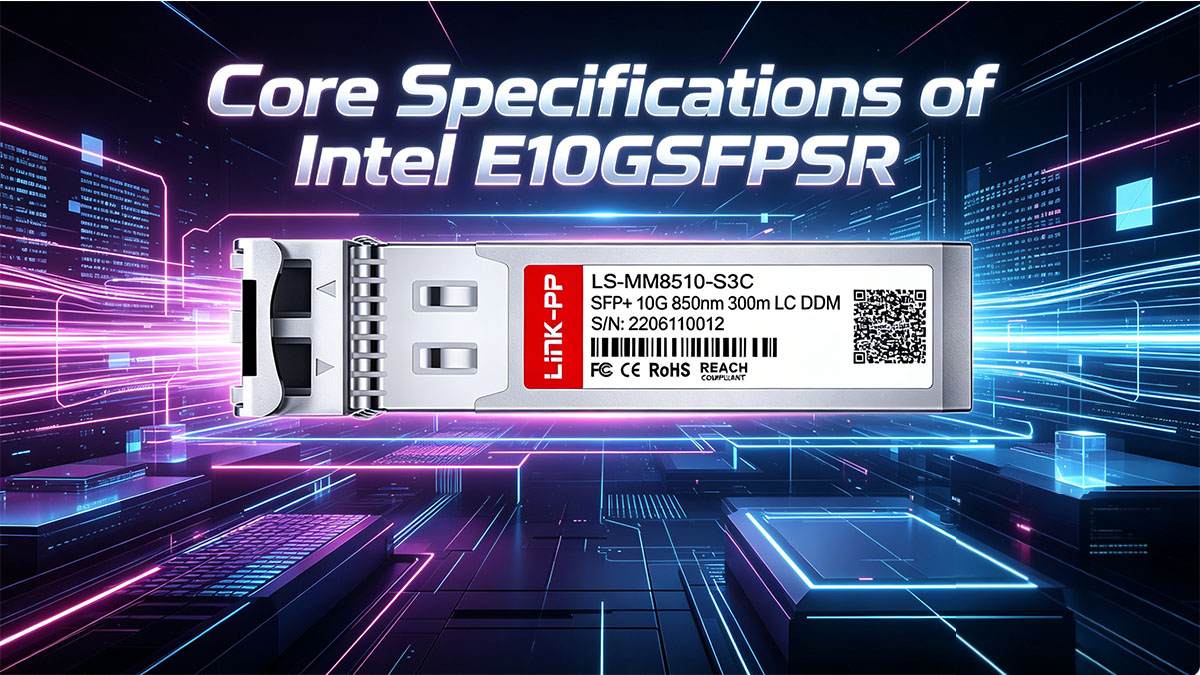
⏳ Core Specifications of Intel E10GSFPSR
The Intel E10GSFPSR is defined by a set of standardized 10Gbps optical parameters that ensure predictable performance in short-reach multimode fiber networks. In practical deployments, these specifications determine compatibility, transmission distance, power efficiency, and overall link stability.
Transmission Parameters
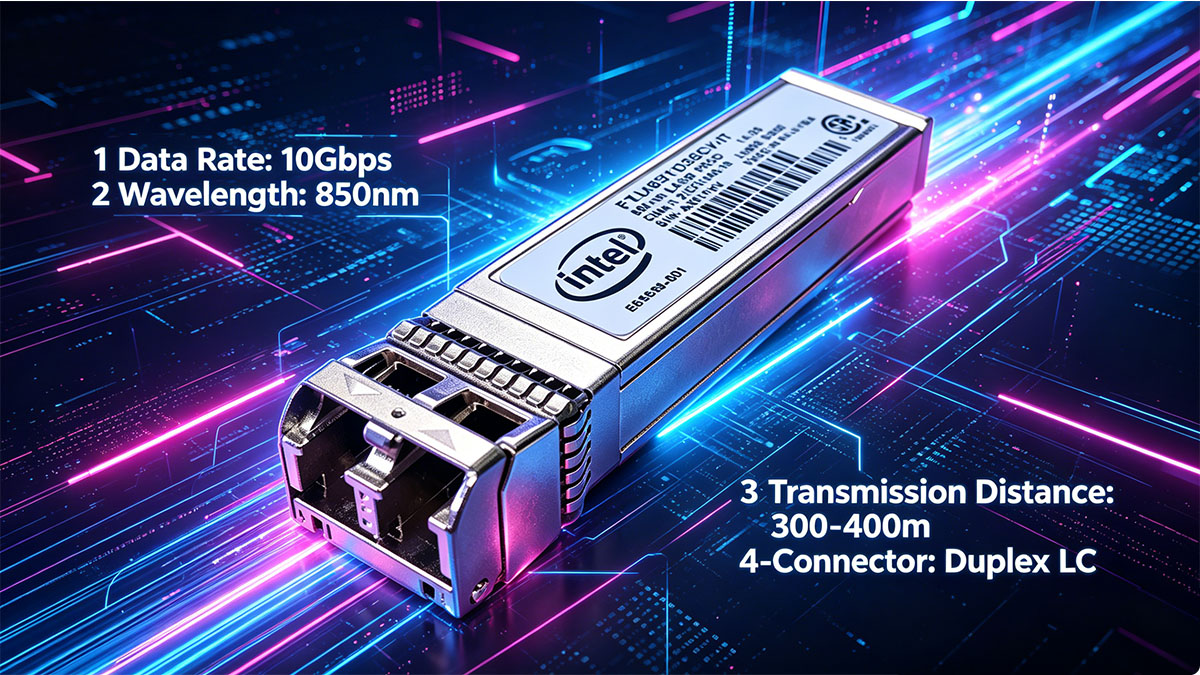
The core value of the Intel E10GSFPSR lies in its ability to deliver stable 10Gbps transmission over multimode fiber using 850nm VCSEL technology.
Before selecting or deploying this module, it is important to understand its fundamental transmission characteristics, which directly define its operating range and fiber requirements.
| Parameter | Specification | Notes on Usage |
|---|---|---|
| Data Rate | 10Gbps | 10G Ethernet compliant |
| Wavelength | 850nm | Optimized for multimode fiber (MMF) |
| Fiber Compatibility | OM3 / OM4 MMF | Higher-grade fiber extends reach |
| Maximum Distance | 300m (OM3), 400m (OM4) | Depends on fiber quality |
These parameters show that the module is specifically optimized for short-range, high-density environments rather than long-distance transmission. The use of OM4 fiber can significantly extend reach compared to OM3 due to lower modal dispersion.
Optical Performance Metrics
Beyond basic transmission specifications, optical performance metrics define how reliably the Intel E10GSFPSR operates within a real network environment.
Key parameters such as transmit power, receiver sensitivity, and optical budget directly impact link stability and error rates.
| Optical Parameter | Typical Range | Functional Impact |
|---|---|---|
| Transmit Power (Tx) | -7.3 to -1 dBm | Determines signal strength output |
| Receiver Sensitivity | ≤ -11.1 dBm | Defines minimum detectable signal |
| Optical Budget | ~3.8 to 7 dB | Maximum allowable link loss |
| Link Margin | Application-dependent | Ensures stable operation buffer |
A well-designed link should always maintain sufficient optical budget margin to account for connector loss, patch panel insertion loss, and fiber attenuation. Insufficient margin is one of the most common causes of intermittent link failures in real deployments.
Interface and Form Factor
The Intel E10GSFPSR follows industry-standard SFP+ mechanical and electrical specifications, ensuring broad interoperability across networking equipment.
Understanding its interface design is essential for ensuring correct physical deployment and compatibility.
| Interface Element | Specification | Practical Meaning |
|---|---|---|
| Form Factor | SFP+ | Hot-swappable compact module |
| Connector Type | LC Duplex | Standard duplex optical interface |
| Protocol Support | IEEE 802.3ae | 10GBASE-SR compliance |
| Hot-Pluggable | Yes | Enables live replacement |
This standardized design allows the module to be deployed across a wide range of switches, routers, and network interface cards without requiring hardware redesign or system downtime.
Power Consumption and Thermal Characteristics
In high-density deployments, power efficiency and heat dissipation become critical factors, especially when dozens or hundreds of modules are used within a single switch chassis.
The Intel E10GSFPSR is designed to maintain low power consumption while ensuring stable thermal performance.
Typical operating characteristics include:
- Power consumption: typically under 1W per module
- Operating temperature: 0°C to 70°C (commercial grade)
- Thermal behavior: stable under high port density with proper airflow
From an engineering perspective, lower power consumption directly reduces heat generation, which in turn improves system reliability and reduces cooling requirements. However, in high-density switch environments, proper airflow design remains essential to prevent thermal accumulation that can degrade optical performance over time.
⏳ Understanding Key Parameters in Practice
The technical specifications of the Intel E10GSFPSR only become meaningful when they are applied in real network environments. In practical deployments, parameters such as wavelength, fiber type, and optical budget directly determine whether a link will be stable, cost-efficient, and scalable. Understanding these relationships helps prevent common deployment issues and ensures optimal performance in 10G data center networks.
Why 850nm Matters in Short-Reach Optics
The 850nm wavelength used in the Intel E10GSFPSR is specifically chosen for multimode fiber transmission because it offers a balance between cost efficiency and short-distance performance.
In practical terms, this wavelength enables the use of VCSEL-based transmitters, which are simpler and more economical than long-wavelength laser systems. It is particularly suitable for intra-data center connections where distances are limited but port density is high.
The key implications of 850nm operation can be summarized as follows:
- Enables low-cost multimode fiber infrastructure
- Supports high-density short-range connectivity
- Optimized for VCSEL laser efficiency and stability
- Limited reach compared to 1310nm single-mode optics
While 850nm is not designed for long-distance transmission, it provides an ideal trade-off for short-reach environments where scalability and cost control are more important than extended range.
Multimode Fiber Compatibility Explained
The performance of the Intel E10GSFPSR is closely tied to the quality and type of multimode fiber used in the network. Differences between OM3 and OM4 fiber can significantly affect achievable transmission distance and signal stability.
Before selecting fiber types, it is important to understand how bandwidth and modal dispersion impact real-world performance.
| Fiber Type | Effective Bandwidth | Maximum Reach (10G) | Practical Use Case |
|---|---|---|---|
| OM3 | 2000 MHz·km | Up to 300m | Standard data center links |
| OM4 | 4700 MHz·km | Up to 400m | High-performance environments |
From a deployment perspective, OM4 fiber provides better signal integrity over longer distances due to reduced modal dispersion. However, OM3 remains widely used because it offers sufficient performance for most rack-to-rack connections at a lower cost.
Proper fiber selection ensures that the optical link remains within the module's power budget and avoids unexpected degradation over distance.
Optical Budget and Link Stability
The optical budget is one of the most critical factors in ensuring reliable operation of the Intel E10GSFPSR, as it defines the maximum allowable loss between transmitter and receiver.
In practical deployments, maintaining sufficient margin is essential to compensate for real-world losses caused by connectors, patch panels, and fiber attenuation.
A simplified breakdown of link budget considerations includes:
- Transmit power output from the SFP+ module
- Fiber attenuation per kilometer
- Connector and splice insertion losses
- Safety margin for aging and environmental variation
When these factors exceed the allowable optical budget, issues such as intermittent connectivity, increased bit error rates, or complete link failure may occur.
To ensure stable operation, engineers typically follow these guidelines:
- Keep total link loss well within specified optical budget
- Minimize unnecessary connectors in the path
- Regularly inspect and clean LC connectors
- Use high-quality patch cords with certified performance
Maintaining a proper optical budget is not only about meeting specifications but also about ensuring long-term stability in dynamic, high-density network environments.
⏳ Compatibility and Interoperability
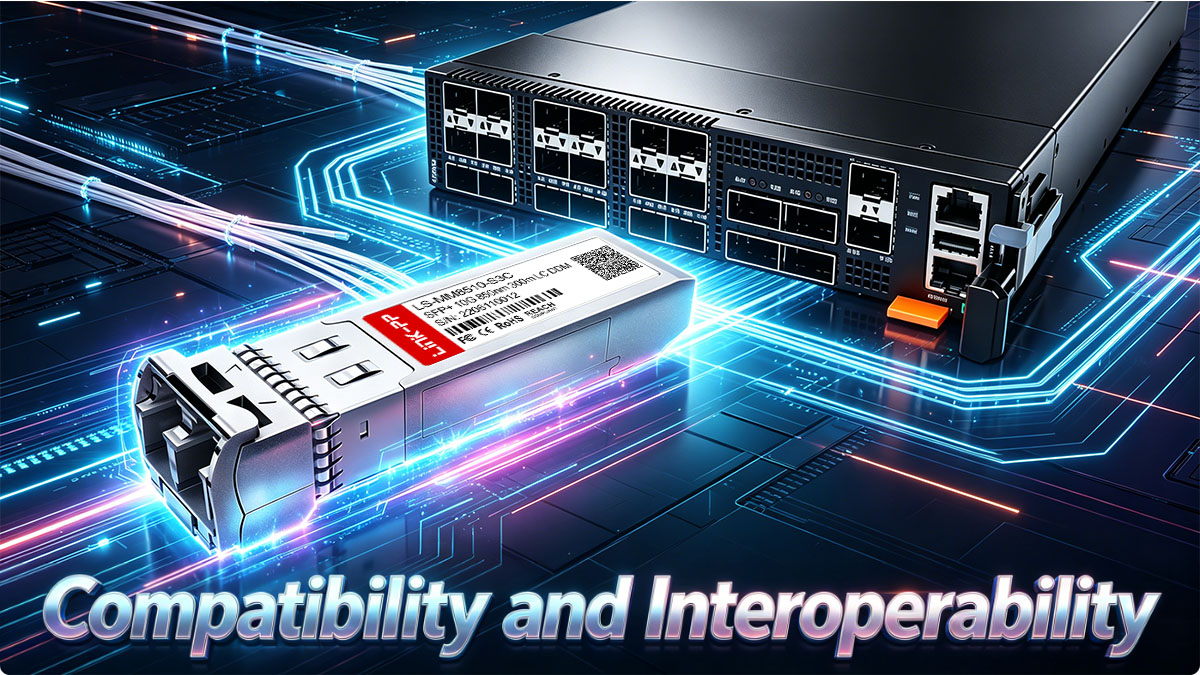
The Intel E10GSFPSR is widely used not only because of its optical performance, but also because of its strong compatibility with a broad range of networking devices. In real deployments, interoperability determines whether a module can operate reliably across different vendors, switch platforms, and network architectures without configuration complexity or link instability.
Intel Switch and NIC Compatibility
The Intel E10GSFPSR is primarily designed for seamless integration within Intel-based networking ecosystems, including Intel Ethernet adapters and compatible switch platforms. In these environments, it typically delivers plug-and-play functionality with minimal configuration requirements.
In practical use, compatibility depends on both hardware support and firmware recognition, which ensures the module is properly identified and operated within expected parameters.
Common compatibility considerations include:
- Support on Intel 10GbE network interface cards (NICs)
- Recognition by Intel Ethernet switch platforms
- Firmware-level validation of optical modules
- Stable operation under standard 10GBASE-SR configurations
When properly matched, the module can operate with full performance without requiring manual tuning, making it suitable for enterprise and data center environments where operational simplicity is critical.
Third-Party Device Compatibility
Beyond Intel ecosystems, the E10GSFPSR is often deployed in mixed-vendor environments, including switches and routers from vendors such as Cisco, Arista, and Juniper. In these cases, interoperability depends on standard compliance and transceiver coding compatibility.
To better understand real-world interoperability factors, the following table outlines key considerations:
| Compatibility Factor | Impact on Deployment | Practical Consideration |
|---|---|---|
| IEEE 802.3ae Standard | Ensures protocol alignment | Required for 10GBASE-SR operation |
| EEPROM Coding | Device recognition by switch | Must match vendor expectations |
| Optical Specifications | Signal integrity and link stability | Must align with SR requirements |
| Firmware Restrictions | May block unsupported modules | Can affect plug-and-play behavior |
In practice, many interoperability issues are not related to optical performance, but rather to vendor-specific firmware restrictions or coding validation rules. Ensuring correct module identification is therefore essential for stable cross-platform deployment.
MSA Compliance and Its Importance
The Intel E10GSFPSR follows the SFP+ Multi-Source Agreement (MSA), which defines standardized mechanical, electrical, and optical specifications for transceiver modules. This compliance is one of the key reasons for its broad compatibility across different networking systems.
From a deployment perspective, MSA compliance ensures that:
- The module fits standard SFP+ cages without mechanical modification
- Electrical signaling follows industry-defined standards
- Optical performance remains consistent across vendors
- Basic interoperability is maintained across compliant devices
However, it is important to note that while MSA ensures physical and electrical compatibility, it does not guarantee full operational acceptance in all vendor ecosystems. Some network devices may still enforce additional validation layers.
As a result, MSA compliance provides a strong foundation for interoperability, but real-world compatibility is ultimately influenced by both hardware standards and vendor-specific software policies.
⏳ Performance Optimization Considerations
The Intel E10GSFPSR can deliver stable 10Gbps short-reach connectivity, but real-world performance depends heavily on how it is deployed within the network. Factors such as fiber quality, physical layout, airflow, and monitoring practices all influence link stability and long-term reliability. Optimizing these elements ensures the module operates consistently at its intended performance level.
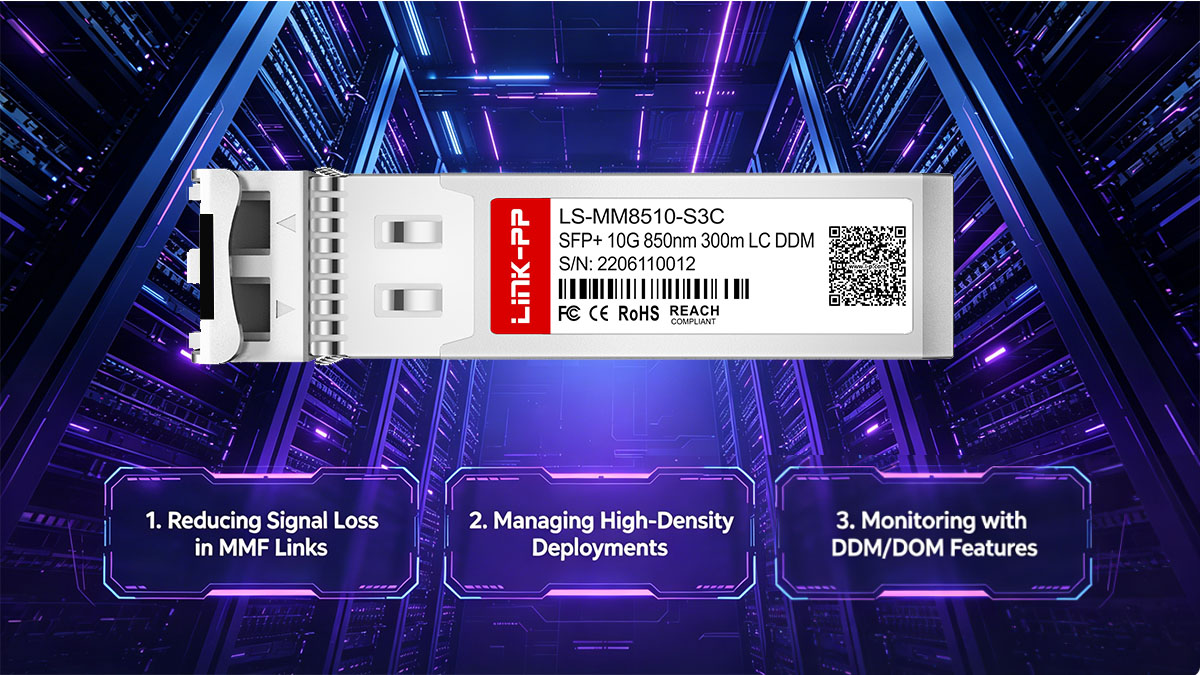
Reducing Signal Loss in MMF Links
In multimode fiber environments, signal loss is one of the most common causes of degraded performance. Although the Intel E10GSFPSR is designed to tolerate typical short-reach attenuation, excessive insertion loss can still reduce link margin and increase error rates.
To maintain optimal signal integrity, engineers typically focus on minimizing avoidable loss points within the optical path.
Key optimization practices include:
- Using high-quality OM3 or OM4 certified fiber cables
- Limiting the number of patch panels in the link path
- Ensuring LC connectors are clean and properly seated
- Avoiding tight bends or physical stress on fiber cables
These practices help preserve optical power within the allowable budget and reduce the risk of intermittent connectivity issues, especially in dense rack environments.
Managing High-Density Deployments
In modern data centers, the Intel E10GSFPSR is often deployed in high-density switch configurations where dozens of optical modules operate in close proximity. In such environments, thermal and physical layout considerations become critical to maintaining stable performance.
Before scaling deployments, it is important to evaluate airflow and heat dissipation capacity within the switch chassis.
A practical optimization checklist includes:
- Ensuring front-to-back or side-to-side airflow alignment
- Avoiding blocked ventilation near SFP+ cages
- Distributing high-power modules evenly across ports
- Monitoring ambient rack temperature regularly
Proper thermal management prevents localized overheating, which can impact optical output stability and reduce module lifespan. Even though the E10GSFPSR typically consumes less than 1W, cumulative heat in dense configurations can still become significant.
Monitoring with DDM/DOM Features
One of the most effective ways to maintain long-term performance stability is through continuous monitoring using Digital Diagnostics Monitoring (DDM) or Digital Optical Monitoring (DOM) capabilities.
These built-in diagnostic features provide real-time visibility into key operating parameters, enabling proactive maintenance before failures occur.
Typical monitored metrics include:
- Transmit optical power (Tx Power)
- Receive optical power (Rx Power)
- Module temperature
- Supply voltage
These parameters help network operators identify early signs of degradation, such as weakening optical signals or abnormal temperature increases. For example, a gradual decline in received power may indicate fiber contamination or connector wear.
By integrating DDM data into network monitoring systems, operators can shift from reactive troubleshooting to predictive maintenance, significantly improving overall network reliability and uptime in 10G environments.
⏳ Comparison with Similar 10G SFP+ Modules
The Intel E10GSFPSR is one of several 10G SFP+ short-reach solutions available on the market, and its real-world value becomes clearer when compared with alternative optical and copper transceivers. In practical deployments, the choice between SR, LR, DAC, and AOC modules is mainly driven by distance requirements, cost efficiency, power consumption, and cabling complexity.
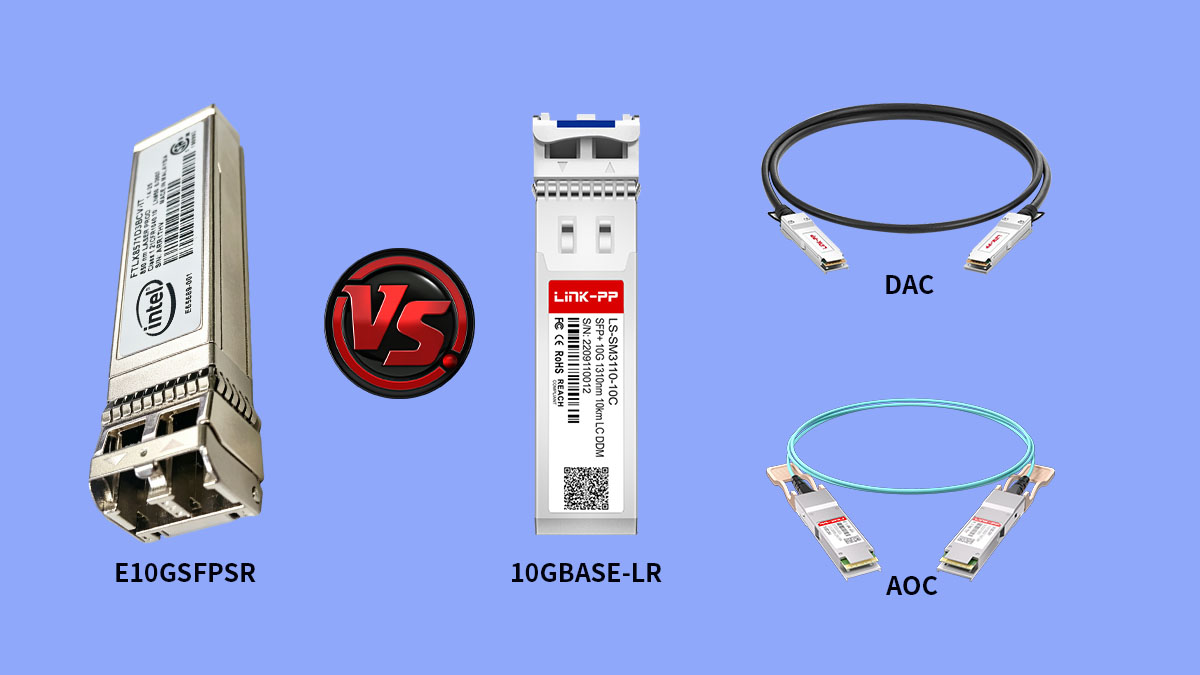
SR vs LR vs DAC vs AOC in 10G Networks
The Intel E10GSFPSR belongs to the 10GBASE-SR category, which is optimized for multimode fiber short-distance transmission. To understand its position, it is useful to compare it with other widely used 10G interconnect types.
| Module Types | Medium | Max Distance | Power Consumption | Typical Use Case |
|---|---|---|---|---|
| SR (E10GSFPSR) | Multimode Fiber (850nm) | 300–400m | ~1W | Intra-data center links |
| LR | Single-mode Fiber (1310nm) | Up to 10km | ~1W | Campus or inter-building links |
| DAC | Twinax Copper | 1–7m | <0.1W | In-rack server connections |
| AOC | Active Optical Cable | Up to 100m | 1–2W | Inter-rack simplified cabling |
From a deployment perspective, SR optics like the Intel E10GSFPSR are positioned between ultra-short DAC solutions and long-range LR optics, making them ideal for structured data center fiber layouts where flexibility and scalability are required.
Key Differences Between SR and LR Modules
Although both SR and LR modules operate at 10Gbps SFP+ interfaces, they differ significantly in wavelength, fiber type, and deployment scope. These differences directly influence network design decisions.
- SR modules (including E10GSFPSR) use 850nm VCSEL lasers and multimode fiber
- LR modules use 1310nm lasers and single-mode fiber
- SR is optimized for short-reach, high-density environments
- LR is designed for long-distance backbone or campus connectivity
In practice, SR modules are preferred when devices are located within the same data center facility, while LR modules are used when fiber runs extend across buildings or long-distance aggregation layers.
SR vs DAC: Optical Flexibility vs Cost Efficiency
DAC (Direct Attach Copper) is often considered the most cost-efficient 10G interconnect, but it comes with strict distance limitations compared to SR optics like the Intel E10GSFPSR.
- DAC provides extremely low latency and power consumption
- SR provides significantly greater reach and flexible fiber routing
- DAC is limited to very short intra-rack connections
- SR supports structured cabling across racks and rows
From an engineering perspective, SR modules are more scalable in environments where future expansion or reconfiguration is expected, while DAC is best suited for fixed, short-distance server-to-switch links.
SR vs AOC: Modular Flexibility vs Integrated Design
AOC (Active Optical Cable) combines transceivers and fiber into a single integrated cable assembly, offering simplicity at the cost of flexibility.
- AOC reduces installation complexity with pre-terminated connectors
- SR allows independent fiber infrastructure and module replacement
- AOC is easier to deploy but harder to reconfigure or repair
- SR provides better long-term scalability in large networks
In contrast, the Intel E10GSFPSR allows network operators to independently manage fiber infrastructure and transceiver hardware, which is particularly valuable in large-scale or evolving data center environments.
⏳ Common Issues and Troubleshooting
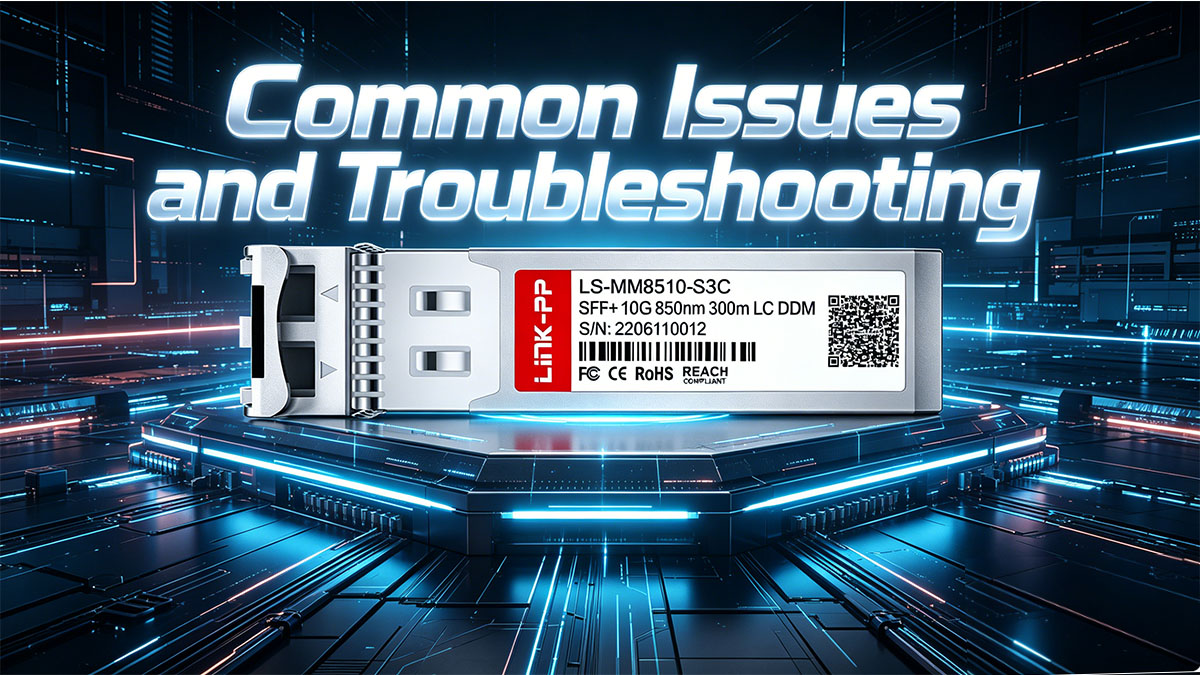
The Intel E10GSFPSR is generally stable in properly designed 10G networks, but real-world deployments can still encounter issues related to compatibility, optical loss, or environmental conditions. Most problems are not caused by the module itself, but by fiber infrastructure, configuration mismatches, or physical-layer degradation. Understanding these common failure scenarios helps reduce downtime and improves long-term network reliability.
Link Not Coming Up
A "link down" condition is one of the most frequently reported issues when deploying the Intel E10GSFPSR, especially in mixed-vendor environments or newly installed fiber links.
In most cases, this problem is related to compatibility or physical-layer mismatches rather than hardware failure.
Typical causes include:
- Incompatible or unsupported SFP+ coding on the switch or NIC
- Incorrect fiber type (e.g., using single-mode instead of multimode fiber)
- Improper module seating in the SFP+ cage
- Disabled or misconfigured port settings on the switch
A structured troubleshooting approach helps isolate the issue quickly:
| Check Item | Expected Condition | Action if Failed |
|---|---|---|
| Module detection | Recognized by device | Reinsert or verify compatibility |
| Fiber type | OM3/OM4 multimode | Replace with correct fiber |
| Port configuration | Auto/10G enabled | Adjust switch settings |
| Physical connection | Secure LC insertion | Clean and reseat connectors |
In practice, the majority of link-up issues are resolved by verifying fiber type and ensuring proper vendor compatibility.
High Bit Error Rate (BER)
A high bit error rate typically indicates signal degradation rather than complete link failure. While the link may appear operational, data integrity is compromised, leading to retransmissions or application-level performance issues.
Common contributing factors include:
- Dirty or contaminated LC connectors
- Excessive insertion loss in the optical path
- Fiber bends exceeding minimum bend radius
- Near-threshold optical power levels
To stabilize the link, engineers typically perform the following corrective actions:
- Clean both transmitter and receiver LC connectors using approved cleaning tools
- Recalculate optical budget to ensure sufficient margin
- Inspect fiber routing for sharp bends or physical stress points
- Replace aging or low-quality patch cables
In many cases, improving physical cleanliness and reducing loss points immediately restores acceptable BER levels.
Overheating Problems
Although the Intel E10GSFPSR is designed for low power consumption, overheating can still occur in dense switch environments where airflow is restricted or multiple high-density modules operate simultaneously.
Thermal issues often develop gradually and may lead to intermittent performance degradation before complete failure.
Key causes include:
- Insufficient airflow within the switch chassis
- High port density without proper thermal zoning
- Elevated ambient rack temperature
- Blocked ventilation near SFP+ cages
Recommended mitigation strategies:
- Ensure proper front-to-back or side-to-side airflow alignment
- Avoid clustering high-power modules in adjacent ports
- Maintain rack-level cooling within manufacturer specifications
- Monitor module temperature via DOM/DDM regularly
Sustained high temperatures can accelerate component aging and reduce optical stability, so thermal management is a critical part of long-term deployment planning.
Intermittent Connectivity Issues
Intermittent link flapping is often more difficult to diagnose because it may be caused by a combination of marginal optical conditions and environmental instability.
Typical root causes include:
- Marginal optical power near the lower sensitivity threshold
- Loose LC connectors or poor mechanical fit
- Aging fiber infrastructure with increased attenuation
- Electrical interference or unstable switch ports
A systematic debugging approach includes:
- Monitoring real-time Rx power fluctuations via DOM
- Testing with known-good patch cables and fibers
- Replacing connectors suspected of mechanical wear
- Verifying stability across multiple switch ports
Unlike complete link failures, intermittent issues usually indicate borderline optical conditions that require gradual optimization rather than immediate replacement of components.
⏳ Conclusion
The Intel E10GSFPSR is a 10GBASE-SR SFP+ optical transceiver designed for short-reach multimode fiber connectivity, widely used in modern data center and enterprise networks. Its value lies in delivering stable 10Gbps performance over OM3/OM4 fiber while maintaining low power consumption, strong interoperability, and predictable optical behavior. When compared with other 10G SFP+ options such as LR, DAC, and AOC, it consistently stands out as a balanced solution for scalable, high-density short-range networking.
To better summarize its role and technical value, the most important insights can be grouped as follows:
- Designed for short-range 10Gbps transmission using 850nm VCSEL technology
- Supports multimode fiber (OM3 up to 300m, OM4 up to 400m)
- Offers a balance between cost efficiency, flexibility, and scalability
- Requires proper optical budget management for stable performance
- Highly dependent on fiber quality, connector cleanliness, and correct deployment design
- Positioned between DAC (ultra-short reach) and LR (long-distance) solutions in 10G architectures
These points highlight that successful deployment is not only about the module itself, but also about how well it integrates into the overall optical infrastructure.
In modern 10G network design, choosing the right transceiver is a critical decision that directly impacts performance, scalability, and long-term operational stability. The Intel E10GSFPSR remains a widely adopted option because it effectively meets the demands of short-range, high-density data center environments while maintaining compatibility with industry-standard SFP+ infrastructure.
For network engineers and system designers seeking reliable optical interconnect solutions, understanding detailed specifications and real-world deployment considerations is essential for avoiding performance bottlenecks and ensuring long-term stability.
For further technical guidance, compatibility insights, and alternative optical module options, you may explore professional solutions available at the LINK-PP Official Store, where a wide range of SFP+ transceivers are provided for different network architectures and deployment requirements.