The rapid growth of cloud computing, artificial intelligence, and hyperscale data centers has significantly increased the demand for high-bandwidth network infrastructure. As data traffic inside modern data centers continues to surge, 400GbE networking has become a key technology for supporting large-scale east-west traffic between switches, servers, and compute clusters. Optical transceivers capable of delivering reliable short-reach connectivity are therefore essential for building efficient 400G network architectures.
A 400G DR4 transceiver is one of the most widely used optical modules for short-distance 400GbE links in data center environments. Designed for parallel single-mode fiber transmission, it uses four optical lanes operating at 100Gbps each to deliver an aggregated bandwidth of 400Gbps. With a typical reach of up to 500m, 400G DR4 modules provide a balance of high performance, efficient cabling, and scalable network design.
This guide explains what a 400G DR4 transceiver is, how it works, its key specifications, and where it is commonly deployed. It also compares 400G DR4 with other 400G optical modules and outlines important considerations for data center deployment.
? What Is a 400G DR4 Transceiver?
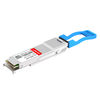
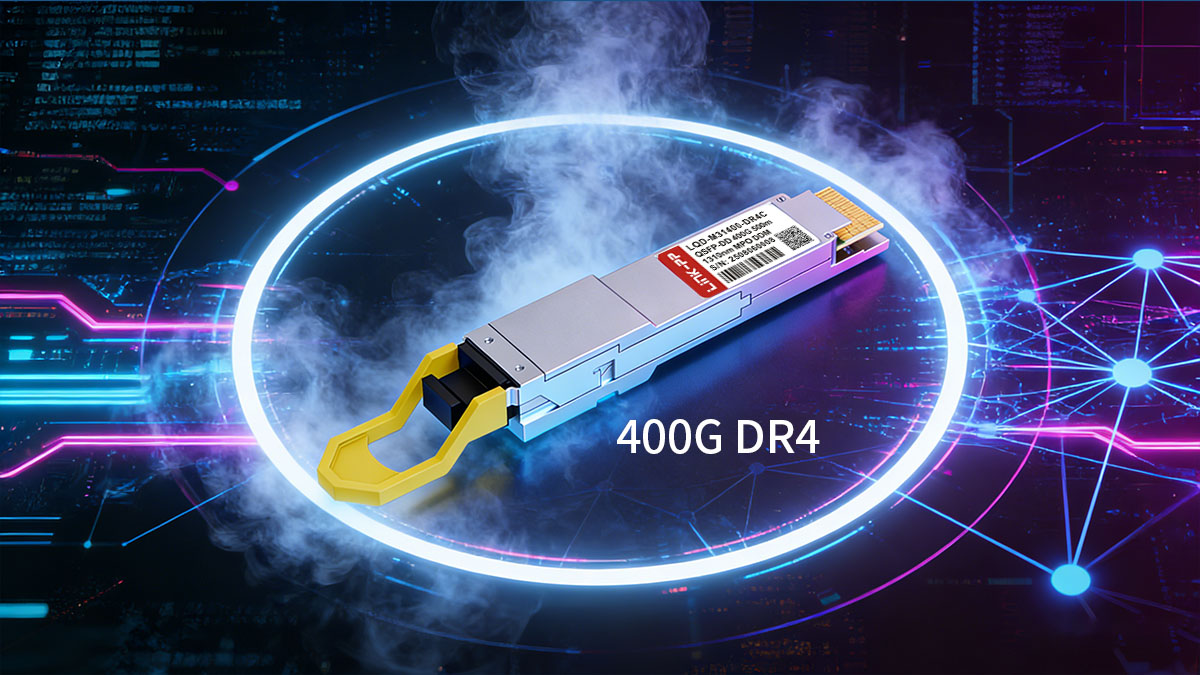
A 400G DR4 transceiver is a high-speed optical module designed for short-reach 400GbE connectivity in modern data centers. It converts high-speed electrical signals from network switches into optical signals transmitted over single-mode fiber, enabling reliable and high-bandwidth communication between switches, servers, and compute clusters.
Defined by the IEEE 802.3bs standard, the 400G DR4 optical module uses four parallel optical lanes, each carrying 100Gbps using PAM4 modulation. These lanes operate over single-mode fiber through an MPO-12 connector, delivering a total throughput of 400Gbps with a typical reach of up to 500m. Because of its balance between bandwidth, distance, and cabling efficiency, 400G DR4 is widely deployed in hyperscale and cloud data center networks.
Definition of 400G DR4 Optical Module
A 400G DR4 optical module is a parallel single-mode fiber transceiver built specifically for high-density 400GbE switch ports. It is commonly available in form factors such as QSFP-DD and OSFP and is optimized for short-distance data center interconnects.
Key characteristics include:
- Supports 400GbE Ethernet transmission
- Uses 4 × 100Gbps PAM4 optical lanes
- Designed for single-mode fiber (SMF)
- Provides up to 500m transmission distance
- Uses MPO-12 optical interface
These features make the 400G DR4 transceiver particularly suitable for spine-leaf architecture and high-bandwidth switching environments.
Key Technical Characteristics
The 400G DR4 transceiver follows a parallel optical transmission design that distributes data across multiple high-speed lanes. Each lane carries a portion of the total bandwidth, enabling the module to achieve 400Gbps throughput efficiently.
| Parameter |
400G DR4 Specification |
| Total Data Rate |
400Gbps |
| Optical Lanes |
4 Tx + 4 Rx |
| Modulation |
PAM4 |
| Maximum Reach |
500m over SMF |
This architecture allows the module to deliver high capacity while maintaining stable signal transmission over short distances commonly found within large data centers.
DR4 Naming Explained
The term DR4 reflects both the intended application and the internal optical architecture of the module.
- DR (Data Center Reach) indicates that the module is designed for short-reach connections within data centers rather than long-haul transmission.
- 4 refers to the number of optical lanes used for transmission.
In practical deployments, a 400G DR4 transceiver sends four 100Gbps optical signals in parallel over single-mode fiber and receives four signals simultaneously. This parallel design supports high bandwidth while keeping latency and power consumption within acceptable limits for high-density switching platforms.
? Key Specifications of a 400G DR4 Transceiver
A 400G DR4 transceiver is designed for high-speed, short-reach connectivity in modern data center networks. Its specifications focus on delivering 400Gbps bandwidth through parallel optics, while maintaining efficient power consumption and compatibility with high-density switch platforms.

Understanding the main specifications—including optical interface, wavelength, modulation technology, and form factor—helps network engineers design reliable 400GbE infrastructure.
Optical Interface and Fiber Type
A 400G DR4 transceiver uses parallel single-mode fiber transmission through an MPO interface. Unlike LC duplex sfp that use wavelength multiplexing, DR4 distributes traffic across multiple fibers to achieve higher throughput.
| Interface Parameter |
400G DR4 Specification |
| Connector Type |
MPO-12 |
| Active Fibers |
8 fibers (4 Tx + 4 Rx) |
| Fiber Type |
OS2 Single-mode fiber |
| Maximum Reach |
500m |
This configuration allows four fibers to transmit data and four fibers to receive data simultaneously. Although the connector contains 12 fiber positions, only eight fibers are used for optical transmission.
Parallel fiber connectivity is commonly deployed in structured data center cabling systems where high-density interconnects are required between switches.
Wavelength and Modulation Technology
400G DR4 modules operate in the 1310nm optical window, which offers stable signal transmission over single-mode fiber for short to medium distances. Instead of traditional NRZ signaling, DR4 relies on PAM4 modulation to increase data throughput per lane.
Key technical aspects include:
- Wavelength: typically around 1310nm
- Modulation format: PAM4 (Pulse Amplitude Modulation with 4 levels)
- Per-lane data rate: 100Gbps
- Number of optical lanes: 4 transmit + 4 receive
PAM4 encoding allows each symbol to carry two bits of data, effectively doubling the data rate compared with traditional NRZ modulation. This makes it possible to reach 400Gbps using only four optical lanes.
Power Consumption and Form Factors
To support modern high-density switching platforms, 400G DR4 transceivers are available in compact pluggable form factors with optimized power efficiency.
| Parameter |
Typical Specification |
| Supported Form Factors |
QSFP-DD |
| Electrical Interface |
8 × 50Gbps PAM4 |
| Typical Power Consumption |
10–15W |
| Port Density Support |
High-density 400G switches |
QSFP-DD and OSFP form factors allow network equipment manufacturers to integrate multiple 400G ports within a single switch chassis. These designs are widely used in hyperscale data centers where port density and power efficiency are critical factors.
Efficient thermal design and airflow management are also important when deploying large numbers of high speed optical transceiver in data center switches.
? How a 400G DR4 Transceiver Works
A 400G QSFP-DD DR4 transceiver converts high-speed electrical signals from a network switch into parallel optical signals transmitted over single-mode fiber. It uses four optical lanes, each carrying 100Gbps with PAM4 modulation, allowing the module to achieve a total throughput of 400Gbps.
The process involves electrical signal processing, optical transmission through parallel fibers, and signal recovery at the receiving end. These steps enable reliable high-speed communication between switches and servers in data center environments.

Electrical-to-Optical Signal Conversion
The first step occurs inside the switch ASIC and the transceiver’s internal signal processing components. High-speed electrical data is prepared for optical transmission.
Typical signal flow includes:
- The switch ASIC outputs 8 electrical lanes at 50Gbps PAM4.
- A gearbox inside the module converts these into 4 lanes at 100Gbps PAM4.
- The digital signal processor (DSP) performs signal conditioning, equalization, and error correction.
- Laser drivers convert the processed electrical signals into optical signals generated by four lasers.
This conversion stage ensures that the electrical data from the switch can be transmitted efficiently over optical fiber while maintaining signal integrity.
Parallel Optical Transmission
After conversion, the optical signals are transmitted through multiple fibers simultaneously. The DR4 architecture relies on parallel optics to distribute the total bandwidth across four independent channels.
| Transmission Component |
Function |
| Optical Lanes |
4 transmit + 4 receive |
| Data Rate per Lane |
100Gbps PAM4 |
| Fiber Type |
Single-mode fiber |
| Optical Connector |
MPO-12 |
Each transmit fiber carries a 100Gbps optical signal. Together, the four parallel lanes deliver the aggregated bandwidth required for a 400GbE connection.
This parallel transmission method reduces complexity compared with wavelength multiplexing approaches and is well suited for structured cabling systems commonly used in data centers.
Signal Reception and Processing
At the receiving end, the process is reversed to recover the transmitted data.
The main steps include:
- Photodiodes detect incoming optical signals from the four receive fibers.
- The signals are converted back into electrical form.
- The DSP performs signal equalization and error correction to compensate for optical impairments.
- A gearbox converts the data into electrical lanes compatible with the switch ASIC.
Through these processes, the receiving device reconstructs the original high-speed data stream. This architecture allows 400G DR4 transceivers to maintain reliable performance even in dense data center environments where large volumes of traffic are transmitted simultaneously.
? Typical Applications of 400G DR4 Transceivers
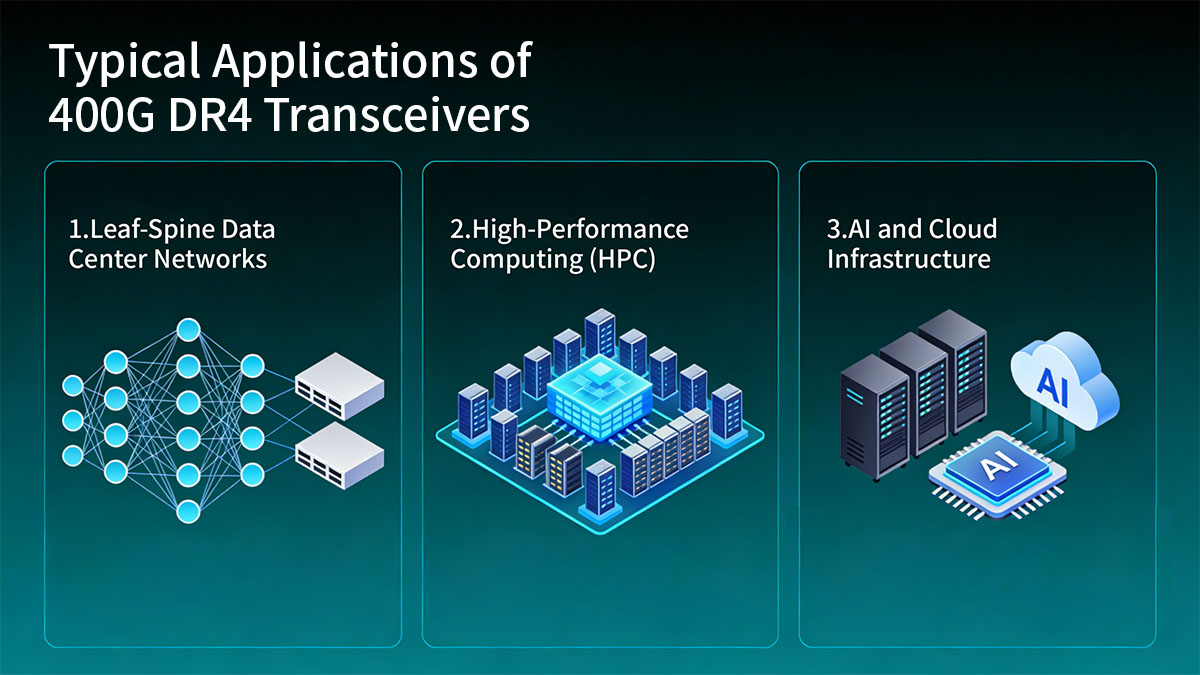
A 400G QSFP-DD DR4 transceiver is primarily deployed in environments that require high-bandwidth, short-reach optical connectivity over single-mode fiber. Its parallel optical architecture and 500m transmission capability make it particularly suitable for large-scale data centers where high-speed switch interconnections are essential.
These modules are widely used in hyperscale infrastructures, AI clusters, and high-performance computing environments where large volumes of east-west traffic must be transmitted efficiently.
Leaf-Spine Data Center Networks
One of the most common uses of 400G DR4 transceivers is within spine-leaf architecture in modern data centers. In this topology, leaf switches connect servers and storage devices, while spine switches provide high-capacity interconnection between leaf layers.
Typical deployment roles include:
- Leaf-to-spine connectivity for high-bandwidth switching
- Spine-to-spine links within large-scale network fabrics
- Short-distance switch interconnects inside a data center row or zone
| Deployment Scenario |
Role of 400G DR4 |
| Leaf to Spine |
High-capacity uplinks |
| Spine to Spine |
Core fabric interconnection |
| Intra-row switching |
Short-distance high-speed links |
Because most leaf-spine links in hyperscale data centers fall within a few hundred meters, the 500m reach of 400G DR4 modules fits well with typical structured cabling layouts.
High-Performance Computing (HPC)
High-performance computing environments require extremely fast data exchange between compute nodes. 400G DR4 transceivers help support these requirements by enabling low-latency, high-throughput communication across large clusters.
Common HPC deployment scenarios include:
- Compute cluster interconnects
- Storage network connectivity
- High-bandwidth backbone links inside supercomputing facilities
The use of single-mode fiber also allows HPC networks to maintain stable performance across larger facilities compared with multimode fiber-based solutions.
AI and Cloud Infrastructure
The rapid expansion of AI training systems and cloud computing platforms has increased the demand for high-speed data center interconnects. Large GPU clusters generate massive volumes of data that must be exchanged continuously during model training and distributed workloads.
Typical use cases in AI and cloud infrastructure include:
- GPU-to-GPU cluster networking
- High-speed connectivity between AI compute nodes
- Distributed storage and data processing networks
| Infrastructure Type |
Connectivity Requirement |
| AI training clusters |
Large east-west traffic |
| Cloud data centers |
High-density switch interconnects |
| Distributed storage systems |
High throughput and low latency |
Because 400G DR4 modules support dense 400GbE switch ports and parallel optical transmission, they provide a practical solution for building scalable networks that support data-intensive workloads.
? 400G DR4 vs Other 400G Optical Modules
A 400G DR4 transceiver is optimized for short-reach single-mode fiber links in data centers, but it is not the only 400G optical transceivers available. Other common options—such as 400G FR4, 400G SR8, and 400G LR4—are designed for different fiber types, distances, and network architectures.
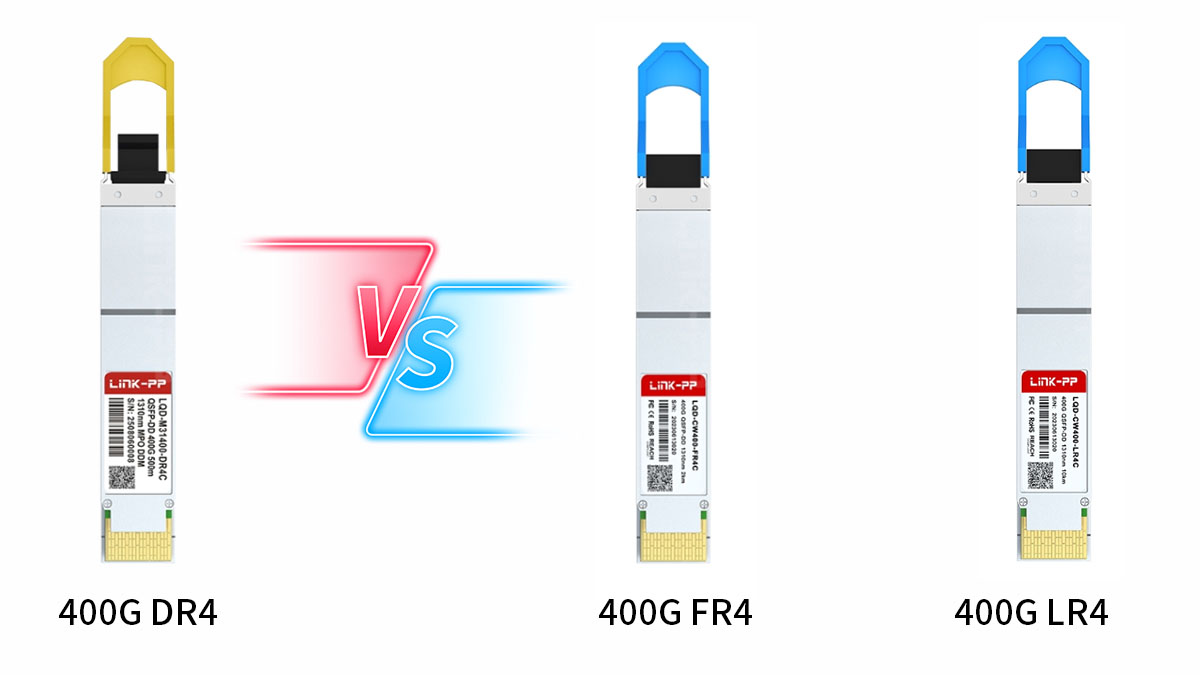
Understanding the differences between these 400G optics helps network designers select the most appropriate solution based on transmission distance, cabling infrastructure, and switch interface requirements.
400G DR4 vs 400G FR4
The main difference between 400G DR4 and 400G FR4 lies in their optical transmission method. DR4 uses parallel fibers, while FR4 uses wavelength multiplexing over duplex fiber.
| Feature |
400G DR4 |
400G FR4 |
| Fiber Type |
Single-mode fiber |
Single-mode fiber |
| Connector |
MPO-12 |
Duplex LC |
| Transmission Method |
Parallel optics |
CWDM4 wavelength multiplexing |
| Maximum Reach |
500m |
2km |
Because DR4 requires multiple fibers, it is often used in structured data center cabling environments where MPO infrastructure already exists. In contrast, FR4 optics is more suitable when duplex LC fiber connections are preferred and longer reach—up to 2km—is required.
400G DR4 vs 400G SR8
The difference between 400G DR4 and 400G SR8 primarily relates to the fiber type and transmission distance. SR8 modules are designed for multimode fiber and shorter connections within data centers.
| Feature |
400G DR4 |
400G SR8 |
| Fiber Type |
Single-mode fiber |
Multimode fiber |
| Connector |
MPO-12 |
MPO-16 |
| Optical Lanes |
4 Tx + 4 Rx |
8 Tx + 8 Rx |
| Maximum Reach |
500m |
100m |
SR8 modules are typically used for very short connections between switches inside the same rack or row. DR4 modules, on the other hand, support longer distances and are more suitable for large data center halls.
400G DR4 vs 400G LR4
The key difference between 400G DR4 and 400G LR4 is the intended transmission range. LR4 optics is designed for longer-distance connections that extend beyond typical data center boundaries.
| Feature |
400G DR4 |
400G LR4 |
| Fiber Type |
Single-mode fiber |
Single-mode fiber |
| Transmission Method |
Parallel optics |
Wavelength multiplexing |
| Connector |
MPO-12 |
Duplex LC |
| Maximum Reach |
500m |
10km |
LR4 modules are often used for campus networks, metro connections, or inter-building links. DR4 modules remain the preferred option for high-density, short-reach 400GbE connectivity within large data centers where parallel fiber infrastructure is available.
Overall, each 400G transceiver serve a specific networking scenario. DR4 provides an effective balance between bandwidth, reach, and cabling efficiency for many modern data center deployments.
? Advantages of Using 400G DR4 Transceivers
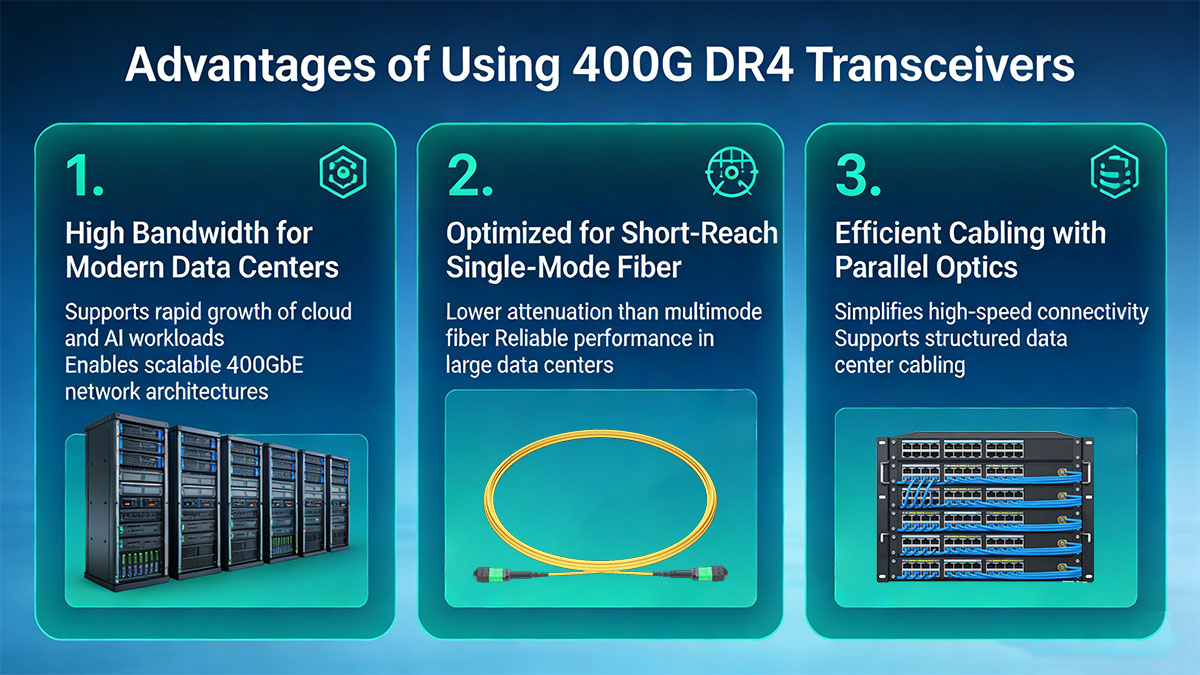
A 400G DR4 transceiver provides several advantages for modern data center networks, particularly in environments that require high bandwidth, short-reach connectivity, and scalable infrastructure. Its parallel optical design, support for single-mode fiber, and compatibility with high-density switch platforms make it a practical solution for many 400GbE deployments.
These advantages make 400G DR4 modules widely used in hyperscale data centers, cloud infrastructure, and AI computing environments.
High Bandwidth for Modern Data Centers
400G DR4 transceivers deliver 400Gbps of aggregate bandwidth, enabling data centers to support rapidly growing traffic volumes generated by cloud services, distributed computing, and AI workloads.
Key benefits include:
- Supporting high-capacity leaf–spine network architectures
- Reducing network bottlenecks in east–west traffic
- Enabling high-speed interconnection between switches and compute clusters
| Parameter |
400G DR4 Capability |
| Total Data Rate |
400Gbps |
| Optical Lanes |
4 × 100Gbps |
| Modulation |
PAM4 |
| Typical Reach |
500m |
By delivering high bandwidth through parallel optical lanes, these modules help data centers scale network capacity without significantly increasing hardware complexity.
Optimized for Short-Reach Single-Mode Fiber
Another major advantage of 400G DR4 modules is their optimization for short-distance transmission over single-mode fiber. Compared with multimode solutions, single-mode fiber provides better signal stability and lower attenuation over longer distances within large data center facilities.
Important characteristics include:
- Reliable transmission up to 500m over SMF
- Better scalability for large data center halls
- Reduced signal loss compared with multimode fiber
This capability allows network operators to design flexible data center layouts while maintaining stable high-speed connectivity.
Efficient Cabling with Parallel Optics
400G DR4 modules use parallel optical transmission, which distributes the data stream across multiple fibers. This design simplifies high-speed connectivity in structured cabling environments.
Typical cabling advantages include:
- High-density fiber connectivity using MPO interfaces
- Efficient support for large-scale switch interconnections
- Compatibility with pre-terminated fiber trunk cabling systems
| Cabling Aspect |
Benefit |
| MPO Interface |
Supports parallel fiber transmission |
| Fiber Architecture |
Suitable for structured cabling |
| Port Density |
Enables dense 400G switch deployments |
Parallel fiber connectivity is widely used in hyperscale data centers because it supports scalable cabling infrastructure while maintaining consistent performance for high-speed Ethernet links.
? Key Considerations When Deploying 400G DR4 Modules
Deploying a 400GBASE DR4 transceiver requires careful planning of fiber infrastructure, hardware compatibility, and thermal management. Although DR4 modules are designed for efficient short-reach connectivity, improper cabling, unsupported hardware, or insufficient cooling can affect network performance.
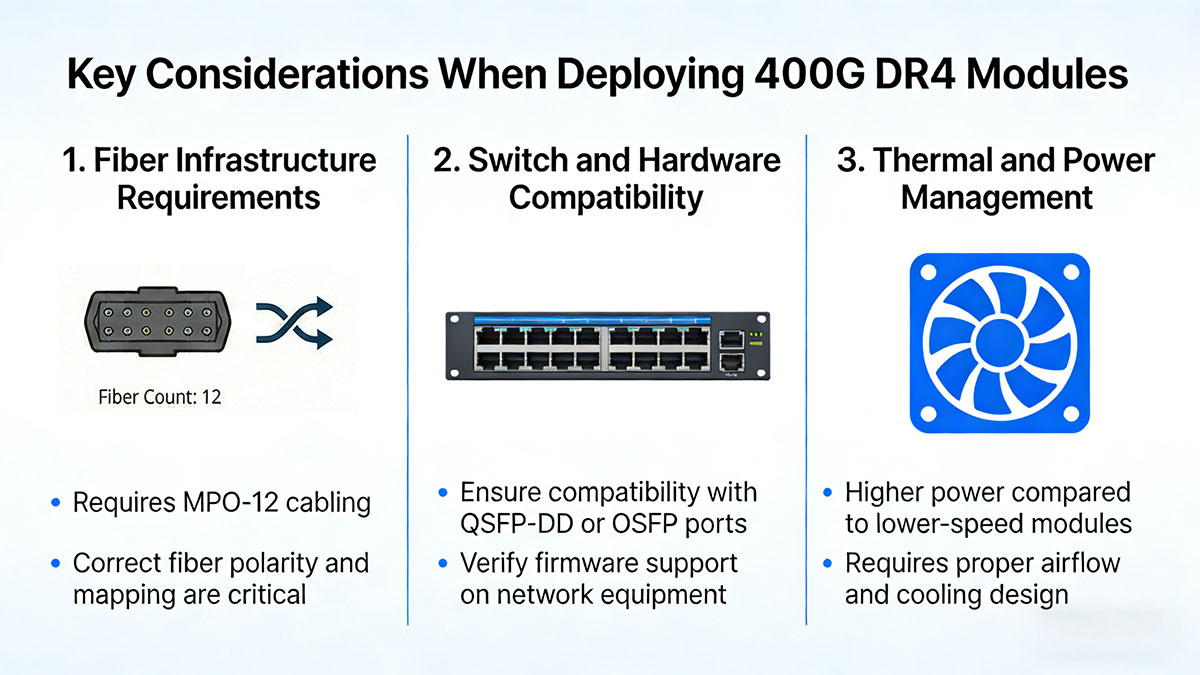
Understanding these key factors helps ensure stable operation and efficient integration within 400GbE data center networks.
Fiber Infrastructure Requirements
A 400G DR4 module relies on parallel single-mode fiber connections, which means the cabling system must support MPO-based fiber architecture. Correct fiber mapping and polarity are essential for proper signal transmission.
| Fiber Requirement |
Specification |
| Connector Type |
MPO-12 |
| Active Fibers |
8 fibers (4 Tx + 4 Rx) |
| Fiber Type |
Single-mode fiber (OS2) |
| Maximum Link Distance |
500m |
Because DR4 uses separate fibers for transmit and receive channels, the fiber trunk must maintain proper alignment between the transmitting and receiving lanes. In many deployments, pre-terminated MPO trunk cables are used to simplify installation and maintain consistent fiber polarity.
Network operators should also verify that the structured cabling layout within the data center can support parallel fiber connections between switch racks.
Switch and Hardware Compatibility
Before deploying 400G DR4 modules, it is important to ensure that the network equipment supports the appropriate optical interface and electrical signaling standard.
Key compatibility factors include:
- Supported form factor (QSFP-DD or OSFP ports on the switch)
- Electrical interface compatibility with the switch ASIC
- Firmware and operating system support for the module type
- Optical interface compatibility with MPO-based cabling
| Compatibility Aspect |
Deployment Consideration |
| Switch Port Type |
QSFP-DD or OSFP |
| Electrical Interface |
400GbE PAM4 signaling |
| Firmware Support |
Required for module recognition |
| Port Density |
High-density switch platforms |
Verifying compatibility before installation helps avoid issues such as module detection errors or unsupported interface configurations.
Thermal and Power Management
High-speed optical modules generate more heat than lower-speed transceivers, making thermal management an important consideration in dense switching environments.
Typical operating characteristics include:
- Power consumption typically between 10W and 15W
- Increased heat generation in high-density switch chassis
- Dependence on adequate airflow within the equipment rack
| Thermal Factor |
Consideration |
| Typical Power Consumption |
10–15W |
| Cooling Method |
Switch airflow design |
| Deployment Density |
Multiple 400G ports per switch |
| Rack Environment |
Adequate ventilation required |
Proper airflow design, rack spacing, and switch cooling mechanisms help maintain stable operating temperatures for optical modules. In large data center deployments with many 400G ports, thermal planning becomes an important part of network infrastructure design.
? Future Outlook of 400G DR4 in Optical Networking
As data center traffic continues to grow due to cloud computing, artificial intelligence, and distributed applications, high-speed optical interconnect technologies remain a critical part of modern network infrastructure. The 400G DR4 transceiver plays an important role in supporting scalable short-reach connectivity within large data centers.
Although newer technologies such as 800GbE are emerging, 400G DR4 modules are expected to remain widely deployed due to their balance of performance, cost efficiency, and compatibility with existing fiber infrastructure.
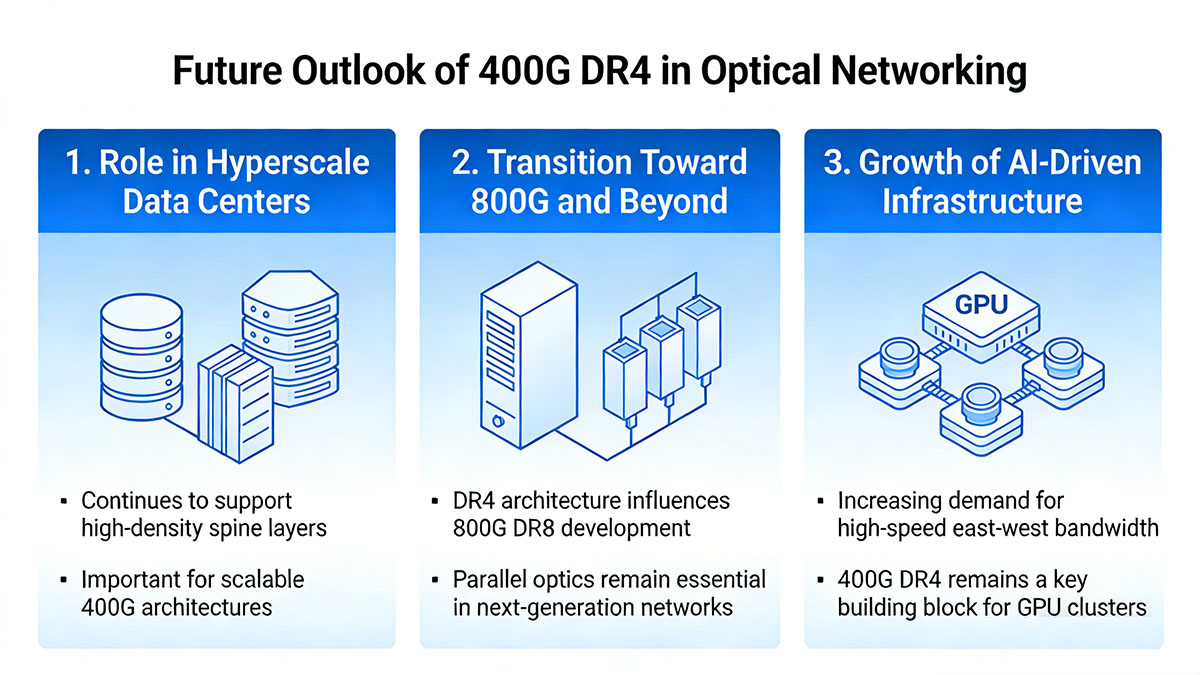
Role in Hyperscale Data Centers
Hyperscale data centers require large numbers of high-speed switch ports to handle massive east–west traffic flows between servers and storage systems. In these environments, 400G DR4 modules provide reliable short-distance connectivity between switches.
Typical roles in hyperscale environments include:
- Leaf-to-spine interconnections supporting high-capacity switching fabrics
- Spine-layer aggregation links in large network fabrics
- Short-reach backbone connections across data center rows or zones
| Infrastructure Layer |
Typical Use of 400G DR4 |
| Leaf Layer |
High-speed server aggregation |
| Spine Layer |
Fabric interconnection |
| Data Center Backbone |
Short-distance switch links |
Because many hyperscale deployments rely on structured fiber systems with MPO connectivity, DR4 modules continue to integrate well with existing data center cabling designs.
Transition Toward 800G and Higher Speeds
The development of next-generation Ethernet technologies is pushing the industry toward 800GbE and even higher data rates. However, the architecture used in 400G DR4 modules provides an important foundation for these future optical technologies.
Key technology trends include:
- Evolution from 400G DR4 (4 × 100Gbps) to 800G DR8 (8 × 100Gbps)
- Continued adoption of PAM4 modulation for higher-speed transmission
- Increased demand for parallel optical architectures
| Technology Generation |
Optical Lane Structure |
| 400G DR4 |
4 × 100Gbps PAM4 |
| 800G DR8 |
8 × 100Gbps PAM4 |
| Future 1.6T Modules |
Higher lane counts and advanced DSP |
This evolution shows how parallel optics will remain an important design approach for scaling network speeds in data centers.
Growth of AI-Driven Infrastructure
Artificial intelligence workloads are creating new demands for extremely high bandwidth within data centers. Large GPU clusters used for model training require rapid data exchange between compute nodes, storage systems, and networking devices.
Key infrastructure trends include:
- Rapid expansion of AI training clusters
- Increased demand for high-bandwidth east–west traffic
- Larger GPU-to-GPU communication networks
| AI Infrastructure Component |
Networking Requirement |
| GPU Clusters |
High-throughput interconnects |
| Distributed Storage |
Large data transfer capacity |
| AI Training Systems |
Low latency and high bandwidth |
Because 400G DR4 modules support high-density 400GbE ports and efficient short-reach connectivity, they remain an important building block for data center networks that support large-scale AI and cloud computing workloads.
? FAQs About 400G DR4 Transceivers
What does DR4 mean in a 400G DR4 transceiver?
DR4 stands for Data Center Reach with four optical lanes. It indicates a 400GbE optical module designed for short-distance single-mode fiber connections using four parallel transmit and receive channels.
How many fibers does a 400G DR4 transceiver use?
A 400G DR4 transceiver uses 8 active fibers—four for transmission and four for reception—through an MPO-12 connector.
What modulation format is used in 400G DR4 modules?
400G DR4 modules use PAM4 (Pulse Amplitude Modulation with four levels), allowing each optical lane to transmit 100Gbps of data.
Can a 400G DR4 transceiver be used with duplex LC fiber?
No. 400G DR4 modules require MPO-based parallel fiber connections, so they are not compatible with duplex LC fiber links.
What form factors support 400G DR4 optical modules?
400G DR4 modules are commonly available in QSFP-DD and OSFP form factors, both designed for high-density 400GbE switch ports.
Is 400G DR4 suitable for multimode fiber networks?
No. 400G DR4 modules are designed specifically for single-mode fiber (SMF) and are not intended for multimode fiber environments.
What type of network architecture commonly uses 400G DR4?
400G DR4 transceivers are widely used in leaf–spine data center network architectures, where high-bandwidth connections between switches are required.
? Conclusion
The 400G DR4 transceiver has become an important component in modern 400GbE data center networks. By using four parallel 100Gbps optical lanes over single-mode fiber, it provides a practical balance between bandwidth, transmission distance, and cabling efficiency. With support for up to 500m links and compatibility with high-density switch platforms such as QSFP-DD and OSFP, 400G DR4 optics are well suited for leaf–spine architectures, hyperscale infrastructures, and high-performance computing environments.
As cloud services, AI workloads, and large-scale data processing continue to expand, reliable short-reach optical interconnects will remain essential. Technologies like 400G DR4 help network operators scale their infrastructure while maintaining efficient and stable high-speed connectivity inside data centers.
For readers who want to explore detailed specifications and compatible optical modules for different networking environments, the LINK-PP Official Store provides additional technical resources and product information related to 400G optical transceivers and data center connectivity solutions.