In modern high-speed networking environments, reliable short-distance connectivity plays a critical role in ensuring stable data transmission and efficient infrastructure design. The SFBR-709SMZ-CS1 is a widely recognized 10GBASE-SR SFP+ optical transceiver designed to meet these demands, offering a balance of performance, cost efficiency, and deployment flexibility in enterprise and data center networks.
Operating at 10Gbps over an 850nm wavelength, the SFBR-709SMZ-CS1 is optimized for multimode fiber (MMF) applications, typically supporting transmission distances of up to 300m on OM3 fiber. Its compact SFP+ form factor and hot-pluggable capability make it a practical solution for high-density environments where scalability and ease of maintenance are essential.
As network architectures continue to evolve toward higher bandwidth and lower latency, understanding the technical characteristics, compatibility considerations, and real-world applications of modules like the SFBR-709SMZ-CS1 becomes increasingly important. This guide provides a detailed exploration of its specifications, core features, deployment scenarios, and optimization strategies, helping network professionals make informed decisions in 10G optical connectivity planning.
💢 What Is SFBR-709SMZ-CS1?
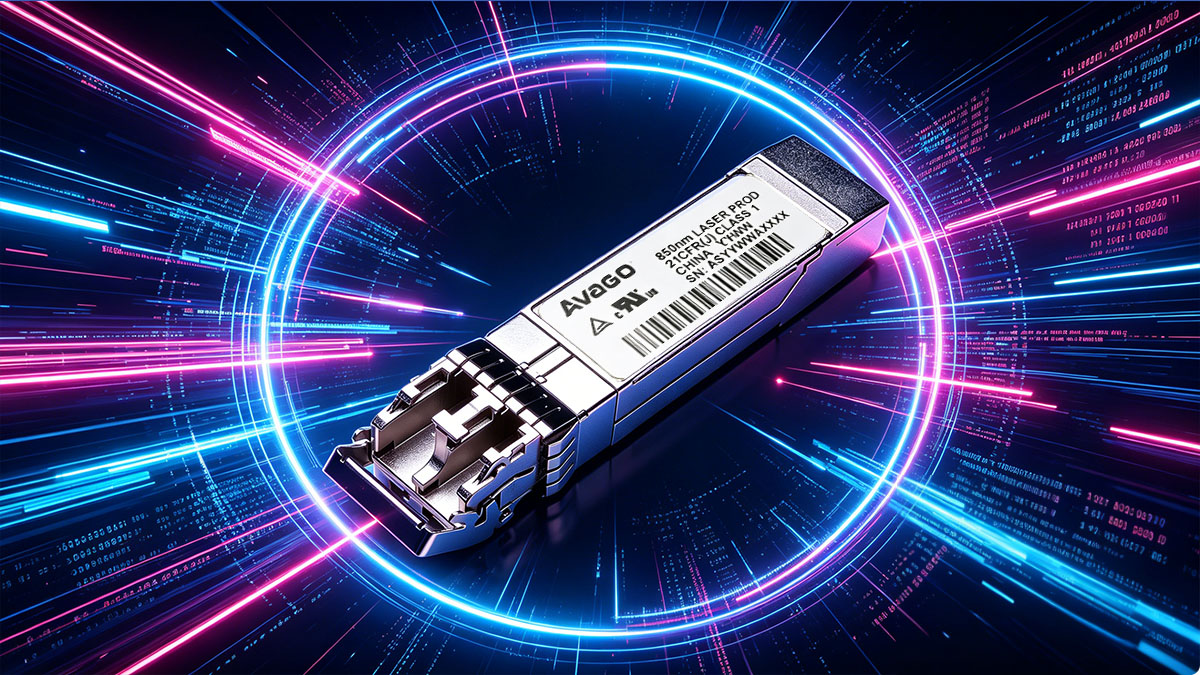
The SFBR-709SMZ-CS1 is a 10GBASE-SR SFP+ optical transceiver designed for high-speed data transmission over short distances using multimode fiber. It is commonly deployed in data centers and enterprise networks where reliable 10Gbps connectivity within racks or between nearby racks is required.
Product Overview
The SFBR-709SMZ-CS1 belongs to the SFP+ (Small Form-Factor Pluggable Plus) family and follows industry-standard MSA specifications, ensuring interoperability across a wide range of networking equipment. Originally developed under the Avago (now Broadcom) portfolio, it is widely recognized for its stability and consistent performance in demanding environments.
From a functional perspective, this module converts electrical signals from switches or network interface cards into optical signals for transmission over fiber, and vice versa. Its hot-pluggable design allows installation or replacement without shutting down network devices, which is essential for maintaining uptime in production environments.
Key Specifications
The core specifications of the SFBR-709SMZ-CS1 define its performance boundaries and deployment scenarios. The following table summarizes its primary technical parameters:
| Parameter |
Specification |
Notes |
| Data Rate |
10Gbps |
Supports 10G Ethernet |
| Wavelength |
850nm |
VCSEL laser source |
| Fiber Type |
Multimode (MMF) |
OM3 / OM4 supported |
| Max Distance |
Up to 300m |
Based on OM3 fiber |
| Connector Type |
Duplex LC |
Standard optical interface |
These specifications indicate that the module is optimized for short-reach, high-bandwidth applications rather than long-distance transmission.
10GBASE-SR Standard Explained
The SFBR-709SMZ-CS1 operates under the 10GBASE-SR standard defined in IEEE 802.3ae, which focuses on short-range optical communication over multimode fiber. This standard is specifically engineered for environments where high data throughput is required within limited physical distances.
Key characteristics of 10GBASE-SR include:
- Use of 850nm wavelength optimized for multimode fiber
- Support for relatively short transmission distances (typically up to 300m)
- Lower cost compared to long-reach optical standards such as 10GBASE-LR
- High compatibility with existing data center fiber infrastructure
These characteristics make 10GBASE-SR modules like the SFBR-709SMZ-CS1 particularly suitable for high-density deployments, where cost control, performance consistency, and ease of integration are all critical factors.
💢 Core Features and Advantages of SFBR-709SMZ-CS1
The SFBR-709SMZ-CS1 is widely adopted in 10G optical networks because it combines stable performance with practical deployment advantages. Its design focuses on efficient short-reach connectivity, low operational complexity, and compatibility with standard multimode fiber infrastructure.
High-Speed Data Transmission
The most fundamental advantage of the SFBR-709SMZ-CS1 is its ability to support 10Gbps transmission with consistent signal integrity. This ensures smooth handling of bandwidth-intensive applications such as virtualization, cloud computing, and high-volume data exchange between servers and switches.
From a practical networking perspective, this level of throughput is essential in environments where multiple users or services rely on shared infrastructure. The module maintains stable performance under continuous traffic loads, reducing the risk of bottlenecks in aggregation layers.
Optimized for Short-Distance Connectivity
The SFBR-709SMZ-CS1 is specifically designed for short-range optical links, typically within data centers or campus networks. Its 850nm VCSEL-based design allows efficient transmission over multimode fiber, especially OM3 and OM4 cabling.
To better understand its deployment suitability, the following comparison highlights typical short-reach use cases:
| Deployment Scenario |
Distance Range |
Fiber Type |
Typical Use Case |
| Intra-rack connection |
<10m |
OM3/OM4 |
Server-to-switch links |
| Inter-rack connection |
10–100m |
OM3 |
Top-of-Rack switching |
| Cross-room connection |
100–300m |
OM3/OM4 |
Aggregation layer links |
These scenarios demonstrate that the module is optimized for environments where long-distance transmission is not required but low latency and high throughput are critical.
Energy Efficiency and Thermal Performance
Another important advantage of the SFBR-709SMZ-CS1 is its relatively low power consumption compared to higher-reach optical modules. This makes it suitable for high-density deployments where thermal management is a key concern.
Key efficiency benefits include:
- Lower heat output, reducing cooling requirements in dense switch environments
- Stable optical performance under continuous operation
- Efficient VCSEL laser design optimized for short-reach transmission
In practical deployment, these characteristics help reduce overall operational costs while maintaining network stability.
Hot-Pluggable SFP+ Form Factor
The SFBR-709SMZ-CS1 uses a standard SFP+ hot-pluggable design, which significantly simplifies installation and maintenance. Network administrators can insert or remove the module without powering down the host device.
This feature provides several operational benefits:
- Minimizes network downtime during upgrades or replacements
- Enables flexible scaling of network ports
- Simplifies troubleshooting and module swapping in live environments
In modern data center operations, this flexibility is essential for maintaining high availability and efficient infrastructure management.
💢 Applications of SFBR-709SMZ-CS1
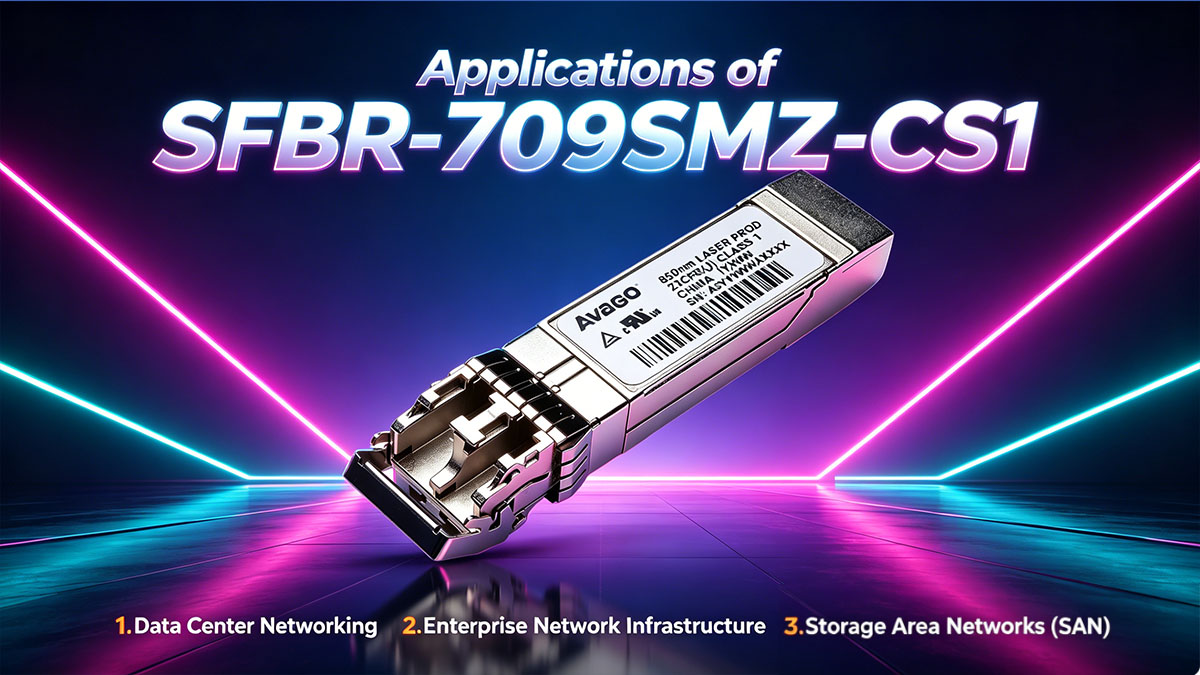
The SFBR-709SMZ-CS1 is primarily used in high-speed optical networks where short-reach 10Gbps connectivity is required. Its design makes it suitable for dense environments such as data centers, enterprise backbones, and storage systems, where stable and low-latency communication is essential.
Data Center Networking
In modern data centers, the SFBR-709SMZ-CS1 is commonly deployed to connect servers, switches, and aggregation devices. Its 10GBASE-SR capability supports high-throughput traffic between computing and storage layers, making it a key component in scalable architectures.
Typical data center use cases include:
- Server-to-top-of-rack (ToR) switch connections
- Inter-switch uplinks within the same rack row
- Leaf-spine architecture short-reach links
These applications benefit from the module's low latency and consistent bandwidth performance, which are essential for virtualization, cloud workloads, and distributed applications.
Enterprise Network Infrastructure
In enterprise environments, the SFBR-709SMZ-CS1 is often used to support backbone and aggregation layer connectivity. It helps organizations build reliable high-speed networks within office buildings, campuses, and multi-floor facilities.
A structured view of common enterprise applications is shown below:
This structure highlights how the module contributes to efficient traffic aggregation and backbone performance in medium to large-scale enterprise networks.
Storage Area Networks (SAN)
The SFBR-709SMZ-CS1 is also widely used in Storage Area Networks (SANs), where high-speed and low-latency communication between storage devices and servers is critical. It supports data-intensive workloads such as database replication, backup operations, and real-time analytics.
Key SAN-related use cases include:
- High-speed storage array interconnection
- Fibre Channel over Ethernet (FCoE) environments
- Backup and disaster recovery data transfer links
In these scenarios, consistent 10Gbps throughput helps ensure data integrity and reduces latency in storage operations, which is crucial for mission-critical applications.
Overall, the SFBR-709SMZ-CS1 plays a versatile role across multiple networking environments, with its strongest value appearing in short-distance, high-density, and performance-sensitive applications.
💢 Compatibility and Interoperability
The SFBR-709SMZ-CS1 is designed to operate within standardized SFP+ optical ecosystems, which makes compatibility and interoperability key advantages in multi-vendor network environments. In practice, its performance depends not only on its optical specifications but also on how well it integrates with switches, NICs, and existing fiber infrastructure.
Vendor Compatibility
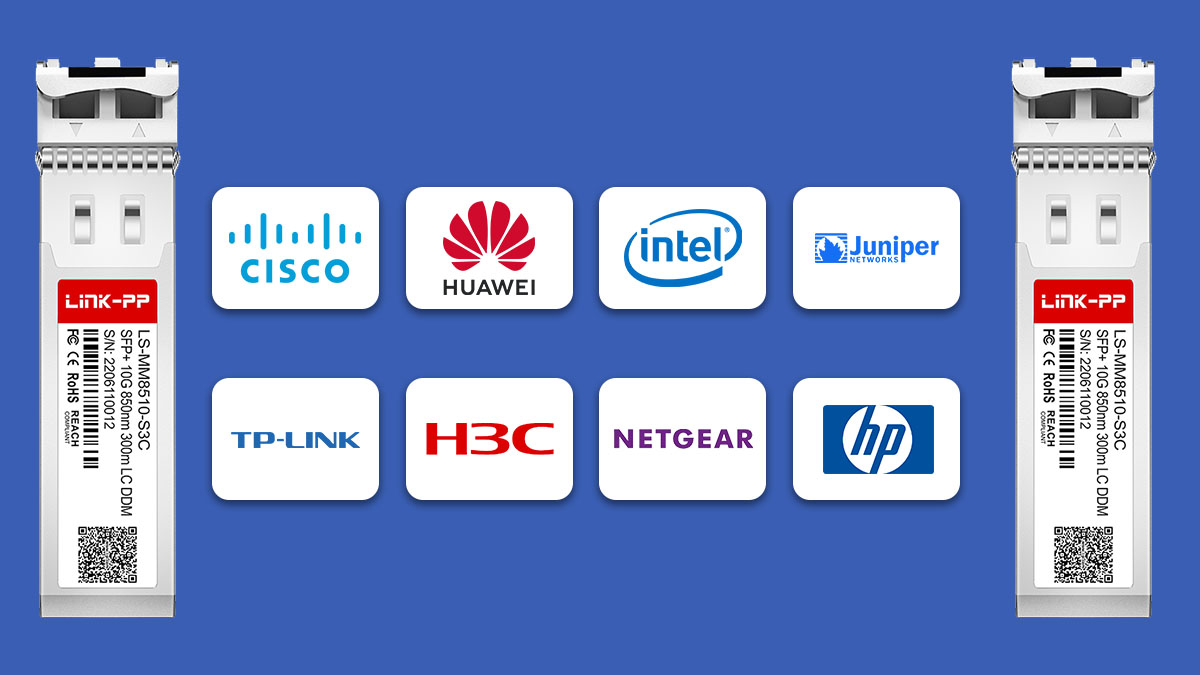
One of the main strengths of the SFBR-709SMZ-CS1 is its adherence to SFP+ Multi-Source Agreement (MSA) standards. This ensures that it can physically fit and function across a wide range of networking platforms, including major enterprise and data center vendors.
In real-world deployments, compatibility typically includes:
- Enterprise switches from mainstream networking vendors
- Server network interface cards (NICs) with SFP+ ports
- Modular routers and aggregation devices supporting 10G SFP+ interfaces
However, operational compatibility is also influenced by firmware validation. Some vendors implement coding checks (EEPROM or vendor lock) that may restrict or require specific transceiver identification. In such cases, ensuring proper coding alignment is essential for seamless operation.
Third-Party Optical Modules
In addition to original branded versions, the SFBR-709SMZ-CS1 is often used as a reference model for third-party compatible optical modules. These alternatives are widely adopted in cost-sensitive or large-scale deployments where scalability is a priority.
A comparison of key considerations is shown below:
| Network Layer |
Role in Network |
SFBR-709SMZ-CS1 Usage |
| Access Layer |
End-device connectivity |
Limited use (via switches) |
| Aggregation Layer |
Traffic consolidation |
10G uplinks between switches |
| Core Layer |
High-speed backbone |
Short-range interconnect links |
| Factor |
Original Module |
Compatible Module |
| Hardware Design |
Reference standard |
Based on same MSA design |
| Cost Efficiency |
Higher |
More flexible pricing |
| Compatibility Risk |
Minimal |
Depends on vendor coding |
| Availability |
Brand-controlled |
Widely available |
While third-party modules offer flexibility and cost advantages, proper validation is necessary to ensure stable interoperability, especially in mixed-vendor environments.
Switch and NIC Compatibility Checks
Before deploying the SFBR-709SMZ-CS1, it is important to verify compatibility at both hardware and software levels. This helps prevent link failures, recognition issues, or degraded performance.
Key compatibility checks include:
- Port type verification: ensuring the device supports SFP+ (not SFP or QSFP without adapters)
- Firmware support: confirming that the switch OS recognizes 10GBASE-SR optics
- Fiber infrastructure match: verifying OM3/OM4 multimode fiber usage
- DOM/DDM support: checking if diagnostic monitoring is enabled for real-time metrics
These checks are especially important in heterogeneous networks where equipment from different vendors is interconnected. Proper validation ensures stable link establishment and optimal 10Gbps performance across the network.
💢 SFBR-709SMZ-CS1 vs Other 10G SFP+ Modules
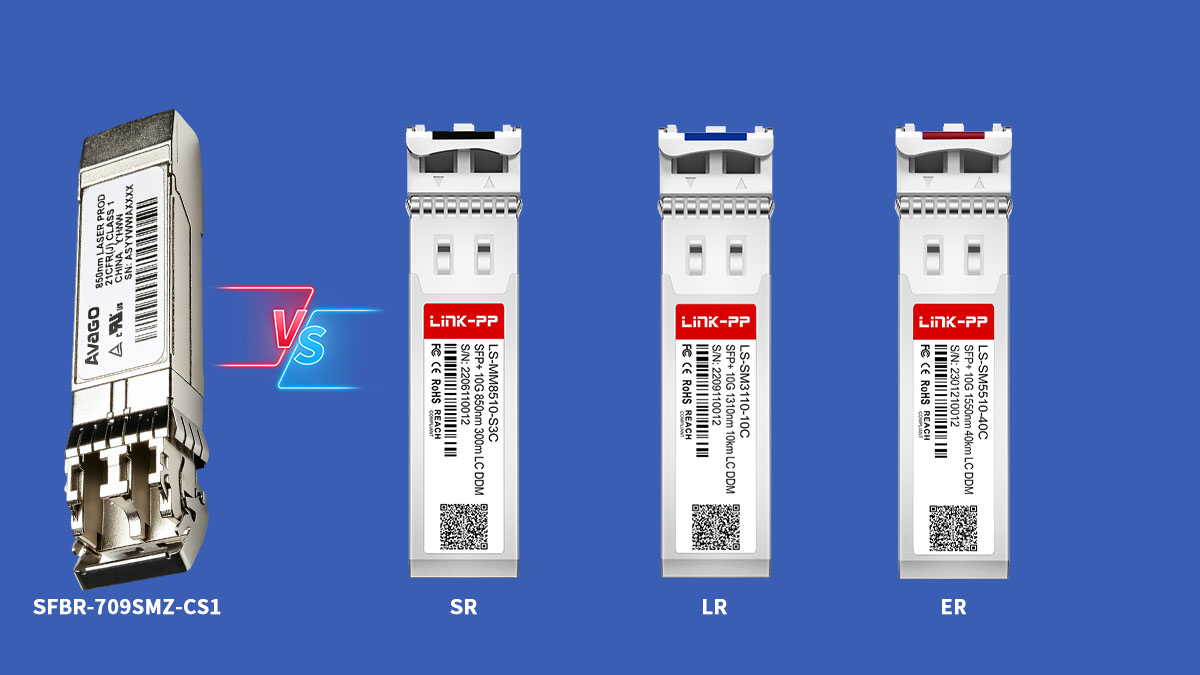
The SFBR-709SMZ-CS1 belongs to the 10GBASE-SR optical transceiver category, which is optimized for short-range multimode fiber connectivity. When compared with other 10G SFP+ modules such as LR and ER types, the key differences are defined by optical wavelength, transmission distance, fiber compatibility, and deployment scenarios. Understanding these distinctions is essential for selecting the right module for different network layers.
SR vs LR vs ER Comparison
The SFBR-709SMZ-CS1 (SR) is designed for short-distance transmission over multimode fiber, while LR and ER modules are intended for progressively longer reach over single-mode fiber. Although all three operate at 10Gbps, their physical-layer characteristics significantly affect network design decisions.
The table below summarizes the core differences:
| Module Type |
Wavelength |
Fiber Type |
Maximum Distance |
Typical Application |
| SR (SFBR-709SMZ-CS1) |
850nm |
Multimode fiber (MMF) |
Up to 300m |
Data centers, rack-to-rack links |
| LR |
1310nm |
Single-mode fiber (SMF) |
Up to 10km |
Campus and inter-building links |
| ER |
1550nm |
Single-mode fiber (SMF) |
Up to 40km |
Metro and long-haul connections |
From a deployment perspective, SR modules prioritize density and cost efficiency, while LR and ER modules extend reach at the expense of higher optical complexity and infrastructure requirements.
Cost considerations also play a major role in selection. SR modules like the SFBR-709SMZ-CS1 typically require less expensive multimode fiber infrastructure, making them more economical for short-reach environments. In contrast, LR and ER solutions rely on single-mode fiber, which increases both transceiver and cabling costs but enables significantly longer transmission distances.
When to Choose SR Modules
SR-class modules such as the SFBR-709SMZ-CS1 are most effective in environments where high bandwidth is required over short distances. Their design is optimized for simplicity, efficiency, and dense deployment scenarios.
Typical situations where SR modules are preferred include:
- Short-distance deployments within data centers
- Server-to-switch or switch-to-switch connections in the same rack row
- High-density switching environments requiring many 10G links
- Infrastructure using existing multimode fiber (OM3 or OM4)
In addition to technical suitability, SR modules are often chosen in budget-conscious environments where scaling port density is more important than long-distance capability. Their lower infrastructure requirements make them a practical choice for organizations expanding internal network capacity without redesigning fiber architecture.
Alternative Models Comparison Table
Within the 10GBASE-SR category, the SFBR-709SMZ-CS1 is functionally similar to many other compliant SFP+ modules. Differences are typically related to vendor coding, power efficiency, and interoperability rather than core optical performance.
The following comparison highlights key aspects of similar SR modules:
While all SR modules share the same fundamental optical specifications, differences in EEPROM coding, thermal design, and vendor validation can influence real-world interoperability. The SFBR-709SMZ-CS1 is often referenced as a baseline model due to its adherence to standard SFP+ and 10GBASE-SR specifications, making it broadly compatible across mainstream networking platforms.
Overall, selecting between these options depends less on optical performance and more on system compatibility requirements, vendor ecosystem constraints, and deployment environment conditions.
💢 Installation and Deployment Best Practices
Proper installation and deployment of the SFBR-709SMZ-CS1 is essential to ensure stable 10Gbps performance, minimize link failures, and extend the lifespan of both the optical module and the fiber infrastructure. While the module is designed for plug-and-play operation, real-world network stability depends heavily on correct handling, cabling, and environment design.
Fiber Cabling Considerations
The performance of the SFBR-709SMZ-CS1 is closely tied to the quality and type of multimode fiber used in the network. Since it operates at 850nm, it is optimized for OM3 and OM4 fiber types, which directly influence achievable transmission distance and signal integrity.
A practical comparison of fiber suitability is shown below:
| Module Model (Example) |
Power Consumption |
Compatibility Scope |
Max Distance |
Key Differentiator |
| SFBR-709SMZ-CS1 |
Low (~1W class) |
Broad SFP+ MSA support |
300m (OM3) |
Original reference design |
| Generic 10GBASE-SR SFP+ |
Low–Moderate |
Multi-vendor (depends on coding) |
300m (OM3) |
Cost-optimized alternative |
| OEM Branded SR Module |
Low |
Vendor-specific systems |
300m (OM3) |
Optimized firmware compatibility |
| Industrial-grade SR Module |
Low–Stable |
Rugged environments |
300m (OM3) |
Enhanced temperature tolerance |
| Fiber Type |
Effective Bandwidth |
Recommended Distance |
Suitability for SFBR-709SMZ-CS1 |
| OM2 |
Lower |
Short (<82m) |
Limited use |
| OM3 |
High |
Up to 300m |
Standard recommended choice |
| OM4 |
Higher |
Up to 400m+ |
Best performance option |
Before deployment, it is important to ensure that fiber polarity is correctly configured and that LC duplex connectors are properly aligned. Even small misalignments can result in significant signal loss or unstable links.
Proper Handling and Installation
Although SFP+ modules are hot-pluggable, improper handling can still lead to physical or optical damage. The SFBR-709SMZ-CS1 should always be handled with standard electrostatic discharge (ESD) precautions.
Key installation practices include:
- Always wear ESD protection when handling optical modules
- Avoid touching the optical connector end faces
- Insert the module firmly but without excessive force
- Ensure the latch mechanism clicks into place before connecting fiber
After insertion, fiber patch cables should be cleaned and inspected before connection. Contaminated connectors are one of the most common causes of signal degradation in 10G optical links.
Troubleshooting Common Issues
Even with correct installation, optical links may occasionally fail or perform below expectations. Identifying the root cause quickly is critical for maintaining network uptime.
Common issues and their causes include:
- Link not detected: incompatible switch firmware or disabled SFP+ port
- Intermittent connectivity: dirty connectors or poor fiber alignment
- High error rates: excessive bending radius or damaged fiber cable
- No optical signal: incorrect Tx/Rx polarity or defective module
A structured troubleshooting approach is recommended:
- Verify module recognition in the switch system
- Check DOM/DDM optical power levels
- Inspect fiber polarity (Tx ↔ Rx alignment)
- Clean and reseat LC connectors
- Replace cable or module if issues persist
In many cases, the issue is not caused by the SFBR-709SMZ-CS1 itself but by external factors such as cabling quality or environmental conditions.
💢 Performance Optimization Tips
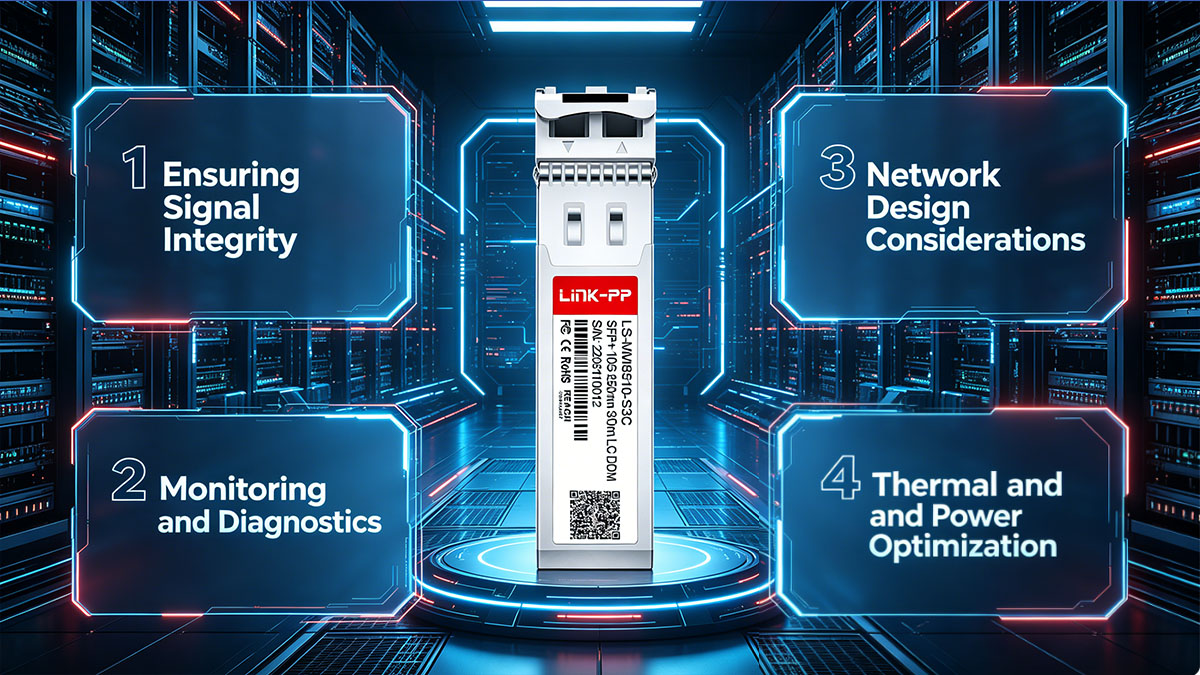
The SFBR-709SMZ-CS1 is designed to deliver stable 10Gbps performance in multimode fiber environments, but real-world network efficiency depends heavily on how the optical link is deployed, maintained, and monitored. Optimizing performance is not only about the module itself, but also about fiber quality, physical layout, and continuous diagnostics.
Ensuring Signal Integrity
Signal integrity is the foundation of reliable 10GBASE-SR communication. Since the SFBR-709SMZ-CS1 operates at 850nm over multimode fiber, it is particularly sensitive to physical cabling conditions and optical loss.
To maintain strong signal quality, consider the following practices:
- Maintain proper minimum bend radius to avoid micro-bending loss
- Use OM3 or OM4 fiber to ensure adequate modal bandwidth
- Avoid excessive patch panel chaining in a single link path
- Keep connector end-faces clean to reduce insertion loss
These factors directly affect optical power levels and bit error rates. Even small degradations in fiber condition can lead to intermittent packet loss or unstable link behavior in high-traffic environments.
Monitoring and Diagnostics
Modern SFP+ modules like the SFBR-709SMZ-CS1 often support Digital Diagnostic Monitoring (DDM), also known as DOM. This feature provides real-time visibility into optical and electrical parameters, which is critical for proactive network management.
Key metrics to monitor include:
- Tx optical power (transmit strength)
- Rx optical power (received signal level)
- Module temperature
- Supply voltage stability
A practical monitoring overview:
| Parameter |
Normal Range (Typical) |
Risk Indicator |
| Tx Power |
Within vendor spec |
Too low = weak transmission |
| Rx Power |
Above sensitivity limit |
Too low = signal loss |
| Temperature |
0°C–70°C (typical) |
High = thermal stress |
| Voltage |
Stable 3.3V supply |
Fluctuation = instability |
Regular monitoring of these parameters helps detect early signs of degradation, such as aging fibers, contaminated connectors, or failing transceivers.
Network Design Considerations
Even if the SFBR-709SMZ-CS1 is properly installed, suboptimal network design can still limit performance. Careful planning of topology and link distribution ensures consistent throughput and scalability.
Key design recommendations include:
- Keep SR links within recommended OM3/OM4 distance limits (≤300m for OM3)
- Avoid mixing too many patch segments in a single transmission path
- Use structured cabling layouts in data center racks (ToR or EoR design)
- Balance traffic loads across multiple 10G links to prevent congestion
In high-density environments, adopting a leaf-spine architecture can significantly improve scalability while maintaining low-latency communication between nodes.
Thermal and Power Optimization
Although the SFBR-709SMZ-CS1 is energy efficient, high port density can still generate cumulative heat inside switches. Managing thermal conditions is therefore essential for long-term stability.
Recommended optimization strategies:
- Ensure sufficient airflow in front-to-back or side-to-side cooling systems
- Avoid placing high-density optical modules in poorly ventilated slots
- Monitor switch internal temperature when multiple SFP+ ports are active
- Use power-efficient configurations where unused ports are disabled
Thermal stability directly affects optical signal consistency, as excessive heat can reduce laser efficiency and shorten module lifespan.
💢 Future Trends in 10G Optical Modules
Although higher-speed standards such as 25G, 100G, and beyond are rapidly expanding in modern networks, 10G optical modules like the SFBR-709SMZ-CS1 continue to play an important role in enterprise and data center infrastructure. Their future is shaped not only by technological evolution but also by cost efficiency, compatibility needs, and infrastructure longevity.

Transition Toward Higher-Speed Networks
The networking industry is steadily moving toward higher bandwidth standards to support cloud computing, AI workloads, and large-scale data processing. As a result, 25G and 100G optical modules are increasingly deployed in new builds.
However, 10GBASE-SR modules remain widely used due to their established ecosystem and lower deployment complexity. In many environments, 10G links still serve as the foundation of access and aggregation layers, even when core networks operate at higher speeds.
Typical migration trends include:
- 10G remaining dominant in access and server-to-switch layers
- 25G replacing 10G in next-generation server uplinks
- 100G and above used primarily in core and spine layers
- Hybrid networks combining multiple speed tiers
This gradual transition ensures that existing 10G infrastructure, including modules like the SFBR-709SMZ-CS1, continues to deliver value during long upgrade cycles.
Continued Relevance of 10G SR Modules
Despite the rise of higher-speed technologies, 10G SR modules maintain strong relevance due to their balance of performance and cost efficiency. The SFBR-709SMZ-CS1, in particular, remains suitable for a wide range of short-reach applications where upgrading to higher speeds may not be immediately necessary.
Key reasons for continued adoption include:
- Mature and stable technology with proven reliability
- Extensive installed base of multimode fiber infrastructure
- Lower total cost compared to higher-speed optics
- Sufficient bandwidth for many enterprise workloads
In many real-world scenarios, 10G connectivity still exceeds the actual bandwidth requirements of applications such as internal enterprise systems, virtualization clusters, and storage replication.
Evolution of Multimode Fiber Infrastructure
Multimode fiber continues to evolve alongside optical module development. OM3 and OM4 fibers remain widely deployed, while newer standards such as OM5 aim to extend bandwidth capabilities for future applications.
The evolution trend can be summarized as:
- OM3: Standard for 10GBASE-SR up to 300m
- OM4: Enhanced performance for longer 10G and early 40G support
- OM5: Designed for wavelength-division multiplexing (WDM) and future scalability
This progression ensures that modules like the SFBR-709SMZ-CS1 remain compatible with existing infrastructure while supporting incremental upgrades in network performance.
💢 Conclusion
The SFBR-709SMZ-CS1 is a 10GBASE-SR SFP+ optical transceiver designed for short-reach, high-performance multimode fiber connectivity. It delivers stable 10Gbps transmission over 850nm wavelength, making it an ideal solution for data centers, enterprise networks, and storage systems that require reliable intra-rack or inter-rack communication. As a widely adopted SFBR-709SMZ-CS1 10G optical module, it continues to serve as a dependable choice for scalable and cost-efficient 10G networking infrastructure.
To summarize the most important aspects of the SFBR-709SMZ-CS1, the following points highlight its value in modern network environments:
- Supports 10Gbps high-speed transmission based on 10GBASE-SR standard
- Operates over 850nm wavelength with multimode fiber (OM3/OM4) support
- Ideal for short-distance links up to 300m in data center environments
- Offers low power consumption and stable thermal performance in dense deployments
- Provides broad compatibility across SFP+ MSA-compliant networking equipment
- Well-suited for server-to-switch, switch-to-switch, and storage network applications
These characteristics make it a practical and widely used optical module in both enterprise and cloud-scale infrastructures where reliability and efficiency are critical.
For network planners and infrastructure engineers seeking dependable 10G optical solutions, understanding the role of modules like the SFBR-709SMZ-CS1 is essential for building efficient and scalable architectures. Whether upgrading existing multimode fiber systems or optimizing short-reach connections in high-density environments, selecting the right transceiver directly impacts overall network stability and performance.
For more technical resources, compatibility guidance, and a wide range of optical transceiver solutions, you can explore the LINK-PP Official Store, where a comprehensive portfolio of 10G, 25G, and higher-speed modules is available to support diverse networking requirements.