

























Fibre Channel technology remains a critical foundation for enterprise storage area networks (SANs), supporting high-speed, low-latency data communication between servers, switches, and storage systems. As organizations continue to expand virtualization environments, databases, and mission-critical applications, reliable optical connectivity becomes increasingly important for maintaining stable storage performance. Fibre Channel transceivers play a key role in ensuring efficient data transmission while meeting the demanding requirements of modern data centers.
Among these solutions, the Cisco DS-SFP-FC32G-SW is a 32G Fibre Channel shortwave optical transceiver designed for high-performance SAN connectivity. Understanding the DS-SFP-FC32G-SW datasheet helps network professionals evaluate its optical specifications, fiber compatibility, transmission capabilities, and suitability for different Fibre Channel infrastructures. Detailed knowledge of these parameters is essential when planning upgrades, replacements, or expansions within storage networks.
This article provides a comprehensive overview of Cisco DS-SFP-FC32G-SW technical information and deployment considerations, including:
Key features and hardware characteristics of the module.
Optical specifications, Fibre Channel standards, and compatibility requirements.
Common applications, advantages, limitations, and evaluation methods before deployment.
By analyzing these aspects, this guide helps readers better understand how Cisco DS-SFP-FC32G-SW fits into modern SAN environments and supports more reliable storage network planning.
🔔 Cisco DS-SFP-FC32G-SW Overview
Cisco DS-SFP-FC32G-SW is a 32G Fibre Channel shortwave optical transceiver designed to provide high-speed and reliable connectivity for enterprise SAN environments. As an SFP-based Fibre Channel module, it enables efficient communication between Cisco storage switches, servers, and storage systems while supporting the performance requirements of modern data center infrastructures.
The module is mainly deployed in Fibre Channel networks that require high bandwidth, low latency, and stable optical transmission over short distances. By combining 32Gb Fibre Channel capability with multimode fiber support, Cisco DS-SFP-FC32G-SW helps organizations improve SAN scalability while maintaining compatibility with existing Fibre Channel architectures.
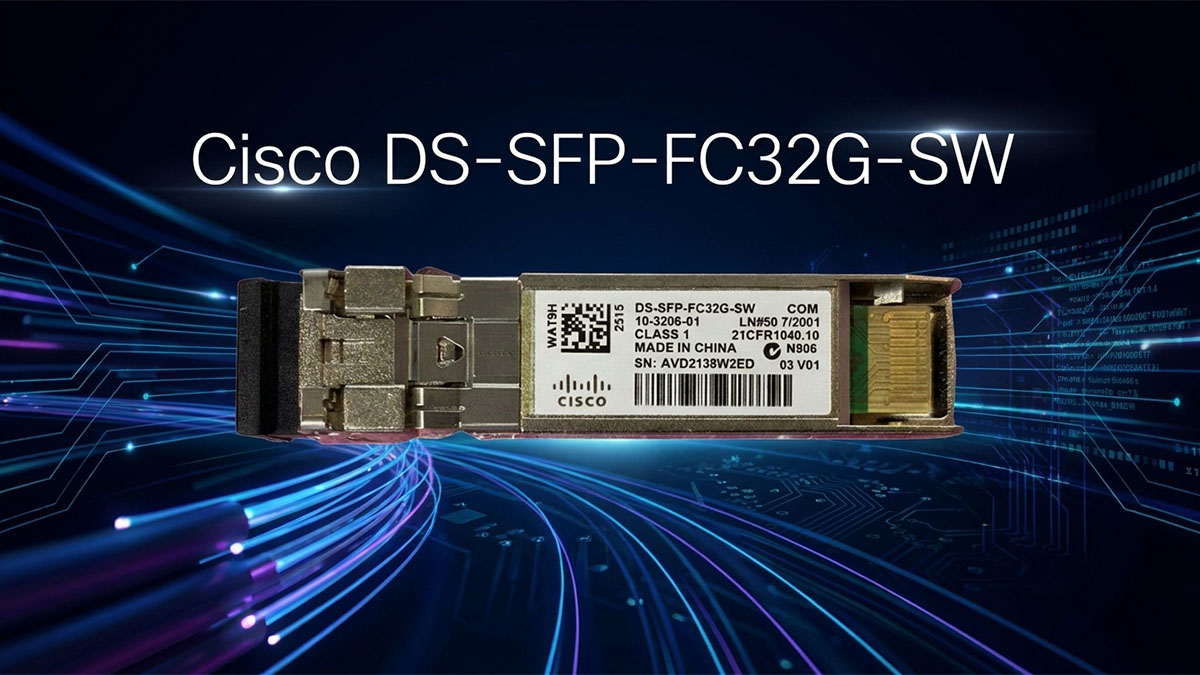
What Is Cisco DS-SFP-FC32G-SW?
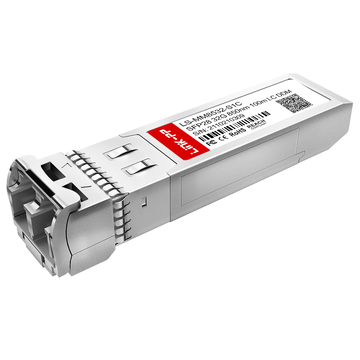
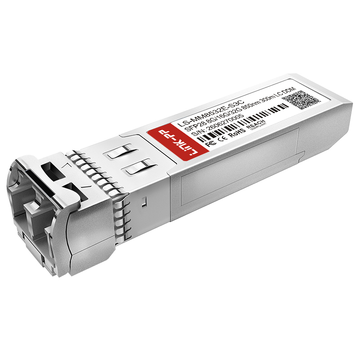
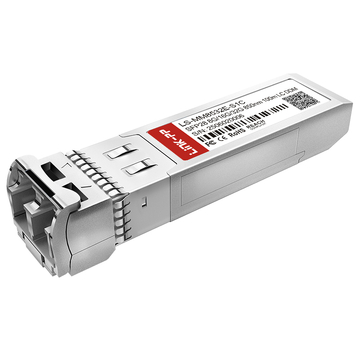
Cisco DS-SFP-FC32G-SW is a 32G Fibre Channel shortwave SFP optical transceiver that uses an 850nm wavelength for high-speed data transmission over multimode fiber. It is designed for short-reach SAN connections where high-performance storage communication and reliable optical links are required.
The module functions as an optical interface between Fibre Channel switching equipment and connected storage devices, converting electrical Fibre Channel signals into optical signals and transmitting them through fiber infrastructure. Its primary characteristics include:
- Support for 32Gb Fibre Channel connectivity in enterprise SAN environments.
- Shortwave optical transmission using 850nm wavelength technology.
- Compatibility with multimode fiber cabling systems.
- SFP form factor for high-density Fibre Channel switch deployments.
- Support for diagnostic monitoring features to assist network maintenance.
Cisco DS-SFP-FC32G-SW is commonly associated with Cisco MDS storage networking platforms, where Fibre Channel performance and interoperability are essential factors for mission-critical applications. The module helps maintain predictable storage traffic performance by providing a dedicated optical connection for Fibre Channel fabrics.
Key Features of Cisco DS-SFP-FC32G-SW
Cisco DS-SFP-FC32G-SW combines high-speed Fibre Channel performance, compact design, and monitoring capabilities to meet the requirements of modern storage networks. Its key features support efficient SAN operation and simplified infrastructure management.
The major features of Cisco DS-SFP-FC32G-SW include:
- 32G Fibre Channel Performance
- Provides 32Gbps Fibre Channel data transmission capability.
- Supports high-throughput storage workloads such as virtualization, database operations, and enterprise applications.
- 850nm Shortwave Optical Interface
- Designed for short-distance communication over multimode fiber.
- Optimized for data center environments where switches and storage equipment are typically located within the same facility.
- Multimode Fiber Support
- Works with multimode fiber cabling, including OM3 and OM4 fiber infrastructures.
- Enables cost-effective short-reach SAN deployments.
- Hot-Pluggable SFP Design
- Allows installation and replacement without shutting down compatible network equipment.
- Supports flexible maintenance and network expansion strategies.
- Digital Optical Monitoring Capability
- Provides visibility into important operating parameters.
- Helps administrators monitor module health and identify potential optical issues before service interruptions occur.
These features make Cisco DS-SFP-FC32G-SW suitable for organizations requiring dependable Fibre Channel connectivity with efficient space utilization and simplified SAN management. The combination of high-speed transmission and optical monitoring support allows the module to serve as a practical component in modern storage infrastructures.
🔔 Cisco DS-SFP-FC32G-SW Datasheet Technical Specifications
Cisco DS-SFP-FC32G-SW datasheet specifications provide essential information about the module’s optical performance, electrical interface, physical design, and monitoring capabilities. These parameters determine how the transceiver performs within a 32G Fibre Channel SAN environment and whether it can meet the requirements of specific storage network deployments.
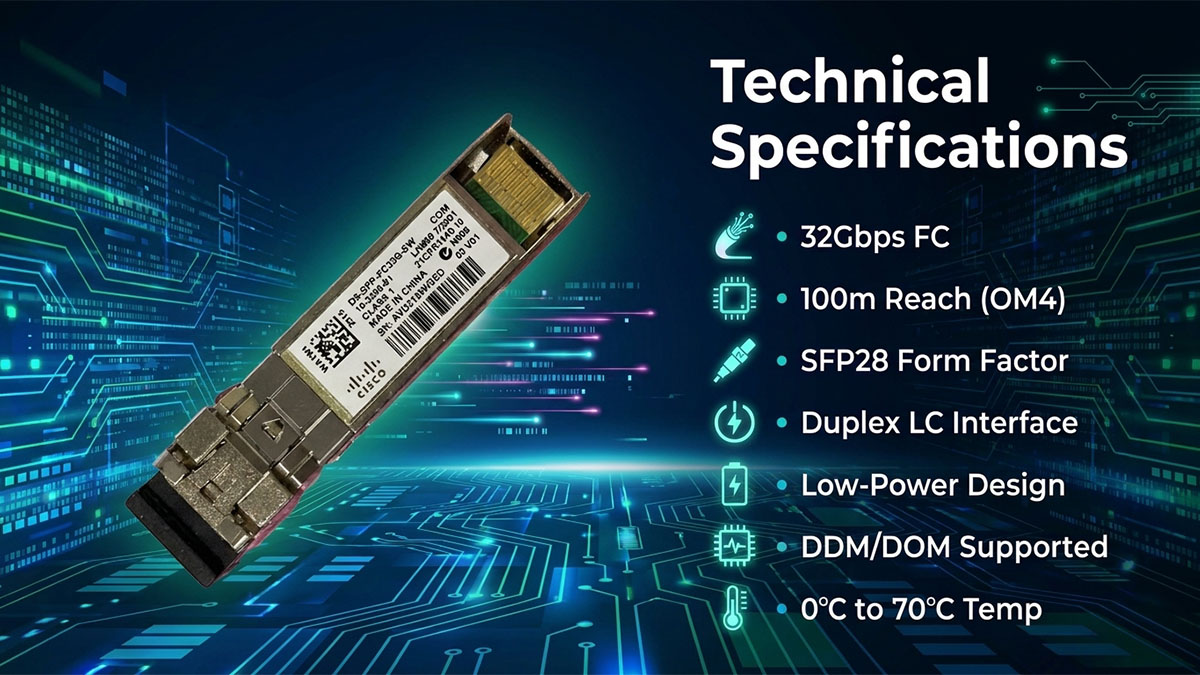
Understanding these technical specifications helps network engineers evaluate fiber compatibility, transmission distance, link reliability, and hardware integration before deploying Cisco DS-SFP-FC32G-SW in enterprise storage infrastructures.
Optical Performance Parameters
Cisco DS-SFP-FC32G-SW optical parameters define its transmission capability and indicate the type of fiber infrastructure required for stable Fibre Channel connectivity. The module is designed for shortwave optical transmission using multimode fiber, making it suitable for high-density data center SAN environments.
The key optical specifications of Cisco DS-SFP-FC32G-SW include:
| Parameter | Specification | Description |
|---|---|---|
| Max Data Rate | 28.05Gbps | Supports Gen 6 Fibre Channel connectivity for high-performance SAN applications |
| Wavelength | 850nm | Shortwave optical transmission optimized for multimode fiber |
| Fiber Type | Multimode Fiber (MMF) | Designed for OM3 and OM4 fiber cabling systems |
| Maximum Distance | Up to 100m with OM4 MMF | Suitable for short-reach data center and SAN connections |
| Connector Type | LC Duplex | Standard interface for Fibre Channel optical links |
These optical characteristics define the deployment range of Cisco DS-SFP-FC32G-SW. The 850nm wavelength and multimode fiber design allow the module to deliver high-speed connectivity over short distances while maintaining the low-latency performance required by Fibre Channel storage networks.
Electrical Interface and Hardware Characteristics
Cisco DS-SFP-FC32G-SW uses an SFP-based electrical interface designed for integration with compatible Fibre Channel switching equipment. Its compact form factor allows high-density installation in storage switches and SAN directors where port scalability is important.
The main hardware characteristics include:
- SFP form factor following industry-standard mechanical requirements.
- Hot-swappable design for simplified maintenance and replacement.
- Low-power operation suitable for high-density Fibre Channel deployments.
- Electrical interface designed for 32G Fibre Channel host connectivity.
- Compact module size that helps optimize switch port utilization.
The SFP design of Cisco DS-SFP-FC32G-SW enables flexible deployment in environments where storage networks require frequent upgrades or expansion. Its removable architecture also reduces service interruptions during maintenance activities.
Digital Diagnostic Monitoring (DDM/DOM)
Cisco DS-SFP-FC32G-SW supports digital diagnostic monitoring capabilities that help administrators monitor optical module operating conditions. These monitoring functions provide valuable visibility into link performance and assist with troubleshooting Fibre Channel connectivity issues.
The primary monitoring parameters typically include:
- Transmitter optical power monitoring.
- Receiver optical power monitoring.
- Module operating temperature measurement.
- Supply voltage monitoring.
- Laser bias current tracking.
DOM information allows network teams to identify potential optical degradation, such as reduced signal strength or abnormal operating conditions, before they affect SAN availability. This capability is especially valuable in enterprise environments where continuous storage access and predictable network performance are critical.
🔔 Cisco DS-SFP-FC32G-SW Standards and Compliance
Cisco DS-SFP-FC32G-SW standards and compliance information defines how the module operates within Fibre Channel networks and ensures interoperability with compatible SAN infrastructure. By following established industry specifications, this 32G Fibre Channel shortwave transceiver can provide consistent optical performance, reliable communication, and predictable integration across enterprise storage environments.
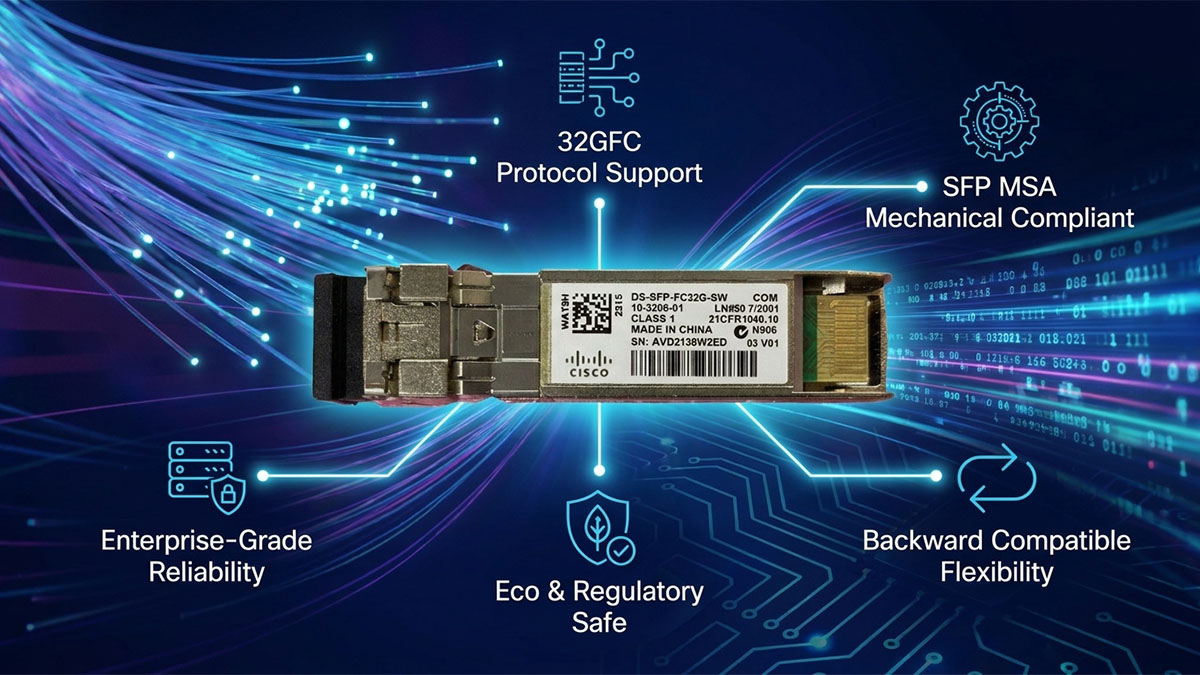
Understanding the supported standards is important because Fibre Channel networks depend on strict physical-layer and protocol-level requirements. Compliance with these specifications helps verify that Cisco DS-SFP-FC32G-SW can work effectively with compatible switches, storage systems, and Fibre Channel components.
Fibre Channel Protocol Support
Cisco DS-SFP-FC32G-SW is designed for 32G Fibre Channel environments and supports the high-speed communication requirements of modern SAN architectures. The module operates within Fibre Channel specifications that define data transmission, signaling, and interoperability between storage networking devices.
Key Fibre Channel protocol considerations include:
- Supports 32G Fibre Channel (32GFC) connectivity for next-generation SAN deployments.
- Designed for high-bandwidth storage traffic between Fibre Channel switches, servers, and storage systems.
- Supports Fibre Channel fabric environments where low latency and consistent performance are required.
- Enables integration with Fibre Channel infrastructures using compatible host devices and switching platforms.
- Allows Fibre Channel speed negotiation when connected with supported lower-generation Fibre Channel equipment.
The ability to operate within the Fibre Channel ecosystem allows Cisco DS-SFP-FC32G-SW to support enterprise applications that require stable storage communication, including virtualization platforms, large databases, and mission-critical workloads.
Industry Standards Compliance
Cisco DS-SFP-FC32G-SW follows established optical transceiver and Fibre Channel industry standards to maintain compatibility and reliable operation. These standards define important aspects such as optical signaling, mechanical dimensions, and electrical interfaces.
The major compliance areas include:
- Fibre Channel physical layer specifications for 32G Fibre Channel transmission.
- SFP Multi-Source Agreement (MSA) mechanical requirements for module dimensions and interfaces.
- Optical interface specifications related to wavelength, fiber type, and signal performance.
- Host device interface requirements for integration with compatible SAN equipment.
Compliance with these standards helps ensure that Cisco DS-SFP-FC32G-SW can be integrated into structured Fibre Channel networks without requiring major infrastructure modifications. It also provides a foundation for interoperability between different components within a SAN environment.
Safety and Environmental Compliance
Cisco DS-SFP-FC32G-SW deployment reliability also depends on environmental and operational compliance requirements. Optical transceivers used in enterprise storage networks must maintain stable performance under different operating conditions while meeting relevant safety expectations.
Important environmental considerations include:
- Operating temperature requirements specified by the manufacturer.
- Proper airflow and thermal management inside storage switches.
- Protection against excessive dust, humidity, and physical contamination.
- Compliance with applicable industry safety and regulatory requirements.
Maintaining suitable environmental conditions helps extend module service life and reduces the risk of optical performance degradation. For large-scale SAN deployments, evaluating environmental compatibility alongside technical specifications is essential for achieving long-term network stability.
Overall, Cisco DS-SFP-FC32G-SW standards and compliance characteristics ensure that the module can operate as a reliable component within enterprise Fibre Channel infrastructures. Its alignment with Fibre Channel protocols, SFP interface requirements, and optical communication standards supports consistent performance in modern storage networking environments.
🔔 Cisco DS-SFP-FC32G-SW Compatibility Considerations
Cisco DS-SFP-FC32G-SW compatibility considerations are essential for ensuring successful integration into Fibre Channel SAN environments. Although the module follows industry-standard Fibre Channel and SFP specifications, network administrators must verify hardware support, fiber infrastructure requirements, and system-level compatibility before deployment.
Proper compatibility evaluation helps prevent issues such as module recognition failures, unsupported Fibre Channel speeds, optical link instability, and performance limitations caused by mismatched infrastructure components.
Cisco Platform Compatibility
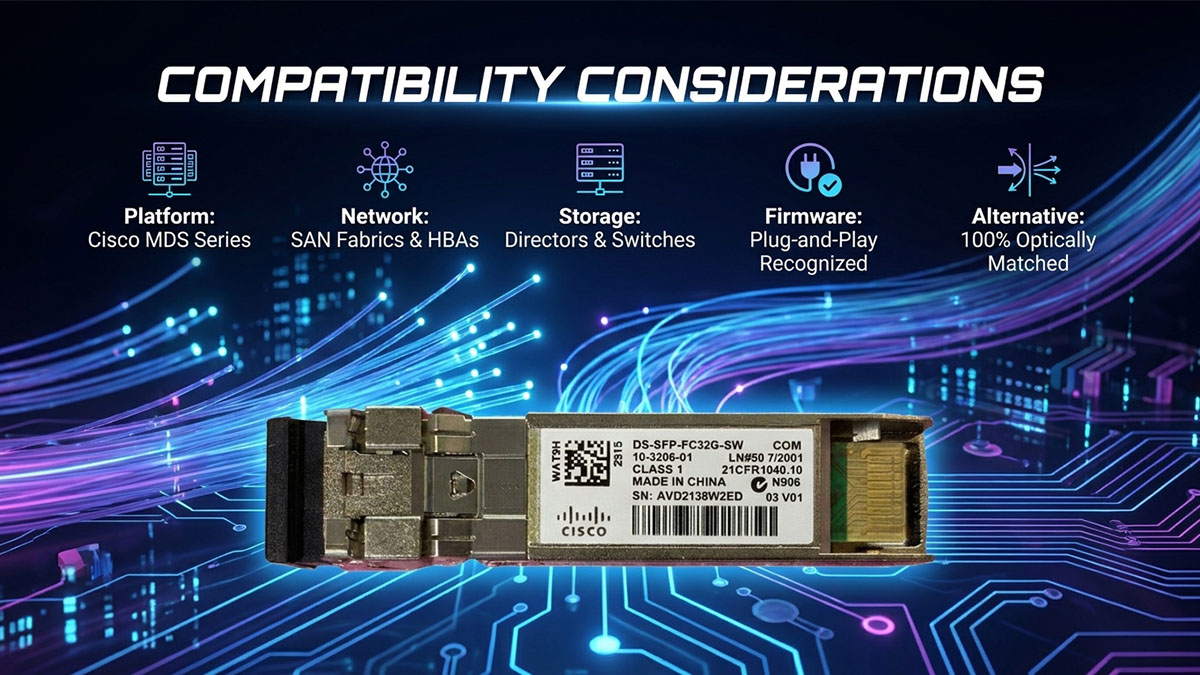
Cisco DS-SFP-FC32G-SW is primarily designed for deployment with compatible Cisco Fibre Channel switching platforms, especially enterprise SAN environments based on Cisco MDS solutions. Confirming platform support ensures that the transceiver can be properly recognized and operate at the expected Fibre Channel speed.
Important Cisco platform compatibility factors include:
- Verify that the Fibre Channel switch or director supports 32G Fibre Channel interfaces.
- Confirm hardware compatibility between the transceiver and the target Cisco storage networking platform.
- Check software and firmware versions to ensure proper module recognition.
- Ensure the installed port supports the required Fibre Channel generation and optical interface type.
- Consider existing SAN architecture requirements when upgrading from older Fibre Channel modules.
Cisco SAN environments often include multiple Fibre Channel generations and hardware platforms. Therefore, compatibility verification should be completed before deployment to ensure the DS-SFP-FC32G-SW operates according to its intended specifications.
Storage Network Compatibility
Cisco DS-SFP-FC32G-SW compatibility extends beyond the switch itself and includes the entire Fibre Channel storage ecosystem. A successful optical link requires matching specifications across switches, servers, storage devices, and fiber cabling infrastructure.
The main storage network compatibility factors include:
- Matching Fibre Channel speed capabilities between connected devices.
- Ensuring both endpoints support compatible optical interfaces.
- Confirming the use of appropriate multimode fiber cabling.
- Verifying that fiber connectors and patch panels meet optical requirements.
- Evaluating link distance based on fiber type and transmission conditions.
The following table summarizes key compatibility elements that should be reviewed before integrating Cisco DS-SFP-FC32G-SW into a SAN environment:
| Compatibility Factor | Requirement | Deployment Consideration |
|---|---|---|
| Fibre Channel Speed | 8G/16G/32G FC support | Confirm switch and connected devices support the required speed |
| Fiber Type | Multimode Fiber (OM3/OM4 recommended) | Ensure cabling infrastructure matches optical specifications |
| Connector Interface | LC Duplex | Verify compatibility with existing fiber patch panels |
| Transmission Distance | Short-reach SAN links | Evaluate actual cable length and optical loss |
These compatibility checks help ensure that the optical module can deliver stable Fibre Channel performance without being limited by other network components.
Third-Party Compatible Module Considerations
When evaluating compatible alternatives for Cisco DS-SFP-FC32G-SW, technical matching is more important than selecting a module based only on physical appearance or basic specifications. A compatible Fibre Channel optical module must meet optical, electrical, and coding requirements to function correctly within the target system.
Key evaluation factors include:
- Matching the same Fibre Channel data rate and optical wavelength.
- Ensuring compatibility with multimode fiber infrastructure.
- Confirming proper device coding and system recognition.
- Verifying compliance with relevant Fibre Channel and SFP standards.
- Reviewing quality testing procedures and reliability performance.
A properly matched compatible module can support flexible SAN maintenance and expansion strategies while maintaining required network performance. However, compatibility testing remains an important step to ensure seamless integration with existing Cisco Fibre Channel environments.
🔔 Cisco DS-SFP-FC32G-SW Applications in SAN Environments
Cisco DS-SFP-FC32G-SW is widely used in SAN environments that require high-speed, low-latency, and reliable Fibre Channel connectivity. With 32G Fibre Channel performance and shortwave multimode fiber support, this optical transceiver is suitable for connecting storage switches, servers, and storage systems within enterprise data centers.
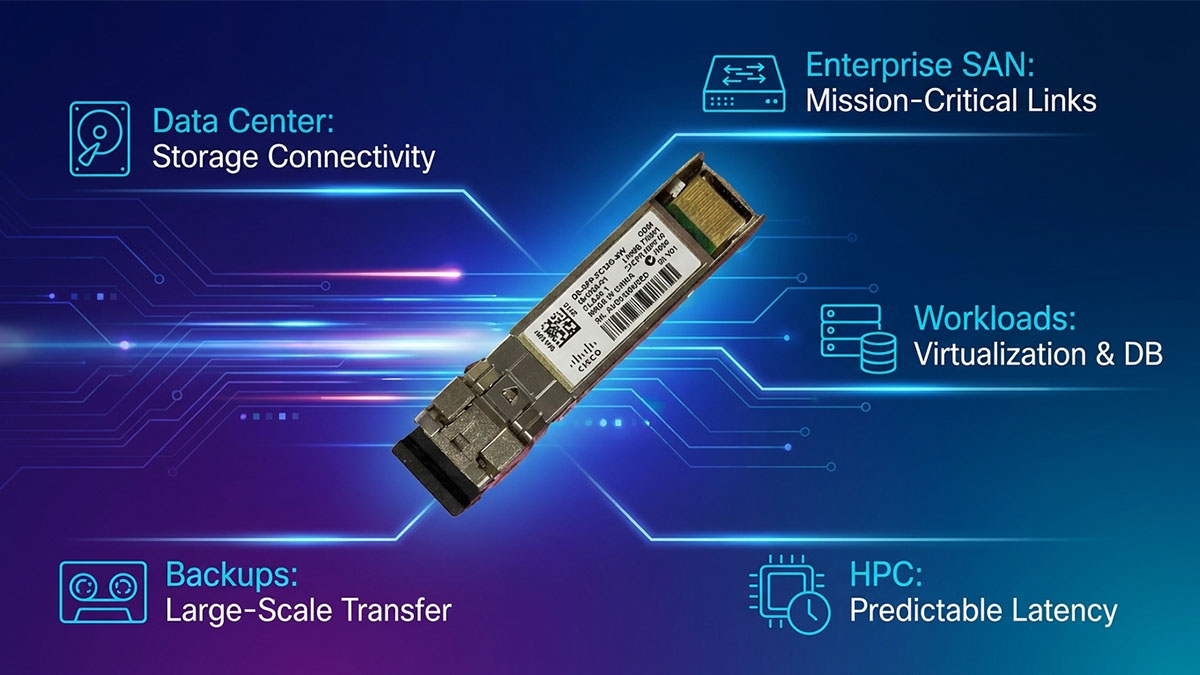
Data Center Storage Connectivity
Cisco DS-SFP-FC32G-SW is commonly used in data centers to establish high-speed optical links between Fibre Channel devices. These connections support the movement of large volumes of storage traffic while maintaining the low latency characteristics required by enterprise applications.
Typical data center applications include:
- Connecting Fibre Channel switches with storage arrays.
- Linking SAN directors with server infrastructure.
- Supporting high-speed communication between storage networking devices.
- Expanding existing Fibre Channel fabrics with additional optical ports.
- Enabling reliable storage access for virtualization and cloud infrastructure.
In modern data centers, storage traffic often requires continuous availability and consistent performance. Cisco DS-SFP-FC32G-SW helps maintain efficient communication paths between critical infrastructure components by providing dedicated 32G Fibre Channel optical connectivity.
Enterprise SAN Infrastructure
Cisco DS-SFP-FC32G-SW plays an important role in enterprise SAN deployments where organizations require scalable and dependable storage networks. It supports Fibre Channel fabrics designed for applications that demand high throughput, stable connectivity, and predictable response times.
Common enterprise SAN use cases include:
- Database storage environments requiring high-speed data access.
- Virtualized server environments with intensive storage workloads.
- Enterprise backup and recovery infrastructures.
- Storage consolidation projects that improve resource utilization.
- Mission-critical applications requiring reliable Fibre Channel communication.
The module’s Fibre Channel design allows enterprises to maintain dedicated storage networks separate from general-purpose data networks. This separation helps improve storage performance management and provides more predictable operation for important business applications.
High-Performance Computing and Backup Networks
Cisco DS-SFP-FC32G-SW is also suitable for high-performance computing and backup environments where large data transfers and stable storage connections are necessary. Fibre Channel technology is often selected in these scenarios because it provides consistent bandwidth and efficient handling of storage-intensive workloads.
Key application scenarios include:
- High-performance computing clusters requiring rapid storage access.
- Large-scale data backup systems with frequent data movement.
- Disaster recovery infrastructures requiring dependable SAN connectivity.
- Data-intensive research and analytics environments.
- Storage environments handling large sequential and transactional workloads.
These applications benefit from the module’s 32G Fibre Channel capability, which helps reduce storage bottlenecks and supports faster communication between computing resources and storage platforms.
Overall, Cisco DS-SFP-FC32G-SW applications extend across various SAN environments, from enterprise data centers to specialized high-performance storage infrastructures. By providing reliable shortwave Fibre Channel connectivity, the module helps organizations build scalable storage networks that meet modern performance and availability requirements.
🔔 How to Evaluate Cisco DS-SFP-FC32G-SW Datasheet Before Deployment
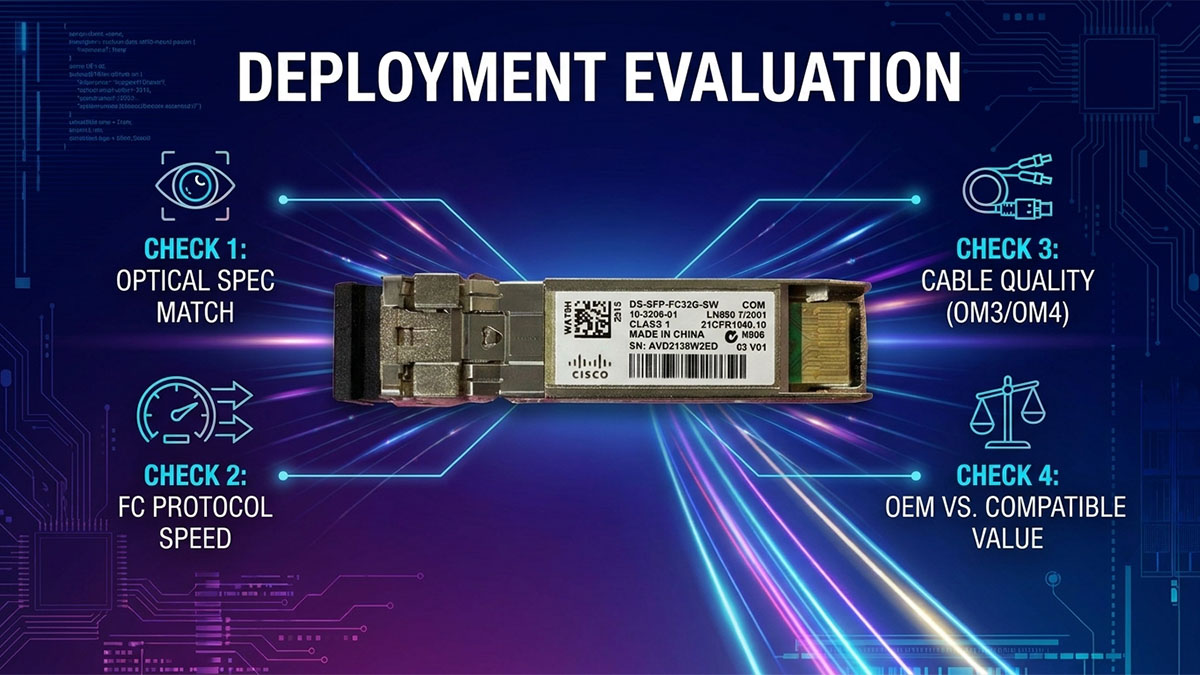
Evaluating the Cisco DS-SFP-FC32G-SW datasheet before deployment helps ensure that the optical transceiver matches the requirements of the existing Fibre Channel SAN infrastructure. Key factors such as optical specifications, hardware compatibility, fiber type, and operating conditions directly affect network reliability and long-term performance.
A detailed datasheet review allows network engineers to identify potential compatibility issues before installation and confirm that the module can support the expected storage workloads.
Verify Optical Specifications
The first step in evaluating Cisco DS-SFP-FC32G-SW is confirming that its optical specifications align with the existing fiber infrastructure. Optical mismatches are one of the most common causes of unstable Fibre Channel links, making specification verification essential before deployment.
Important optical parameters to review include:
- Confirm the 32G Fibre Channel data rate matches the requirements of the SAN environment.
- Verify the 850nm wavelength is compatible with the planned optical connection.
- Ensure the fiber type is suitable, especially multimode fiber cabling such as OM3 or OM4.
- Check the supported transmission distance based on the installed fiber infrastructure.
- Review optical power specifications to ensure sufficient link margin.
These optical characteristics determine whether Cisco DS-SFP-FC32G-SW can provide stable communication between connected Fibre Channel devices. Proper alignment between the module and cabling system helps maintain reliable signal transmission and reduces potential link failures.
Check Hardware and Protocol Compatibility
Cisco DS-SFP-FC32G-SW must be compatible with the target Fibre Channel hardware platform and supported communication protocols. Even when optical specifications match, differences in switch support, firmware, or Fibre Channel generations may affect module operation.
Before deployment, engineers should evaluate:
- Whether the Fibre Channel switch or director supports 32G Fibre Channel modules.
- Whether the installed hardware recognizes the DS-SFP-FC32G-SW transceiver.
- Whether firmware versions support the required optical module functions.
- Whether connected storage devices and host adapters support the intended Fibre Channel speed.
- Whether the SAN architecture can properly negotiate the connection speed.
Checking these compatibility factors ensures that the module can operate correctly within the complete Fibre Channel ecosystem rather than only matching the physical interface.
Assess Network Environment Requirements
The physical and operational environment also influences Cisco DS-SFP-FC32G-SW performance. A suitable installation environment helps maintain optical reliability and extends the service life of the transceiver.
The main environmental considerations include:
- Evaluating fiber cable quality and connector cleanliness.
- Confirming cable routing meets required bend radius specifications.
- Ensuring proper airflow and thermal conditions inside equipment racks.
- Checking operating temperature requirements.
- Reviewing future SAN expansion plans and port availability.
A well-prepared network environment reduces maintenance requirements and helps prevent performance degradation caused by physical infrastructure issues.
Compare OEM and Compatible Options
When evaluating Cisco DS-SFP-FC32G-SW solutions, organizations should focus on technical specifications, compatibility, and reliability rather than comparing only basic product appearance. A suitable optical module should meet the same functional requirements as the original design.
Key comparison factors include:
- Matching Fibre Channel speed and optical characteristics.
- Confirming wavelength and fiber compatibility.
- Verifying module coding and device recognition.
- Checking compliance with Fibre Channel and SFP industry standards.
- Reviewing supplier testing procedures and quality assurance practices.
A careful evaluation process helps ensure that the selected module meets SAN performance requirements while maintaining stable interoperability with existing Fibre Channel infrastructure.
Overall, reviewing the Cisco DS-SFP-FC32G-SW datasheet before deployment provides a systematic approach to reducing compatibility risks and improving SAN reliability. By verifying optical parameters, hardware support, environmental conditions, and module quality factors, organizations can create a more stable and efficient Fibre Channel storage network.
🔔 Conclusion
Cisco DS-SFP-FC32G-SW is a 32G Fibre Channel shortwave SFP+ optical transceiver designed to support high-performance SAN connectivity in enterprise storage environments. By reviewing the DS-SFP-FC32G-SW datasheet, network professionals can better understand its optical specifications, Fibre Channel compatibility, multimode fiber requirements, and deployment limitations. Cisco identifies this module as a 32Gb Fibre Channel SW SFP+ with an LC interface for compatible Fibre Channel platforms.
The key points to consider when evaluating Cisco DS-SFP-FC32G-SW include:
- Supports 8G/16G/32G Fibre Channel connectivity for modern SAN infrastructures.
- Uses 850nm shortwave optical transmission designed for multimode fiber networks.
- Provides compatibility considerations across Fibre Channel switches, storage systems, and fiber cabling environments.
- Requires careful evaluation of optical parameters, platform support, and deployment conditions before installation.
- Helps enterprise networks maintain high-speed, low-latency storage communication for demanding workloads.
A complete understanding of Cisco DS-SFP-FC32G-SW technical specifications allows organizations to select suitable optical connectivity solutions while reducing compatibility risks during SAN upgrades or expansions. For professionals looking for reliable compatible Fibre Channel optical modules and networking solutions, the LINK-PP Official Store provides a range of optical transceiver options designed to support diverse data center and storage networking requirements.