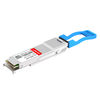
As data centers continue to scale toward higher bandwidth densities, 400G SR4 has become one of the most widely adopted solutions for short-reach optical interconnects. Designed for high-performance environments such as cloud infrastructures, hyperscale data centers, and AI compute clusters, 400G SR4 enables efficient 400GbE transmission over multimode fiber with a balance of cost, power, and port density.
At its core, 400G SR4 is a 4-lane parallel optical transceiver architecture that typically operates over OM4 multimode fiber using an MPO-12 interface. It leverages PAM4 modulation (4-level Pulse Amplitude Modulation) to achieve 100G per lane, delivering a total aggregated bandwidth of 400G. With a typical reach of up to 50 meters on OM4 fiber, SR4 is optimized for intra–data center links such as rack-to-rack or top-of-rack to spine connections.
However, in real-world deployments, engineers rarely evaluate SR4 in isolation. Search behavior and industry discussions consistently show that users compare it against alternatives such as SR4.2, DR4, AOC, and DAC solutions to determine the best fit for specific network architectures. This is because each option represents a different trade-off between reach, fiber type (multimode vs single-mode), infrastructure cost, and scalability.
From a search intent perspective, users looking for “400G SR4” are typically not just seeking a definition—they are trying to make deployment decisions. Common questions include:
- How far can 400G SR4 actually reach in production networks?
- What type of fiber and connectors are required?
- How does SR4 compare with SR4.2 or DR4 for future-proofing?
- Is it the most cost-effective choice for short-reach data center links?
This article breaks down 400G SR4 engineering specifications, deployment considerations, and real-world use cases, helping network architects, engineers, and procurement teams make informed decisions for modern high-speed optical networks.
🔷 What Is 400G SR4 In Simple Terms?
400G SR4 is a type of high-speed optical transceiver used in modern data centers to transmit 400 gigabits per second (400GbE) over short distances using multimode fiber. In simple terms, it is a “short-reach 400G optical module” designed to connect nearby networking equipment inside the same data center, such as switches in the same rack row or adjacent rows.
Unlike long-distance optical solutions that rely on single-mode fiber, 400G SR4 is optimized for short-reach, high-density environments where speed and cost efficiency matter more than transmission distance.
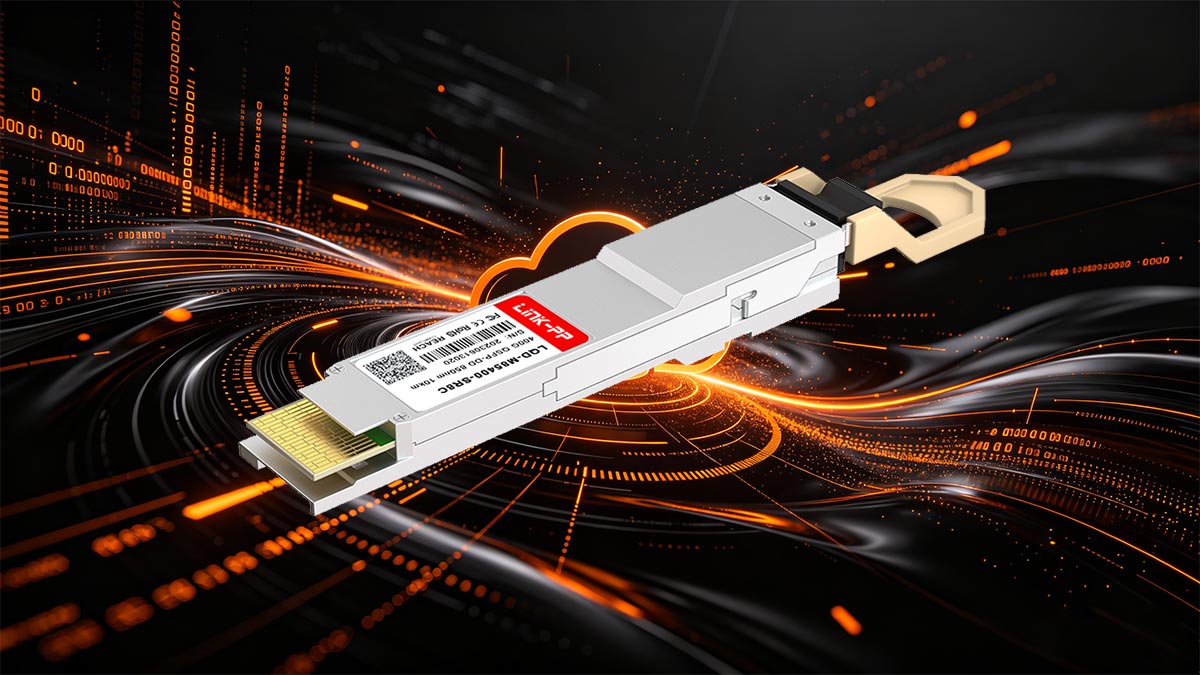
Explain Multimode Short-Reach Concept
400G SR4 uses multimode fiber (MMF), typically OM4, which allows multiple light paths to travel through the fiber core. This makes it ideal for short-distance, high-bandwidth transmission, usually up to around 50 meters in typical deployments.
Because multimode fiber is less expensive and easier to install than single-mode fiber, SR4 is widely used in:
- Data center spine-leaf connections
- Rack-to-rack interconnects
- High-density cloud and enterprise networks
However, its trade-off is distance limitation, which is why it is classified as a short-reach optic.
Introduce MPO-12 Fiber Structure
400G SR4 typically uses an MPO-12 connector, a high-density fiber connector that bundles multiple fibers into a single interface. In SR4 applications, the MPO-12 connector supports parallel transmission across 8 active fibers (4 transmit + 4 receive lanes), enabling simultaneous high-speed data transfer.
This structure allows:
- High port density in data center switches
- Simplified cable management compared to multiple duplex fibers
- Efficient parallel optical transmission for 400G bandwidth
Clean Technical Definition
400G SR4 is a short-reach 400G Ethernet optical transceiver that uses 4-channel parallel transmission over multimode fiber via an MPO-12 connector, typically supporting up to ~50m reach in data center environments.
🔷 400G SR4 Technical Specifications Explained
Understanding the technical specifications of 400G SR4 is essential for evaluating its performance in real-world data center deployments. This section breaks down the core building blocks of the module—including its modulation scheme, lane architecture, connector type, fiber compatibility, reach limitations, and power characteristics. Together, these parameters define how SR4 delivers high-speed 400G connectivity over short-reach multimode fiber links.
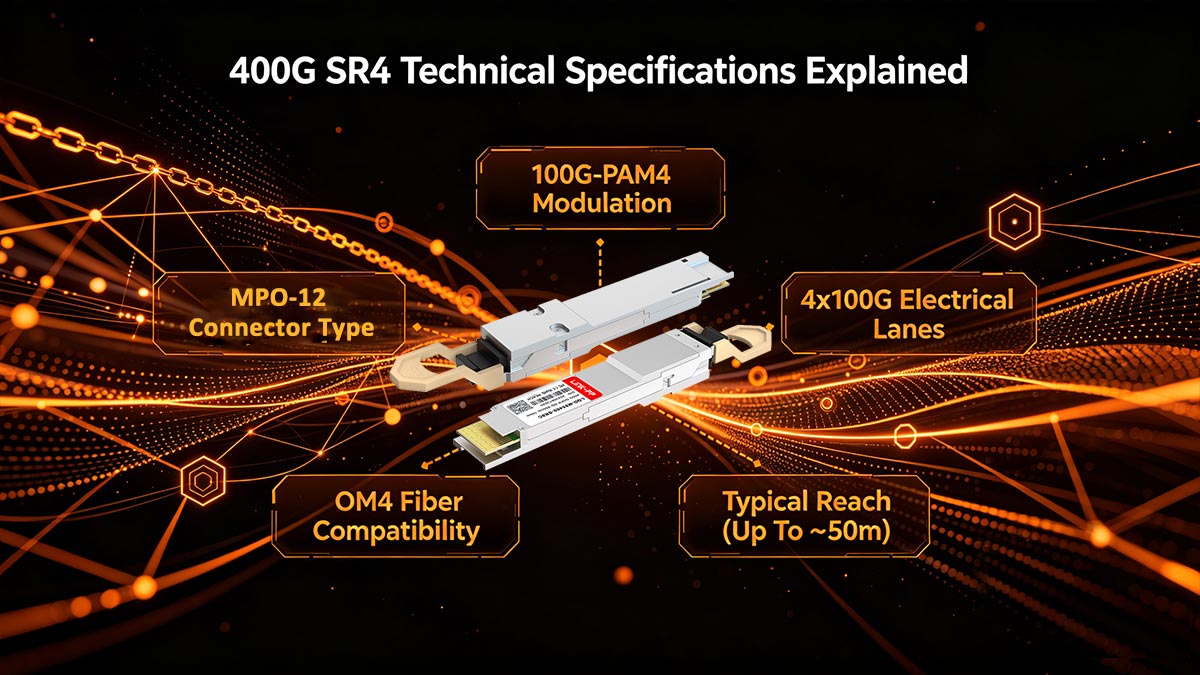
100G-PAM4 Modulation
400G SR4 uses PAM4 (Pulse Amplitude Modulation with 4 levels) to transmit data more efficiently over optical channels. Instead of traditional binary signaling (PAM2), PAM4 encodes 2 bits per symbol, effectively doubling the data rate without increasing the signal bandwidth. This enables each lane to carry 100G of throughput, which is essential for achieving 400G total bandwidth within a compact transceiver form factor.
4x100G Electrical Lanes
The architecture of 400G SR4 is based on four parallel electrical and optical lanes, each operating at 100G. These lanes work simultaneously to deliver an aggregated 400G data rate.
This parallel design provides:
- High bandwidth scalability
- Lower signaling complexity per lane
- Efficient short-reach transmission performance
It is especially suitable for high-density data center interconnects, where multiple parallel paths are preferred over single high-speed serial links.
MPO-12 Connector Type
400G SR4 typically uses an MPO-12 (Multi-Fiber Push-On 12) connector, which supports high-density fiber integration in a single interface.
In SR4 applications:
- 8 fibers are actively used (4 transmit + 4 receive)
- Remaining fibers are reserved for alignment or future use depending on implementation
- The connector enables compact and structured cabling for 400G parallel optics
This design reduces cable clutter and supports efficient deployment in large-scale data center environments.
OM4 Fiber Compatibility
400G SR4 is designed for multimode fiber (MMF), specifically OM4-grade fiber, which supports higher bandwidth and longer reach compared to OM3.
Key characteristics:
- Optimized for 850nm wavelength operation
- Supports high-speed short-reach transmission
- Maintains signal integrity across dense parallel channels
OM4 fiber is the standard choice for SR4 deployments due to its balance of cost efficiency and optical performance.
Typical Reach (Up To ~50m)
The standard transmission distance for 400G SR4 is approximately up to 50 meters on OM4 fiber under typical data center conditions.
This range makes it ideal for:
- Rack-to-rack connections
- Row-to-row switching architectures
- Intra–data center spine-leaf links
Because it is not designed for long-haul transmission, SR4 is classified as a short-reach optical solution.
Power Consumption Overview
400G SR4 modules generally have moderate power consumption, typically in the range of 8W–12W depending on vendor implementation and thermal design.
Key considerations include:
- Lower power per bit compared to older 100G architectures
- Efficient PAM4 signaling helps reduce energy overhead
- Heat dissipation must still be managed in high-density switch environments
In modern data centers, SR4 is often chosen because it balances performance, density, and power efficiency for short-reach optical interconnects.
🔷 400G SR4 vs. SR4.2 vs. DR4 Comparison
As 400G data center networks evolve, engineers rarely evaluate 400G SR4 in isolation. Instead, it is typically compared with closely related optics such as SR4.2 and DR4 to determine the best balance between reach, infrastructure cost, and scalability. These comparisons are critical for making deployment decisions in modern spine-leaf and AI-driven data center architectures.
SR4 vs. SR4.2 (Reach Expansion To 100m)
The main difference between SR4 and SR4.2 is transmission reach and optical architecture efficiency.
- 400G SR4: Typically supports up to ~50m over OM4 multimode fiber
- 400G SR4.2: Extends reach up to ~100m on OM4 multimode fiber
SR4.2 achieves longer reach by optimizing signaling and optical design while still using multimode infrastructure. This makes it a preferred option for larger data center layouts where rack distances exceed traditional SR4 limits but operators still want to avoid migrating to single-mode fiber.
SR4 vs. DR4 (Multimode Vs Single-Mode – 500m)
The comparison between SR4 and DR4 is primarily a multimode vs. single-mode fiber decision.
- SR4 (Multimode Fiber)
- Uses OM4 fiber
- Short reach (~50m)
- Lower cost structured cabling
- MPO-based parallel optics
- DR4 (Single-Mode Fiber)
- Uses OS2 single-mode fiber
- Reach up to ~500m
- Higher deployment flexibility
- Better suited for inter-building or large-scale data center links
DR4 is generally chosen when distance and scalability outweigh cost considerations, while SR4 is optimized for high-density, short-reach environments.
Use-Case Comparison Concept (Decision View)
| Optical Type |
Fiber Type |
Typical Reach |
Best Use Case |
| SR4 |
Multimode (OM4) |
~50m |
Rack-to-rack, short spine-leaf |
| SR4.2 |
Multimode (OM4) |
~100m |
Medium-scale data center links |
| DR4 |
Single-mode (OS2) |
~500m |
Campus, inter-row or inter-building links |
This comparison helps network designers quickly evaluate which optical module aligns with their physical topology and budget constraints.
Cost vs. Performance Trade-Offs
Choosing between SR4, SR4.2, and DR4 is ultimately a balance between infrastructure cost and network scalability.
- SR4: Lowest cost for short-reach, high-density deployments
- SR4.2: Mid-range cost with improved flexibility for larger layouts
- DR4: Higher cost but significantly greater reach and long-term scalability
In practice, many hyperscale data centers adopt a mixed-architecture approach, using SR4/SR4.2 for intra-rack connectivity and DR4 for longer spine or inter-zone links.
🔷 Where 400G SR4 Is Used (Real Deployment Scenarios)
400G SR4 is designed specifically for high-speed, short-reach optical connectivity inside modern data centers. Its value is not just in raw bandwidth, but in how efficiently it supports dense, high-performance network architectures where thousands of interconnections must operate reliably at 400G speeds.
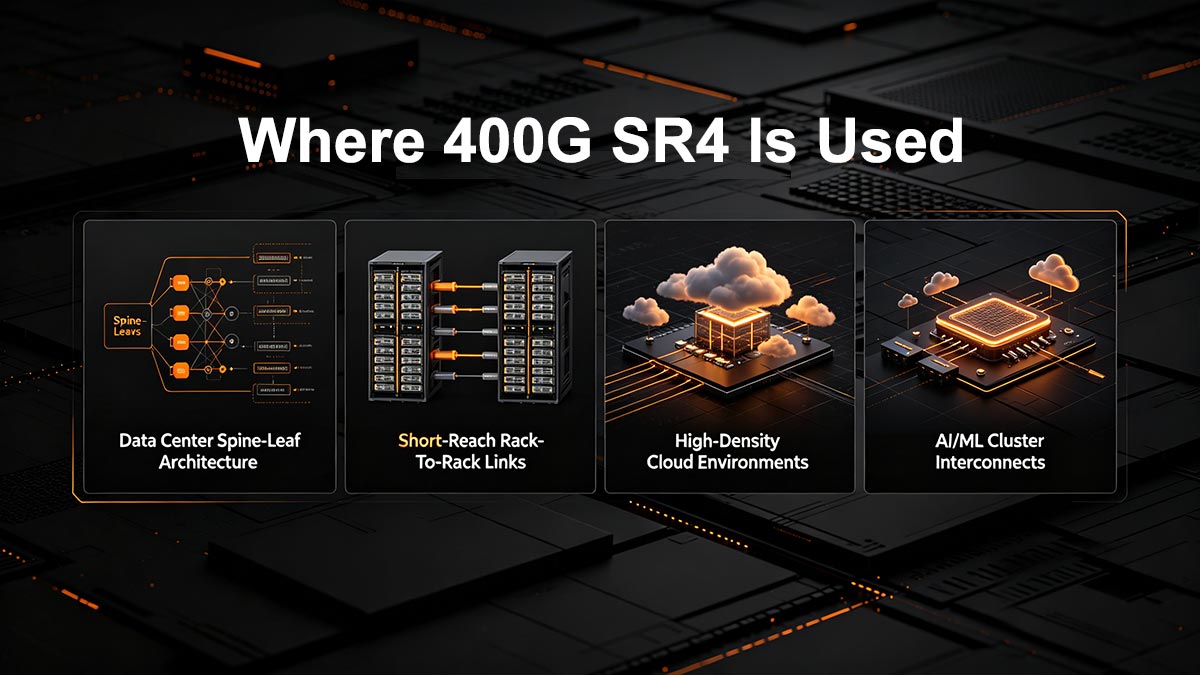
Data Center Spine-Leaf Architecture
One of the most common applications of 400G SR4 is in spine-leaf network topologies, which are widely used in modern data center design.
In this architecture:
- Leaf switches connect servers within racks
- Spine switches provide high-speed aggregation between leaf layers
400G SR4 is typically deployed on short-reach leaf-to-spine links, where distances remain within multimode fiber limits. Its parallel optics design enables high throughput while maintaining predictable latency and cost efficiency.
Short-Reach Rack-To-Rack Links
400G SR4 is widely used for rack-to-rack interconnections, especially in high-density switching environments.
Typical scenarios include:
- Top-of-rack (ToR) switch uplinks
- Adjacent rack interconnects
- Row-level aggregation switches
Because SR4 supports up to ~50 meters over OM4 fiber, it is ideal for structured cabling layouts where devices are located within the same data hall or nearby rows.
High-Density Cloud Environments
Cloud service providers rely heavily on 400G SR4 to support massive east-west traffic flows inside data centers.
Key benefits in cloud environments:
- High port density using MPO-based parallel optics
- Efficient bandwidth scaling for virtualized workloads
- Reduced latency for distributed cloud applications
This makes SR4 a practical choice for environments where traffic volume is more important than long-distance reach.
AI/ML Cluster Interconnects
With the rapid growth of AI workloads, GPU and accelerator clusters require extremely high-bandwidth interconnects.
400G SR4 is commonly used in:
- AI training clusters
- Distributed machine learning infrastructure
- High-performance computing (HPC) fabrics
Its ability to deliver 400G aggregated throughput over short distances makes it suitable for connecting compute nodes, storage systems, and high-speed switching fabrics within AI data centers.
Hyperscale Data Center Use Cases
Hyperscale operators deploy 400G SR4 in large volumes due to its balance of cost efficiency, scalability, and deployment simplicity.
Common use cases include:
- Short-reach inter-switch connections
- Modular data hall expansion links
- High-density aggregation layers
In hyperscale environments, SR4 is often part of a multi-optic strategy, used alongside SR4.2 and DR4 depending on distance and topology requirements, ensuring optimized performance across the entire network fabric.
🔷 400G SR4 Fiber And Cabling Requirements
Deploying 400G SR4 successfully requires more than just selecting the right transceiver. Because it relies on multimode parallel optics and MPO-based connectivity, the fiber infrastructure and cabling design play a critical role in ensuring stable performance, low loss, and correct polarity across the link.
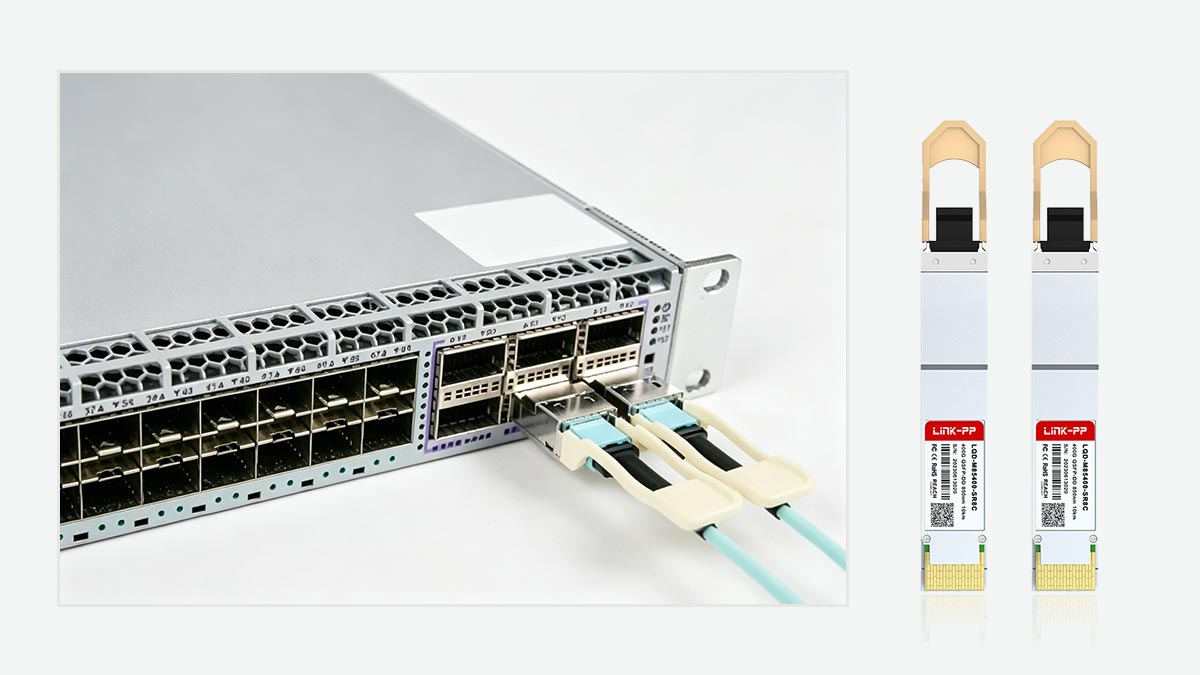
OM3 Vs. OM4 Fiber Explanation
400G SR4 operates over multimode fiber (MMF), primarily OM4, with OM3 as a legacy or lower-performance alternative.
- OM3 fiber:
- Supports shorter reach and lower bandwidth capacity
- Generally not preferred for 400G deployments
- May be limited in high-speed 400G environments
- OM4 fiber:
- Higher bandwidth performance than OM3
- Standard choice for 400G SR4 deployments
- Supports typical SR4 reach up to ~50 meters
In modern data centers, OM4 is the recommended baseline to ensure signal integrity for 400G PAM4 transmission.
MPO-12 Polarity Considerations
400G SR4 uses an MPO-12 connector, which introduces important polarity management requirements.
Key points include:
- Proper alignment of transmit (Tx) and receive (Rx) fibers
- Use of correct Type A, B, or C polarity schemes
- Ensuring end-to-end fiber mapping consistency
Incorrect polarity configuration is one of the most common causes of link failure or no-light conditions in SR4 deployments, making structured cabling validation essential.
Patch Panel And Trunk Cabling Design
In structured cabling systems, 400G SR4 is typically deployed using MPO trunk cables and patch panels.
Best practices include:
- Using pre-terminated MPO trunk cables for consistency
- Minimizing patch points to reduce insertion loss
- Maintaining clean cable routing in high-density racks
- Ensuring proper labeling for fiber identification
Patch panels act as aggregation points, enabling flexible reconfiguration while maintaining structured fiber management in large-scale deployments.
Common Deployment Mistakes
Several recurring issues can impact 400G SR4 performance:
- Incorrect MPO polarity setup
- Mixing OM3 and OM4 fiber in the same link
- Excessive connector loss from poor termination
- Over-bending or improper fiber management
- Incompatible transceiver vendor configurations
These mistakes can lead to signal degradation, link instability, or complete link failure, especially in high-speed 400G environments where tolerances are tighter.
Link Budget Considerations
Although 400G SR4 is designed for short-reach transmission, proper link budget planning is still essential.
Key factors include:
- Fiber attenuation over OM4 (typically low but cumulative)
- Connector insertion loss across MPO interfaces
- Patch panel and splice losses
- Total channel loss within allowable limits
Ensuring the total optical loss remains within the transceiver’s specification is critical for maintaining reliable 400G performance and error-free transmission in production networks.
🔷 Advantages And Limitations Of 400G SR4
Like most high-speed optical solutions, 400G SR4 is designed for a specific operating environment. It offers strong advantages in short-reach, high-density data center deployments, but it also has clear limitations that must be considered when designing modern 400G networks.
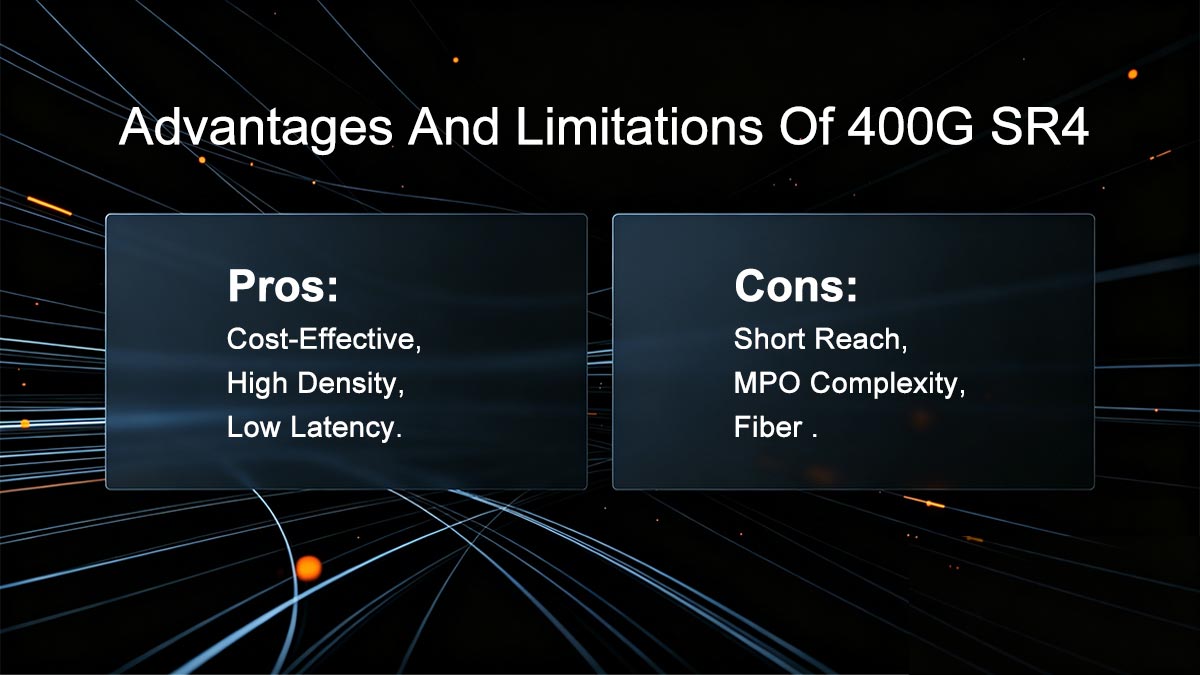
Pros: Cost-Effective, High Density, Low Latency
400G SR4 is widely adopted because it delivers a strong balance of performance and cost efficiency in short-reach environments.
Key advantages include:
- Cost-effective deployment
Uses multimode fiber (OM4), which is generally less expensive than single-mode infrastructure, reducing overall cabling cost in data centers.
- High port density
MPO-12 parallel optics enable compact cabling, making it ideal for high-density switch environments.
- Low latency performance
Short-reach optical transmission minimizes propagation delay, which is critical for latency-sensitive workloads such as cloud computing and AI clusters.
- Efficient 400G aggregation
Four 100G lanes (4×100G PAM4) allow efficient bandwidth scaling within compact form factors.
Cons: Short Reach, MPO Complexity, Fiber Management
Despite its strengths, 400G SR4 also introduces deployment constraints.
Key limitations include:
- Short transmission distance
Typically limited to ~50 meters on OM4 fiber, making it unsuitable for long-range or inter-building connections.
- MPO connector complexity
Requires precise polarity control and fiber alignment, increasing installation and maintenance complexity.
- Fiber management challenges
High-density MPO cabling can be difficult to manage in large-scale deployments without structured cabling discipline.
- Limited flexibility
Not ideal for networks requiring frequent reconfiguration or long-distance scalability.
When SR4 Is The Wrong Choice
400G SR4 is not suitable in scenarios where:
- Distance exceeds multimode fiber limits (beyond ~50m)
- Inter-building or campus-wide connectivity is required
- Simplified LC-based cabling is preferred
- Long-term scalability favors single-mode infrastructure
- Cabling flexibility is more important than density
In these cases, solutions like 400G DR4 or FR4 are typically more appropriate due to their extended reach and single-mode fiber compatibility.
When SR4 Is The Best Option
400G SR4 is the optimal choice when the network requires:
- Short-reach interconnects within a single data hall
- High-density spine-leaf architectures
- Cost-sensitive 400G upgrades from 100G infrastructure
- Low-latency communication between adjacent racks
- Scalable multimode fiber-based environments
In practice, SR4 is most effective in hyperscale and enterprise data centers where traffic density is high but physical distances are limited, making it a core building block of modern 400G short-reach optical networks.
🔷 How To Choose Between 400G SR4 And Other Optics
Selecting the right 400G optical solution is not just a technical decision—it is an architecture decision. 400G SR4, AOC, DAC, and single-mode optics (such as DR4 or FR4) all solve different problems. The correct choice depends on distance, infrastructure, density, and cost constraints.

Decision Tree Approach
A practical way to evaluate 400G SR4 against other options is to follow a simple decision flow based on four key factors:
Distance Requirement
- ≤ 50m → 400G SR4 or AOC
- 50m–100m → SR4.2 or short-range single-mode options
- > 100m → DR4 / FR4 (single-mode fiber required)
Distance is often the first and most critical filter in optical selection.
Fiber Infrastructure (MMF Vs. SMF)
- Multimode fiber (MMF) → SR4, SR4.2
- Single-mode fiber (SMF) → DR4, FR4
If the data center is already built on OM4 multimode infrastructure, SR4 becomes the natural choice. If future scalability is the priority, SMF-based optics may be preferred.
Port Density Needs
- High-density environments → SR4 (MPO-based parallel optics)
- Simplified cabling environments → DAC or AOC
- Long-range scalable fabrics → DR4 / FR4
SR4 is especially strong where maximizing switch port utilization per rack unit is a priority.
Budget Constraints
- Lowest cost (shortest reach) → DAC
- Balanced cost/performance → SR4 / AOC
- Higher cost, long reach flexibility → DR4 / FR4
SR4 typically sits in the mid-to-low cost range for 400G optical deployments, making it attractive for large-scale rollouts.
SR4 vs. AOC vs. DAC Comparison Logic
| Solution |
Medium |
Typical Reach |
Key Strength |
Limitation |
| DAC |
Copper |
~1–3m |
Lowest cost |
Very short distance |
| AOC |
Active fiber |
~3–30m |
Plug-and-play simplicity |
Fixed length, limited flexibility |
| SR4 |
MMF (MPO) |
~50m |
High density, scalable |
MPO complexity |
| DR4 |
SMF |
~500m |
Long reach, scalable |
Higher infrastructure cost |
This comparison shows that SR4 is positioned as the balanced high-density multimode solution for structured data center environments.
Enterprise vs. Hyperscale Selection Patterns
Enterprise Data Centers
- Prefer SR4 or AOC
- Focus on cost efficiency and simplicity
- Limited fiber diversity (often MMF-based)
- Moderate scale and shorter interconnect distances
Hyperscale Data Centers
- Use a mix of SR4, SR4.2, and DR4
- Optimize per-layer architecture (leaf/spine/core)
- Separate roles for MMF and SMF infrastructure
- Prioritize scalability, density, and long-term flexibility
In hyperscale environments, SR4 is typically used for high-density short-reach layers, while DR4 or FR4 handles longer spine or inter-zone connectivity.
Key Takeaway
The choice between 400G SR4 and other optics is not a single-product decision. It is an infrastructure strategy decision, balancing distance, fiber type, density, and total cost of ownership across the entire data center architecture.
🔷 Future Trends Of 400G SR4 And 800G Migration
The evolution of 400G SR4 is closely tied to the broader transition toward 800G and next-generation data center architectures. While SR4 remains a widely deployed short-reach solution today, its role is gradually shifting as networks prepare for higher bandwidth density, AI-driven workloads, and more efficient optical interconnect standards.
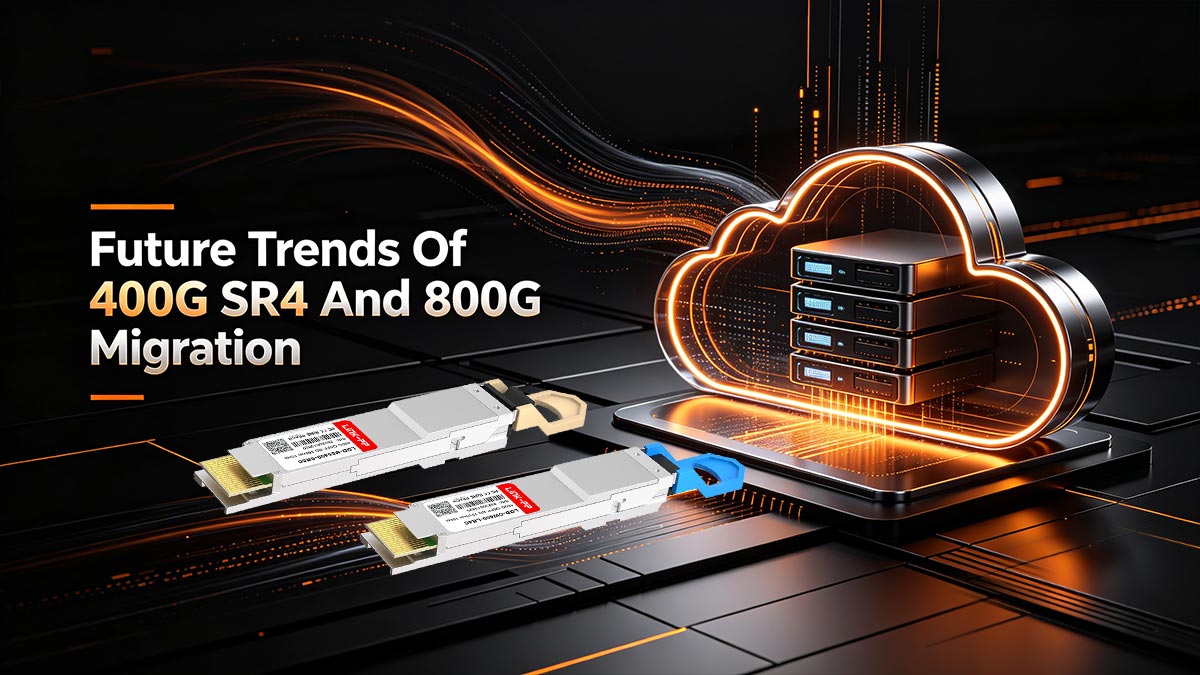
Transition Toward 800G SR8 / DR8
The industry is rapidly moving from 400G to 800G Ethernet, with new optical formats such as SR8 and DR8 emerging as successors.
- 800G SR8: Uses 8 lanes of 100G PAM4 over multimode fiber, extending the SR concept for higher density short-reach links
- 800G DR8: Uses single-mode fiber for longer reach and scalable data center interconnects
In this transition, 400G SR4 acts as a foundational stepping stone, helping data centers upgrade incrementally rather than replacing infrastructure all at once.
MPO Evolution vs. Next-Gen Fiber Interfaces
The continued use of MPO-based cabling (such as MPO-12 and MPO-16) remains central to parallel optics, but the ecosystem is evolving.
Key trends include:
- Migration from MPO-12 to higher-fiber-count connectors
- Improved polarity management and pre-terminated trunk systems
- Increased adoption of factory-optimized cabling solutions
At the same time, next-generation interfaces aim to reduce complexity while maintaining or increasing bandwidth density.
AI Data Center Impact
The rise of AI and machine learning workloads is one of the strongest drivers behind optical evolution.
400G SR4 is currently widely used in:
- GPU cluster interconnects
- AI training infrastructure
- High-bandwidth east-west traffic fabrics
However, as AI models scale, demand is shifting toward 800G and beyond, requiring even higher-density and more energy-efficient optical solutions.
Upgrade Trends
Several key trends are shaping optical network upgrades:
- Rapid adoption of 800G optics in hyperscale environments
- Gradual replacement of 400G SR4 in new deployments
- Increased focus on power efficiency per bit
- Hybrid architectures combining 400G and 800G layers
- Expansion of AI-optimized data center fabrics
Despite these changes, 400G SR4 will remain relevant in short-reach legacy and cost-sensitive deployments for several more years.
Future-Proofing Optics Infrastructure
As data center architectures evolve, the key challenge is balancing current performance needs with future scalability. While 400G SR4 continues to serve as a reliable short-reach solution, many operators are designing networks with a gradual migration path toward 800G and beyond.
Choosing the right optical strategy today helps ensure long-term infrastructure stability and upgrade flexibility as bandwidth demands continue to grow.
If you are planning a 400G or 800G data center upgrade, selecting the right optical modules and compatible components is critical for long-term performance and scalability.
👉 Explore high-quality optical and connectivity solutions at the: LINK-PP Official Store