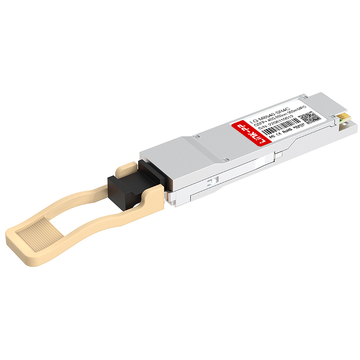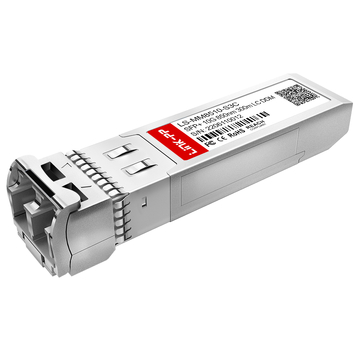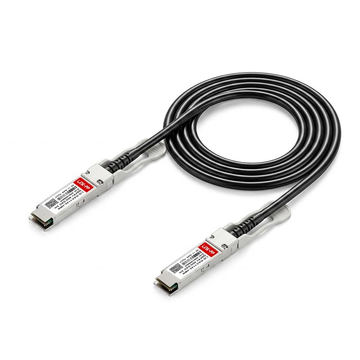
Data center and enterprise networks are increasingly built around high-density Ethernet architectures, where 40GbE aggregation layers are used to efficiently connect multiple 10GbE access switches and servers. In these environments, breakout connectivity has become a practical approach to improve port utilization while reducing cabling complexity and simplifying network expansion.
A typical implementation is the Fortinet FG-TRAN-QSFP-4XSFP, which allows a single 40G QSFP+ interface to be divided into four independent 10G SFP+ links. This enables flexible deployment in spine-leaf and top-of-rack designs, especially where mixed-speed interoperability is required. However, differences in platform compatibility, supply continuity, and design preferences often drive the need to evaluate alternative breakout solutions that provide similar functionality.
This article provides a structured breakdown of FG-TRAN-QSFP-4XSFP alternatives and their role in modern 40G-to-4×10G networks, focusing on the following aspects:
- Fundamental structure and operating principle of QSFP+ breakout technology
- Typical deployment scenarios in enterprise and data center environments
- Key technical and compatibility factors influencing alternative selection
- Comparison of major breakout approaches including AOC, DAC, and optical transceiver-based designs
- Practical considerations for long-term deployment and network scalability
By examining these areas in detail, readers can better understand how different breakout solutions fit into evolving network architectures and what factors should be prioritized when planning 40G-to-10G connectivity strategies.
📜 Understanding the FG-TRAN-QSFP-4XSFP Active Optical Breakout Cable
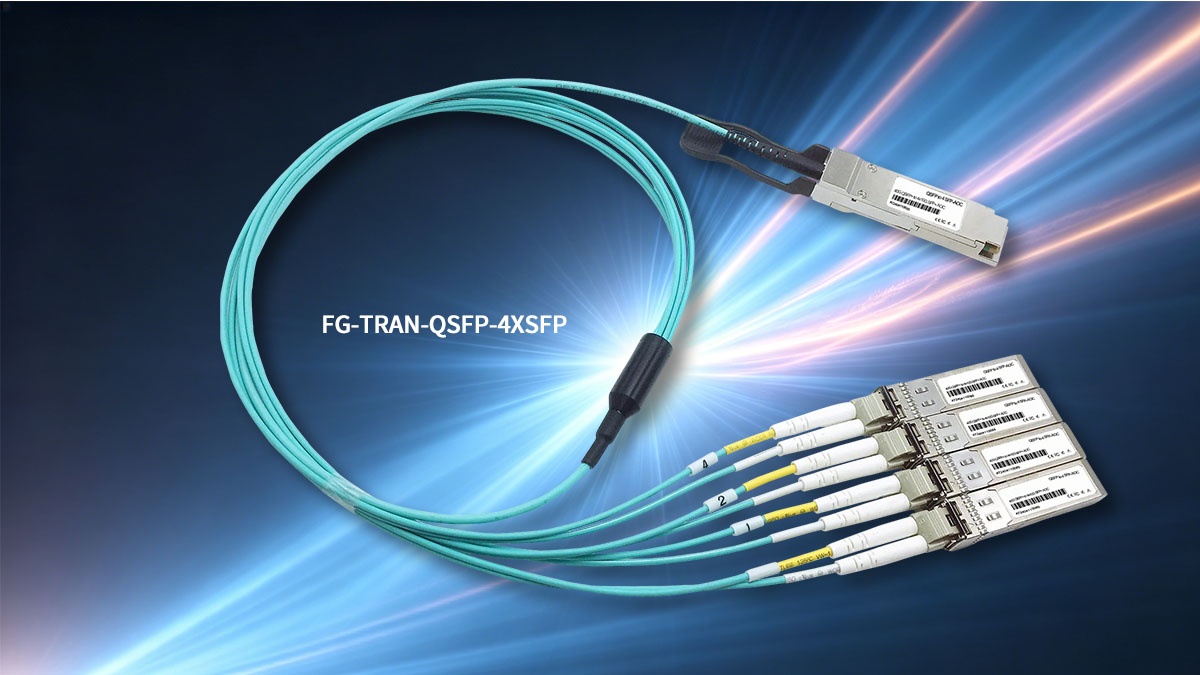
The FG-TRAN-QSFP-4XSFP active optical breakout cable is designed to convert a single 40GbE QSFP+ port into four independent 10GbE SFP+ links. In practical terms, it is a high-density interconnect solution that enables one upstream switch port to simultaneously serve multiple downstream devices, making it highly effective in aggregation and leaf-layer network designs where 10G endpoints remain widely deployed.
What Is FG-TRAN-QSFP-4XSFP?
The Fortinet FG-TRAN-QSFP-4XSFP is a pre-terminated active optical breakout assembly that integrates transceiver functionality within the cable itself. Instead of using separate QSFP+ and SFP+ optical transceivers with patch cords, it combines optical components into a single unit, simplifying deployment and reducing configuration overhead.
In most deployments, its primary function is to:
- Split one 40G QSFP+ interface into four 10G SFP+ connections
- Support short-to-medium range fiber connectivity between switches and servers
- Provide plug-and-play compatibility in supported Fortinet switching environments
This makes it especially useful in environments where predictable performance and simplified cabling are more important than modular transceiver flexibility.
Key Technical Specifications
The FG-TRAN-QSFP-4XSFP breakout cable is designed around 40GBASE-SR4-style architecture principles, but packaged as an active optical assembly. Its typical characteristics can be summarized as follows:
| Parameter | Specification |
|---|---|
| Interface Type | QSFP+ to 4×SFP+ |
| Total Bandwidth | 40Gbps (4×10Gbps lanes) |
| Transmission Medium | Multimode fiber (integrated AOC design) |
| Reach Distance | Typically up to ~100m (depending on fiber type) |
Before selecting this type of breakout cable, it is important to understand that performance and reach are closely tied to the active optical design, which includes embedded electro-optical conversion within the cable assembly. This eliminates the need for separate optical modules but also means the cable itself becomes a fixed-function component.
How Active Optical Breakout Cables Work
Active optical breakout cables operate by embedding transceiver circuitry directly inside the cable ends. In the case of FG-TRAN-QSFP-4XSFP, the QSFP+ side receives a 40G electrical signal, which is then internally demultiplexed into four separate 10G electrical lanes. These lanes are converted into optical signals and transmitted over parallel fiber paths to the SFP+ endpoints.
This architecture typically provides:
- Stable signal integrity over longer distances compared to DAC solutions
- Reduced latency variation due to controlled internal conversion
- Simplified installation with no need for separate module pairing
At the same time, the integrated design also means the cable behaves as a single active device, requiring careful attention to platform compatibility and firmware recognition during deployment.
📜 Why 40G to 4×10G Breakout Connectivity Remains Important
40G to 4×10G breakout connectivity remains widely used because many data center networks still operate in mixed-speed environments where 10GbE access layers coexist with 40GbE aggregation layers. Instead of replacing entire infrastructures, breakout solutions allow organizations to extend the value of existing 40G switching assets while supporting large numbers of 10G endpoints in a cost-efficient and scalable way.
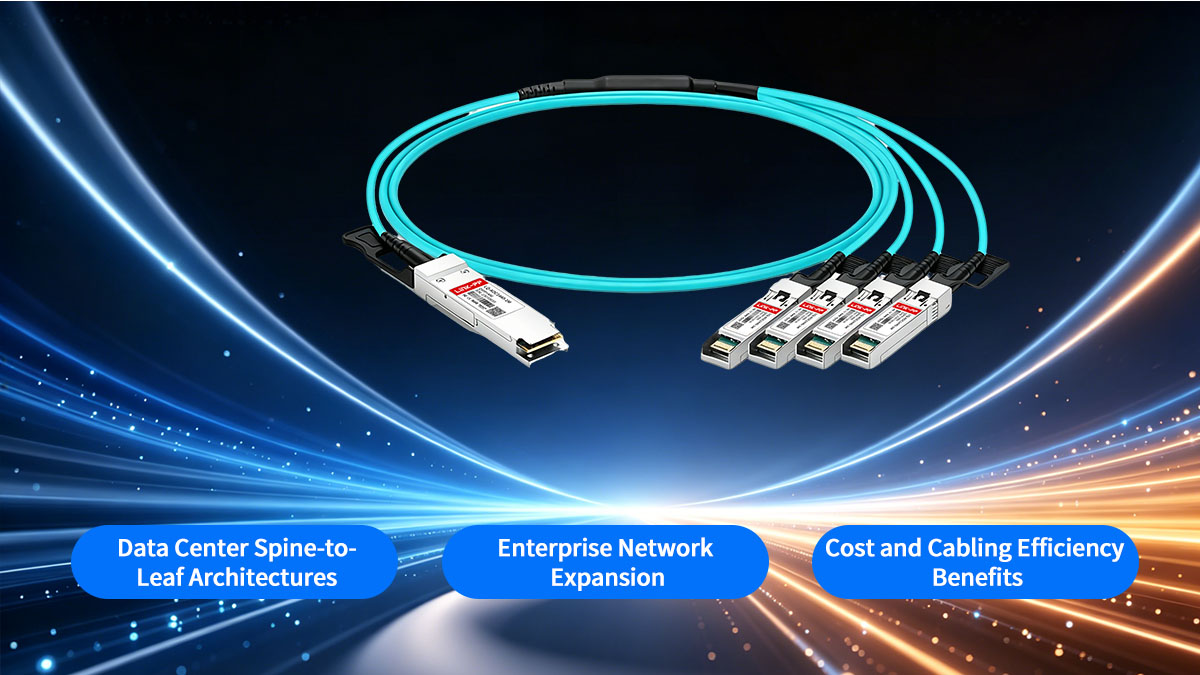
Data Center Spine-to-Leaf Architectures
In spine-leaf network designs, 40G links are commonly deployed at the spine or aggregation layer to provide high-capacity uplinks, while 10G ports dominate server-facing connections. Breakout cables make this architecture more efficient by allowing one high-speed port to serve multiple lower-speed devices.
In practical deployments, this approach typically:
- Improves utilization of 40G uplink ports by distributing bandwidth across multiple 10G connections
- Reduces the need for additional switches at the aggregation layer
- Simplifies network topology in environments with dense server connectivity
This is especially valuable in environments where traffic patterns are distributed rather than concentrated, enabling more balanced bandwidth allocation across the network fabric.
Enterprise Network Expansion
Enterprise networks often evolve gradually rather than through full-scale hardware replacement. In these scenarios, 40G-to-4×10G breakout connectivity provides a transition path that supports incremental upgrades without disrupting existing 10G infrastructure.
Key benefits in enterprise environments include:
- Enabling coexistence of legacy 10G systems with newer 40G-capable switching platforms
- Supporting phased upgrades across departments or buildings
- Maintaining operational continuity during infrastructure scaling
This approach reduces migration complexity and allows IT teams to align upgrades with budget cycles and operational priorities.
Cost and Cabling Efficiency Benefits
Beyond architectural flexibility, breakout connectivity also delivers tangible efficiency improvements in physical infrastructure design. Instead of deploying four separate 10G uplinks with individual transceivers and fiber runs, a single 40G breakout cable can achieve the same connectivity outcome.
Typical efficiency gains include:
- Reduced number of optical modules required per deployment
- Lower fiber patching complexity in high-density racks
- Simplified cable management and improved airflow within racks
Overall, this makes breakout solutions a practical choice for environments where space, power, and cabling density are critical constraints, while still maintaining predictable performance across multiple 10G links.
📜 Common Deployment Scenarios for FG-TRAN-QSFP-4XSFP
The Fortinet FG-TRAN-QSFP-4XSFP is typically deployed in environments where a single 40GbE uplink needs to be distributed across multiple 10GbE endpoints. Its value is most visible in high-density switching architectures, where efficient port utilization and simplified cabling directly impact operational scalability and network design flexibility.
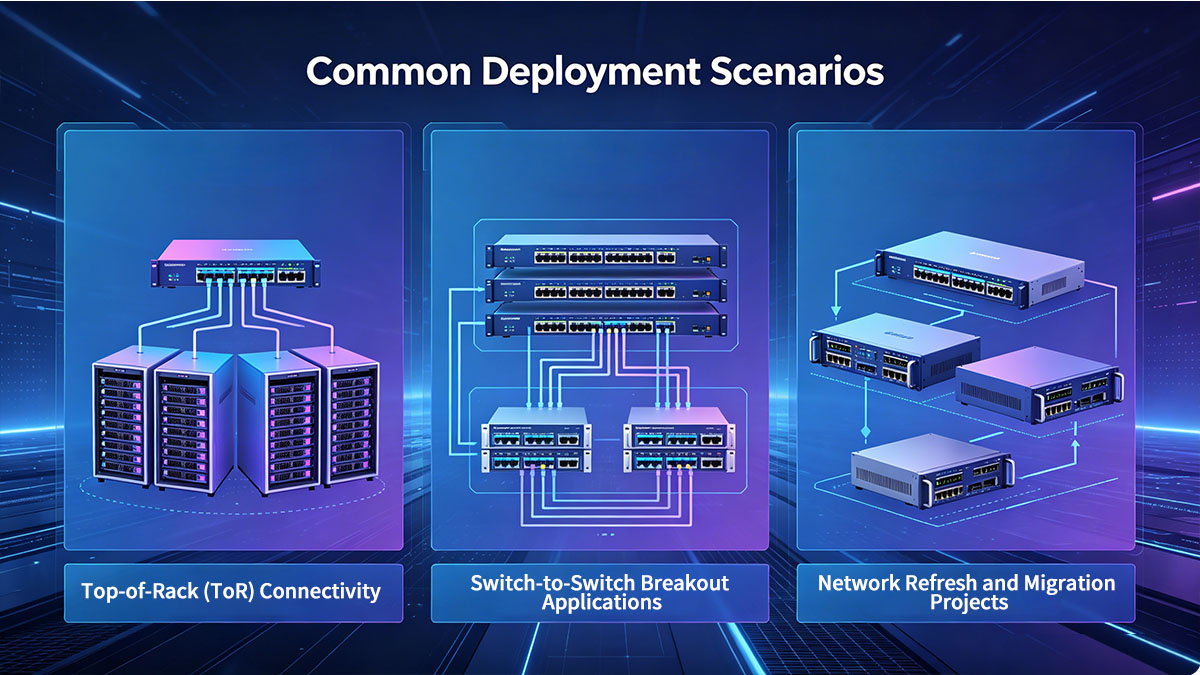
Top-of-Rack (ToR) Connectivity
In Top-of-Rack deployments, servers within a single rack are commonly connected at 10GbE speeds, while uplinks from the ToR switch operate at 40GbE or higher. A breakout cable enables one 40G uplink to serve multiple servers or access switches within the same rack.
This scenario typically benefits from:
- Direct aggregation of multiple 10G server connections into a single 40G uplink
- Reduced requirement for additional uplink ports on ToR switches
- Simplified rack-level cabling structure, improving airflow and maintenance access
This makes breakout connectivity especially practical in virtualization-heavy environments where server density is high and east-west traffic is significant.
Switch-to-Switch Breakout Applications
Another common use case is switch-to-switch connectivity, particularly between aggregation and access layers in a spine-leaf architecture. A 40G port on a spine switch can be split into four 10G links to connect multiple access-layer switches.
Key advantages in this scenario include:
- More efficient use of high-bandwidth spine ports
- Flexible distribution of uplink capacity across multiple downstream switches
- Reduced need for additional 40G-capable access-layer hardware
This approach is often used in environments where access switches remain 10G-capable but upstream aggregation has already transitioned to 40G.
Network Refresh and Migration Projects
During staged infrastructure upgrades, organizations often operate hybrid networks that include both legacy 10G equipment and newer 40G-capable systems. Breakout connectivity plays a transitional role in these migration phases.
Typical deployment patterns include:
- Gradual replacement of 10G aggregation links with 40G uplinks
- Temporary bridging between old and new switching generations
- Maintaining service continuity while upgrading network tiers
In these scenarios, breakout cables help avoid disruptive full-stack replacements and allow network teams to align upgrades with operational windows and budget planning cycles, ensuring stable performance throughout the migration process.
📜 Why Organizations Consider FG-TRAN-QSFP-4XSFP Alternatives
Even though the Fortinet FG-TRAN-QSFP-4XSFP is widely used in 40G-to-10G breakout deployments, many organizations still evaluate alternative solutions to better align with evolving network requirements. These considerations are typically driven by compatibility, lifecycle planning, scalability needs, and operational flexibility rather than purely technical performance limitations.
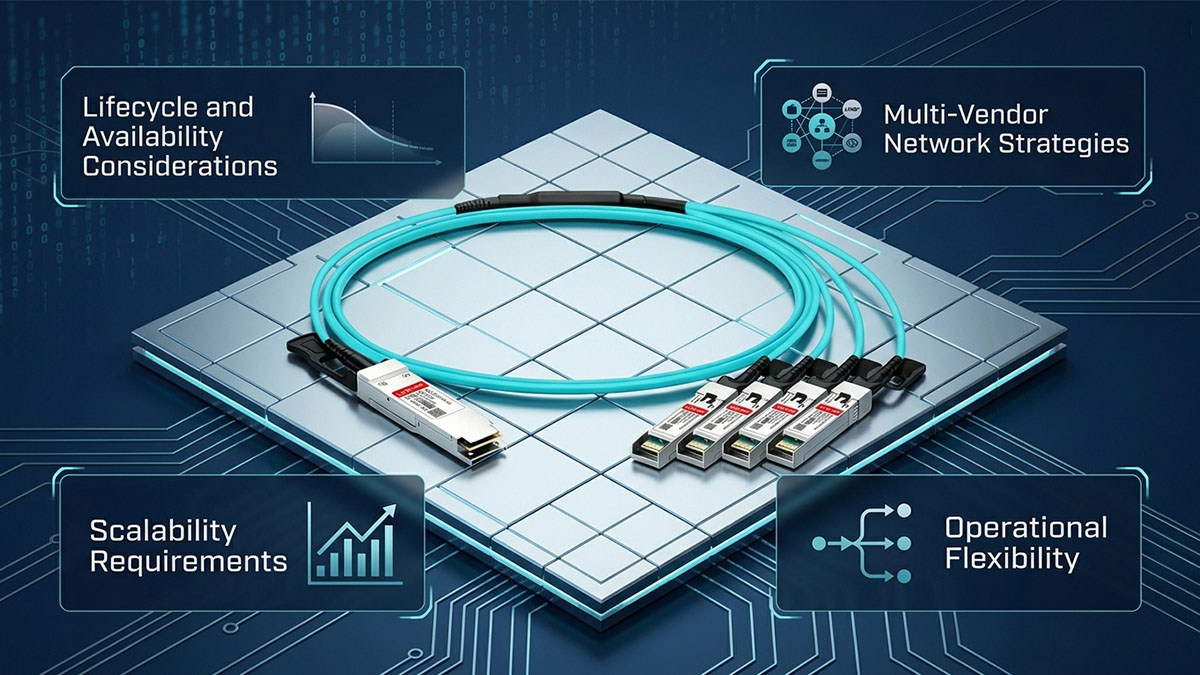
Lifecycle and Availability Considerations
One of the most common reasons for exploring alternatives is product lifecycle management. As networks evolve toward higher speeds such as 25G and 100G, certain 40G breakout components may become less central in long-term infrastructure planning.
In practice, this leads organizations to:
- Assess long-term availability of specific breakout models
- Avoid dependency on a single hardware generation
- Standardize on broader optical or breakout platforms that support multiple speed tiers
This approach helps ensure continuity in procurement and reduces the risk of future redesigns caused by component obsolescence.
Multi-Vendor Network Strategies
Modern data centers rarely rely on a single vendor across all network layers. As a result, interoperability becomes a key factor when selecting breakout solutions.
Alternative evaluation is often driven by:
- The need for consistent behavior across different switching platforms
- Avoiding vendor-locked transceiver ecosystems
- Ensuring compatibility with mixed Fortinet, Cisco, Juniper, or open networking environments
This is especially important in large-scale deployments where network standardization across multiple hardware vendors improves operational efficiency.
Scalability Requirements
As traffic demands grow, organizations often reassess whether their existing 40G breakout strategy can scale efficiently in future phases of expansion. Alternatives may offer more flexible upgrade paths or broader compatibility across different port speeds.
Common scalability-driven considerations include:
- Planning transitions from SFP+ 10G to SFP28 25G server access layers
- Reducing dependence on fixed 4×10G breakout structures
- Aligning breakout design with next-generation switching architectures
This ensures that current deployment choices do not restrict future network evolution.
Operational Flexibility
Operational efficiency is another key driver behind evaluating alternatives. While integrated breakout cables simplify deployment, they also represent fixed-function components that may not suit all environments.
Organizations often look for alternatives that provide:
- Greater flexibility in cable length selection
- Easier inventory management across multiple network designs
- Broader compatibility across different switch models and firmware versions
By introducing alternative breakout solutions, network teams can maintain more adaptable infrastructure planning, especially in environments that require frequent reconfiguration or multi-site standardization.
📜 Technical Factors to Evaluate When Selecting an FG-TRAN-QSFP-4XSFP Alternative
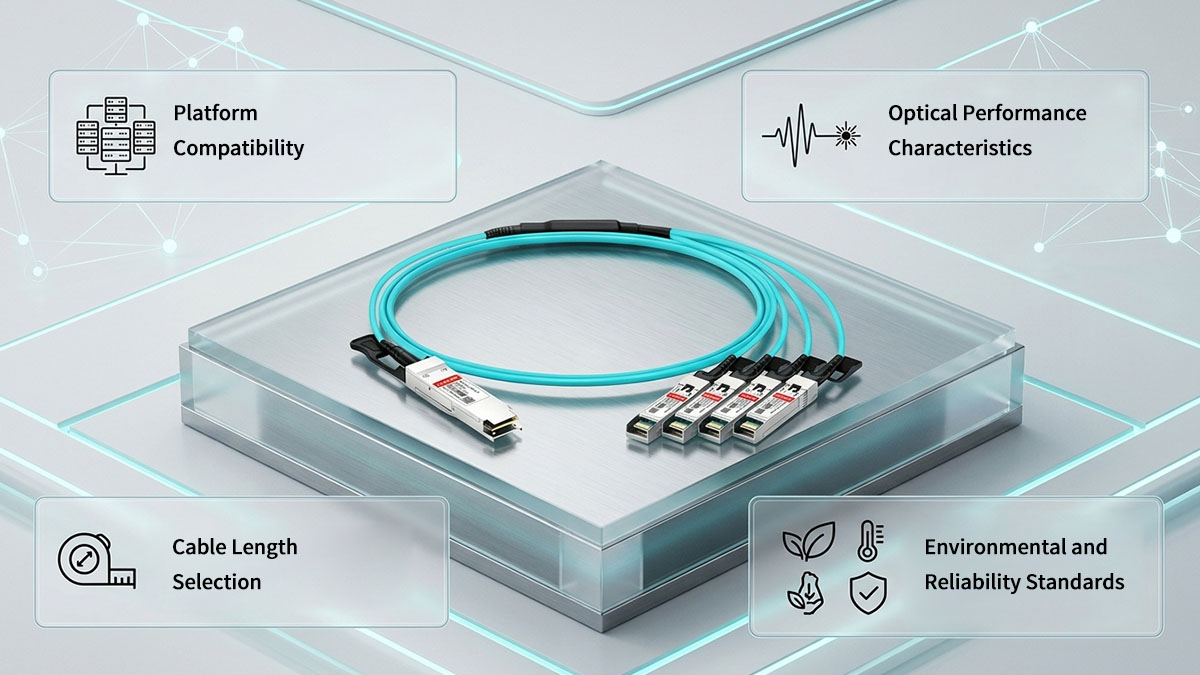
When evaluating an alternative to the Fortinet FG-TRAN-QSFP-4XSFP, the decision is primarily driven by technical compatibility and deployment reliability rather than simple port matching. Because breakout cables sit directly in the high-speed data path, even small mismatches in signaling, coding, or optical behavior can affect link stability across multiple 10G endpoints.
Platform Compatibility
Compatibility is the first and most critical factor, since QSFP+ breakout cables rely on switch-level recognition and proper port breakout support. Without correct platform alignment, even a technically correct cable may fail to initialize.
Key compatibility checks typically include:
- Whether the switch supports 40G QSFP+ breakout mode to 4×10G SFP+
- Firmware and operating system support for breakout configuration
- Vendor-specific transceiver coding or EEPROM recognition requirements
In many deployments, platform validation is performed before rollout to ensure that each 10G lane is correctly detected and independently operational.
Optical Performance Characteristics
Beyond compatibility, optical performance determines whether the breakout solution can sustain stable throughput under real traffic conditions. Since each QSFP+ port is split into four independent 10G channels, signal quality must remain consistent across all lanes.
Important performance factors include:
- Signal integrity across all four 10G paths
- Bit error rate (BER) stability under continuous load
- Support for expected optical standards such as short-range multimode transmission
Even minor inconsistencies in optical conversion or internal alignment can result in intermittent link flapping or degraded throughput, especially in high-utilization environments.
Cable Length Selection
Breakout cables are available in different lengths, and selecting the correct distance is essential for maintaining optical performance and physical deployment efficiency. Unlike modular transceiver setups, length is fixed in integrated active optical cables, making upfront planning critical.
Typical considerations include:
- Rack-to-rack vs intra-rack connectivity requirements
- Airflow and cable routing constraints within dense racks
- Avoiding unnecessary slack that may impact cable management
Proper length selection ensures both signal reliability and maintainable physical infrastructure design.
Environmental and Reliability Standards
Since breakout cables often operate in high-density and continuously active environments, long-term reliability is a key evaluation factor. This is especially important in data centers where downtime or intermittent degradation can affect multiple connected endpoints simultaneously.
Key reliability aspects include:
- Operating temperature tolerance in dense rack environments
- Manufacturing consistency across multi-lane optical assemblies
- Resistance to signal degradation over time under sustained traffic loads
In addition, organizations often evaluate whether the alternative meets internal qualification standards for production deployment, ensuring predictable performance across large-scale network fabrics.
📜 FG-TRAN-QSFP-4XSFP vs Other 40G Connectivity Options
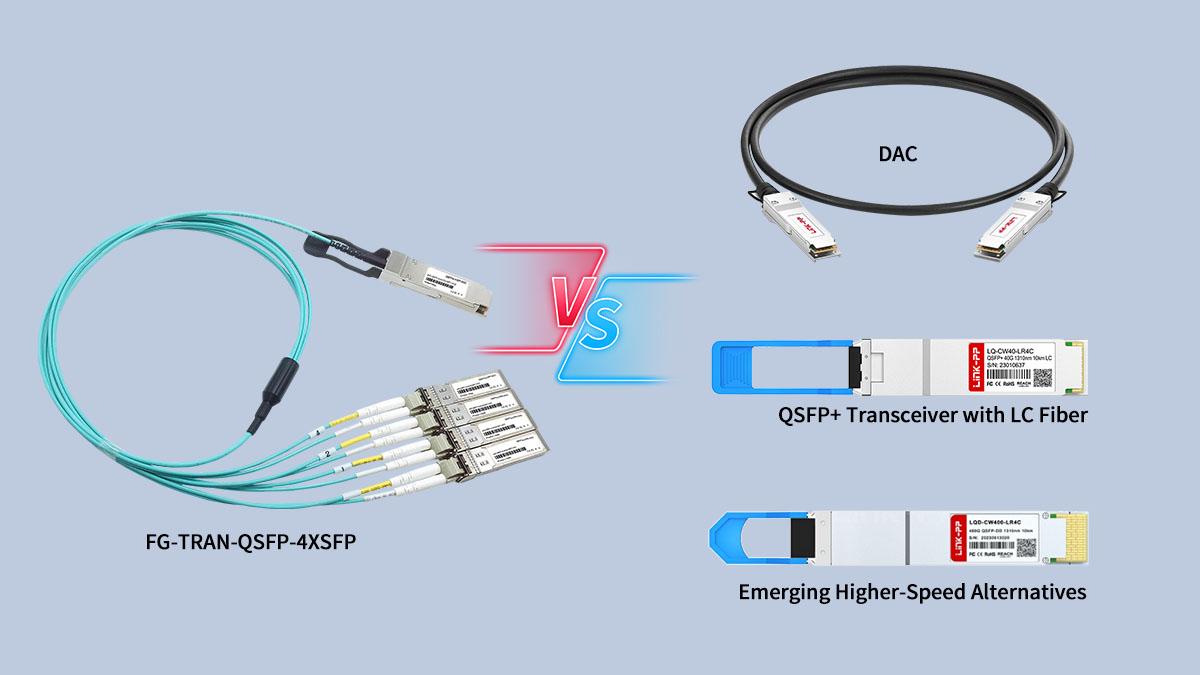
The Fortinet FG-TRAN-QSFP-4XSFP is one of several ways to implement 40G-to-10G connectivity in modern networks. However, it is not the only option. Depending on distance, modularity requirements, and deployment strategy, network architects often compare it against DAC solutions, modular transceiver-based fiber links, and other optical breakout designs to determine the most suitable approach.
Active Optical Cable (AOC) vs Direct Attach Cable (DAC)
Active Optical Cables (AOCs) and Direct Attach Cables (DACs) are both commonly used for short-range high-speed connectivity, but they differ significantly in signal transmission technology and deployment flexibility.
AOC-based breakout solutions, such as FG-TRAN-QSFP-4XSFP, use embedded optical transceivers, while DACs (like Fortinet SP-CABLE-FS-QSFP+1) rely on passive or active copper conductors. This fundamental difference leads to distinct operational characteristics.
Key differences include:
| Feature | AOC Breakout (FG-TRAN-QSFP-4XSFP) | DAC Breakout |
|---|---|---|
| Medium | Optical fiber | Copper twinax |
| Reach | Longer (typically up to ~100m) | Short (typically 1–7m) |
| Signal integrity | Higher over distance | Degrades over longer runs |
| Power consumption | Higher | Lower |
| Flexibility | Better for rack-to-rack links | Best for intra-rack links |
AOCs are generally preferred when stable performance is required across racks or when electromagnetic interference must be minimized, while DACs are more cost-efficient for very short-distance connections within a single rack.
AOC vs QSFP+ Transceiver with LC Fiber
Another common alternative is using discrete QSFP+ and SFP+ optical transceivers (such as Fortinet FG-TRAN-QSFP+SR and FG-TRAN-SFP+SR) connected via LC duplex fiber instead of an integrated breakout cable.
Unlike integrated breakout AOCs, this approach separates each connection into modular components, offering greater flexibility but increased configuration complexity.
Key comparison points include:
- Modularity: Transceiver-based solutions allow independent replacement of components
- Cabling complexity: Breakout AOCs simplify physical installation by eliminating patch cord management
- Troubleshooting: Modular systems make fault isolation more granular
- Deployment speed: Integrated AOCs are faster to deploy in bulk installations
This makes transceiver-based architectures more suitable for environments requiring frequent reconfiguration or mixed vendor interoperability.
AOC vs Emerging Higher-Speed Alternatives
As networks evolve beyond QSFP+ 40G toward QSFP28 100G and QSFP-DD 400G architectures, 40G breakout solutions are increasingly evaluated within a broader migration context rather than as standalone technologies.
In this comparison, key considerations include:
- Whether current 10G endpoints will eventually transition to 25G or higher speeds
- Compatibility of existing QSFP+ infrastructure with newer QSFP28/QSFP-DD platforms
- Long-term cost efficiency of maintaining 40G breakout vs upgrading to native higher-speed links
While 40G breakout cables remain highly relevant in existing infrastructures, newer high-speed optics often provide better scalability for long-term backbone design, especially in greenfield deployments or major network refresh cycles.
📜 Compatibility Verification Best Practices
Before deploying any alternative to the Fortinet FG-TRAN-QSFP-4XSFP, compatibility verification is essential to ensure stable link establishment across all four 10GbE lanes. Because breakout cables depend on both hardware support and firmware recognition, even small mismatches can lead to link initialization failures or uneven port behavior.

Confirming Breakout Support on Switch Ports
The first step is verifying whether the switch platform supports 40G QSFP+ breakout functionality into 4×10G SFP+ links. Not all QSFP+ ports are inherently capable of breakout mode, and this capability is often dependent on both hardware design and software configuration.
Key checks typically include:
- QSFP+ port breakout capability in hardware specifications
- Support for 4×10G mode in the switch operating system
- Correct port configuration commands for enabling breakout mode
Without explicit breakout support, the QSFP+ port may only operate as a single 40G link, even if a physically compatible cable is used.
Reviewing Vendor Documentation
Vendor documentation plays a critical role in ensuring interoperability, especially in multi-vendor environments or when using third-party alternatives. Compatibility matrices and transceiver support lists provide authoritative guidance on validated configurations.
Important areas to review include:
- Approved transceiver and cable compatibility lists
- Firmware version requirements for breakout operation
- Known limitations for specific switch models or hardware revisions
This step reduces the risk of deploying unsupported configurations that may appear functional initially but fail under production traffic conditions.
Conducting Pre-Deployment Validation
Before full-scale deployment, controlled validation testing is strongly recommended to confirm stable performance across all breakout channels. This step helps identify issues early, especially in environments with mixed-speed infrastructure.
Typical validation activities include:
- Verifying that all four 10G SFP+ links initialize correctly
- Testing bidirectional traffic under sustained load conditions
- Monitoring for link flapping or CRC error accumulation
- Checking consistency across all breakout lanes rather than a single link
In many enterprise deployments, this testing is performed in a lab environment that mirrors production topology, ensuring that any compatibility issues are resolved before rollout.
📜 Common Challenges and Troubleshooting Tips
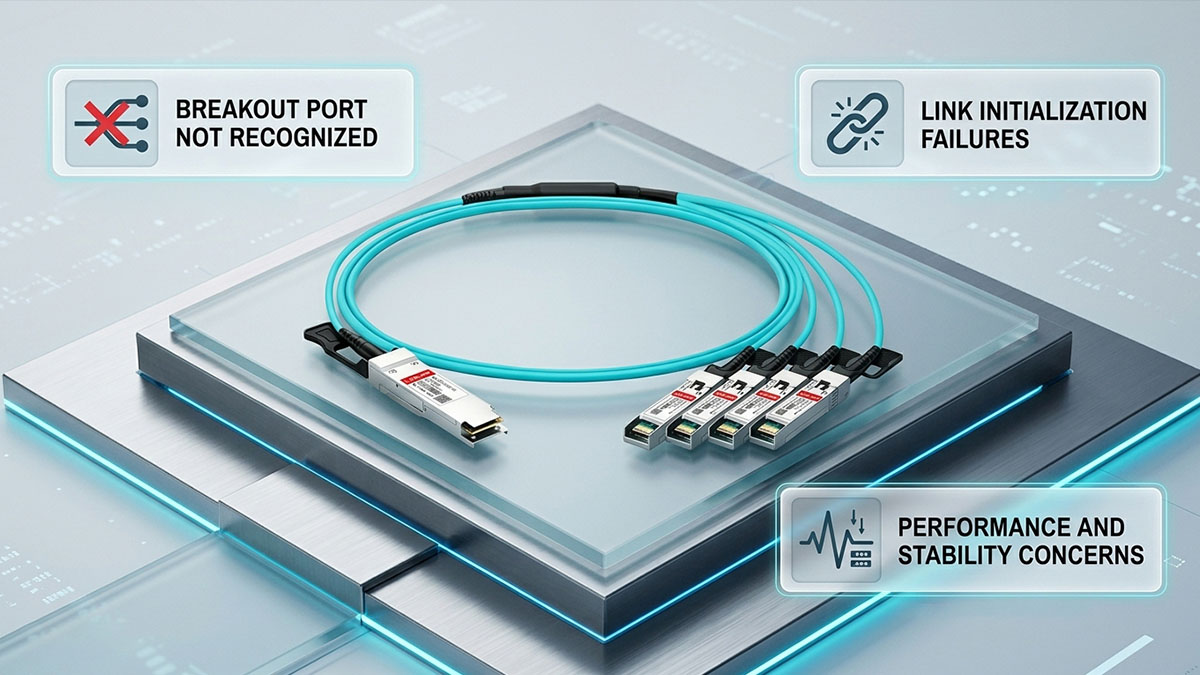
Even when an alternative is carefully selected for the Fortinet FG-TRAN-QSFP-4XSFP, real-world deployments can still encounter operational issues. These problems are often related to configuration mismatches, firmware limitations, or optical signal inconsistencies across the four 10GbE breakout lanes. Understanding typical failure patterns helps accelerate troubleshooting and improve network stability.
Breakout Port Not Recognized
One of the most common issues is when the switch fails to recognize the breakout configuration, resulting in the QSFP+ port operating only in 40G mode or not initializing all SFP+ lanes.
Typical causes include:
- Breakout mode not enabled in switch configuration
- Unsupported hardware platform or QSFP+ port type
- Incorrect or missing transceiver coding compatibility
Troubleshooting steps usually involve verifying port configuration commands, confirming platform support for 4×10G breakout, and checking whether the installed cable or module is on the supported compatibility list.
Link Initialization Failures
Another frequent issue is partial or complete failure of one or more 10G links to come up after connection. Since breakout cables rely on synchronized multi-lane signal distribution, even a single faulty lane can indicate broader compatibility problems.
Common root causes include:
- Incompatible firmware between switch and optical assembly
- Faulty or low-quality optical channel in the breakout cable
- Improper seating of QSFP+ or SFP+ connectors
In practice, isolating the issue often requires testing each SFP+ endpoint individually and swapping ports to determine whether the problem follows the cable, the port, or the endpoint device.
Performance and Stability Concerns
In some cases, links may appear operational but exhibit unstable performance under traffic load. This can manifest as packet loss, CRC errors, or intermittent throughput drops across one or more breakout lanes.
Key contributing factors include:
- Optical signal degradation over longer-than-recommended distances
- Uneven performance across the four internal optical channels
- High electromagnetic or environmental interference in dense rack environments
Troubleshooting typically involves monitoring interface error counters, checking optical power levels where supported, and validating that cable length and routing align with deployment guidelines.
📜 Future Trends in Breakout Connectivity
Breakout connectivity continues to evolve alongside the broader shift toward higher-speed Ethernet architectures. While solutions like the Fortinet FG-TRAN-QSFP-4XSFP remain widely deployed in existing 40G infrastructures, future designs are increasingly influenced by higher port speeds, greater density requirements, and more flexible multi-rate networking strategies.

Continued Support for Hybrid-Speed Networks
Most enterprise and data center environments are not transitioning to higher speeds in a single step. Instead, they operate hybrid networks where 10G, 25G, 40G, and 100G links coexist. In this context, breakout connectivity remains a practical tool for bridging different generations of network hardware.
Key trends include:
- Ongoing use of 40G breakout in legacy 10G server environments
- Integration of breakout strategies into mixed-speed spine-leaf fabrics
- Gradual replacement of 10G endpoints while maintaining 40G aggregation layers
This hybrid approach allows organizations to extend infrastructure lifecycles without disrupting existing service models.
Migration Toward Higher-Density Architectures
As application workloads continue to grow, network architectures are shifting toward higher port density and more granular bandwidth allocation. This reduces reliance on fixed-speed breakout patterns and increases demand for more flexible optical designs.
Emerging patterns include:
- Transition from 40G breakout (4×10G) to 100G breakout (4×25G) models
- Increased adoption of modular, high-density QSFP28 and QSFP-DD platforms
- Greater emphasis on per-port scalability rather than fixed breakout ratios
In this evolution, traditional 40G breakout solutions remain important in existing deployments but gradually become part of a broader multi-generational infrastructure strategy.
Growing Demand for Interoperable Optical Solutions
Modern networks increasingly require interoperability across multiple vendors and hardware generations. This drives demand for breakout and optical solutions that are less dependent on proprietary implementations and more aligned with open networking standards.
Key developments include:
- Broader support for multi-vendor transceiver compatibility
- Standardization of optical signaling across higher-speed interfaces
- Increased use of programmable or firmware-aware optical modules
These trends reduce deployment friction and make it easier to integrate breakout connectivity into heterogeneous network environments without extensive platform-specific customization.
📜 Conclusion
40G to 4×10G breakout connectivity remains a practical and widely adopted solution for bridging aggregation and access layers in modern data center and enterprise networks. Throughout this discussion, the Fortinet FG-TRAN-QSFP-4XSFP has been used as a representative example of how a single QSFP+ port can efficiently support multiple 10GbE links, enabling higher port utilization and simplified network expansion without major architectural changes.
At the same time, evaluating alternatives is a necessary step in long-term network planning. Factors such as platform compatibility, optical performance, lifecycle availability, and scalability requirements all influence whether a breakout solution will remain effective as infrastructure evolves toward higher-speed environments. Understanding these technical dimensions helps ensure stable deployment across mixed-speed architectures and reduces operational risk during upgrades or expansions.
For organizations looking to explore compatible optical and breakout solutions across different network environments, resources such as the LINK-PP Official Store provide additional reference options for evaluating transceiver and cabling ecosystems aligned with modern data center requirements.