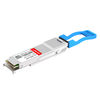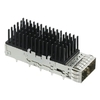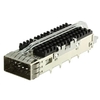
As data center traffic continues to grow, network infrastructure must support higher bandwidth while maintaining efficient port density. Optical transceivers play a critical role in enabling high-speed connectivity, particularly in modern Ethernet environments where 100GbE and 400GbE technologies are widely deployed. Among the most commonly discussed form factors are QSFP28 and QSFP-DD.
QSFP28 has become a standard solution for 100GbE networking, offering reliable performance for spine–leaf architectures, enterprise cores, and high-performance computing clusters. However, as hyperscale data centers and AI workloads demand significantly higher throughput, newer transceiver form factors such as QSFP-DD have been introduced to support 200G and 400G Ethernet speeds.
Understanding the differences between QSFP-DD and QSFP28 is important for network architects, engineers, and IT planners who need to design scalable infrastructure. While the two modules appear similar in size, they differ significantly in electrical lane architecture, bandwidth capacity, compatibility, and deployment scenarios.
This article provides a structured comparison of QSFP-DD vs QSFP28, explaining their technical specifications, key differences, compatibility considerations, and typical use cases in modern data center networks. By the end, you will have a clear understanding of how each transceiver fits into high-speed networking environments and when each technology is most appropriate.
? What Is QSFP28?
QSFP28 is a widely used optical transceiver form factor designed primarily for 100GbE networking. It builds on the earlier QSFP+ design but increases the per-lane data rate to support higher bandwidth. By using four high-speed electrical lanes, QSFP28 enables compact, high-density 100G connectivity commonly deployed in modern data center networks.
Definition and Standard Overview
QSFP28 (Quad Small Form-factor Pluggable 28) is a pluggable transceiver standard developed by the QSFP+ MSA. It supports 100GbE by transmitting data across four electrical lanes, each operating at approximately 25Gbps.
Compared with earlier QSFP+ modules used for 40GbE, QSFP28 maintains a similar physical form factor while significantly increasing lane speed. This design allows network switches and routers to support higher bandwidth without increasing port size or front-panel space.
In practical deployments, QSFP28 modules are commonly used in data center spine–leaf architectures, server aggregation layers, and high-performance computing environments where reliable 100G connectivity is required.
QSFP28 Technical Specifications
QSFP28 achieves 100Gbps throughput by combining multiple high-speed lanes within a compact module design. The following table summarizes its core technical characteristics.
| Specification |
QSFP28 |
| Electrical Lanes |
4 lanes |
| Lane Data Rate |
25Gbps per lane |
| Maximum Bandwidth |
100Gbps |
| Typical Interface |
MPO or duplex LC |
This architecture allows QSFP28 to efficiently deliver 100G bandwidth while maintaining high port density on switches. Because the module uses four lanes instead of a single high-speed channel, it can support multiple optical transmission methods such as parallel optics and wavelength multiplexing.
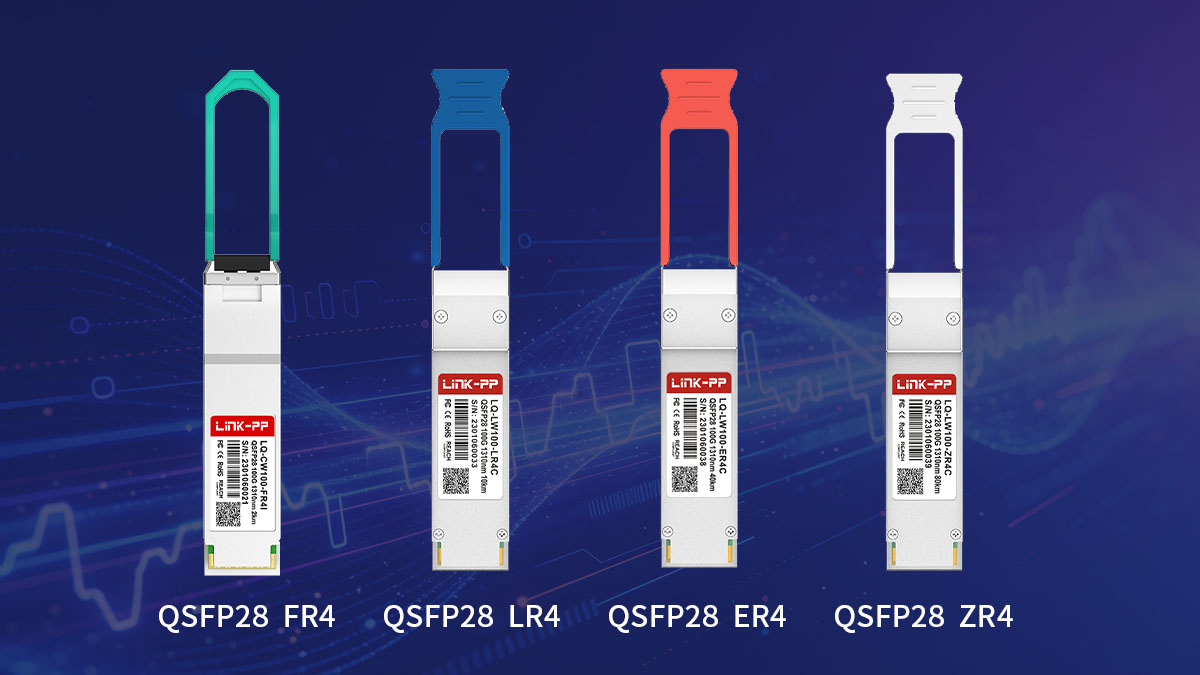
Common QSFP28 Optical Module Types
QSFP28 supports several standardized optical transceiver variants designed for different transmission distances and cabling infrastructures.
These options allow QSFP28 to support a wide range of deployment environments, from short-reach server connections within a rack to longer inter-switch links across data centers.
Typical Deployment Scenarios
QSFP28 remains one of the most widely deployed optical module types in 100G networks. Its balance of performance, density, and compatibility makes it suitable for many networking environments.
Common scenarios include:
-
Data center spine–leaf architectures supporting east-west traffic
-
Enterprise core and aggregation networks transitioning from 40G to 100G
-
High-performance computing clusters requiring low-latency 100G connectivity
-
Data center interconnect (DCI) links for medium-distance connections
Because of its mature ecosystem and broad hardware support, QSFP28 continues to play a significant role in modern optical networking, even as higher-speed technologies such as QSFP-DD emerge for 200G and 400G deployments.
? What Is QSFP-DD?
QSFP-DD is a next-generation optical transceiver form factor designed to deliver significantly higher bandwidth than earlier QSFP-based modules. By doubling the number of electrical lanes inside the module, QSFP-DD supports speeds of up to 400Gbps while maintaining a front-panel size similar to QSFP28. This design allows data centers to increase network capacity without sacrificing port density.
Definition and Standard Architecture
QSFP-DD stands for Quad Small Form-factor Pluggable Double Density. The specification was developed by the QSFP-DD MSA Group to address the growing demand for 200G and 400G Ethernet connectivity in large-scale data center environments.
The key architectural difference between QSFP-DD and earlier QSFP modules lies in the number of electrical lanes. While QSFP28 uses four lanes, QSFP-DD integrates eight high-speed lanes within the same general form factor. This expanded interface allows the module to support higher data rates while maintaining compatibility with existing network hardware designs.
In practical terms, QSFP-DD enables switch manufacturers to provide much higher bandwidth per port without increasing the physical footprint of networking equipment.
QSFP-DD Technical Specifications
QSFP-DD achieves higher throughput by using an eight-lane electrical interface and supporting faster signaling technologies.
| Specification |
QSFP-DD |
| Electrical Lanes |
8 lanes |
| Lane Data Rate |
25Gbps or 50Gbps per lane |
| Maximum Bandwidth |
Up to 400Gbps |
| Typical Interface |
MPO or duplex LC |
Because the module doubles the number of lanes compared with QSFP28, QSFP-DD can support multiple Ethernet speeds such as 200GbE and 400GbE. This flexibility allows network operators to deploy high-speed connections while keeping hardware platforms scalable.
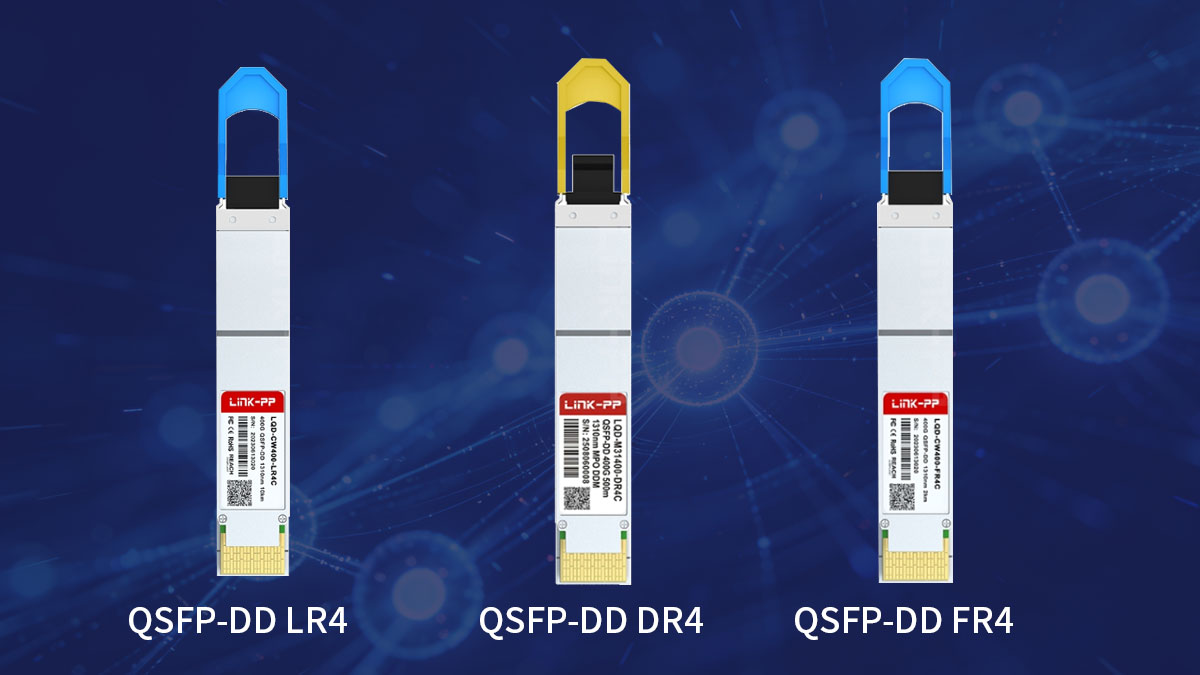
Common QSFP-DD Optical Module Types
QSFP-DD is widely used for high-speed Ethernet optical modules designed for 400G connectivity. Several standardized variants support different transmission distances and fiber architectures.
These optical modules allow QSFP-DD to support a wide range of network links, from short-reach intra–data center connections to longer data center interconnect deployments.
Key Deployment Environments
QSFP-DD is primarily deployed in environments that require very high network bandwidth and scalable infrastructure. As traffic demands increase, many modern network designs rely on 400G connectivity to support large-scale computing workloads.
Typical deployment scenarios include:
-
Hyperscale data centers operated by cloud service providers
-
AI and machine learning clusters that generate massive east–west traffic
-
High-capacity spine switches in 400G leaf–spine architectures
-
Data center interconnect (DCI) links requiring high throughput between facilities
By combining higher lane density with backward compatibility for earlier QSFP modules, QSFP-DD provides a practical upgrade path for organizations transitioning from 100G networking to 200G and 400G infrastructure.
? QSFP-DD vs QSFP28: Core Technical Differences
QSFP-DD and QSFP28 may look similar externally, but they differ significantly in bandwidth capacity, electrical architecture, power consumption, and scalability. QSFP28 is primarily designed for 100GbE networking, while QSFP-DD enables much higher speeds such as 200GbE and 400GbE by doubling the number of electrical lanes inside the module.
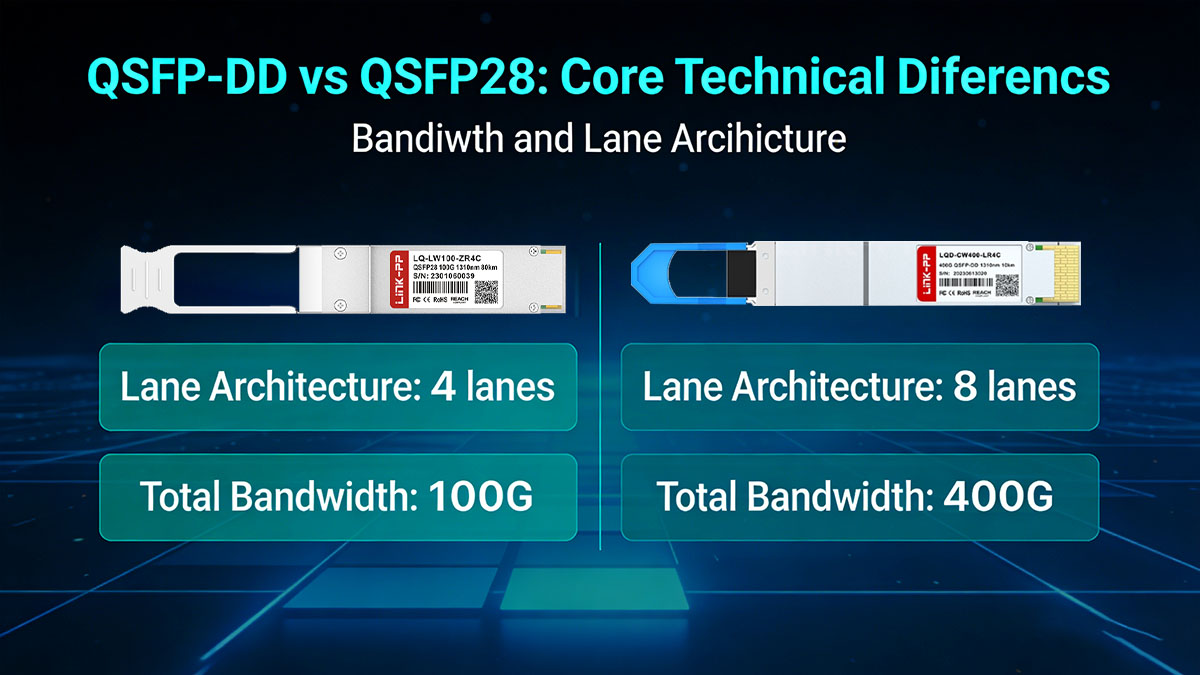
Understanding these technical differences helps network engineers determine which form factor is more suitable for a specific deployment environment.
Bandwidth and Lane Architecture
The most fundamental difference between QSFP-DD and QSFP28 lies in the number of electrical lanes and the total bandwidth they support.
| Feature |
QSFP28 |
QSFP-DD |
| Electrical Lanes |
4 |
8 |
| Lane Data Rate |
25Gbps |
25Gbps or 50Gbps |
| Maximum Bandwidth |
100Gbps |
Up to 400Gbps |
QSFP28 achieves 100Gbps throughput by combining four 25Gbps lanes. In contrast, QSFP-DD doubles the lane count to eight, enabling significantly higher aggregate bandwidth. This architecture makes QSFP-DD suitable for high-capacity networking environments where traffic demands continue to increase.
Port Density and Scalability
QSFP-DD enables higher bandwidth per switch port while maintaining a similar front-panel footprint to QSFP28.
| Feature |
QSFP28 |
QSFP-DD |
| Maximum Speed per Port |
100G |
400G |
| Switch Bandwidth Scaling |
Moderate |
High |
| Typical Data Center Tier |
Leaf / Aggregation |
Spine / Core |
Because QSFP-DD can deliver four times the bandwidth of QSFP28 within a similar port size, it allows switch vendors to significantly increase overall switch capacity. This is particularly valuable in hyperscale data centers where maximizing bandwidth per rack unit is essential.
Power Consumption and Thermal Design
Higher bandwidth generally requires higher power consumption and improved thermal management.
| Parameter |
QSFP28 |
QSFP-DD |
| Typical Power Consumption |
3–4W |
7–12W |
| Cooling Requirement |
Standard airflow |
Enhanced cooling design |
| Thermal Density |
Moderate |
Higher |
QSFP-DD modules typically consume more power because they operate more electrical lanes and support higher signaling speeds. As a result, modern switches designed for QSFP-DD often include enhanced cooling systems to maintain stable operation.
Physical Form Factor Differences
Although QSFP-DD and QSFP28 appear similar from the front panel, their internal connector structures are different.
| Attribute |
QSFP28 |
QSFP-DD |
| Connector Contacts |
Single row |
Double-row contacts |
| Electrical Interface |
4 lanes |
8 lanes |
| Module Depth |
Standard |
Slightly deeper |
QSFP-DD adds an additional row of electrical contacts behind the existing QSFP connector. This expanded interface enables the module to support twice as many lanes while maintaining backward compatibility with QSFP28 modules.
Overall, the main advantage of QSFP-DD over QSFP28 is its ability to deliver significantly higher bandwidth while preserving the familiar QSFP ecosystem. This combination makes QSFP-DD a key technology for scaling modern data center networks beyond 100G connectivity.
? Compatibility Between QSFP-DD and QSFP28
QSFP-DD was designed with backward compatibility in mind, allowing network operators to reuse existing QSFP28 modules in newer hardware platforms. This compatibility simplifies the transition from 100G to higher-speed networking by enabling gradual infrastructure upgrades rather than requiring a complete hardware replacement.
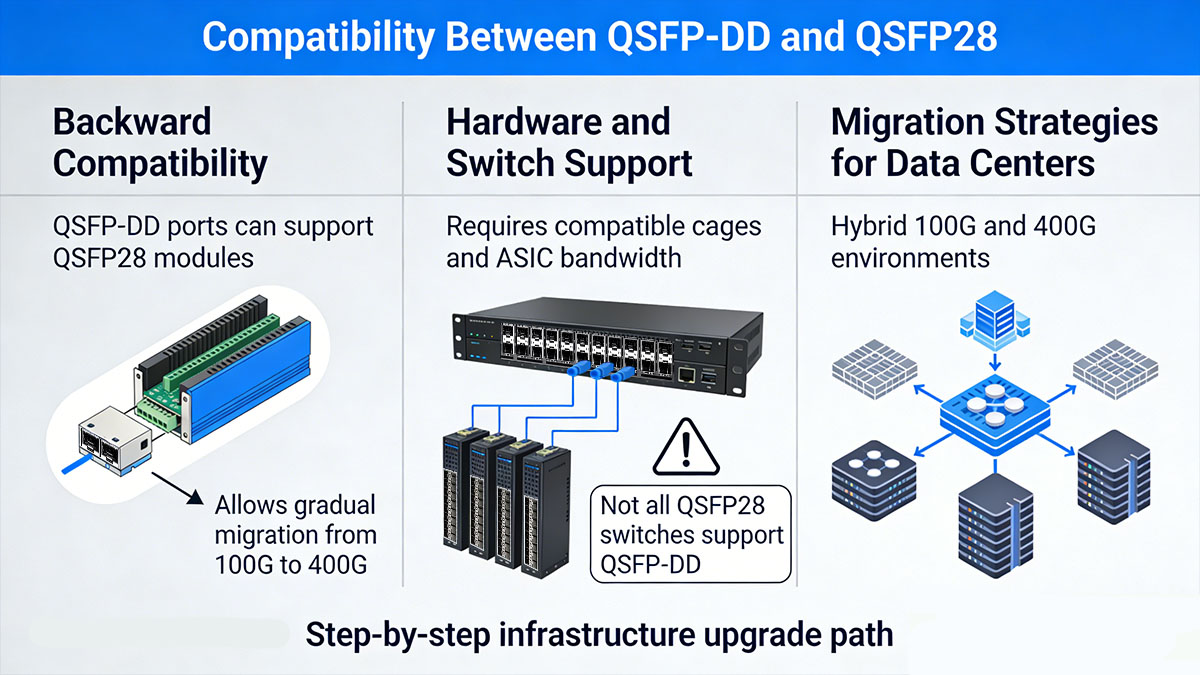
Understanding how QSFP-DD and QSFP28 interact at the port and module level helps engineers plan scalable network deployments.
Backward Compatibility
QSFP-DD ports are designed to accept QSFP28 modules, allowing 100G optics to operate in switches built for higher-speed interfaces.
| Compatibility Scenario |
Supported |
Notes |
| QSFP28 module in QSFP-DD port |
Yes |
Operates at 100G |
| QSFP-DD module in QSFP28 port |
No |
QSFP28 lacks required electrical lanes |
| QSFP-DD to QSFP-DD connection |
Yes |
Supports 200G/400G depending on optics |
This compatibility is possible because the QSFP-DD connector includes an additional row of electrical contacts behind the original QSFP interface. When a QSFP28 module is inserted into a QSFP-DD port, only the front row of contacts is used, enabling normal 100G operation.
As a result, data centers can deploy switches with QSFP-DD ports while continuing to operate existing QSFP28 optical modules.
Hardware and Switch Support
Although QSFP-DD ports can accept QSFP28 modules, the switch hardware must still support the appropriate interface speeds and configurations.
Key hardware considerations include:
-
ASIC bandwidth capability determines whether the switch can support 200G or 400G speeds
-
Port configuration options may allow QSFP-DD ports to operate in 100G mode with QSFP28 modules
-
Firmware and operating system support is required to correctly recognize inserted modules
Many modern switches provide flexible port configurations, allowing a single QSFP-DD port to operate as:
-
1 × 400G
-
2 × 200G
-
4 × 100G
This flexibility helps network operators adapt their infrastructure to different bandwidth requirements.
Migration Strategies for Data Centers
Backward compatibility makes QSFP-DD an effective upgrade path for organizations transitioning from 100G to 400G networks.
A typical migration approach includes the following stages:
-
Deploy switches with QSFP-DD ports while continuing to use QSFP28 optics.
-
Operate mixed-speed environments where some links remain at 100G and others upgrade to higher speeds.
-
Gradually introduce 200G or 400G QSFP-DD modules as bandwidth requirements increase.
-
Expand high-speed links to spine and core layers of the network.
This phased strategy allows data centers to increase network capacity without disrupting existing connectivity. By supporting both legacy and next-generation modules, QSFP-DD provides a practical bridge between current 100G deployments and future high-speed networking infrastructure.
? QSFP-DD vs QSFP28 Use Cases
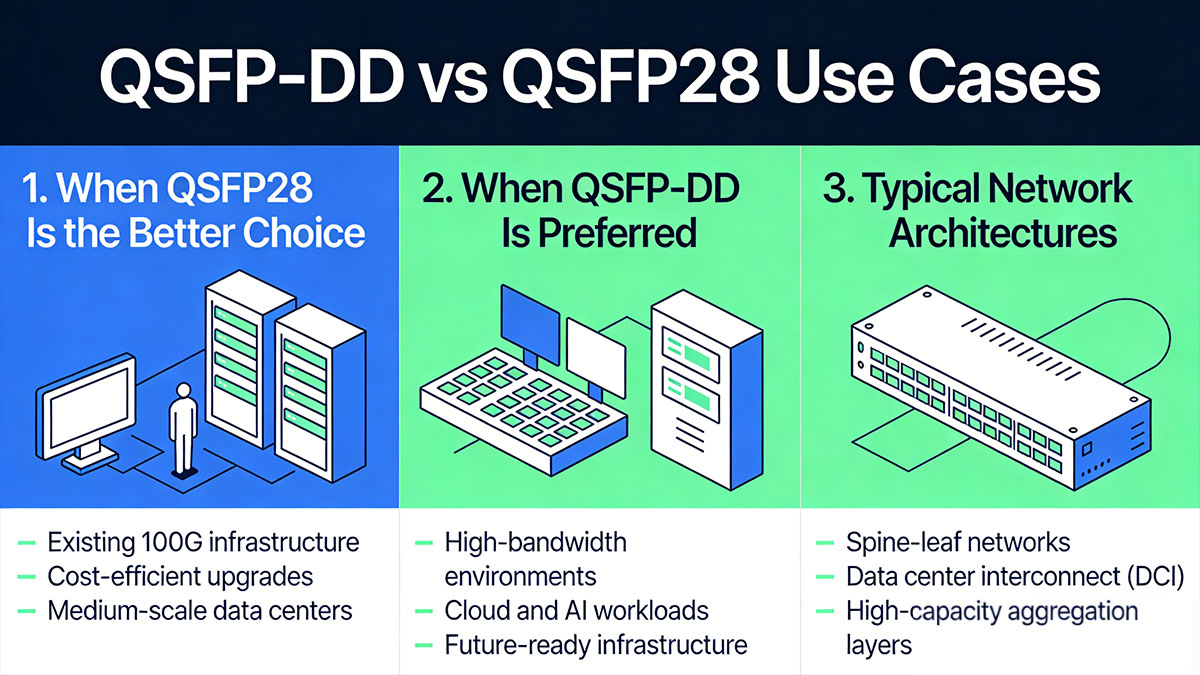
QSFP28 and QSFP-DD are designed for different generations of high-speed networking. QSFP28 remains widely used in 100G infrastructures, while QSFP-DD is typically deployed in environments that require higher bandwidth such as 200G and 400G networks. Choosing between them depends on factors such as network scale, bandwidth requirements, and long-term infrastructure planning.
When QSFP28 Is the Better Choice
QSFP28 remains a practical solution for many networks that rely on stable and mature 100G connectivity. It provides reliable performance while maintaining relatively low power consumption and broad compatibility with existing equipment.
Common situations where QSFP28 is suitable include:
-
Existing 100G infrastructure where switches and routers are already designed for QSFP28 modules
-
Enterprise and campus data centers that do not require 400G bandwidth
-
High-performance computing clusters using 100G spine–leaf architectures
-
Cost-sensitive upgrades from earlier 40G networks(such as the 40G-ER4 variant)
These environments often prioritize reliability and compatibility over maximum bandwidth, making QSFP28 an efficient and widely supported option.
When QSFP-DD Is Preferred
QSFP-DD is designed for networks that must scale beyond the limits of 100G connectivity. Its eight-lane architecture enables higher throughput while maintaining a compact form factor suitable for dense switch designs.
QSFP-DD is commonly deployed in:
-
Hyperscale cloud data centers handling large volumes of east–west traffic
-
AI and machine learning clusters requiring extremely high data throughput between GPUs
-
400G spine or core network layers where bandwidth aggregation is critical
-
Large-scale data center interconnect (DCI) environments
These deployments benefit from the ability of QSFP-DD modules to deliver significantly higher bandwidth per port.
Typical Network Architectures
Different network architectures often determine whether QSFP28 or QSFP-DD is more appropriate. The following table illustrates common deployment patterns.
| Network Layer |
Typical Module |
Primary Purpose |
| Access / Server Layer |
QSFP28(such as 100G LR4 optics) |
100G server aggregation |
| Leaf Switch Layer |
QSFP28(such as 100G SR4 optics) |
100G east–west traffic |
| Spine Layer |
QSFP-DD(such as 400G DR4 optics) |
High-capacity 400G backbone |
| Data Center Interconnect |
QSFP-DD(such as 400G FR4 optics) |
Long-distance high-speed links |
In many modern data centers, both technologies coexist within the same network architecture. QSFP28 modules continue to serve 100G access and aggregation layers, while QSFP-DD modules provide higher-capacity connections at the spine or core layer.
This layered approach allows network operators to balance cost, performance, and scalability while gradually transitioning toward higher-speed optical technologies.
? Future Trends in High-Speed Optical Transceivers
High-speed optical transceivers continue to evolve as data center traffic grows rapidly due to cloud computing, artificial intelligence, and large-scale distributed applications. While QSFP28 remains common in 100G networks and QSFP-DD enables 400G deployments, the industry is already moving toward even higher speeds and more efficient optical architectures.
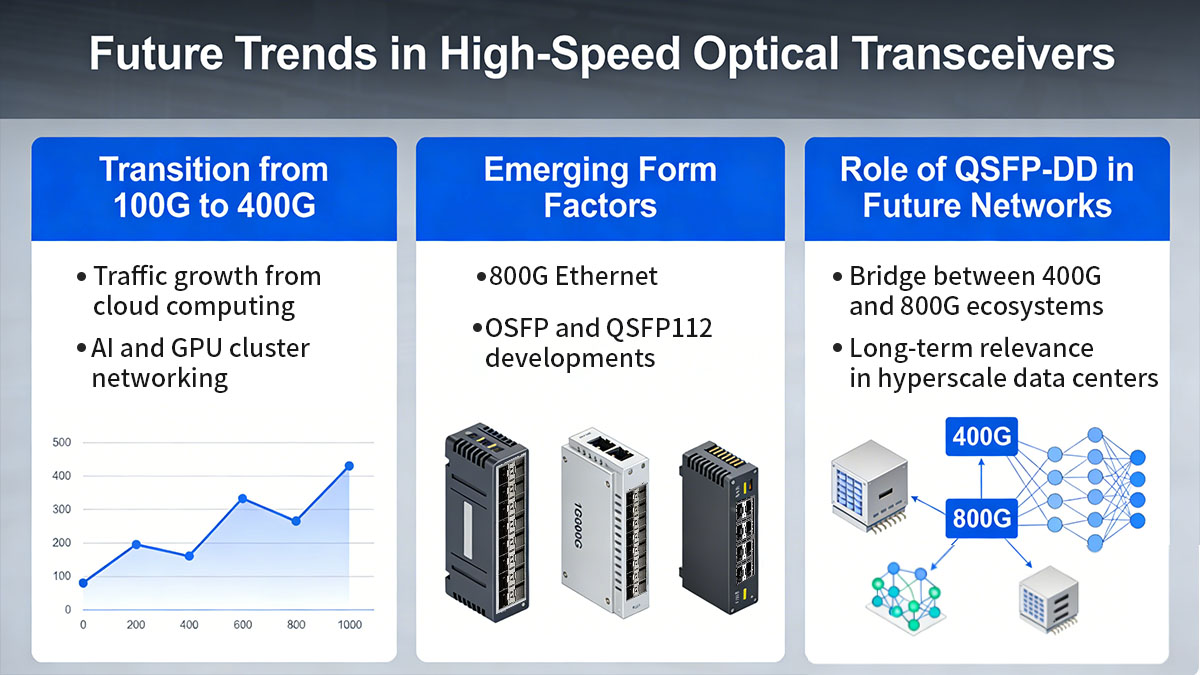
Understanding these trends helps network planners anticipate how technologies like QSFP-DD will fit into future infrastructure upgrades.
Transition from 100G to 400G
One of the most significant trends in optical networking is the gradual transition from 100G to 400G Ethernet. As workloads generate larger volumes of east–west traffic inside data centers, higher link speeds become necessary to maintain performance and scalability.
| Network Generation |
Typical Speed |
Common Module Form Factor |
| 100G Networks |
100Gbps |
QSFP28 |
| 200G Networks |
200Gbps |
QSFP-DD |
| 400G Networks |
400Gbps |
QSFP-DD |
This progression reflects the increasing demand for bandwidth in hyperscale environments. Technologies defined under standards such as 400 Gigabit Ethernet allow modern switches to support significantly higher throughput while maintaining manageable port density.
As a result, many large data centers are transitioning from 100G spine–leaf architectures toward 400G backbone connections.
Emerging Form Factors
In addition to QSFP-DD, new optical module form factors are emerging to support even higher bandwidth and improved thermal performance.
| Form Factor |
Typical Speed |
Key Design Goal |
| QSFP-DD |
Up to 400Gbps |
High-density compatibility |
| OSFP |
400Gbps–800Gbps |
Improved thermal performance |
| QSFP112 |
400Gbps |
Higher lane signaling rates |
These form factors address the increasing thermal and electrical requirements of high-speed networking. For example, OSFP modules provide a larger housing to support higher power levels, while QSFP112 supports faster electrical lanes that enable next-generation optical modules.
Role of QSFP-DD in Future Networks
QSFP-DD is expected to remain an important bridge technology as networks evolve toward even higher speeds. Its compatibility with earlier QSFP modules(such as 40G-LR optics) and its ability to support multiple Ethernet speeds make it highly adaptable.
Several factors contribute to the continued relevance of QSFP-DD:
-
Backward compatibility with QSFP28 modules
-
Support for both 200G and 400G networking
-
High port density suitable for modern switches
-
Strong ecosystem support from switch and optics vendors
At the same time, the networking industry is also developing technologies such as 800 Gigabit Ethernet to address the growing bandwidth demands of AI clusters and hyperscale cloud platforms.
In many cases, QSFP-DD platforms deployed today will serve as the foundation for these future upgrades, enabling data centers to scale network capacity while maintaining a familiar and widely supported transceiver ecosystem.
? FAQs About QSFP-DD vs QSFP28
What does QSFP-DD stand for?
QSFP-DD stands for Quad Small Form-factor Pluggable Double Density. The design doubles the electrical lane count from four to eight compared with earlier QSFP modules, allowing the interface to support higher Ethernet speeds such as 200GbE and 400GbE.
What does QSFP28 mean?
QSFP28 refers to Quad Small Form-factor Pluggable 28, where “28” indicates the approximate 28Gbps signaling capability per lane. By combining four lanes, QSFP28 modules can deliver up to 100Gbps of total bandwidth in 100GbE networks.
Can QSFP-DD ports support 100G connections?
Yes. QSFP-DD ports can operate at 100Gbps when using compatible QSFP28 modules. This capability allows switches designed for higher speeds to still connect to existing 100G infrastructure.
Are QSFP-DD modules used for 400G Ethernet?
Yes. QSFP-DD is one of the most common form factors used for standards such as 400G-DR4 module and 400G-FR4 module, which enable high-speed optical links in modern data centers.
Do QSFP-DD and QSFP28 use the same fiber types?
Both module types can support single-mode fiber (SMF) or multimode fiber (MMF) depending on the optical standard used. For example, short-reach modules may use multimode fiber, while long-distance links typically rely on single-mode fiber.
Why are QSFP-DD modules typically more power-hungry?
QSFP-DD modules operate more electrical lanes and higher signaling speeds, which increases power consumption compared with QSFP28. As a result, switches designed for QSFP-DD often include improved thermal management and airflow systems.
Is QSFP28 still widely used in data centers?
Yes. QSFP28 remains a widely deployed solution for 100GbE networks, particularly in enterprise data centers, high-performance computing environments, and spine–leaf architectures where 100G bandwidth is sufficient for current workloads.
? Conclusion
QSFP28 and QSFP-DD represent two important generations of high-speed optical transceiver technology used in modern Ethernet networks. QSFP28 has become a mature and widely deployed solution for 100GbE connectivity, offering reliable performance for enterprise data centers, spine–leaf architectures, and high-performance computing environments. In contrast, QSFP-DD expands the QSFP ecosystem by doubling the number of electrical lanes, enabling support for 200G and 400G networking required by hyperscale cloud platforms and AI-driven workloads.
Although both form factors share a similar external size, their internal architecture, bandwidth capabilities, and deployment scenarios are quite different. QSFP28 remains well suited for existing 100G infrastructures, while QSFP-DD provides a scalable path for organizations planning to upgrade toward higher-capacity networks. The backward compatibility between QSFP-DD ports and QSFP28 modules also allows data centers to adopt new hardware platforms while continuing to operate legacy 100G optics.
As network traffic continues to grow, selecting the appropriate transceiver technology becomes increasingly important for balancing performance, scalability, and long-term infrastructure planning. Understanding the differences between QSFP-DD vs QSFP28 helps network engineers design architectures that can efficiently support both current workloads and future bandwidth demands.
For organizations evaluating high-speed optical modules or planning network upgrades, exploring reliable and compatible transceiver solutions is an important next step. You can learn more about available options and technical specifications by visiting the LINK-PP Official Store, where a wide range of optical transceivers for 100G, 200G, and 400G networking environments are available.