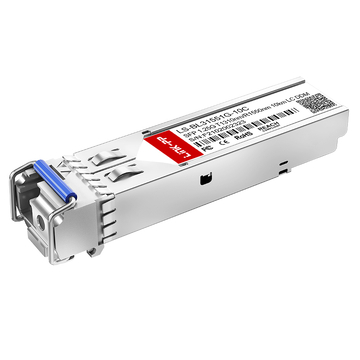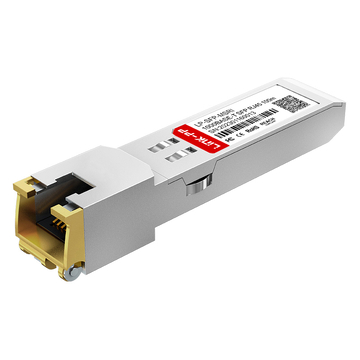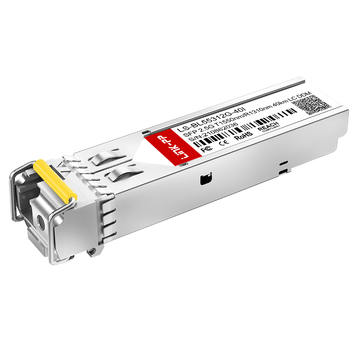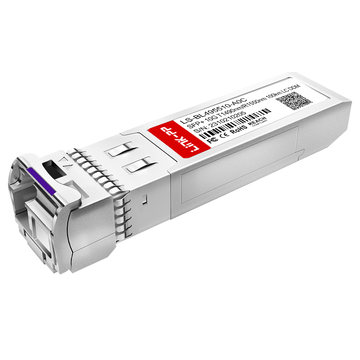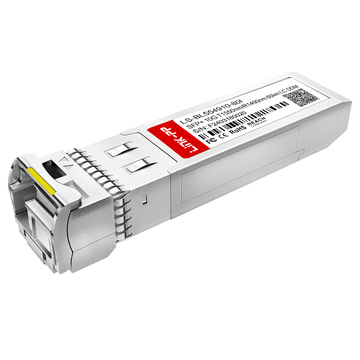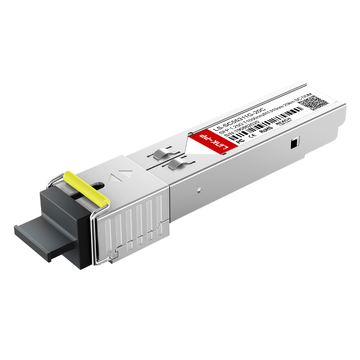
In many optical network deployments, fiber resources are limited while bandwidth requirements continue to grow. A bidirectional SFP (BiDi SFP) provides an efficient solution by enabling data transmission and reception over a single strand of optical fiber. Instead of using separate fibers for transmit and receive signals, BiDi modules rely on wavelength division multiplexing (WDM) to send signals in opposite directions through different wavelengths. This design allows network operators to maximize existing fiber infrastructure without additional cabling.
Single-fiber communication has become increasingly common in environments such as campus networks, metropolitan access networks, and building-to-building connections. In these scenarios, deploying a bidirectional SFP module such as SFP28 BiDi optics can significantly reduce fiber usage while maintaining reliable high-speed connectivity. However, selecting the correct BiDi SFP requires careful attention to several technical factors, including wavelength pairing, transmission distance, data rate compatibility, and device support.
This guide explains how bidirectional SFP technology works and outlines the key specifications to consider when selecting modules for single-fiber links. It also covers common BiDi SFP types, deployment considerations, and typical application scenarios to help ensure stable and efficient optical network operation.
⭐ What Is a Bidirectional SFP?
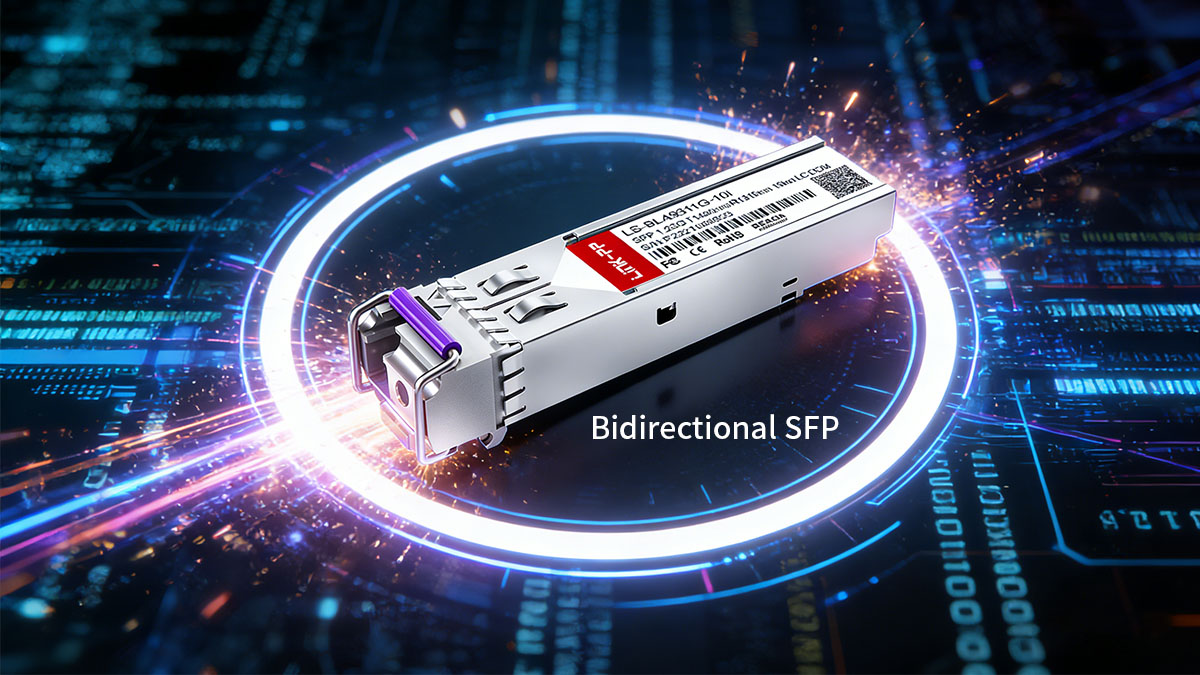
A bidirectional SFP (BiDi SFP) is an optical transceiver designed to transmit and receive data over a single strand of single-mode fiber. Instead of using two separate fibers for transmit and receive signals, the module uses different optical wavelengths to send traffic in opposite directions. This approach allows two devices to communicate through one fiber link while maintaining full-duplex data transmission.
BiDi SFP modules are commonly used in environments where fiber resources are limited or where reducing cabling complexity is important. Because they rely on wavelength separation rather than physical fiber separation, they must always operate in complementary pairs with reversed transmit and receive wavelengths.
Definition of Bidirectional SFP (BiDi)
A bidirectional SFP is a small form-factor pluggable optical transceiver that supports full-duplex communication over a single fiber by using wavelength division multiplexing (WDM). Each module transmits at one wavelength and receives at another.
The key concept behind BiDi technology is that two modules form a matched pair, where the transmit wavelength of one module matches the receive wavelength of the other.
A typical pairing structure is shown below.
| Module Side | TX Wavelength | RX Wavelength |
|---|---|---|
| BiDi Module A | 1310nm | 1550nm |
| BiDi Module B | 1550nm | 1310nm |
In this configuration, both modules can send and receive signals simultaneously through the same fiber strand. The internal WDM filter inside the transceiver separates incoming and outgoing wavelengths so that signals do not interfere with each other.
This design allows networks to achieve full-duplex optical communication while using only half the fiber infrastructure required by traditional dual-fiber connections.
How Bidirectional Transmission Works
Bidirectional optical transmission works by separating transmit and receive signals using different wavelengths of light. Inside the BiDi SFP module, an integrated WDM coupler or filter combines outgoing signals and separates incoming ones.
The communication process typically follows these steps:
-
The transmitter inside the BiDi SFP sends optical signals at a specific wavelength.
-
The signal travels through the single-mode fiber toward the remote device.
-
The remote BiDi module receives that wavelength while transmitting a different wavelength back.
-
Internal WDM filters separate the incoming and outgoing optical signals.
Because each side uses a different wavelength, both directions of communication can occur simultaneously on the same fiber without interference.
This method allows efficient utilization of fiber infrastructure while maintaining reliable full-duplex network performance.
Bidirectional SFP vs Standard Dual-Fiber SFP
The primary difference between a bidirectional SFP and a standard optical SFP lies in how the fiber link is structured. Traditional optical modules use one fiber for transmitting and another fiber for receiving, while BiDi modules combine both functions into a single fiber.
| Feature | Bidirectional SFP | Standard SFP |
|---|---|---|
| Fiber Requirement | Single fiber | Two fibers |
| Transmission Method | WDM wavelengths | Separate TX/RX fibers |
| Typical Use Case | Fiber-limited links | Standard fiber infrastructure |
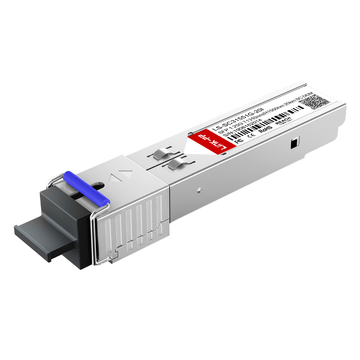
Using a BiDi SFP such as 1.25G BiDi SFP module can significantly reduce fiber consumption, which is especially beneficial in metro networks, campus connections, or legacy infrastructure where additional fiber installation may be costly or impractical.
However, the deployment requires careful wavelength pairing and compatible modules on both ends of the link to ensure proper communication.
⭐ Advantages of Using Bidirectional SFP for Single-Fiber Links
Bidirectional SFP modules provide several practical advantages for networks where fiber availability, infrastructure cost, and deployment flexibility are key considerations. By enabling full-duplex communication over a single strand of fiber, these modules help optimize existing optical infrastructure while maintaining reliable network performance.
In many real-world deployments, the ability to operate with fewer fiber strands can simplify network expansion and reduce installation complexity.
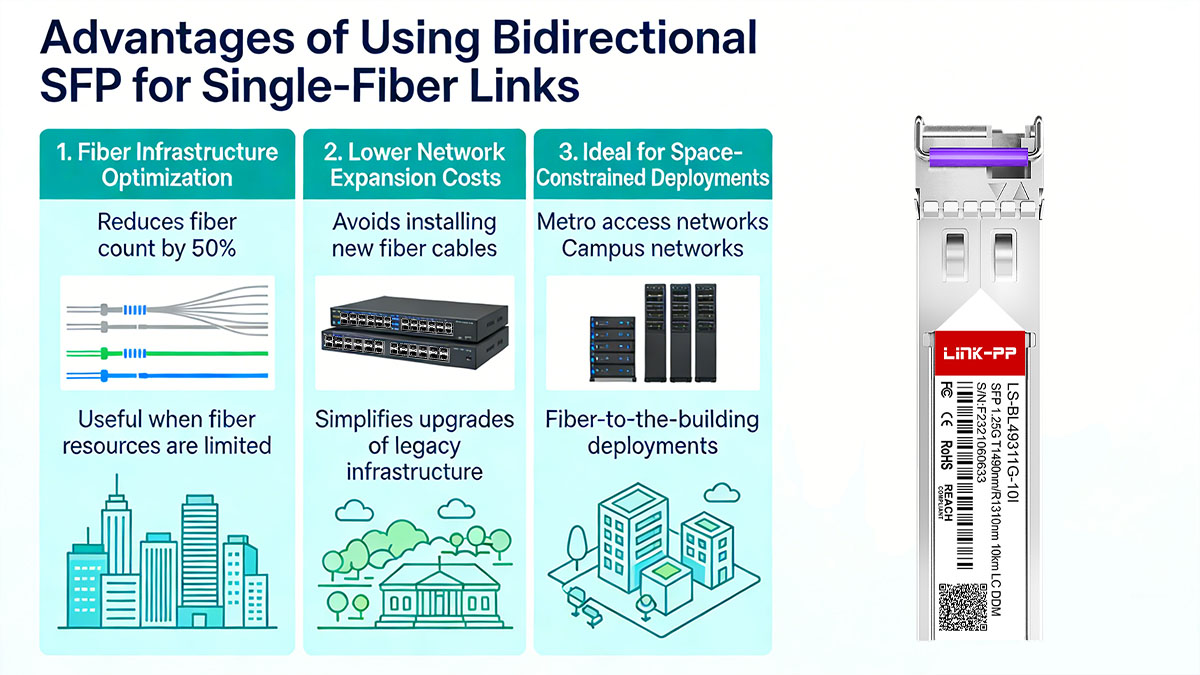
Fiber Infrastructure Optimization
The most direct advantage of bidirectional SFP modules is their ability to reduce fiber usage. A single-fiber link can replace the two-fiber architecture required by traditional optical connections.
| Link Type | Fiber Strands Required | Transmission Method |
|---|---|---|
| Standard optical link | 2 fibers | Separate TX and RX fibers |
| Bidirectional SFP link | 1 fiber | WDM wavelength separation |
By using different wavelengths for transmit and receive signals, BiDi modules allow both directions of communication to share the same fiber strand. This effectively doubles the utilization of existing fiber infrastructure.
For networks with limited fiber availability—such as older campus installations or dense metropolitan areas—this approach can significantly extend the capacity of existing cabling without additional fiber deployment.
Lower Network Expansion Costs
Reducing fiber requirements can directly lower network expansion costs. Installing new fiber cables often involves construction work, trenching, and permitting, which can be expensive and time-consuming.
Using bidirectional SFP modules can reduce these costs in several ways:
-
Avoids the need for additional fiber installation
-
Allows reuse of existing single-fiber infrastructure
-
Reduces cable management complexity in patch panels and distribution frames
-
Simplifies upgrades in legacy fiber environments
In many enterprise and telecom networks, the cost of fiber installation can exceed the cost of optical modules themselves. As a result, single-fiber links can provide a more efficient upgrade path when expanding network capacity.
Ideal for Space-Constrained Deployments
Bidirectional SFP modules are particularly useful in environments where physical space or cabling density is limited. Because each link uses only one fiber, the number of required patch cords and fiber ports can be reduced.
Typical deployment environments include:
-
Campus networks connecting multiple buildings
-
Metropolitan access networks with high fiber utilization
-
Data aggregation layers in enterprise infrastructure
-
Fiber-to-the-building (FTTB) connectivity
-
Legacy networks with limited fiber pairs
In these scenarios, using BiDi modules can help maintain organized cabling layouts while supporting high-density network connections.
By reducing the amount of fiber required per link, network operators gain greater flexibility when scaling or modifying optical network infrastructure.
⭐ Key Specifications to Consider When Selecting a Bidirectional SFP
Selecting the correct bidirectional SFP for a single-fiber link requires evaluating several technical parameters. Because BiDi modules rely on wavelength pairing and optical power balance, factors such as wavelength compatibility, transmission distance, supported data rate, and connector type directly affect link reliability.
Understanding these specifications helps ensure that both ends of the optical link operate correctly and that the module matches the requirements of the network equipment and fiber infrastructure.
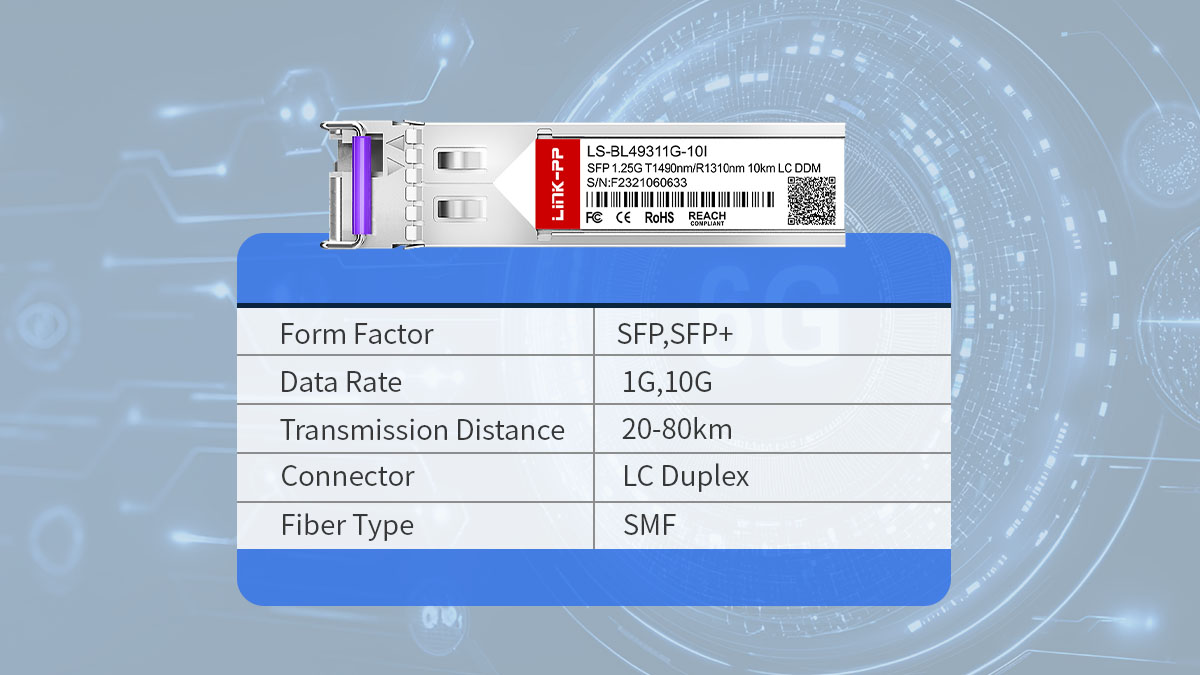
Wavelength Pair Compatibility
The most important requirement when selecting a bidirectional SFP is ensuring that the modules operate as a complementary wavelength pair. Each module transmits at one wavelength and receives at another, so the transmit wavelength on one side must match the receive wavelength on the opposite side.
A typical pairing structure is shown below.
| Module Type | TX Wavelength | RX Wavelength |
|---|---|---|
| BiDi Module A | 1310nm | 1550nm |
| BiDi Module B | 1550nm | 1310nm |
These two modules must always be deployed together to form a functioning single-fiber link. If both ends use the same wavelength configuration, the modules will transmit on identical wavelengths and communication will fail.
For this reason, many vendors label modules as A/B, TX/RX reversed (such as the 1G BiDi SFP 1550nm-TX/1490nm-RX) , or matched pair, making it easier to identify the correct combination during installation.
Transmission Distance
Bidirectional SFP modules are designed for different transmission distances depending on their optical power budget and wavelength characteristics. Choosing the correct distance rating ensures that the signal remains within acceptable power levels after accounting for fiber attenuation and connector losses.
Typical distance options are summarized below.
| Distance Rating | Typical Fiber Type | Common Use Case |
|---|---|---|
| 10km | Single-mode fiber | Campus networks |
| 20km | Single-mode fiber | Enterprise interconnects |
| 40km | Single-mode fiber | Metro access networks |
| 80km | Single-mode fiber | Long-distance aggregation |
When evaluating distance, it is important to consider not only the fiber length but also additional losses introduced by connectors, patch panels, and splicing points. Maintaining sufficient optical margin helps ensure stable link performance.
Data Rate Support
Bidirectional SFP modules are available in multiple speed classes, and the selected module must match the supported interface speed of the network device.
The most common data rate categories include:
| Module Type | Typical Data Rate | Typical Application |
|---|---|---|
| BiDi SFP | 1Gbps | Access and enterprise networks |
| BiDi SFP+ | 10Gbps | Aggregation and high-speed uplinks |
A network device must support the same speed and interface standard as the installed transceiver. For example, a 10Gbps SFP+ port cannot operate with a 1Gbps SFP module unless the device explicitly supports backward compatibility.
Ensuring data rate compatibility between the optical module and the switch or router is essential for proper link initialization.
Optical Connector Type
Most bidirectional SFP modules use a standard LC optical connector, which is widely adopted in single-mode optical networking.
| Connector Type | Fiber Type | Typical Usage |
|---|---|---|
| LC | Single-mode fiber | Most BiDi SFP modules |
| SC | Single-mode fiber | Legacy equipment in some networks |
LC connectors provide a compact design suitable for high-density switch ports and patch panels. Because only one fiber strand is required for a BiDi link, a single LC connector is used instead of the duplex LC connectors typically found in dual-fiber SFP modules.
Proper connector cleanliness and fiber inspection remain important to maintain stable optical performance and avoid signal degradation.
⭐ Common Types of Bidirectional SFP Modules
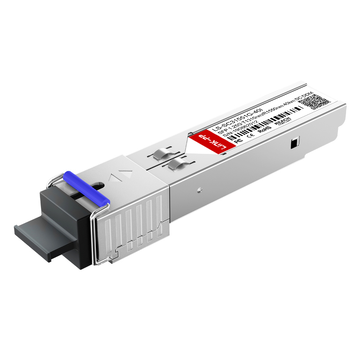
Bidirectional SFP modules such as the 1310nm-TX/1490nm-RX 1G BiDi SFP are available in several variations designed to support different network speeds, transmission distances, and deployment environments. While the underlying principle of single-fiber communication remains the same, the module specifications can vary depending on bandwidth requirements and operating conditions.
The most common categories include 1G BiDi SFP, 10G BiDi SFP+, and industrial-grade variants designed for harsh environments.
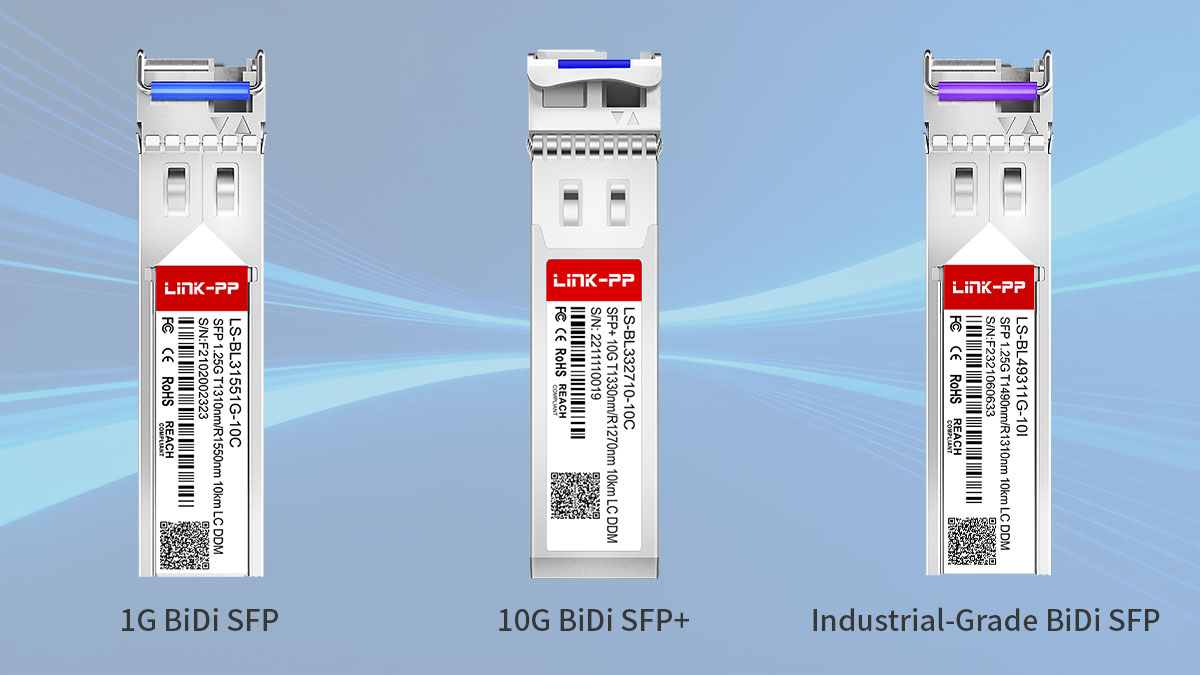
1G BiDi SFP
1G bidirectional SFP modules are widely used in access networks and enterprise connectivity where Gigabit Ethernet bandwidth is sufficient. These modules provide reliable single-fiber communication for short- to medium-distance links while minimizing fiber usage.
| Parameter | Typical Specification | Notes |
|---|---|---|
| Data Rate | 1Gbps | Gigabit Ethernet |
| Wavelength Pair | 1310nm / 1550nm | Complementary TX/RX pair |
| Typical Distance | 10km–20km | Over single-mode fiber |
| Connector | LC | Single-fiber connection |
Because of their simplicity and compatibility with standard Gigabit Ethernet switches, 1G BiDi modules are commonly used for building-to-building connections, campus networks, and access-layer aggregation.
Their relatively low power consumption and cost also make them suitable for large-scale deployments where many fiber links must be established using limited fiber infrastructure.
10G BiDi SFP+
10G bidirectional SFP+ modules such as the 1550nm-TX/1490nm-RX 10G BiDi SFP support higher bandwidth requirements while maintaining the single-fiber transmission model. These modules are commonly deployed in aggregation networks and enterprise backbone connections where higher throughput is required.
| Parameter | Typical Specification | Notes |
|---|---|---|
| Data Rate | 10Gbps | 10 Gigabit Ethernet |
| Wavelength Pair | 1270nm / 1330nm or 1310nm / 1550nm | Depends on module design |
| Typical Distance | 10km–40km | Over single-mode fiber |
| Connector | LC | Single-fiber operation |
The increased bandwidth of 10Gbps allows these modules to support high-capacity links between distribution switches, aggregation layers, or data center edge devices.
In networks that previously used dual-fiber 10G connections, BiDi SFP+ modules can reduce fiber consumption while maintaining equivalent throughput.
Industrial-Grade BiDi SFP
Industrial-grade bidirectional SFP modules are designed for environments where temperature variations, vibration, and electrical interference may affect network equipment. These modules typically include enhanced components and extended operating temperature ranges.
| Parameter | Industrial BiDi SFP | Standard BiDi SFP |
|---|---|---|
| Operating Temperature | -40°C to 85°C | 0°C to 70°C |
| Deployment Environment | Industrial networks | Enterprise networks |
| Reliability Features | Rugged components | Standard components |
These modules are commonly deployed in applications such as:
-
Industrial automation networks
-
Transportation infrastructure
-
Power utility communication systems
-
Outdoor telecom cabinets
In these environments, maintaining stable optical communication over a single fiber can simplify network design while ensuring reliable operation under demanding conditions.
⭐ How to Choose the Right Bidirectional SFP for Your Network
Selecting the appropriate bidirectional SFP module requires evaluating several deployment factors, including wavelength pairing, device compatibility, transmission distance, and long-term network scalability. Because BiDi modules operate as complementary pairs on a single fiber, careful planning helps ensure stable communication and prevents configuration errors during installation.
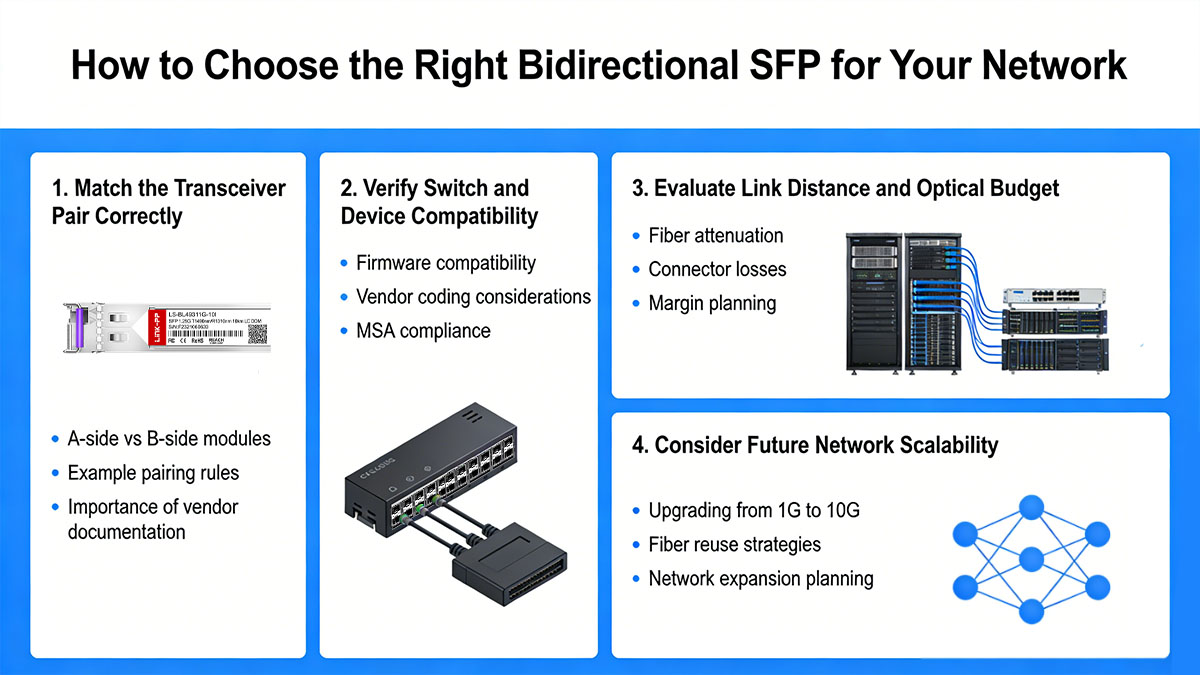
The following considerations can help determine which bidirectional SFP is suitable for a specific network environment.
Match the Transceiver Pair Correctly
Bidirectional SFP modules must always be installed as a complementary pair. One module transmits at a wavelength that the other module is designed to receive, and vice versa. Using the wrong combination will prevent the link from establishing communication.
A typical pairing structure is shown below.
| Module Side | TX Wavelength | RX Wavelength |
|---|---|---|
| Module A | 1310nm | 1550nm |
| Module B | 1550nm | 1310nm |
To ensure proper pairing during deployment:
-
Verify that the transmit wavelength of one module matches the receive wavelength of the other.
-
Identify modules labeled as A-side and B-side or similar vendor designations.
-
Confirm wavelength specifications in the module datasheet before installation.
Many network operators label fiber connections and module pairs during deployment to avoid mismatches when maintaining or upgrading the network.
Verify Switch and Device Compatibility
Before selecting a bidirectional SFP, it is important to confirm that the network device supports the module’s interface type, data rate, and coding format.
| Compatibility Factor | Why It Matters | Example |
|---|---|---|
| Port Type | Determines supported module format | SFP or SFP+ |
| Data Rate | Must match device interface speed | 1Gbps or 10Gbps |
| Vendor Coding | Some switches require coded modules | Vendor-specific firmware |
Many optical modules follow Multi-Source Agreement (MSA) standards, which define mechanical and electrical compatibility. However, certain network vendors may implement firmware checks that require properly coded modules for full compatibility.
Confirming compatibility before deployment helps avoid link initialization issues or unsupported transceiver warnings.
Evaluate Link Distance and Optical Budget
Transmission distance is determined by the optical power budget of the transceiver and the total attenuation of the fiber link. Selecting a module with an appropriate distance rating helps maintain signal integrity across the entire link.
| Distance Class | Typical Use Case | Fiber Type |
|---|---|---|
| 10km | Campus interconnect | Single-mode fiber |
| 20km | Enterprise aggregation | Single-mode fiber |
| 40km | Metro access links | Single-mode fiber |
| 80km | Long-distance aggregation | Single-mode fiber |
When estimating link distance, consider the following sources of optical loss:
-
Fiber attenuation over long distances
-
Connector and patch panel insertion loss
-
Splice points in the fiber path
Maintaining a reasonable optical margin ensures that signal levels remain within the operating range of the receiver.
Consider Future Network Scalability
Network infrastructure often evolves over time as bandwidth requirements increase. Selecting bidirectional SFP modules with future expansion in mind can help simplify upgrades and reduce infrastructure changes.
Key planning considerations include:
-
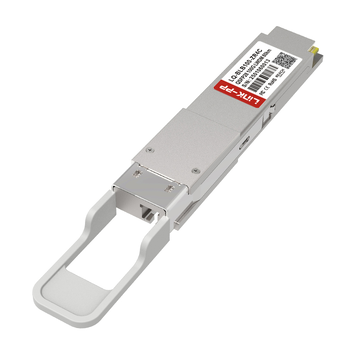
Choosing fiber types that support higher speeds such as 100G QSFP28 BiDi if future upgrades are expected
-
Ensuring switches support both 1Gbps and 10Gbps interfaces where possible
-
Planning fiber routes that allow additional links without re-cabling
For example, an enterprise network initially using 1Gbps BiDi SFP modules for building connectivity may later upgrade to 10Gbps BiDi SFP+ modules while continuing to use the same single-fiber infrastructure.
Taking scalability into account during the initial deployment can help extend the useful life of the optical network while minimizing future modifications.
⭐ Typical Applications of Bidirectional SFP Modules
Bidirectional SFP modules are commonly deployed in network environments where fiber availability is limited or where reducing cabling complexity is beneficial. Because these modules support full-duplex communication over a single strand of single-mode fiber, they are well suited for access networks, campus interconnects, and metropolitan infrastructure.
In many cases, BiDi SFP technology allows network operators to extend or upgrade connectivity without installing additional fiber cables.
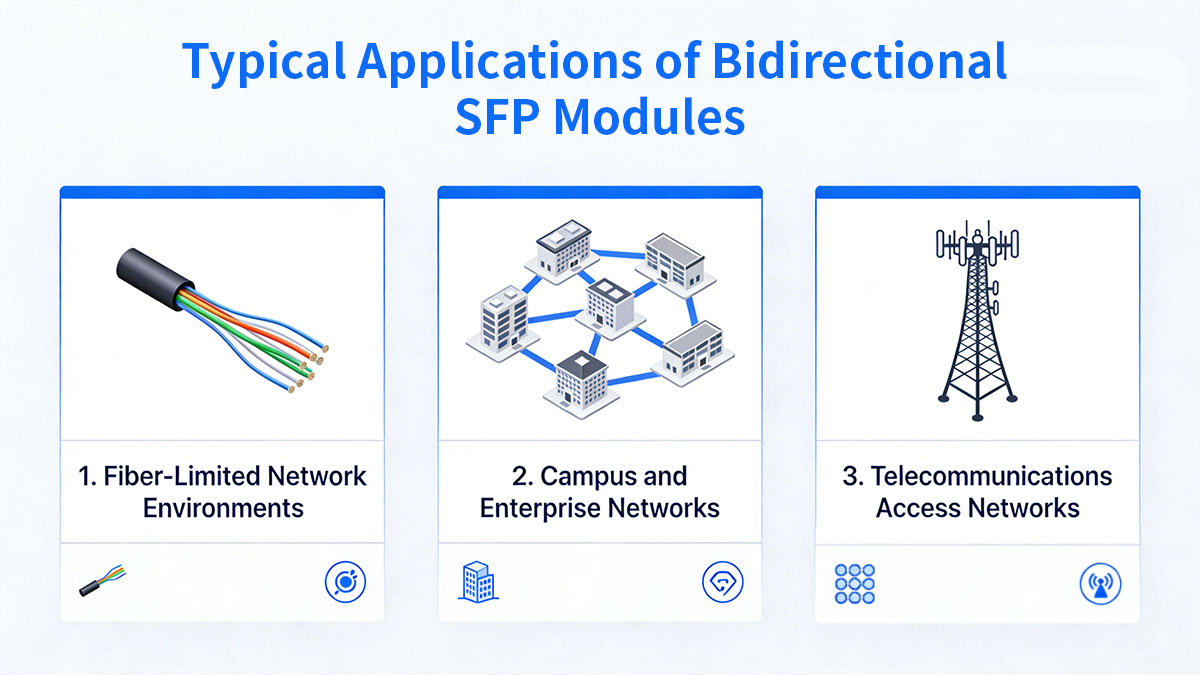
Fiber-Limited Network Environments
Bidirectional SFP modules are frequently used in networks where the number of available fiber strands is limited. This situation often occurs in older infrastructure or densely populated urban areas where installing new fiber may be difficult or costly.
| Network Condition | Challenge | Benefit of BiDi SFP |
|---|---|---|
| Limited fiber pairs | Not enough fibers for dual-link connections | Single-fiber transmission |
| Legacy fiber infrastructure | Existing cables cannot be expanded easily | Reuse existing fiber |
| High fiber utilization | Many services share the same cable routes | Reduced fiber consumption |
By transmitting and receiving signals on different wavelengths within the same fiber strand, BiDi modules allow networks to maintain full-duplex communication while conserving fiber resources.
This capability is particularly valuable when expanding networks that were originally designed with a limited number of fiber pairs.
Campus and Enterprise Networks
Campus and enterprise networks often require optical links between multiple buildings, distribution closets, or aggregation switches. In these environments, minimizing cabling complexity can simplify network management and reduce installation requirements.
Common campus deployment scenarios include:
-
Building-to-building network connections
-
Distribution layer to access layer links
-
Interconnection of remote equipment rooms
-
Backup links between campus network segments
Using bidirectional SFP modules allows these links to operate over a single fiber strand, which can reduce the number of patch cords, simplify cable routing, and improve overall cable organization within network cabinets.
Telecommunications Access Networks
Telecommunications providers frequently deploy bidirectional SFP modules in access networks where fiber infrastructure must support many distributed endpoints. Single-fiber links can improve the efficiency of fiber utilization in these environments.
| Access Network Scenario | Typical Deployment Role |
|---|---|
| Metro access nodes | Connecting aggregation switches |
| Last-mile connectivity | Linking remote network devices |
| Access layer uplinks | Connecting distribution equipment |
In metropolitan and regional networks, using BiDi SFP modules can allow service providers to connect additional endpoints without expanding fiber routes. This makes single-fiber optical communication a practical option for scaling access networks while maintaining efficient use of existing infrastructure.
⭐ Deployment Tips for Reliable Single-Fiber Links
Deploying bidirectional SFP modules in a single-fiber link requires careful planning and verification to ensure stable optical communication. Because both transmit and receive signals share the same fiber strand, correct module pairing, fiber identification, and link validation are particularly important.
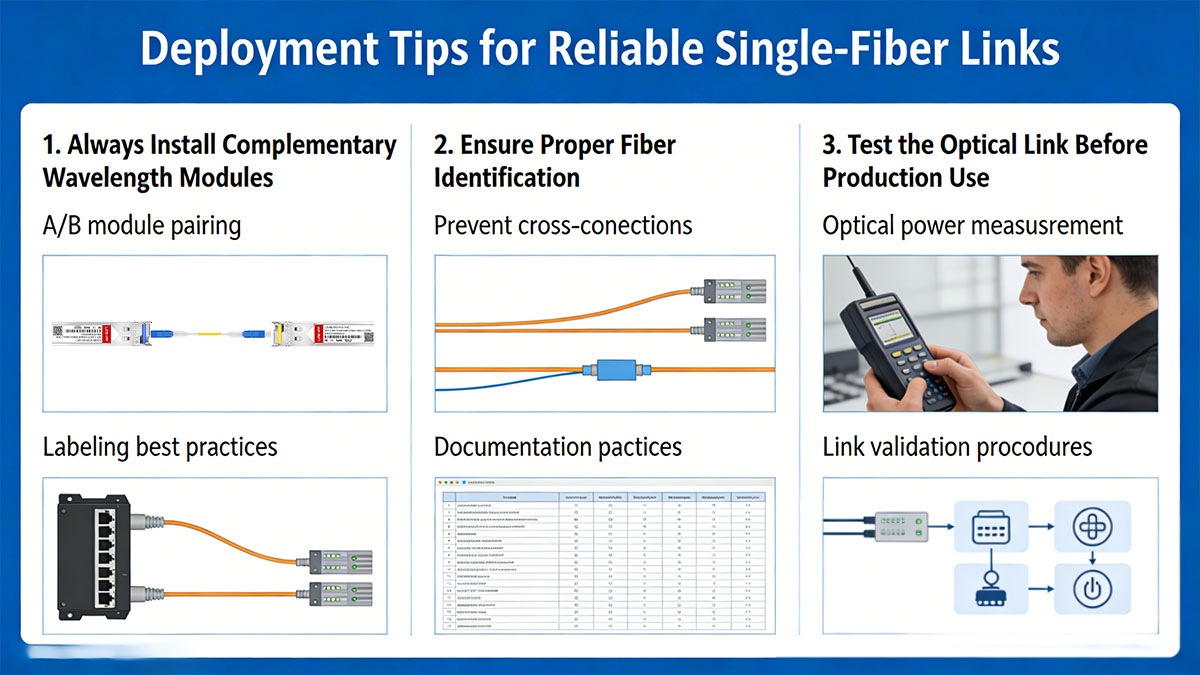
Following a few practical deployment practices can help prevent configuration errors and maintain reliable network performance.
Always Install Complementary Wavelength Modules
Bidirectional SFP modules must operate as complementary wavelength pairs. Each module transmits at one wavelength and receives at another, so the modules installed at both ends of the fiber must have reversed wavelength configurations.
A typical pairing structure is shown below.
| Module Type | TX Wavelength | RX Wavelength |
|---|---|---|
| BiDi Module A | 1310nm | 1550nm |
| BiDi Module B | 1550nm | 1310nm |
To reduce the risk of pairing errors during installation:
-
Verify wavelength specifications before inserting the modules
-
Confirm A-side and B-side labels provided by the manufacturer
-
Document the installed module types in network records
Maintaining accurate documentation helps prevent incorrect module replacement during future maintenance.
Ensure Proper Fiber Identification
Since a bidirectional link uses only one fiber strand, it is important to correctly identify and label the fiber path during installation. Misidentifying the fiber can interrupt communication between network devices.
Common identification practices include:
-
Labeling both ends of the fiber cable with the link identifier
-
Recording the fiber path in network documentation
-
Verifying the physical connection before activating the link
-
Maintaining consistent labeling standards across patch panels
These practices are especially helpful in large network environments where many optical links terminate within the same distribution frame.
Test the Optical Link Before Production Use
Before placing a single-fiber optical link into active service, it is recommended to test the link to verify signal quality and connectivity. Basic optical validation helps confirm that the modules are correctly paired and that the fiber path meets the required optical budget.
| Test Method | Purpose | Typical Tool |
|---|---|---|
| Optical power measurement | Verify received signal level | Optical power meter |
| Link continuity test | Confirm fiber path connectivity | Visual fault locator |
| Transceiver diagnostics | Check module operating status | Digital diagnostics monitoring |
Performing these tests before production deployment helps detect issues such as excessive attenuation, connector contamination, or incorrect module pairing. Addressing these problems early can prevent service interruptions after the link becomes operational.
⭐ Bidirectional SFP vs Other Single-Fiber Technologies
Bidirectional SFP modules are not the only technology that enables communication over a single optical fiber. Other solutions, such as CWDM optical modules and passive optical network (PON) technologies, can also transmit multiple signals through a single fiber strand. However, these technologies differ in architecture, scalability, and deployment scenarios.
Understanding these differences helps determine when bidirectional SFP modules are the most appropriate choice for a network.
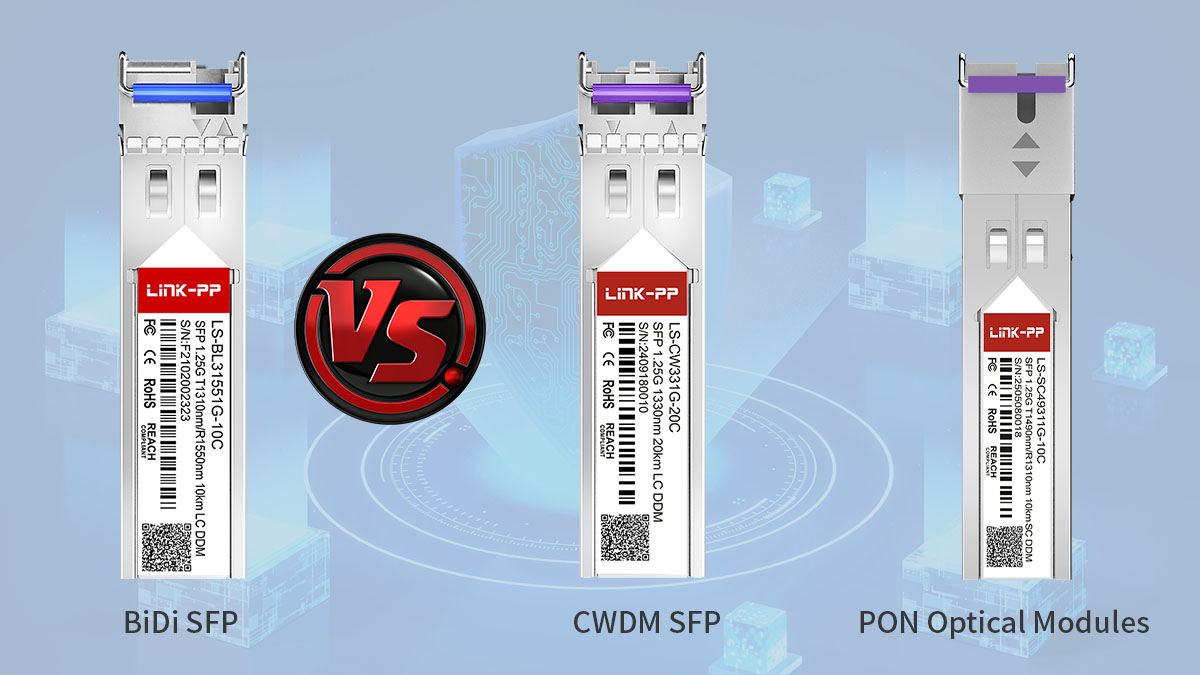
BiDi SFP vs CWDM SFP
Bidirectional SFP modules use two wavelengths to enable full-duplex communication over a single fiber link between two devices. In contrast, CWDM optical modules use multiple wavelength channels to multiplex several independent signals onto the same fiber.
| Feature | BiDi SFP | CWDM SFP |
|---|---|---|
| Transmission Method | Two complementary wavelengths | Multiple wavelength channels |
| Channel Capacity | One link per fiber | Multiple channels per fiber |
| Deployment Complexity | Simple point-to-point link | Requires CWDM multiplexers |
| Typical Use Case | Single-fiber connections | High-capacity fiber sharing |
CWDM technology is typically used when multiple services must share a single fiber infrastructure. By assigning different wavelengths to different channels, several optical signals can travel simultaneously through the same fiber.
In comparison, BiDi SFP modules are simpler to deploy because they do not require external multiplexers or demultiplexers. For straightforward point-to-point links where fiber availability is limited, BiDi modules provide a more direct solution.
BiDi SFP vs PON Optical Modules
Passive optical network technologies also use single-fiber transmission, but their architecture differs significantly from bidirectional SFP deployments.
| Feature | BiDi SFP | PON Optical Modules |
|---|---|---|
| Network Architecture | Point-to-point | Point-to-multipoint |
| Infrastructure | Active Ethernet network | Passive optical splitters |
| Typical Deployment | Enterprise and metro links | Broadband access networks |
| Network Control | Managed Ethernet devices | OLT/ONU system |
In a BiDi SFP deployment, each link connects two active network devices such as switches or routers. The connection operates as a dedicated point-to-point optical link.
PON systems, on the other hand, use passive optical splitters to distribute signals from a central optical line terminal (OLT) to multiple optical network units (ONUs). This architecture is commonly used for residential broadband services and large-scale fiber access networks.
Because of these architectural differences, BiDi SFP modules are typically preferred for enterprise networks, campus connectivity, and metro aggregation links, while PON technologies are optimized for mass subscriber access networks.
⭐ FAQs About Bidirectional SFP
Can a bidirectional SFP operate over multimode fiber?
No. Most bidirectional SFP modules are designed for single-mode fiber (SMF) because they rely on specific wavelength pairs and optical budgets optimized for long-distance transmission. Multimode fiber typically does not support these wavelength characteristics reliably.
How can you identify a matched pair of BiDi SFP modules?
Matched BiDi modules are identified by reversed transmit and receive wavelengths. For example, one module may transmit at 1310nm and receive at 1550nm, while its counterpart transmits at 1550nm and receives at 1310nm. Vendors often label them as A/B pairs or TX/RX reversed.
Do bidirectional SFP modules require special fiber cables?
No special fiber cable is required. BiDi SFP modules typically operate over standard single-mode fiber with LC connectors, using only one fiber strand instead of a duplex fiber pair.
What happens if the same BiDi module type is installed at both ends?
If identical modules are installed on both ends, both devices will transmit on the same wavelength and attempt to receive on the same wavelength. Because the wavelengths do not complement each other, the optical link will not establish communication.
Can bidirectional SFP modules support long-distance links?
Yes. Depending on the optical power budget and wavelength design, bidirectional SFP modules are available for distances ranging from 10km to 80km over single-mode fiber.
Are BiDi SFP modules compatible with standard SFP ports?
Yes. As long as the data rate, interface type, and device firmware compatibility match the switch or router specifications, BiDi SFP modules can operate in standard SFP or SFP+ ports like other optical transceivers.
⭐ Conclusion
Bidirectional SFP modules provide an efficient way to establish reliable optical communication over a single strand of fiber. By transmitting and receiving signals on different wavelengths, these modules enable full-duplex connectivity while significantly reducing fiber consumption. This makes them particularly useful in environments where fiber resources are limited, such as campus networks, metropolitan access infrastructure, and legacy fiber deployments.
Selecting the appropriate bidirectional SFP requires careful attention to several key factors, including wavelength pairing, supported data rate, transmission distance, and device compatibility. Proper module pairing, accurate fiber identification, and thorough link testing also help ensure stable operation in single-fiber network environments.
As network capacity continues to grow, single-fiber optical solutions remain a practical way to maximize existing infrastructure without increasing cabling complexity. If you are evaluating bidirectional SFP modules for your network, you can explore a range of compatible optical transceivers and technical specifications through the LINK-PP Official Store, where detailed product information can help support planning for efficient single-fiber connectivity.