In high-density data center environments, the Cisco QSFP-100G-CU5M DAC cable has long been a go-to solution for short-range, cost-effective 100G interconnects. However, deploying a 5-meter passive copper cable at 100G speeds pushes the physical limits of copper to its absolute boundary. Network engineers frequently encounter severe challenges with the QSFP-100G-CU5M, including significant insertion loss, signal attenuation, and bulky 26AWG cabling that restricts airflow and complicates cable management within high-density racks.
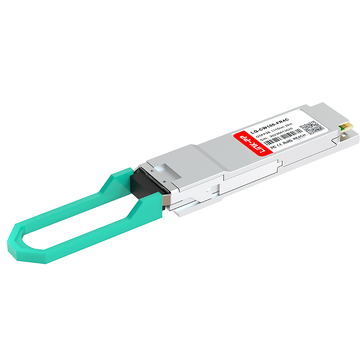
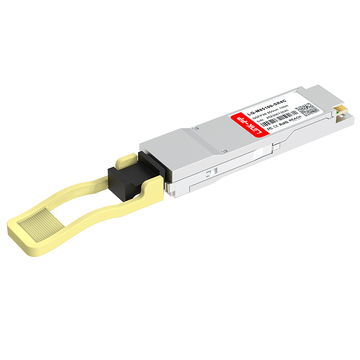
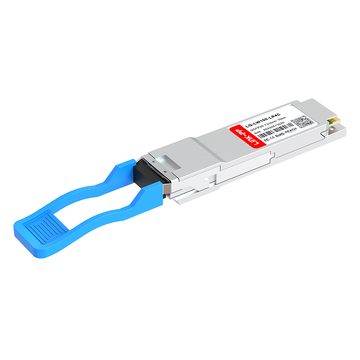
To overcome these physical and distance barriers, transitioning to optical alternatives is no longer just an upgrade, but an operational necessity. This blog explores the top Cisco-compatible optical alternatives to the QSFP-100G-CU5M — including Active Optical Cables (AOCs), Short-Reach (SR4), and Long-Reach (LR4/CWDM4) optics. We will analyze how shifting from thick copper to flexible fiber infrastructure optimizes thermal efficiency, eliminates electromagnetic interference (EMI), and extends your network's reach while maintaining seamless hardware compatibility and cost efficiency.
💫 Understanding the Physical Limits of the Cisco QSFP-100G-CU5M DAC
The Cisco QSFP-100G-CU5M passive Direct Attach Copper (DAC) cable is highly efficient for immediate, short-range connections, but it operates at the absolute brink of copper's physical capabilities. At 100Gbps speeds, high-frequency signals degrade rapidly over metal mediums, introducing strict boundary constraints. Understanding these physical limitations is essential for engineers planning reliable, scalable data center architectures.
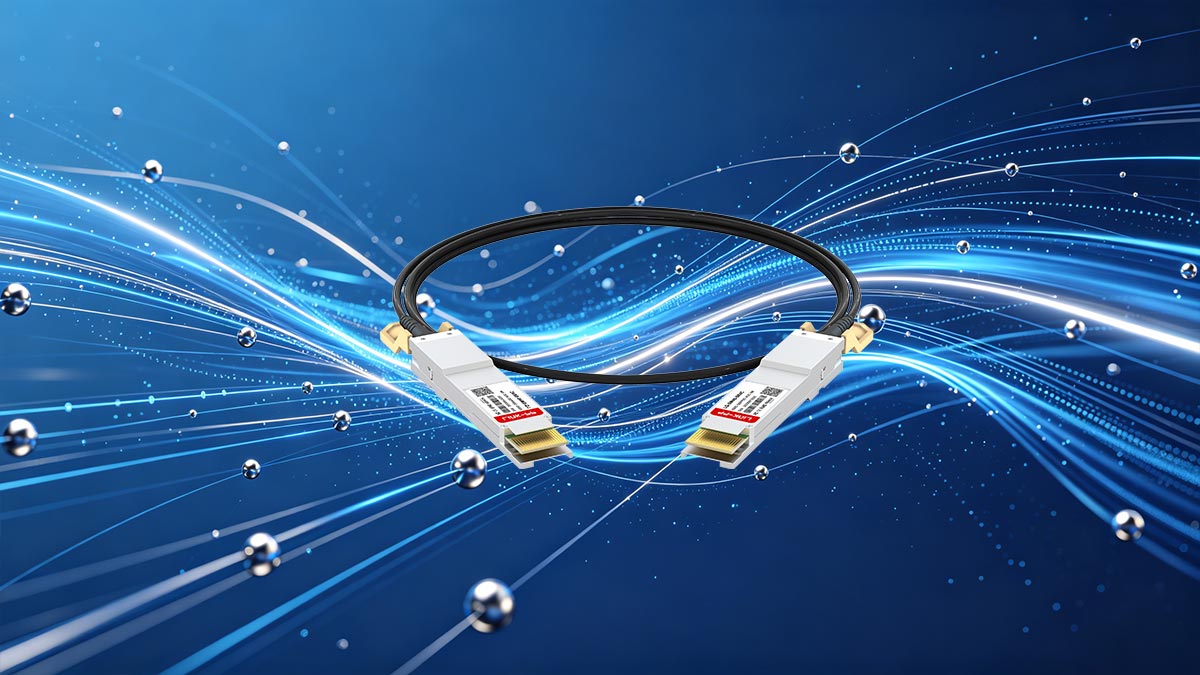
Maximum Reach Constraints of 100G Direct Attach Copper Cables
Passive copper cables do not use active electronics to boost the data signal, meaning they rely entirely on the original signal strength from the switch port. At 100G data rates, the maximum reliable distance for a passive copper link is strictly capped at 5m.
Attempting to extend passive copper beyond this 5-meter limit inevitably results in data corruption and dropped packets. For modern data centers requiring cross-rack or row-to-row connectivity, this rigid distance barrier makes the QSFP-100G-CU5M mathematically and physically unviable.
Insertion Loss and Signal Attenuation at 5 Meters
As electrical signals travel down the 5-meter copper wire, they naturally lose strength due to a phenomenon known as insertion loss. At high frequencies like 25Gbps per channel (which combine to form 100G), this signal attenuation becomes exceptionally severe.
By the time the data reaches the end of the 5-meter cable, the signal-to-noise ratio is deeply degraded. This leaves data center networks highly vulnerable to bit errors, forcing network switches to work harder to correct errors and reducing overall link stability.
Weight, Bend Radius, and Cable Management Challenges in High-Density Racks
To combat high attenuation, the QSFP-100G-CU5M must use incredibly thick 26AWG copper wires. This heavy shielding makes the cable extremely rigid, bulky, and difficult to bend around tight corners within standard server racks.
In high-density network environments, managing dozens of these thick, heavy cables creates a logistical nightmare. They put physical strain on switch ports, severely restrict airflow necessary for cooling, and complicate routine hardware maintenance.
💫 Why Network Engineers Replace QSFP-100G-CU5M with Optical Transceivers
To overcome the inherent physical limitations of heavy copper cabling, network engineers are increasingly swapping out the QSFP-100G-CU5M for optical transceiver modules. Optical solutions utilize light instead of electricity to transmit data, which inherently eliminates the core performance bottlenecks of copper. By transitioning to fiber, data centers unlock vastly superior reach, absolute data integrity, and significantly improved rack environments.
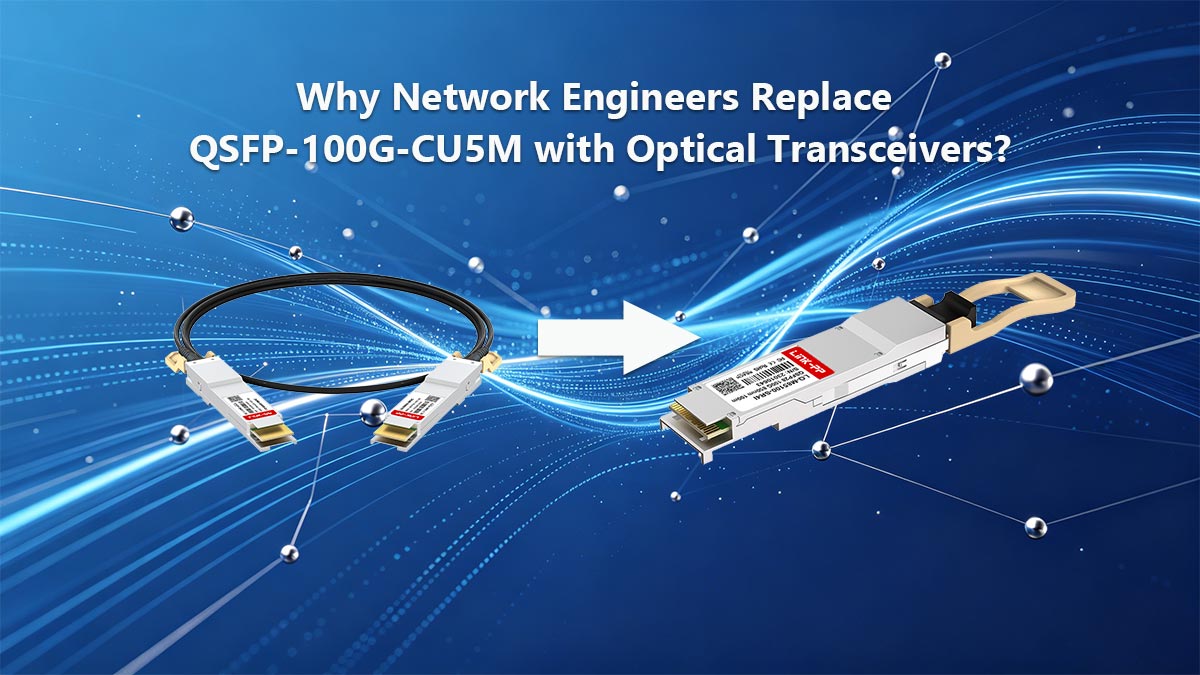
Overcoming Distance Barriers Beyond 5 Meters
The most immediate reason for replacing the QSFP-100G-CU5M is the need to connect switches and servers across greater distances. While passive copper rigidly stops working at 5m, optical transceivers easily span anywhere from 100m to tens of kilometers.
This extended reach allows network architects to design more flexible layouts, such as End-of-Row (EoR) or Centralized-Row topologies. Engineers are no longer forced to keep interconnected equipment tightly clustered in adjacent racks just to satisfy cable length limitations.
Electromagnetic Interference Immunity in Enterprise Data Centers
Enterprise data centers are packed with high-voltage power lines, massive cooling units, and dense rows of servers that generate substantial electromagnetic noise. Because the QSFP-100G-CU5M relies on electrical signals, it acts like an antenna that can absorb this ambient interference.
Optical modules, on the other hand, offer total immunity to electromagnetic interference (EMI) because they transmit data as pulses of light over glass fiber. This guarantees pristine signal integrity and eliminates intermittent packet drops, even when routed directly alongside heavy power cables.
Airflow Optimization and Thermal Efficiency Benefits of Fiber
Replacing bulky copper with ultra-thin fiber cabling does more than just clean up the look of a server rack; it actively transforms the thermal dynamics of the entire data center. When engineers transition from thick copper to lightweight optics, they unlock critical environmental benefits that directly impact hardware longevity and operational costs:
- Drastic Airflow Improvement: The thick 26AWG construction of the QSFP-100G-CU5M creates physical blockages at the back of server chassis, trapping hot exhaust air inside the equipment. Switching to thin optical fiber cords instantly clears these pathways, allowing the switch fans to efficiently pull cool air through the chassis.
- Reduced System Power Strain: When airflow is restricted by heavy copper cables, equipment fans must spin at maximum RPMs to prevent overheating, which drastically increases the overall power draw of the rack. Optically optimized airflow keeps system temperatures low naturally, meaning fans consume less energy and experience fewer mechanical failures over time.
💫 Active Optical Cables (AOC) vs. QSFP-100G-CU5M for Medium-Range Deployment
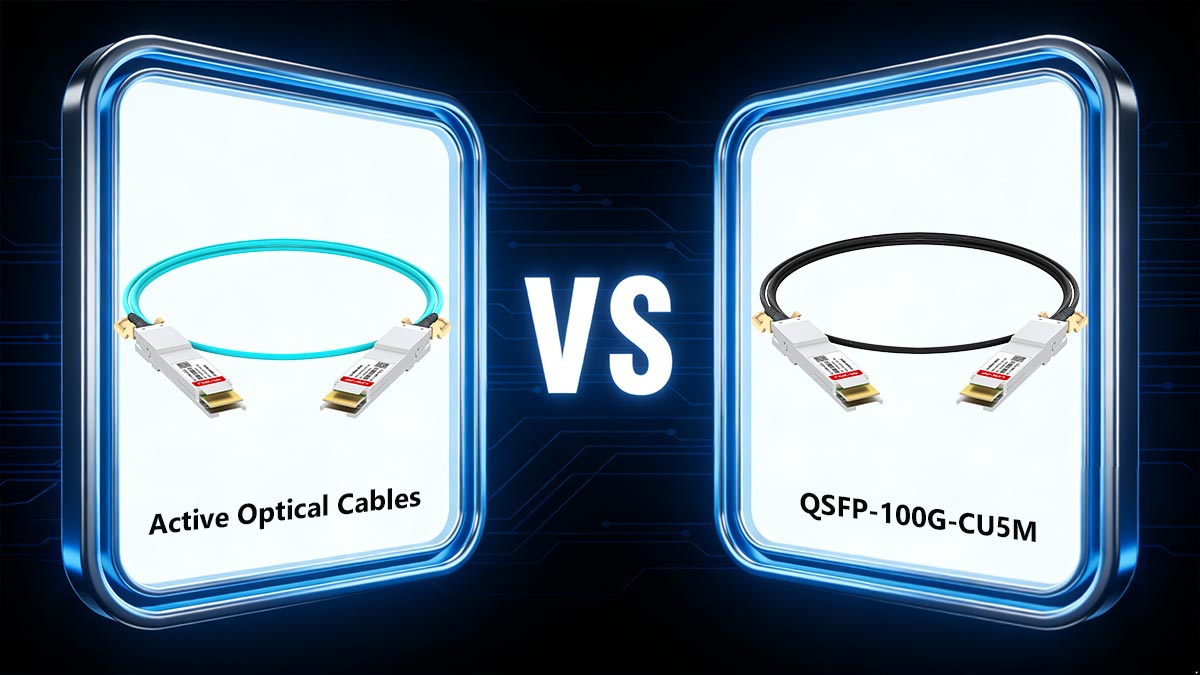
Active Optical Cables (AOCs) offer a seamless middle ground for data centers that require longer reach than the QSFP-100G-CU5M but want to avoid the complexity of separate transceivers and fiber patch cords. While the passive copper DAC is strictly limited by distance and bulkiness, AOCs utilize bonded fiber-optic technology to deliver superior performance across much wider spatial layouts.
To help visualize these differences, the table below highlights the key technical and structural distinctions between these two medium-range deployment options based on updated performance metrics:
| Feature / Metric | Cisco QSFP-100G-CU5M DAC | 100G Active Optical Cable (AOC) |
| Maximum Distance | Strictly limited to 5m | Up to 100m |
| Cable Thickness & Weight | Thick 26AWG copper, very heavy | Ultra-thin, lightweight optical fiber |
| Bend Radius & Flexibility | Rigid, difficult to route in tight spaces | Highly flexible, tight bend radius |
| EMI Immunity | Vulnerable to electrical interference | 100% immune to EMI |
| Power Consumption | Approx. 0.5W or less | Approx. 3.5W or less |
The Cost-Performance Balance of 100G AOCs
For mid-range distances up to 100m, 100G AOCs strike an ideal balance between upfront procurement cost and high-speed performance. Because AOCs arrive as pre-terminated, factory-sealed cable assemblies, they eliminate the need for expensive optical cleaning kits and testing equipment.
This factory-integrated design prevents dust contamination during installation, significantly reducing field failures and troubleshooting time. While AOCs carry a slightly higher initial price tag than the passive QSFP-100G-CU5M, the elimination of performance drops and installation errors offers far greater long-term value.
Flexibility and Ease of Installation Compared to Thick 26AWG Copper
Handling the QSFP-100G-CU5M inside a crowded network rack requires careful planning due to its thick 26AWG copper composition and stiff bend radius. It places continuous mechanical stress on switch ports and requires wide routing paths that quickly clutter cable trays.
In stark contrast, 100G AOCs utilize lightweight optical fibers wrapped in a highly flexible jacket that can easily navigate tight corners and dense cable bundles. This flexibility makes AOC installation incredibly fast and effortless, vastly improving overall cable organization inside high-density rack systems.
Power Consumption Profiles: DAC vs. AOC
From an energy efficiency standpoint, the passive QSFP-100G-CU5M holds a distinct advantage because its copper wires transmit data with minimal overhead. It operates efficiently, consuming approximately 0.5W or less, making it a very low-power choice within its brief 5-meter limit.
Conversely, 100G AOCs feature built-in optical components inside the transceiver ends that actively convert electrical signals to light and vice versa. This active conversion process requires more energy, consuming approximately 3.5W or less per end. Network engineers must factor this higher power profile into their overall data center thermal and utility budgets when deploying AOCs at scale.
💫 Short-Range Optical Alternatives to the QSFP-100G-CU5M Module
When datacenter layouts expand beyond the physical limits of the QSFP-100G-CU5M, short-reach optical transceivers provide the next logical step for reliable connectivity. Unlike fixed DAC cables, these modular optics allow engineers to leverage dedicated fiber patch cables for highly flexible, structured cabling systems. Transitioning to short-range optics removes distance bottlenecks while maintaining high-speed throughput across data center rows.
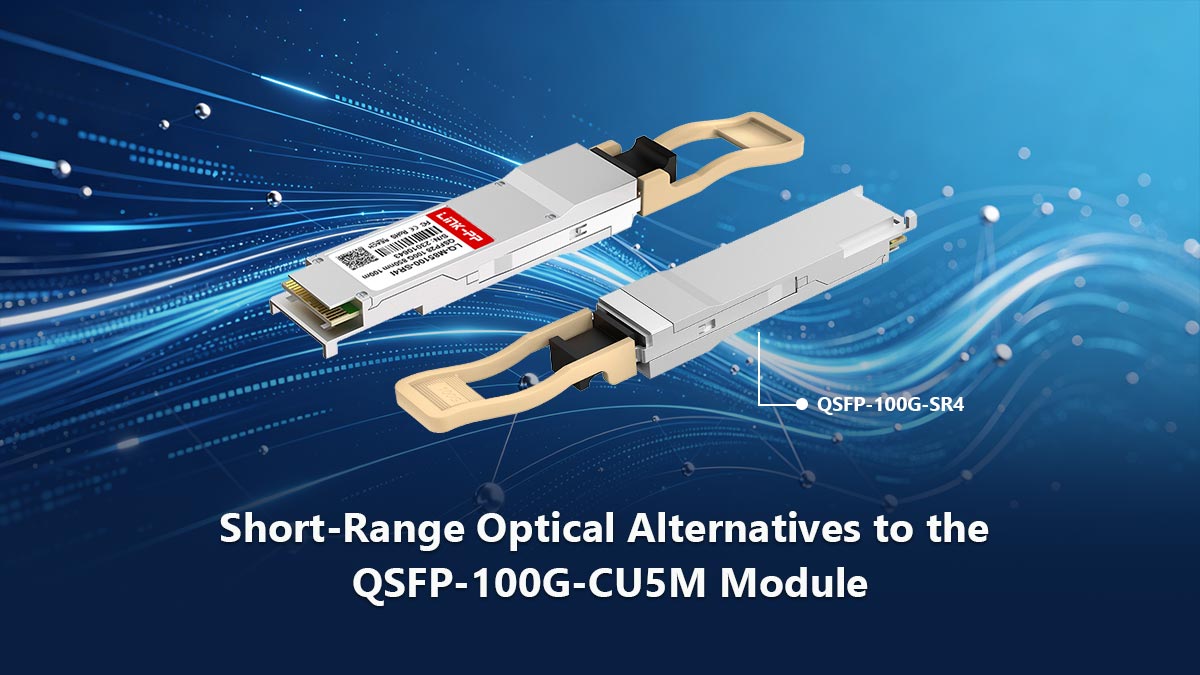
Upgrading to QSFP-100G-SR4 for Multi-Mode Fiber Infrastructure
Upgrading to the QSFP-100G-SR4 Cisco compatible transceiver is the most common path for replacing the restrictive QSFP-100G-CU5M over short distances. This optical module utilizes multi-mode fiber (MMF) cabling, such as OM3 or OM4, to transmit data using lasers rather than electrical currents.
By making this switch, the maximum reach instantly jumps from a rigid 5m to 70m over OM3, or up to 100m over OM4 fiber. This drastically expands deployment options, enabling stable 100G connections between distant racks or across different rows in the facility.
MPO/MTP Cabling Requirements for 100G SR4 Deployments
Deploying QSFP-100G-SR4 transceiver modules requires a shift away from standard single-fiber connections to specialized multi-fiber patch cords. To ensure successful implementation, network engineers must adhere to the following cabling requirements:
- 12-Fiber MPO/MTP Connectors: The QSFP-100G-SR4 transceiver utilizes an MPO or MTP interface, which houses multiple fibers within a single compact connector.
- 4-Channel Parallel Transmission: The module transmits data over 4 active parallel fiber channels and receives over another 4 channels, leaving the center 4 fibers unused in a standard 12-fiber configuration.
- Type-B Polarity Alignment: To guarantee that the transmitter on one end correctly connects to the receiver on the opposite end, engineers must use Type-B (flipped) polarity MPO patch cords.
Analyzing the Total Cost of Ownership Shift from DAC to Optics
While the upfront cost of a QSFP-100G-CU5M copper cable is lower than buying individual transceivers and fiber patches, evaluating the Total Cost of Ownership (TCO) reveals long-term financial advantages. Copper cables are inflexible assets that must be completely discarded if equipment is moved beyond 5m.
In contrast, investing in a modular optical infrastructure protects your budget against future network layout changes. The installed multi-mode fiber cabling remains permanently in place, meaning future upgrades only require swapping out inexpensive transceivers rather than ripping out heavy, costly copper bundles.
💫 Long-Range Single-Mode Optics to Succeed QSFP-100G-CU5M
When network requirements span across expansive data center campuses or connect separate buildings, passive copper links are completely out of the question. Long-reach single-mode optical transceivers provide the ultimate replacement for the QSFP-100G-CU5M by completely eliminating distance as a limitation. Utilizing advanced laser technologies over single-mode fiber (SMF), these optics easily scale from hundreds of meters to tens of kilometers with exceptional signal stability.
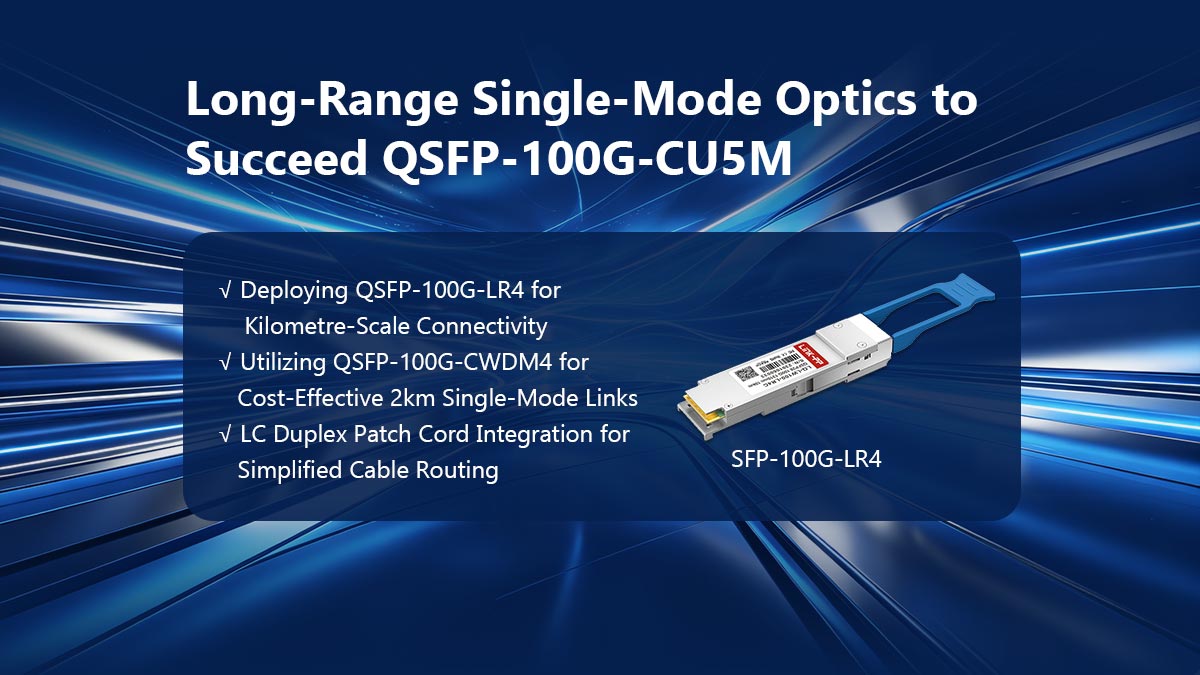
Deploying QSFP-100G-LR4 for Kilometre-Scale Connectivity
The QSFP-100G-LR4 transceiver represents a massive leap in distance capabilities compared to the 5-meter limit of the QSFP-100G-CU5M. This module utilizes Wavelength Division Multiplexing (WDM) technology to multiplex four independent transmit channels onto a single pair of single-mode fibers.
By using this approach, the QSFP-100G-LR4 can reliably carry 100G data traffic over transmission distances reaching as far as 10 km — or even 20km. This makes it the premier choice for campus backbones, metropolitan links, and cross-facility connections where short-range copper or multi-mode options simply cannot reach.
Utilizing QSFP-100G-CWDM4 for Cost-Effective 2km Single-Mode Links
For environments that require single-mode fiber but do not need the full 10km or 20km reach of an LR4 module, the QSFP-100G-CWDM4 offers an excellent middle ground. This transceiver is specifically optimized for links up to 2km, matching the needs of most large-scale data center structures.
By targeting a shorter single-mode distance, the CWDM4 optic uses less expensive laser components, resulting in a much lower price point than LR4 hardware. It delivers the perfect blend of long-range performance and budget optimization for enterprise operators scaling past the QSFP-100G-CU5M.
LC Duplex Patch Cord Integration for Simplified Cable Routing
Unlike short-range SR4 modules that require complex multi-fiber connectors, both LR4 and CWDM4 long-reach optics utilize standard LC Duplex interfaces. Shifting to LC duplex patch cords provides several distinct advantages for data center infrastructure management:
- Ultra-Thin Fiber Profile: LC duplex patch cables consist of just two ultra-thin strands of single-mode fiber, taking up a fraction of the space required by the bulky QSFP-100G-CU5M.
- Simplified Infrastructure: Because it only requires a dual-fiber connection, engineers can use standard, widely available patch panels without needing specialized multi-fiber migration modules.
- Effortless Routing: The lightweight, highly flexible nature of LC duplex cords allows for flawless cable routing through tight pathways, overhead trays, and dense vertical managers.
💫 Cost Optimization Strategies for Moving Beyond QSFP-100G-CU5M
Transitioning from the QSFP-100G-CU5M copper cable to optical infrastructure is highly beneficial for performance, but it can introduce significant budget concerns if not managed correctly. Fortunately, adopting smart procurement strategies allows data center operators to deploy high-quality optical upgrades without overspending. By understanding how to balance hardware choices and verification processes, you can scale your network efficiently while driving down overall capital expenses.
Evaluating OEM Cisco Optics vs. Third-Party Compatible Solutions
Choosing Original Equipment Manufacturer (OEM) Cisco transceivers provides guaranteed compatibility, but it comes with a steep brand premium that rapidly drains IT budgets. For large-scale upgrades, buying OEM hardware purely can become financially unsustainable, forcing teams to look for alternative sourcing paths. High-quality third-party compatible transceivers offer the exact same internal optical specifications and performance metrics as OEM modules, but at a fraction of the cost.
These compatible alternatives are built using identical optical components and industry-standard MSA guidelines, ensuring they match the performance of the original Cisco hardware. By carefully evaluating third-party optics against OEM choices, network managers can break free from vendor lock-in. This strategic shift allows organizations to redirect massive amounts of capital toward other critical infrastructure upgrades while enjoying identical data transmission speeds.
Maximizing Procurement Budgets without Sacrificing Link Reliability
Maximizing a procurement budget does not mean sacrificing network reliability or settling for inferior equipment. By implementing a hybrid sourcing strategy, data centers can deploy OEM modules on critical core backbone links while utilizing highly cost-effective third-party compatible optics transceivers for secondary leaf-spine or access layer connections. This balanced approach dramatically drops overall deployment costs while keeping the most critical network segments fully supported by original manufacturer hardware.
Furthermore, the substantial cost savings gained from third-party alternatives allow procurement teams to easily purchase spare modules to keep on-site. Having immediate access to spare transceivers on the data center floor minimizes network downtime far more effectively than waiting for an OEM replacement shipment. Ultimately, this procurement strategy delivers a much lower total cost of ownership while maximizing overall network uptime.
The Role of Independent Compatibility Testing and Validation
The key to successfully replacing the QSFP-100G-CU5M with third-party compatible optics transceivers lies in selecting vendors that practice strict independent compatibility testing. Reliable vendors maintain dedicated testing labs equipped with actual Cisco Nexus and Catalyst switches to validate every batch of transceivers they produce. This independent validation process ensures that the module's firmware is properly written to mimic an official Cisco product perfectly.
Rigorous testing guarantees that the replacement optics will be recognized instantly by Cisco's operating system without triggering errors or configuration issues. It also confirms that essential monitoring features, like real-time temperature and voltage tracking, operate flawlessly. Investing in third-party hardware backed by independent verification provides network engineers with total peace of mind regarding long-term operational stability.
💫 Maintaining Cisco Hardware Compatibility with QSFP-100G-CU5M Alternatives
When swapping out the QSFP-100G-CU5M for optical transceivers, ensuring seamless hardware compatibility is a top priority for network administrators. Cisco operating systems are notoriously strict about recognizing interconnected hardware, often blocking non-certified equipment. Achieving seamless integration requires alternative optics to precisely mirror original configurations to protect network uptime.
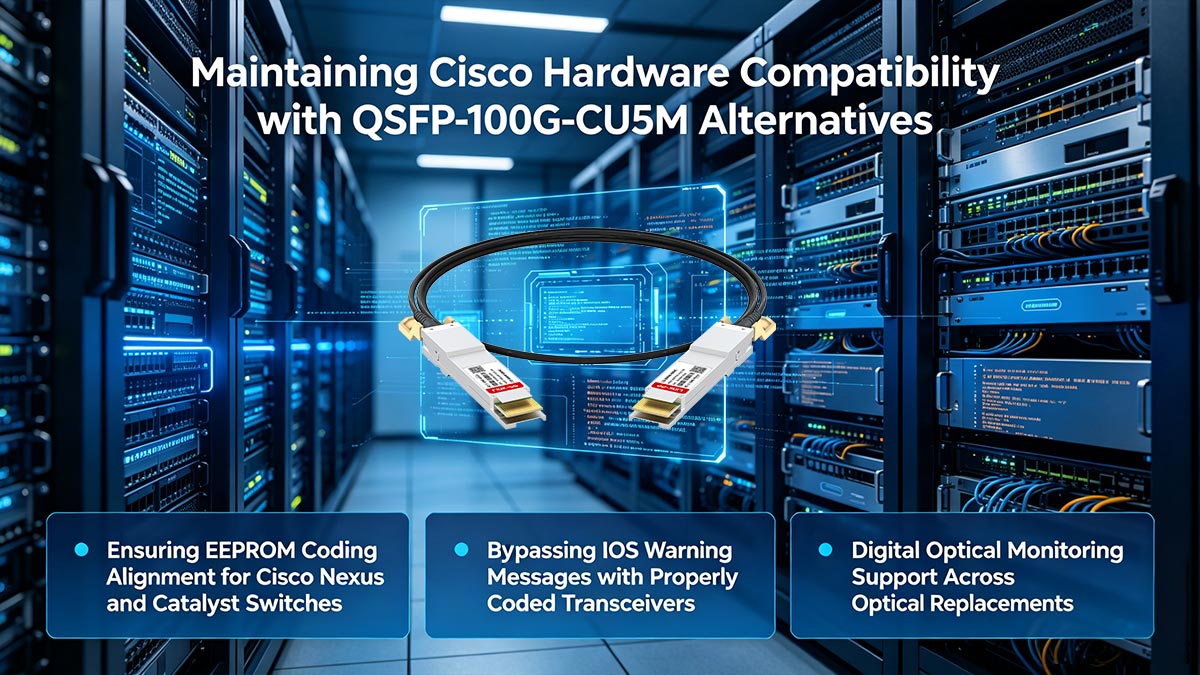
Ensuring EEPROM Coding Alignment for Cisco Nexus and Catalyst Switches
Cisco Nexus and Catalyst switches use advanced internal software algorithms to read the EEPROM chip embedded inside any attached transceiver. If the vendor data encoded on this chip does not match Cisco’s exact signature, the switch port will immediately disable itself.
Therefore, high-quality optical alternatives must feature flawless EEPROM coding alignment that perfectly replicates OEM parameters. This precise programming ensures the switch instantly identifies the replacement module as a trusted, native component upon insertion.
Bypassing IOS Warning Messages with Properly Coded Transceivers
Inserting an unverified or poorly coded transceiver typically triggers automated security alerts within Cisco's operating system. When the switch detects non-compliant hardware, it immediately flags the port and often forces the interface into an error-disabled state, completely shutting down the connection.
By deploying properly coded transceivers, network engineers can completely prevent these disruptive software blocks without relying on manual command-line overrides. The replacement optics allow the link to initialize cleanly and immediately, ensuring a smooth, plug-and-play installation experience that perfectly mirrors the original module.
Digital Optical Monitoring Support Across Optical Replacements
Unlike passive copper cables, high-performance optical replacements must fully support Digital Optical Monitoring (DOM) functionality. This crucial feature allows network engineers to monitor the real-time health and operational metrics of the optical link directly from the Cisco CLI.
With active DOM support, teams can instantly track critical telemetry metrics such as optical laser output power, receiver input power, temperature, and supply voltage. Having access to this granular, real-time data ensures that engineers can easily troubleshoot performance drops and isolate fiber faults before they cause a major network outage.
💫 Conclusion: Sourcing Reliable Optical Alternatives to the QSFP-100G-CU5M
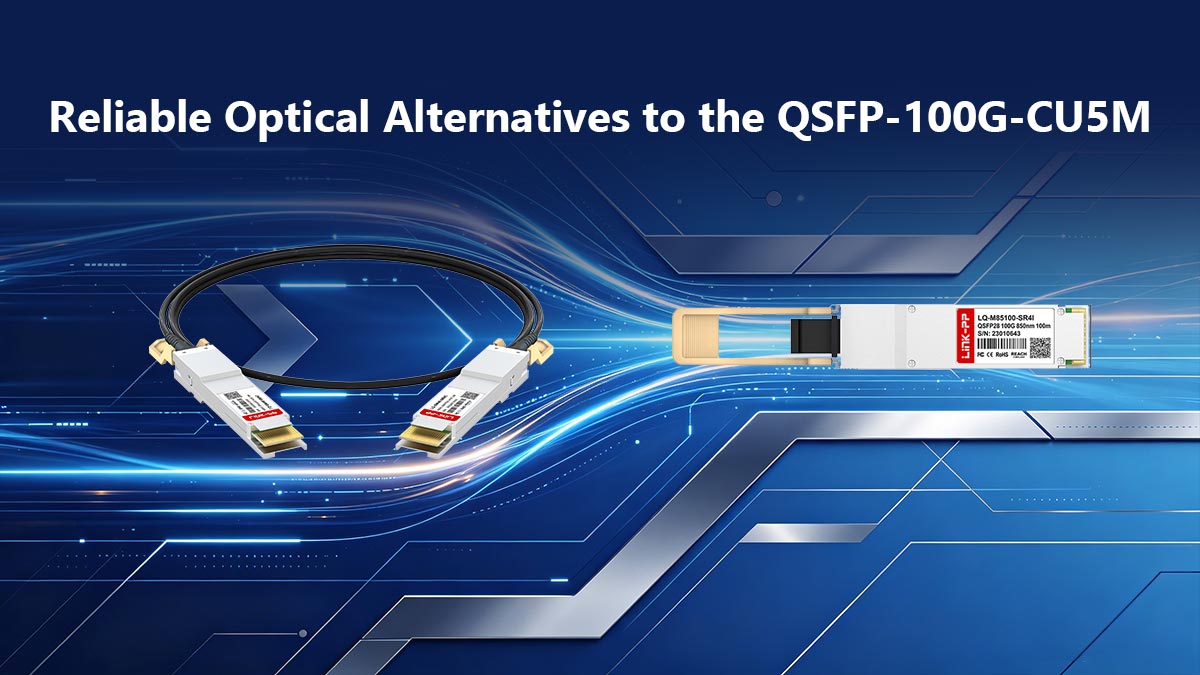
While the Cisco QSFP-100G-CU5M passive copper DAC remains a viable choice for ultra-short connections within a single rack, modern data centers require greater scalability, flexibility, and physical efficiency. Moving beyond the 5-meter copper barrier to embrace optical infrastructure allows network architects to future-proof their systems while dramatically improving enterprise performance.
When planning your migration from thick copper to high-speed transceivers, consider these key takeaways to ensure a successful deployment:
- Select the Right Tool for the Distance: Match your layout needs precisely by utilizing 100G AOCs for flexible mid-range runs up to 100m, QSFP-100G-SR4 for standard multi-mode rows, or single-mode optics (100G CWDM4 / 100G LR4) for long-distance campus scale.
- Prioritize Structural Benefits: Remember that transitioning to thin fiber cabling instantly restores proper airflow to your switch chassis, naturally lowering rack temperatures and decreasing fan power strain.
- Insist on Rigorous Validation: Avoid network downtime by only sourcing third-party compatible optics transceivers that feature perfect EEPROM coding alignment, ensuring seamless plug-and-play compatibility with Cisco Nexus and Catalyst switches.
Ready to optimize your high-density network infrastructure and move past the limitations of copper? You can browse a comprehensive selection of premium, fully compatible 100G QSFP28 transceivers and active optical cables at the LINK-PP Official Store, where proven enterprise-grade reliability meets maximum budget efficiency.