As data centers and enterprise networks transition from SFP+ 10G to SFP28 25G infrastructure to meet escalating bandwidth demands, optimizing short-range connectivity has become a top priority for procurement and engineering teams. The SFP28 DAC (Direct Attach Copper) cable has emerged as the industry standard for high-density, short-distance transmissions, offering an unmatched combination of ultra-low latency and power efficiency. By eliminating costly optical transceivers and utilizing direct electrical signal transmission over copper media, these cables provide a highly reliable framework for Top-of-Rack (ToR) switch-to-server links under 5m.
However, selecting and budgeting for SFP28 DAC deployments involves navigating a complex matrix of technical specifications, material engineering, and vendor ecosystems. From wire gauge (AWG) thickness and EEPROM coding compatibility to the stark price disparities between OEM and third-party alternatives, minor hardware variations directly impact both upfront capital expenditure (CapEx) and long-term operational efficiency (OpEx). Understanding these underlying cost drivers and performance trade-offs is essential for building a resilient, cost-effective 25G network infrastructure.
🔍 Defining the SFP28 DAC: Technical Basics for Procurement Teams
For procurement teams, sourcing networking hardware requires a solid understanding of the underlying technology to balance cost and performance. The SFP28 DAC (Direct Attach Copper) is a specialized copper cable designed to support 25Gbps data rates over ultra-short distances without the premium cost of optical components. Recognizing how these cables operate fundamentally alters how technical buyers evaluate vendor quotes and infrastructure design.

Hardware Architecture and the Absence of Optical Transceivers
Unlike traditional fiber optic connections, an SFP28 DAC is a fixed, integrated cable assembly. It consists of a twinaxial copper cable permanently terminated with SFP28 transceiver modules at both ends. Because these modules' ends connect directly to the copper wire without internal lasers or light-emitting components, they are entirely passive pieces of hardware.
The absence of lasers, photodetectors, and complex internal optical circuitry significantly simplifies the manufacturing process. For procurement, this translates to a drastically lower baseline hardware cost compared to optical modules. By removing the delicate optical components that are prone to wear and environmental fouling, the physical architecture of a DAC inherently boosts hardware reliability.
Electrical Signal Transmission and Low-Latency Benefits
The defining operational characteristic of an SFP28 DAC is that it passes native electrical signals directly from the host switch through the copper wire to the receiving device. Traditional optical links require an extra step: converting electrical signals into light pulses at the source, and then converting those light pulses back into electrical signals at the destination.
By skipping this electro-optical conversion entirely, SFP28 DACs achieve near-zero latency, making them highly desirable for high-frequency trading and high-performance computing (HPC) environments. Additionally, because there are no active circuits converting signals, passive DACs consume virtually zero power. This creates substantial ongoing energy and cooling savings across a large data center deployment.
Maximum Distance Limits of Copper Media at 25Gbps
While copper is highly efficient, it faces strict physics-based limitations when pushing 25Gbps bandwidth. High-frequency electrical signals degrade quickly as they travel down a copper conductor due to natural resistance and signal attenuation. Consequently, passive SFP28 DACs are strictly limited to short-distance applications, with a functional maximum length of 5m.
For procurement teams, this distance constraint dictates where DACs can be deployed. They are ideal for Top-of-Rack (ToR) patching, where switches connect directly to servers in the same or adjacent cabinets. Attempting to bridge longer distances across a data center requires a pivot to active copper transceivers or fiber optic cabling, which carries a different pricing structure.
Why Passive Designs Do Not Support Digital Optical Monitoring
Digital Optical Monitoring (DOM) is a standard diagnostic feature found in optical transceiver modules that allows network administrators to track real-time metrics such as laser temperature, transmitter power, and receiver power. Because a passive SFP28 DAC completely lacks optical components and internal lasers, it does not generate or support traditional DOM data.
Without these active diagnostic chips built into the cable ends, the hardware remains inexpensive and simple. However, procurement teams must note that network monitoring for passive DACs relies entirely on the host switch’s port-level error counters (such as frame loss or bit error rates) rather than internal cable telemetry. This lack of DOM is a deliberate design trade-off that keeps passive DACs exceptionally cost-effective.
🔍 Material and Engineering Factors That Dictate SFP28 DAC Pricing
While two SFP28 DAC cables may look identical on the outside, their internal construction and material grades can cause significant price variations. Sourcing teams often encounter wide price gaps because high-frequency 25Gbps signals require premium raw materials and precise engineering to prevent signal degradation. Understanding these physical and material differentiators allows procurement professionals to identify high-quality cables that ensure network uptime without overpaying.

High-Purity Copper vs. Alloy Conductors and Raw Material Costs
The core material of the twinaxial cable is the single largest factor in baseline manufacturing costs. Premium SFP28 DACs utilize high-purity Oxygen-Free Copper (OFC) or silver-plated copper conductors, which provide exceptionally low electrical resistance and superior signal integrity. These high-grade materials ensure that the 25Gbps data streams travel smoothly with minimal attenuation over the length of the cable.
In contrast, budget-tier manufacturers often substitute pure copper with cheaper copper alloys or copper-clad aluminum (CCA) to cut costs. While these alloy cables are far less expensive, they suffer from much higher electrical resistance and prone to quicker signal degradation. For procurement, opting for the lowest-priced alloy cables often results in high packet drop rates and link instability in production environments.
American Wire Gauge Grading and Copper Thickness Impact
The thickness of the copper wire inside the cable, measured by the American Wire Gauge (AWG) system, directly impacts both the manufacturing cost and the maximum distance the cable can reliably support. Thicker copper wires (indicated by lower AWG numbers, such as 26AWG) have less resistance and can carry 25G signals over longer distances, but they require more raw material and are more expensive. Conversely, thinner wires (higher AWG numbers, like 30AWG) use less copper and cost less, but they are limited to very short lengths due to rapid signal loss.
The following matrix illustrates how the wire gauge thickness influences both the production cost and the ideal deployment distance for SFP28 DACs:
| Wire Gauge (AWG) | Copper Thickness | Relative Manufacturing Cost | Ideal Length / Application |
| 30 AWG | Thinnest | Low | 0.5m to 1m (Intra-rack / ToR server patching) |
| 28 AWG | Medium | Moderate | 1.5m to 2m (Adjacent rack patching) |
| 26 AWG | Thickest | High | 3m to 5m (Cross-rack or long passive runs) |
Shielding Technology: Jacket Materials and Electromagnetic Interference Protection
To protect the sensitive 25Gbps data lanes from outside electrical noise, SFP28 DACs rely on robust physical shielding and high-performance outer jacket materials. High-quality cables use multi-layer shielding, combining aluminum-mylar foils with dense braided copper mesh, wrapped in an LSZH (Low Smoke Zero Halogen) flame-retardant outer jacket. This advanced shielding prevents cross-talk between tightly packed cables and ensures compliance with strict data center safety regulations, driving up the engineering cost.
To better understand how these defensive layers and jacket choices impact overall market pricing, consider the breakdown below:
| Shielding / Jacket Component | Technical Function | Impact on Cable Pricing |
| Foil & Braided Shielding | Blocks EMI and minimizes cross-talk between adjacent cables. | High-density braiding increases raw material and production costs. |
| PVC (Polyvinyl Chloride) Jacket | Standard plastic outer protective layer. | Budget-friendly; standard tier pricing. |
| LSZH (Low Smoke Zero Halogen) | Emits limited toxic smoke during fire incidents. | Premium pricing; required by strict data center safety codes. |
Connector Housing Construction and Gold-Plating Thickness on Pins
The structural integrity of the SFP28 module head at each end of the cable plays a massive role in long-term reliability and pricing. Premium brands use zinc alloy die-cast housings, which offer excellent structural strength and superior electromagnetic shielding right at the connection point. Additionally, the pull-tab mechanics must be durable enough to withstand repeated insertions and extractions in high-density switch environments.
Crucially, the thickness of the gold plating on the connector's electrical contact pins varies by price point. High-end cables feature heavy gold plating (typically 30 to 50 micro-inches), which prevents pin oxidation and maintains a flawless electrical connection over hundreds of mating cycles. Budget cables use ultra-thin gold flash plating that wears away quickly, leading to intermittent port connectivity issues and premature cable failure.
🔍 SFP28 DAC Price Matrix: OEM vs. Third-Party Brand Comparisons
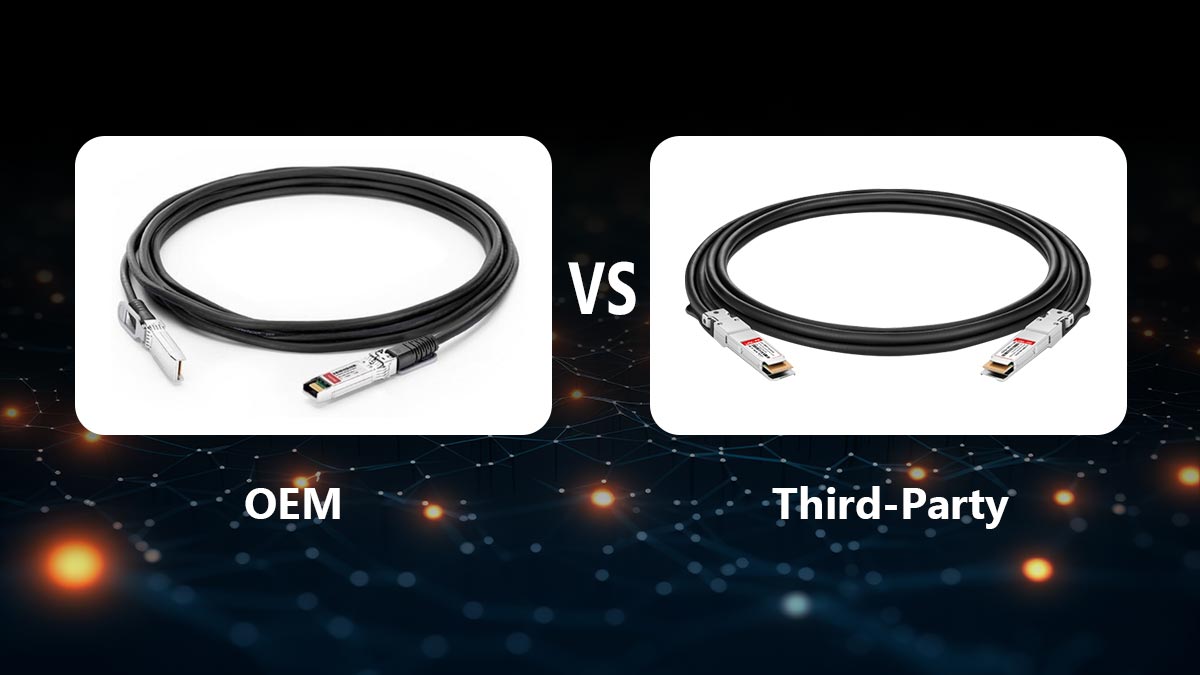
Sourcing SFP28 DAC cables requires balancing the financial savings of third-party alternatives against the guaranteed compatibility of Original Equipment Manufacturer (OEM) hardware. While OEMs command premium pricing, third-party brands have significantly lower capital expenditure. This section analyzes the financial and operational trade-offs between these two sourcing strategies.
Direct Purchase Cost: Original Equipment vs. Compatible Alternatives
OEM SFP28 DAC cables carry a substantial price premium, often costing 2 to 3 times more than third-party alternatives. This markup funds vendor brand equity, testing overhead, and bundled ecosystem support. Third-party compatible cables utilize identical raw physical materials and copper structures but bypass the OEM branding tax, offering substantial upfront cost savings for large-scale data center rollouts.
Return on Investment: Long-Term Warranty and Support Differences
OEM purchases provide the convenience of single-vendor accountability, where technical support for both the host switch and the interconnect cable is handled under a unified ecosystem service contract. On the other hand, established alternative vendors offer highly structured warranty programs and rapid hardware replacement services at a highly competitive price point. This allows procurement teams to significantly lower initial capital costs while maintaining reliable, long-term hardware protection for their 25G network infrastructure.
Technical Risk Assessment: Port Locking vs. Open Compatibility
Major network OEMs use proprietary software keys to lock host ports, causing switches to reject un-coded third-party cables. Reputable third-party manufacturers mitigate this risk by flashing precise, vendor-specific EEPROM code onto their cables to seamlessly bypass port locking. Opting for low-grade, generic third-party alternatives risks link rejection, port disabling, and continuous system error alarms.
Hidden Operational Expenses: Power Efficiency and Port Failure Rates
While SFP28 DAC cables consume minimal power across all brands, long-term operational expenses diverge due to structural component failure rates. Substandard cables can suffer from poor structural tolerances or inferior gold-plating on contacts, leading to physical port damage or intermittent link drops. These failures result in costly network downtime and troubleshooting labor that can quickly wipe out the initial acquisition savings.
🔍 Analyzing SFP28 DAC Interoperability and EEPROM Coding Costs
Interoperability is a vital factor in network deployment, as an SFP28 DAC must be recognized by the host switches to function. The key to this compatibility lies in the EEPROM chip embedded within the cable connector, which contains the specific identity code required by network hardware. Understanding the engineering and testing that goes into this coding helps procurement teams evaluate why seemingly identical copper cables carry different price tags.
Vendor Lock-in: Why EEPROM Coding Impacts Baseline Hardware Costs
Many major networking hardware manufacturers program their switches to look for specific vendor data before enabling a port. The small memory chip inside the SFP28 DAC module — the EEPROM — must hold a precise digital signature that matches the host equipment. This system is known as vendor lock-in, and it prevents unauthorized or non-compliant hardware from being utilized.
Writing, verifying, and maintaining these specialized configuration codes adds a layer of software engineering overhead to production. Sourcing teams should note that a significant portion of a cable's baseline cost goes toward this coding security layer. This engineering effort ensures that the copper assembly can successfully present itself to the switch as a validated, native component.
Host Switch Compatibility: Avoiding Port Disabling and Error Alarms
When a switch detects an unapproved signature or a coding mismatch in an SFP28 DAC, its operating system will often trigger an error alarm. In severe cases, the switch will automatically disable the port entirely to protect the system. This stops network communication on that link, causing unexpected deployment delays or network downtime.
Using professionally coded cables avoids these disruptive error alarms and port lockouts. High-quality compatible cables are flashed with exact vendor-specific parameter maps, allowing them to pass initialization checks instantly. This seamless integration ensures that the 25G link comes online immediately without requiring manual software overrides or administrative intervention.
Uncoded Cable Performance: The Technical Risks of Using "Generic" EEPROMs
Some budget-friendly cables are sold with "generic" or completely uncoded EEPROMs to minimize production costs. While these generic cables might work fine on open-standard white-box switches, they pose significant operational risks in mainstream brand environments. Without the correct vendor profile, the host switch may run the link at reduced performance.
Furthermore, generic coding can cause intermittent link drops during high-traffic periods because the switch cannot optimize its electrical signaling parameters for an unknown cable. For procurement, buying generic cables to save a small amount upfront often leads to higher long-term engineering costs when technicians have to troubleshoot unstable 25G links.
🔍 Selecting the Right SFP28 DAC Length: Pricing and Performance Trade-offs
Choosing the appropriate length for an SFP28 DAC involves a careful balance between component cost, physical spatial constraints, and high-frequency signal behavior. As cable length increases, the physical properties of copper demand thicker wires and more advanced engineering to maintain data integrity at 25Gbps. Sourcing teams must evaluate these dimensional and structural variations to prevent over-provisioning budget or under-provisioning network performance.
0.5 Meter to 1 Meter SFP28 DAC: Top-of-Rack Switch to Server Links
Short-length SFP28 DACs ranging from 0.5m to 1m represent the most economical and high-density interconnect solutions in modern data center architectures. These ultra-short cables are engineered specifically for intra-rack patching, providing the definitive standard for connecting a Top-of-Rack (ToR) switch directly to adjacent servers positioned immediately below or above it.
Deploying these specific lengths provides distinct advantages for high-density compute environments:
- Minimal Component Costs: Utilizing the least amount of raw copper material and thinner wire gauges (typically 30 AWG) allows these cables to carry the lowest purchase price in the entire 25G inventory matrix.
- Optimal Airflow and Less Clutter: Their compact physical footprint eliminates excess cable slack, minimizing bulk within the rack and maximizing open airflow pathways for critical server cooling.
- Peak Signal Integrity: Because the electrical signal only travels a minimal distance, signal attenuation and insertion loss are virtually nonexistent, ensuring exceptionally stable link performance.
2 Meter to 3 Meter SFP28 DAC: Mid-Row and Adjacent Rack Patching Solutions
When network designs expand outside a single server cabinet, 2m and 3m SFP28 DAC cables serve as the primary bridging mechanism. These intermediate lengths are required for adjacent rack patching or connecting mid-row switches to multi-tier blade chassis. Because the physical distance is greater, these assemblies require a thicker copper core (typically 28 AWG or 26 AWG) to combat natural signal degradation over the longer path.
Sourcing teams evaluating these mid-length options must consider how the increased distance impacts procurement parameters:
- Moderate Price Escalation: The unit cost increases compared to 1-meter options due to the combination of additional raw copper volume and the more complex manufacturing tolerances required for thicker wires.
- Strategic Cabinet Mapping: These lengths provide the necessary physical reach to route cables neatly through overhead cable trays or under-floor spaces to link adjacent equipment rows safely.
- Balanced Engineering Performance: They offer a reliable middle ground, delivering the low latency and zero-power benefits of passive copper without crossing into the high-attenuation risk zones associated with maximum length limits.
5 Meter SFP28 DAC: Limits of Passive Copper, Active Copper Alternatives, and Signal Loss
A 5-meter length represents the absolute physical boundary for passive copper media transmitting data at 25Gbps. At this distance, high-frequency electrical signals suffer from severe attenuation and distortion, requiring the thickest possible raw copper conductors (26 AWG) and premium shielding to maintain an acceptable link. Because of these stringent physical demands, a 5-meter passive SFP28 DAC carries a significantly higher price tag and a noticeably stiffer, bulkier profile.
When managing connections at this maximum threshold, engineering teams must evaluate specific performance and alternative pathways:
- High Attenuation and Error Risks: Passive 5-meter runs operate right at the edge of signal viability, leaving very little margin for error regarding port compatibility, signal jitter, or packet loss.
- Pivot to Active Copper (ACC/AEC): If a 5-meter copper run exhibits stability issues, procurement must consider Active Copper Cables, which integrate small signal-boosting chips inside the module heads to restore signal clarity.
- Transition to Optical Alternatives: For paths pushing to 5 meters and beyond, switching the architecture to Active Optical Cables (AOC) or discrete transceivers often becomes the more reliable and performant choice, despite a higher upfront cost.
Cable Management and Bend Radius Considerations for Thicker AWG SFP28 DAC Cables
Physical cable management becomes a major operational factor when deploying longer SFP28 DACs that utilize heavy 26 AWG or 28 AWG copper wire. These thick, heavily shielded cable assemblies are rigid and heavy, making them considerably harder to manipulate than thin fiber patch cords. If a thick copper cable is bent too sharply to fit into a tight cabinet space, the internal geometry of the twinaxial pairs can deform, causing permanent signal reflection and immediate link failure.
Proper deployment of these heavy-gauge copper links requires strict adherence to physical installation guidelines:
- Strict Bend Radius Compliance: Thicker cables require a larger bend radius (typically 5 to 10 times the outer diameter of the cable) to protect the internal copper shield from tearing or crimping.
- Increased Cable Tray Load: The cumulative weight of dozens of thick 26 AWG cables can place significant structural strain on overhead cable trays and managers, requiring robust physical support infrastructure.
- Strain Relief Planning: Adequate strain relief must be provided at the switch port connection point to prevent the heavy hanging weight of long copper cables from sagging and damaging the sensitive SFP28 switch cage over time.
🔍 SFP28 DAC Technical Specifications That Impact Long-Term ROI
Evaluating the technical specifications of an SFP28 DAC is essential for projecting its true return on investment (ROI) over years of continuous data center operation. Beyond the upfront purchase price, a cable's performance metrics directly dictate network stability, power efficiency, and hardware longevity. Prioritizing these technical indicators allows procurement teams to secure low total cost of ownership (TCO) and prevent expensive network maintenance cycles.
Bit Error Rate (BER) Thresholds (10⁻¹² to 10⁻¹⁵) and Link Reliability
The Bit Error Rate (BER) measures the percentage of transmitted bits that encounter errors over a network link, acting as a primary indicator of data integrity. While standard networking guidelines consider a BER of 10⁻¹² acceptable for 25G Ethernet, premium-grade SFP28 DAC cables routinely achieve a much stricter threshold of 10⁻¹⁵. Sourcing assemblies that maintain this superior error rate ensures highly stable data streams, significantly reducing the need for packet retransmissions and preventing unexpected latency spikes in high-volume traffic.
Insertion Loss, Cross-Talk (NEXT/FEXT), and Signal Integrity Metrics
Insertion loss represents the total signal power lost as electrical waves travel down the copper wire, while cross-talk — measured as Near-End (NEXT) and Far-End (FEXT) — quantifies the unwanted electrical interference between adjacent data lanes. High-quality SFP28 DACs are engineered with precise internal wire twisting and shielding to keep insertion loss and cross-talk well below industry thresholds. Cables that deliver clean signal integrity metrics guarantee that the host switch can easily interpret the 25G signal, preventing intermittent link drops and port-level errors.
Thermal Dissipation and Power Consumption Limits in High-Density 25G Ports
A major operational benefit of passive SFP28 DACs is their negligible power consumption, which typically sits below 0.5W per module end. This lack of active electronic components prevents the cable heads from generating heat, allowing high-density switch cages to maintain optimal thermal profiles. Choosing low-power passive copper options over active transceivers drastically lowers annual electricity and cooling costs, directly contributing to a healthier operational budget for large-scale data center environments.
Durability Metrics: Insertion Cycles and Pull-Tab Mechanical Reliability
Physical durability determines how well a cable withstands the rigors of initial installation and routine hardware upgrades over its lifespan. Standard industrial benchmarks require SFP28 module connectors to endure at least 100 mating (insertion and extraction) cycles without experiencing physical or electrical degradation on the pins. Furthermore, a robust pull-tab mechanism ensures that technicians can safely unlock and remove cables from tightly packed switch ports without snapping the latch or damaging the expensive switch cage itself.
🔍 Strategic SFP28 DAC Alternatives: When to Pivot to Other 25G Options
While passive SFP28 DAC cables offer the most cost-effective solution for ultra-short ranges, they are not universally applicable across all data center layouts. Physical distance boundaries, strict airflow demands, and future-proofing strategies often require network architects to look beyond copper media. Understanding when to pivot to alternative 25G technologies ensures that network performance remains uncompromised as deployment scales.
When Passive SFP28 DAC Fails: Evaluating SFP28 Active Optical Cables
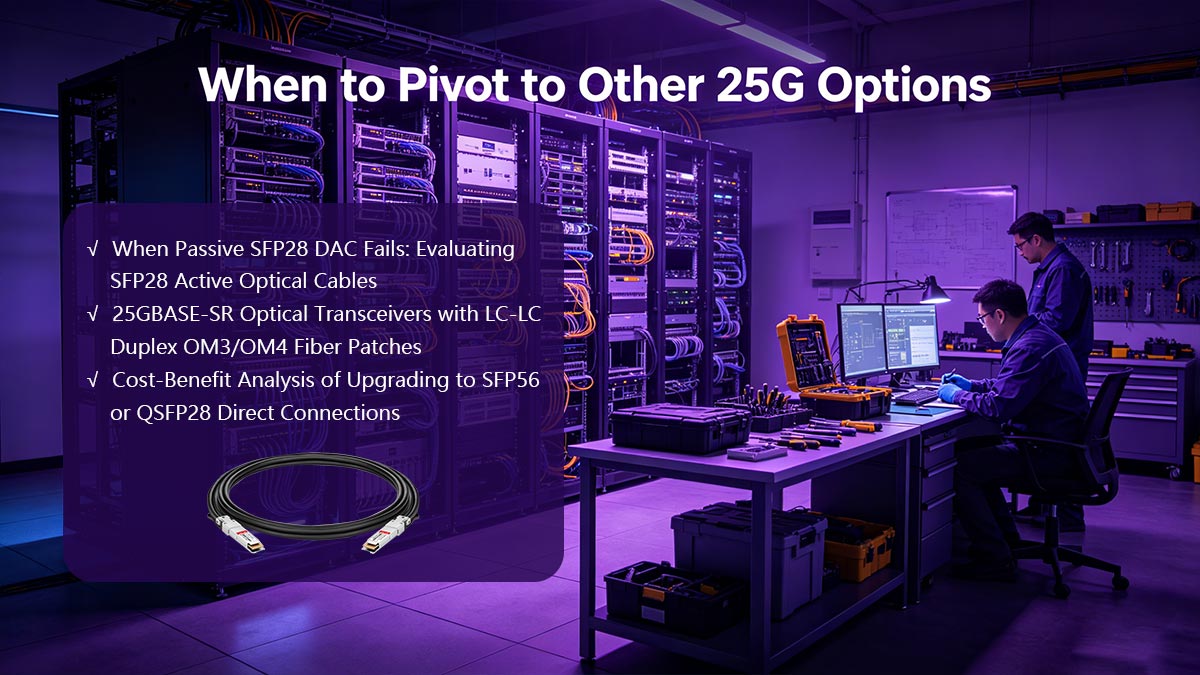
As connection lengths stretch past 5m, passive copper cables can no longer maintain reliable 25Gbps signal integrity due to massive electrical attenuation. SFP28 Active Optical Cables (AOCs) solve this issue by utilizing lightweight multi-mode fiber optics permanently attached to the module ends. AOCs offer an excellent alternative for cross-rack patching, providing a much thinner, more flexible cable profile that significantly improves rack airflow while easily extending data transmission up to 100m.
25GBASE-SR Optical Transceivers with LC-LC Duplex OM3/OM4 Fiber Patches
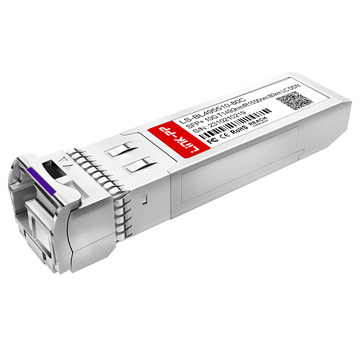
For complex, structured cabling environments that span across separate rows or dedicated server rooms, deploying discrete optical transceivers paired with fiber patch cords is the industry standard. A premier option for this architecture is the LINK-PP LS-MM8525-S1C, a high-performance 25GBASE-SR optical transceiver designed to deliver flawless data transmission over LC-LC duplex OM3 or OM4 multi-mode fiber. This approach carries a higher initial hardware cost than a fixed DAC setup, but it grants network engineers complete flexibility to route cables through walls and conduits, safely covering distances up to 100m.
Cost-Benefit Analysis of Upgrading to SFP56 or QSFP28 Direct Connections
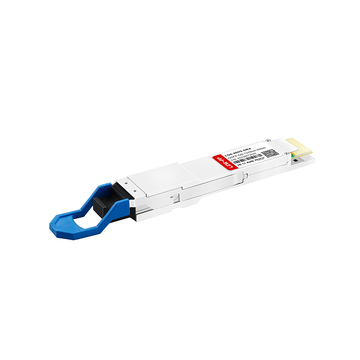
When planning long-term infrastructure investments, procurement teams must weigh the benefit of sticking with 25G hardware against upgrading directly to next-generation speeds like 50G SFP56 or 100G QSFP28. While a 100G QSFP28 direct copper link requires a higher upfront expenditure per port, it delivers four times the bandwidth capacity of an SFP28 link using a similar physical space. Evaluating this upgrade path involves analyzing your current data growth rates; investing in higher-capacity links now can significantly reduce future labor and hardware replacement costs down the road.
🔍 Final Verdict on SFP28 DAC Deployment for 25G Short-Range Infrastructure
In conclusion, deploying SFP28 DAC cables offers the most practical and financially sound strategy for short-range 25G data center applications. By eliminating expensive optical conversion components, these passive assemblies deliver unmatched low latency, near-zero power consumption, and highly reliable performance for connections up to 5 meters. Balancing initial purchase price against essential engineering metrics — such as AWG thickness, premium shielding, and precise EEPROM compatibility coding — ensures your network achieves peak uptime with an optimized total cost of ownership.
When designing or upgrading your 25G network fabric, choosing hardware that guarantees seamless interoperability is critical to avoiding deployment delays. For data centers requiring longer spans or structured fiber configurations, partnering with a proven component vendor makes all the difference. Explore a comprehensive selection of fully compatible, carrier-grade optical components and transceiver modules by visiting the LINK-PP Official Store to build a resilient, high-performance connectivity infrastructure.