What is the true cost of an SFP-1G-SX module?
The SFP-1G-SX is a 1 Gigabit Ethernet optical transceiver operating at an 850nm wavelength over Multi-Mode Fiber (MMF), supporting distances up to 550 meters under the IEEE 802.3z 1000BASE-SX standard. In 2025, the average pricing for an OEM SFP-1G-SX module (e.g., Cisco, Aruba, or Juniper) ranges from $150 to $350. However, Multi-Source Agreement (MSA) compliant third-party transceivers offer identical hardware and performance for $5 to $15. IT procurement teams can safely eliminate the 80-90% "OEM tax" by validating third-party optics that feature custom EEPROM coding and DOM (Digital Optical Monitoring) support.

While enterprise data centers are aggressively migrating to 100G and 400G architectures, 1 Gigabit Ethernet (1GbE) remains the ubiquitous backbone for legacy edge switching, campus networks, and out-of-band management. Because the 1000BASE-SX standard is fully mature and highly commoditized, paying premium tier pricing for these transceivers is no longer a justifiable capital expenditure (CapEx).
Despite this, many IT departments continue to overspend out of fear of compatibility issues or warranty voidance. Based on our deployment data across enterprise networks, the underlying components—specifically the 850nm VCSEL (Vertical-Cavity Surface-Emitting Laser) and the PIN photodiode receiver—are manufactured by a select few global foundries. OEMs and reputable third-party vendors are sourcing from the exact same supply chains.
This procurement guide is designed to provide network architects and purchasing managers with a transparent, data-driven framework. We will break down the precise cost drivers of the SFP-1G-SX, provide a definitive comparison between OEM and third-party optics, and deliver a low-risk validation checklist for your next infrastructure rollout.
Core Technical Baseline: Defining the SFP-1G-SX
Before evaluating pricing models, procurement teams must ensure they are quoting the correct technical specifications. The SFP-1G-SX is strictly defined by the following MSA and IEEE parameters:
- Standard Compliance: IEEE 802.3z 1000BASE-SX
- Form Factor: SFP (Small Form-factor Pluggable) with dual LC duplex receptacles.
- Optical Components: 850nm VCSEL transmitter and PIN receiver.
- Cable Medium: Multi-Mode Fiber (MMF) only.
- Maximum Transmission Distance:
- OM1 (62.5/125 µm): 220 meters
- OM2 (50/125 µm): 275 meters
- OM3 / OM4 (50/125 µm): 550 meters
- Diagnostic Capability: DOM/DDM (Digital Optical/Diagnostic Monitoring) per SFF-8472, enabling real-time tracking of optical output power, receiver input power, and internal temperature.
Procurement Rule of Thumb: If your building's fiber plant utilizes Single-Mode Fiber (SMF), the SFP-1G-SX will fail to link. You must procure the SFP-1G-LX (1310nm) instead.
🔵 What is an SFP-1G-SX Module?
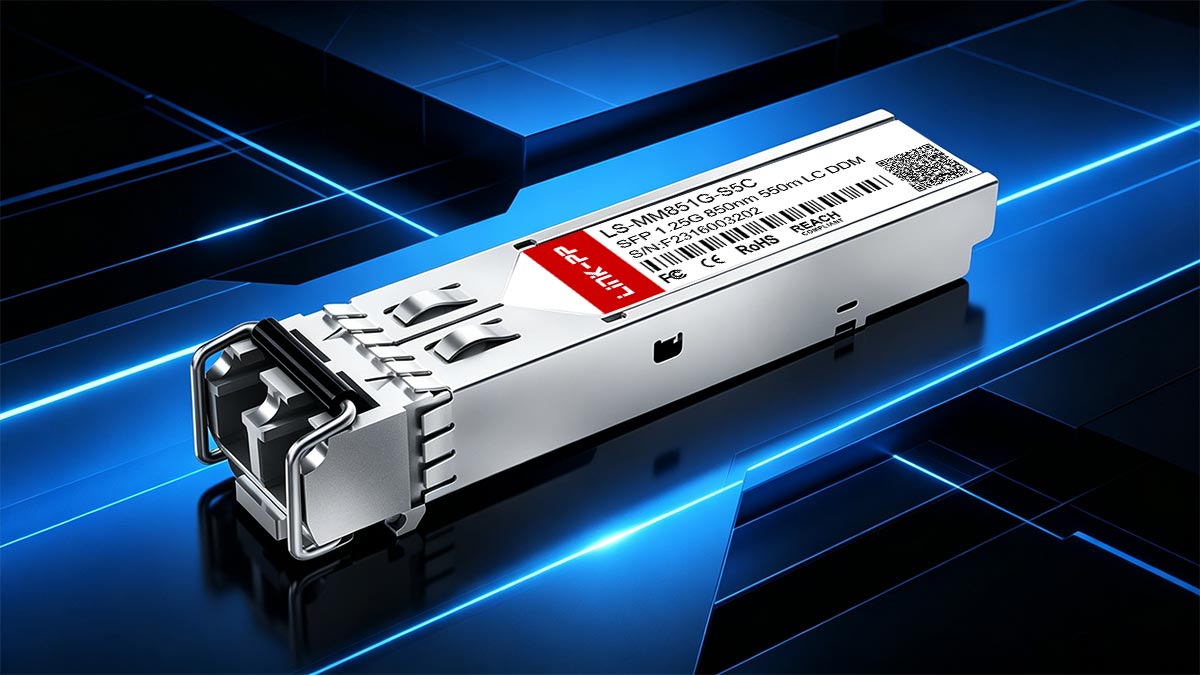
The SFP-1G-SX is a hot-swappable, 1 Gigabit Small Form-factor Pluggable optical transceiver engineered for short-haul data transmission. Operating at an 850nm wavelength over Multi-Mode Fiber (MMF), it functions at the Physical Layer (Layer 1), converting electrical signals from a host device (like a switch or router) into optical signals. It remains the industry standard for intra-rack and short building-to-building enterprise connectivity.
To fully understand pricing and procurement strategies, buyers must look beyond the external metal casing and understand the internal architecture of the module. The term "SX" stands for Short Wavelength, denoting its specific use case for localized, high-bandwidth data links rather than long-distance telecommunications.
Internal Architecture: How It Works
The reliability of an SFP-1G-SX module relies entirely on its optical sub-assemblies. Regardless of the brand name printed on the label, every MSA-compliant 1000BASE-SX transceiver consists of three core internal components:
| Component | Technical Definition & Function |
|---|---|
| TOSA (Transmitter Optical Sub-Assembly) | Houses the 850nm VCSEL (Vertical-Cavity Surface-Emitting Laser). The VCSEL is highly cost-effective to manufacture, which is why SX modules are significantly cheaper than long-haul LX modules (which require more complex Fabry-Perot or DFB lasers). |
| ROSA (Receiver Optical Sub-Assembly) | Contains a PIN Photodiode and a Transimpedance Amplifier (TIA). It receives the incoming 850nm light pulses from the fiber cable and translates them back into electrical currents for the switch's ASIC to process. |
| EEPROM & I2C Interface | The "brain" of the module. The EEPROM memory chip stores the vendor identification, part number, and serial number. The host switch reads this data via a 2-wire I2C interface to determine if the module is "supported" or "unsupported." |
The Role of the Multi-Source Agreement (MSA)
The physical dimensions, electrical interfaces, and signaling protocols of the SFP-1G-SX are not owned by any single company like Cisco or Hewlett Packard Enterprise. Instead, they are governed by the SFF Committee through a Multi-Source Agreement (MSA).
Micro-definition: An MSA is an industry-wide agreement among telecom manufacturers to standardize the form factor and operational parameters of fiber optic transceivers.
Because the SFP-1G-SX is an MSA-standardized commodity, the physical hardware is virtually identical across the entire market. The primary differentiator between a $150 module and a $10 module is the proprietary data flashed onto the EEPROM chip, which dictates vendor lock-in protocols. Understanding this hardware parity is the crucial first step for IT procurement teams looking to transition to cost-effective third-party optics.
🔵 What Drives the Price of an SFP-1G-SX Module?
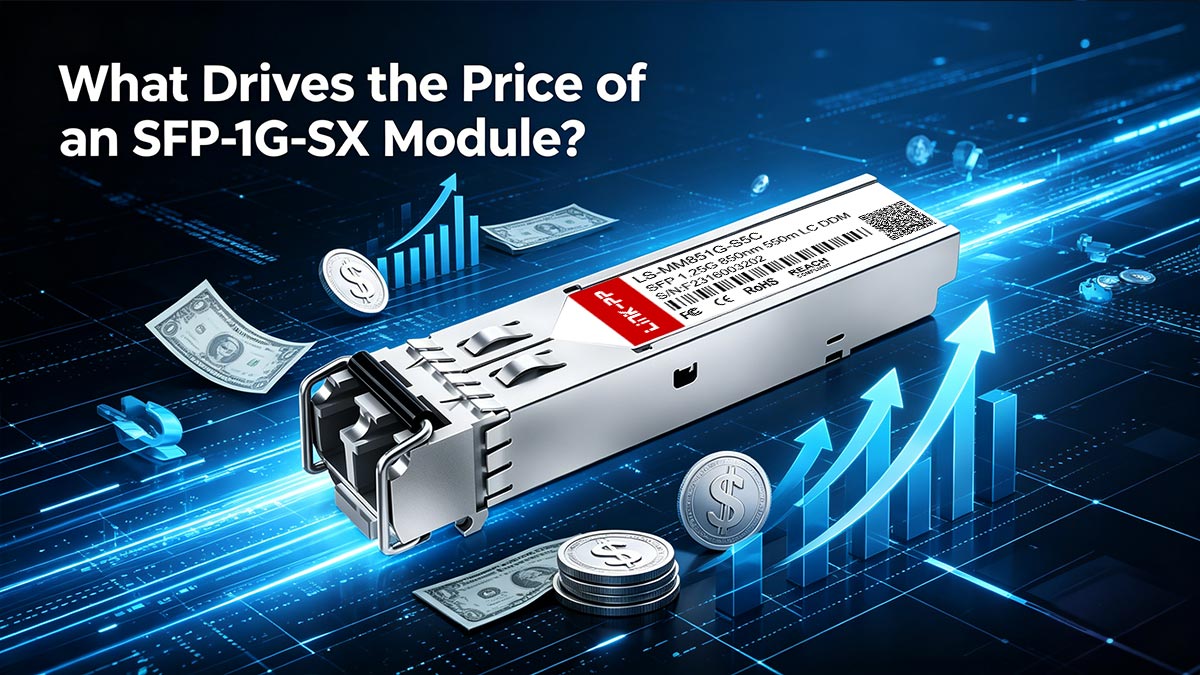
The extreme price variance of an SFP-1G-SX module (ranging from $5 to over $350) is driven primarily by the brand markup (the "OEM tax"). Because the optical components are MSA-standardized commodities, manufacturing costs are virtually identical. Secondary cost drivers include EEPROM custom coding, operating temperature grades (Commercial vs. Industrial), DOM/DDM integration, warranty SLAs, and purchasing volume.
If the TOSA, ROSA, and physical housing of a 1000BASE-SX transceiver are governed by the same industry standards, why do enterprise procurement teams see such massive discrepancies in supplier quotes? Understanding the specific cost drivers allows buyers to dissect quotes and pay only for the technical value they actually require.
1. Brand Markup (The "OEM Tax")
The single largest factor in SFP pricing is the logo printed on the pull-tab. Original Equipment Manufacturers (OEMs) such as Cisco, Juniper, and HPE Aruba do not manufacture their own optical transceivers. They source them from global contract manufacturers (such as Coherent/Finisar or Innolight), flash them with proprietary firmware, and apply markups that often exceed 1,000%. When you pay $200+ for an OEM SFP-1G-SX, you are paying for brand ecosystem lock-in, not superior optical performance.
2. EEPROM Coding & Compatibility Assurance
For third-party optics, the complexity of the EEPROM programming influences the price. A "generic" or "blank" MSA-compliant module is the cheapest option. However, inserting a generic module into an enterprise switch may trigger an err-disable port state or an "unsupported transceiver" alarm. Reputable third-party vendors invest heavily in R&D to custom-code the EEPROM to perfectly mimic specific OEM signatures. This guarantees plug-and-play compatibility but adds a minor premium (usually $1 to $3) to the base cost of the module.
3. Operating Temperature Grade
The physical environment where the switch is deployed dictates the required temperature grade of the transceiver. Upgrading to a ruggedized module requires higher-tolerance VCSELs and rigorous thermal chamber testing, increasing the unit cost.
| Temperature Grade | Operating Range | Typical Use Case | Price Impact |
|---|---|---|---|
| Commercial (COM / C-Temp) | 0°C to 70°C (32°F to 158°F) | Climate-controlled enterprise data centers and indoor wiring closets. | Standard Baseline Price |
| Industrial (IND / I-Temp) | -40°C to 85°C (-40°F to 185°F) | Outdoor enclosures, cell tower RRUs, and manufacturing facility floors. | + 30% to 50% Premium |
4. DOM / DDM Support (Digital Optical Monitoring)
Governed by the SFF-8472 standard, DOM (or DDM - Digital Diagnostic Monitoring) requires an additional microcontroller within the SFP to measure real-time laser temperature, voltage, and optical Tx/Rx power. While almost all modern enterprise-grade SFP-1G-SX modules include DOM by default, ultra-cheap legacy modules found on secondary markets may omit it. Procurement policies should explicitly mandate DOM support, as it is critical for proactive network troubleshooting.
5. Warranty SLAs and Stock Availability
The level of post-purchase support directly affects the price. Vendors offering true lifetime warranties with advanced replacement SLAs (Service Level Agreements) factor that risk into the initial purchase price. Furthermore, local warehousing (e.g., stock held in the US or EU for next-day delivery) incurs higher logistics and storage costs compared to modules shipped directly from overseas factories with a 14-day lead time.
6. Order Quantity and Bulk Economics
Optical transceivers are quintessential volume-driven commodities. Purchasing single units for break-fix scenarios yields the highest cost per unit. Structuring procurement to buy in bulk—such as standardizing on 50-packs or 100-packs for annual infrastructure rollouts—can reduce the per-unit cost of a third-party SFP-1G-SX by an additional 15% to 25%.
🔵 SFP-1G-SX Pricing Comparison: OEM vs. Third-Party Optics
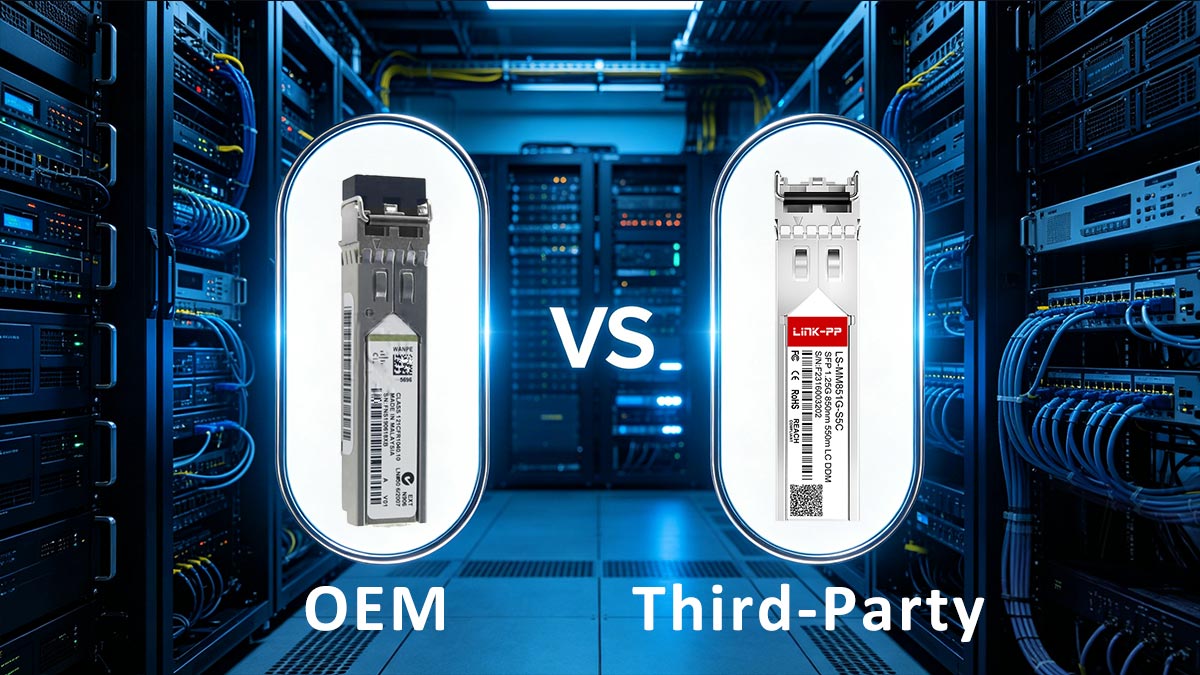
An OEM SFP-1G-SX module costs between $150 and $350, while an equivalent MSA-compliant third-party module costs between $5 and $15. This price gap—often representing a 1,000% to 2,000% markup—is referred to as the "OEM Tax." Because both OEM and third-party transceivers are built using identical optical components from the same global foundries, procurement teams can safely eliminate this tax by sourcing from reputable third-party vendors without compromising Layer 1 network stability.
Demystifying the "OEM Tax" in IT Procurement
When an enterprise issues a purchase order for a Cisco GLC-SX-MMD, an Aruba J4858D, or a Juniper equivalent, they are paying a premium for the brand ecosystem, not for superior optical engineering. Major switch manufacturers do not fabricate their own optical transceivers. Instead, they operate as resellers.
OEMs purchase base MSA-compliant modules from Tier-1 optical foundries (such as Coherent/Finisar, Innolight, or Hisense). The OEM then flashes the EEPROM with proprietary cryptographic signatures, re-labels the hardware, and applies a massive markup. This "OEM Tax" serves two business purposes for the manufacturer: it subsidizes the R&D costs of their core routing/switching hardware, and it enforces vendor lock-in.
Data-Driven Comparison: OEM vs. Third-Party
To illustrate the stark contrast in CapEx (Capital Expenditure), consider the following baseline comparison for a standard 1000BASE-SX deployment.
| Evaluation Metric | OEM Optics (e.g., Cisco, Aruba) | Premium Third-Party Optics |
|---|---|---|
| Average Price (Per Unit) | $150 - $350+ | $5 - $15 |
| Hardware Sourcing | Tier-1 Global Foundries | Tier-1 Global Foundries |
| EEPROM Coding | Proprietary Vendor Lock-in | Custom-coded to mimic OEM signatures |
| Standard Warranty | 1 to 5 Years (tied to SmartNet/Care packs) | Often Lifetime Advanced Replacement |
| CapEx for 100 Units | ~$20,000 - $35,000 | ~$500 - $1,500 |
Addressing the "Voided Warranty" Myth
The most common barrier to adopting third-party optics is the fear of voiding the host switch's warranty. OEMs frequently utilize FUD (Fear, Uncertainty, and Doubt) during the sales cycle to enforce compliance.
Micro-definition: FUD is a manipulative sales strategy utilized to deter customers from buying competing products by disseminating negative, often legally dubious, information.
Legally, in the United States, the Magnuson-Moss Warranty Act prohibits tie-in sales provisions. An OEM cannot legally void your switch chassis warranty simply because you plugged in a third-party SFP-1G-SX module. The OEM can only refuse support for the specific optical link if they can definitively prove that the third-party transceiver caused physical electrical damage to the switch port—an exceedingly rare occurrence with MSA-compliant hardware.
Pros & Cons: Making the Procurement Decision
To eliminate ambiguity for purchasing managers, here is the objective decision-making framework:
Third-Party Optics
- Pro: Reduces optical CapEx by up to 90%, freeing budget for core infrastructure.
- Pro: Identical Layer 1 physical performance and DOM reporting.
- Con: OEM TAC (Technical Assistance Center) support may temporarily refuse to troubleshoot a downed link until an OEM optic is inserted for verification.
OEM Optics
- Pro: Zero friction when opening support tickets with the OEM TAC.
- Con: Exorbitant pricing that cannot be justified for legacy 1GbE connections.
- Con: Rigid supply chains can lead to long lead times during global component shortages.
Procurement Strategy: The industry best practice is to deploy high-quality third-party SFP-1G-SX modules across the network, while keeping a small handful (2 to 5 units) of genuine OEM optics on hand. If a complex support ticket arises, engineers can temporarily swap in the OEM optic to satisfy TAC requirements, securing the 90% cost savings without sacrificing vendor support.
🔵 Best Cost-effective Third-Party SFP-1G-SX Alternatives
The best cost-effective SFP-1G-SX alternatives are MSA-compliant transceivers sourced directly from specialized optical manufacturers that provide in-house EEPROM custom coding. By avoiding gray-market resellers and partnering with direct-to-market brands, enterprise procurement teams can secure rigorously tested, DOM-enabled 1000BASE-SX modules for under $10 per unit, guaranteeing 100% native compatibility with major switch ecosystems.
Once an IT department decides to bypass the OEM tax, the next challenge is navigating the highly saturated third-party optics market. It is critical to understand that not all third-party transceivers are created equal. The market ranges from highly engineered, enterprise-grade modules to unreliable, factory-rejected clones sold on secondary marketplaces.
Avoiding the Gray Market
When searching for "cheap SFP-1G-SX modules," buyers will inevitably encounter secondary marketplaces (like eBay or unvetted Amazon third-party sellers). Purchasing from these sources introduces severe network risks.
Micro-definition: Gray Market Optics refer to unauthorized, often counterfeit or factory-rejected transceivers sold outside of official distribution channels. They typically lack firmware updates, proper thermal testing, and reliable warranty support.
To ensure Layer 1 stability, procurement teams must evaluate third-party alternatives based on strict engineering and supply-chain criteria, rather than just the lowest bottom-line price.
Evaluation Criteria for Enterprise-Grade Alternatives
A reliable third-party optical vendor must demonstrate the following capabilities:
- In-House EEPROM Coding: The vendor must possess the proprietary software and hardware to flash the transceiver's EEPROM with the exact cryptographic signatures required by specific OEM switches (e.g., Cisco, Juniper, Arista, or HPE).
- Comprehensive Switch Testbeds: The vendor should physically test the coded optics on actual OEM host switches to verify DOM/DDM reporting accuracy and ensure no err-disable port errors occur prior to shipping.
- Direct-to-Buyer Economics: The most cost-effective alternatives come from manufacturers that eliminate the reseller middleman, offering factory-direct pricing and scalable bulk discounts.
- Component Traceability: Reliable vendors use premium Tier-1 VCSEL lasers and PIN receivers, ensuring the module meets the full 550-meter distance specification on OM4 fiber without signal degradation.
The Recommended Sourcing Strategy: LINK-PP
For network architects and purchasing managers looking to consolidate their optical supply chain with a trusted, direct-to-market manufacturer, LINK-PP represents the optimal balance of precision engineering and CapEx reduction.
Streamline Your Procurement with LINK-PP
With decades of specialized experience in telecom magnetic components and optical networking, LINK-PP manufactures strict MSA-compliant transceivers designed for high-density enterprise environments. Their SFP-1G-SX modules undergo rigorous thermal and optical testing, ensuring flawless 850nm transmission and highly accurate real-time DOM reporting.
By bypassing traditional distribution channels and purchasing directly through the LINK-PP Official Store, procurement teams gain access to factory-direct pricing, customized EEPROM coding for any major switch brand, and responsive technical support. Whether you need a 10-pack for a localized wiring closet or a 500-unit bulk order for a campus overhaul, the LINK-PP Official Store provides a transparent, low-risk purchasing avenue to maximize your IT budget.
🔵 Cables, Distance, and Compatibility: Technical Validation Before You Buy
Before issuing a purchase order for SFP-1G-SX modules, you must validate three physical layer requirements: Cable Type (must be Multi-Mode Fiber with LC-Duplex connectors), Distance Limitations (max 275m on OM2; max 550m on OM3/OM4), and Host Compatibility (ensuring the module's EEPROM is coded specifically for the target switch brand to prevent port disablement).
Procurement errors at the Physical Layer (Layer 1) are costly. Purchasing the correct optical transceiver is only half the equation; it must be paired with the correct physical infrastructure. The SFP-1G-SX operates under the IEEE 802.3z 1000BASE-SX standard, which dictates strict parameters regarding fiber types and transmission distances. Failing to validate these parameters prior to purchase will result in dark links, CRC errors, and costly RMAs (Return Merchandise Authorizations).
1. Fiber Optic Cable Validation
The 850nm VCSEL laser inside an SFP-1G-SX is engineered exclusively for Multi-Mode Fiber (MMF). If you attempt to connect an SX module to a Single-Mode Fiber (SMF) patch cable (typically yellow), the larger core size mismatch and wavelength incompatibility will cause severe modal dispersion, resulting in a failed link.
Furthermore, the physical connector on the transceiver must match the patch cable. Almost all MSA-compliant SFP-1G-SX modules utilize a Dual LC (LC-Duplex) receptacle.
Validation Checklist for Cables:
- Verify the existing building fiber or patch cables are Multi-Mode (OM1, OM2, OM3, OM4, or OM5).
- Verify the connector type is LC-to-LC (or LC-to-SC if connecting to legacy equipment, though the SFP side must remain LC).
2. Distance Limitations Based on Fiber Grade
The maximum operational distance of an SFP-1G-SX is not a static number; it is entirely dependent on the modal bandwidth (quality) of the Multi-Mode Fiber being used. Legacy fiber plants (OM1/OM2) suffer from higher attenuation and lower bandwidth capacity, severely limiting the reach of the 1Gbps signal.
Below is the IEEE 802.3z standardized distance matrix for 1000BASE-SX optics:
| Fiber Grade (MMF) | Core Size (µm) | Jacket Color (Standard) | Max 1G Distance (SFP-1G-SX) |
|---|---|---|---|
| OM1 (Legacy) | 62.5 / 125 | Orange | 220 meters (722 ft) |
| OM2 (Legacy) | 50 / 125 | Orange | 275 meters (902 ft) |
| OM3 (Laser-Optimized) | 50 / 125 | Aqua | 550 meters (1,804 ft) |
| OM4 / OM5 | 50 / 125 | Magenta / Aqua / Lime Green | 550 meters (1,804 ft) |
Engineering Note: While OM4 and OM5 fiber offer superior bandwidth for 10G/40G/100G applications, they do not extend the distance of a 1G 1000BASE-SX signal beyond the IEEE hard limit of 550 meters.
3. Host Switch Compatibility and Vendor Lock-in
As discussed in the pricing comparison, the physical hardware of a third-party SFP-1G-SX may be identical to an OEM module, but the host switch's Operating System (e.g., Cisco IOS, Aruba-OS, Juniper Junos) acts as a gatekeeper.
When you insert a transceiver, the switch reads the EEPROM data via the I2C interface. If the vendor OUI (Organizationally Unique Identifier) or the cryptographic checksum does not match the switch's internal whitelist, the switch may throw a syslog error (e.g., %PHY-4-UNSUPPORTED_TRANSCEIVER) and place the port into an err-disable state, effectively blocking traffic.
Validation Checklist for Compatibility:
- Specify the Host Brand: When ordering third-party optics (such as from the LINK-PP Official Store), explicitly state the exact make and model of the host switch (e.g., "Cisco Catalyst 9300"). The vendor will flash the module with the correct signature prior to shipping.
- Know Your CLI Overrides: In some environments, network engineers can force the switch to accept generic MSA modules using undocumented Command Line Interface (CLI) commands. For example, in Cisco environments, the commands service unsupported-transceiver and no errdisable detect cause gbic-invalid can be used, though purchasing pre-coded modules is a much safer, zero-touch operational strategy.
🔵 FAQ About SFP-1G-SX Pricing and Selection
1. What is the difference between SFP-1G-SX and SFP-1G-LX?
SFP-1G-SX utilizes an 850nm short-wavelength laser designed exclusively for Multi-Mode Fiber (MMF), supporting maximum distances of 550 meters. SFP-1G-LX utilizes a 1310nm long-wavelength laser designed primarily for Single-Mode Fiber (SMF), supporting distances up to 10 kilometers. SX modules are cheaper to manufacture and are used for intra-building links, while LX modules are used for long-haul, campus-wide, or inter-building connections. You cannot connect an SX module directly to an LX module.
2. How much should an SFP-1G-SX module cost?
For a high-quality, MSA-compliant, third-party SFP-1G-SX module featuring DOM (Digital Optical Monitoring) and custom EEPROM coding, the fair market price is between $5.00 and $15.00 per unit. OEM-branded equivalents (e.g., Cisco, Aruba) typically range from $150 to $350. Buying in bulk (e.g., 50-packs) from direct manufacturers can reduce the per-unit cost closer to the $5.00 threshold.
3. Will using third-party SFP-1G-SX modules void my switch warranty?
No. Under the US Magnuson-Moss Warranty Act (and similar international anti-trust regulations), an equipment manufacturer cannot legally void your hardware warranty simply because you used a third-party optic. The OEM can only refuse support for the specific link issue if they can definitively prove the third-party transceiver caused physical electrical damage to the switch chassis—an incredibly rare scenario with MSA-compliant hardware.
4. What cable do I need for an SFP-1G-SX transceiver?
You require a Multi-Mode Fiber (MMF) patch cable terminated with LC-Duplex (Dual LC) connectors. For optimal performance and to achieve the maximum 550-meter distance, use OM3 (aqua jacket) or OM4 (magenta/aqua jacket) fiber grades. Do not use yellow Single-Mode Fiber (SMF) cables, as the core size mismatch will result in link failure.
5. Can I mix different brands of SFP-1G-SX modules on the same link?
Yes. Because the SFP-1G-SX standard (IEEE 802.3z 1000BASE-SX) is governed by a Multi-Source Agreement (MSA), the optical signaling is universally standardized. You can have a Cisco-branded SX module on one end of the fiber link and a LINK-PP third-party SX module on the other end. As long as both are 850nm multi-mode transceivers, they will negotiate the 1Gbps link flawlessly.
🔵 How to Build a Low-Risk Purchasing Decision
Transitioning from OEM to third-party SFP-1G-SX optics reduces CapEx by up to 90%, but requires a structured validation process to mitigate Layer 1 network risks. A low-risk procurement framework involves five distinct phases: Vendor Vetting, Sample Testing (PoC), CLI Technical Validation, Bulk Approval, and implementing a "Cold Spare" inventory strategy to drastically reduce Mean Time To Recovery (MTTR).
For enterprise procurement teams accustomed to the safety net of OEM purchasing, adopting third-party transceivers represents a shift in operational strategy. To ensure absolute network stability and seamless integration, IT directors should implement the following step-by-step buyer checklist.

The 5-Step SFP-1G-SX Buyer Checklist
Phase 1: Quoting & Vendor Vetting
Do not buy from unknown secondary marketplaces. Request quotes directly from specialized optical manufacturers. Ensure the vendor explicitly guarantees:
- Compliance with the IEEE 802.3z 1000BASE-SX standard.
- Support for SFF-8472 DOM/DDM (Digital Optical Monitoring).
- In-house EEPROM custom coding for your specific switch chassis (e.g., Cisco Catalyst, Juniper EX).
- A lifetime advanced-replacement warranty.
Phase 2: Sample Testing (Proof of Concept)
Before committing to a bulk purchase of 100+ units, execute a low-cost Proof of Concept (PoC). Purchase 2 to 4 sample modules. Deploy them in a non-production lab environment or on low-priority edge access switches rather than the network core.
Phase 3: Technical Validation via CLI
Physical plug-and-play is not enough; you must validate the module's telemetry. Access your switch's Command Line Interface (CLI) and run diagnostic commands (e.g., show interfaces transceiver detail in Cisco IOS). Verify the following:
- The switch natively recognizes the module without generating unsupported transceiver syslog errors.
- The DOM metrics accurately report internal temperature, voltage, and Tx/Rx optical power levels.
- The Tx (Transmit) power falls within the standard -9.5 to -3.0 dBm range for an 850nm VCSEL.
Phase 4: Approval & Bulk Rollout
Once the network engineering team signs off on the PoC, procurement can confidently approve the vendor as a standardized supplier. Issue the purchase order for the bulk rollout, taking advantage of volume-tier pricing to push the per-unit cost below the $10 threshold.
Phase 5: The "Cold Spare" Strategy
Because third-party SFP-1G-SX modules are incredibly cost-effective, you should intentionally over-provision. Purchase 10% to 15% more modules than required for the active deployment. Keep these extra units on-site in the wiring closet as "cold spares." If an optic fails, local IT staff can swap it instantly, resulting in a faster MTTR than waiting for a 4-hour OEM SmartNet replacement.
Final Recommendation Framework
To finalize your SFP-1G-SX procurement strategy for 2025 and beyond, adhere to this definitive decision matrix:
| Network Scenario | Procurement Action | Justification |
|---|---|---|
| Standard Enterprise / Data Center (Multi-Mode Fiber) | Buy Premium Third-Party (e.g., LINK-PP) | Maximizes CapEx savings (~90%) with zero loss in Layer 1 performance or DOM visibility. |
| Strict Government / Defense Contracts | Buy OEM (if legally mandated) | Maintains strict compliance with rigid TAA or proprietary vendor lock-in mandates, despite the extreme cost. |
| Long-Haul / Single-Mode Fiber Environment | DO NOT BUY SFP-1G-SX | SX is incompatible with SMF. You must pivot procurement to the 1310nm SFP-1G-LX standard. |