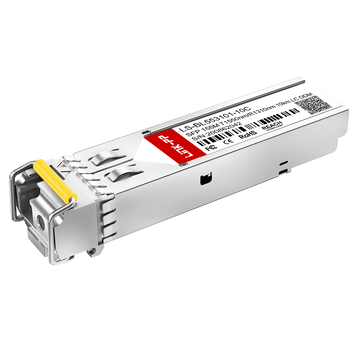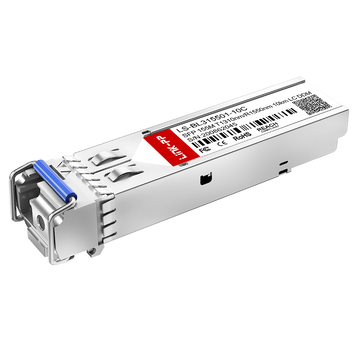
Cisco GLC-FE-100BX-D is a Fast Ethernet 100BASE-BX SFP optical transceiver designed for single-fiber bidirectional transmission, commonly used in enterprise access networks and legacy fiber deployments. It is widely deployed in environments where stable 100Mbps connectivity is still required while fiber resources are limited.
In practical network planning, this module is often selected not only for its technical compatibility with Cisco switching platforms but also for its ability to extend Ethernet connectivity over long distances using a single strand of single-mode fiber. This makes it particularly relevant in cost-sensitive infrastructure scenarios where fiber expansion is restricted or expensive.
From a procurement perspective, demand for Cisco GLC-FE-100BX-D remains steady due to its continued use in existing network architectures, especially in branch offices, industrial systems, and metro access networks. However, availability fluctuations, pricing variations, and the growing presence of compatible alternatives have made sourcing decisions more complex than in the past.
As a result, network engineers and procurement teams increasingly evaluate this module not only from a technical compatibility standpoint but also from the perspective of lifecycle cost, supply reliability, and alternative sourcing strategies.
📋 Understanding Cisco GLC-FE-100BX-D Fundamentals
Cisco GLC-FE-100BX-D is a Fast Ethernet bidirectional SFP transceiver designed to transmit and receive data over a single strand of single-mode fiber. It is primarily used in 100BASE-BX network environments where fiber efficiency and stable 100Mbps connectivity are required.
In practical terms, this module enables two-way communication using different wavelengths in each direction, which reduces fiber infrastructure requirements while maintaining reliable Ethernet transmission over access and distribution networks.
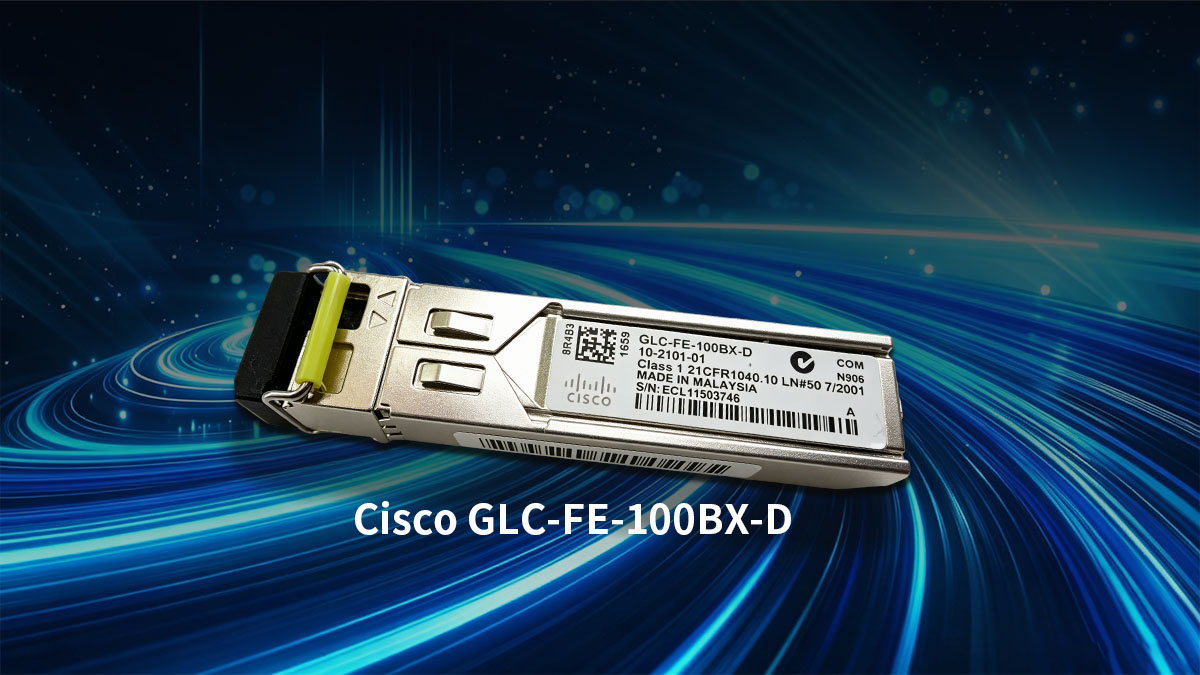
What Is Cisco GLC-FE-100BX-D
Cisco GLC-FE-100BX-D is a 100M SFP transceiver that supports BiDi (bidirectional) transmission over a single fiber strand. It is commonly deployed in Cisco switching environments to extend Fast Ethernet links efficiently.
Its core characteristics can be summarized as follows:
- Supports 100BASE-BX Fast Ethernet standard
- Operates over single-mode fiber using BiDi transmission
- Designed for Cisco-compatible switching platforms
- Used in point-to-point optical access links
This module is typically paired with its complementary counterpart (GLC-FE-100BX-U) to establish a full duplex optical link over a single fiber pair.
Key Technical Specifications
The Cisco GLC-FE-100BX-D module is defined by a set of stable optical and Ethernet parameters that ensure predictable performance in legacy and access network deployments.
Before listing the specifications, it is important to understand that these parameters directly determine compatibility, reach, and deployment feasibility in real-world fiber environments.
| Parameter | Specification |
|---|---|
| Data Rate | 100Mbps (Fast Ethernet) |
| Wavelength | TX: 1550nm / RX: 1310nm |
| Transmission Distance | Up to 10km over SMF |
| Connector Type | LC Simplex |
| Fiber Type | Single-mode fiber (SMF) |
| Power Budget | Typically around 14–16dB range |
These specifications make the module suitable for medium-distance optical links, especially in campus or metro access networks where fiber availability is limited but stable connectivity is required.
Typical Deployment Scenarios
Cisco GLC-FE-100BX-D is primarily deployed in environments where existing infrastructure still relies on Fast Ethernet but requires fiber-based connectivity for extended reach or isolation from copper limitations.
Common deployment scenarios include:
- Enterprise branch interconnection
- Campus edge access networks
- Industrial automation and control systems
- Metro access or last-mile fiber extensions
- Legacy switch upgrades without full network replacement
These use cases typically share a common requirement: maintaining stable 100Mbps connectivity while minimizing fiber usage and infrastructure complexity.
📋 Market Demand and Procurement Drivers
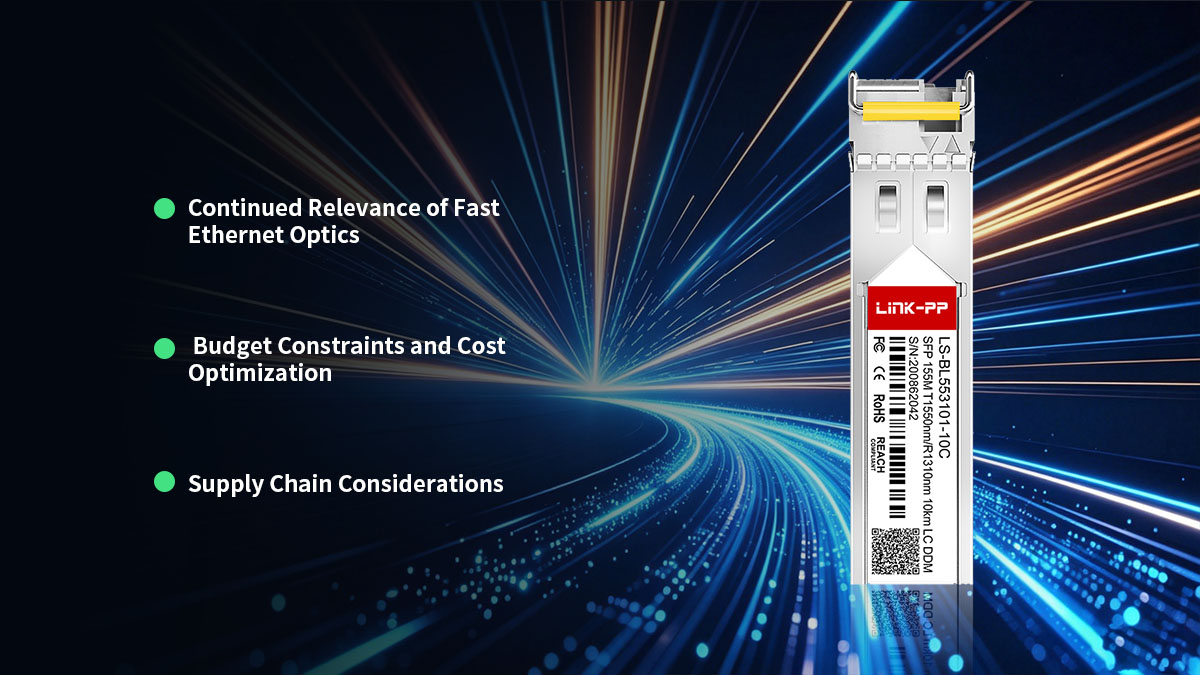
Cisco GLC-FE-100BX-D continues to see steady demand in the market because it remains a practical solution for maintaining Fast Ethernet connectivity in existing fiber infrastructures. Its procurement is often driven less by new network builds and more by ongoing maintenance, expansion, and replacement needs in legacy environments.
Continued Relevance of Fast Ethernet Optics
Cisco GLC-FE-100BX-D remains relevant because a significant portion of installed network infrastructure still operates on 100Mbps links, particularly in access and edge environments.
Key reasons for continued relevance include:
- Large installed base of Fast Ethernet switching equipment
- Stable performance requirements in non-bandwidth-intensive applications
- Cost avoidance associated with full network upgrades
- Long lifecycle of industrial and campus networks
Rather than being replaced immediately, these environments often prioritize maintaining existing performance levels, making compatible optical modules a practical necessity rather than an optional upgrade.
Budget Constraints and Cost Optimization
Procurement decisions for Cisco GLC-FE-100BX-D are heavily influenced by cost considerations, especially in large-scale or distributed deployments.
Before listing key cost drivers, it is important to note that organizations often evaluate this module as part of a broader lifecycle cost strategy rather than a standalone purchase.
Common cost-related factors include:
- Need to minimize capital expenditure in legacy networks
- High volume replacement requirements in aging infrastructure
- Budget allocation preference for higher-layer network upgrades
- Cost differences between original and compatible modules
In many cases, organizations prioritize maintaining functional stability over adopting newer technologies, making cost efficiency a central driver in procurement decisions.
Supply Chain Considerations
Availability and supply chain stability play a significant role in sourcing Cisco GLC-FE-100BX-D modules, especially as product lifecycles mature and distribution channels evolve.
Key supply-related factors include:
- Variability in OEM stock availability across regions
- Longer lead times for original Cisco-branded units
- Dependence on authorized distributors for guaranteed authenticity
- Increasing reliance on third-party manufacturing channels
These conditions often lead procurement teams to evaluate multiple sourcing options to ensure continuity of supply. In many cases, supply predictability becomes just as important as price, particularly in environments where network uptime is critical.
📋 Original vs Compatible Modules: Trade-offs Explained
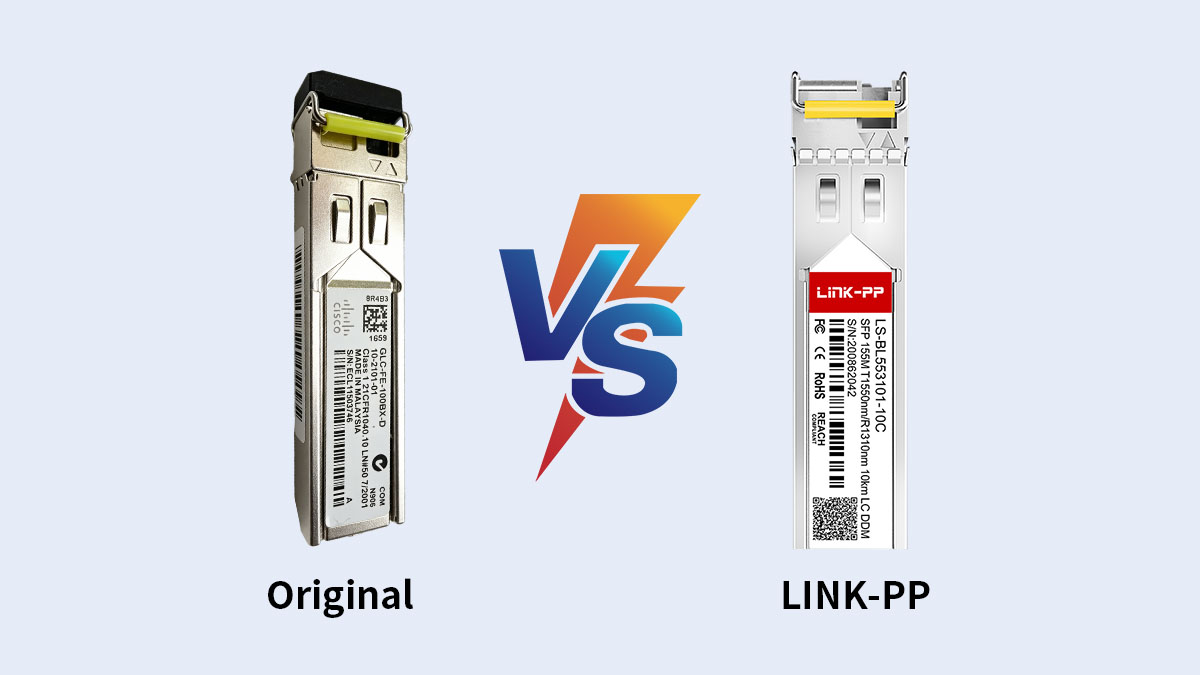
When sourcing Cisco GLC-FE-100BX-D, procurement teams typically face a key decision between original Cisco-branded modules and compatible third-party alternatives. Both options can support similar network functions, but they differ in cost structure, validation level, and long-term operational considerations.
Characteristics of Original Cisco Modules
Original Cisco GLC-FE-100BX-D modules are manufactured and certified under Cisco's official supply chain, ensuring full alignment with Cisco networking environments.
Their primary characteristics include:
- Full compliance with Cisco hardware and firmware ecosystems
- Factory-validated optical performance and interoperability
- Predictable behavior across Cisco switching platforms
- Strong traceability and product authentication
From an operational perspective, these modules are often preferred in environments where strict vendor compliance and long-term stability are prioritized over cost optimization.
However, in real procurement contexts, they also typically involve:
- Higher unit cost compared to alternatives
- Limited flexibility in supply sourcing channels
- Dependency on Cisco's distribution and lifecycle policies
Rise of Compatible Alternatives
Compatible modules designed for Cisco GLC-FE-100BX-D have become widely adopted due to advancements in optical manufacturing and interoperability testing standards.
These alternatives are generally engineered to match Cisco specifications while being produced by third-party optical vendors.
Key characteristics include:
- Functional compatibility with Cisco switching platforms
- Compliance with standard 100BASE-BX optical specifications
- Broader availability across global supply markets
- Cost-efficient positioning for large-scale deployments
In many cases, these modules are programmed or coded to ensure device recognition by Cisco equipment, reducing integration barriers in standard deployments.
Their increasing adoption is largely driven by:
- Pressure to reduce network maintenance costs
- Need for diversified sourcing strategies
- Availability challenges in original module supply chains
Performance and Reliability Comparison
Performance differences between original and compatible Cisco GLC-FE-100BX-D modules are often a central concern during procurement evaluation.
Before presenting comparative factors, it is important to note that both categories are designed to meet the same fundamental optical standards, meaning baseline functionality is generally equivalent when sourced from reputable suppliers.
| Evaluation Dimension | Original Cisco Module | Compatible Module |
|---|---|---|
| Optical Performance | Fully validated by Cisco | Matches standard specifications |
| Device Compatibility | Guaranteed Cisco ecosystem support | Depends on vendor coding quality |
| Quality Consistency | Highly standardized production | Varies by manufacturer |
| Cost Level | Premium pricing | Cost-optimized |
| Supply Availability | Controlled distribution channels | Broader market availability |
From a practical standpoint, the key differences are not usually related to basic link performance but rather to consistency, validation depth, and long-term sourcing stability.
📋 Key Evaluation Criteria for Cisco GLC-FE-100BX-D Alternatives
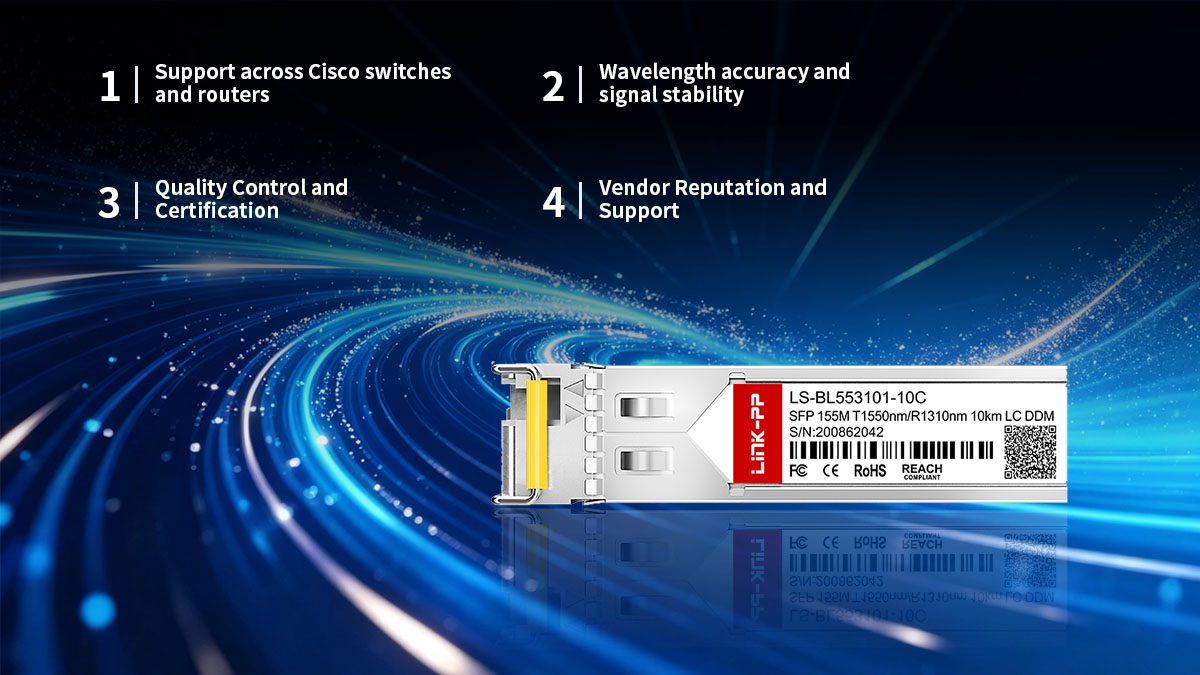
Selecting compatible alternatives for Cisco GLC-FE-100BX-D requires a structured evaluation approach that goes beyond simple price comparison. In real procurement scenarios, the goal is to ensure that alternative modules deliver stable optical performance, seamless device integration, and predictable long-term behavior within Cisco environments.
A well-defined evaluation framework helps reduce deployment risks while maintaining network continuity in Fast Ethernet fiber infrastructures.
Compatibility Assurance
Compatibility is the most critical factor when evaluating alternatives, as Cisco networking equipment may enforce strict transceiver recognition rules depending on platform and firmware.
Key aspects to assess include:
- Verified compatibility with Cisco Fast Ethernet switches and routers
- Correct BiDi pairing behavior (GLC-FE-100BX-D with matching counterpart)
- Vendor coding or EEPROM configuration aligned with Cisco standards
- Real-world interoperability testing in target hardware models
Before listing these criteria in detail, it is important to understand that compatibility is not only about link activation but also about stable long-term recognition under system updates and operational load.
Optical Performance Standards
Optical performance determines whether an alternative module can reliably match the transmission behavior of the original Cisco GLC-FE-100BX-D in real network conditions.
Key performance indicators include:
- Wavelength accuracy for both transmission and reception paths
- Stable output power within defined link budget range
- Consistent receiver sensitivity across operating conditions
- Compliance with 100BASE-BX Fast Ethernet standards
These parameters directly influence signal integrity over distance and ensure that the module performs reliably up to the typical 10km reach specification over single-mode fiber.
Quality Control and Certification
Quality assurance processes play a significant role in distinguishing reliable alternatives from low-grade substitutes in the optical transceiver market.
Before evaluating certification details, it is important to recognize that consistent manufacturing quality directly impacts long-term network stability and failure rates.
Key quality-related factors include:
- ISO-certified manufacturing processes
- Multi-stage optical testing during production
- Compliance with RoHS and environmental standards
- Burn-in testing for early failure detection
- End-of-line performance validation for each unit
Suppliers with structured quality control systems are more likely to deliver consistent batch-to-batch performance, which is especially important in large-scale network deployments.
Vendor Reputation and Support
Beyond technical specifications, vendor reliability is a decisive factor when selecting Cisco GLC-FE-100BX-D alternatives, especially for mission-critical network environments.
Key evaluation points include:
- Proven track record in optical module supply
- Availability of technical support for deployment issues
- Clear warranty policies and replacement procedures
- Transparency in product specification and testing data
- Responsiveness in logistics and post-sales support
In practical sourcing decisions, vendors with strong technical support capabilities often reduce operational risk during installation, troubleshooting, and lifecycle maintenance.
Reliable vendors also tend to provide consistent documentation and compatibility guidance, which is particularly valuable in mixed-network environments where multiple hardware generations coexist.
📋 Pricing Landscape and Cost Structure Analysis
The pricing of Cisco GLC-FE-100BX-D and its compatible alternatives is shaped by a combination of manufacturing costs, brand positioning, distribution channels, and supply availability. In practical procurement environments, pricing is rarely fixed and can vary significantly depending on sourcing strategy and order scale.
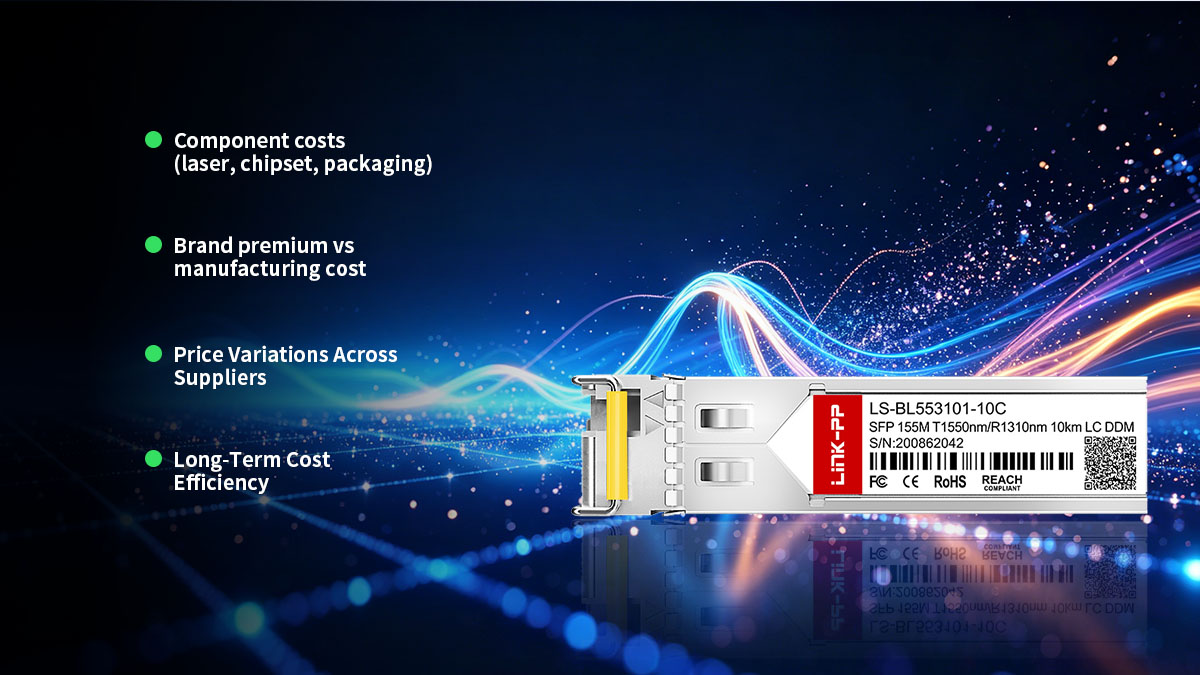
Understanding how pricing is structured helps organizations make more informed decisions that balance upfront cost with long-term operational efficiency.
Factors Influencing Pricing
The price of Cisco GLC-FE-100BX-D modules is determined by multiple upstream and downstream cost components. Before breaking them down, it is important to recognize that optical transceivers are precision components, where small differences in manufacturing processes can significantly impact final pricing.
Key pricing drivers include:
- Optical component costs (laser diodes, photodetectors, ICs)
- Manufacturing precision and calibration processes
- Firmware coding and compatibility validation efforts
- Packaging, testing, and quality assurance overhead
- Brand premium associated with Cisco-certified products
These factors collectively explain why original modules typically maintain a higher price point compared to third-party alternatives, even when core technical specifications are similar.
Price Variations Across Suppliers
Pricing for Cisco GLC-FE-100BX-D can vary widely across different supply channels, especially between OEM distribution and third-party vendors.
Before listing the differences, it is important to note that market fragmentation and regional distribution policies contribute significantly to price inconsistencies.
Common pricing variations include:
- Higher pricing through official Cisco distribution channels
- Moderate pricing via authorized resellers with limited discounts
- Lower pricing from independent optical module manufacturers
- Volume-based discounts for bulk procurement orders
In many cases, pricing differences are influenced more by supply chain structure than by differences in core product functionality, making supplier selection a key cost-control lever.
Long-Term Cost Efficiency
When evaluating Cisco GLC-FE-100BX-D from a lifecycle perspective, total cost of ownership often provides a more accurate picture than unit price alone.
Before outlining cost efficiency factors, it is important to emphasize that network environments typically involve ongoing maintenance, replacements, and scaling requirements.
Key long-term cost considerations include:
- Replacement frequency due to module lifecycle or failure rates
- Maintenance and troubleshooting overhead
- Downtime costs associated with module replacement
- Inventory management and spare part availability
- Scalability costs in multi-site deployments
In practical terms, a lower upfront price does not always translate into lower overall cost if it results in higher replacement frequency or operational disruption.
📋 Deployment Considerations for Seamless Integration
Deploying Cisco GLC-FE-100BX-D in a network requires careful planning to ensure stable link establishment and long-term operational reliability. Although the module is designed for straightforward plug-and-play use in Cisco environments, real-world integration depends heavily on fiber handling, pairing accuracy, and pre-deployment validation.

Installation Best Practices
Proper installation is the foundation of stable performance when working with Cisco GLC-FE-100BX-D modules. Before listing operational steps, it is important to emphasize that BiDi optics are highly sensitive to correct pairing and fiber cleanliness.
Key installation practices include:
- Always use matched BiDi pairs (GLC-FE-100BX-D with its corresponding counterpart, typically BX-U)
- Ensure correct insertion into SFP ports with no physical force
- Maintain proper fiber polarity alignment according to deployment design
- Avoid mixing different wavelength modules on the same link
Additional handling considerations:
- Clean LC connectors before insertion to prevent signal loss
- Avoid bending fiber beyond recommended minimum bend radius
- Use protective dust caps when ports are not in use
- Verify port status LEDs after installation for initial link confirmation
These practices significantly reduce the risk of link instability and help ensure consistent optical performance from the start of deployment.
Compatibility Testing Before Rollout
Compatibility testing is a critical step before large-scale deployment of Cisco GLC-FE-100BX-D modules, especially when using mixed vendor environments or compatible alternatives.
Before outlining testing steps, it is important to recognize that early validation helps prevent costly downtime and troubleshooting in production networks.
Key testing procedures include:
- Lab validation using target Cisco switch models
- Verification of module recognition in device CLI or management interface
- Stress testing under continuous traffic conditions
- Optical power level measurement to confirm link budget compliance
Additional validation points:
- Confirm correct EEPROM identification by the host device
- Test interoperability across multiple switch ports
- Monitor link stability over extended runtime periods
- Validate performance under temperature variation if applicable
A structured testing phase ensures that deployment risks are identified early, reducing the likelihood of unexpected failures in live environments.
Troubleshooting Common Issues
Even with proper installation and testing, deployment issues may occasionally occur due to fiber conditions, configuration mismatches, or hardware incompatibilities.
Before listing common issues, it is important to understand that most problems in BiDi systems are related to physical layer conditions rather than module defects.
Typical issues and corrective actions include:
- No link establishment
- Verify correct BiDi pairing (transmit/receive direction alignment)
- Check fiber polarity and connector seating
- Intermittent connectivity
- Inspect fiber for bends, damage, or contamination
- Re-clean LC connectors and retest
- Low optical signal strength
- Measure link budget and compare with specification
- Replace or test alternative fiber patch cords
- Module not recognized by switch
- Confirm compatibility coding or vendor support
- Re-seat module or test in alternate port
In most cases, systematic verification of fiber quality and module pairing resolves deployment issues without requiring hardware replacement.
📋 Risks to Avoid in Transaction-Oriented Sourcing
When sourcing Cisco GLC-FE-100BX-D in a transaction-driven procurement environment, the focus often shifts toward speed and unit price. While this approach can be efficient, it also introduces several risks that may impact network stability, long-term cost, and operational continuity.
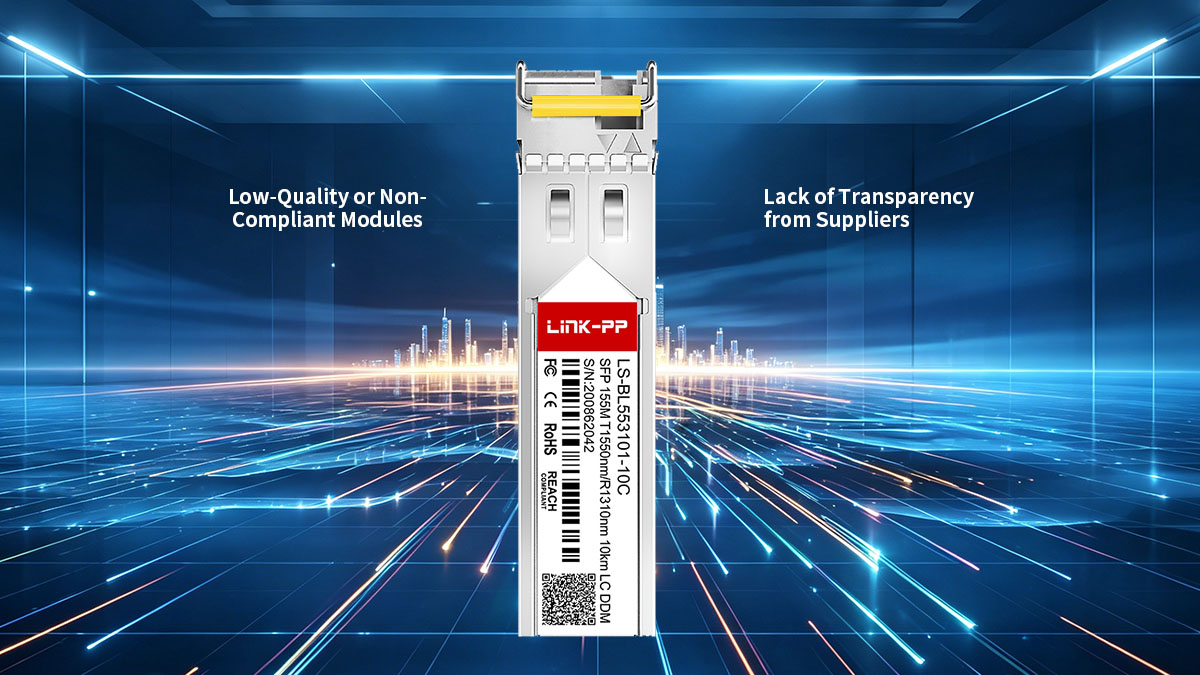
Low-Quality or Non-Compliant Modules
One of the most significant risks in transactional sourcing is the presence of low-quality or non-compliant optical modules that do not fully meet Cisco GLC-FE-100BX-D performance expectations.
Before listing specific risks, it is important to note that optical transceivers operate at the physical layer, where small deviations in performance can lead to major network instability.
Key risks include:
- Inconsistent optical output power affecting link stability
- Poor wavelength accuracy causing interoperability issues
- Insufficient quality control during manufacturing
- Higher-than-normal failure rates under continuous operation
Additional operational consequences:
- Unexpected link drops in production environments
- Increased maintenance and replacement frequency
- Difficulty diagnosing intermittent optical issues
These issues are often not immediately visible during initial installation but become apparent under sustained network load.
Lack of Transparency from Suppliers
Another critical risk in transactional procurement is insufficient transparency regarding product specifications, testing processes, and compatibility validation.
Before detailing these concerns, it is important to recognize that optical module performance depends heavily on accurate technical documentation and verified testing data.
Common transparency issues include:
- Missing or incomplete specification sheets
- Lack of documented compatibility testing with Cisco platforms
- Absence of optical performance test reports
- Unclear manufacturing origin or batch traceability
Operational implications:
- Increased uncertainty during deployment planning
- Higher troubleshooting effort when issues arise
- Reduced confidence in long-term reliability
In enterprise environments, lack of transparency often leads to conservative deployment strategies or additional validation workload before full-scale rollout.
Overlooking Lifecycle and Support
Focusing solely on transactional factors such as price and availability can result in underestimating the importance of lifecycle management and post-deployment support.
Before outlining the risks, it is important to emphasize that optical modules are long-term infrastructure components, not one-time consumables.
Key risks include:
- Limited or no warranty coverage for replacement units
- Lack of technical support for integration or troubleshooting
- Unclear product lifecycle or discontinuation policies
- Difficulty sourcing identical replacements in the future
Additional long-term impacts:
- Inconsistent network behavior due to mixed module batches
- Increased operational complexity in maintaining spare inventory
- Higher total cost of ownership over time
In practice, organizations that neglect lifecycle considerations often face challenges when scaling or maintaining multi-site deployments, where consistency and support availability become critical for operational stability.
📋 Strategic Sourcing Approaches for Cisco GLC-FE-100BX-D
Effective sourcing of Cisco GLC-FE-100BX-D requires more than selecting a single supplier or focusing on short-term availability. In real procurement environments, strategic sourcing is about balancing cost, reliability, and supply continuity while ensuring consistent network performance across deployments.
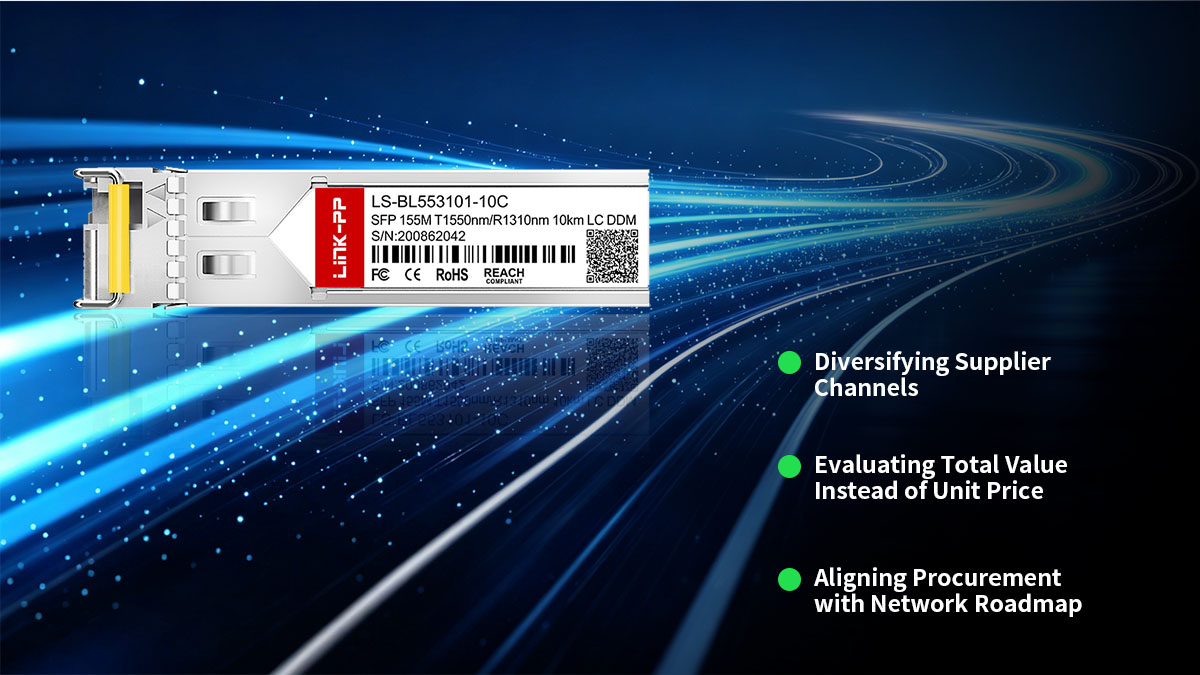
Diversifying Supplier Channels
Relying on a single supply source for Cisco GLC-FE-100BX-D can increase exposure to price fluctuations, lead time delays, and stock shortages. Diversification across multiple qualified channels is a key strategy for maintaining procurement resilience.
Before listing key practices, it is important to understand that diversified sourcing does not mean uncontrolled purchasing, but rather structured qualification of multiple vendors.
Key approaches include:
- Engaging both OEM distribution channels and qualified third-party suppliers
- Maintaining a shortlist of pre-approved vendors for fast procurement cycles
- Sourcing from multiple geographic regions to reduce supply chain dependency
- Establishing backup suppliers for emergency replenishment
Operational benefits:
- Improved supply continuity during shortages
- Reduced dependency on a single pricing structure
- Faster response time for urgent deployment needs
Evaluating Total Value Instead of Unit Price
Focusing only on unit price can lead to suboptimal procurement decisions when sourcing Cisco GLC-FE-100BX-D. A more effective approach is to evaluate total value, which includes performance consistency, reliability, and operational impact.
Before detailing evaluation factors, it is important to recognize that optical modules directly affect network uptime and maintenance workload.
Key value-based evaluation factors include:
- Module reliability and failure rate under real workloads
- Compatibility consistency across Cisco platforms
- Technical support availability during deployment
- Warranty coverage and replacement efficiency
- Impact on network downtime and maintenance cycles
Additional considerations:
- Cost of potential service interruptions
- Labor cost associated with troubleshooting and replacements
- Inventory efficiency and spare part management
This approach ensures that procurement decisions align with long-term operational efficiency rather than short-term cost reduction alone.
Aligning Procurement with Network Roadmap
A strategic sourcing model should be aligned with the broader network evolution plan to ensure that Cisco GLC-FE-100BX-D procurement supports both current operations and future infrastructure changes.
Before outlining alignment practices, it is important to note that many organizations operate hybrid environments where legacy Fast Ethernet systems coexist with higher-speed networks.
Key alignment strategies include:
- Forecasting demand based on planned network expansions or replacements
- Avoiding overstocking of legacy modules in declining infrastructure segments
- Coordinating procurement with upgrade cycles to higher-speed technologies
- Ensuring backward compatibility for transitional network phases
Long-term planning benefits:
- Reduced risk of stranded inventory
- Better capital allocation across network layers
- Smoother transition from legacy to modern optical infrastructure
In practice, aligning procurement with the network roadmap helps organizations avoid reactive purchasing and supports a more predictable, cost-efficient infrastructure lifecycle.
📋 Future Trends in Fast Ethernet Optical Module Sourcing
The sourcing landscape for Cisco GLC-FE-100BX-D and similar Fast Ethernet optical modules is evolving as network infrastructures gradually transition toward higher speeds. However, despite this shift, Fast Ethernet optics continue to play a meaningful role in legacy systems, industrial environments, and cost-sensitive deployments.
Understanding future trends helps procurement teams anticipate supply changes, manage lifecycle risks, and adapt sourcing strategies to long-term infrastructure shifts.
Gradual Transition to Higher Speeds
The most significant trend affecting Cisco GLC-FE-100BX-D sourcing is the steady migration from Fast Ethernet toward Gigabit and multi-gigabit optical solutions. However, this transition is not uniform across all industries.
Before outlining specific impacts, it is important to note that many networks still rely on 100Mbps links due to infrastructure constraints or application requirements.
Key transition dynamics include:
- Replacement of Fast Ethernet links with 1G SFP or 10G SFP+ optics in enterprise cores
- Continued use of 100Mbps links in industrial control and legacy systems
- Gradual phase-out of Fast Ethernet in new deployments
- Extended lifecycle of existing deployed modules due to replacement cost avoidance
Impact on sourcing:
- Reduced long-term demand in greenfield projects
- Increased importance of spare part availability for maintenance
- More selective procurement focused on replacement rather than expansion
Increasing Standardization of Compatible Optics
Another emerging trend is the growing standardization and maturity of compatible optical transceivers designed for Cisco environments, including modules equivalent to GLC-FE-100BX-D.
Before detailing this trend, it is important to recognize that improved manufacturing consistency and interoperability testing have significantly narrowed the performance gap between original and third-party modules in many use cases.
Key developments include:
- Improved adherence to IEEE optical standards across manufacturers
- Wider adoption of compatibility coding for Cisco platforms
- Enhanced quality control and batch-level testing processes
- Increased transparency in specification reporting
Market implications:
- Broader acceptance of compatible modules in enterprise procurement
- Greater competition among optical module vendors
- More predictable performance outcomes from third-party sourcing
This standardization trend is reshaping procurement strategies by increasing supplier options while maintaining acceptable reliability levels.
Digitalization of Procurement Processes
Procurement of Cisco GLC-FE-100BX-D is increasingly influenced by digital sourcing platforms and data-driven decision-making tools. This shift is improving efficiency, transparency, and supplier evaluation accuracy.
Before listing specific changes, it is important to note that digital procurement is not only about automation but also about improving decision quality through better information access.
Key digital transformation trends include:
- Online B2B sourcing platforms for optical modules
- Real-time inventory visibility across multiple suppliers
- Data-driven supplier performance comparison tools
- Automated quotation and procurement workflows
Additional benefits:
- Faster sourcing cycles for urgent replacements
- Improved price transparency across vendors
- Easier benchmarking of compatible and original modules
In practical terms, digitalization is reducing procurement friction while enabling more structured evaluation of Cisco GLC-FE-100BX-D sourcing options across global markets.
📋 Conclusion
Cisco GLC-FE-100BX-D remains an important component in Fast Ethernet fiber deployments, especially in environments where legacy infrastructure, cost control, and stable 100Mbps connectivity are still required. Its role is less about cutting-edge performance and more about sustaining reliable optical links within established Cisco-based networks.
Across the full lifecycle of planning, procurement, and deployment, several key considerations consistently emerge:
- Technical compatibility and correct BiDi pairing are essential for stable operation
- Supply availability and sourcing strategy directly influence deployment continuity
- Pricing varies significantly depending on vendor type and supply channel
- Long-term value depends on reliability, lifecycle support, and maintenance efficiency
- Structured evaluation of alternatives can reduce operational risk and total cost
In practice, organizations that take a strategic approach to sourcing—rather than focusing only on immediate availability—tend to achieve better stability and lower long-term operational disruption in their optical networks.
For procurement teams seeking additional sourcing flexibility and a wider range of compatible optical transceivers for Cisco environments, platforms such as the LINK-PP Official Store can serve as a practical reference point for exploring alternative options that align with both technical requirements and budget considerations.