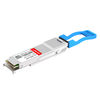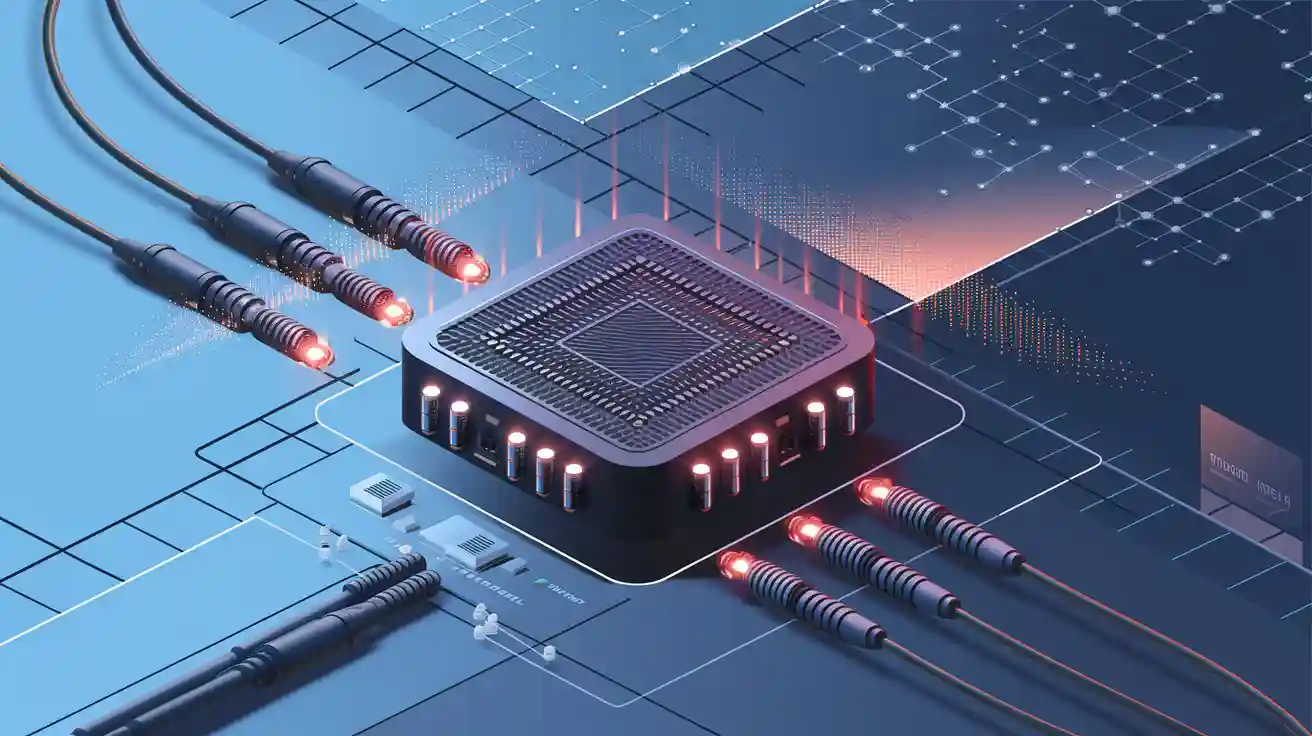
As data centers and enterprise networks continue to scale toward 100G and beyond, one challenge keeps resurfacing: how to upgrade bandwidth without rebuilding the entire fiber infrastructure. This is exactly where 100GBASE BiDi enters the conversation.
100GBASE BiDi (Bidirectional) refers to a class of 100G optical transceivers that transmit and receive signals over the same pair of fibers, allowing network engineers to reuse existing duplex LC multimode fiber (MMF) instead of migrating to more complex MPO-based cabling systems. In simple terms, it offers a practical way to move from 10G or 40G to 100G without doubling fiber count or increasing cabling complexity.
However, there is an important clarification that many users overlook:
100GBASE BiDi is not an official standard defined by the IEEE. Instead, it is an industry-adopted term, commonly used by vendors such as Cisco, to describe bidirectional 100G optical modules designed for short-reach, fiber-efficient deployments.
This distinction matters because it explains why:
- Compatibility can vary between vendors
- Naming conventions are not always consistent
- Procurement decisions require more than just reading a datasheet
From a search and deployment perspective, most users are not just asking “What is 100GBASE BiDi?”—they are trying to answer more practical questions:
- Can I use 100GBASE BiDi with my existing LC fiber?
- Is it better than 100G SR4 or MPO solutions?
- Will it work with my switch platform?
- Is it a cost-saving solution or a long-term limitation?
This guide is designed to answer those exact questions. By the end of this article, you will clearly understand how 100GBASE BiDi works, when to use it, when to avoid it, and how to choose the right module for your network—so you can make a cost-efficient and future-aware 100G upgrade decision.
⭐ What Is 100GBASE BiDi?
100GBASE BiDi refers to a type of 100G optical transceiver that uses bidirectional (BiDi) transmission over a standard duplex LC fiber pair, allowing simultaneous transmit and receive signals on the same two fibers.
Unlike traditional 100G optics that require multiple parallel fibers, 100GBASE BiDi modules are designed to reuse existing duplex multimode fiber (MMF) infrastructure—making them a practical solution for upgrading from 10G or 40G to 100G without changing the cabling system.
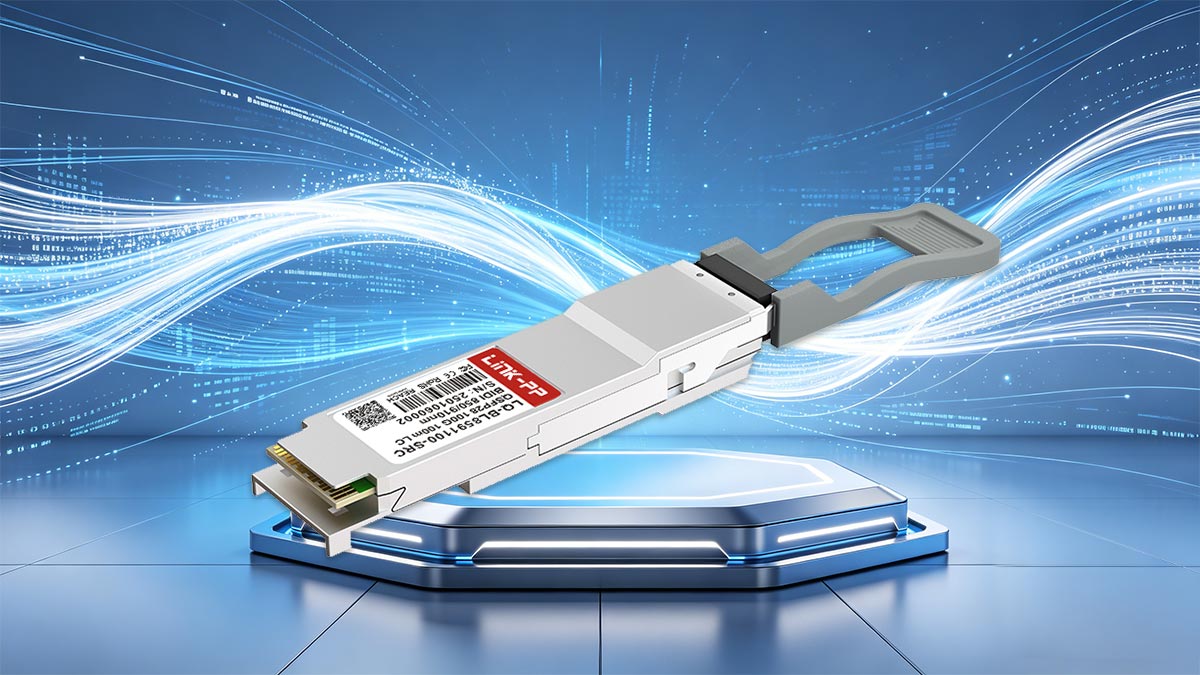
100GBASE BiDi is an industry-adopted term for 100G optical modules that transmit and receive signals bidirectionally over duplex LC fiber, enabling fiber-efficient upgrades without MPO cabling.
In a 100GBASE BiDi module:
- Two different wavelengths are used on each fiber
- Each fiber carries both transmit (Tx) and receive (Rx) signals simultaneously
- Advanced modulation (typically PAM4) enables 100G throughput over fewer optical lanes
This design allows a two-fiber (duplex LC) setup to achieve the same data rate that would otherwise require 8 or more fibers in parallel optics.
Important Clarification: Not an Official Standard
Although widely used, 100GBASE BiDi is not defined by the IEEE.
Instead, it is a vendor-driven, industry-adopted term used by companies like Cisco to describe proprietary implementations of bidirectional 100G transmission.
This means:
- There is no single universal specification
- Compatibility may depend on vendor coding and platform support
- Product names and performance can vary between manufacturers
100GBASE BiDi vs. 100GBASE-SR4 (MPO)
The key difference lies in fiber architecture and deployment model:
- 100GBASE BiDi
- Uses duplex LC fiber (2 fibers)
- Designed for fiber reuse and simplicity
- Ideal for upgrading existing 10G/40G infrastructure
- 100GBASE-SR4
- Uses MPO/MTP connectors (typically 8 fibers)
- Based on parallel optics (4 transmit + 4 receive lanes)
- Requires new cabling in many deployments
In short: BiDi prioritizes fiber efficiency, while SR4 prioritizes standardized parallel performance.
Why This Definition Matters
Understanding what 100GBASE BiDi actually is helps avoid common confusion, such as:
- Assuming it works over a single fiber (it typically uses duplex, not single-strand)
- Treating it as an IEEE standard like SR4 or LR4
- Overlooking compatibility and deployment constraints
This foundational clarity makes it much easier to decide whether 100GBASE BiDi is the right choice for your network upgrade.
⭐ Why Choose 100GBASE BiDi for Cost-Efficient Fiber Deployment?
For most network teams, the decision to use 100GBASE BiDi is not about adopting a new technology—it’s about solving a practical constraint: how to scale bandwidth without rebuilding the fiber plant.
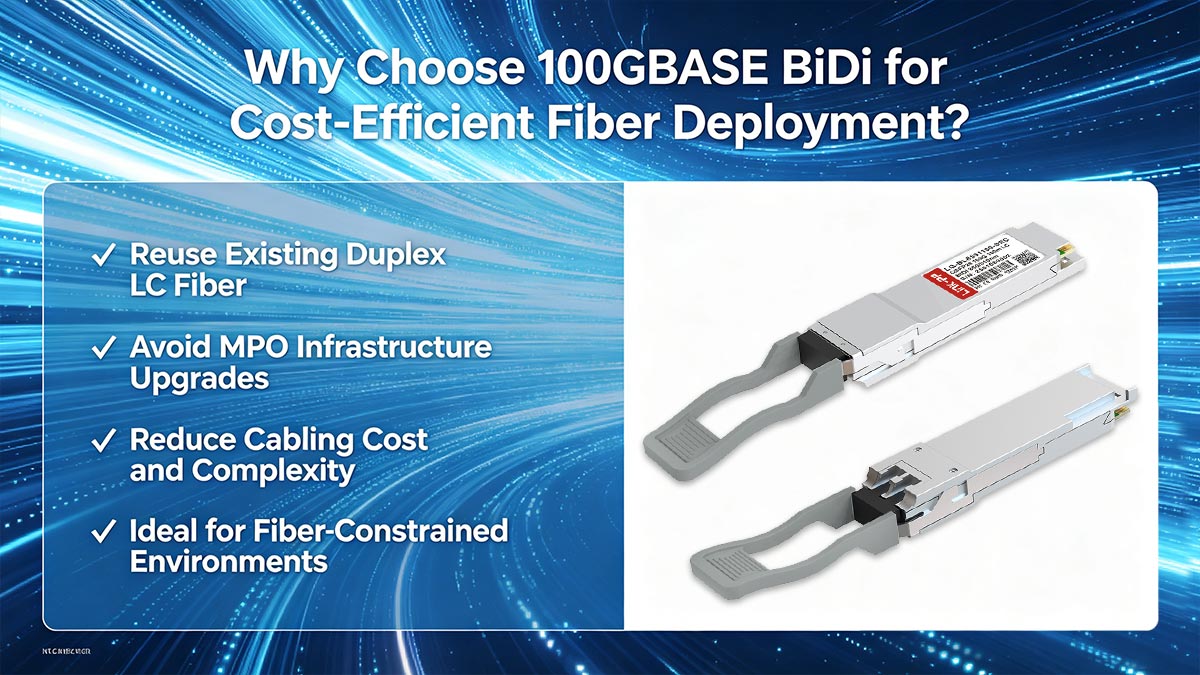
Reuse Existing Duplex LC Fiber
The biggest advantage of 100GBASE BiDi is its ability to run 100G over the same duplex LC fiber used for 10G and 40G.
Instead of replacing cabling, you can:
- Keep your existing OM3/OM4 multimode fiber
- Avoid re-terminating or re-routing fiber
- Upgrade ports simply by swapping transceivers
This directly reduces both deployment time and operational disruption.
Avoid MPO Infrastructure Upgrades
Traditional 100G solutions like SR4 rely on MPO/MTP cabling, which often requires:
- New trunk cables
- New patch panels
- Additional polarity management
By contrast, 100GBASE BiDi eliminates the need for MPO entirely, allowing you to:
- Stay within a familiar LC-based architecture
- Simplify installation and maintenance
- Reduce the risk of cabling errors
For many enterprises, avoiding MPO is a major cost and complexity win.
Reduce Cabling Cost and Complexity
Fiber infrastructure is often one of the most expensive and disruptive parts of a network upgrade. With 100GBASE BiDi:
- Fiber count stays the same (2 fibers instead of 8)
- No need for high-density MPO breakout solutions
- Lower installation labor and fewer components
This translates into:
- Lower CapEx (no new cabling systems)
- Lower OpEx (simpler troubleshooting and management)
In real deployments, the savings often come more from infrastructure reuse than from the module itself.
Ideal for Fiber-Constrained Environments
100GBASE BiDi is especially valuable when fiber resources are limited, such as:
- Data centers with fully utilized fiber trays
- Campus networks with fixed conduit capacity
- Legacy buildings where adding fiber is difficult or expensive
In these scenarios, BiDi allows you to:
- Increase bandwidth without increasing fiber count
- Extend the life of existing infrastructure
- Delay or avoid costly physical upgrades
When BiDi Makes the Most Sense
Choose 100GBASE BiDi when your priority is:
- Maximizing existing fiber investment
- Minimizing deployment complexity
- Achieving fast, cost-efficient 100G upgrades
In short, 100GBASE BiDi is not just a technical option—it’s a strategic choice for networks where fiber efficiency directly impacts cost and scalability.
⭐ How 100GBASE BiDi Works (PAM4 + Duplex LC Explained)
To understand why 100GBASE BiDi is so fiber-efficient, you need to look at how it transmits 100G data over just two fibers instead of eight. The key lies in a combination of wavelength multiplexing and advanced modulation (PAM4).
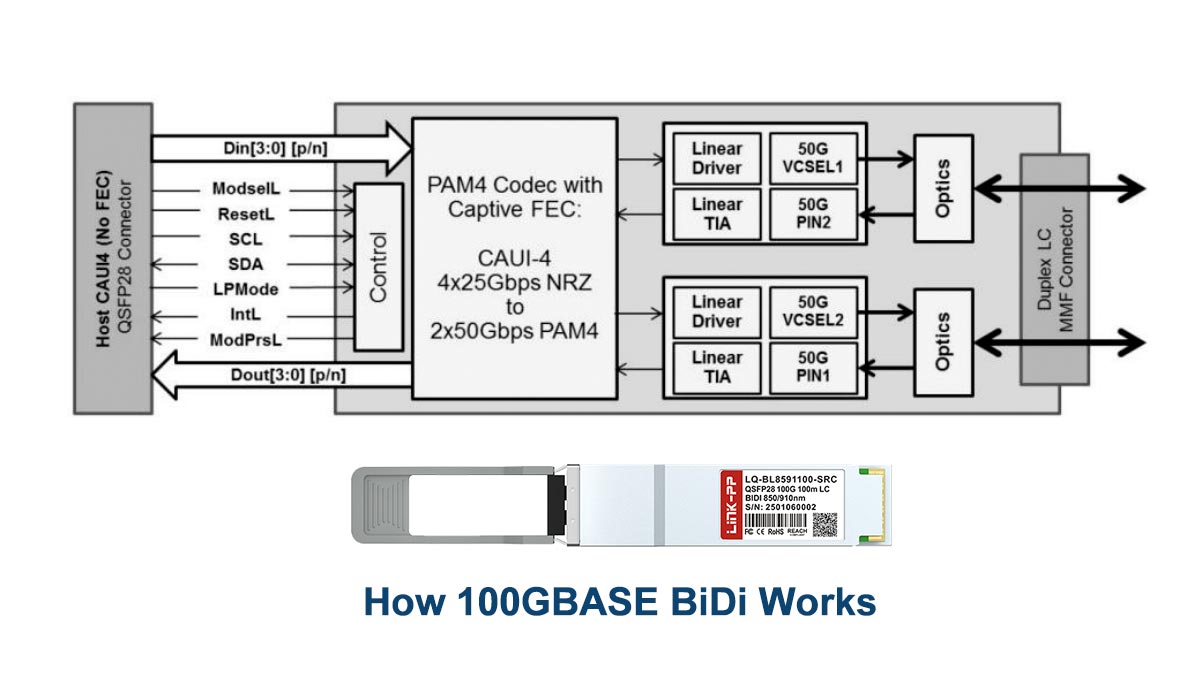
Two Wavelengths Over Two Fibers
In a typical 100GBASE BiDi setup:
- The module uses a duplex LC connection (2 fibers)
- Each fiber carries both transmit (Tx) and receive (Rx) signals simultaneously
- This is achieved by using two different wavelengths per fiber
For example:
- Fiber A: transmits at wavelength λ1, receives at λ2
- Fiber B: transmits at λ2, receives at λ1
This bidirectional design allows full-duplex communication over the same fiber pair, effectively doubling fiber utilization without increasing strand count.
PAM4 Modulation Basics
To push 100G throughput over fewer optical lanes, 100GBASE BiDi typically relies on Pulse Amplitude Modulation 4-level (PAM4).
Instead of sending 1 bit per signal level (as in NRZ), PAM4 uses four distinct signal levels, allowing:
- 2 bits per symbol
- Higher data rates without increasing bandwidth per lane
In simple terms:
- NRZ: 1 bit per signal change
- PAM4: 2 bits per signal change
This enables 100G transmission using fewer optical channels, which is essential for BiDi designs.
Comparison with 4-Lane SR4 Architecture
To see the advantage clearly, compare BiDi with traditional 100GBASE-SR4:
100GBASE BiDi
- Uses 2 fibers (duplex LC)
- Bidirectional transmission on each fiber
- Typically 2 wavelengths + PAM4
- Optimized for fiber reuse
100GBASE-SR4
- Uses 8 fibers (MPO/MTP)
- Parallel optics: 4 transmit + 4 receive lanes
- Each lane runs at ~25G (NRZ)
- Requires new cabling infrastructure
The fundamental difference:
- BiDi = fewer fibers + more complex signaling
- SR4 = more fibers + simpler signaling
Why This Architecture Matters
This design is what makes 100GBASE BiDi attractive—but it also explains some trade-offs:
- Higher reliance on signal processing (PAM4 sensitivity)
- Vendor-specific implementations (no unified standard)
- Strict pairing requirements between modules
At the same time, it delivers a major advantage: 100G performance without increasing fiber count
Simple Takeaway:100GBASE BiDi works by combining bidirectional wavelength transmission with PAM4 modulation to deliver 100G over standard duplex LC fiber—eliminating the need for multi-fiber MPO connections.
This is the core reason it’s widely used for cost-efficient 100G upgrades in existing fiber environments.
⭐ 100GBASE BiDi Compatibility Checklist Before Deployment
Before purchasing a 100GBASE BiDi module, compatibility is the single most important factor that determines whether your deployment will work smoothly—or fail entirely. Because BiDi is vendor-driven rather than standardized, you must verify multiple parameters beyond basic specifications.
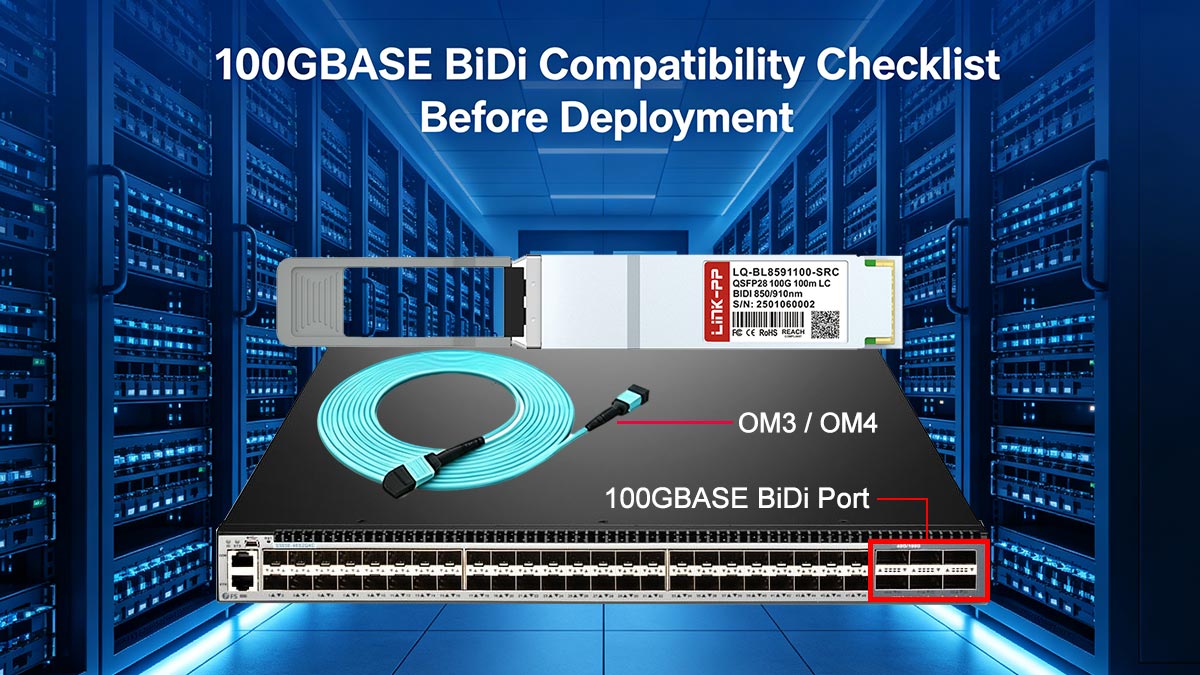
Below is a practical checklist used by network engineers to avoid costly mistakes.
Switch and Vendor Compatibility
Not all switches support 100GBASE BiDi modules, even if they support standard 100G optics.
You should always verify compatibility with your platform vendor, such as:
Key checks:
- Does the switch OS recognize BiDi optics?
- Is specific firmware required?
- Are third-party modules supported or restricted?
Many failures occur because users assume “100G = universal compatibility”—this is not true for BiDi.
Fiber Type: OM3 / OM4 vs. Single-Mode Fiber
Most 100GBASE BiDi modules are designed for multimode fiber (MMF), specifically:
- OM3 (shorter reach)
- OM4 (longer reach, better performance)
Important:
- BiDi modules typically use duplex LC MMF
- They are not interchangeable with single-mode (SMF) optics
Using the wrong fiber type is one of the most common deployment errors.
Distance Limitations
100GBASE BiDi is primarily a short-reach solution.
Typical ranges:
- OM3: ~70 meters
- OM4: ~100 meters
Compared to other 100G optics:
- SR4: similar range but requires MPO
- LR4 / CWDM: much longer reach but higher cost
Always match the module’s optical budget to your actual link distance.
A/B Side Pairing Requirements
Unlike standard SR optics, BiDi modules often require paired wavelengths, meaning:
- One end uses an “A-side” module
- The other end uses a “B-side” module
These modules:
- Operate on complementary wavelengths
- Must be deployed as a matched pair
Installing two identical modules on both ends may result in no link or unstable connection.
Vendor Coding and EEPROM Compatibility
Each optical module contains EEPROM data that identifies it to the switch. This is critical for:
- Device recognition
- Link initialization
- Monitoring and diagnostics
When using third-party modules:
- Ensure proper vendor coding (e.g., Cisco-coded, Juniper-coded)
- Confirm support for Digital Optical Monitoring (DOM)
- Verify compatibility with switch firmware
Incorrect coding can cause:
- Port shutdowns
- “Unsupported transceiver” errors
- Loss of monitoring visibility
Final Pre-Purchase Checklist
Before you buy, confirm:
- ✔ Switch supports 100GBASE BiDi
- ✔ Correct vendor coding is applied
- ✔ Fiber type matches (OM3/OM4 MMF)
- ✔ Distance is within supported range
- ✔ A/B module pairing is correctly planned
100GBASE BiDi compatibility is not plug-and-play by default.
A careful validation process ensures:
- Stable link performance
- Full device compatibility
- Avoidance of costly deployment failures
In real-world procurement, compatibility verification is just as important as price—and often the difference between a successful upgrade and a troubleshooting nightmare.
⭐ 100GBASE BiDi vs SR4, MPO, CWDM, and DWDM
Choosing between 100GBASE BiDi and other 100G optical solutions is not just a technical decision—it’s a trade-off between cost, scalability, and infrastructure constraints. This section breaks down the real differences so you can make the right call based on your network environment.
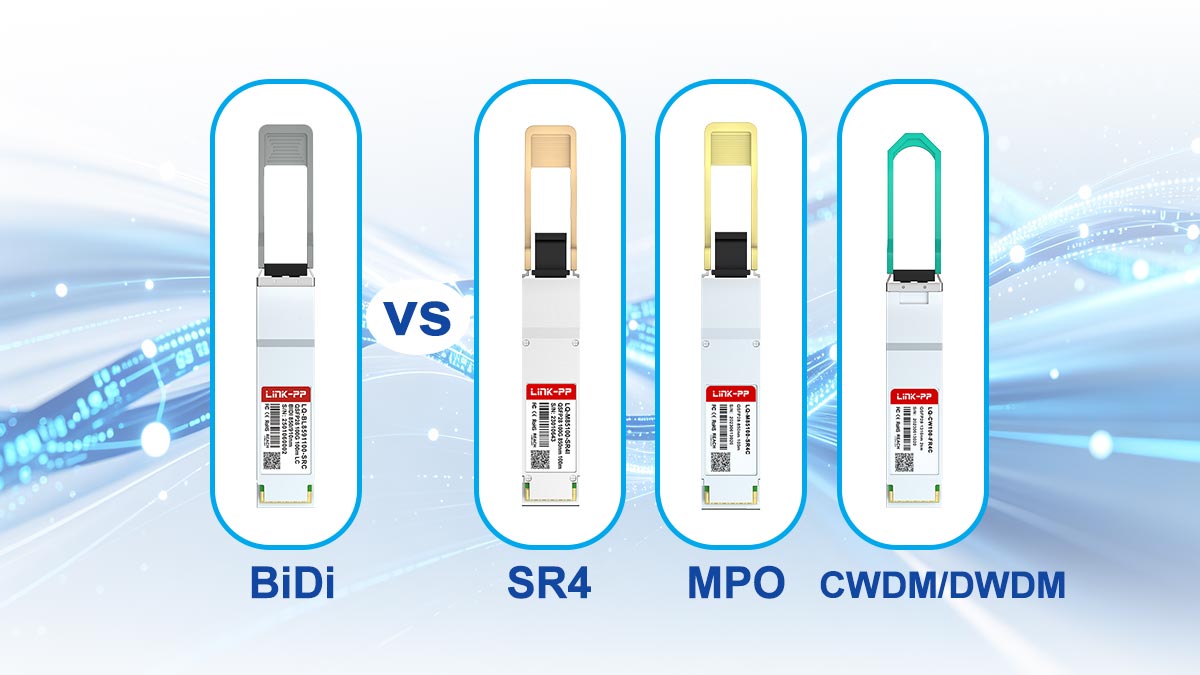
100GBASE BiDi vs. 100GBASE-SR4 (LC vs MPO)
The most common comparison is between BiDi and 100GBASE-SR4.
100GBASE BiDi
- Uses duplex LC fiber (2 fibers)
- Bidirectional transmission (Tx/Rx on same fiber)
- Designed for fiber reuse
- Lower cabling complexity
100GBASE-SR4
- Uses MPO/MTP connectors (8 fibers: 4 Tx + 4 Rx)
- Parallel optics (NRZ signaling)
- Standardized by IEEE
- Requires new cabling in many cases
Key takeaway:
- Choose BiDi if you want to reuse LC fiber
- Choose SR4 if you want a standardized, widely interoperable solution
100GBASE BiDi vs. MPO Infrastructure
Even beyond SR4 optics, the bigger decision is often LC vs MPO cabling architecture.
BiDi (LC-based infrastructure)
- Simple patching and polarity
- Familiar to most network teams
- Easier maintenance and troubleshooting
MPO-based systems
- Higher fiber density
- Supports breakout (e.g., 100G → 4×25G)
- Requires careful polarity and cleaning management
Trade-off:
- BiDi = simplicity and lower operational risk
- MPO = scalability and flexibility for high-density environments
100GBASE BiDi vs. CWDM / DWDM (Scalability vs. Simplicity)
When moving beyond short-reach MMF, the comparison shifts to wavelength-division technologies.
BiDi
- Short reach (MMF, typically ≤100m)
- Lower cost for intra-rack / row connections
- Minimal configuration complexity
CWDM / DWDM
- Based on Coarse Wavelength Division Multiplexing and Dense Wavelength Division Multiplexing
- Long-distance transmission (km-level)
- High scalability (multiple channels per fiber)
- Higher cost and design complexity
Key difference:
- BiDi solves fiber shortage in short reach
- CWDM/DWDM solve capacity and distance at scale
When NOT to Choose 100GBASE BiDi
Despite its advantages, BiDi is not always the best option. Avoid it in the following scenarios:
1. You need long-distance transmission
- BiDi is limited to short-reach MMF
- Use LR4, CWDM, or DWDM instead
2. You require maximum scalability
- BiDi does not support multi-channel expansion like DWDM
- Not ideal for carrier or metro networks
3. You are building a new high-density data center
- MPO-based architectures may offer better long-term flexibility
- Easier migration to 400G/800G in some designs
4. You prioritize strict standardization
- BiDi is not an IEEE-defined standard
- Interoperability depends on vendor implementation
Decision Summary
- Choose 100GBASE BiDi for:
- Fiber-constrained environments
- LC-based infrastructure reuse
- Cost-efficient short-reach upgrades
- Choose SR4 / MPO for:
- Standardized deployments
- High-density data center designs
- Choose CWDM / DWDM for:
- Long-distance transmission
- Scalable wavelength multiplexing
100GBASE BiDi is a practical solution, not a universal one.
It excels when fiber efficiency and cost reduction are the priority—but it becomes limiting when distance, scalability, or strict standardization are required.
The right choice depends less on the technology itself and more on your fiber infrastructure, growth plans, and operational constraints.
Quick Comparison Table: 100GBASE BiDi vs SR4, MPO, CWDM, and DWDM
| Feature |
100GBASE BiDi |
100GBASE-SR4 |
MPO Infrastructure |
CWDM |
DWDM |
| Fiber Type |
MMF (OM3/OM4) |
MMF (OM3/OM4) |
MMF / SMF |
SMF |
SMF |
| Connector |
Duplex LC |
MPO/MTP |
MPO/MTP |
Duplex LC |
Duplex LC |
| Fiber Count |
2 fibers |
8 fibers (4 Tx + 4 Rx) |
8–24+ fibers |
2 fibers |
2 fibers |
| Transmission Method |
BiDi (2 wavelengths) |
Parallel (NRZ lanes) |
Parallel optics |
WDM (coarse) |
WDM (dense) |
| Modulation |
PAM4 |
NRZ |
NRZ / PAM4 |
NRZ / PAM4 |
NRZ / PAM4 |
| Typical Reach |
≤100 m |
≤100 m |
≤100 m (MMF) |
Up to ~10–40 km |
Up to 80 km+ |
| Infrastructure Requirement |
Reuse LC fiber |
Requires MPO cabling |
High-density cabling |
SMF required |
SMF + advanced system |
| Cost (Overall) |
Low–Medium |
Medium |
High (cabling) |
Medium–High |
High |
| Deployment Complexity |
Low |
Medium |
High |
Medium |
High |
| Scalability |
Limited |
Moderate |
High |
High |
Very High |
| Best Use Case |
Fiber-constrained upgrades |
Standard DC links |
High-density DC |
Campus / metro links |
Carrier / long-haul |
- 100GBASE BiDi → Best for cost-efficient upgrades using existing LC fiber
- SR4 / MPO → Better for standardized, high-density data center deployments
- CWDM / DWDM → Designed for long-distance and scalable optical networks
This table helps quickly answer a common decision question: “Should I choose BiDi or move to a different optical architecture?”
⭐ Best Use Cases for 100GBASE BiDi in Real Networks
The real value of 100GBASE BiDi becomes clear when you look at how it’s deployed in production environments. It’s not designed to replace every 100G optical solution—instead, it excels in specific, constraint-driven scenarios where fiber efficiency and cost control are critical.
Data Center Upgrades (10G → 40G → 100G)
One of the most common use cases is upgrading legacy data center networks.
Many existing deployments were built on:
- 10GBASE-SR (duplex LC)
- 40G BiDi or SR solutions
With 100GBASE BiDi, you can:
- Reuse the same duplex LC MMF infrastructure
- Avoid migrating to MPO cabling required by 100GBASE-SR4
- Upgrade bandwidth with minimal physical changes
This makes BiDi ideal for incremental upgrades without service disruption.
Short-Reach Interconnects (Top-of-Rack to End-of-Row)
100GBASE BiDi is optimized for short-distance links, typically within:
- The same rack (intra-rack)
- Adjacent racks
- Row-level aggregation (ToR ↔ EoR)
In these scenarios:
- Distance requirements are well within BiDi limits (≤100m)
- Fiber reuse provides immediate cost savings
- Simpler LC connectivity reduces operational overhead
For high-density server environments, BiDi offers a clean and efficient alternative to MPO-based SR4 links.
Fiber-Limited Environments
In many real-world deployments, fiber availability—not bandwidth—is the limiting factor.
Typical constraints include:
- Fully utilized fiber trays in data centers
- Limited conduit space in buildings
- High cost of pulling new fiber
With 100GBASE BiDi:
- You can deliver 100G using only 2 fibers instead of 8
- Avoid expensive infrastructure expansion
- Extend the usable life of existing cabling
This is where BiDi provides the highest ROI.
Enterprise Campus Networks
Campus environments often combine:
- Legacy multimode fiber
- Medium-distance links
- Budget constraints on infrastructure upgrades
100GBASE BiDi fits well because it:
- Works with existing LC-based MMF networks
- Simplifies deployment for IT teams without deep optical expertise
- Avoids complex MPO polarity and cleaning requirements
Especially in enterprise IT, simplicity and compatibility often outweigh theoretical performance advantages.
When These Use Cases Make the Most Sense
100GBASE BiDi is the right choice when your environment prioritizes:
- Minimal infrastructure change
- Short-reach connectivity
- Cost control over maximum scalability
100GBASE BiDi is not a universal solution—but in the right scenarios, it is the most practical one.
It delivers the most value when:
- You already have duplex LC multimode fiber
- Your distances are short
- Your goal is to upgrade bandwidth without rebuilding the network
In real deployments, that combination is extremely common—making BiDi a highly relevant and widely adopted solution for modern 100G upgrades.
⭐ Common Mistakes When Selecting 100GBASE BiDi Modules
Although 100GBASE BiDi is designed to simplify 100G deployment, many real-world issues come from misunderstanding how it actually works rather than limitations of the technology itself. These mistakes often lead to link failures, compatibility errors, or poor long-term scalability planning.
Below are the most common pitfalls seen in production environments.
Mistake 1: Assuming “BiDi = Single Fiber”
One of the most frequent misunderstandings is assuming that 100GBASE BiDi runs on a single fiber strand.
In reality:
- 100GBASE BiDi typically uses a duplex LC pair (2 fibers)
- Each fiber carries both transmit and receive signals using different wavelengths
Confusion arises because “BiDi” refers to bidirectional transmission, not single-fiber operation.
Impact of this mistake:
- Incorrect fiber planning
- Wrong patching design
- Unexpected link failure during deployment
Mistake 2: Ignoring Compatibility Coding (Vendor Lock Issues)
Many users overlook the importance of vendor coding (EEPROM programming).
Modules must be compatible with switch platforms such as:
Key risks include:
- “Unsupported transceiver” errors
- Disabled ports after insertion
- Missing Digital Optical Monitoring (DOM) support
Even if the optics are technically identical, wrong coding can prevent the module from working entirely.
Mistake 3: Mixing MMF and SMF Incorrectly
100GBASE BiDi is typically designed for multimode fiber (MMF) environments (OM3/OM4), not single-mode fiber (SMF).
Common mistakes include:
- Installing BiDi in SMF-based long-haul networks
- Assuming all 100G optics are interchangeable
- Ignoring fiber type labeling in existing infrastructure
Result:
- Signal loss
- No link establishment
- Misleading troubleshooting efforts
Mistake 4: Choosing BiDi Without Considering Future Scalability
While 100GBASE BiDi is excellent for cost-efficient upgrades, it is not always the best long-term architecture choice.
Limitations include:
- Short-reach focus (typically ≤100m)
- Limited scalability compared to WDM-based solutions
- Dependency on duplex LC architecture
In contrast, technologies like:
- Dense Wavelength Division Multiplexing (DWDM) offer far greater expansion potential.
The mistake happens when teams optimize for short-term cost savings but ignore long-term network growth requirements.
How to Avoid These Mistakes
Before deployment, always validate:
- Fiber type (MMF vs. SMF)
- Correct A/B module pairing
- Vendor compatibility and coding requirements
- Future bandwidth scaling roadmap
Most 100GBASE BiDi failures are not caused by the technology itself—but by incorrect assumptions during planning and procurement.
When properly matched to the environment, BiDi delivers:
- Reliable 100G performance
- Significant fiber savings
- Simplified infrastructure management
Success depends less on the module itself—and more on correct deployment decisions upfront.
⭐ FAQs About 100GBASE BiDi
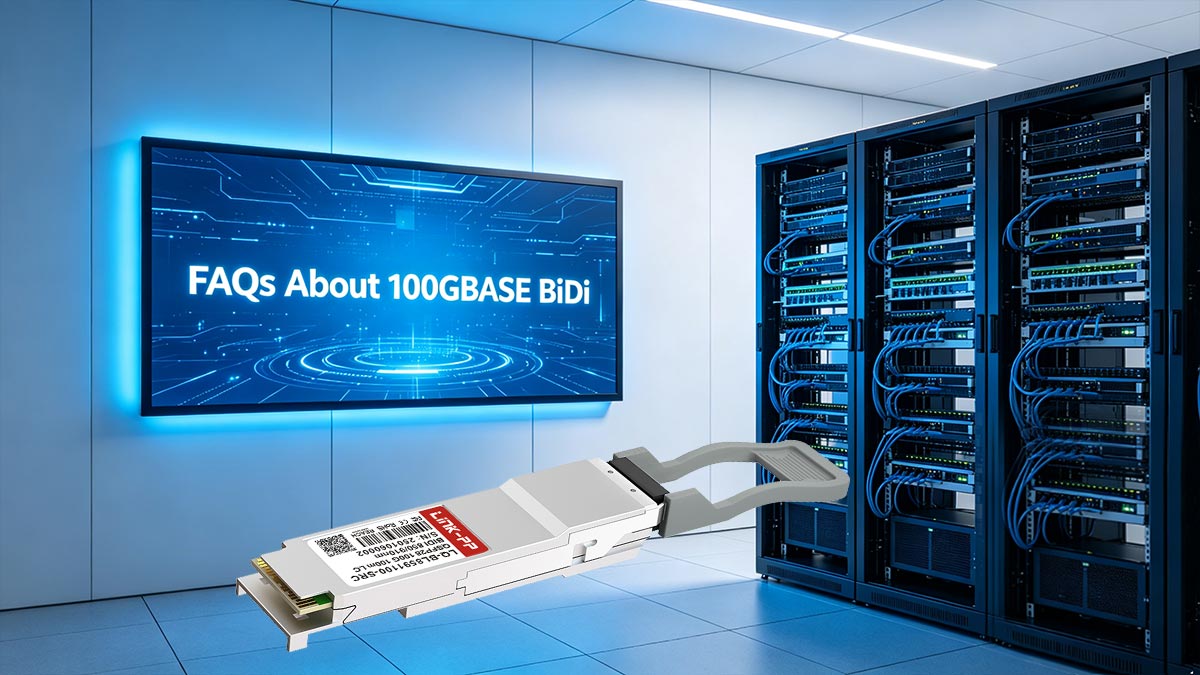
Q1. Is 100GBASE BiDi an IEEE standard?
No. 100GBASE BiDi is not an official standard defined by the IEEE.
It is an industry-adopted term used by optical module vendors to describe 100G bidirectional transceivers based on duplex LC fiber. Different manufacturers may implement BiDi slightly differently, but the underlying concept remains consistent: fiber-efficient 100G transmission using bidirectional wavelengths.
Q2. Does 100GBASE BiDi use single fiber or dual fiber?
100GBASE BiDi typically uses dual-fiber (duplex LC) connections, not single-fiber transmission.
- One fiber carries Tx/Rx using wavelength A
- The second fiber carries Tx/Rx using wavelength B
This allows full bidirectional communication over a two-fiber system, which is why it is often confused with single-fiber solutions.
Q3. Can 100GBASE BiDi replace SR4?
Yes—but only in specific scenarios.
100GBASE BiDi can replace 100GBASE-SR4 when:
- You are using existing duplex LC multimode fiber
- You want to avoid MPO/MTP cabling
- Your link distance is within short-reach limits (typically ≤100m)
However, SR4 may still be preferred for:
- High-density structured cabling designs
- Standardized parallel optic deployments
- Future migration to 400G MPO-based architectures
Q4. Is 100GBASE BiDi compatible with Cisco switches?
Compatibility depends on both the switch model and transceiver coding.
For platforms from Cisco:
- Official Cisco-coded BiDi modules are fully supported
- Third-party modules may work, but require correct EEPROM coding
- Firmware restrictions may block unsupported optics
Always verify compatibility lists before deployment to avoid port disablement or “unsupported transceiver” alerts.
Q5. What distance does 100GBASE BiDi support?
Typical 100GBASE BiDi distance depends on fiber type:
- OM3 multimode fiber: ~70 meters
- OM4 multimode fiber: up to ~100 meters
It is primarily designed for short-reach data center and enterprise interconnects, not long-haul transmission.
For longer distances, technologies like CWDM or DWDM systems are more appropriate.
⭐ How to Choose the Right 100GBASE BiDi Supplier
Selecting a reliable 100GBASE BiDi supplier is just as important as choosing the right optical specification. In real-world procurement, differences in quality, coding, and support can directly impact network stability, compatibility, and long-term maintenance costs.
OEM vs. Third-Party Modules
One of the first decisions is whether to buy OEM optics or third-party compatible modules.
- OEM modules (e.g., from Cisco)
- Fully validated for native platform compatibility
- Higher cost
- Guaranteed firmware and support alignment
- Third-party modules
- Lower cost and flexible sourcing
- Must ensure proper vendor coding
- Quality varies by manufacturer
In practice, many enterprises use a mixed strategy: OEM for critical core links and third-party for access layers.
Compatibility Guarantees
Because 100GBASE BiDi is not an IEEE-defined standard, compatibility is not universal.
A reliable supplier should provide:
- Switch compatibility lists
- Tested platform validation (Cisco, Juniper, etc.)
- Clear A/B side pairing guidance
- Firmware/version matching information
Without these guarantees, deployment risk increases significantly.
Testing and Certification
High-quality suppliers should provide proof of:
- Optical performance testing (power budget, BER testing)
- Temperature stability validation
- Compliance with QSFP28 MSA specifications
- Factory burn-in testing
This ensures modules perform reliably in real data center conditions—not just in lab environments.
Lead Time and Cost Considerations
Procurement decisions are often influenced by:
- Production lead time (especially for large deployments)
- Inventory availability
- Pricing stability for bulk orders
Key balance:
- Lower cost should not compromise compatibility reliability
- Faster delivery should not bypass testing validation
In large-scale upgrades, delays or incompatibility issues can cost far more than the module itself.
After-Sales Support
A professional supplier should offer:
- Technical support for deployment issues
- Replacement or RMA process for failures
- Firmware or coding adjustments if needed
- Long-term availability assurance for scaling projects
This becomes critical when troubleshooting live network environments.
Choosing the Right 100GBASE BiDi Strategy
100GBASE BiDi is most effective when it is deployed as part of a carefully planned procurement strategy—not just a hardware purchase.
It delivers maximum value when you:
- Reuse existing duplex LC infrastructure
- Avoid costly MPO fiber upgrades
- Optimize short-reach 100G deployments
However, long-term success depends on choosing a supplier that ensures compatibility, consistency, and support reliability.
If you are planning a cost-efficient 100G upgrade and need validated BiDi transceivers, you can explore professionally tested options at the LINK-PP Oficial Store for reliable deployment support and compatible optical solutions.