



































As data traffic continues to grow exponentially across cloud computing, AI workloads, and hyperscale data centers, traditional signaling methods are reaching their physical limits. To support higher bandwidth without dramatically increasing cost or power consumption, the industry has shifted toward more efficient modulation techniques. One of the most important breakthroughs in this evolution is 100G PAM4 modulation.
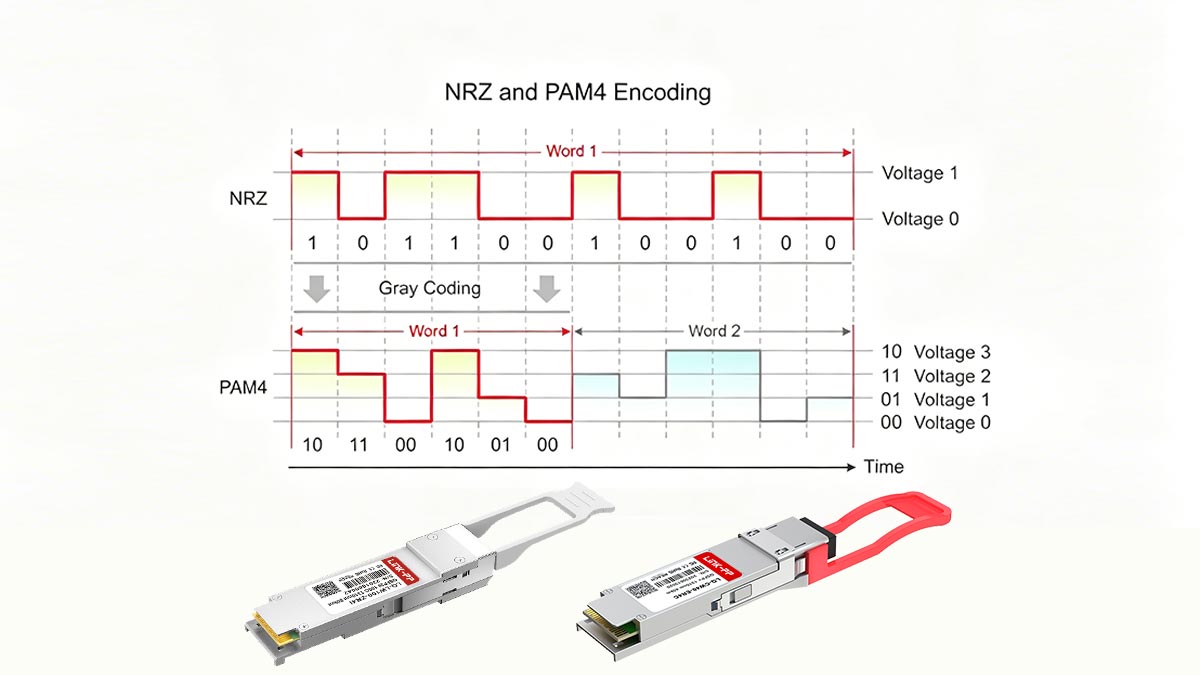
At its core, PAM4 (Pulse Amplitude Modulation with 4 levels) is a signaling method that encodes two bits per symbol instead of one, effectively doubling the data rate within the same bandwidth compared to traditional NRZ (Non-Return-to-Zero) signaling. In 100G optical and electrical interconnects, this efficiency is critical because it allows network designers to achieve higher throughput without requiring proportional increases in lane speed or spectrum.
However, 100G PAM4 is not just about “more speed.” It represents a fundamental shift in how high-speed optical links are engineered. By introducing multiple amplitude levels into the signal, PAM4 enables higher spectral efficiency—but also brings new challenges such as increased noise sensitivity, tighter signal-to-noise requirements, and the need for advanced forward error correction (FEC).
This is why engineers, network architects, and even system integrators frequently ask questions such as:
- What exactly is 100G PAM4 modulation?
- Is PAM4 a digital or analog signal?
- How does it compare with NRZ or coherent modulation?
- Why is it widely adopted in 100G Ethernet and data center optics?
These questions reflect a real industry transition: moving from legacy binary signaling to multi-level modulation schemes that can sustain the explosive demand for cloud-scale connectivity.
In this article, we will break down 100G PAM4 modulation in a clear, structured, and engineering-focused way—explaining how it works, why it is used, and where it fits within modern optical communication systems. Whether you are designing high-speed interconnects or simply trying to understand the technology behind 100G transceivers, this guide will give you a practical and accurate foundation.
🟠 What Is 100G PAM4 Modulation?
100G PAM4 modulation is a signaling technology used in high-speed communication systems to transmit data at 100 gigabits per second (100G) by encoding more information into each signal change.
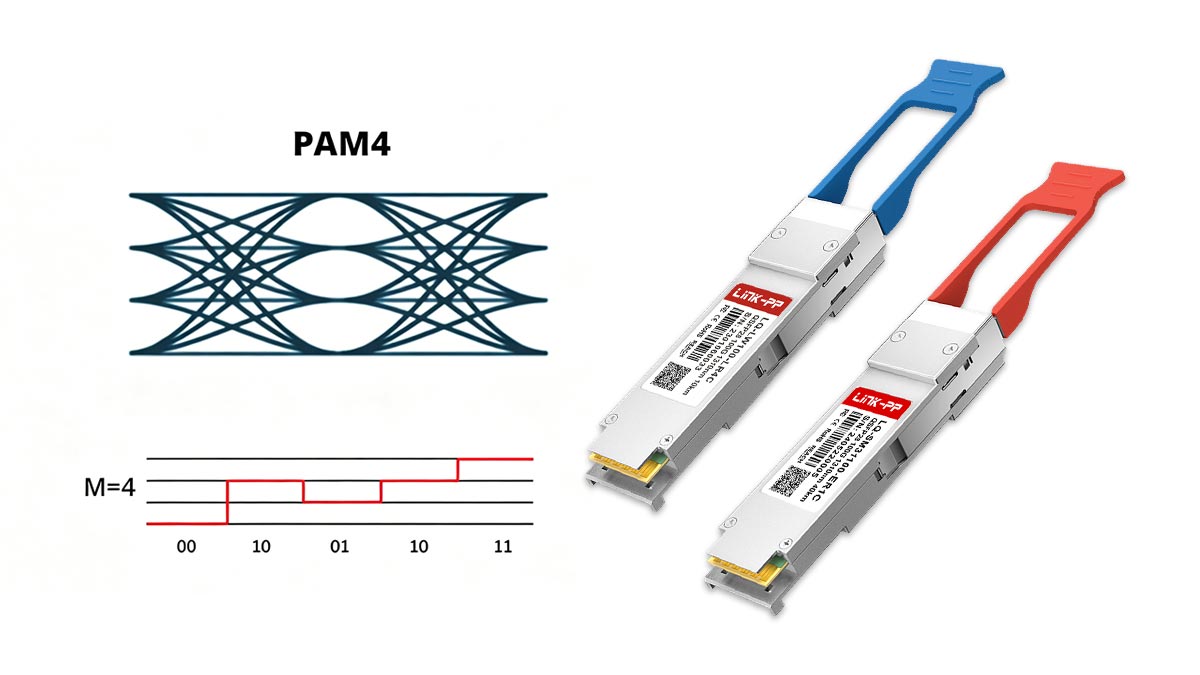
In simple terms, PAM4 (Pulse Amplitude Modulation with 4 levels) works by using four distinct signal levels instead of just two. Traditional signaling methods like NRZ use only:
- Low (0)
- High (1)
PAM4 expands this into four levels, which allows each symbol to represent two bits of data instead of one:
| Signal Level | Binary Value |
|---|---|
| Level 0 | 00 |
| Level 1 | 01 |
| Level 2 | 10 |
| Level 3 | 11 |
Why This Matters for 100G Transmission
The key advantage of PAM4 is doubling data efficiency without doubling bandwidth.
In traditional NRZ systems:
- 1 symbol = 1 bit
- To reach 100G, you need very high signal frequency
With PAM4:
- 1 symbol = 2 bits
- The same data rate can be achieved at half the symbol rate
This is critical for 100G systems because:
- It reduces the required bandwidth on electrical and optical channels
- It enables higher data rates over existing infrastructure
- It lowers cost compared to scaling purely with frequency
A Simple Way to Understand PAM4
Think of it like this:
- NRZ is like a light switch: ON or OFF (2 states)
- PAM4 is like a dimmer switch: four brightness levels (4 states)
By adding more levels, you can send more information with each signal change.
Why the Industry Uses PAM4 for 100G
As data rates increase, simply pushing signals faster (as NRZ does) becomes inefficient and technically challenging due to:
- Signal loss
- Bandwidth limitations
- Power consumption
PAM4 solves this by improving spectral efficiency, meaning more data is transmitted within the same channel capacity.
That’s why PAM4 has become the standard modulation method for modern 100G optical transceivers, especially in:
- Data center interconnects
- High-speed Ethernet links
- Short-reach optical communication systems
In the next section, we’ll explore exactly how PAM4 improves spectral efficiency and why it is essential for scaling beyond 100G networks.
🟠 How 100G PAM4 Improves Spectral Efficiency
The main reason 100G PAM4 modulation is widely adopted is its ability to increase spectral efficiency—that is, transmitting more data within the same bandwidth.
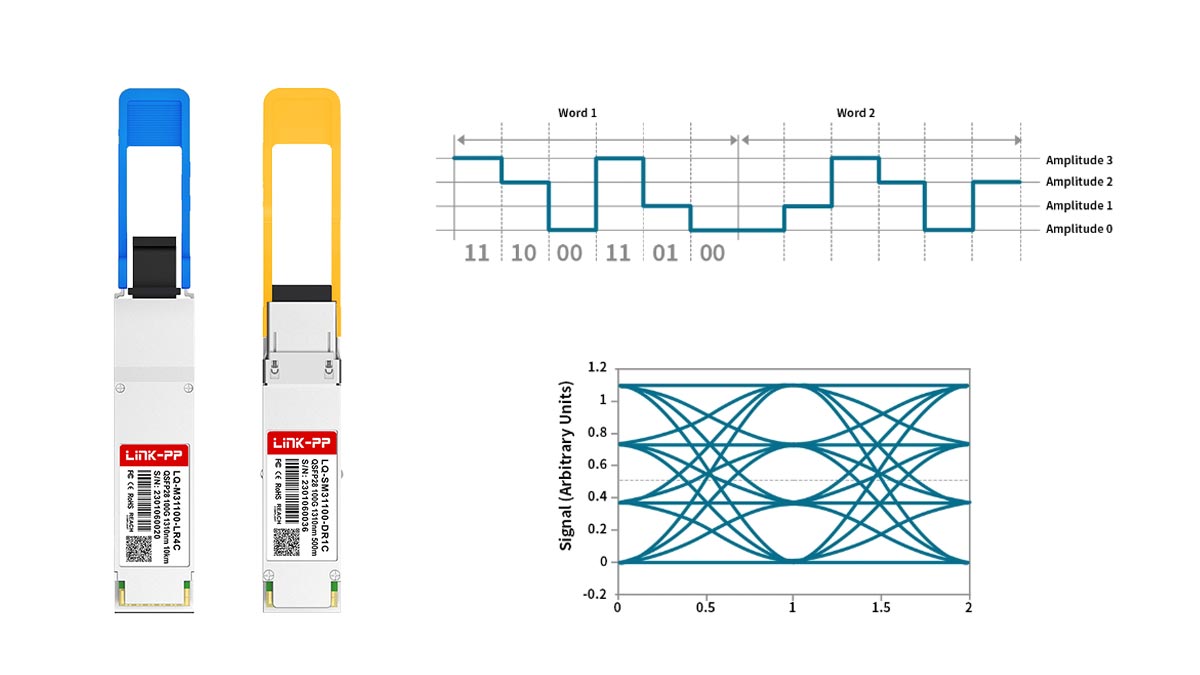
PAM4 vs. NRZ: Bits per Symbol
In traditional NRZ (Non-Return-to-Zero) signaling:
- Each symbol carries 1 bit
- Two signal levels represent binary 0 and 1
In PAM4:
- Each symbol carries 2 bits
- Four signal levels represent 00, 01, 10, 11
This means PAM4 effectively doubles the data capacity per symbol.
What This Means for Bandwidth
Bandwidth is one of the most limited and expensive resources in high-speed communication systems. To achieve higher data rates, you typically need to increase the signal frequency—which introduces challenges like:
- Higher signal loss
- Increased electromagnetic interference
- Greater power consumption
PAM4 solves this by transmitting more bits without increasing the symbol rate proportionally.
For example:
- A 100G NRZ system requires extremely high signaling rates
- A 100G PAM4 system can achieve the same data throughput at roughly half the symbol rate
In practical terms:
- Lower frequency = lower loss
- Lower bandwidth demand = easier channel design
Why This Matters in Real Systems
Modern data center and optical interconnect environments are constrained by:
- PCB trace limitations
- Connector bandwidth
- Optical component performance
By reducing the required bandwidth, PAM4 enables:
- Longer reach over the same medium
- Better compatibility with existing infrastructure
- More scalable system design
The Trade-Off Behind Higher Efficiency
While PAM4 improves spectral efficiency, it also introduces tighter signal margins.
Because the four signal levels are closer together:
- The system becomes more sensitive to noise
- Signal distortion has a greater impact
- Advanced techniques like Forward Error Correction (FEC) are required
Bottom Line: 100G PAM4 improves spectral efficiency by encoding twice as much data per symbol as NRZ, allowing higher data rates without proportionally increasing bandwidth.
This efficiency is what makes PAM4 essential for scaling modern networks—especially as the industry moves beyond 100G toward 400G and 800G optical links.
🟠 Is PAM4 Digital or Analog?
This is one of the most common—and most confusing—questions about 100G PAM4 modulation.
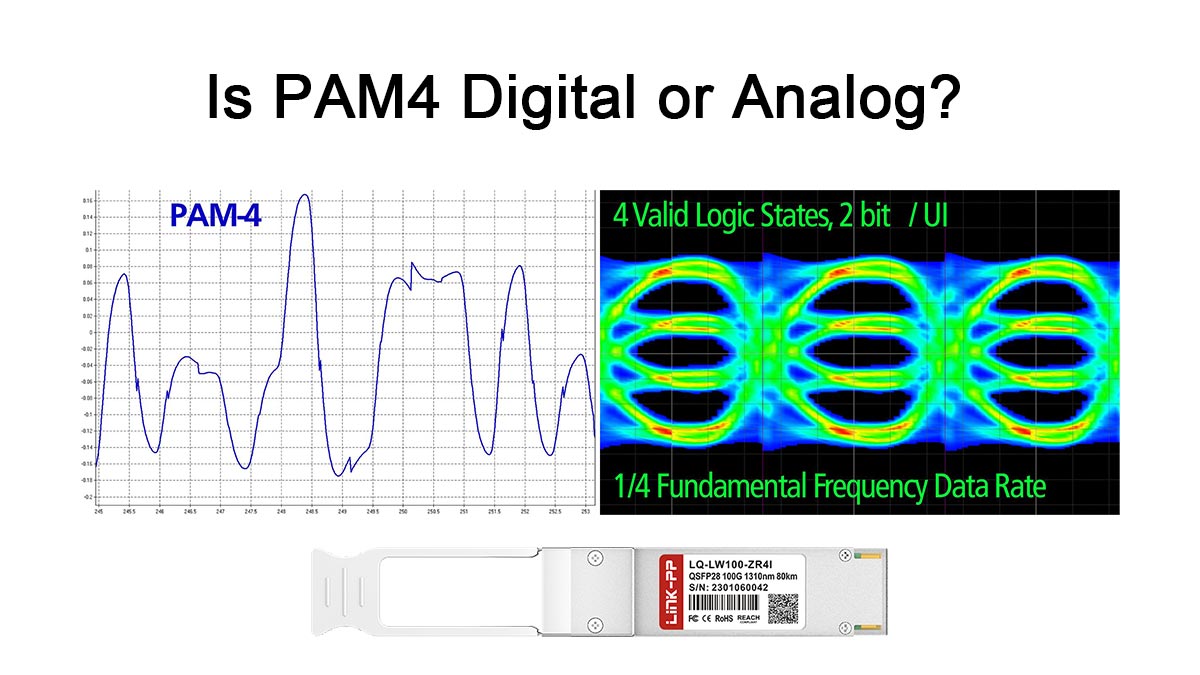
The Short Answer: PAM4 is a digital modulation technique transmitted over an analog signal.
Why This Causes Confusion
At first glance, PAM4 doesn’t “look” digital because it uses four different voltage (or optical power) levels, instead of just two. Many people associate digital signals with only “0” and “1,” so seeing multiple levels makes it seem analog.
But the key difference is this:
- Digital = discrete information (bits)
- Analog = continuous physical signal (voltage, light, etc.)
How PAM4 Actually Works
- The data being transmitted is still digital (binary bits like 00, 01, 10, 11)
- The signal carrying that data is analog (voltage levels or light intensity)
PAM4 simply maps digital data onto four distinct signal levels, instead of two.
You can think of it like this:
- NRZ:
- 2 levels → represent 0 or 1
- PAM4:
- 4 levels → represent 2 bits per symbol
Even though there are more levels, each one still corresponds to a specific, predefined digital value.
A Simple Analogy
Imagine sending messages using hand signals:
- With NRZ, you only have two gestures (like thumbs up or thumbs down)
- With PAM4, you have four gestures, each representing more information
The gestures (physical movement) are analog, but the meaning behind them is still digital.
Why This Distinction Matters
Understanding this helps clarify several important engineering concepts:
- Why PAM4 requires precise signal detection
- Why it is more sensitive to noise than NRZ
- Why advanced processing (like FEC) is necessary
Because the signal levels are closer together, the system must more accurately distinguish between them—making signal integrity more critical.
Bottom Line: PAM4 is digital in terms of data, but analog in terms of how that data is physically transmitted.
This hybrid nature is exactly what allows 100G PAM4 modulation to achieve higher efficiency—while also introducing new design challenges that engineers must carefully manage.
🟠 What Does a 100G PAM4 Signal Look Like?
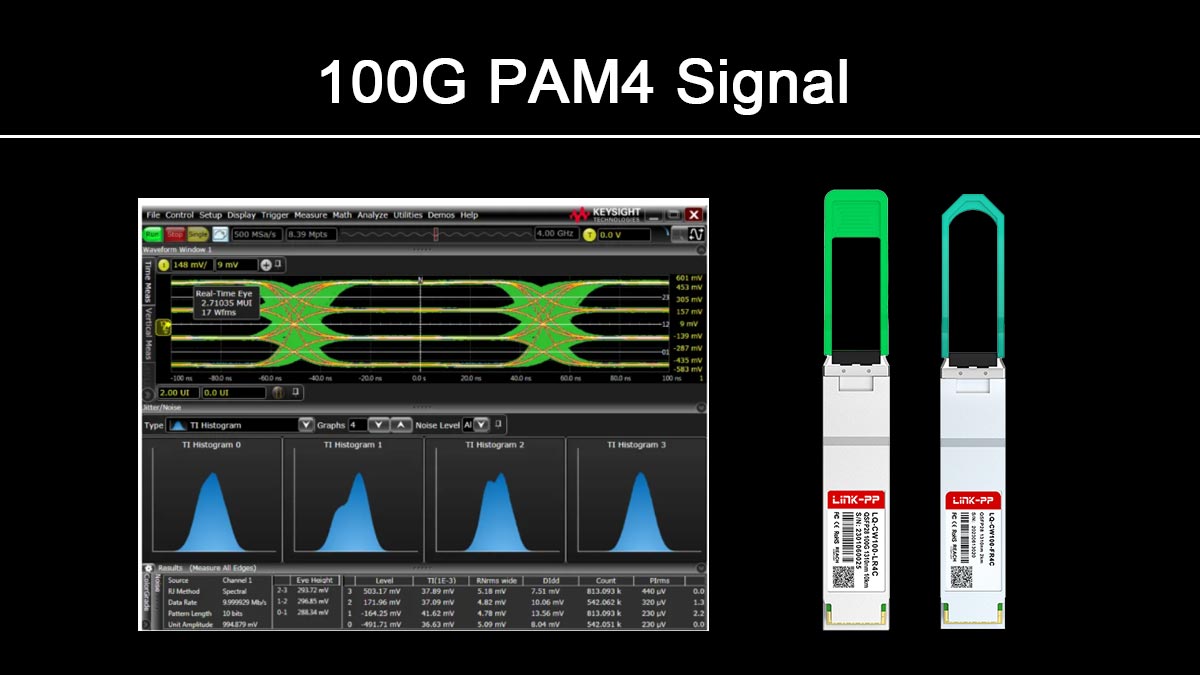
To truly understand 100G PAM4 modulation, it helps to visualize how the signal behaves in the physical world. Unlike traditional binary signals, a PAM4 waveform is multi-level, meaning it carries more information in each signal transition.
1. The PAM4 Waveform: Four Distinct Levels
A PAM4 signal consists of four discrete amplitude levels, typically equally spaced:
- Lowest level → represents 00
- Second level → represents 01
- Third level → represents 10
- Highest level → represents 11
Instead of switching only between “low” and “high” (as in NRZ), the signal transitions among four voltage or optical power levels over time.
Visually, this looks like a step-like waveform with four possible heights, rather than a simple square wave.
2. How the Signal Changes Over Time
As data is transmitted:
- Each symbol interval carries 2 bits
- The signal jumps between levels depending on the encoded data sequence
For example:
- 00 → lowest level
- 11 → highest level
- 01 or 10 → intermediate levels
Because of this, the waveform appears more complex and less “clean” than NRZ, especially at high speeds like 100G.
3. The PAM4 Eye Diagram: Three “Eyes” Instead of One
Engineers often analyze signals using an eye diagram, which overlays multiple bits to evaluate signal quality.
In NRZ:
- There is one eye opening
In PAM4:
- There are three eye openings (because four levels create three gaps)
This is a critical difference:
- Each “eye” represents a decision boundary
- The receiver must correctly distinguish between three thresholds instead of one
4. Why the Eyes Are Smaller
Compared to NRZ, PAM4 eye diagrams have:
- Narrower vertical openings
- Reduced noise margin
This happens because the same total signal range is divided into four levels instead of two.
Result:
- Signals are more sensitive to:
- Noise
- Jitter
- Distortion
5. Electrical vs Optical Representation
In a 100G electrical link:
- The levels are different voltages
In a 100G optical link:
- The levels correspond to different light intensities
The concept remains the same—the signal has four discrete states—but the physical medium changes.
6. Why Visualization Matters
Understanding what a PAM4 signal looks like helps explain:
- Why signal integrity is more challenging
- Why equalization and FEC are required
- Why PAM4 systems need more precise design
Bottom Line: A 100G PAM4 signal is a multi-level waveform with four distinct amplitudes and a three-eye diagram structure. This design enables higher data density—but also requires tighter control over noise and signal quality to ensure reliable transmission.
🟠 100G PAM4 vs. NRZ: Why the Industry Moved Forward
To understand why 100G PAM4 modulation became the industry standard for high-speed links, it’s essential to compare it directly with its predecessor: NRZ (Non-Return-to-Zero) signaling.
For years, NRZ was the foundation of digital communication. But as data rates pushed beyond 25G per lane, its limitations became increasingly difficult—and expensive—to overcome.
♦ 100G PAM4 vs NRZ Comparison Table
| Feature | NRZ (Non-Return-to-Zero) | 100G PAM4 Modulation |
|---|---|---|
| Bits per symbol | 1 bit | 2 bits |
| Signal levels | 2 (0, 1) | 4 (00, 01, 10, 11) |
| Spectral efficiency | Lower | Higher (2× NRZ) |
| Required bandwidth | Higher | Lower |
| Symbol rate (for 100G) | Higher | ~50% of NRZ |
| Noise tolerance | Strong | Lower (more sensitive) |
| Signal complexity | Simple | More complex (3 thresholds) |
| DSP / FEC requirement | Minimal | Required |
| Power efficiency | Lower at high speeds | Better for 100G+ scaling |
| Typical applications | ≤25G / legacy links | 100G, 200G, 400G optics |
♦ Speed and Data Capacity
- NRZ:
- 1 bit per symbol
- Requires higher symbol rates to increase data speed
- PAM4:
- 2 bits per symbol
- Achieves the same data rate at half the symbol rate
Example:
- 100G with NRZ requires extremely high-speed lanes
- 100G with PAM4 can use more manageable signaling rates
Result: PAM4 enables higher throughput without pushing hardware to extreme frequency limits.
♦ Spectral Efficiency
- NRZ: Lower efficiency (1 bit per symbol)
- PAM4: Higher efficiency (2 bits per symbol)
This means PAM4 transmits twice the data within the same bandwidth, making it far more suitable for modern bandwidth-constrained environments.
♦ Hardware Complexity
- NRZ:
- Simpler transmitter and receiver design
- Easier signal detection (only one threshold)
- PAM4:
- More complex signal processing
- Requires three decision thresholds
- Needs advanced DSP and equalization
PAM4 systems also depend heavily on:
- Forward Error Correction (FEC)
- Signal conditioning techniques
Result: PAM4 increases system complexity, but this is offset by its efficiency gains.
♦ Noise Tolerance and Signal Integrity
- NRZ:
- Larger voltage swing between 0 and 1
- Better noise margin
- More robust in noisy environments
- PAM4:
- Smaller spacing between signal levels
- More sensitive to noise, jitter, and distortion
This is one of PAM4’s biggest trade-offs:
- Higher efficiency comes at the cost of reduced signal margin
♦ Power and Cost Efficiency
- NRZ scaling challenges:
- Higher speeds require more power
- Increased hardware cost due to high-frequency design
- PAM4 advantage:
- Lower symbol rate reduces bandwidth pressure
- Enables reuse of existing channels and components
Result: PAM4 often provides a more cost-effective path to 100G and beyond, especially in dense data center environments.
♦ Why the Industry Chose PAM4
The transition from NRZ to PAM4 wasn’t just about performance—it was about practical scalability.
As networks evolved toward:
- QSFP28 100G
- QSFP56 200G
- QSFP-DD 400G
- OSFP 800G
NRZ became increasingly inefficient and difficult to scale.
PAM4, despite its added complexity, offered a balanced solution:
- Higher data density
- Acceptable hardware complexity (with DSP support)
- Better alignment with existing infrastructure limits
The industry moved from NRZ to PAM4 because PAM4 delivers twice the data efficiency within the same bandwidth—making it the most practical solution for scaling beyond 100G.
While it introduces more complexity and tighter signal requirements, PAM4 enables modern high-speed networks to grow without hitting fundamental physical limits.
🟠 100G PAM4 vs. Coherent Modulation
As networks scale beyond 100G, engineers often compare PAM4 modulation with coherent modulation. While both enable high data rates, they are designed for very different use cases and operate on fundamentally different principles.
1. Core Difference: Simplicity vs Advanced Signal Processing
- 100G PAM4
- Uses amplitude levels only (4 signal levels)
- Direct detection (simpler receiver design)
- Lower cost and power consumption
- Coherent modulation
- Uses both amplitude and phase (e.g., QPSK, QAM)
- Requires a local oscillator laser + DSP
- Much more complex but highly capable
In simple terms:
- PAM4 = efficient and simple
- Coherent = powerful and sophisticated
2. Distance and Reach
This is the most important distinction.
- PAM4 (Direct Detect)
- Optimized for short to medium reach
- Typical use:
- Data centers
- Intra-DC links
- Campus networks
- Distance range:
- A few meters to ~2 km (sometimes up to 10 km depending on design)
- Coherent Optics
- Designed for long-haul transmission
- Typical use:
- Metro networks
- Backbone infrastructure
- Subsea cables
- Distance range:
- Tens to thousands of kilometers
Rule of thumb:
- Short reach → PAM4
- Long reach → Coherent
3. Spectral Efficiency and Capacity
- PAM4
- Improves efficiency compared to NRZ
- Limited to amplitude modulation
- Suitable for cost-sensitive, high-volume deployments
- Coherent
- Extremely high spectral efficiency
- Uses advanced modulation formats (e.g., 16QAM, 64QAM)
- Maximizes fiber capacity over long distances
4. Cost, Power, and Deployment Complexity
- PAM4 Advantages
- Lower cost transceivers
- Lower power consumption
- Easier integration into switches and servers
- Coherent Trade-offs
- Higher cost optical transceiver modules
- Higher power usage
- More complex system design and tuning
This is why PAM4 dominates data center environments, where cost per port and power density are critical.
5. Why Both Technologies Coexist
PAM4 and coherent modulation are not competitors—they are complementary technologies.
- PAM4 is ideal for:
- High-density, short-reach links
- Scaling Ethernet speeds (100G → 400G → 800G)
- Coherent is essential for:
- Long-distance transport
- Maximizing fiber capacity across networks
Modern network architectures typically use:
- PAM4 inside the data center
- Coherent optics between data centers
Quick Comparison Table
| Feature | 100G PAM4 | Coherent Modulation |
|---|---|---|
| Modulation type | Amplitude (4 levels) | Amplitude + Phase |
| Detection method | Direct detect | Coherent detection |
| Complexity | Moderate | High |
| Typical reach | Short (≤10 km) | Long (100 km–1000+ km) |
| Cost | Lower | Higher |
| Power consumption | Lower | Higher |
| Use case | Data centers, Ethernet | Metro, long-haul networks |
100G PAM4 is the best choice for short-reach, high-density, cost-sensitive applications, while coherent modulation is essential for long-distance, high-capacity transmission.
Choosing between them depends primarily on distance, cost, and network architecture—not just raw performance.
🟠 Key Advantages and Trade-Offs of 100G PAM4
100G PAM4 modulation is widely adopted because it strikes a practical balance between performance and scalability. However, its benefits come with real engineering trade-offs that must be carefully managed in system design.
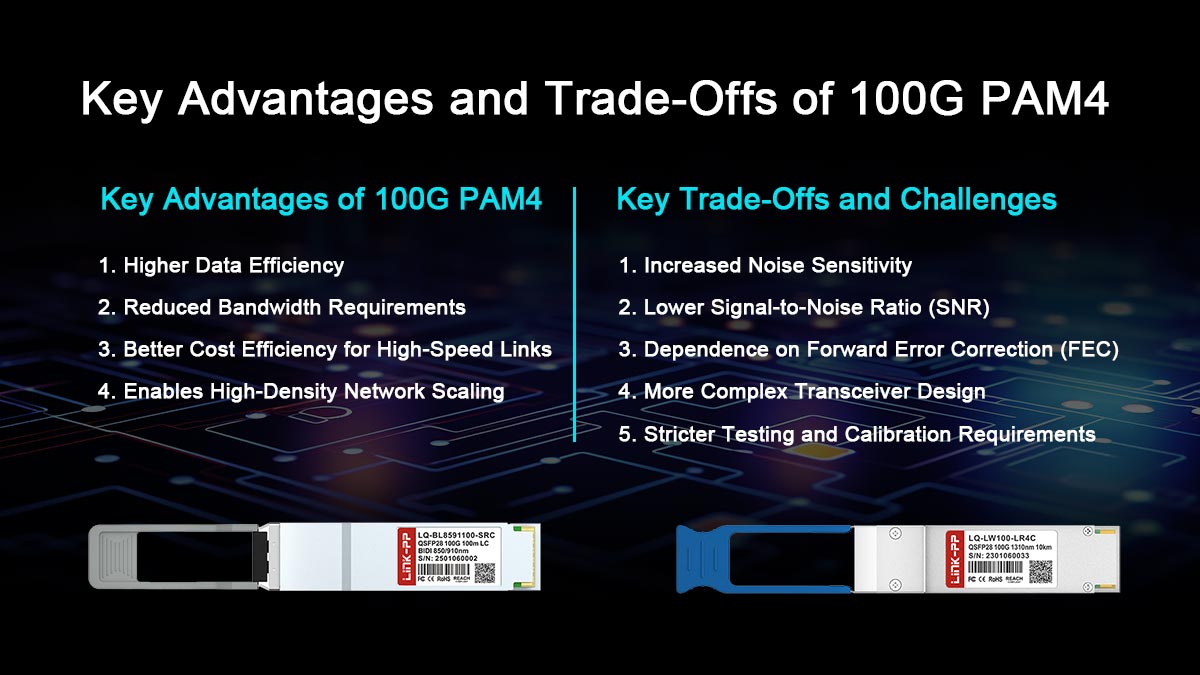
Key Advantages of 100G PAM4
1. Higher Data Efficiency
PAM4 encodes 2 bits per symbol, doubling the data capacity compared to NRZ without doubling the bandwidth.
Result:
- Enables 100G transmission using fewer or slower lanes
- Supports scaling to 200G, 400G, and beyond
2. Reduced Bandwidth Requirements
Because PAM4 achieves the same data rate at a lower symbol rate, it reduces pressure on:
- PCB traces
- Connectors
- Optical components
This makes it easier to deploy high-speed links using existing infrastructure.
3. Better Cost Efficiency for High-Speed Links
Instead of pushing hardware to extreme frequencies (as NRZ would require), PAM4 allows:
- More economical transceiver design
- Lower cost per bit at 100G+ speeds
This is especially valuable in data center environments, where port density and cost scale rapidly.
4. Enables High-Density Network Scaling
PAM4 is the foundation for modern Ethernet evolution:
- 100G → 400G → 800G
It allows network operators to increase capacity without proportional increases in physical resources.
Key Trade-Offs and Challenges
1. Increased Noise Sensitivity
Because PAM4 divides the signal into four closely spaced levels, the margin between them is smaller.
Result:
- More sensitive to:
- Noise
- Jitter
- Signal distortion
This makes signal integrity a critical design factor.
2. Lower Signal-to-Noise Ratio (SNR)
Compared to NRZ, PAM4 inherently has a lower effective SNR.
Practical impact:
- Higher bit error rates (BER) without correction
- Greater reliance on advanced signal processing
3. Dependence on Forward Error Correction (FEC)
To maintain reliable transmission, PAM4 systems almost always require FEC.
FEC helps:
- Detect and correct errors
- Improve link reliability
But it also introduces:
- Additional latency
- Extra processing overhead
4. More Complex Transceiver Design
PAM4 systems require:
- Multiple decision thresholds (instead of one)
- Advanced DSP (Digital Signal Processing)
- Equalization techniques
This increases:
- Design complexity
- Power consumption (in some cases)
5. Stricter Testing and Calibration Requirements
Because of tighter signal margins, PAM4 links require:
- More precise tuning
- Better manufacturing control
- Advanced testing methods (e.g., eye diagram analysis)
Quick Summary Table
| Aspect | Advantage | Trade-Off |
|---|---|---|
| Data rate | 2× efficiency vs NRZ | Higher error sensitivity |
| Bandwidth usage | Lower requirement | Tighter signal margins |
| Cost | Lower cost per bit at scale | More complex hardware |
| Reliability | Improved with FEC | FEC adds latency and overhead |
| Scalability | Enables 100G+ evolution | Requires advanced system design |
100G PAM4 delivers the efficiency needed for modern high-speed networks, but achieving reliable performance requires careful management of noise, signal integrity, and error correction.
In other words:
- PAM4 makes high-speed communication possible and scalable
- Engineering expertise makes it stable and reliable
🟠 Where 100G PAM4 Is Used in Real Networks
100G PAM4 modulation is not just a theoretical improvement—it is already deeply embedded in modern network infrastructure. Its ability to deliver higher data rates within limited bandwidth makes it the preferred choice for short-reach, high-density, and cost-sensitive environments.
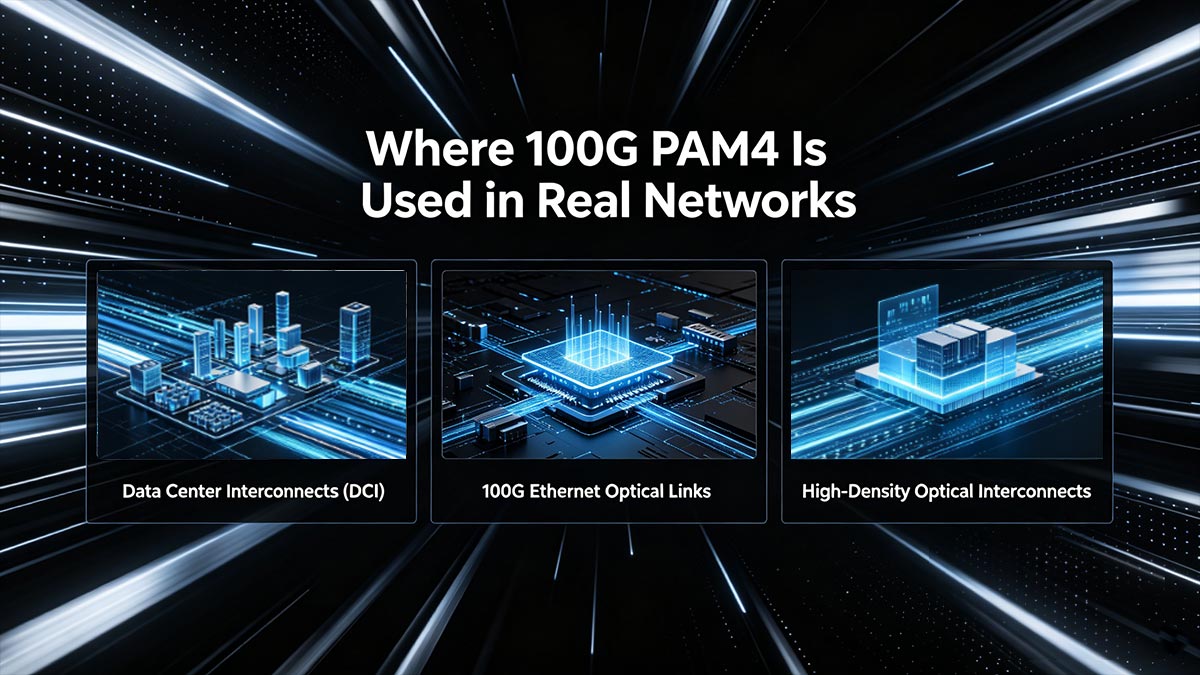
Below are the most common real-world deployment scenarios.
▶ Data Center Interconnects (DCI)
One of the primary use cases for 100G PAM4 is inside and between data centers.
Typical scenarios:
- Server-to-switch links
- Switch-to-switch (leaf–spine architecture)
- Short-reach interconnects between racks
Why PAM4 is used:
- High port density requirements
- Limited space and power budgets
- Need for cost-effective scaling
PAM4 enables data centers to move from:
- 25G → 100G → 400G without redesigning the entire physical infrastructure.
▶ 100G Ethernet Optical Links
PAM4 is widely used in 100G Ethernet standards, especially for multi-lane and high-speed interfaces.
Common applications:
- 100GBASE-DR / FR optical modules
- QSFP28 / QSFP56 transceivers
- High-speed switch uplinks
Why it matters:
- Allows 100G transmission over fewer lanes
- Reduces complexity in cabling and hardware
This makes PAM4 a key enabler for modern Ethernet evolution.
▶ High-Density Optical Interconnects
In environments where space and bandwidth are both constrained, PAM4 plays a critical role.
Examples:
- Top-of-rack (ToR) switches
- Spine switches in hyperscale networks
- AI cluster interconnects
Key benefit:
- More bandwidth per port
- Higher throughput within the same rack space
This is especially important for AI and cloud workloads that require massive east-west traffic.
▶ Short-Reach Optical Communication (≤10 km)
PAM4 is optimized for short to medium distances, where cost and efficiency matter more than ultra-long reach.
Typical distances:
- 500 m (MMF or short SMF links)
- 2 km (data center campus)
- Up to ~10 km (some single-mode applications)
Why PAM4 fits here:
- Lower complexity than coherent optics
- Sufficient performance for short-reach links
- Better cost-performance balance
▶ Electrical Interfaces Inside Systems
PAM4 is also used in high-speed electrical interconnects, not just optical links.
Examples:
- SerDes interfaces
- Chip-to-chip communication
- Backplane connections
Why it’s important:
- Extends high-speed signaling beyond optics
- Enables end-to-end 100G+ system design
▶ Emerging AI and Cloud Infrastructure
With the rapid growth of AI workloads, network bandwidth demands are increasing dramatically.
PAM4 supports:
- GPU cluster interconnects
- High-throughput storage networks
- Low-latency data exchange
Why PAM4 is critical:
- Delivers high bandwidth without excessive power consumption
- Supports scalable, high-density architectures
Bottom Line: 100G PAM4 is primarily used in short-reach, high-density network environments such as data centers, Ethernet links, and optical interconnects.
It has become the default modulation method for modern 100G deployments because it provides the best balance between:
- Performance
- Cost
- Scalability
As network demands continue to grow, PAM4 will remain a foundational technology for building faster and more efficient communication systems.
🟠 Common User Questions About 100G PAM4 Modulation

Q1. Why does 100G PAM4 require Forward Error Correction (FEC)?
100G PAM4 requires FEC because its signal levels are closer together, making it more prone to errors. FEC detects and corrects bit errors in real time, ensuring reliable transmission even when signal quality is reduced.
Q2. What types of optical modules use 100G PAM4?
Common 100G PAM4 optical modules include:
- QSFP28 DR (500 m)
- QSFP28 FR (2 km)
- Some LR (10 km) implementations
These transceiver modules are widely used in data centers and short-reach single-mode fiber links.
Q3. Does 100G PAM4 increase latency?
Yes, slightly. The use of FEC introduces additional processing delay, typically in the range of nanoseconds to microseconds, depending on the implementation.
In most data center applications, this latency is negligible compared to the benefits.
Q4. Is 100G PAM4 compatible with existing fiber infrastructure?
In most cases, yes. 100G PAM4 is designed to work over:
- Existing single-mode fiber (SMF)
- Standard connectors and cabling
However, link performance depends on:
- Fiber quality
- Distance
- Optical budget
Q5. What is the typical reach of 100G PAM4?
Typical distances include:
- Up to 500 meters (data center links)
- Up to 2 km (campus connections)
- Up to ~10 km (longer SMF applications)
PAM4 is primarily optimized for short- to medium-reach transmission.
Q6. Can 100G PAM4 be used for long-haul networks?
No, it is not ideal for long-haul transmission. For long distances (hundreds to thousands of kilometers), coherent modulation is preferred due to better signal performance and advanced compensation techniques.
Q7. What are the main challenges when deploying 100G PAM4?
Key challenges include:
- Signal integrity and noise sensitivity
- FEC configuration and compatibility
- Precise link budget planning
Proper system design and testing are essential for stable performance.
Q8. Is 100G PAM4 future-proof?
Yes, to a large extent. PAM4 is already the foundation for:
- 100G
- 200G
- 400G
- 800G
While future technologies may evolve further, PAM4 will remain a core modulation method for high-speed networks for years to come.
🟠 Choosing the Right 100G PAM4 Solution
Selecting the right 100G PAM4 modulation solution is not just about achieving 100G speeds—it’s about choosing a configuration that fits your distance, compatibility, and real-world application needs. A well-matched solution ensures stable performance, lower cost, and easier scalability.

1. Choose Based on Reach (Distance First)
Start by defining your transmission distance:
- ≤500 m (intra–data center links)
→ Choose DR (Data Center Reach) modules
→ Ideal for high-density, short-reach deployments - Up to ~2 km (campus or inter-building)
→ Choose FR (Fiber Reach) modules
→ Balanced for performance and cost - Up to ~10 km (extended single-mode links)
→ Choose LR (Long Reach) solutions
→ Suitable for aggregation or metro edge
Key insight: The shorter the reach, the more cost- and power-efficient your solution will be.
2. Ensure Interoperability and Compatibility
Not all 100G PAM4 modules are plug-and-play across every platform.
Before deployment, confirm:
- Switch and router compatibility
- Vendor coding (e.g., Cisco, Arista, Juniper, etc.)
- Compliance with IEEE standards (such as 100GBASE-DR/FR/LR)
This avoids:
- Link failures
- Performance instability
- Costly troubleshooting
3. Match the Application Scenario
Different environments have different priorities:
- Data Centers / Cloud Infrastructure → Focus on high density, low power, and cost efficiency
- Enterprise Networks → Prioritize stability and compatibility
- AI / High-Performance Computing (HPC) → Require high throughput and low latency
Choosing the right module depends on what matters most in your network: cost, performance, or scalability.
4. Consider Future Scalability
100G is often just the starting point.
When selecting a PAM4 solution, think ahead:
- Will you upgrade to 400G or 800G?
- Is your infrastructure ready for higher density?
- Can your current vendor support future migration?
A forward-compatible design reduces long-term upgrade costs.
5. Balance Cost vs. Performance
While PAM4 reduces cost per bit, different module types still vary in price.
- Short-range optics → lowest cost
- Long-range transceivers → higher cost due to optics and power requirements
Avoid over-specifying reach if it’s not needed.
Final Recommendation
To choose the right 100G PAM4 solution, follow this simple decision path:
- Define your distance
- Verify compatibility with your equipment
- Align with your application requirements
- Plan for future scalability
Take the Next Step
If you're evaluating or deploying 100G PAM4 optical solutions, choosing the right module can significantly impact your network’s performance and cost efficiency.
👉 Explore a full range of 100G PAM4 transceivers and connectivity solutions at the LINK-PP Official Store, where you can find options tailored for data centers, enterprise networks, and high-speed interconnect applications.
The best 100G PAM4 solution is not the most powerful—it’s the one that fits your network perfectly. By aligning reach, compatibility, and application needs, you can build a high-performance, scalable, and cost-efficient 100G infrastructure.







