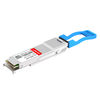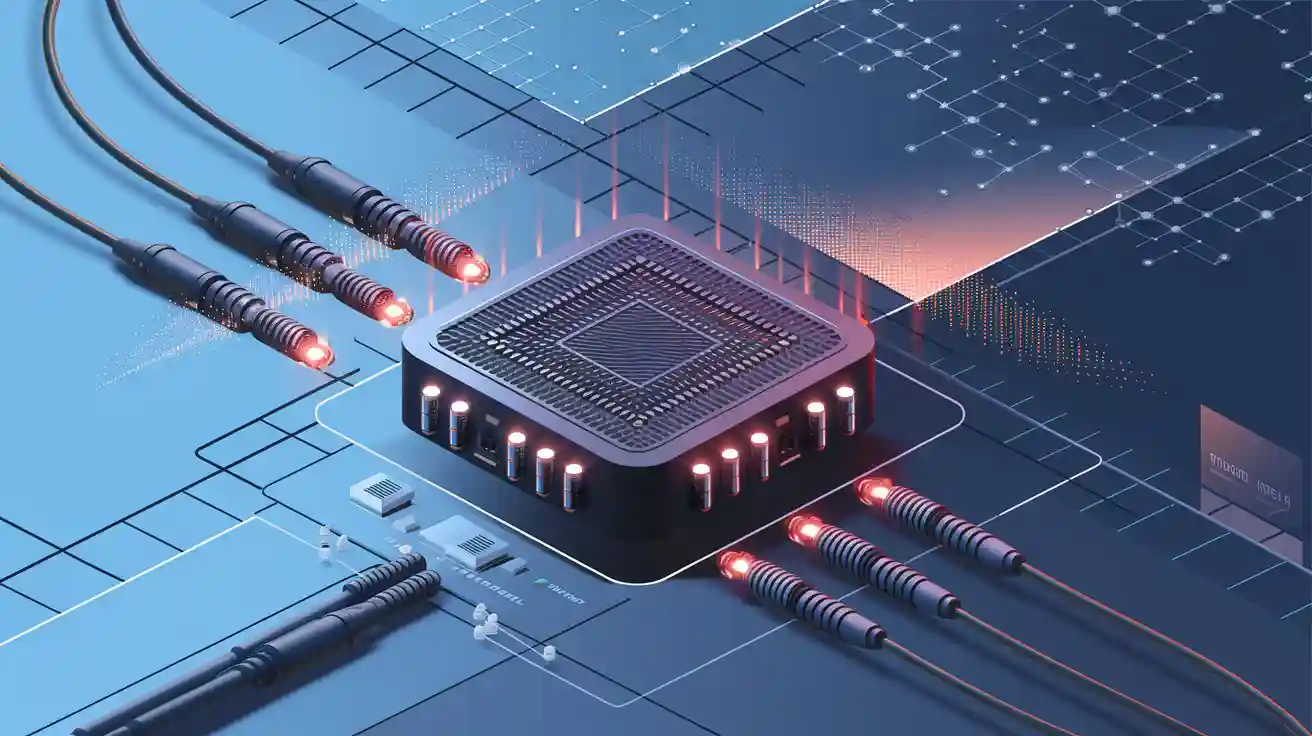
100BASE FX SFP remains a widely used solution for deploying 100Mbps fiber connectivity in industrial, enterprise, and legacy Fast Ethernet networks. While Gigabit and higher-speed optics dominate modern data centers, many control systems, surveillance networks, transportation infrastructure, and campus backbones still rely on stable and interference-resistant 100BASE-FX links.
A 100BASE FX SFP transceiver enables Fast Ethernet transmission over multimode fiber, typically operating at 1310nm and supporting distances up to 2km. Compared with copper-based 100BASE-TX connections, it offers stronger EMI immunity, longer reach, and improved reliability in electrically noisy environments.
This guide explains what a 100BASE FX SFP is, how it works, its key specifications, compatibility considerations, deployment best practices, and when it remains the right choice for modern network architectures. Whether you are maintaining legacy infrastructure or designing industrial Ethernet systems, understanding the technical characteristics of 100BASE-FX SFP modules helps ensure stable and efficient fiber connectivity.
⭐ What Is 100BASE FX SFP?
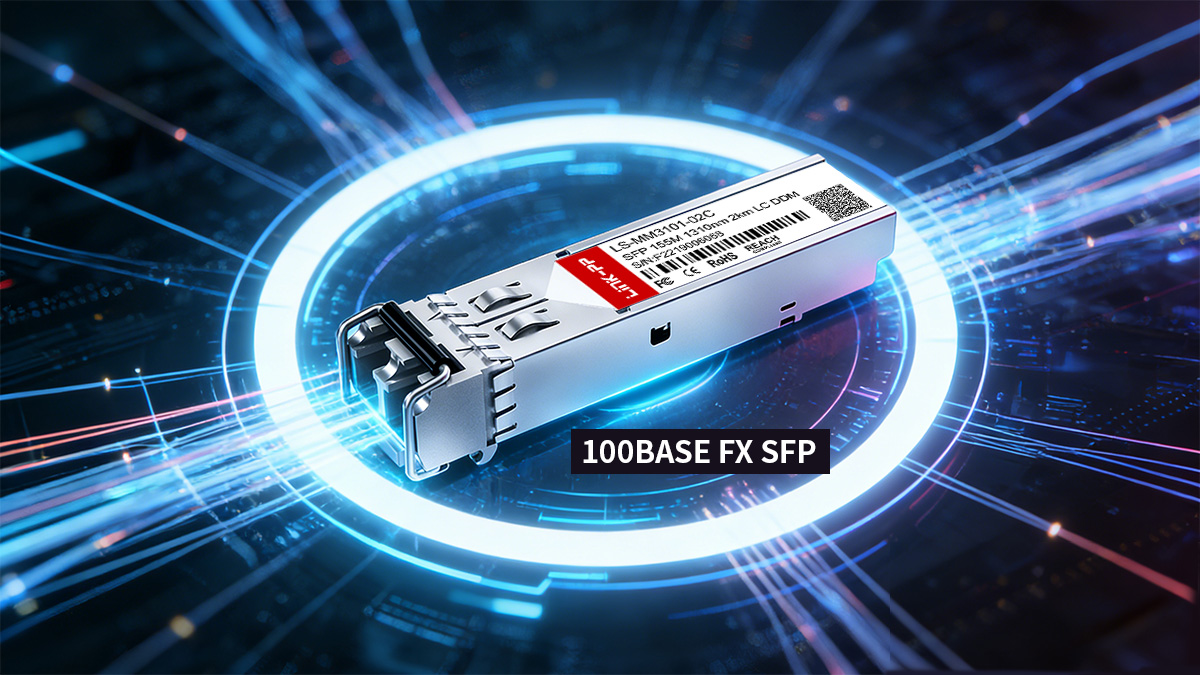
A 100BASE FX SFP is a 100Mbps Fast Ethernet optical transceiver designed to transmit data over multimode fiber using the 100BASE-FX standard. It combines the Fast Ethernet physical layer specification with the compact Small Form-factor Pluggable (SFP) interface, allowing flexible deployment in switches, routers, and media converters.
Definition of 100BASE-FX Standard
100BASE-FX is a Fast Ethernet fiber optic standard defined by the IEEE under IEEE 802.3u. It specifies 100Mbps data transmission over multimode fiber using a 1310nm wavelength and 4B/5B encoding.
In practical terms, 100BASE-FX enables stable full-duplex 100Mbps communication over fiber links up to 2km, depending on fiber type and link budget. It was originally introduced to extend Fast Ethernet beyond the 100m limitation of copper 100BASE-TX connections.
Key technical characteristics include:
-
Data rate: 100Mbps
-
Wavelength: 1310nm
-
Fiber type: Multimode fiber (MMF)
-
Maximum distance: up to 2km
-
Encoding: 4B/5B with NRZI signaling
Because it operates over fiber, 100BASE-FX provides better noise immunity and longer reach than copper Fast Ethernet.
What Is an SFP Transceiver?
An SFP (Small Form-factor Pluggable) transceiver is a hot-swappable optical module used to convert electrical Ethernet signals into optical signals and vice versa. It allows network devices to support different transmission media simply by changing the module.
In the case of a 100BASE FX SFP:
-
The switch port provides a 100Mbps electrical interface internally.
-
The SFP module converts the signal to optical transmission at 1310nm.
-
The fiber cable carries the signal to the remote device.
-
The receiving SFP converts the optical signal back to electrical form.
This modular design enables flexible fiber deployment without replacing the entire networking device.
How 100BASE FX SFP Differs from 100BASE-TX
The primary difference between 100BASE FX and 100BASE-TX lies in transmission media and distance capability.
100BASE-FX uses fiber optic cable, while 100BASE-TX uses twisted-pair copper (Cat5 or higher). This leads to practical differences in performance and application scenarios.
100BASE-FX is typically chosen when longer distance or EMI resistance is required.
| Parameter |
100BASE-FX |
100BASE-TX |
| Medium |
Multimode fiber |
Twisted-pair copper |
| Max Distance |
Up to 2km |
100m |
| EMI Immunity |
High |
Moderate |
| Connector |
LC/SC |
RJ45 |
Because fiber is immune to electromagnetic interference, 100BASE FX SFP modules are widely used in factories, power substations, transportation systems, and outdoor campus links where electrical noise or grounding differences may affect copper Ethernet connections.
✅ In summary, a 100BASE FX SFP combines the Fast Ethernet 100BASE-FX fiber standard with the flexible SFP form factor, providing a reliable 100Mbps optical connectivity option for environments where copper is insufficient.
⭐ Key Specifications of 100BASE FX SFP
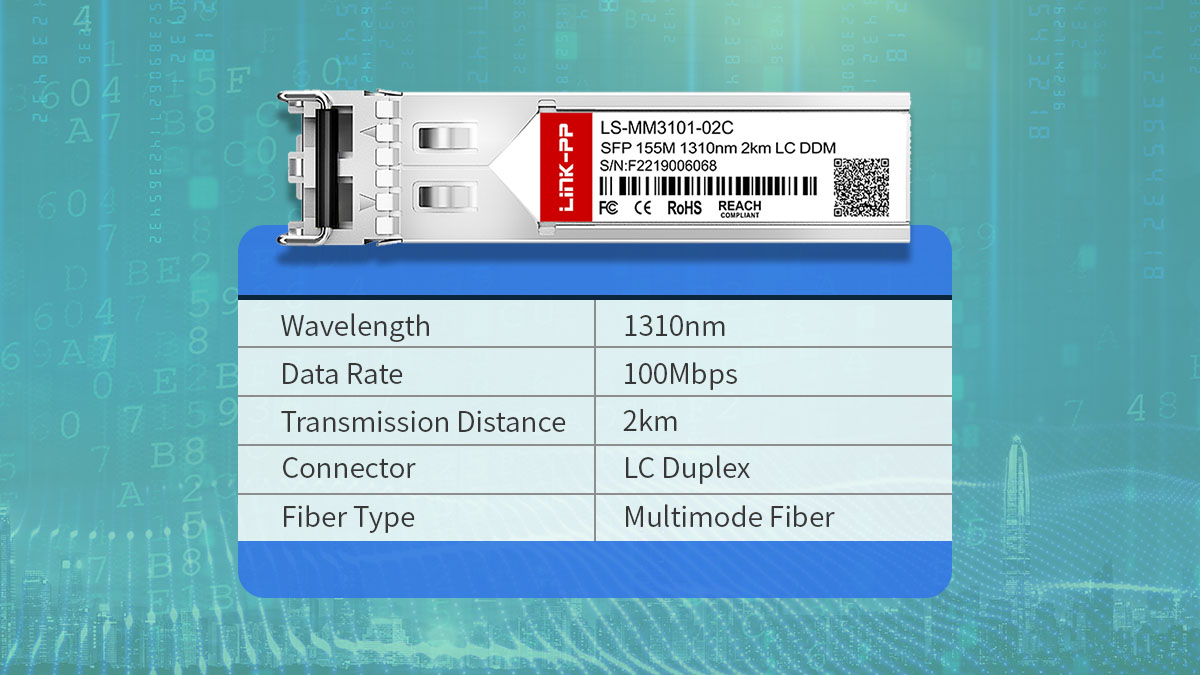
A 100BASE FX SFP is defined by a small set of core optical and electrical parameters that determine compatibility, transmission distance, and deployment environment. Understanding these specifications helps ensure proper link design and avoids common mismatches in legacy Fast Ethernet networks.
Transmission Speed and Data Rate
A 100BASE FX SFP operates at a fixed Fast Ethernet speed of 100Mbps. Unlike many Gigabit SFP modules, it does not support multi-rate operation.
100BASE FX SFP modules are designed specifically for 100Mbps Fast Ethernet ports and typically do not downshift or auto-negotiate to other speeds.
Key characteristics:
-
Nominal data rate: 100Mbps
-
Duplex mode: Full-duplex (most common), some support half-duplex
-
Encoding: 4B/5B line coding
-
Designed for Fast Ethernet PHY interfaces
Because of this fixed-rate design, it is important to verify that the switch or media converter explicitly supports 100BASE-FX SFP modules rather than only 1000BASE-X ports.
Wavelength and Optical Budget
Most 100BASE FX SFP modules operate at 1310nm over multimode fiber. The wavelength is optimized for reliable short-to-medium distance transmission and stable attenuation performance in MMF.
The optical power range and link budget determine whether a fiber run can reliably reach its intended distance.
| Parameter |
Typical Value |
| Operating Wavelength |
1310nm |
| Transmit Power |
-20dBm to -14dBm |
| Receiver Sensitivity |
Around -31dBm |
| Typical Link Budget |
11–15dB |
The link budget must account for:
Exceeding the optical budget may result in unstable links or intermittent connectivity.
Transmission Distance
Under standard conditions, a 100BASE FX SFP supports distances up to 2km over multimode fiber.
Actual achievable distance depends on fiber type, attenuation, and connector quality.
Typical reach scenarios:
-
OM1 (62.5/125µm): up to 2km
-
OM2 (50/125µm): up to 2km
-
Poor-quality fiber or high insertion loss: reduced distance
Although 2km is the theoretical maximum, real-world installations often operate well below this limit to maintain optical margin.
Connector Type and Fiber Compatibility
Most 100BASE FX SFP modules use LC duplex connectors, though some legacy or specialized versions may use SC connectors depending on the manufacturer.
Proper fiber type matching is critical for stable operation.
| Specification |
Common Option |
| Connector Type |
LC Duplex |
| Fiber Type |
Multimode (MMF) |
| Core Size |
50/125µm or 62.5/125µm |
| Fiber Mode |
Duplex |
Using single-mode fiber with a multimode 100BASE-FX module is generally not recommended unless specifically designed for that configuration.
Operating Temperature Range
100BASE FX SFP modules are available in both commercial and industrial temperature grades.
Industrial-grade modules are designed for harsh environments where temperature fluctuation is significant.
| Temperature Grade |
Operating Range |
| Commercial |
0°C to 70°C |
| Industrial |
-40°C to 85°C |
Industrial versions are commonly deployed in:
-
Factory automation systems
-
Outdoor cabinets
-
Transportation infrastructure
-
Utility and energy networks
Selecting the correct temperature rating ensures long-term reliability and reduces the risk of optical drift or hardware failure in extreme conditions.
✅ In summary, the key specifications of a 100BASE FX SFP—100Mbps speed, 1310nm wavelength, up to 2km reach, multimode fiber compatibility, and defined temperature ratings—directly determine its suitability for legacy Fast Ethernet and industrial fiber deployments.
⭐ How 100BASE FX SFP Works in a Network
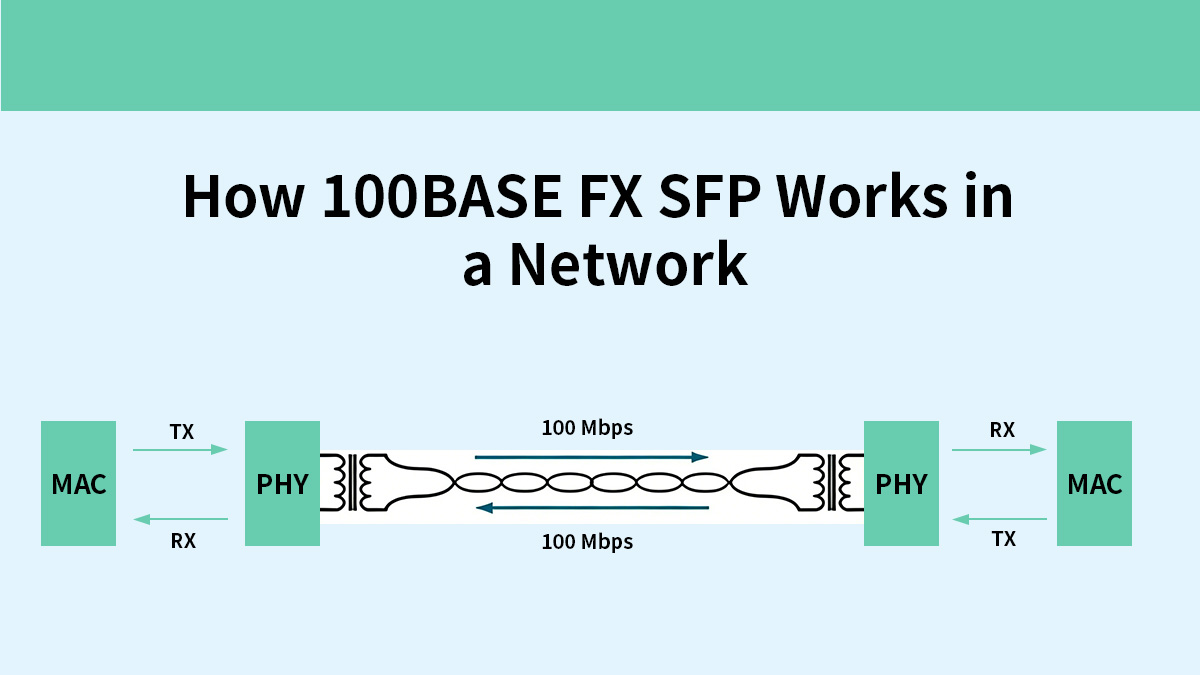
A 100BASE FX SFP enables 100Mbps Fast Ethernet transmission by converting electrical signals from a switch or media converter into optical signals for fiber transmission, and then converting them back to electrical signals at the receiving end. Its operation follows the Fast Ethernet physical layer specification and integrates directly into standard SFP ports that support 100BASE-FX.
Electrical-to-Optical Signal Conversion
A 100BASE FX SFP performs bidirectional signal conversion at the PHY layer.
It translates 100Mbps electrical Fast Ethernet signals into 1310nm optical pulses for transmission over multimode fiber.
The process includes:
-
The switch ASIC sends a 100Mbps electrical signal to the SFP interface.
-
The SFP module’s PHY encodes data using 4B/5B encoding.
-
The internal laser diode emits modulated light at 1310nm.
-
The optical signal travels through duplex multimode fiber.
-
The receiving module detects the light and converts it back to an electrical signal.
Because fiber transmission is immune to electromagnetic interference, signal integrity remains stable even in electrically noisy environments such as factories or substations.
Integration with Switches and Media Converters
A 100BASE FX SFP is typically installed in:
-
Fast Ethernet switches with 100Mbps SFP ports
-
Industrial Ethernet switches
-
Fiber media converters
-
Legacy enterprise access switches
The host device must explicitly support 100BASE-FX; Gigabit-only SFP ports may not recognize 100Mbps modules.
Common deployment scenarios include:
-
Extending copper-based 100BASE-TX networks beyond 100m
-
Connecting remote buildings via multimode fiber
-
Upgrading copper links to fiber without replacing core equipment
In industrial environments, media converters are frequently used to convert RJ45 copper ports to fiber uplinks using 100BASE FX SFP modules.
Link Negotiation and Duplex Settings
Unlike Gigabit Ethernet, 100BASE-FX does not always rely on auto-negotiation in the same way copper Ethernet does.
Most 100BASE FX SFP deployments operate in fixed 100Mbps full-duplex mode to ensure stable connectivity.
Important operational considerations:
-
Some devices require manual speed configuration
-
Duplex mismatch can cause packet loss or collisions
-
Half-duplex operation is rare but technically supported under IEEE 802.3u
| Setting |
Typical Configuration |
| Speed |
100Mbps |
| Duplex |
Full-duplex |
| Auto-Negotiation |
Often disabled or limited |
| Flow Control |
Optional |
When troubleshooting link issues, verifying speed and duplex alignment on both ends is critical.
⭐ Typical Applications of 100BASE FX SFP
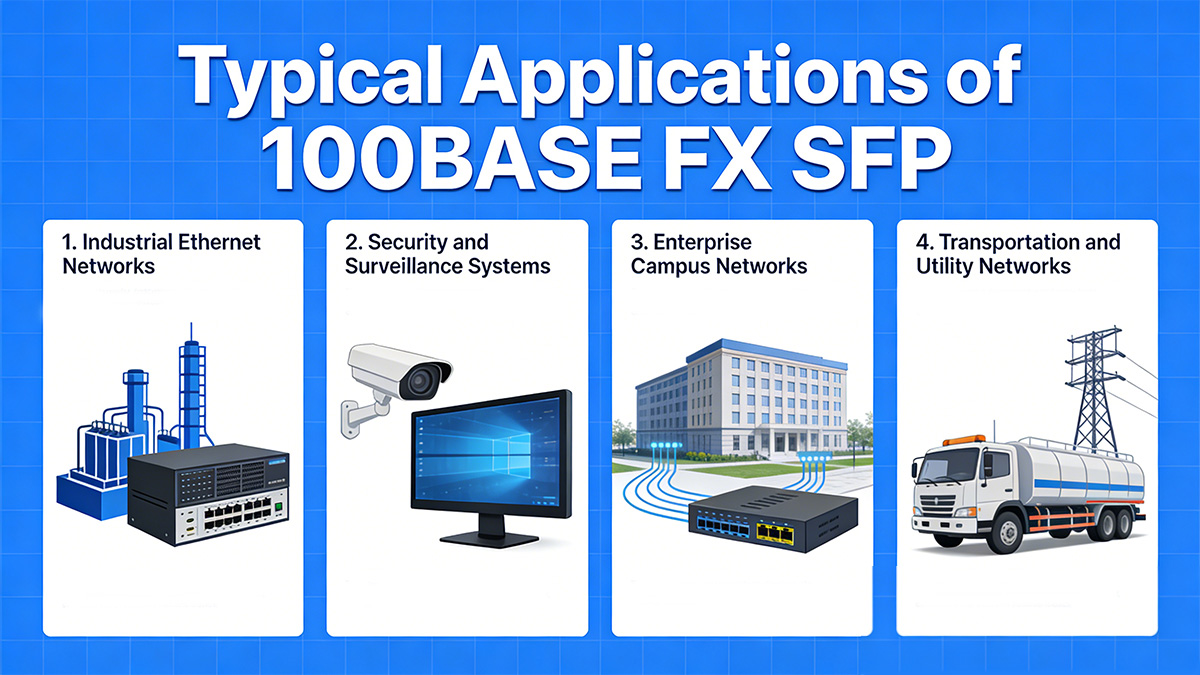
A 100BASE FX SFP is primarily deployed in environments where 100Mbps bandwidth is sufficient but longer distance, EMI resistance, or electrical isolation is required. Although higher-speed optics are common in data centers, Fast Ethernet fiber modules remain widely used in industrial control systems, infrastructure networks, and legacy enterprise environments.
Industrial Ethernet Networks
100BASE FX SFP is frequently used in industrial automation systems where reliability and noise immunity are more important than bandwidth.
Fiber-based 100BASE-FX links are preferred in electrically noisy environments where copper Ethernet may suffer interference or grounding issues.
Common industrial use cases include:
Fiber transmission provides:
-
Immunity to electromagnetic interference (EMI)
-
Electrical isolation between devices
-
Stable long-distance communication within large facilities
Industrial-grade (-40°C to 85°C) modules are particularly common in these deployments.
Security and Surveillance Systems
In surveillance networks, 100BASE FX SFP modules are widely used for fiber backhaul of IP cameras and monitoring equipment.
When camera bandwidth requirements remain below 100Mbps, 100BASE-FX offers a cost-effective and stable fiber uplink solution.
Typical scenarios:
Because fiber supports longer distances than copper, surveillance systems can connect remote camera clusters to a central monitoring room without repeaters.
Enterprise Campus Networks
Many enterprise campuses still operate legacy Fast Ethernet infrastructure for access-layer connectivity.
100BASE FX SFP modules are commonly used to interconnect buildings or extend Fast Ethernet beyond the 100m copper limit.
Typical deployment patterns:
In situations where upgrading to Gigabit is unnecessary or budget-constrained, 100BASE-FX remains a practical option.
Transportation and Utility Networks
Infrastructure sectors such as transportation and energy continue to rely on 100Mbps fiber links for control and monitoring systems.
Deterministic performance and long-term equipment compatibility make 100BASE-FX suitable for critical infrastructure networks.
Representative applications:
These environments often require:
-
Long operational life cycles
-
Stable 100Mbps connectivity
-
Industrial temperature tolerance
-
Immunity to lightning-induced interference
✅ In summary, 100BASE FX SFP modules are most commonly deployed in industrial, surveillance, campus, and infrastructure networks where 100Mbps bandwidth is sufficient but fiber reliability, extended reach, and environmental resilience are essential.
⭐ 100BASE FX SFP vs Other SFP Modules
A 100BASE FX SFP is optimized for 100Mbps Fast Ethernet over multimode fiber, but it is often compared with Gigabit SFP modules or copper-based Fast Ethernet SFPs. The correct choice depends on speed requirements, transmission distance, infrastructure compatibility, and long-term upgrade plans.
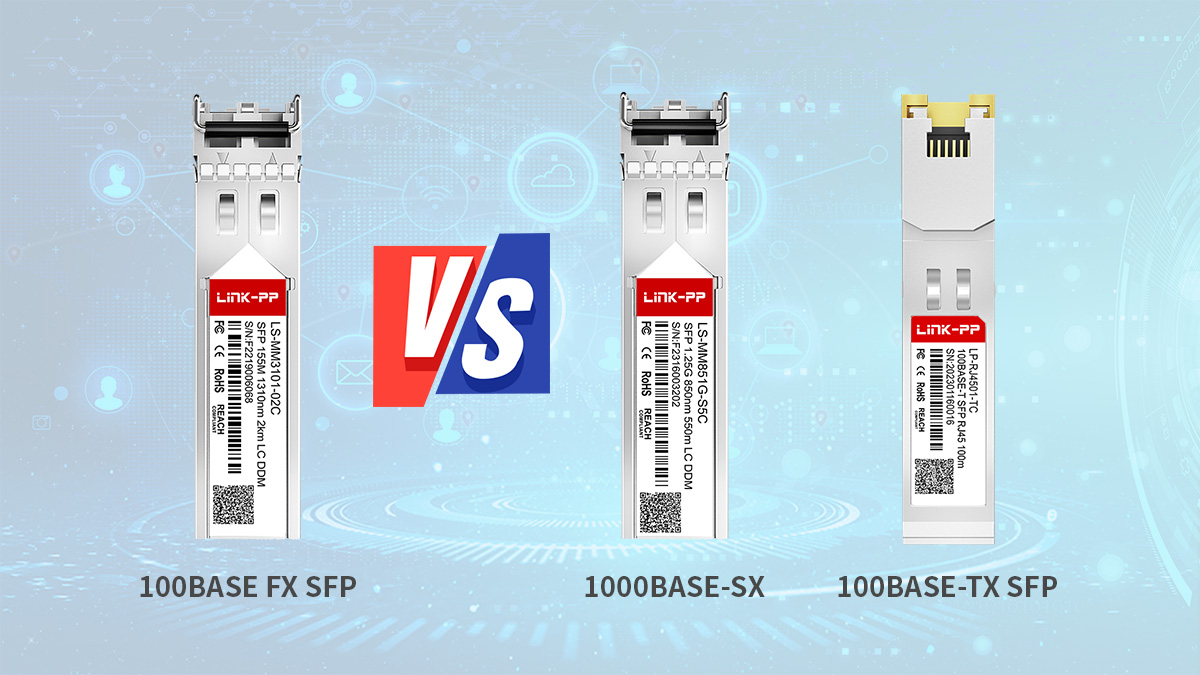
100BASE FX SFP vs 1000BASE-SX
The primary difference between 100BASE FX and 1000BASE-SX lies in transmission speed and PHY design.
If the network requires only 100Mbps and existing equipment supports Fast Ethernet, 100BASE FX is typically more compatible and cost-efficient.
| Parameter |
100BASE-FX SFP |
1000BASE-SX SFP |
| Data Rate |
100Mbps |
1Gbps |
| Wavelength |
1310nm |
850nm |
| Fiber Type |
Multimode |
Multimode |
| Max Distance |
Up to 2km |
Typically 220–550m |
Additional considerations:
-
1000BASE-SX is defined under the IEEE 802.3z Gigabit Ethernet specification.
-
Gigabit SFP ports generally do not support 100Mbps modules unless explicitly dual-rate.
-
Upgrading to 1Gbps may require replacing both modules and switching hardware.
In legacy industrial systems, upgrading to Gigabit may not be feasible due to equipment constraints, making 100BASE-FX the practical option.
100BASE FX SFP vs 100BASE-TX SFP
Both modules operate at 100Mbps, but the transmission media differs.
The decision between fiber (FX) and copper (TX) depends primarily on distance, interference environment, and grounding conditions.
| Parameter |
100BASE-FX |
100BASE-TX |
| Transmission Medium |
Multimode Fiber |
Cat5/5e Copper |
| Max Distance |
Up to 2km |
100m |
| EMI Immunity |
High |
Moderate |
| Connector |
LC/SC |
RJ45 |
Fiber-based 100BASE-FX is preferred when:
-
Distance exceeds 100m
-
EMI is present (industrial machinery, power systems)
-
Electrical isolation is required between buildings
Copper-based 100BASE-TX is suitable for:
-
Short-distance indoor wiring
-
Low-cost access connections
-
Standard office environments
When to Choose 100BASE FX Instead of Gigabit
Although Gigabit Ethernet is common, 100BASE FX SFP remains relevant in specific conditions.
Choose 100BASE FX when network requirements prioritize stability, compatibility, and environmental resilience over bandwidth expansion.
Typical decision scenarios:
-
Existing Fast Ethernet switches only support 100Mbps
-
Industrial control systems certified for 100Mbps only
-
Bandwidth demand is well below 100Mbps
-
Budget constraints limit infrastructure replacement
-
Long lifecycle environments (utilities, transportation)
In contrast, Gigabit SFP modules are recommended when:
-
Future scalability is required
-
High data throughput is necessary
-
Network modernization projects are underway
✅ Overall, 100BASE FX SFP modules serve a specific niche: stable 100Mbps fiber connectivity in legacy, industrial, and infrastructure networks. While higher-speed SFP modules dominate new enterprise deployments, 100BASE-FX continues to provide reliable performance where Fast Ethernet remains sufficient and fully supported.
⭐ Compatibility and Interoperability
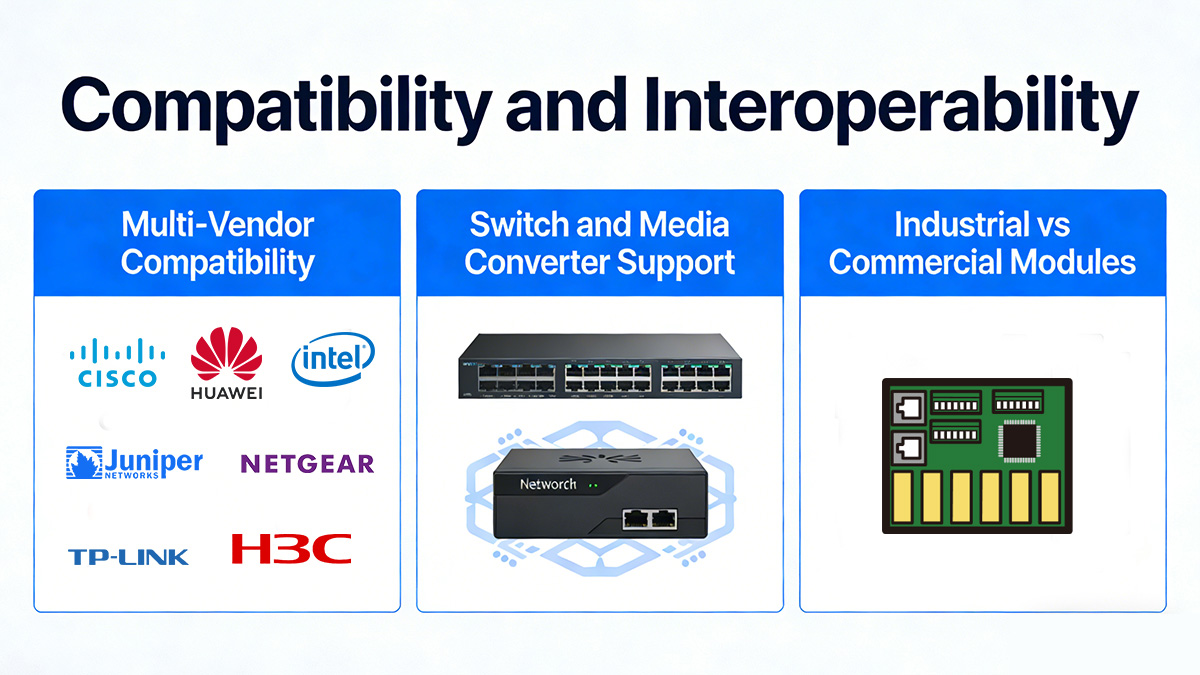
A 100BASE FX SFP must match the host device’s electrical interface, firmware support, and optical specifications to ensure stable operation. Although Fast Ethernet fiber modules follow standardized PHY definitions, real-world interoperability depends on port capability and vendor implementation.
Multi-Vendor Compatibility
Most 100BASE FX SFP modules are designed according to Multi-Source Agreement (MSA) specifications and IEEE 802.3u Fast Ethernet standards.
In principle, an MSA-compliant 100BASE FX SFP should function across different switch brands, provided the host port supports 100BASE-FX operation.
However, interoperability may be influenced by:
-
Vendor EEPROM coding requirements
-
Firmware validation rules
-
Port speed limitations (100Mbps-only vs 1Gbps-only SFP ports)
-
DOM/DDM support expectations (some Fast Ethernet SFP do not support digital diagnostics)
When deploying across mixed-vendor environments:
-
Verify that the switch explicitly supports 100BASE-FX
-
Confirm whether vendor-locked coding is required
-
Check firmware release notes for supported transceiver types
Switch and Media Converter Support
The most common compatibility issue occurs when installing a 100BASE FX SFP into a Gigabit-only SFP slot.
Not all SFP ports support 100Mbps modules; many 1000BASE-X ports are fixed at 1Gbps and will not recognize Fast Ethernet optics.
| Host Port Type |
100BASE FX SFP Support |
| 100Mbps SFP Port |
Supported |
| Dual-Rate 100/1000 SFP Port |
Usually Supported |
| 1000BASE-X Only Port |
Not Supported |
| Media Converter (100FX) |
Supported |
Before deployment:
-
Confirm port speed capability in device specifications.
-
Verify whether manual speed configuration is required.
-
Ensure duplex settings match on both ends.
Industrial Ethernet switches commonly provide dedicated 100BASE-FX SFP slots, ensuring direct compatibility.
Industrial vs Commercial Modules
Temperature rating and environmental certifications also affect interoperability in real-world scenarios.
Selecting the correct temperature grade ensures electrical stability and optical performance within the intended operating environment.
| Module Grade |
Operating Temperature |
| Commercial |
0°C to 70°C |
| Industrial |
-40°C to 85°C |
Additional compatibility factors may include:
In infrastructure deployments such as transportation or utilities, industrial-grade 100BASE FX SFP modules are typically required to maintain consistent optical output across temperature fluctuations.
⭐ Installation and Deployment Best Practices
Proper installation of a 100BASE FX SFP directly affects link stability, optical performance, and long-term reliability. Although Fast Ethernet fiber links are relatively simple compared to higher-speed optics, incorrect fiber selection, contamination, or configuration mismatches can still cause link failure.
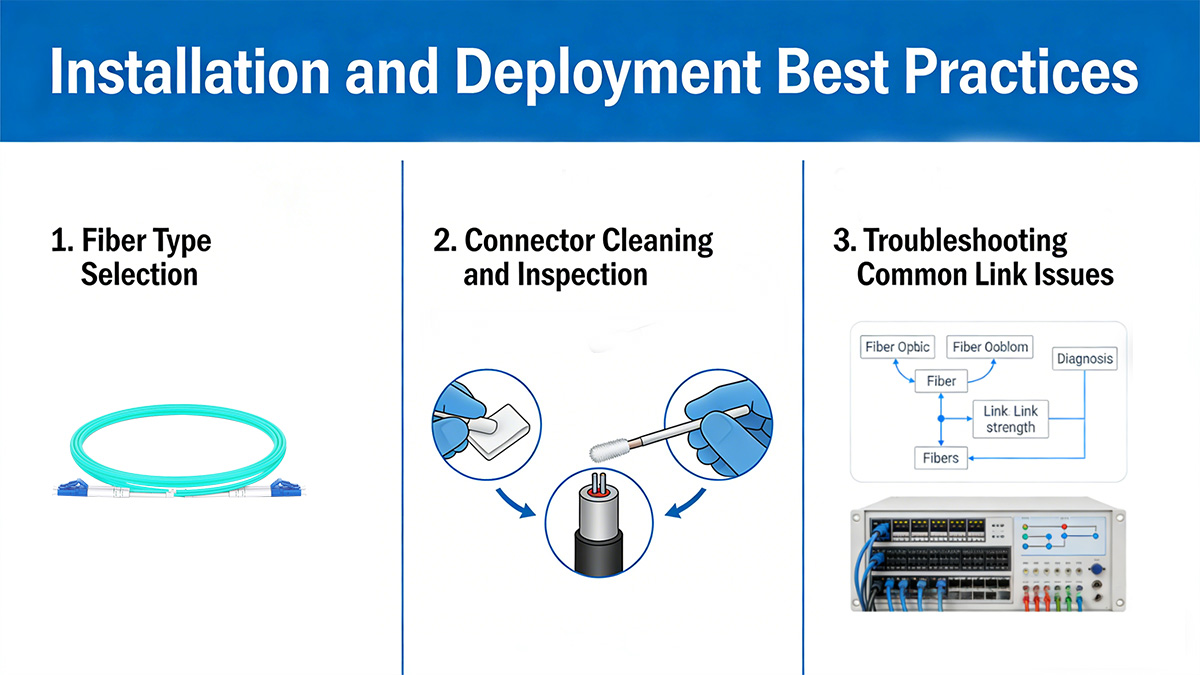
Fiber Type Selection
100BASE-FX is designed primarily for multimode fiber (MMF). Using the correct fiber type ensures that the optical budget supports the intended distance.
Always match a 100BASE FX SFP with multimode fiber (50/125µm or 62.5/125µm) unless the module specification explicitly states otherwise.
| Fiber Type |
Core Size |
Typical Max Distance |
| OM1 |
62.5/125µm |
Up to 2km |
| OM2 |
50/125µm |
Up to 2km |
| Single-Mode (SMF) |
9/125µm |
Not recommended (standard MMF module) |
Deployment considerations:
-
Confirm fiber type before installation.
-
Avoid mixing MMF and SMF unless using compatible optics.
-
Account for connector and splice loss in long runs.
-
Maintain at least 2–3dB safety margin within the optical budget.
Incorrect fiber pairing is one of the most common causes of unstable Fast Ethernet fiber links.
Connector Cleaning and Inspection
Fiber contamination can significantly increase insertion loss, even in 100Mbps systems.
Always inspect and clean LC connectors before inserting a 100BASE FX SFP module.
Recommended procedure:
-
Inspect fiber end-face using a fiber microscope.
-
Clean with lint-free wipes and isopropyl alcohol or a fiber cleaning tool.
-
Reinspect to confirm no residue remains.
-
Insert gently without excessive force.
Even small dust particles can reduce received optical power and cause intermittent link drops.
Troubleshooting Common Link Issues
If a 100BASE FX SFP link does not come up, the issue is typically related to configuration, polarity, or optical power.
Most 100BASE-FX link failures are caused by speed mismatch, incorrect fiber type, or polarity reversal.
| Issue |
Possible Cause |
Recommended Action |
| No Link Light |
Port speed unsupported |
Verify 100BASE-FX support |
| Intermittent Link |
Optical loss too high |
Measure and clean connectors |
| Link Up, No Traffic |
Duplex mismatch |
Align full-duplex settings |
Systematic troubleshooting steps:
-
Verify both ends use compatible 100BASE-FX modules.
-
Confirm port speed is set to 100Mbps.
-
Check TX/RX polarity (swap fiber pair if needed).
-
Measure optical power levels if available.
Because 100BASE FX SFP modules typically operate without advanced diagnostics, physical inspection and configuration verification remain essential troubleshooting tools.
✅ In summary, successful deployment of a 100BASE FX SFP depends on correct multimode fiber selection, disciplined connector hygiene, proper port configuration, and structured troubleshooting. Following these practices ensures stable 100Mbps fiber connectivity in industrial, campus, and infrastructure networks.
⭐ FAQs About 100BASE FX SFP
Q1: Can a 100BASE FX SFP connect directly to a 1000BASE-SX SFP?
No. 100BASE-FX and 1000BASE-SX operate at different speeds and use different PHY standards. Both ends must run at 100Mbps Fast Ethernet to establish a link.
Q2: Does 100BASE FX SFP support single-mode fiber?
Standard 100BASE-FX SFP modules are designed for multimode fiber. Single-mode operation requires a specifically designed 100Mbps single-mode variant, not a typical MMF model.
Q3: Is Digital Diagnostic Monitoring (DDM) available on 100BASE FX SFP?
Many 100BASE FX SFP modules do not support DDM/DOM features. Monitoring capability depends on the manufacturer and module design.
Q4: Can 100BASE FX operate over one fiber strand?
Traditional 100BASE-FX uses duplex fiber (separate TX and RX). Single-fiber (BiDi) versions are uncommon and require matched wavelength pairs.
Q5: What happens if the fiber distance is shorter than the maximum rating?
Shorter distances generally pose no issue, as long as received optical power does not exceed the maximum input threshold. In standard multimode deployments, this is rarely a concern.
Q6: Is 100BASE FX still used in modern networks?
Yes. It remains common in industrial automation, transportation systems, utilities, and legacy enterprise environments where 100Mbps bandwidth is sufficient and long-term equipment compatibility is required.
⭐ Conclusion
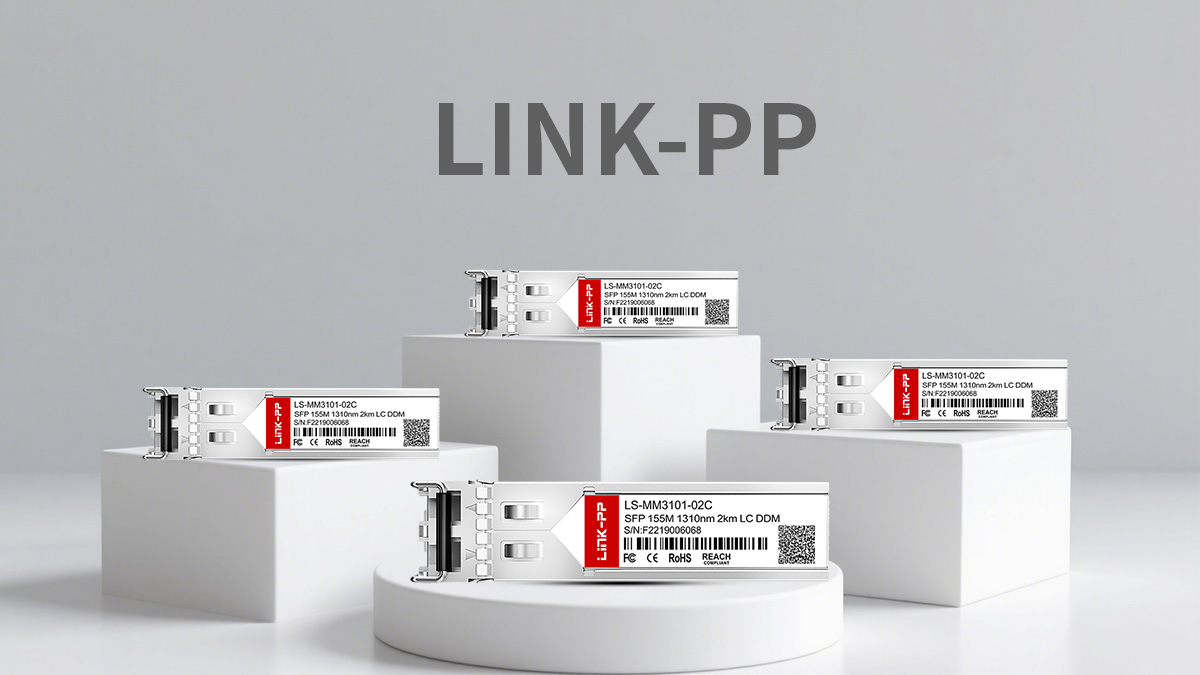
100BASE FX SFP remains a practical and reliable solution for delivering 100Mbps Fast Ethernet over multimode fiber. While modern enterprise networks often prioritize Gigabit or higher speeds, many industrial systems, surveillance networks, campus infrastructures, and utility environments continue to depend on stable 100BASE-FX connectivity. Its 1310nm operation, up to 2km reach, strong EMI immunity, and compatibility with legacy Fast Ethernet equipment make it well suited for long-lifecycle deployments where bandwidth demands are moderate but reliability is critical.
When selecting a 100BASE FX SFP, verifying port speed support, fiber type, optical budget, and environmental rating ensures consistent performance and long-term stability. Proper installation and compatibility validation help avoid common link issues and maximize the value of existing infrastructure.
If you are maintaining or expanding a Fast Ethernet fiber network, you can explore compatible and industrial-grade 100BASE FX SFP modules at the LINK-PP Official Store to ensure dependable performance in your deployment environment.