The Juniper QFX-QSFP-40G-SR4 module is widely used in modern data center networks to support high-speed 40G Ethernet connectivity over multimode fiber infrastructure. As enterprise and cloud environments continue to expand, network teams increasingly rely on QSFP+ SR4 optics to maintain stable, high-bandwidth interconnects between switches in spine-leaf and aggregation architectures.
However, as deployments scale and hardware lifecycles evolve, many organizations begin evaluating replacement options for QFX-QSFP-40G-SR4 modules. These evaluations are typically driven by requirements such as improved supply flexibility, multi-vendor interoperability, consistent optical performance, and long-term operational stability in demanding network environments.
This article provides a structured benchmark review of QFX-QSFP-40G-SR4 replacement options and their technical considerations. It covers the key aspects needed for informed evaluation, including:
- Core specifications and deployment use cases of the original module
- Technical and operational reasons for replacement in real-world networks
- Benchmark criteria such as optical performance, compatibility, and reliability testing
- Comparative analysis between original and replacement modules
- Deployment best practices and common challenges in 40G environments
- Future trends shaping 40G optical connectivity and migration paths
Together, these insights help clarify how replacement modules should be assessed in performance-critical Juniper-based infrastructures.
? Understanding the Juniper QFX-QSFP-40G-SR4
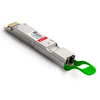
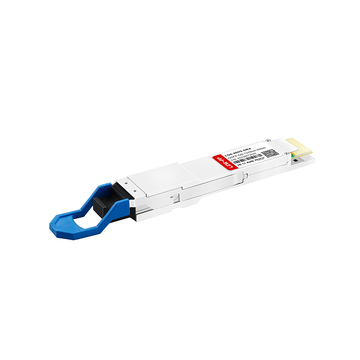
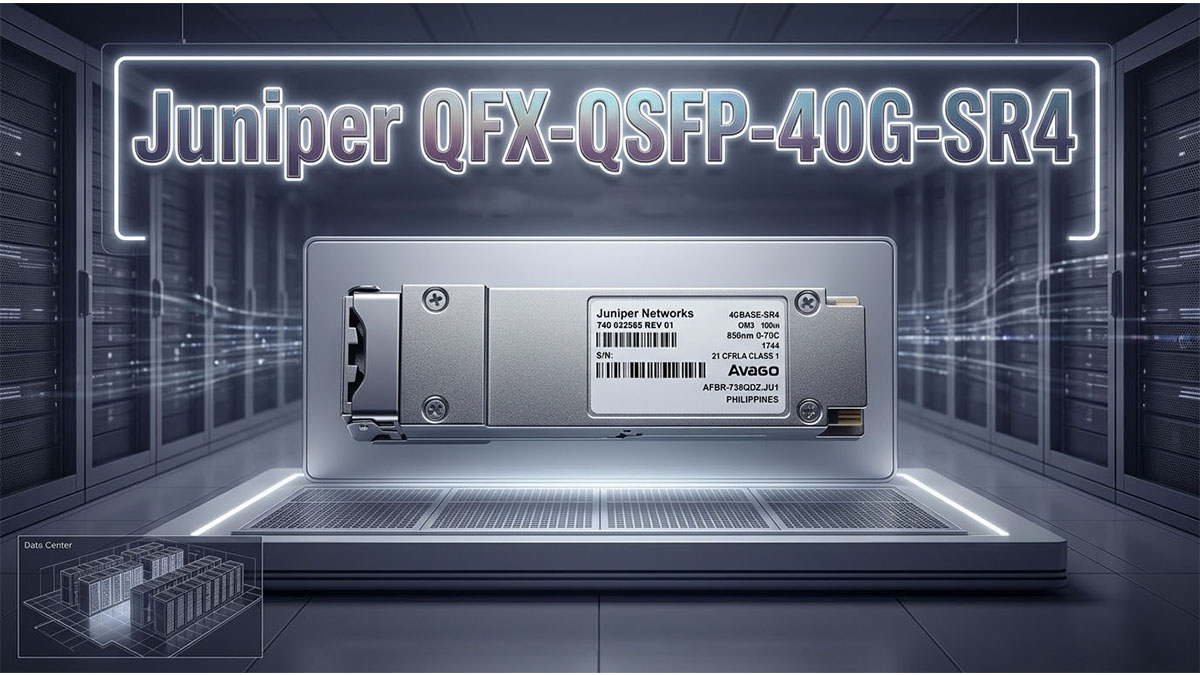
The Juniper QFX-QSFP-40G-SR4 is a 40Gbps QSFP+ optical transceiver designed for short-reach multimode fiber connections in high-density data center networks. It is primarily used to enable reliable 40G Ethernet links between switches in spine-leaf architectures, offering a standardized and efficient solution for intra-data-center connectivity.
Key Technical Specifications
The QFX-QSFP-40G-SR4 module is defined by a set of core optical and electrical characteristics that determine its performance in real-world deployments. These specifications make it suitable for high-speed aggregation and short-distance interconnects.
Key technical features include:
- 40Gbps aggregate transmission rate using four parallel lanes
- 850nm VCSEL-based optical signaling
- QSFP+ form factor compliant with industry standards
- MPO/MTP multimode fiber interface
- Support for OM3 and OM4 fiber cabling environments
Typical transmission distances vary depending on fiber grade:
| Fiber Type |
Maximum Reach |
Operating Condition |
| OM3 |
Up to 100m |
Optimized for legacy multimode deployments |
| OM4 |
Up to 150m |
Improved reach with lower modal dispersion |
These parameters make the module a stable choice for short-reach, high-bandwidth switching environments, especially within modern data center racks and aggregation layers.
Common Deployment Scenarios
In practical network environments, the QFX-QSFP-40G-SR4 is widely deployed in scenarios that require predictable high-throughput performance over short distances. Its design aligns well with structured data center architectures where switch-to-switch communication is critical.
Typical use cases include:
- Spine-leaf data center fabric interconnects
- Top-of-rack (ToR) switch uplinks
- Aggregation layer connectivity in enterprise networks
- High-performance computing cluster interconnections
These deployment scenarios benefit from the module's parallel optics design, which ensures consistent bandwidth delivery across multiple lanes while maintaining low latency and stable optical performance.
Industry Standards and Compliance
The QFX-QSFP-40G-SR4 is built to align with established networking and optical standards, ensuring interoperability and predictable behavior across compliant environments. Standards compliance is a key factor in maintaining cross-platform compatibility in multi-vendor infrastructures.
Key compliance aspects include:
- IEEE 802.3ba 40GBASE-SR4 Ethernet standard support
- QSFP+ Multi-Source Agreement (MSA) compliance
- Defined electrical and optical interface specifications
- Compatibility with structured multimode fiber systems
This standards-based design ensures that the module can operate reliably within Juniper environments while also integrating into broader heterogeneous network ecosystems, provided proper compatibility validation is performed.
? Why Organizations Seek QFX-QSFP-40G-SR4 Replacements
Organizations look for QFX-QSFP-40G-SR4 replacement modules primarily to address evolving network scale, operational efficiency, and lifecycle constraints in 40G data center environments. While the original module remains widely deployed, infrastructure growth and multi-vendor strategies often make alternative options more practical in long-term operations.
Network Expansion and Scaling Requirements
The main driver for replacement consideration is network expansion, where existing 40G infrastructures must scale to support increasing traffic loads and new service demands. As east-west traffic continues to dominate modern data centers, consistent high-density connectivity becomes critical.
Common scaling motivations include:
- Rapid growth in server and storage traffic within spine-leaf architectures
- Increased demand for high-bandwidth inter-switch communication
- Expansion of multi-site or hybrid cloud data center environments
- Need for higher port utilization efficiency across switching layers
In this context, replacement modules are evaluated to ensure they can maintain equivalent optical performance while supporting large-scale, distributed deployments without introducing bottlenecks.
Lifecycle Management Considerations
Another key factor is hardware lifecycle planning, especially as networks transition through multiple refresh cycles. Even though 40G remains widely used, procurement and inventory strategies often shift toward more flexible sourcing models over time.
Lifecycle-related considerations include:
- End-of-life planning for legacy optics inventory
- Standardization across multiple hardware generations
- Simplification of spare part management across data center sites
- Alignment with long-term infrastructure refresh cycles
These factors encourage organizations to evaluate replacement options that extend operational continuity while maintaining predictable performance characteristics.
Operational Efficiency Objectives
Operational efficiency is also a major reason organizations assess QFX-QSFP-40G-SR4 alternatives. As networks scale, minimizing operational complexity and improving supply chain agility becomes increasingly important.
Key efficiency-driven motivations include:
- Reducing dependency on single-vendor procurement channels
- Improving flexibility in sourcing compatible optical modules
- Streamlining multi-vendor network deployments
- Enhancing deployment consistency across geographically distributed data centers
Ultimately, replacement evaluation is not only about hardware substitution but also about improving overall network agility and long-term operational resilience in high-density 40G environments.
? Benchmark Criteria for Evaluating QFX-QSFP-40G-SR4 Replacements
Evaluating QFX-QSFP-40G-SR4 replacement modules requires a structured benchmarking framework that goes beyond basic compatibility checks. The goal is to determine whether a replacement can consistently match or exceed expected performance levels in real network conditions while maintaining stability in Juniper-based environments.
Optical Performance Metrics
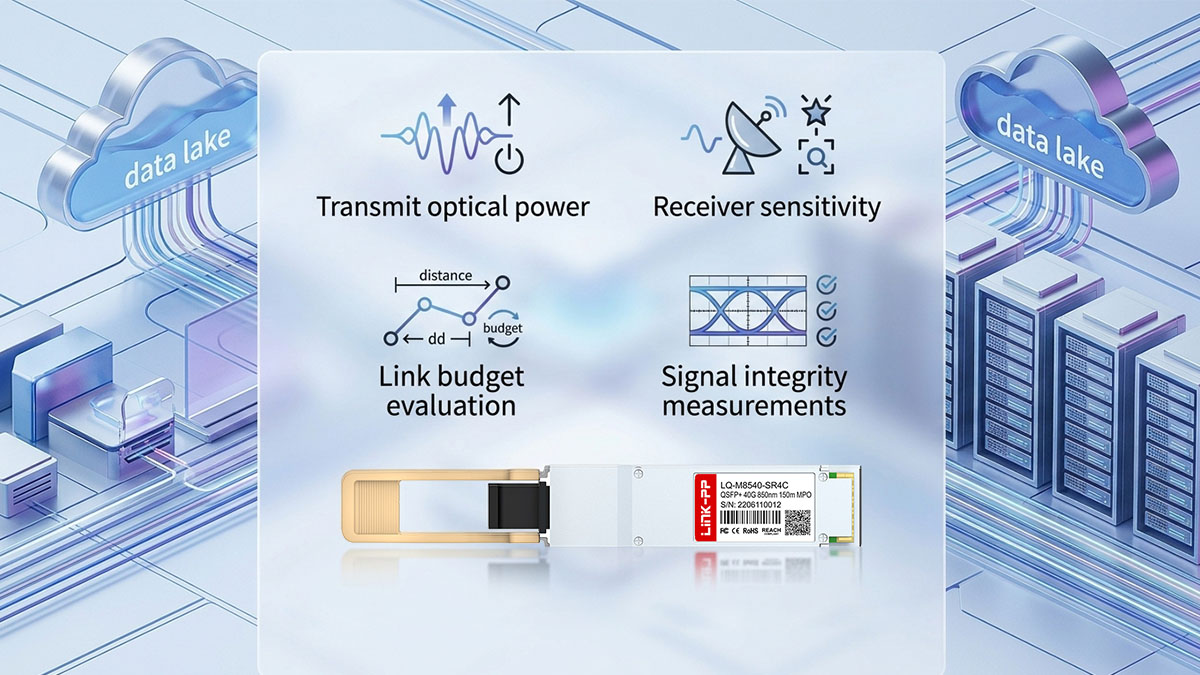
Optical performance is the foundation of any 40G SR4 evaluation because it directly impacts link quality, reach, and error tolerance. A replacement module must demonstrate predictable behavior under standard multimode fiber conditions.
Key evaluation parameters include:
- Transmit optical power consistency across all four lanes
- Receiver sensitivity under varying signal conditions
- End-to-end link budget compliance for OM3/OM4 fiber
- Bit error rate (BER) stability during sustained traffic loads
These metrics help determine whether the module can maintain reliable 40GBASE-SR4 operation without degradation in high-density switching environments.
Reliability and Stability Testing
Beyond raw optical performance, long-term reliability is essential for production deployments where downtime must be minimized. Benchmark testing typically focuses on sustained operation under realistic workload and environmental conditions.
Core reliability factors include:
- Continuous uptime performance under full traffic load
- Thermal stability across extended operating periods
- Error rate consistency during stress testing scenarios
- Resistance to performance drift over time
This stage ensures the module remains stable not only at initial deployment but also throughout its operational lifecycle in data center conditions.
Compatibility Validation
Compatibility is a critical benchmark dimension because even fully compliant optics may behave differently across platforms. For Juniper QFX environments, validation ensures proper module recognition and functional integration.
Important compatibility checkpoints include:
- Successful detection by Juniper QFX switching platforms
- Stable operation without system alarms or link flapping
- Full support for Digital Optical Monitoring (DOM/DDM) functions
- Interoperability across different Juniper firmware versions
A replacement that passes compatibility testing reduces integration risk and ensures smoother deployment across existing infrastructure.
Standards Compliance Assessment
Standards compliance ensures that replacement modules align with industry-defined behavior for 40G Ethernet transmission. This is essential for maintaining interoperability in multi-vendor networks.
Key compliance areas include:
- IEEE 802.3ba 40GBASE-SR4 adherence
- QSFP+ Multi-Source Agreement (MSA) compliance
- Optical interface and signaling consistency
- Manufacturing quality and certification validation
Modules that meet these standards are more likely to deliver predictable performance and integrate seamlessly into existing structured cabling environments.
? QFX-QSFP-40G-SR4 Replacement Benchmark Results
Benchmark testing of QFX-QSFP-40G-SR4 replacement modules focuses on verifying whether alternative optics can maintain equivalent performance, stability, and interoperability in real Juniper QFX environments. The results are typically evaluated across optical behavior, compatibility response, and long-term operational reliability under sustained traffic loads.
Optical Performance Comparison
Optical performance benchmarking shows whether replacement modules can match the signal quality and transmission characteristics of the original SR4 optics. This is essential for ensuring stable 40G links across multimode fiber infrastructure.
Key findings typically include:
- Consistent multi-lane signal output across all four optical channels
- Stable transmission performance within OM3 and OM4 distance ranges
- Link budget results remaining within acceptable IEEE 40GBASE-SR4 thresholds
- Low variation in optical power levels under continuous traffic conditions
These results indicate that well-qualified replacement modules can deliver comparable short-reach performance suitable for spine-leaf and ToR connectivity scenarios.
Compatibility Performance Analysis
Compatibility benchmarking evaluates how replacement modules behave within Juniper switching environments, particularly in terms of system recognition and operational stability. This is critical for avoiding service interruptions in production networks.
Observed behavior patterns include:
- Successful module identification by Juniper QFX platforms
- Stable link establishment without persistent alarms or resets
- Reliable Digital Optical Monitoring (DOM) data reporting
- Consistent operation across supported firmware versions
These outcomes confirm that properly engineered replacement modules can integrate smoothly into existing Juniper infrastructures when compatibility is validated correctly.
Reliability Benchmark Findings
Reliability testing assesses how replacement modules perform under stress conditions and extended runtime scenarios. This helps determine their suitability for continuous data center operation.
Key reliability observations include:
- Stable operation during extended high-throughput stress testing
- Minimal thermal variation under sustained load conditions
- Low incidence of bit errors during long-duration transmission tests
- Consistent performance without signal degradation over time
These findings indicate that reliability is closely tied to manufacturing quality control and optical component consistency.
Cost Efficiency vs Performance Balance
Beyond technical performance, benchmarking also considers operational efficiency and lifecycle value. The goal is to determine whether replacement modules can maintain performance parity while improving deployment flexibility.
Key evaluation points include:
- Balanced performance relative to acquisition and operational costs
- Improved flexibility in multi-site and multi-vendor deployments
- Reduced dependency on single-source supply chains
- Scalable deployment advantages in large data center environments
Overall, benchmark results suggest that high-quality QFX-QSFP-40G-SR4 replacements can achieve a strong equilibrium between performance stability and operational efficiency when properly validated.
? Comparing Original and Compatible QFX-QSFP-40G-SR4 Modules
A clear comparison between original Juniper QFX-QSFP-40G-SR4 modules and compatible replacement options helps clarify how both categories perform in real-world 40G networks. The focus is not only on optical specifications, but also on interoperability behavior, diagnostic capabilities, and deployment flexibility within Juniper-based infrastructures.
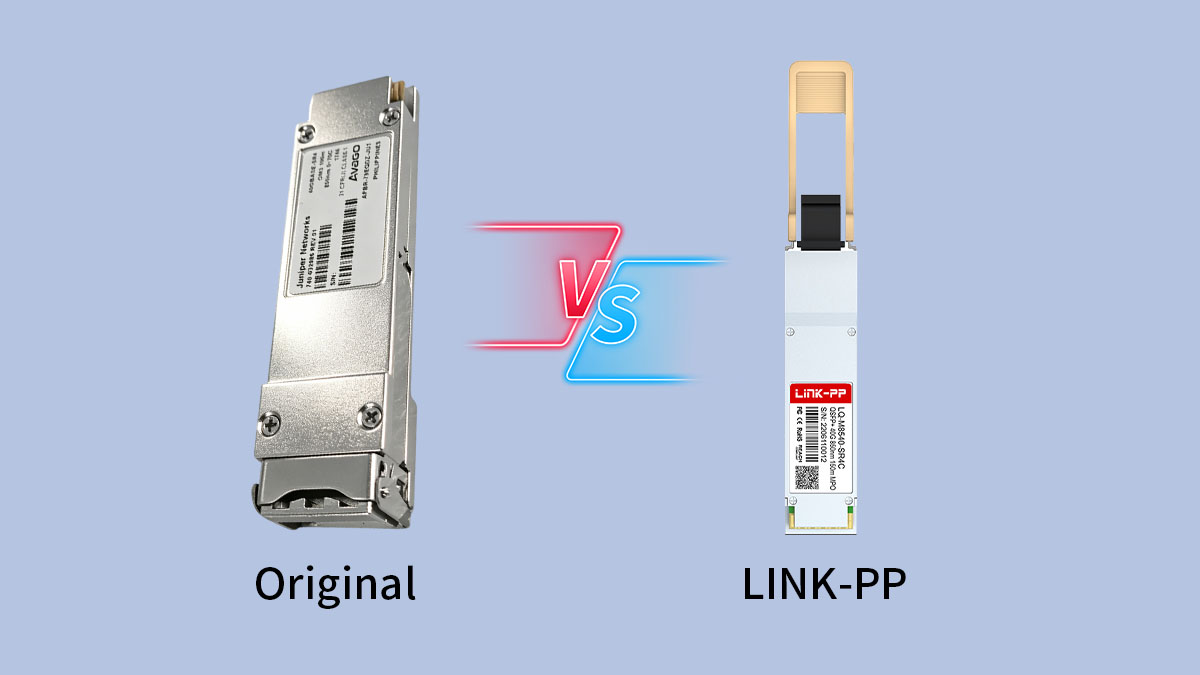
Feature Comparison Overview
To evaluate both module types effectively, key technical and operational characteristics must be reviewed side by side. These factors directly influence performance consistency and network integration quality.
| Evaluation Aspect |
Original QFX-QSFP-40G-SR4 |
Compatible Replacement Modules |
| Optical Standard |
IEEE 802.3ba 40GBASE-SR4 |
IEEE-compliant SR4 implementations |
| Form Factor |
QSFP+ MSA compliant |
QSFP+ MSA compliant |
| Fiber Type |
OM3/OM4 multimode |
OM3/OM4 multimode |
| Distance Support |
Up to 100m–150m |
Up to 100m–150m (design dependent) |
| DOM Support |
Fully supported |
Typically supported (varies by vendor) |
| System Recognition |
Native Juniper support |
Requires compatibility validation |
This comparison highlights that while core optical standards remain consistent, operational behavior such as system recognition and diagnostic visibility may vary depending on implementation quality.
Areas of Similarity
Despite differences in sourcing and qualification processes, original and compatible modules share a strong technical foundation. This ensures that both can function in standard 40G SR4 environments when properly deployed.
Key similarities include:
- Identical 40GBASE-SR4 transmission architecture using four parallel lanes
- Use of 850nm VCSEL technology for short-reach multimode transmission
- Consistent QSFP+ form factor for high-density switching platforms
- Compatibility with OM3 and OM4 structured cabling systems
These shared characteristics ensure that both module types can support the same physical network designs without requiring changes to existing fiber infrastructure.
Potential Differences to Examine
Although functionality is often similar at the protocol level, differences may emerge in manufacturing processes, validation depth, and platform interaction behavior. These factors can influence long-term operational predictability.
Key differences to evaluate include:
- Firmware interaction behavior with Juniper QFX platforms
- Depth of factory calibration and burn-in testing procedures
- Consistency of DOM reporting accuracy and granularity
- Vendor-level quality assurance and traceability standards
These variations do not necessarily impact basic connectivity but can affect operational visibility, troubleshooting efficiency, and long-term reliability in complex deployments.
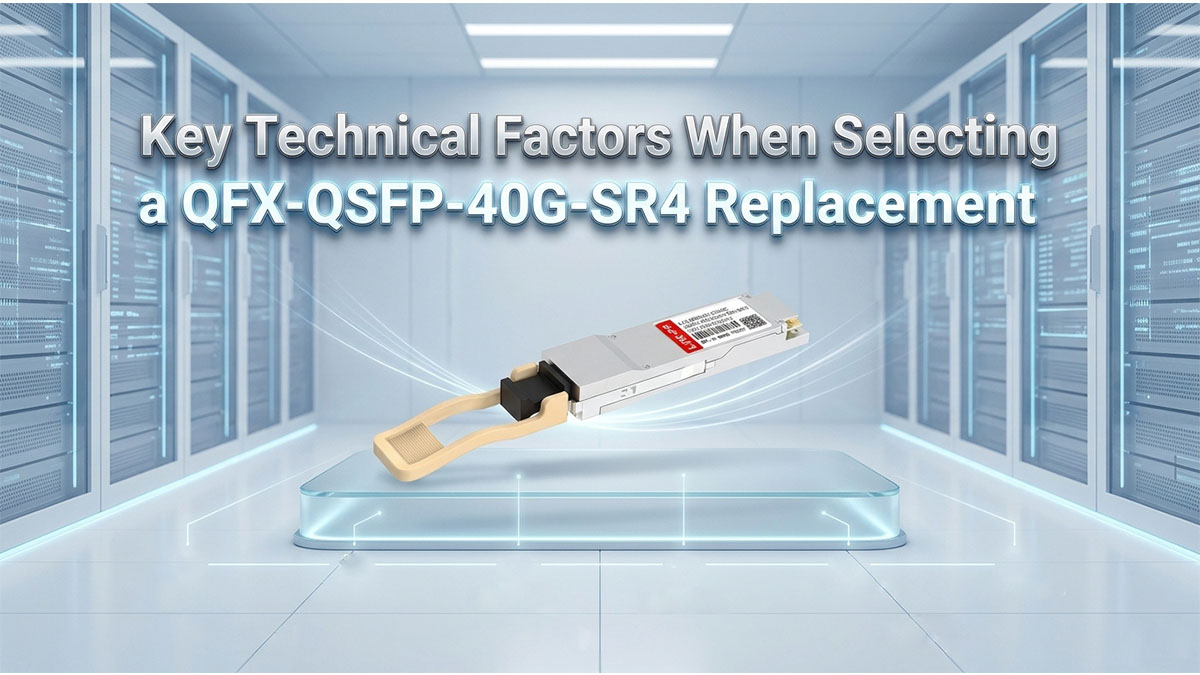
? Key Technical Factors When Selecting a QFX-QSFP-40G-SR4 Replacement
Selecting a suitable QFX-QSFP-40G-SR4 replacement requires careful technical evaluation across fiber compatibility, diagnostic capabilities, and environmental performance. These factors directly influence whether a module can operate reliably within Juniper QFX-based 40G infrastructures without introducing link instability or visibility limitations.
Fiber Infrastructure Compatibility
Fiber compatibility is one of the most important considerations because SR4 optics rely on parallel multimode transmission through MPO/MTP cabling. Any mismatch in cabling type or polarity can significantly impact link performance.
Key points to evaluate include:
- Proper support for OM3 and OM4 multimode fiber types
- MPO/MTP connector alignment and polarity configuration
- Existing structured cabling compatibility within the data center
- Maximum supported transmission distance under real deployment conditions
A technically suitable replacement must align with existing fiber infrastructure to ensure consistent 40G link performance without requiring costly re-cabling or redesign.
Digital Optical Monitoring (DOM) Support
Digital Optical Monitoring (DOM) is essential for real-time visibility into optical link health. It enables network teams to proactively identify performance degradation before it impacts service availability.
Important DOM-related capabilities include:
- Real-time monitoring of transmit and receive optical power
- Temperature and voltage tracking for module health assessment
- Laser bias current visibility for predictive diagnostics
- Consistent reporting accuracy across all optical channels
A replacement module with reliable DOM support improves operational observability and simplifies troubleshooting in large-scale deployments.
Manufacturing Quality Controls
Manufacturing quality directly affects long-term reliability and consistency across large deployments. Even small variations in component quality can lead to performance inconsistencies under high-density traffic conditions.
Key quality control factors include:
- Strict component sourcing and qualification processes
- Factory-level calibration of optical parameters
- Burn-in testing to eliminate early-life failures
- Traceability systems for production batch identification
High-quality manufacturing practices ensure that replacement modules behave predictably across multiple deployment sites.
Environmental and Operational Requirements
Environmental stability is critical for maintaining consistent performance in data center conditions where temperature and workload fluctuations are common. A suitable replacement must remain stable under sustained operational stress.
Key considerations include:
- Operating temperature range suitability for data center environments
- Thermal performance under continuous high-throughput traffic
- Power consumption consistency across operating conditions
- Resistance to performance drift under long-term load
When these environmental factors are properly addressed, QFX-QSFP-40G-SR4 replacements can maintain stable operation even in high-density, high-temperature switching environments.
? Common Challenges During QFX-QSFP-40G-SR4 Replacement Deployment
Deploying QFX-QSFP-40G-SR4 replacement modules in Juniper environments can introduce operational challenges if compatibility, fiber conditions, or validation steps are not properly controlled. These issues are often not related to basic optical transmission capability, but rather to integration behavior within real network infrastructures.
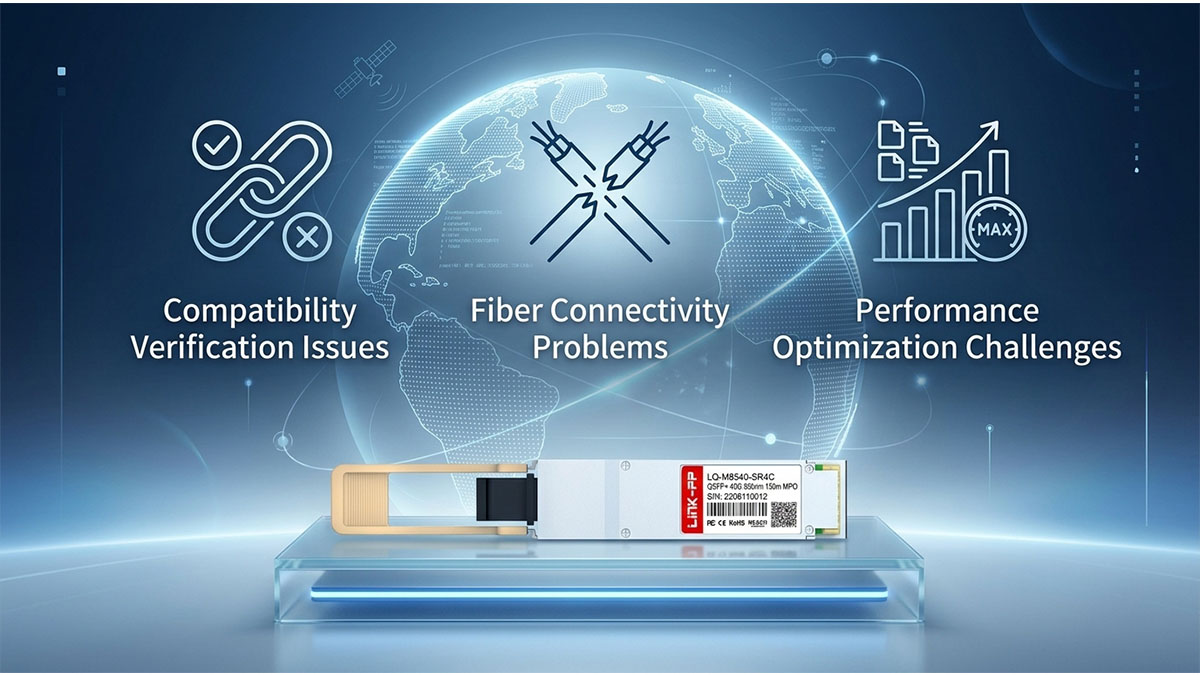
Compatibility Verification Issues
Compatibility-related problems are among the most common challenges during deployment. Even when a module is technically compliant with 40GBASE-SR4 standards, platform-specific behavior can still affect recognition and stability.
Typical issues include:
- Module not being properly recognized by Juniper QFX switches
- System warning messages or unsupported transceiver alerts
- Inconsistent behavior across different firmware versions
- Link instability caused by subtle interoperability mismatches
These challenges highlight the importance of pre-deployment validation in controlled environments before large-scale rollout.
Fiber Connectivity Problems
Physical layer issues in MPO/MTP-based multimode systems can significantly impact link performance and are often mistaken for module defects. In reality, many problems originate from cabling or installation inconsistencies.
Common fiber-related challenges include:
- MPO polarity mismatches leading to failed link establishment
- Connector contamination causing elevated insertion loss
- Excessive bending or physical stress on multimode fiber trunks
- Inconsistent patching practices across data center racks
Proper inspection and cleaning procedures are essential to eliminate these physical-layer risks during deployment.
Performance Optimization Challenges
Even when modules are compatible and fiber links are correctly installed, performance optimization issues can still arise under real traffic conditions. These challenges often appear in high-density or high-utilization environments.
Key performance-related issues include:
- Unexpected link flapping under peak traffic loads
- Optical power levels operating near link budget thresholds
- Variability in error rates between different switch pairs
- Limited visibility into degradation trends without proper monitoring tools
Addressing these challenges requires continuous monitoring and baseline performance tracking to ensure stable long-term operation across all 40G links.
? Best Practices for Evaluating and Deploying QFX-QSFP-40G-SR4 Replacements
A structured approach to evaluating and deploying QFX-QSFP-40G-SR4 replacement modules is essential for maintaining stable 40G network performance in Juniper environments. Proper practices reduce integration risk, improve operational visibility, and ensure consistent behavior across large-scale data center deployments.
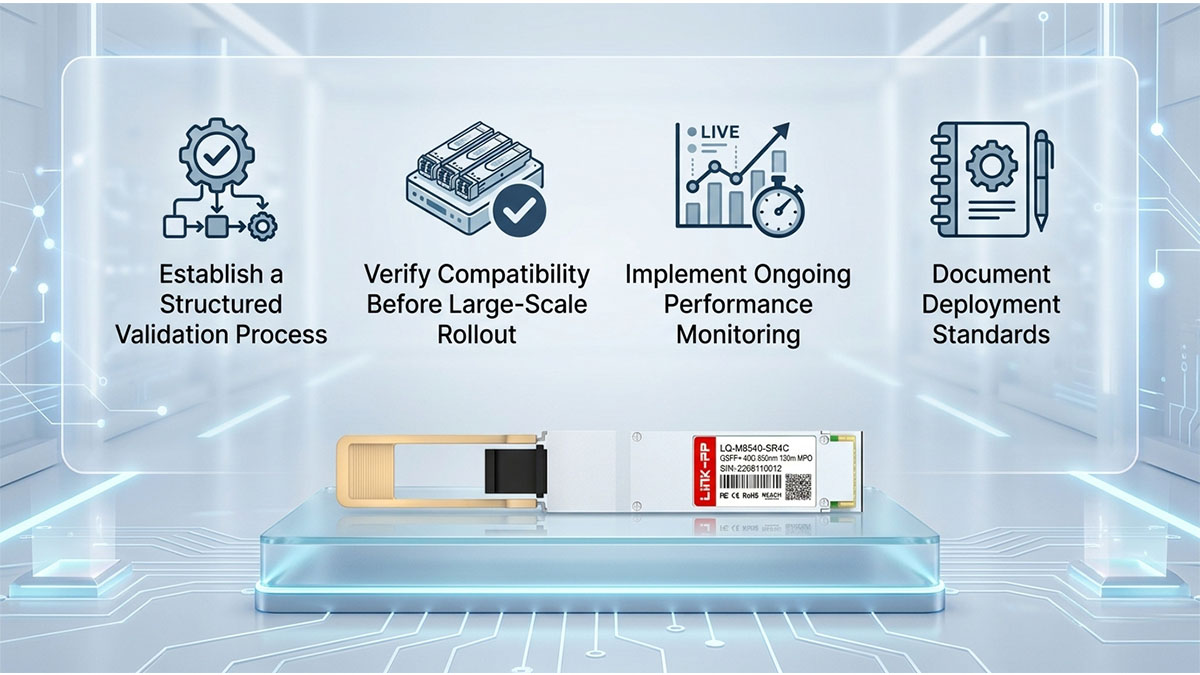
Establish a Structured Validation Process
A controlled validation process is the foundation of any successful deployment. Before introducing replacement modules into production, they should be tested in a predictable and isolated environment.
Recommended validation steps include:
- Laboratory testing under controlled switch and fiber conditions
- Verification of optical power levels and link stability
- Stress testing under sustained traffic loads
- Baseline comparison against known-good SR4 performance
This structured approach helps identify early compatibility or performance issues before they impact live networks.
Verify Compatibility Before Large-Scale Rollout
Compatibility validation ensures that replacement modules operate correctly within Juniper QFX platforms and across different network layers. Skipping this step can lead to unexpected service disruptions.
Key verification practices include:
- Testing module recognition on target Juniper switch models
- Confirming stable link establishment across firmware versions
- Validating Digital Optical Monitoring (DOM) functionality
- Checking interoperability in multi-switch and multi-rack setups
Once compatibility is confirmed in a small-scale environment, confidence in broader deployment increases significantly.
Implement Ongoing Performance Monitoring
Post-deployment monitoring is critical to ensure long-term stability and early detection of potential degradation. Continuous visibility into optical behavior supports proactive maintenance strategies.
Important monitoring practices include:
- Tracking transmit and receive optical power trends
- Monitoring temperature fluctuations under load conditions
- Establishing baseline error rate thresholds for comparison
- Using DOM data for predictive failure analysis
These practices allow network teams to identify subtle performance changes before they escalate into service-impacting issues.
Document Deployment Standards
Standardization across deployment processes ensures consistency, especially in multi-site or large-scale environments. Clear documentation also simplifies future upgrades and troubleshooting.
Key documentation elements include:
- Approved module models and compatibility matrices
- Standard installation and fiber handling procedures
- Firmware and switch configuration baselines
- Incident response and troubleshooting workflows
Maintaining consistent deployment standards improves operational efficiency and reduces variability across different data center locations.
? Future Trends in 40G Optical Connectivity and Migration Planning
40G optical connectivity, including QFX-QSFP-40G-SR4 deployments, continues to play a meaningful role in modern data centers even as higher-speed technologies become more widespread. While 100G and 400G adoption is accelerating, 40G remains relevant in many existing infrastructures where stability, cost control, and incremental scalability are priorities.

Continued Role of 40G Networks
40G networks are still widely used in established data center environments because they provide a balanced combination of bandwidth efficiency and infrastructure reuse. In many cases, they act as a long-term transitional layer rather than a legacy endpoint.
Key ongoing roles include:
- Supporting spine-leaf architectures in mid-scale data centers
- Maintaining aggregation layers in enterprise networks
- Enabling cost-efficient upgrades from 10G infrastructures
- Providing stable interconnects for non-latency-critical workloads
This continued usage ensures that SR4-based optical modules remain operationally relevant in mixed-speed environments.
Migration Paths Toward Higher Speeds
As bandwidth demands increase, organizations are gradually transitioning from 40G to higher-speed optical technologies. However, this migration is typically phased rather than immediate, due to infrastructure and cost considerations.
Common migration directions include:
- Transition from 40G SR4 to 100G SR4 or LR4 links
- Adoption of breakout architectures to maximize port efficiency
- Gradual refresh of switching platforms to support higher throughput
- Evaluation of parallel fiber versus single-lane high-speed optics
These migration paths are often designed to minimize disruption while extending the lifecycle of existing fiber infrastructure where possible.
Importance of Interoperable Optical Ecosystems
Modern network design increasingly emphasizes interoperability and flexibility across vendors, platforms, and optical modules. This trend directly influences how 40G SR4 environments evolve over time.
Key ecosystem trends include:
- Greater reliance on multi-vendor optical compatibility strategies
- Increased use of standardized QSFP+ and QSFP28 form factors
- Emphasis on validated, standards-based transceiver performance
- Growing importance of DOM-based monitoring for lifecycle management
These trends support more flexible procurement and deployment models, allowing organizations to optimize performance while maintaining long-term infrastructure adaptability.
? Conclusion
The QFX-QSFP-40G-SR4 remains a stable and widely deployed solution for 40G multimode connectivity, but replacement evaluation has become increasingly important in modern data center planning. Benchmark analysis shows that well-designed replacement modules can deliver comparable optical performance, standards compliance, and compatibility when properly validated within Juniper QFX environments.
From a technical and operational perspective, several core insights stand out:
- Optical performance parity depends on strict adherence to 40GBASE-SR4 standards and stable link budget behavior
- Compatibility validation is critical to ensure smooth integration with Juniper switches and firmware ecosystems
- Reliability and long-term stability are closely linked to manufacturing quality and testing rigor
- Deployment success relies heavily on structured validation, monitoring, and documentation practices
- Future network evolution continues to position 40G as both a stable legacy layer and a transitional architecture toward higher-speed connectivity
Together, these factors highlight that replacement selection is not only a hardware decision, but also a broader network lifecycle strategy involving performance assurance and operational consistency.
In practical deployments, organizations often align their optical strategy with suppliers that can support both current and future infrastructure requirements. Ecosystem providers such as LINK-PP Official Store play a role in this space by offering a wide range of standards-based optical transceivers designed for compatibility across multi-vendor environments, helping teams maintain continuity while planning for long-term network evolution.