



































The rapid evolution of data center networking has driven widespread adoption of 25GbE infrastructure, especially in cloud computing, enterprise IT, and high-performance server environments. As bandwidth demands continue to increase, optical transceivers play a critical role in ensuring stable, high-speed, and low-latency connectivity across modern network architectures. Among these components, SFP28-based modules have become a key building block for scalable Ethernet deployments.
The HPE 25GB SFP28 SR 100M Transceiver is designed specifically for short-reach optical communication over multimode fiber, offering a standardized solution for 25Gbps links within data center racks and adjacent switch layers. To properly evaluate its suitability in network design, understanding its Technical DataSheet specifications is essential, including optical behavior, electrical characteristics, and compliance standards that define its operational limits and performance boundaries.
This article provides a structured technical breakdown of the HPE 25GB SFP28 SR 100M Transceiver Technical DataSheet, helping readers interpret its core engineering parameters and deployment relevance. It focuses on:
- Optical and electrical performance specifications
- Mechanical and environmental requirements
- Standards compliance and interoperability rules
- Internal architecture and diagnostic capabilities
- Compatibility considerations across HPE networking platforms
Together, these sections provide a complete technical reference for understanding how this transceiver functions within modern 25GbE infrastructure, enabling more accurate planning and system-level evaluation of high-speed optical connectivity.
📠 Overview of the HPE 25GB SFP28 SR 100M Transceiver
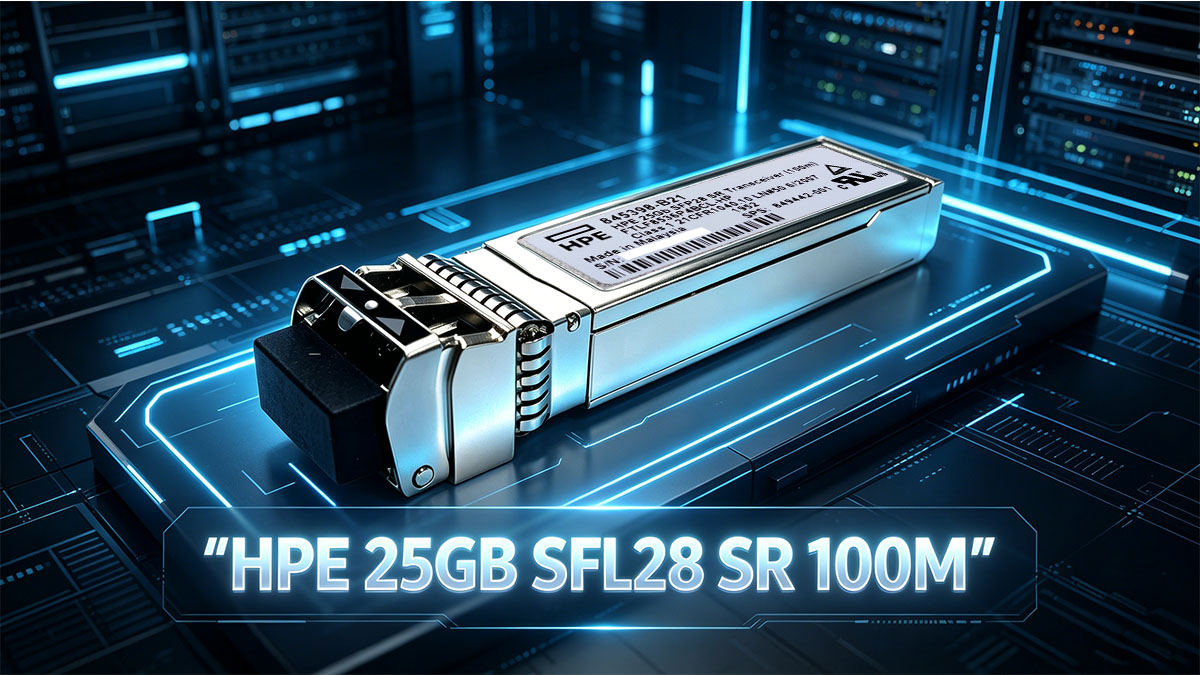
The HPE 25GB SFP28 SR 100M Transceiver is a 25GbE short-reach optical module designed for high-speed Ethernet connectivity over multimode fiber within data center environments. It delivers 25Gbps transmission using 850nm VCSEL technology and is optimized for links up to 100 meters, making it suitable for intra-rack and inter-rack network architectures where low latency and high bandwidth are required.
What Is the HPE 25GB SFP28 SR 100M Transceiver?
The HPE 25GB SFP28 SR 100M Transceiver is a short-reach optical module designed for 25GbE Ethernet connectivity over multimode fiber. It is primarily used to enable high-speed data transmission between servers, switches, and storage systems within modern data center environments, where low latency and high bandwidth are critical requirements.
This transceiver follows the 25GBASE-SR standard and operates using an 850nm VCSEL laser source, making it optimized for short-distance links typically up to 100 meters over OM4 multimode fiber. It provides a cost-efficient and standardized optical solution for intra-rack and inter-rack networking scenarios.
Key Features at a Glance
The HPE 25GB SFP28 SR 100M Transceiver is defined by a set of standardized optical and electrical characteristics that ensure stable 25GbE performance in high-density networking environments. These features are optimized to support predictable interoperability, power efficiency, and scalable deployment across modern data center infrastructures.
Before listing its key features, it is important to understand that this module is engineered to balance bandwidth efficiency, thermal stability, and compatibility with SFP28-based systems.
- 25Gbps data rate supporting high-throughput Ethernet links
- SFP28 hot-pluggable form factor enabling flexible deployment
- 850nm VCSEL-based optical transmission technology
- Duplex LC connector interface for multimode fiber connectivity
- Low power consumption optimized for dense switch environments
- IEEE 802.3by compliant design ensuring standardized interoperability
These features collectively ensure stable performance across compatible HPE networking platforms while maintaining consistent optical behavior under typical data center operating conditions.
Typical Network Environments
The HPE 25GB SFP28 SR 100M Transceiver is designed for short-reach, high-bandwidth optical connectivity scenarios where devices are located within the same facility or adjacent network layers. It is primarily used in structured data center architectures where predictable performance and scalability are required.
Before listing the typical environments, it is important to emphasize that this module is optimized for multimode fiber deployments and is not intended for long-haul transmission scenarios.
- Enterprise data center leaf-spine network architectures
- Cloud computing and virtualization clusters
- Top-of-Rack (ToR) and End-of-Row switch interconnects
- High-performance computing (HPC) environments
- Storage area networks (SAN) and NVMe-over-Fabrics systems
These deployment environments highlight the role of the module as a core optical component in modern 25GbE infrastructure, enabling efficient short-distance connectivity while supporting scalable network expansion strategies.
📠 HPE 25GB SFP28 SR 100M Transceiver Technical DataSheet Specifications
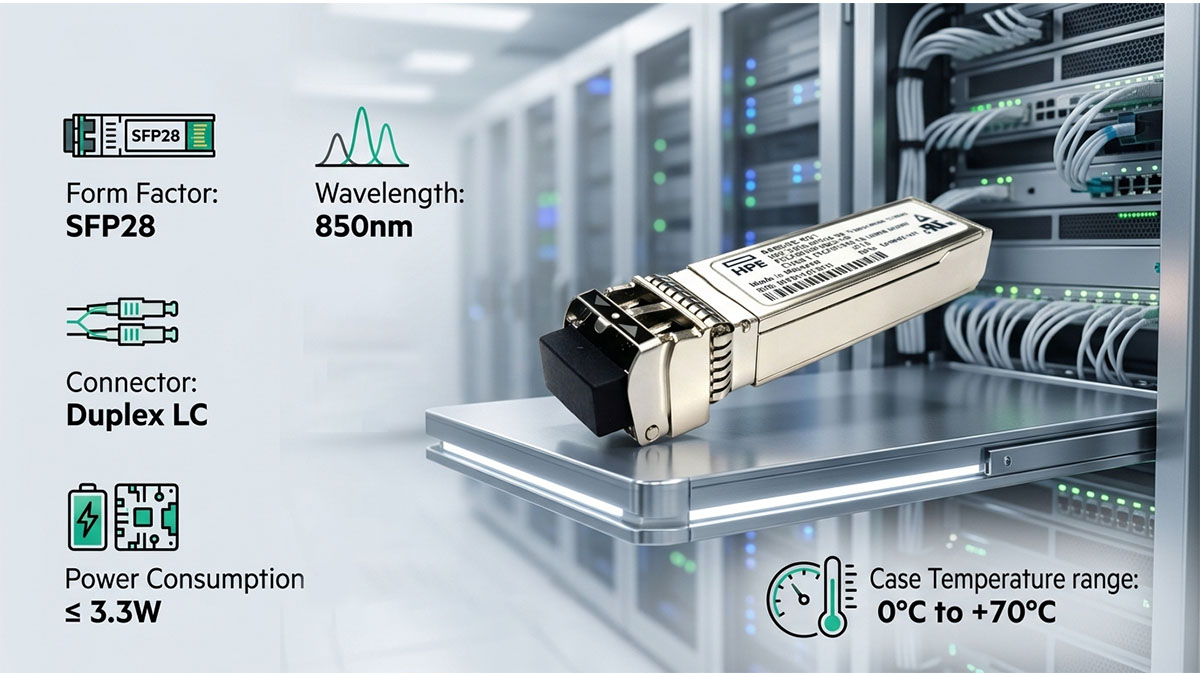
The HPE 25GB SFP28 SR 100M Transceiver is a standards-based 25GbE short-reach optical module designed for multimode fiber connectivity up to 100 meters. According to its Technical DataSheet, it is engineered for high-speed Ethernet transmission using 850nm VCSEL technology and SFP28 architecture, ensuring stable performance in dense data center environments with strict bandwidth and latency requirements.
Physical and Mechanical Specifications
The physical design of the HPE 25GB SFP28 SR 100M Transceiver is optimized for compact, hot-pluggable deployment in high-density switch environments. It follows standardized SFP28 form factor requirements to ensure compatibility across supported hardware platforms.
Before listing the key mechanical attributes, it is important to note that these specifications directly impact port density, airflow design, and rack-level integration in enterprise switches.
- SFP28 hot-pluggable form factor for flexible installation
- Duplex LC optical connector interface for multimode fiber
- Compact module structure optimized for high port density
- Lightweight design supporting large-scale deployments
- MSA-compliant mechanical footprint ensuring interoperability
These physical characteristics ensure the module can be deployed in space-constrained environments while maintaining consistent mechanical compatibility across HPE-supported systems.
Optical Specifications
The optical subsystem defines the transmission performance of the HPE 25GB SFP28 SR 100M Transceiver, which is optimized for short-reach multimode fiber links using 850nm wavelength VCSEL technology. These parameters determine the achievable link distance and signal quality.
Before detailing the optical parameters, it is important to emphasize that performance is closely tied to fiber type and installation quality, especially in OM3 and OM4 environments.
- Operating wavelength: 850nm
- Transmitter technology: VCSEL (Vertical-Cavity Surface-Emitting Laser)
- Fiber type support: Multimode fiber (OM3 / OM4)
- Maximum reach: 70m on OM3, up to 100m on OM4
- Duplex LC interface for bidirectional optical transmission
These optical parameters ensure reliable short-distance connectivity, making the module suitable for intra-data center links where signal integrity and controlled fiber infrastructure are maintained.
Electrical and Power Specifications
The electrical characteristics of the HPE 25GB SFP28 SR 100M Transceiver define its power efficiency and host interface compatibility. These specifications are critical for maintaining stable operation in high-density switching environments where power and thermal budgets are tightly controlled.
Before listing the values, it is important to understand that SFP28 modules operate within strict low-power envelopes to support scalable port deployments without excessive heat generation.
- Supply voltage: 3.3V nominal
- Maximum power consumption: approximately 1.5W
- High-speed electrical interface compliant with SFP28 standards
- Optimized signal integrity for 25Gbps lane operation
- Low-power design suitable for dense switch architectures
These electrical properties ensure predictable power behavior and compatibility with standard SFP28 host interfaces in enterprise and cloud networking equipment.
Performance and Data Rate Specifications
The performance characteristics of the HPE 25GB SFP28 SR 100M Transceiver define its operational capability in 25GbE networks, focusing on data throughput, signal integrity, and error performance.
Before detailing the parameters, it is important to highlight that these specifications are aligned with IEEE Ethernet requirements to ensure deterministic performance across compliant systems.
- Data rate: 25Gbps single-lane Ethernet
- Standard compliance: IEEE 802.3by (25GBASE-SR)
- Low bit error rate (BER) design for stable transmission
- Support for forward error correction (FEC) depending on host configuration
- Optimized latency characteristics for data center workloads
These performance parameters ensure that the module delivers consistent throughput required for modern high-bandwidth applications such as virtualization and storage networking.
Environmental and Reliability Specifications
The environmental specifications define the operational limits of the HPE 25GB SFP28 SR 100M Transceiver under real-world deployment conditions, ensuring stable performance across standard data center environments.
Before listing the parameters, it is important to note that environmental compliance is essential for long-term reliability and failure prevention in continuous-operation systems.
- Operating temperature range: 0°C to 70°C
- Storage temperature range: -40°C to 85°C
- Relative humidity tolerance: up to 85% non-condensing
- Designed for continuous operation in controlled environments
- Industrial-grade reliability for enterprise deployment
These environmental limits ensure the module can operate reliably under standard enterprise and cloud data center conditions without performance degradation.
Technical Specifications Table
The technical specifications of the HPE 25GB SFP28 SR 100M Transceiver are consolidated below to provide a clear, datasheet-style reference for optical, electrical, and environmental parameters. This table helps summarize the key engineering values discussed in the previous sections for quick evaluation and system planning.
Before reviewing the table, it is important to understand that these parameters define the operational boundaries of the module and ensure compatibility with IEEE 802.3by-compliant 25GbE infrastructure.
| Parameter | Specification |
|---|---|
| Form Factor | SFP28 |
| Data Rate | 25Gbps |
| Wavelength | 850nm |
| Connector | Duplex LC |
| Fiber Type | OM3 / OM4 Multimode Fiber |
| Maximum Distance | 70m (OM3), 100m (OM4) |
| Transmitter Technology | VCSEL |
| Receiver Type | PIN Photodiode |
| Supply Voltage | 3.3V |
| Typical Power Consumption | ~1.5W |
| Operating Temperature | 0°C to 70°C |
| Standards Compliance | IEEE 802.3by (25GBASE-SR), SFP28 MSA |
These consolidated specifications provide a quick technical snapshot of the module's core characteristics, enabling network engineers to assess compatibility, deployment feasibility, and optical performance within 25GbE data center environments.
📠 Understanding the 100-Meter Transmission Distance
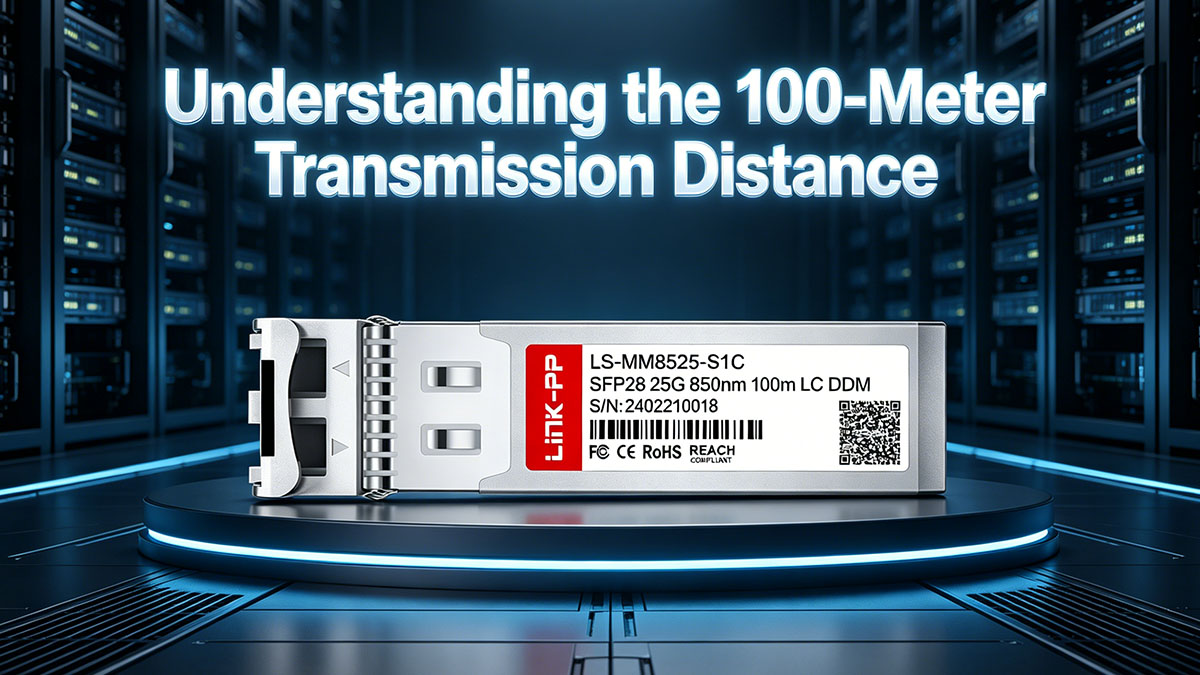
The 100-meter transmission distance of the HPE 25GB SFP28 SR 100M Transceiver is defined by IEEE 25GBASE-SR standards and multimode fiber characteristics, specifically optimized for OM4 fiber environments. This distance represents the maximum reliable optical reach under ideal conditions, ensuring stable 25Gbps data transmission within data center interconnects such as rack-to-rack or switch-to-server links.
The Meaning of 25GBASE-SR Reach Specifications
The 25GBASE-SR reach specification defines short-range optical transmission over multimode fiber using 850nm VCSEL technology. It establishes standardized performance expectations for 25GbE links in controlled environments.
Before listing key characteristics, it is important to highlight that SR (Short Reach) is optimized for high-density, low-latency data center deployments rather than long-distance communication.
- SR indicates short-reach multimode fiber transmission
- Based on IEEE 802.3by Ethernet standard
- Uses 850nm wavelength optimized for VCSEL lasers
- Designed for intra-data center connectivity
- Balanced for cost efficiency and high throughput
These characteristics ensure predictable performance across compliant hardware while maintaining simplified optical infrastructure requirements.
Supported Fiber Types
The HPE 25GB SFP28 SR 100M Transceiver supports standard multimode fiber types commonly deployed in enterprise data centers. These fiber categories directly determine achievable transmission distance and signal quality.
Before listing fiber types, it is important to note that fiber modal bandwidth plays a key role in limiting dispersion and maintaining signal integrity at 25Gbps speeds.
- OM3 multimode fiber: optimized for legacy high-speed short-reach links
- OM4 multimode fiber: enhanced bandwidth for extended reach performance
- Both fiber types use 50/125µm core structure
- OM4 provides improved modal bandwidth over OM3
- Compatibility depends on link budget and installation quality
These fiber types provide the physical medium for SR optics, with OM4 typically enabling full 100-meter performance under optimal conditions.
Distance and Fiber Comparison Table
The achievable transmission distance of the HPE 25GB SFP28 SR 100M Transceiver varies depending on fiber type and optical conditions. The table below summarizes typical performance expectations across supported multimode fiber categories.
Before reviewing the table, it is important to understand that real-world distance can be influenced by connector loss, patch panels, and installation quality.
| Fiber Type | Maximum Reach | Core Size | Typical Application |
|---|---|---|---|
| OM3 MMF | Up to 70m | 50/125µm | Standard enterprise short-reach links |
| OM4 MMF | Up to 100m | 50/125µm | High-density data center interconnects |
This comparison highlights how OM4 fiber extends usable reach by reducing modal dispersion and improving effective bandwidth at 25Gbps transmission rates.
Factors Influencing Link Distance
The actual achievable distance of the HPE 25GB SFP28 SR 100M Transceiver is influenced by multiple physical and environmental factors beyond theoretical specifications. These factors determine real-world optical performance in deployed networks.
Before listing key influences, it is important to emphasize that maintaining optical cleanliness and proper installation practices is critical for achieving rated distances.
- Connector insertion loss from LC interfaces
- Fiber attenuation due to cable quality and aging
- Patch panel and interconnect losses in structured cabling
- Contamination from dust or improper cleaning
- Installation bending radius violations affecting signal integrity
These factors collectively impact the optical budget and can reduce effective transmission distance if not properly controlled in structured cabling environments.
📠 Supported Standards and Compliance
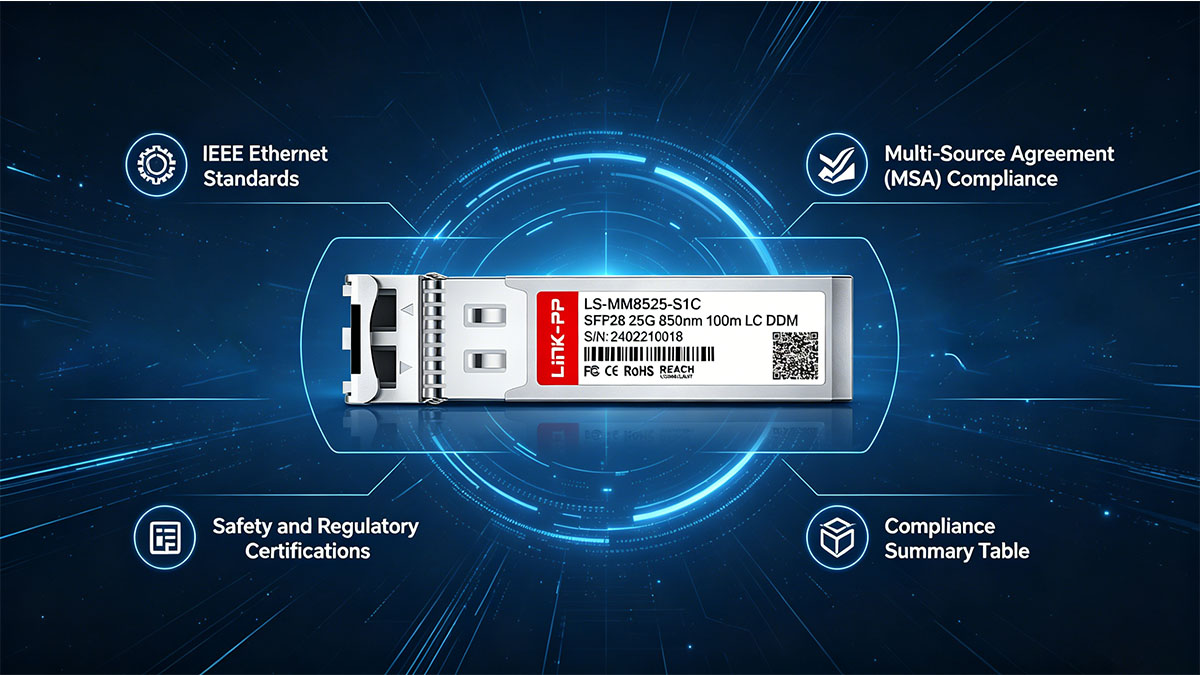
The HPE 25GB SFP28 SR 100M Transceiver is built to comply with established industry standards that govern 25GbE optical transmission, mechanical design, and safety requirements. These standards ensure interoperability across multi-vendor environments and guarantee predictable performance within IEEE-defined Ethernet architectures.
IEEE Ethernet Standards
The optical and electrical behavior of the HPE 25GB SFP28 SR 100M Transceiver is defined primarily by IEEE Ethernet specifications, which ensure consistent 25Gbps transmission performance across compliant devices.
Before listing the key standards, it is important to emphasize that IEEE compliance is essential for guaranteeing interoperability at the physical layer in high-speed Ethernet networks.
- IEEE 802.3by standard for 25GbE physical layer operation
- 25GBASE-SR specification for short-reach multimode fiber links
- Defined 25Gbps single-lane electrical and optical signaling
- Standardized 850nm VCSEL-based transmission requirements
- Ensures compatibility across IEEE-compliant network devices
These standards establish the fundamental framework for optical signaling, ensuring that the module operates consistently within modern 25GbE Ethernet infrastructures.
Multi-Source Agreement (MSA) Compliance
In addition to IEEE standards, the HPE 25GB SFP28 SR 100M Transceiver follows SFP28 Multi-Source Agreement (MSA) specifications, which define mechanical and electrical interoperability between different manufacturers.
Before listing key aspects, it is important to note that MSA compliance is what allows SFP28 modules to function across standardized ports regardless of vendor origin.
- SFP28 MSA form factor standardization
- Defined electrical interface and connector alignment
- Hot-pluggable module architecture compliance
- Standardized module dimensions for cross-vendor compatibility
- I2C communication protocol for host-module interaction
These MSA requirements ensure seamless integration into compliant networking equipment without requiring proprietary modifications.
Safety and Regulatory Certifications
The HPE 25GB SFP28 SR 100M Transceiver also adheres to global safety and environmental regulations, ensuring it meets operational, environmental, and laser safety requirements for enterprise deployment.
Before listing the certifications, it is important to highlight that regulatory compliance ensures safe operation in continuous-use data center environments.
- Laser safety compliance (Class 1 laser product standards)
- RoHS environmental compliance for hazardous substance restriction
- EMC (Electromagnetic Compatibility) requirements for signal integrity
- Environmental compliance for electronic equipment operation
- Industry-standard safety certifications for optical transceivers
These certifications confirm that the module meets international safety and environmental requirements, making it suitable for deployment in regulated enterprise and cloud infrastructure environments.
Compliance Summary Table
To provide a concise technical reference, the following table summarizes the key standards and compliance frameworks supported by the HPE 25GB SFP28 SR 100M Transceiver.
Before reviewing the table, it is important to understand that these compliance layers collectively ensure interoperability, safety, and long-term deployment stability.
| Standard | Description |
|---|---|
| IEEE 802.3by | Defines 25GbE physical layer and 25GBASE-SR operation |
| SFP28 MSA | Ensures mechanical and electrical interoperability |
| RoHS | Restricts hazardous substances in electronic components |
| Laser Safety Class 1 | Ensures safe operation of optical laser transmission |
| EMC Compliance | Maintains electromagnetic compatibility in network environments |
These compliance standards collectively define the operational legitimacy of the module within global networking infrastructure, ensuring both technical compatibility and regulatory approval.
📠 Compatibility with HPE Networking Platforms
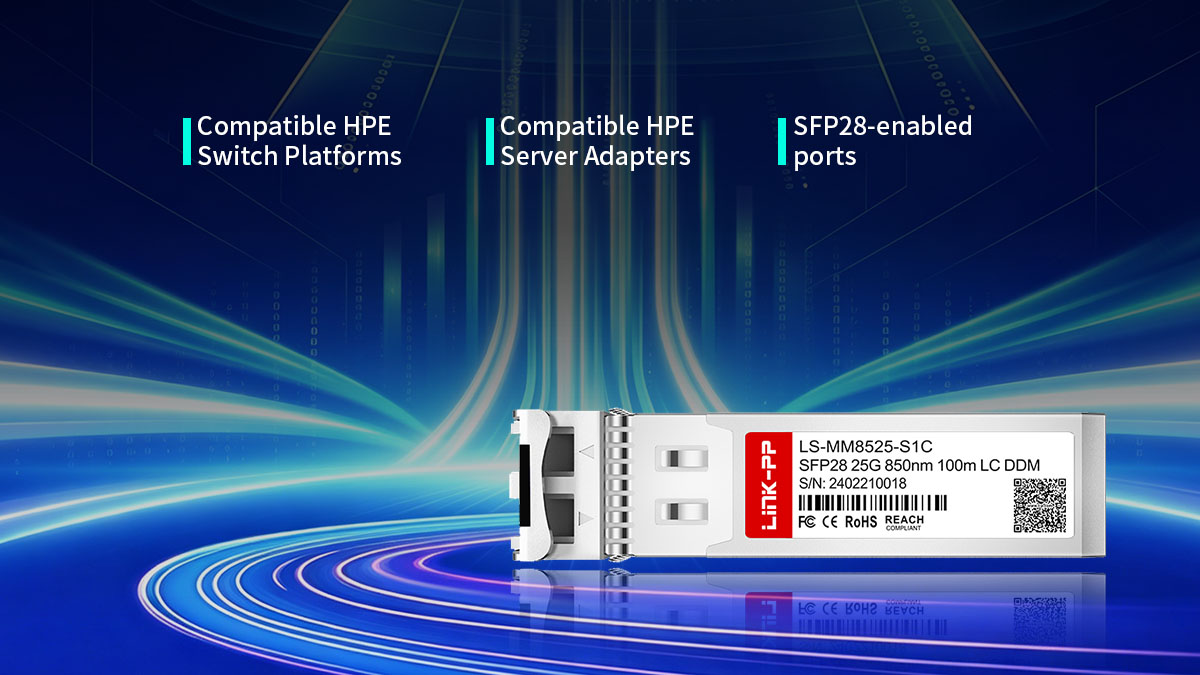
The HPE 25GB SFP28 SR 100M Transceiver is designed for seamless integration with HPE networking equipment that supports SFP28 25GbE interfaces. Its compatibility is defined by both physical SFP28 port support and firmware-level recognition within HPE switch and server ecosystems, ensuring stable operation in standardized 25GbE deployments.
Compatible HPE Switch Platforms
The transceiver is primarily used in HPE switch platforms that support 25GbE SFP28 interfaces, enabling high-density optical connectivity in data center switching architectures.
Before listing compatible environments, it is important to note that support may vary depending on switch generation, port configuration, and installed firmware version.
- HPE data center switches with native SFP28 25GbE ports
- Leaf-spine architecture switches supporting 25GbE uplinks
- Modular switches with SFP28 line card support
- High-density aggregation switches in enterprise environments
- Platforms designed for cloud-scale Ethernet fabrics
These switch platforms enable the module to function as part of scalable Ethernet infrastructures, supporting high-throughput and low-latency traffic patterns across modern data centers.
Compatible HPE Server Adapters
In addition to switching platforms, the HPE 25GB SFP28 SR 100M Transceiver is compatible with HPE server network adapters that provide SFP28 interfaces for high-speed host connectivity.
Before listing adapter compatibility, it is important to highlight that server-side support is essential for end-to-end 25GbE deployment in virtualization and storage-heavy environments.
- HPE 25GbE SFP28 network interface cards (NICs)
- Server adapters designed for virtualization workloads
- High-performance computing (HPC) network interface modules
- Dual-port and multi-port SFP28 adapter configurations
- Data center NICs supporting 25GBASE-SR optical links
These adapters enable direct server connectivity to high-speed switching fabrics, reducing bottlenecks in compute-intensive and storage-intensive workloads.
Host System Requirements
Proper operation of the HPE 25GB SFP28 SR 100M Transceiver depends on host system readiness, including hardware support, firmware compatibility, and optical configuration alignment.
Before listing key requirements, it is important to understand that even physically compatible modules may require firmware validation to ensure full functionality and monitoring support.
- SFP28-compatible 25GbE optical ports on host devices
- Updated firmware supporting third-party or HPE-certified optics
- Proper port configuration for 25GBASE-SR operation
- Support for digital diagnostic monitoring (DDM) functions
- Correct link negotiation settings for 25GbE Ethernet mode
These system-level requirements ensure that the module can operate reliably within the host environment while maintaining full performance and monitoring capabilities.
Compatibility Overview Table
The table below summarizes the compatibility scope of the HPE 25GB SFP28 SR 100M Transceiver across different HPE networking system types.
Before reviewing the table, it is important to understand that compatibility depends on both hardware support and firmware validation within each platform category.
| Platform Type | Compatibility Considerations |
|---|---|
| HPE Switches | SFP28 25GbE ports, firmware validation required |
| HPE Server NICs | 25GbE SFP28 adapters with SR support |
| HPE Servers | Requires compatible network adapters and BIOS support |
| Storage Systems | Supports 25GbE connectivity in converged architectures |
This compatibility structure ensures that the transceiver can be deployed consistently across HPE infrastructure components, enabling unified 25GbE connectivity across compute, storage, and networking layers.
📠 Hardware Architecture and Internal Design
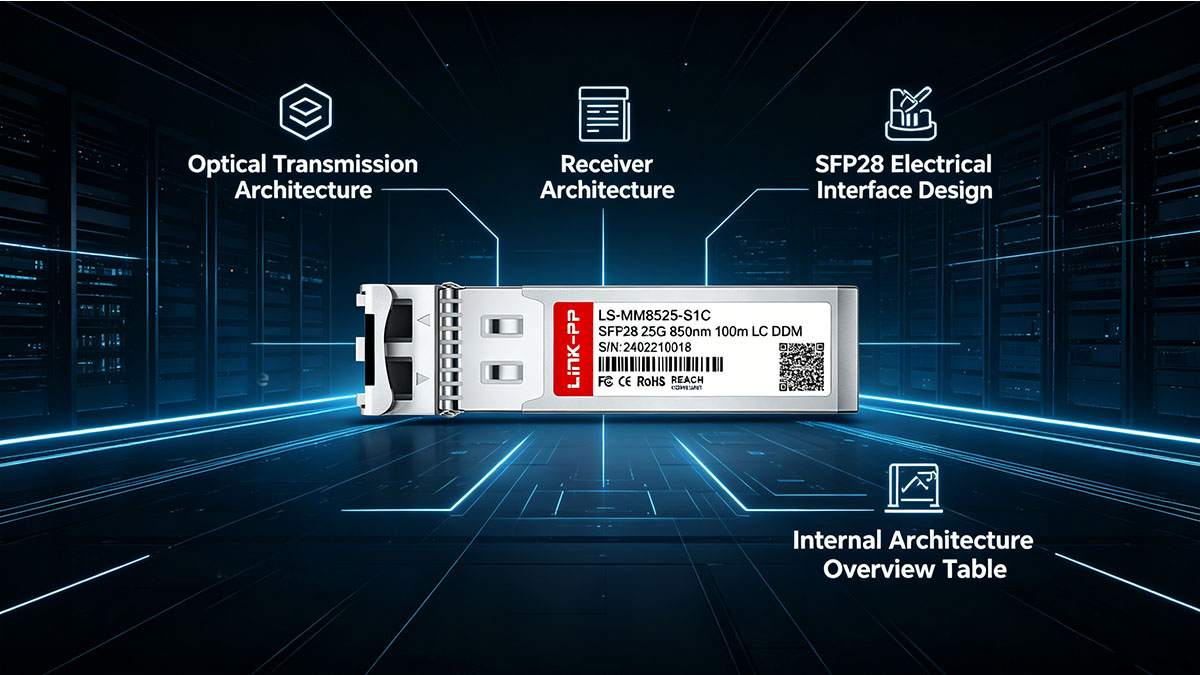
The HPE 25GB SFP28 SR 100M Transceiver is built on a compact optical-electrical architecture that integrates high-speed laser transmission, optical signal reception, and digital control logic within an SFP28 form factor. Its internal design is optimized for 25Gbps short-reach communication over multimode fiber, ensuring stable signal integrity, low power consumption, and consistent performance in dense data center environments.
Optical Transmission Architecture
The optical transmission architecture of the HPE 25GB SFP28 SR 100M Transceiver is responsible for converting high-speed electrical signals into optical signals for transmission over multimode fiber using 850nm wavelength light.
Before listing the core components, it is important to highlight that this subsystem is optimized for short-reach performance using VCSEL technology, which provides high modulation efficiency at low power levels.
- VCSEL (Vertical-Cavity Surface-Emitting Laser) used as optical source
- Electrical-to-optical conversion for 25Gbps data streams
- 850nm wavelength optimized for multimode fiber transmission
- Direct modulation for high-speed signal encoding
- Short-reach optimization for reduced dispersion effects
This architecture ensures efficient optical signal generation with minimal power loss, enabling stable transmission within OM3 and OM4 fiber environments.
Receiver Architecture
The receiver architecture is designed to convert incoming optical signals back into electrical signals while maintaining signal integrity and minimizing noise-induced errors.
Before detailing the components, it is important to note that receiver sensitivity and noise filtering are critical for maintaining low bit error rates in 25GbE short-reach links.
- PIN photodiode for optical signal detection
- Optical-to-electrical conversion for received data streams
- Integrated signal amplification and conditioning circuitry
- Noise suppression mechanisms for improved signal clarity
- Clock and data recovery (CDR) functionality for timing accuracy
This receiver design ensures that incoming optical signals are accurately reconstructed into high-speed electrical data suitable for host processing.
SFP28 Electrical Interface Design
The electrical interface design defines how the transceiver communicates with the host system through the SFP28 connector, enabling 25Gbps high-speed electrical signaling.
Before listing key characteristics, it is important to emphasize that signal integrity at this speed requires strict impedance control and low-jitter electrical design.
- Single-lane 25Gbps electrical interface compliant with SFP28 standard
- High-speed differential signaling for reduced electromagnetic interference
- Controlled impedance PCB design for signal integrity
- Low-latency electrical path between host and optical engine
- Hot-pluggable electrical connector architecture
This interface ensures reliable high-speed data transfer between the transceiver and the host device while maintaining compliance with SFP28 electrical specifications.
Internal Architecture Overview Table
The internal architecture of the HPE 25GB SFP28 SR 100M Transceiver can be summarized by its key functional blocks, each responsible for a specific role in optical communication and module control.
Before reviewing the table, it is important to understand that these components operate in a tightly integrated manner to maintain stable 25GbE performance.
| Component | Function |
|---|---|
| VCSEL Transmitter | Converts electrical signals into optical output at 850nm |
| PIN Receiver | Detects incoming optical signals and converts them to electrical form |
| Signal Processing IC | Manages signal conditioning, timing, and data integrity |
| Clock/Data Recovery (CDR) | Reconstructs timing signals for accurate data synchronization |
| EEPROM Memory | Stores module identity, calibration data, and diagnostics |
These internal components collectively define the module's ability to deliver stable, high-speed optical communication while ensuring compliance with standardized 25GbE network requirements.
📠 Electrical Characteristics and Power Requirements
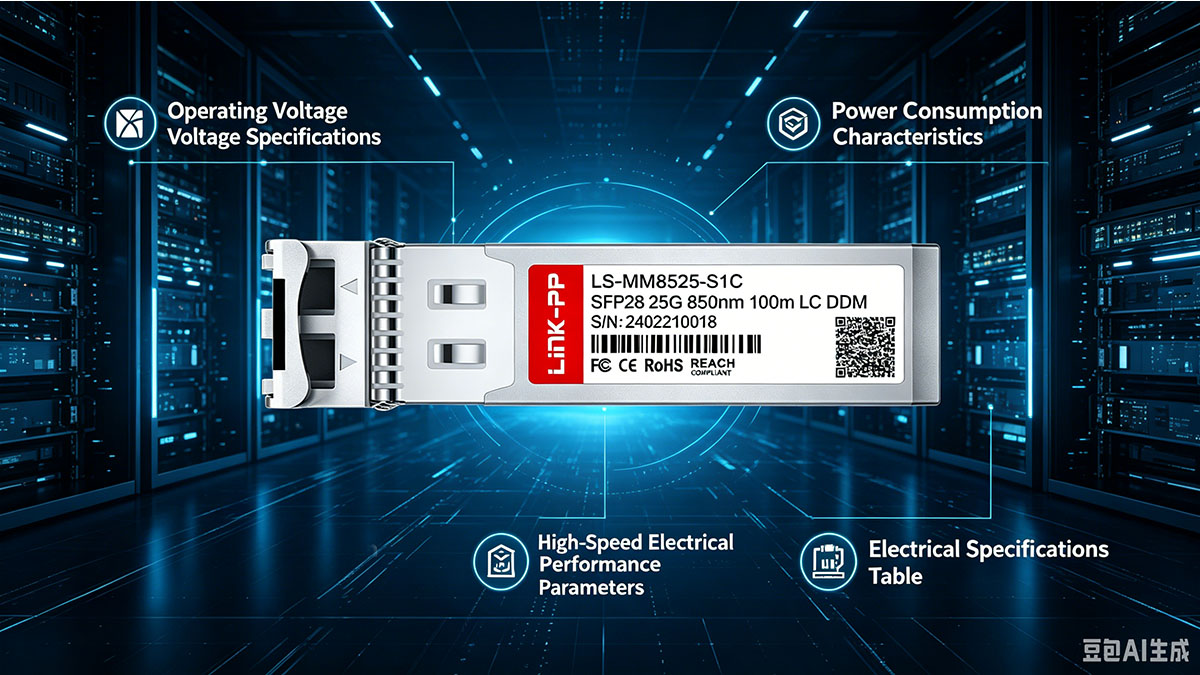
The electrical characteristics and power requirements of the HPE 25GB SFP28 SR 100M Transceiver define how the module interacts with the host system in terms of voltage supply, current consumption, and high-speed signal behavior. These parameters are critical for ensuring stable 25Gbps operation while maintaining low power usage in high-density data center environments.
Operating Voltage Specifications
The HPE 25GB SFP28 SR 100M Transceiver operates under a standardized low-voltage power supply architecture designed for compatibility with SFP28 host systems.
Before listing the key parameters, it is important to note that voltage stability directly impacts optical output consistency and overall link reliability.
- Nominal supply voltage: 3.3V DC
- Voltage tolerance range designed for standard SFP28 hosts
- Stable power input required for consistent optical output performance
- Internal regulation circuitry for voltage conditioning
- Compatibility with standard hot-plug power delivery systems
These voltage specifications ensure that the module can operate reliably across supported HPE platforms without requiring additional external power conditioning.
Power Consumption Characteristics
Power consumption is a key design consideration for the HPE 25GB SFP28 SR 100M Transceiver, especially in high-density switching environments where dozens or hundreds of modules may operate simultaneously.
Before listing the key power parameters, it is important to emphasize that low power operation directly reduces heat generation and improves overall system efficiency.
- Typical power consumption around low-watt level (~1.5W class)
- Optimized energy efficiency for 25Gbps VCSEL operation
- Low thermal output suitable for dense port configurations
- Power scaling dependent on link activity and operating conditions
- Designed to support large-scale deployment without excessive power load
These characteristics make the module suitable for modern data centers where power efficiency is a critical operational requirement.
High-Speed Electrical Performance Parameters
The electrical performance of the HPE 25GB SFP28 SR 100M Transceiver ensures reliable 25Gbps signal transmission between the host system and the optical engine. These parameters define signal quality, timing accuracy, and overall transmission stability.
Before listing the key performance attributes, it is important to understand that electrical signal integrity is essential for minimizing bit errors and ensuring compliance with 25GBASE-SR standards.
- 25Gbps single-lane high-speed differential signaling
- Low jitter electrical interface for stable data transmission
- Controlled impedance design for signal integrity preservation
- High signal-to-noise ratio (SNR) for reliable data recovery
- Compliance with SFP28 electrical interface standards
These electrical performance parameters ensure that high-speed data transmission remains stable even in densely populated switching environments with multiple active optical modules.
Electrical Specifications Table
The following table summarizes the key electrical characteristics of the HPE 25GB SFP28 SR 100M Transceiver for quick reference in system design and compatibility assessment.
Before reviewing the table, it is important to note that these values define the electrical operating envelope of the module within SFP28-compliant systems.
| Parameter | Specification |
|---|---|
| Supply Voltage | 3.3V DC |
| Maximum Current | Defined within SFP28 power class limits |
| Typical Power Consumption | ~1.5W |
| Electrical Interface | SFP28 single-lane 25Gbps |
| Signaling Rate | 25.78125Gbps (Ethernet line rate) |
| Signal Type | High-speed differential signaling |
These electrical specifications ensure stable integration into SFP28-based networking systems while maintaining predictable power behavior and high-speed signal integrity across enterprise and data center deployments.
📠 Digital Diagnostic Monitoring (DDM) Capabilities
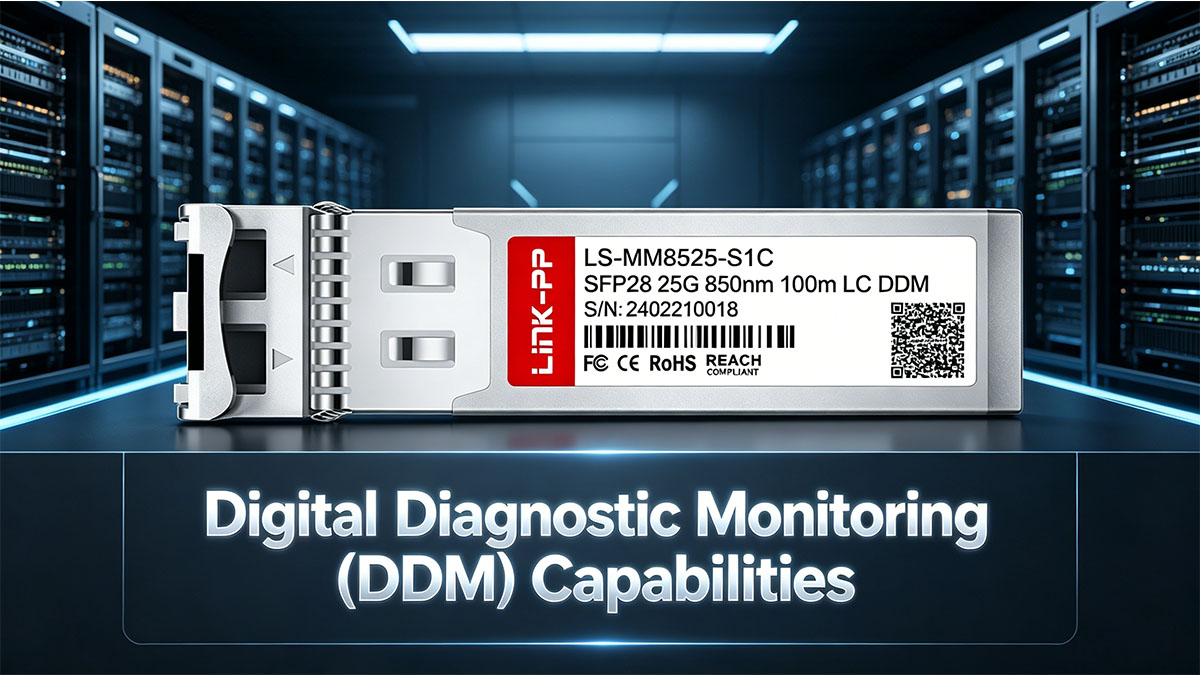
The Digital Diagnostic Monitoring (DDM) capabilities of the HPE 25GB SFP28 SR 100M Transceiver provide real-time visibility into key operating conditions of the optical module. These diagnostics enable continuous monitoring of optical performance, electrical status, and environmental conditions, helping ensure stable 25GbE link operation in data center environments.
Overview of Digital Diagnostics
The DDM system integrated into the HPE 25GB SFP28 SR 100M Transceiver allows the host device to access real-time operational data from the module through a standardized management interface. This enables proactive monitoring and operational transparency at the optical layer.
Before listing key functions, it is important to note that DDM operates continuously during module operation without impacting data transmission performance.
- Real-time monitoring of optical and electrical parameters
- Integration with host system management interfaces (I2C-based access)
- Continuous health tracking of transceiver operating conditions
- Support for fault detection and performance degradation alerts
- Non-intrusive monitoring without affecting data throughput
These diagnostic functions provide essential visibility into module behavior, enabling network administrators to maintain stable performance across 25GbE deployments.
Supported Monitoring Parameters
The DDM feature set covers multiple critical parameters that reflect the health and performance of both optical and electrical components inside the transceiver.
Before listing the parameters, it is important to emphasize that these values are continuously updated and used for real-time system diagnostics and predictive maintenance.
- Module temperature monitoring for thermal stability assessment
- Supply voltage tracking to ensure electrical consistency
- Transmit optical power measurement for output validation
- Receive optical power monitoring for link quality evaluation
- Laser bias current tracking for transmitter health analysis
These parameters collectively provide a complete operational profile of the transceiver, enabling early detection of performance degradation or potential failure conditions.
Benefits of Diagnostic Visibility
The DDM functionality significantly enhances operational reliability by enabling proactive maintenance and faster troubleshooting in 25GbE optical networks.
Before listing the key benefits, it is important to highlight that diagnostic visibility reduces downtime and improves long-term network stability in large-scale deployments.
- Early detection of optical signal degradation
- Improved fault isolation in high-density environments
- Enhanced predictive maintenance capabilities
- Reduced mean time to repair (MTTR) in network failures
- Continuous monitoring of link health and stability
These benefits ensure that network operators can maintain consistent performance levels while minimizing unexpected disruptions in critical infrastructure.
DDM Parameters Table
The table below summarizes the key diagnostic parameters supported by the HPE 25GB SFP28 SR 100M Transceiver and their functional roles in system monitoring.
Before reviewing the table, it is important to understand that these parameters form the foundation of optical module health tracking in modern 25GbE systems.
| Diagnostic Parameter | Purpose |
|---|---|
| Temperature | Monitors internal thermal conditions of the module |
| Supply Voltage | Tracks stability of power input |
| TX Optical Power | Measures transmitted optical signal strength |
| RX Optical Power | Evaluates incoming optical signal quality |
| Laser Bias Current | Indicates transmitter laser operating condition |
These DDM parameters provide a comprehensive diagnostic framework that supports stable operation, performance optimization, and long-term reliability of the HPE 25GB SFP28 SR 100M Transceiver in enterprise and data center networks.
📠 EEPROM Memory and Module Identification
The EEPROM memory and module identification system of the HPE 25GB SFP28 SR 100M Transceiver provides a standardized method for storing, retrieving, and communicating essential module information to the host system. This enables automatic recognition, configuration validation, and inventory management in SFP28-based 25GbE network environments.
EEPROM Function Overview
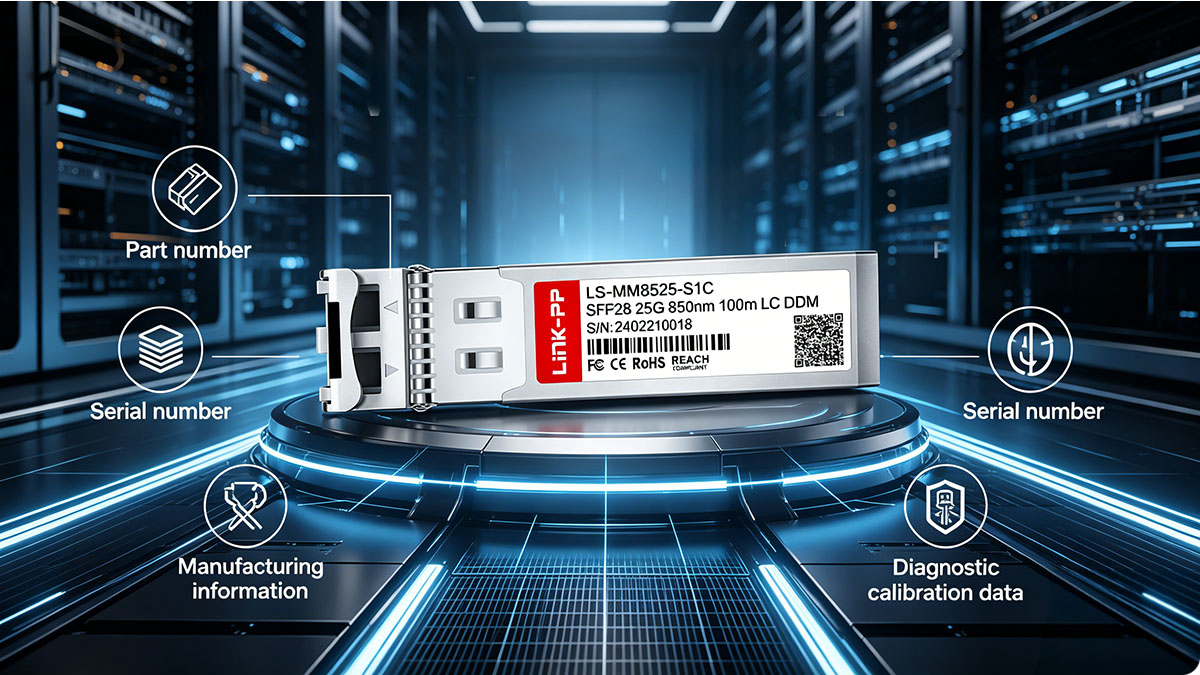
The EEPROM (Electrically Erasable Programmable Read-Only Memory) inside the HPE 25GB SFP28 SR 100M Transceiver stores configuration and identification data that can be accessed by the host system during initialization and runtime. This allows the module to be automatically recognized without manual configuration.
Before listing key functions, it is important to note that EEPROM communication is typically handled via a standardized I2C interface defined by the SFP28 MSA specification.
- Stores permanent module identification and configuration data
- Enables automatic detection by compatible host systems
- Supports plug-and-play operation in SFP28 ports
- Provides calibration data for optical performance accuracy
- Facilitates firmware-independent module recognition
These functions ensure that the transceiver can be seamlessly integrated into compatible networking hardware while maintaining consistent operational behavior.
Stored Information Categories
The EEPROM memory contains multiple categories of structured data that define both the identity and operational characteristics of the module. This information is essential for system validation and lifecycle management.
Before listing the categories, it is important to emphasize that this data is factory-programmed and remains accessible throughout the module's operational life.
- Vendor identification information for manufacturer traceability
- Product part number for hardware classification
- Unique serial number for asset tracking and inventory control
- Manufacturing date and batch information for lifecycle management
- Calibration data for optical performance optimization
These stored parameters ensure accurate identification and enable network systems to manage optical modules efficiently across large-scale deployments.
Host-System Communication
The EEPROM interface allows the host system to communicate with the transceiver through a standardized digital protocol, enabling real-time access to identification and configuration data.
Before listing key communication features, it is important to note that this interaction is essential for automated network provisioning and monitoring.
- I2C-based communication interface for data exchange
- Real-time retrieval of module identification data
- Automatic module recognition during system boot or insertion
- Support for network inventory and asset management systems
- Integration with network automation and orchestration tools
This communication mechanism ensures that the transceiver is fully recognized and properly configured within compatible network infrastructure without manual intervention.
EEPROM Information Table
The EEPROM memory structure contains key identification fields that are used by host systems to define module identity and operational parameters.
Before reviewing the table, it is important to understand that these fields are standardized across SFP28 modules to ensure interoperability.
| Information Type | Description |
|---|---|
| Vendor Name | Identifies the manufacturer of the transceiver |
| Part Number | Defines the specific module model designation |
| Serial Number | Provides a unique identifier for tracking and inventory |
| Manufacturing Data | Includes production date and batch information |
| Calibration Information | Stores factory-tuned optical performance parameters |
These EEPROM-stored values ensure accurate module identification, consistent system integration, and efficient lifecycle management within 25GbE optical networking environments.
📠 Conclusion
The HPE 25GB SFP28 SR 100M Transceiver Technical DataSheet demonstrates that this module is a standards-compliant 25GbE short-reach optical solution designed for multimode fiber connectivity up to 100 meters. Built on IEEE 802.3by and SFP28 MSA specifications, it integrates 850nm VCSEL optical technology, precise electrical signaling, and advanced diagnostic capabilities to support stable high-speed data transmission in modern data center environments. From a technical perspective, its balanced design across optical, electrical, mechanical, and monitoring subsystems makes it a reliable component for scalable 25GbE infrastructure deployments.
The most critical technical characteristics of the HPE 25GB SFP28 SR 100M Transceiver can be summarized into core functional areas that define its performance and compatibility profile.
Before listing the key points, it is important to emphasize that these highlights represent the essential parameters that determine real-world deployment suitability and system-level integration.
- 25Gbps data transmission based on IEEE 802.3by 25GBASE-SR standard
- 850nm VCSEL-based optical engine optimized for multimode fiber
- Up to 100m reach on OM4 fiber with stable link performance
- SFP28 hot-pluggable form factor for high-density switching environments
- Integrated DDM (Digital Diagnostic Monitoring) for real-time health visibility
- EEPROM-based identification enabling automatic system recognition
- Low-power electrical design suitable for large-scale deployments
- Full compliance with industry safety and interoperability standards
These core points define the module's role as a standardized and efficient optical interconnect solution for modern 25GbE network architectures.
From a system design perspective, the HPE 25GB SFP28 SR 100M Transceiver provides a well-balanced combination of performance, reliability, and interoperability, making it suitable for enterprise data centers, cloud infrastructure, and high-density switching environments where predictable optical behavior is essential. Its datasheet-defined parameters ensure consistent integration across compliant networking platforms while supporting long-term scalability of 25GbE architectures.
For organizations evaluating optical transceiver solutions within standardized 25GbE environments, accessing verified specifications and compatible optical modules is essential for ensuring deployment stability and performance consistency. More detailed product references and optical connectivity solutions can be explored through the LINK-PP Official Store, where a wide range of data center interconnect components are available to support high-speed networking infrastructure planning and expansion.







