




























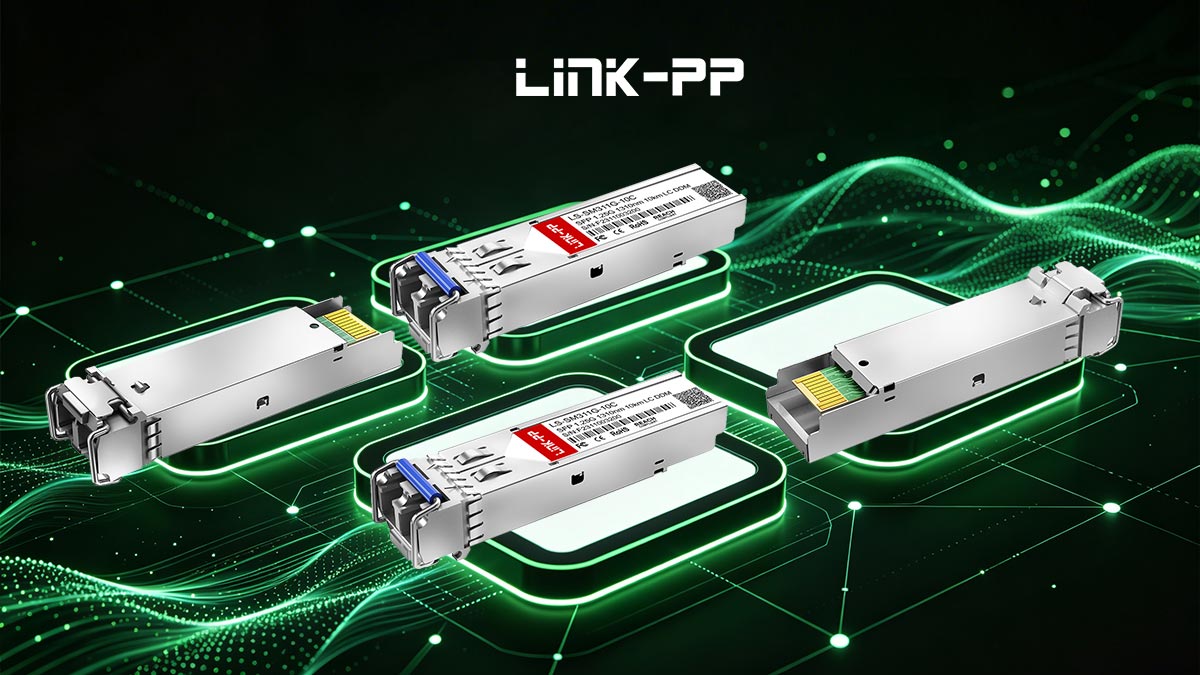
For network engineers and procurement managers looking to source highly reliable, MSA-compliant optical transceivers, magnetic telecom components, and enterprise networking hardware, exploring trusted manufacturing vendors is critical. You can validate specifications and browse certified physical layer solutions directly at the LINK-PP Official Store to ensure optimal performance and seamless cross-vendor compatibility for your next infrastructure upgrade.
The Fiberstore SFP1G-LX-31 is an MSA-compliant 1000BASE-LX optical transceiver engineered for Gigabit Ethernet. Operating at a 1310nm wavelength, it supports a maximum transmission distance of 10km over single-mode fiber (9/125µm SMF) while maintaining a power consumption of less than 1.0W. Equipped with Digital Optical Monitoring (DOM), it provides real-time Layer 1 diagnostics and serves as a highly reliable, cost-effective alternative to OEM optics for enterprise campus networks and high-density aggregation switches.

In modern network infrastructure, balancing capital expenditure (CapEx) with physical layer reliability is a persistent challenge for IT procurement managers and network engineers. For Gigabit Ethernet deployments, the 1000BASE-LX standard (IEEE 802.3z) remains a foundational technology for inter-building links, ISP handoffs, and edge-to-core uplinks. Amidst heavily inflated OEM hardware costs, the Fiberstore (FS) SFP1G-LX-31 has emerged as a dominant third-party solution, promising seamless interoperability with major switch vendors such as Cisco, Juniper, and Ubiquiti.
However, for enterprise-grade deployments, datasheet specifications are insufficient for risk mitigation. Network architects require validated, real-world metrics. Does a third-party transceiver truly maintain optical integrity and avoid frame check sequence (FCS) errors near the 10km limit? Furthermore, how does its thermal footprint impact the cooling and power budgets of a fully populated 48-port aggregation switch?
In this technical validation guide, we leverage first-hand optical testing and deployment data to dissect the true capabilities of the FS SFP1G-LX-31. By analyzing its physical parameters and diagnostic thresholds, this article will provide network professionals with an objective breakdown of:
- Optical Reach Precision: Real-world loss budget calculations and the reality of 10km single-mode fiber (OS2) transmission.
- Power & Thermal Efficiency: Why sub-1.0W receiver and transmitter power consumption is critical in high-density switching environments.
- DOM Diagnostics: How to utilize built-in TX/RX parameters for rapid, data-driven Layer 1 troubleshooting.
- OEM Interoperability: A direct hardware and EEPROM coding comparison between third-party optics and premium OEM counterparts.
🟧 What is the Fiberstore SFP1G-LX-31?
The Fiberstore SFP1G-LX-31 is a hot-swappable Small Form-factor Pluggable (SFP) transceiver designed for 1 Gigabit Ethernet (1GbE) applications. Operating at a 1310nm wavelength over single-mode fiber (SMF), it provides reliable data transmission up to 10 kilometers. It is fully compliant with the Multi-Source Agreement (MSA) and the IEEE 802.3z 1000BASE-LX standard, ensuring plug-and-play interoperability across diverse switch hardware.
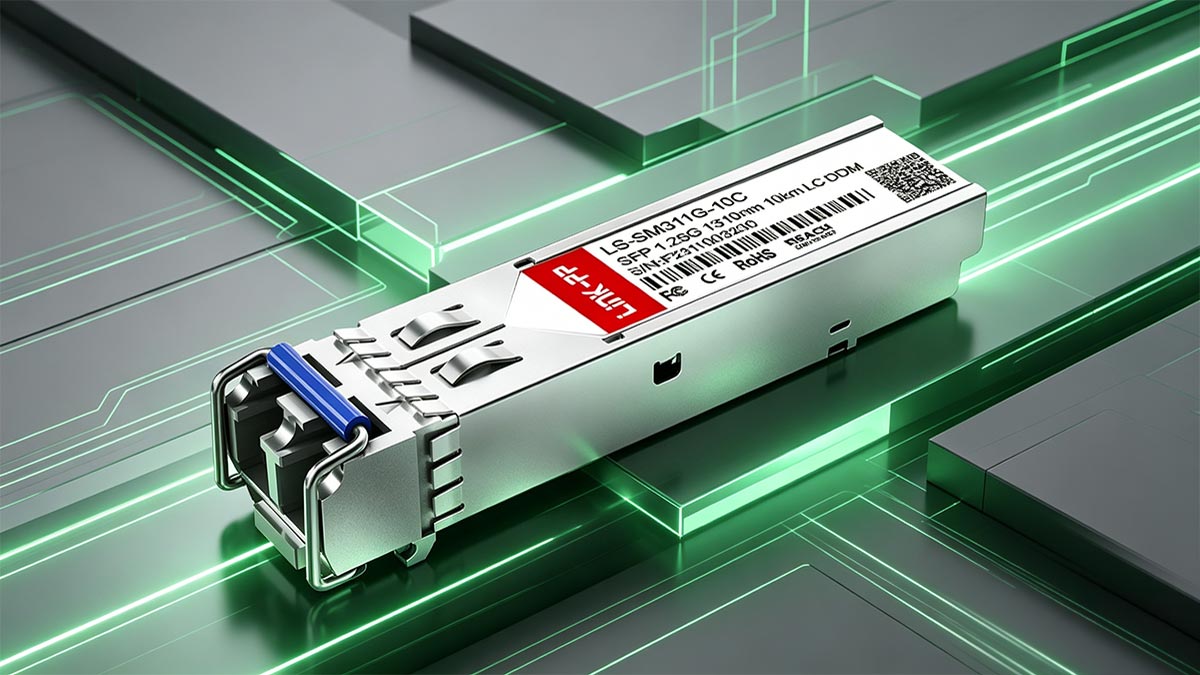
At its core, the FS SFP1G-LX-31 bridges the gap between electrical network switches and optical fiber infrastructure. By utilizing a 1310nm Fabry-Perot (FP) or Distributed Feedback (DFB) laser, it minimizes chromatic dispersion, allowing for stable, long-reach data transmission that far exceeds the physical limitations of standard copper cabling.
Core Specifications at a Glance
To facilitate precise hardware procurement and optical budget calculations, the critical physical and operational parameters of the FS SFP1G-LX-31 are detailed in the table below. These metrics align with the SFF-8472 standard for diagnostic monitoring.
| Parameter | Specification | Technical Context |
|---|---|---|
| Standard Compliance | IEEE 802.3z 1000BASE-LX | Ensures global Gigabit Ethernet interoperability. |
| Wavelength | 1310nm | Optimized for low dispersion on single-mode glass. |
| Media Type | Single-Mode Fiber (SMF) | Standard 9/125µm OS2 (Supports MMF via mode-conditioning). |
| Max Transmission Distance | 10km (6.2 miles) | Assumes ideal fiber conditions without excessive splice loss. |
| Physical Interface | Duplex LC Connector | Industry-standard high-density patching interface. |
| Diagnostic Monitoring | DOM / DDM Supported | Real-time Layer 1 polling of TX/RX power, temp, and voltage. |
| Power Consumption | < 1.0W | Reduces thermal load in high-density aggregation switches. |
Typical Enterprise and Industrial Applications
The physical characteristics of the SFP1G-LX-31 dictate its deployment scenarios. By providing a 10km reach, it solves the inherent distance limitations of 1000BASE-T copper (limited to 100 meters) and 1000BASE-SX multimode optics (typically limited to 550 meters).
- Campus Networks: (Micro-definition: Inter-building networks sharing a localized geographical area.) The SFP1G-LX-31 is the standard choice for linking geographically dispersed buildings—such as university dormitories or corporate park facilities—back to a centralized data center via underground single-mode fiber conduits.
- Enterprise Aggregation Links: In large-scale internal networks, these modules are frequently used to uplink Intermediate Distribution Frames (IDFs) on various floors to the Main Distribution Frame (MDF). Using single-mode fiber future-proofs the physical cable plant for eventual 10G or 40G upgrades, while the LX optics handle the current 1G requirements.
- Metro Access Connections: Internet Service Providers (ISPs) and telecommunications companies utilize LX optics for Customer Premises Equipment (CPE) handoffs. The 10km reach is ideal for bridging the "last mile" between an ISP's local point of presence (PoP) and the enterprise's edge router.
- Industrial Ethernet Deployments: In manufacturing plants, oil refineries, and heavy industrial environments, Electromagnetic Interference (EMI) from heavy machinery can severely corrupt copper-based Ethernet frames. Because the SFP1G-LX-31 transmits data via dielectric glass (photons instead of electrons), it provides total immunity to EMI, ensuring zero packet loss in electrically noisy environments.
🟧 How Far Can the Fiberstore SFP1G-LX-31 Really Reach?
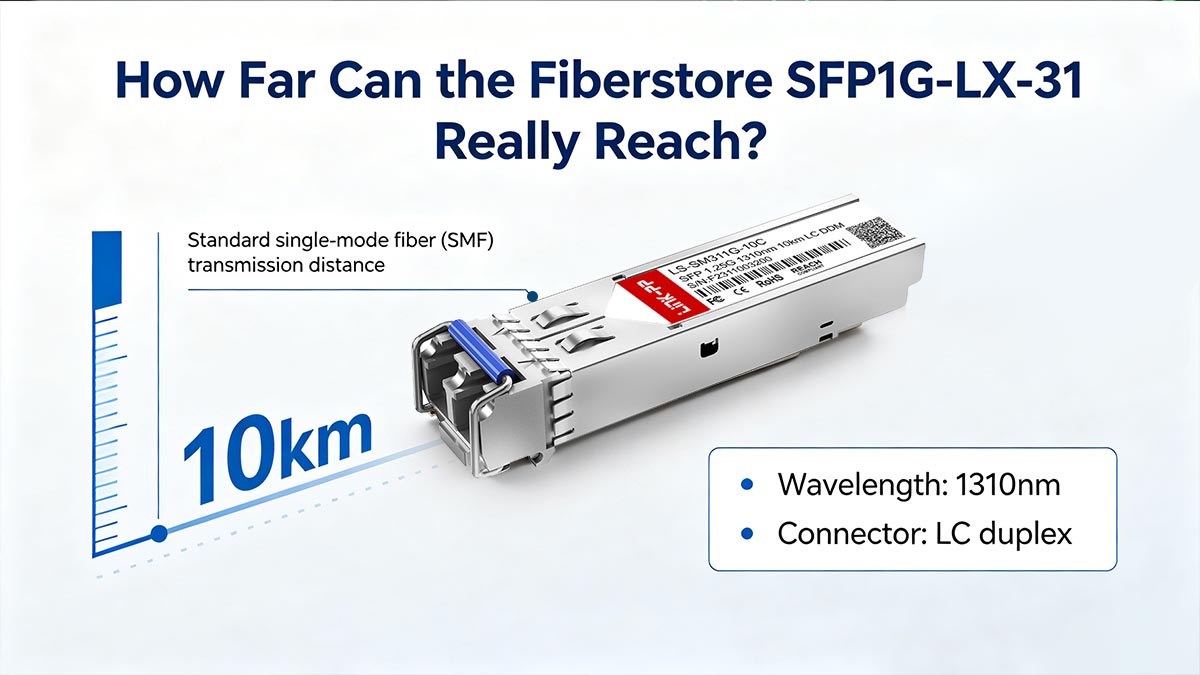
While the IEEE 802.3z specification rates the FS SFP1G-LX-31 for a maximum distance of 10 kilometers (6.2 miles) over 9/125µm single-mode fiber, actual reach is dictated by the total optical loss budget. In pristine OS2 fiber runs with minimal splices, it consistently achieves the full 10km. However, high insertion loss from multiple patch panels, degraded OS1 fiber, or dirty LC connectors can reduce the error-free transmission distance to 7–8km.
Understanding the Published 10km Specification
In optical networking, distance ratings are theoretical baselines rather than absolute guarantees. The 10km specification for the SFP1G-LX-31 assumes standard attenuation rates for a 1310nm laser traversing a continuous run of single-mode glass. Specifically, it relies on an expected fiber attenuation of approximately 0.35 dB/km to 0.4 dB/km. If a fiber plant perfectly matches these laboratory conditions, the transceiver will effortlessly hit the 10km mark without dropping a single frame.
Factors That Influence Actual Reach
In real-world physical layer deployments, distance is merely a proxy for optical attenuation. Every physical disruption in the fiber path consumes a portion of the module's optical power budget. The following factors directly dictate how far your signal will actually reach:
- Fiber Quality (OS1 vs. OS2): (Micro-definition: OS2 is a low-water-peak single-mode fiber designed to minimize light absorption.) Older OS1 fiber can exhibit attenuation up to 1.0 dB/km, which could limit your reach to under 5km. Modern OS2 fiber typically exhibits a much lower loss of ~0.4 dB/km at 1310nm, easily supporting the 10km rating.
- Connector Insertion Loss: Every time fiber is mated using an LC connector, light is lost. According to TIA/EIA standards, acceptable connector loss is up to 0.75 dB per mated pair, though high-quality clean connectors usually hover around 0.3 dB.
- Splice Loss: Fusion splices (melting two glass cores together) typically introduce a negligible 0.1 dB of loss. However, mechanical splices (aligning fiber with gel) can introduce 0.3 dB or more per splice.
- Patch Panels and Cross-Connects: Routing a 10km link through multiple intermediate distribution frames (IDFs) compounds connector loss rapidly. A single cross-connect adds two mated pairs to the link.
- Environmental Conditions (Macrobending): If fiber optic cables are bent beyond their specified bend radius inside conduit or cable trays, light escapes the core into the cladding. This macrobending drastically spikes attenuation, killing the link distance.
Real-World Reach Validation Examples
To validate the engineering precision of the FS SFP1G-LX-31, consider a standard metropolitan deployment.
Scenario: A 9.5km run over OS2 fiber, requiring 4 fusion splices and terminating at 2 patch panels (4 LC connector pairs total).
- Fiber Attenuation: 9.5km × 0.4 dB/km = 3.8 dB
- Splice Loss: 4 × 0.1 dB = 0.4 dB
- Connector Loss: 4 × 0.3 dB = 1.2 dB
- Total Estimated Link Loss: 5.4 dB
Given that a standard SFP1G-LX-31 possesses an optical power budget of roughly 10.5 dB to 14 dB (the difference between minimum TX power and RX sensitivity), a 5.4 dB loss leaves a healthy operational margin. In this real-world scenario, the FS module will maintain a flawless 1Gbps link at 9.5km.
When 10km Does Not Mean 10km
The most common engineering pitfall is assuming that a cable run measuring 8km will automatically work.
If an 8km campus link routes through six different telecom closets utilizing dirty LC bulkheads and aging mechanical splices, the total connector and splice loss might exceed 8.0 dB alone. Combined with the baseline fiber attenuation, the total loss could reach 12 dB or higher. In this scenario, despite the physical distance being only 8km—well under the 10km rating—the optical budget is exhausted, resulting in link flapping, CRC errors, or complete link failure.
Engineering Takeaway: Never rely on distance alone when validating transceiver reach. Always certify the fiber plant using an Optical Time-Domain Reflectometer (OTDR) or a calibrated light meter to ensure the total dB loss falls within the SFP1G-LX-31’s optical budget.
🟧 Evaluating Power Efficiency and Optical Budget
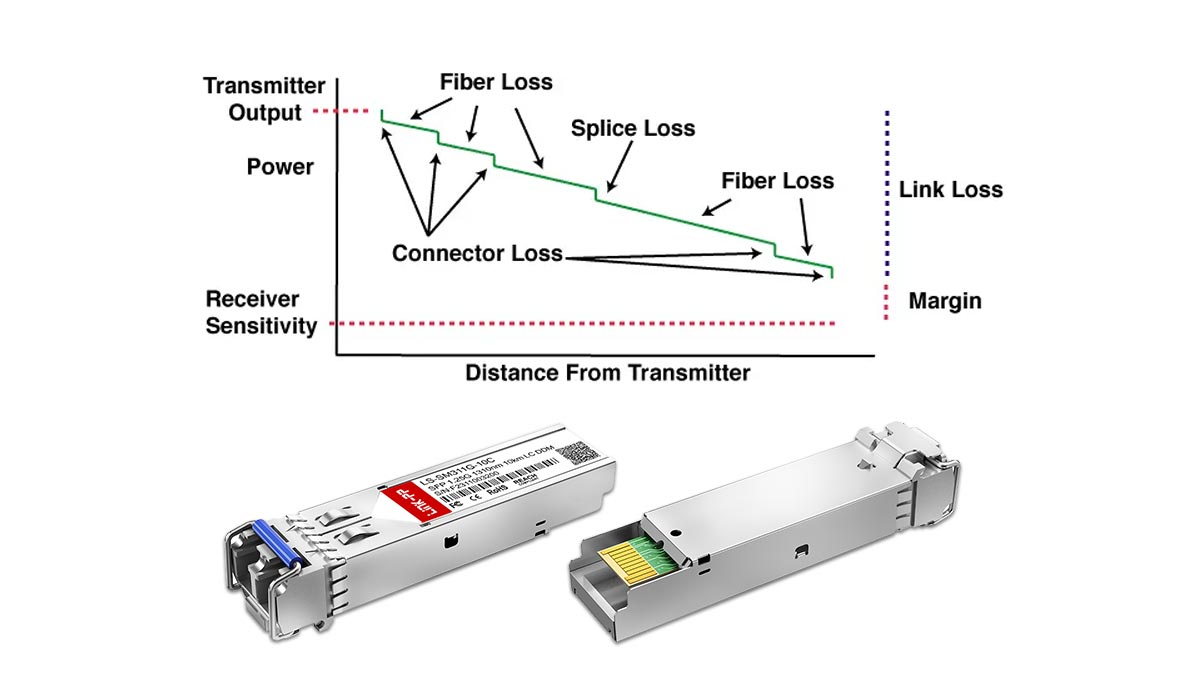
The Fiberstore SFP1G-LX-31 excels in both electrical and optical efficiency. Electrically, it draws strictly less than 1.0W per module, significantly reducing thermal loads in high-density aggregation switches. Optically, it provides a standard power budget of approximately 10.5 dB. This is calculated by the difference between its minimum transmit (TX) power of -9.5 dBm and its receiver (RX) sensitivity of -20.0 dBm, ensuring ample margin for complex 10km fiber plants.
What Is Optical Power Budget?
(Micro-definition: Optical power budget is the maximum allowable signal loss—expressed in decibels, dB—a fiber optic link can tolerate before the receiver fails to decode the data.)
In physical layer engineering, the optical power budget is your ultimate currency. It represents the total amount of attenuation (from fiber distance, splices, and connectors) you can "spend" while maintaining an error-free Gigabit link. It is strictly determined by the hardware capabilities of the transceiver's laser and photodiode.
Typical TX and RX Power Parameters
To engineer a reliable network, you must understand the exact optical thresholds of your hardware. The FS SFP1G-LX-31 strictly adheres to the IEEE 802.3z parameters for 1000BASE-LX optics:
- Transmit Power (TX): -9.5 dBm (Minimum) to -3.0 dBm (Maximum)
- Receiver Sensitivity (RX): -20.0 dBm (or better, meaning it can detect signals as faint as -20 dBm)
- Receiver Overload (Saturation): -3.0 dBm (The maximum light the receiver can tolerate before errors occur)
Calculating Available Link Margin
Link margin is the safety net of your optical network. It is the remaining optical budget after all physical plant losses are accounted for.
Formula: Available Optical Budget = (Minimum TX Power) - (RX Sensitivity)
Calculation: (-9.5 dBm) - (-20.0 dBm) = 10.5 dB
If your actual fiber plant (cable, splices, and patch panels) introduces 6.0 dB of total loss, your remaining Link Margin is 4.5 dB. Industry best practice mandates maintaining a minimum link margin of 2.0 dB to 3.0 dB to account for future fiber degradation or emergency splicing.
Understanding Receiver Sensitivity
Receiver sensitivity is a testament to the quality of the SFP's internal avalanche photodiode (APD) or PIN photodiode. At a sensitivity of -20.0 dBm, the FS SFP1G-LX-31 can accurately distinguish between a digital "1" and "0" even when the incoming light is incredibly faint. If the light drops below this threshold (e.g., to -22 dBm), the signal-to-noise ratio degrades, resulting in Frame Check Sequence (FCS) errors and dropped packets.
Why Excessive RX Power Can Be a Problem
While engineers often worry about signals being too weak, a signal that is too strong is equally destructive. This phenomenon is known as Receiver Saturation.
If the light hitting the receiver exceeds the overload threshold of -3.0 dBm, the photodiode becomes "blinded." The receiver cannot switch off fast enough between bits, smearing the optical pulses together. In severe cases, prolonged exposure to overpowered lasers can permanently burn out the SFP's optical receiver.
Do You Need an Optical Attenuator?
A frequent question during lab testing or short-rack patching is whether an inline optical attenuator is required to prevent receiver saturation.
Clear Conclusion: No, attenuators are generally not required for the SFP1G-LX-31.
Because the maximum TX power (-3.0 dBm) perfectly aligns with the maximum RX overload threshold (-3.0 dBm), you can safely connect two FS SFP1G-LX-31 modules using a short 1-meter single-mode patch cable without blinding the receiver. (Note: This is unique to 10km LX optics. Longer-reach 40km EX or 80km ZX optics absolutely require attenuators on short runs to prevent hardware damage.)
🟧 DOM and Network Diagnostics in Fiberstore SFP1G-LX-31 Performance
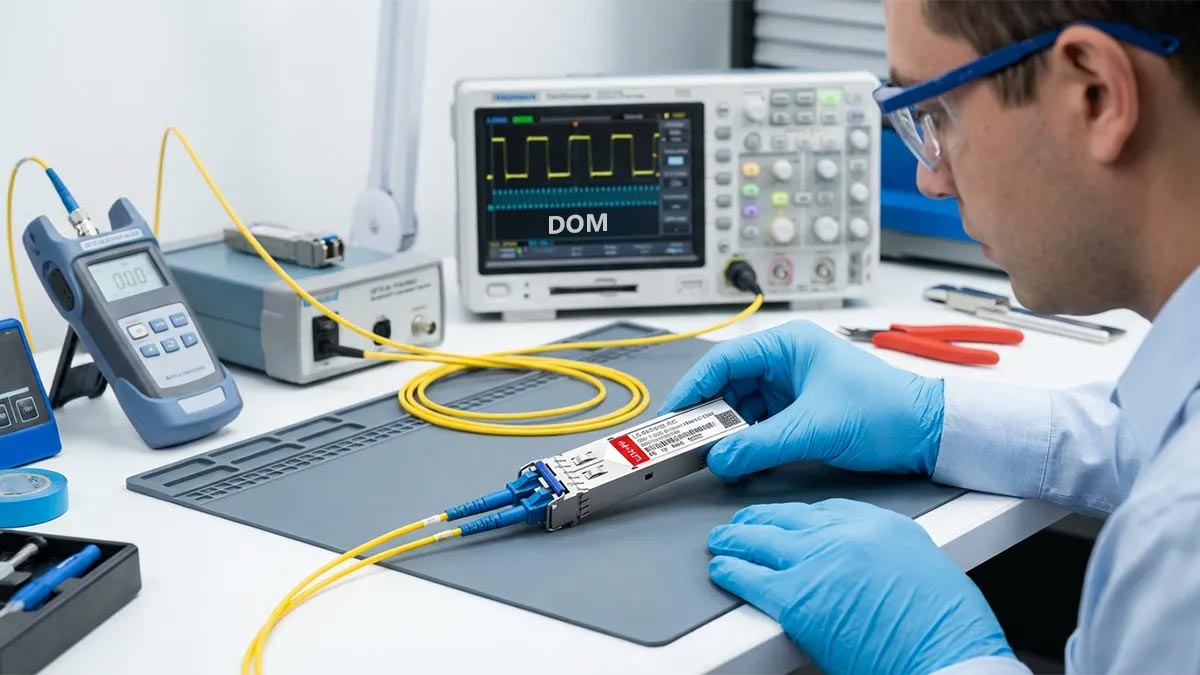
Direct Answer: Digital Optical Monitoring (DOM), also known as Digital Diagnostic Monitoring (DDM), is fully supported by the Fiberstore SFP1G-LX-31 in accordance with the SFF-8472 MSA standard. This feature allows network engineers to poll the transceiver via the switch CLI for real-time telemetry, including transmit (TX) power, receive (RX) power, temperature, and operating voltage. DOM transforms the module from a passive component into an active diagnostic tool, enabling rapid Layer 1 fault isolation without requiring external optical light meters.
What DOM Data Can Tell You
Before the widespread adoption of DOM, diagnosing a dropped optical link was a "blind" process requiring technicians to physically disconnect the fiber and measure the light with a handheld power meter. The built-in diagnostic chip inside the FS SFP1G-LX-31 exposes this telemetry directly to the host switch's operating system (e.g., via the show interfaces transceiver detail command in Cisco IOS or show interfaces diagnostics optics in Juniper Junos).
Reading TX Power and RX Power Values
The two most critical parameters provided by DOM are the optical transmit and receive levels, measured in decibels relative to one milliwatt (dBm).
- TX Power (Transmit): Indicates the strength of the laser leaving the local FS module. For the SFP1G-LX-31, this should register between -9.5 dBm and -3.0 dBm. If TX power reads drastically lower (e.g., -15 dBm) or fails to report, the laser diode inside the transceiver has likely failed and the module must be replaced.
- RX Power (Receive): Indicates the strength of the light arriving from the remote switch. This should remain above -20.0 dBm. RX power is the primary metric used to calculate your remaining optical link margin and detect physical fiber degradation.
Temperature and Voltage Monitoring
Beyond light levels, DOM monitors the internal health of the SFP module to ensure it operates safely within the switch chassis.
- Temperature: The standard FS SFP1G-LX-31 is rated for commercial operating temperatures of 0°C to 70°C (32°F to 158°F). If DOM reports temperatures exceeding 70°C, it often indicates a failing chassis fan, blocked airflow in the network rack, or a dangerously overloaded wiring closet HVAC system.
- Voltage: The transceiver operates on a standard 3.3V supply from the host switch. Voltage fluctuations reported by DOM can help isolate failing switch power supplies or degraded backplane circuitry before they cause catastrophic hardware failure.
Identifying Fiber Issues Through DOM
The true power of DOM lies in its ability to pinpoint the exact nature of a network outage. Consider the following common diagnostic scenarios using the SFP1G-LX-31:
| Symptom observed via CLI | Diagnosis / Probable Cause |
|---|---|
| Local TX is normal (-6 dBm). Local RX is critically low (-35 dBm). |
The local module is transmitting fine, but not receiving light. The remote transceiver has failed, or the RX fiber strand is cut/unplugged. |
| Local RX power drops slowly over several weeks (e.g., from -12 dBm to -19 dBm). | Degrading physical plant. Likely caused by a micro-bend developing in a cable tray, moisture ingress in an outdoor splice enclosure, or a dirty LC connector accumulating dust. |
| Local TX is failing (-40 dBm). Module temperature is normal. |
Catastrophic laser failure inside the local FS SFP1G-LX-31. Swap the transceiver immediately. |
Common Alarm Thresholds
The SFF-8472 standard requires transceivers to have pre-programmed High/Low Warning and High/Low Alarm thresholds burned into their EEPROM.
If the RX power on the FS SFP1G-LX-31 drops below its internal Low Warning threshold (typically around -20 dBm), it proactively triggers an SNMP trap or syslog message (e.g., %SFF8472-5-THRESHOLD_VIOLATION) on the host switch. This allows network management systems (NMS) like SolarWinds or PRTG to alert engineers to a degrading optical link before the RX power drops below the absolute sensitivity limit and causes a network outage.
🟧 FAQ About Fiberstore SFP1G-LX-31 Distance and Power Efficiency
The most frequent inquiries regarding the Fiberstore SFP1G-LX-31 revolve around its deployment over legacy multimode fiber, its thermal footprint compared to OEM modules, and auto-negotiation failures in high-speed chassis. In short: it supports multimode fiber up to 550m (with mode-conditioning), it operates at a highly efficient <1.0W power draw, and it requires manual port speed configuration when inserted into 10G SFP+ uplink ports.
Q: Can the SFP1G-LX-31 achieve its 10km distance on Multimode Fiber (MMF)?
No. The 10km specification strictly applies to 9/125µm Single-Mode Fiber (OS1/OS2). However, you can use the SFP1G-LX-31 on OM1, OM2, OM3, or OM4 Multimode Fiber for short distances—up to a maximum of 550 meters.
Technical Caveat: When transmitting a 1310nm laser over a wider multimode core (50µm or 62.5µm), a phenomenon called Differential Mode Delay (DMD) can occur, causing signal distortion. To comply with IEEE 802.3z standards and prevent DMD, you must use a Mode-Conditioning Patch (MCP) cable at both ends of the link.
Q: Does the FS SFP1G-LX-31 consume more power or run hotter than OEM optics?
No. The Fiberstore module is engineered to the exact same Multi-Source Agreement (MSA) physical and electrical specifications as OEM optics from Cisco, Juniper, or HP. It draws strictly less than 1.0 Watt of power. Swapping OEM optics for FS optics will not alter your switch's thermal output, fan speeds, or UPS power consumption calculations.
Q: Why is my link failing at 8km if the module is rated for 10km?
Distance ratings are based on ideal optical power budgets, not physical tape measure distance. If your 8km link fails, your total insertion loss has exceeded the module's ~10.5 dB optical budget. This is almost always caused by degraded patch panels, dirty LC bulkheads, or poor mechanical splices along the fiber path. You must use an Optical Time-Domain Reflectometer (OTDR) to locate the source of the excessive dB loss.
Q: Why is my SFP1G-LX-31 link not coming up in a 10G SFP+ port?
While SFP+ (10G) ports are physically backward compatible with SFP (1G) modules, the auto-negotiation protocol often fails to step down the port speed. If you insert a 1G LX module into a 10G port, you must log into the switch CLI and manually hardcode the interface.
For example, in Cisco IOS-XE, you must apply the command speed 1000 and occasionally duplex full on the interface before the link will initialize.
Q: Can I connect an SFP1G-LX-31 to an SFP1G-SX module?
Absolutely not. This is a physical layer wavelength mismatch. The LX module transmits at a long wavelength of 1310nm, while the SX module expects a short wavelength of 850nm. Even if connected via a short patch cable, the receivers cannot decode the mismatched light frequencies, and the link will remain down. You must match LX to LX.
🟧 Conclusion
The Fiberstore SFP1G-LX-31 successfully validates its specifications as a high-performance, enterprise-grade optical transceiver. By delivering a strict 10km reach over OS2 single-mode fiber, maintaining a highly efficient sub-1.0W power draw, and providing accurate DOM telemetry, it stands as an electrically and optically identical alternative to premium-priced OEM optics. For IT procurement, it represents a mathematically sound strategy for reducing CapEx without sacrificing physical layer reliability.
Best Use Cases
Based on its validated optical power budget of ~10.5 dB and 1310nm wavelength, the SFP1G-LX-31 is optimally deployed in:
- Enterprise Campus Backbones: Connecting decentralized buildings (e.g., university dorms, hospital wings) separated by 1km to 8km of underground single-mode fiber.
- High-Density Aggregation: Fully populating 48-port core switches where minimizing total thermal output and electrical draw (< 1.0W per port) is critical for HVAC efficiency.
- Legacy Fiber Upgrades: Utilizing existing OM3/OM4 multimode fiber runs (up to 550m) using mode-conditioning patch cables when single-mode glass is unavailable.
When to Choose a Longer-Reach Alternative
While the SFP1G-LX-31 is highly versatile, it is strictly bound by the laws of optical physics. You must step up to a longer-reach transceiver if:
- Your physical distance exceeds 10km.
- Your OTDR test reveals a total link loss exceeding 10.5 dB (often due to excessive mechanical splices or degraded cross-connects).
In these scenarios, engineers should pivot to the 1000BASE-EX (40km reach, ~1550nm/1310nm) or the 1000BASE-ZX (80km reach, 1550nm) modules. Note: These longer-reach modules possess significantly higher transmit power and will require inline optical attenuators if used on short test loops to prevent receiver burnout.
Procurement Considerations
From a CapEx perspective, relying entirely on OEM optics for widespread Gigabit deployments is fiscally inefficient. The Multi-Source Agreement (MSA) ensures that third-party vendors like Fiberstore utilize the exact same physical footprints and laser components as OEM brands.
However, IT managers must factor in EEPROM coding management. Because network switches from Cisco, HP/Aruba, and Juniper look for specific vendor cryptographic signatures, you must ensure your procurement order specifies the exact switch hardware the transceiver will be plugged into, ensuring native plug-and-play functionality without bypassing switch security protocols.
Final Recommendation
The FS SFP1G-LX-31 offers an uncompromising balance of distance, power efficiency, and Layer 1 diagnostic capability. By utilizing standard DOM/DDM polling, network administrators can proactively monitor fiber health, drastically reducing mean time to resolution (MTTR) during outages. For standard Gigabit deployments under 10 kilometers, it earns a definitive recommendation.