



































In modern network environments, flexibility and interoperability have become critical requirements, especially as enterprises and data centers increasingly adopt multi-vendor infrastructures. Traditional optical transceivers often come with strict vendor-specific limitations, making it challenging to scale networks efficiently or integrate third-party components without compatibility concerns. This is where e-SFP (enhanced small form-factor pluggable) modules play a pivotal role.
e-SFP technology is designed to bridge the gap between proprietary systems and open networking demands by enabling optimized compatibility with a wide range of switches and routers. Through advanced encoding mechanisms, improved digital diagnostics, and adaptive firmware interaction, e-SFP modules allow third-party optical links to function reliably across diverse platforms.
Understanding how e-SFP compatibility works is essential for network engineers aiming to balance performance, cost, and operational simplicity. This article explores the underlying mechanisms, key compatibility factors, and best practices for deploying e-SFP modules, helping you build more scalable and vendor-flexible optical networks.
? What is e-SFP and Why It Matters in Modern Networks
e-SFP is an enhanced version of standard SFP transceivers designed to improve compatibility, diagnostics, and interoperability in multi-vendor network environments. It matters because it enables stable third-party optical links while reducing dependency on proprietary vendor ecosystems.
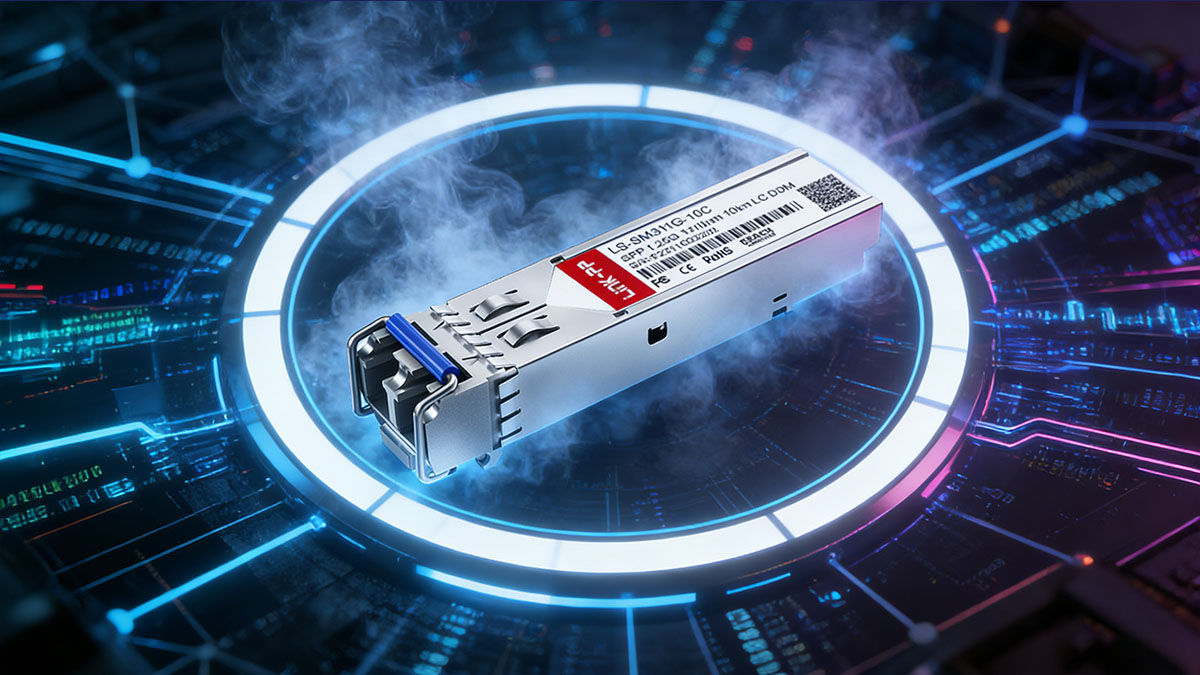
Definition and Core Characteristics of e-SFP
e-SFP refers to small form-factor pluggable transceivers that incorporate enhanced EEPROM coding, extended digital diagnostics, and improved interoperability logic compared to traditional SFP modules. These enhancements allow the module to be more adaptable across different networking platforms.
A clear distinction between standard SFP and e-SFP can be summarized as follows:
| Feature | Standard SFP | e-SFP |
|---|---|---|
| Compatibility | Vendor-restricted | Multi-vendor optimized |
| EEPROM Encoding | Fixed vendor profile | Flexible or programmable |
| Diagnostics (DDM) | Basic or optional | Advanced real-time monitoring |
| Interoperability | Limited | Enhanced across platforms |
The key takeaway is that e-SFP modules are engineered to go beyond basic optical transmission by embedding intelligence that enables broader compatibility and better operational visibility.
In practical deployments, this means network devices can recognize and utilize e-SFP modules without triggering compatibility errors, while also benefiting from richer telemetry data for monitoring and troubleshooting.
Evolution of SFP Standards Toward e-SFP
e-SFP emerged as a response to the limitations of traditional fiber SFP modules, particularly in environments where multiple vendors coexist. Standard SFPs were originally designed for tightly controlled ecosystems, where hardware and transceivers came from the same manufacturer.
Several factors drove the evolution toward e-SFP:
- Increasing adoption of multi-vendor network architectures
- Demand for cost-effective alternatives to OEM optics
- Need for better visibility into optical link performance
- Growth of data center scalability requirements
Traditional SFP modules often rely on static vendor identifiers stored in EEPROM, which can lead to rejection by switches that enforce strict compatibility checks. e-SFP modules address this by introducing more flexible encoding schemes and better alignment with industry standards.
As networks evolved toward openness and interoperability, e-SFP became a practical solution to ensure consistent performance without being constrained by vendor-specific limitations.
Role of e-SFP in Scalable Network Architectures
e-SFP plays a critical role in enabling scalable and flexible network designs, especially in modern data centers and enterprise infrastructures where rapid expansion and vendor diversity are common.
Its importance can be understood through the following deployment advantages:
- Enables seamless integration across different switch and router brands
- Simplifies network expansion without requiring vendor-specific optics
- Supports standardized monitoring through enhanced DDM features
- Reduces operational friction in large-scale deployments
In scalable architectures, maintaining consistency across hundreds or thousands of optical links is essential. e-SFP modules help achieve this by providing predictable compatibility behavior and unified monitoring capabilities.
Additionally, as organizations move toward software-defined networking (SDN) and disaggregated infrastructure models, the ability to decouple hardware from vendor-specific constraints becomes increasingly valuable. e-SFP aligns with this trend by supporting a more open and adaptable optical layer.
Overall, e-SFP is not just an incremental improvement over standard SFP—it is a foundational component for building flexible, cost-efficient, and future-ready optical networks.
? Understanding e-SFP Compatibility Mechanisms
e-SFP compatibility is achieved through a combination of programmable EEPROM data, standardized diagnostics, and alignment with device-level validation processes. These mechanisms allow third-party optical modules to be recognized, accepted, and operated reliably across different network platforms.
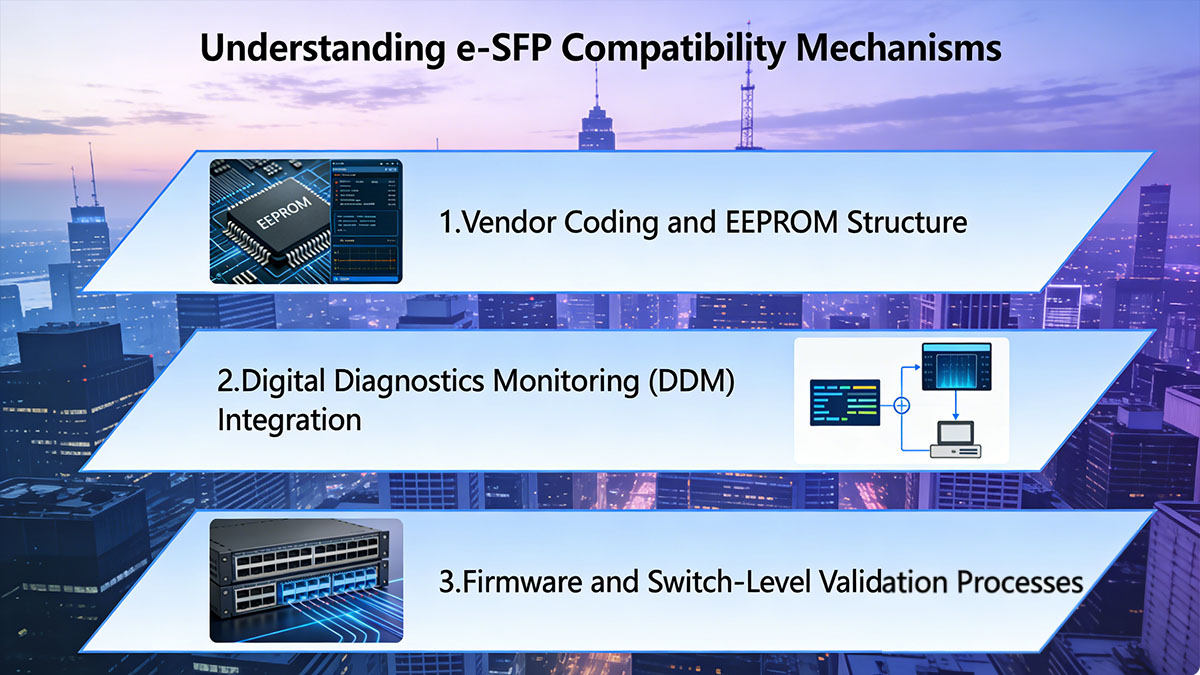
Vendor Coding and EEPROM Structure
e-SFP compatibility primarily depends on how EEPROM data is structured and interpreted by host devices. By optimizing vendor-specific fields, e-SFP modules can align with the expectations of different switch and router manufacturers.
A simplified comparison of EEPROM behavior is shown below:
| Aspect | Standard SFP | e-SFP |
|---|---|---|
| Vendor ID Fields | Fixed, vendor-locked | Adjustable or pre-coded |
| Compliance Codes | Static | Tuned for multi-platform use |
| Checksum Handling | Basic validation | Optimized for acceptance |
| Encoding Flexibility | Limited | High |
The key point is that e-SFP modules use carefully structured EEPROM data to “present” themselves in a way that is acceptable to multiple vendors’ hardware.
In practice, this involves aligning fields such as vendor name, part number, and compliance codes with expected formats. Some advanced e-SFP implementations also support reprogramming, allowing adaptation to specific environments. However, consistency and accuracy in EEPROM mapping are critical, as even minor mismatches can lead to module rejection.
Digital Diagnostics Monitoring (DDM) Integration
e-SFP modules enhance compatibility by integrating robust Digital Diagnostics Monitoring (DDM), which provides real-time operational data that aligns with host system expectations.
A comparison of diagnostic capabilities highlights the difference:
| Parameter | Standard SFP | e-SFP |
|---|---|---|
| Temperature | Optional | Real-time monitoring |
| Voltage | Limited | Continuous tracking |
| TX/RX Power | Basic | High-precision reporting |
| Alarm Thresholds | Minimal | Configurable/standardized |
The key takeaway is that e-SFP modules not only transmit data but also communicate their operating status in a standardized and reliable way.
This consistency is important because many modern switches rely on DDM data to validate module health and compliance. If diagnostic data is missing, inaccurate, or outside expected ranges, the device may flag the module as incompatible or unstable.
By ensuring accurate and standards-compliant telemetry, e-SFP modules improve both compatibility and operational transparency, enabling proactive monitoring and faster troubleshooting.
Firmware and Switch-Level Validation Processes
e-SFP compatibility is ultimately determined by how the host device firmware validates the inserted module. Network equipment vendors often implement strict checks to control which transceivers are accepted.
These validation mechanisms typically include:
- Verification of EEPROM vendor and part number fields
- CRC or checksum validation of stored data
- Monitoring of DDM parameters for expected ranges
- Detection of unsupported or unrecognized identifiers
A simplified comparison of validation behavior is shown below:
| Validation Step | OEM Modules | e-SFP Modules |
|---|---|---|
| Vendor Verification | Always passes | Optimized to match expectations |
| EEPROM Integrity Check | Native alignment | Pre-validated coding |
| DDM Compliance | Fully supported | Standard-aligned |
| Firmware Acceptance | Guaranteed | High success rate |
The key point is that e-SFP modules are engineered to pass these validation steps without triggering errors or restrictions.
However, compatibility is not entirely universal. Firmware updates on network devices may introduce stricter checks, potentially affecting previously working modules. Therefore, understanding the interaction between module coding and device firmware is essential.
In real-world deployments, successful e-SFP compatibility depends on aligning three layers: correctly encoded EEPROM data, accurate diagnostic reporting, and compatibility with the host system’s firmware validation logic.
? Advantages of Using e-SFP for Third-Party Optical Links
e-SFP modules provide clear advantages in interoperability, cost efficiency, and operational simplicity, making them a practical choice for deploying stable third-party optical links in multi-vendor environments.
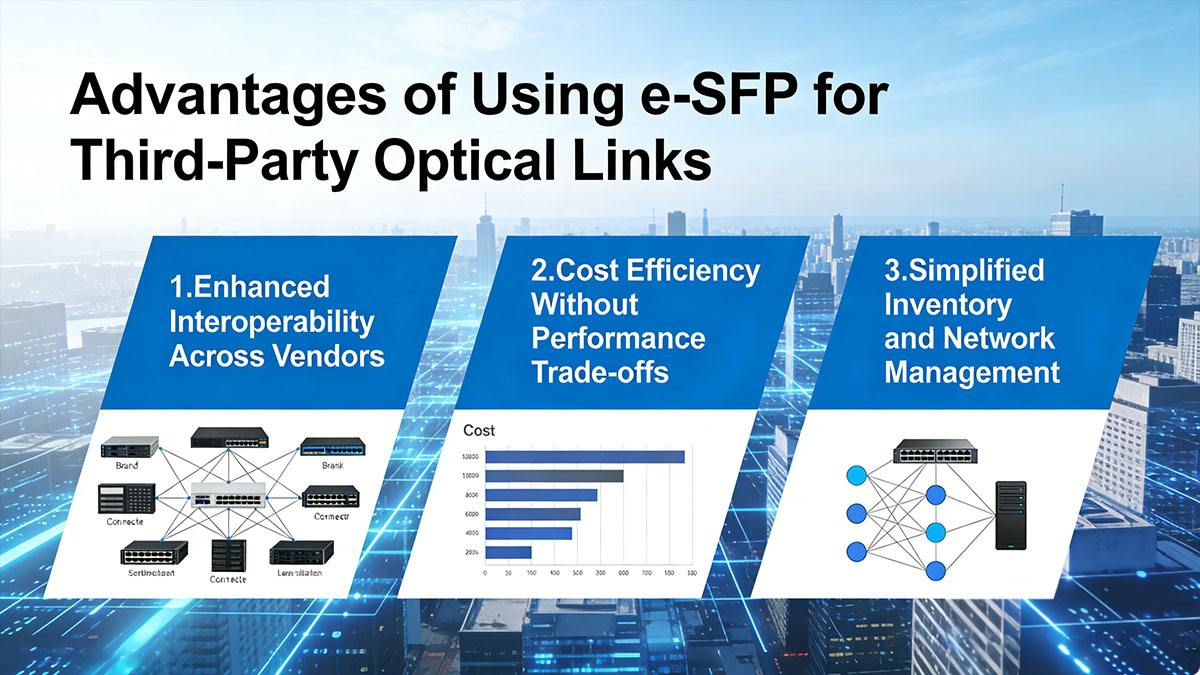
Enhanced Interoperability Across Vendors
e-SFP significantly improves interoperability by enabling optical modules to function reliably across different brands of switches and routers. This is achieved through optimized EEPROM coding and standardized diagnostics that align with multiple vendor requirements.
A comparison of interoperability capabilities is shown below:
| Aspect | Standard SFP | e-SFP |
|---|---|---|
| Vendor Compatibility | Single-vendor focused | Multi-vendor optimized |
| Deployment Flexibility | Limited | High |
| Cross-Platform Use | Restricted | Broad |
| Integration Effort | Higher | Lower |
The key takeaway is that e-SFP modules reduce the friction typically associated with integrating third-party optics into existing networks.
In real deployments, this allows network operators to standardize transceivers across heterogeneous infrastructures, minimizing compatibility conflicts and simplifying expansion planning.
Cost Efficiency Without Performance Trade-offs
e-SFP modules help reduce overall network costs while maintaining performance levels comparable to OEM optics. This makes them particularly valuable in large-scale or budget-sensitive deployments.
A simplified cost-performance comparison is shown below:
| Metric | OEM Optical Modules | e-SFP Modules |
|---|---|---|
| Initial Cost | High | Lower |
| Performance | Vendor-certified | Comparable |
| Scalability Cost | Expensive | More manageable |
| Replacement Cost | High | Reduced |
The key point is that e-SFP enables organizations to optimize total cost of ownership without sacrificing reliability or throughput.
This cost advantage becomes more significant as network size grows. In environments with hundreds or thousands of optical links, even small per-unit savings can translate into substantial budget efficiencies over time.
Simplified Inventory and Network Management
e-SFP modules contribute to streamlined operations by reducing the complexity of inventory management and maintenance workflows. Their multi-vendor compatibility allows organizations to standardize on fewer module types.
This operational simplification can be summarized as follows:
- Fewer SKUs required for different network devices
- Easier spare parts management across multiple platforms
- Faster replacement and reduced downtime
- Consistent monitoring through standardized DDM data
The key takeaway is that e-SFP reduces both logistical overhead and operational risk in day-to-day network management.
Additionally, standardized diagnostics and predictable compatibility behavior make it easier for network teams to monitor performance, identify issues, and maintain consistent service levels across the entire infrastructure.
? Key Compatibility Factors to Evaluate
e-SFP compatibility depends on aligning hardware, software, and optical parameters with the target network environment. Evaluating these factors in advance helps prevent recognition issues, link instability, and performance degradation.
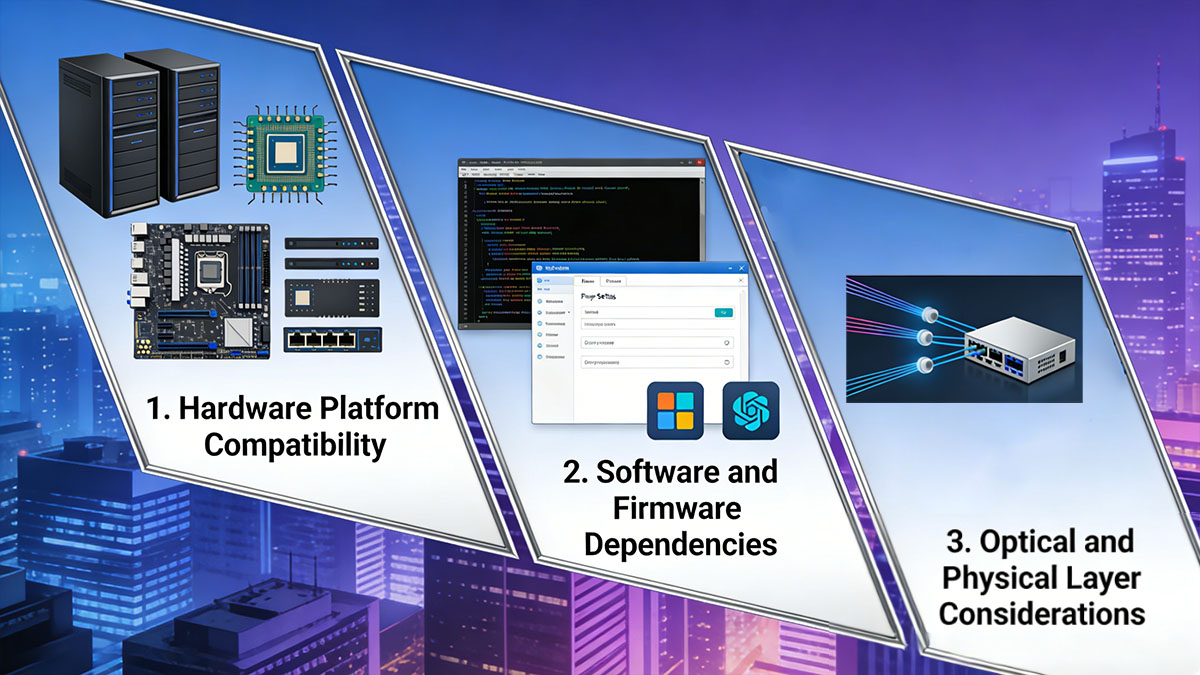
Hardware Platform Compatibility
e-SFP modules must match the physical and electrical characteristics of the target device to function correctly. Compatibility at the hardware level determines whether the module can be recognized and operate within supported specifications.
A quick evaluation of hardware compatibility factors is shown below:
| Factor | What to Check | Impact on Compatibility |
|---|---|---|
| Port Type | SFP/SFP+ slot support | Determines physical fit |
| Data Rate | 1G, 10G alignment | Prevents link mismatch |
| Interface Standard | 1000BASE-LX, SX, etc. | Ensures protocol compatibility |
| Power Budget | Device-supported limits | Avoids module rejection |
The key takeaway is that even if an e-SFP is logically compatible, hardware mismatches can still prevent successful deployment.
In practice, engineers should verify switch or router datasheets to confirm supported transceiver types and ensure that the module’s specifications align with port capabilities.
Software and Firmware Dependencies
Device operating systems and firmware play a critical role in determining whether an e-SFP module is accepted or restricted. Even physically compatible modules may fail if software validation rules are not met.
The most important software-related factors include:
- Operating system version and supported transceiver list
- Firmware-level vendor checks and restrictions
- Updates that may tighten compatibility validation
- Availability of diagnostic support (DDM integration)
A comparison of firmware influence is outlined below:
| Software Aspect | Stable Environment | Updated/Strict Environment |
|---|---|---|
| Module Recognition | Consistent | May vary |
| Vendor Checks | Moderate | More restrictive |
| Compatibility Risk | Lower | Higher |
| Update Impact | Minimal | Potential disruptions |
The key point is that firmware updates can directly affect previously working e-SFP modules.
To mitigate risks, it is advisable to validate compatibility after firmware upgrades and maintain documentation of tested module-device combinations.
Optical and Physical Layer Considerations
Beyond device compatibility, e-SFP modules must also align with optical transmission requirements to ensure stable link performance. Mismatches at the physical layer often lead to degraded signals or link failures.
Key optical parameters to evaluate include:
- Wavelength (e.g., 1310nm, 850nm)
- Transmission distance (e.g., 10km, 550m)
- Fiber type (single-mode vs multi-mode)
- Connector type (LC, SC)
A simplified compatibility overview is shown below:
| Parameter | Matching Requirement | Result if Mismatched |
|---|---|---|
| Wavelength | Must align on both ends | No link establishment |
| Fiber Type | SMF vs MMF consistency | Signal loss or failure |
| Distance Rating | Within supported range | Unstable or weak signal |
| Connector Type | Physical compatibility | Inability to connect |
The key takeaway is that optical mismatches are a common but avoidable cause of compatibility issues.
Even when e-SFP modules are correctly recognized by devices, improper fiber selection or exceeding distance limits can result in poor performance. Careful planning of optical parameters ensures reliable end-to-end connectivity.
? Common Compatibility Issues and Troubleshooting
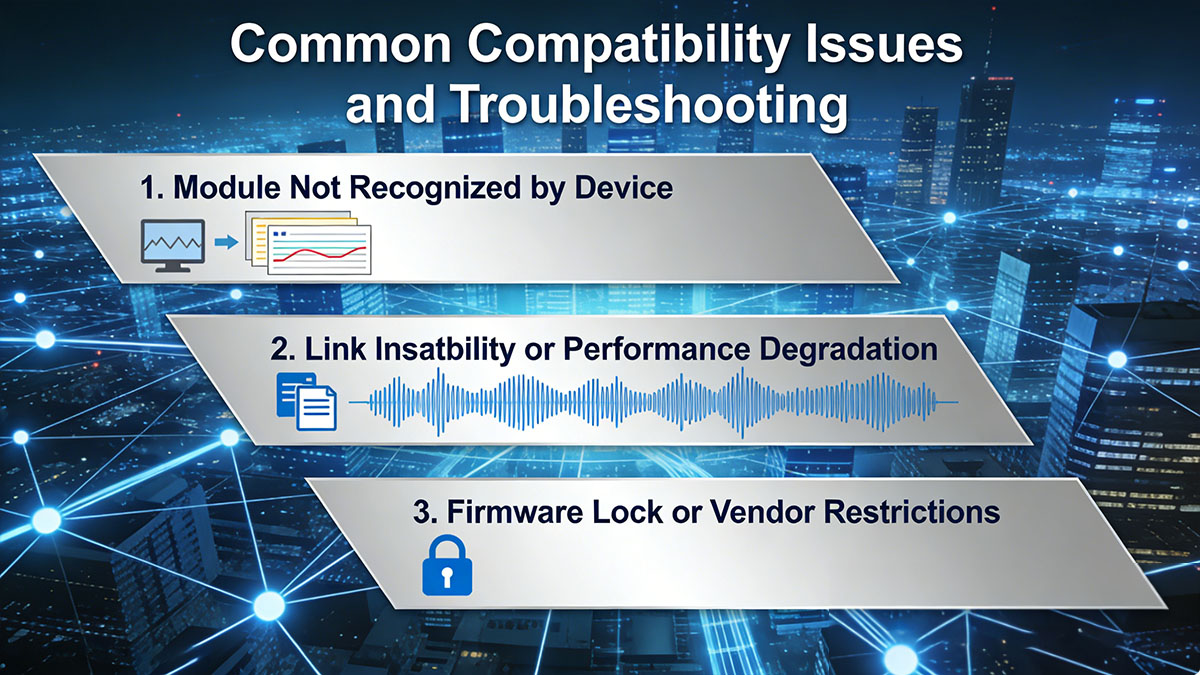
e-SFP deployments may encounter issues related to device recognition, link stability, or firmware restrictions. Most problems can be traced to mismatches in EEPROM data, optical parameters, or host device validation logic, and can be resolved through systematic troubleshooting.
Module Not Recognized by Device
When an e-SFP module is not recognized, the most common cause is a mismatch between the module’s EEPROM coding and the host device’s validation requirements.
A quick diagnosis of recognition issues is summarized below:
| Symptom | Likely Cause | Recommended Action |
|---|---|---|
| Module not detected | EEPROM mismatch | Verify or reprogram coding |
| Unsupported transceiver | Vendor check failure | Use compatible encoding |
| No interface activation | Port incompatibility | Confirm port specifications |
| Intermittent detection | Poor contact or hardware issue | Reseat or replace module |
The key takeaway is that recognition failures are typically related to identification data rather than hardware defects.
In practice, engineers should first check device logs for error messages, then verify module compatibility lists or test the module on another device. Reprogramming EEPROM or selecting a properly coded e-SFP often resolves the issue.
Link Instability or Performance Degradation
If the module is recognized but the link is unstable or underperforming, the issue is usually related to optical signal quality or environmental conditions rather than compatibility coding.
Common causes of instability include:
- Mismatched transmit and receive optical power levels
- Dirty or damaged fiber connectors
- Incorrect fiber type or excessive link distance
- Temperature fluctuations affecting module performance
A structured troubleshooting approach includes:
- Check DDM readings (TX/RX power, temperature, voltage)
- Inspect and clean fiber connectors
- Verify that wavelength and fiber type match on both ends
- Ensure the link distance is within module specifications
The key point is that optical layer issues can mimic compatibility problems, even when the module is correctly recognized.
Consistent monitoring of DDM parameters helps identify early signs of degradation, allowing proactive maintenance before link failures occur.
Firmware Lock or Vendor Restrictions
Some network devices enforce strict firmware-level controls that restrict the use of third-party optical modules, which can impact e-SFP compatibility.
A comparison of restriction scenarios is shown below:
| Scenario | Behavior | Mitigation Approach |
|---|---|---|
| Soft warning | Logs or alerts only | Monitor without action |
| Feature limitation | Disabled diagnostics or ports | Adjust configuration |
| Hard restriction | Module disabled | Use supported coding |
| Post-upgrade blocking | Previously working modules fail | Validate before upgrading |
The key takeaway is that firmware restrictions can override otherwise valid compatibility configurations.
To minimize risk, it is important to test e-SFP modules in the target environment before large-scale deployment and to review firmware release notes for changes in transceiver validation policies. In some cases, maintaining stable firmware versions or selecting modules with proven compatibility profiles can prevent unexpected disruptions.
? Best Practices for Deploying e-SFP Modules
Deploying e-SFP modules successfully requires a combination of thorough preparation, careful vendor selection, and ongoing monitoring. Adhering to best practices ensures optimal link performance, minimizes downtime, and maximizes compatibility across multi-vendor environments.

Pre-Deployment Compatibility Testing
Testing e-SFP modules in a controlled environment before connecting them to production systems is essential to prevent recognition issues or unstable links.
Key steps for effective pre-deployment testing include:
- Verify that each module is correctly recognized by the target switch or router
- Check Digital Diagnostics Monitoring (DDM) readings, including temperature, voltage, and TX/RX power
- Conduct test transmissions over the intended fiber type and distance to validate signal integrity
- Document confirmed module-device combinations for reference and future deployments
The key takeaway is that early validation establishes a reliable baseline and reduces the likelihood of operational interruptions once modules are deployed in production networks.
Selecting Reliable Third-Party Vendors
The choice of e-SFP vendor is critical for long-term network stability. Modules from reputable vendors tend to have better firmware alignment, stricter quality control, and higher compliance with industry standards.
Consider the following criteria when evaluating vendors:
- Compliance with relevant Multi-Source Agreement (MSA) standards such as SFF-8472 for DDM
- Comprehensive datasheets detailing supported devices, wavelengths, and link distances
- Rigorous quality assurance processes, including burn-in testing and reliability verification
- Availability of technical support, updates, and documented compatibility reports
The key point is that selecting reliable vendors reduces the risk of module rejection, intermittent failures, and compatibility-related performance issues.
Ongoing Monitoring and Maintenance
Even after successful deployment, continuous monitoring and proactive maintenance are crucial to sustain e-SFP performance over time.
Best practices include:
- Continuously monitor DDM parameters to detect early signs of overheating, voltage fluctuations, or signal degradation
- Perform scheduled cleaning and inspection of fiber connectors to maintain signal quality
- Track firmware versions on connected devices and validate that updates do not impact module compatibility
- Keep records of module installation, performance trends, and any replacements to facilitate troubleshooting
The key takeaway is that a proactive approach to monitoring and maintenance not only extends the life of e-SFP modules but also ensures reliable optical connectivity across multi-vendor networks.
Following these best practices—careful testing, selecting dependable vendors, and implementing consistent monitoring—enables network teams to fully leverage the advantages of e-SFP modules while maintaining high levels of stability and performance.
? e-SFP vs Standard SFP and Other Optical Modules
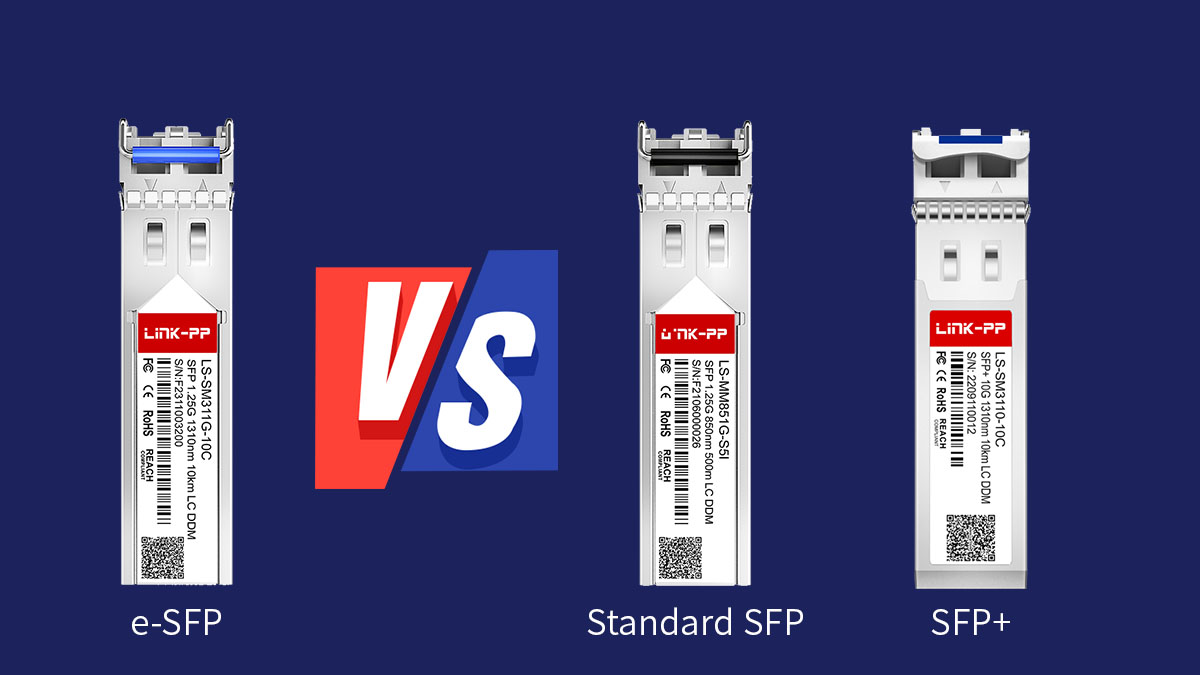
Understanding the differences between e-SFP and other optical transceiver types is essential for selecting the right modules for your network. e-SFP offers enhanced interoperability, diagnostics, and flexibility compared to standard SFP, while also occupying a distinct niche relative to SFP+ and other high-speed transceivers.
Comparison with Standard SFP Modules
e-SFP improves on the basic capabilities of standard fiber optic SFP module in several key areas:
- Interoperability: Standard SFPs are often vendor-restricted and may fail to operate on devices from other manufacturers. e-SFP modules are engineered to be compatible across multiple vendors, reducing integration challenges in heterogeneous networks.
- Diagnostics: While standard SFPs may offer limited or optional DDM functionality, e-SFP modules provide enhanced, real-time monitoring of voltage, temperature, and optical power levels.
- EEPROM Flexibility: Standard SFP EEPROM coding is fixed, whereas e-SFP modules use optimized or programmable coding to satisfy multiple host device validation requirements.
A simplified comparison is illustrated below:
| Feature | Standard SFP | e-SFP |
|---|---|---|
| Vendor Compatibility | Restricted | Multi-vendor optimized |
| DDM Support | Optional/basic | Advanced and real-time |
| EEPROM Coding | Fixed | Flexible / programmable |
| Deployment Flexibility | Limited | High |
The key takeaway is that e-SFP modules address the limitations of standard SFPs, enabling more reliable and flexible deployments in multi-vendor networks.
Comparison with SFP+ and Higher-Speed Modules
SFP+ and other higher-speed modules primarily target greater bandwidth (SFP+ 10G, SFP28 25G, or QSFP28 100G), whereas e-SFP focuses on compatibility and diagnostics. While SFP+ 10G may support similar physical form factors, it is generally optimized for speed rather than cross-vendor interoperability.
Key distinctions include:
- Performance Focus: SFP+ prioritizes high-speed transmission and lower latency, which may limit its compatibility with some older hardware.
- Interoperability: e-SFP is designed for broad compatibility at standard speeds (1G/10G), making it ideal for mixed environments where vendor diversity is high.
- Diagnostics and Monitoring: e-SFP provides enhanced DDM and telemetry features that may not be fully supported or standardized in all SFP+ modules.
A side-by-side feature overview:
| Feature | SFP+ | e-SFP |
|---|---|---|
| Data Rate | 10G+ | 1G–10G |
| Vendor Flexibility | Moderate | High |
| Diagnostics | Basic or vendor-specific | Standardized and advanced |
| Use Case Focus | High-speed links | Multi-vendor interoperability |
The key point is that while SFP+ is essential for high-bandwidth applications, e-SFP provides critical advantages in interoperability and operational transparency, making it more suitable for environments that prioritize vendor flexibility and consistent monitoring.
When to Choose e-SFP Over Alternatives
e-SFP modules are particularly valuable in scenarios where interoperability, network monitoring, and operational simplicity outweigh the need for maximum bandwidth. Situations where e-SFP is advantageous include:
- Multi-vendor networks with mixed switches and routers
- Deployments requiring proactive optical link monitoring through DDM
- Environments aiming to reduce vendor lock-in while maintaining reliable connectivity
- Standard-speed applications (SFP 1G or SFP+ 10G) where high compatibility is more critical than top-end performance
The key takeaway is that e-SFP should be selected when network flexibility, diagnostics, and cross-platform compatibility are the primary requirements, whereas standard SFP and SFP+ may be chosen for cost-sensitive or high-speed scenarios, respectively.
By understanding these distinctions, network engineers can make informed decisions about which transceiver type best aligns with performance, interoperability, and operational priorities.
? Future Trends in e-SFP Compatibility and Optical Networking
e-SFP modules are evolving alongside broader changes in optical networking, including multi-vendor openness, intelligent transceivers, and the push toward higher-speed networks. Understanding these trends is essential for designing networks that remain flexible, scalable, and future-proof.

Increasing Demand for Open Networking
Open networking is a growing trend where network devices, operating systems, and optical transceivers are decoupled from single-vendor constraints. e-SFP modules are well-positioned to support this trend because of their multi-vendor compatibility and standardized diagnostics.
Key aspects include:
- Disaggregated Infrastructure: e-SFP supports deployment in environments where switches and routers from different vendors coexist, enabling operators to mix and match hardware without sacrificing reliability.
- Software-Defined Networking (SDN) Integration: e-SFP modules provide consistent DDM data, which can be leveraged by SDN controllers for automated monitoring, performance optimization, and predictive maintenance.
- Vendor-Neutral Ecosystems: Organizations can reduce dependency on a single vendor, lowering costs and simplifying procurement and inventory management.
The key takeaway is that as networks move toward openness, e-SFP modules provide a bridge between traditional proprietary constraints and modern multi-vendor architectures.
Advancements in Intelligent Transceivers
The next generation of e-SFP modules is expected to include more advanced intelligence features, further enhancing compatibility, monitoring, and network automation.
Emerging capabilities include:
- Enhanced Telemetry: Beyond basic DDM, modules may report real-time link quality, error rates, and signal degradation trends.
- AI-Driven Network Optimization: Intelligent transceivers can feed data into AI-based tools for predictive maintenance, congestion management, and energy efficiency.
- Adaptive Power and Signal Management: Future e-SFP modules may adjust optical power or modulation dynamically to maintain optimal link quality, even across heterogeneous environments.
The key point is that intelligent e-SFP modules will transform optical links from passive components into active contributors to network reliability and performance optimization.
Evolution Toward Higher Speeds and Compatibility Standards
While e-SFP currently focuses on 1G–10G interoperability, future developments are likely to extend its principles to higher-speed transceivers, including QSFP+/QSFP28 (40G/100G), and 200G QSFP-DD/400G QSFP-DD.
Considerations for future evolution include:
- Backward Compatibility Challenges: Maintaining cross-vendor compatibility while supporting higher speeds requires careful standardization of coding, DDM, and optical parameters.
- Standardization Efforts: Industry groups are expected to expand MSAs and interoperability guidelines to ensure that enhanced transceivers remain compatible across platforms as speeds increase.
- Integration with Next-Gen Network Architectures: e-SFP concepts may be applied to modular optics in data center fabrics, metro networks, and edge deployments, ensuring consistent monitoring and vendor flexibility.
The key takeaway is that the principles of e-SFP—interoperability, diagnostics, and flexibility—will continue to guide the design of future optical modules, enabling reliable multi-vendor deployment even as network speeds and complexity increase.
By understanding these trends, network engineers can plan infrastructure that leverages current e-SFP advantages while remaining adaptable to emerging technologies and higher-speed requirements.
? Conclusion
e-SFP modules represent a significant step forward in achieving reliable, multi-vendor optical connectivity. By combining enhanced interoperability, advanced diagnostics, and flexible EEPROM coding, e-SFP enables stable third-party optical links while simplifying network management and reducing operational risk. Evaluating key compatibility factors—hardware alignment, firmware validation, and optical parameters—along with following best deployment practices ensures consistent performance and long-term reliability.
As network environments continue to evolve toward open architectures, intelligent transceivers, and higher-speed standards, e-SFP modules provide a practical foundation for flexible, future-ready optical networks. For organizations looking to optimize their network infrastructure while maintaining vendor flexibility and monitoring capabilities, integrating e-SFP modules is a proven approach.
Explore a wide range of high-quality e-SFP modules and compatible optical solutions at LINK-PP Official Store, designed to deliver reliable performance across diverse network platforms.







