



































As bandwidth demand continues to grow across FTTH, enterprise, campus, and data center networks, choosing the right fiber access architecture has become increasingly important. Two of the most widely discussed models are the AON Active Optical Network and the Passive Optical Network (PON).
An Active Optical Network (AON) uses powered switching equipment to create dedicated point-to-point fiber connections between users and the central network. In contrast, a PON architecture uses passive optical splitters that allow multiple subscribers to share the same fiber infrastructure. This difference affects bandwidth allocation, latency, scalability, deployment cost, power consumption, and network management.
Because of these tradeoffs, engineers and network planners frequently compare AON vs. PON, GPON vs. EPON, and when designing modern optical infrastructure.
In this guide, we will explain:
-
What an AON Active Optical Network is
-
How AON works in real-world deployments
-
The differences between AON and PON
-
AON vs GPON vs EPON comparisons
-
The advantages, limitations, and best use cases for each architecture
By the end of this article, you will have a clear understanding of how AON fits into modern fiber networking and when it is the right choice for high-performance optical access networks.
🟨 What Is an AON Active Optical Network?
An AON Active Optical Network is a fiber-optic access architecture that uses electrically powered networking equipment to transmit and manage data traffic between end users and the central network. Unlike passive optical systems that rely on optical splitters, AON networks use active devices such as Ethernet switches, routers, or aggregation nodes to direct traffic through dedicated fiber connections.
In most deployments, AON is based on a point-to-point (P2P) fiber architecture, meaning each subscriber or endpoint receives a dedicated optical path back to the provider’s switching equipment. Because bandwidth is not shared through passive splitters, AON can provide predictable performance, lower latency, and easier traffic isolation.
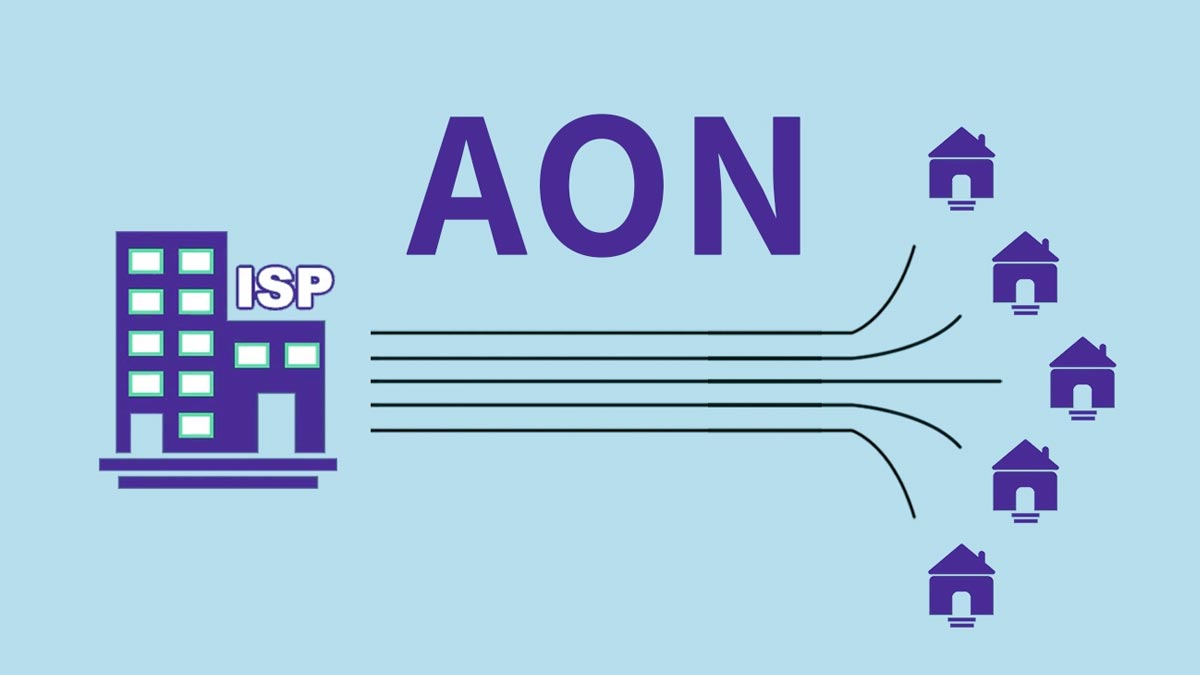
For this reason, AON is often associated with Active Ethernet networks used in:
-
Enterprise campuses
-
FTTH broadband deployments
-
Industrial Ethernet systems
-
Smart buildings and smart city infrastructure
-
Data center interconnection environments
Key Characteristics of AON Networks
1. Dedicated Bandwidth
Each user typically receives a dedicated fiber link rather than sharing bandwidth across multiple subscribers. This improves performance consistency during peak traffic periods.
2. Point-to-Point Topology
AON networks commonly use point-to-point fiber connections, making troubleshooting and bandwidth management simpler compared with shared PON architectures.
3. Active Switching Equipment
Powered Ethernet switches or optical access nodes actively control signal routing and traffic management throughout the network.
4. Higher Flexibility
AON networks are often easier to scale for enterprise applications because administrators can manage subscribers similarly to standard Ethernet infrastructure.
5. Greater Fiber Usage
Since each endpoint usually requires its own dedicated fiber strand, AON deployments often consume more fiber resources than GPON or EPON systems.
Why AON Is Sometimes Called Active Ethernet
Many modern AON deployments operate using standard Ethernet protocols over fiber-optic cabling. Because of this, the terms AON and Active Ethernet are frequently used interchangeably in the networking industry.
However, Active Ethernet specifically describes the Ethernet transport method, while AON refers more broadly to the overall active optical access architecture.
🟨 How an Active Optical Network Works in Practice
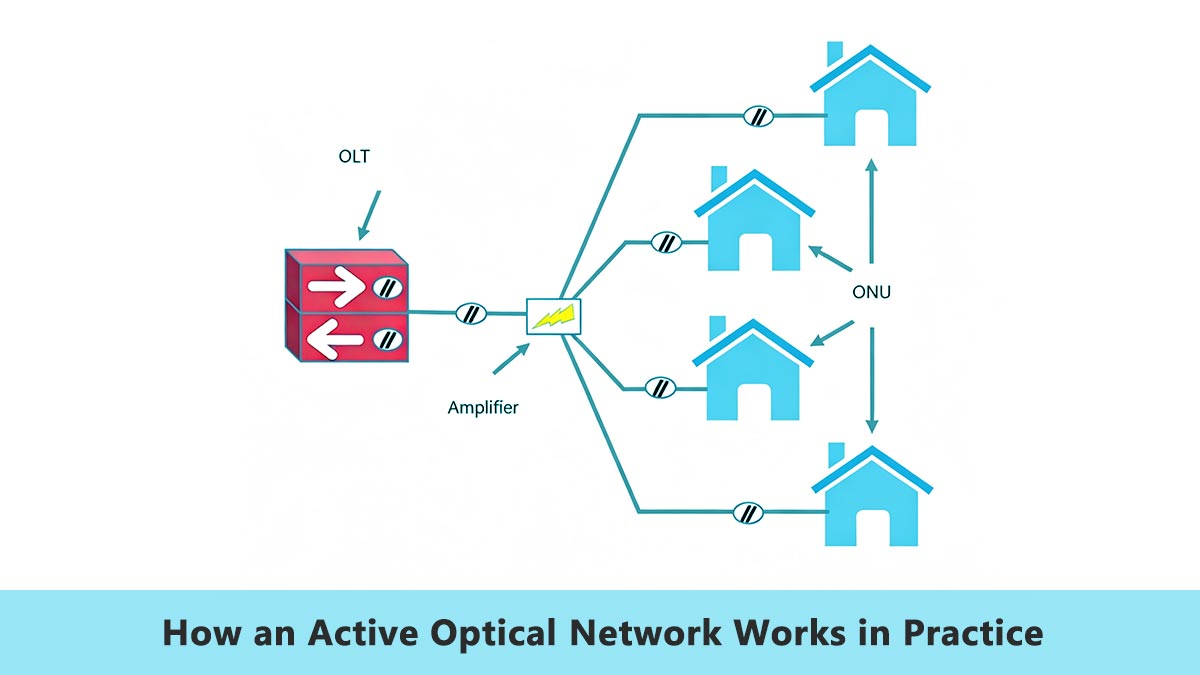
In real-world deployments, an Active Optical Network (AON) operates much like a traditional Ethernet network, but with fiber-optic cabling replacing copper module infrastructure. Instead of distributing signals through passive optical splitters, AON uses powered switching equipment to manage and forward traffic between the central network and each subscriber.
The architecture is commonly deployed in FTTH broadband networks, enterprise campuses, industrial facilities, hospitals, universities, and smart building environments where dedicated bandwidth and low-latency connectivity are important.
Basic AON Network Architecture
A typical AON deployment includes four major components:
|
Component |
Function |
|---|---|
|
Central Office (CO) or Core Switch |
Aggregates and manages network traffic |
|
Active Ethernet Switch |
Directs traffic to individual fiber links |
|
Fiber Distribution Network |
Provides dedicated optical connections |
|
Customer Premises Equipment (CPE) |
Connects end users to the optical network |
Unlike GPON or EPON systems that share one optical line among multiple subscribers, AON usually provides a dedicated point-to-point fiber connection for every endpoint.
Step-by-Step Data Transmission Process
1. Data Leaves the Core Network
Traffic originates from the service provider’s core network or enterprise data center. The data is forwarded to an aggregation switch or Ethernet access node located in the central office or field cabinet.
2. Active Switching Equipment Processes Traffic
The active Ethernet switch identifies the destination subscriber and routes the traffic through a dedicated optical port. Because switching intelligence exists within the network, traffic management can be more granular than in passive optical architectures.
3. Dedicated Fiber Carries the Signal
Each subscriber receives data through an individual optical fiber link. Since bandwidth is not shared through passive splitters, network congestion between neighboring users is minimized.
4. Customer Equipment Receives the Data
At the user side, the optical signal reaches customer premises equipment (CPE), media converters, or fiber Ethernet terminals that convert optical signals into usable Ethernet connections for routers, PCs, switches, or wireless access points.
Why Enterprises Often Prefer AON
Many enterprise and campus networks choose AON because the architecture closely resembles standard Ethernet infrastructure. Network administrators can manage traffic, VLANs, QoS policies, and subscriber isolation using familiar Ethernet tools and switching methods.
AON is particularly attractive for applications requiring:
-
Stable symmetrical bandwidth
-
Low latency
-
Dedicated fiber connectivity
-
Enhanced traffic security and isolation
-
Simplified troubleshooting
-
Flexible network upgrades
Real-World Example of AON Deployment
Consider a university campus deploying fiber connectivity across multiple buildings. With an AON architecture, each building can receive a dedicated fiber connection back to the central network switch. This allows the IT team to independently manage bandwidth, security policies, and traffic routing for each location without sharing optical capacity across passive splitters.
Similarly, some FTTH providers use Active Ethernet-based AON systems in densely populated urban environments where high-performance business connectivity is required.
🟨 AON vs. PON: The Core Differences Explained
The comparison between AON (Active Optical Network) and PON (Passive Optical Network) is one of the most important decisions in modern fiber network design. Although both technologies deliver high-speed optical connectivity, they use fundamentally different architectures for transmitting and managing data traffic.
The primary difference is simple:
-
AON uses powered active switching equipment
-
PON uses passive optical splitters without electrical power
This architectural distinction affects bandwidth allocation, scalability, deployment cost, maintenance requirements, latency, and long-term network flexibility.
AON vs. PON Architecture
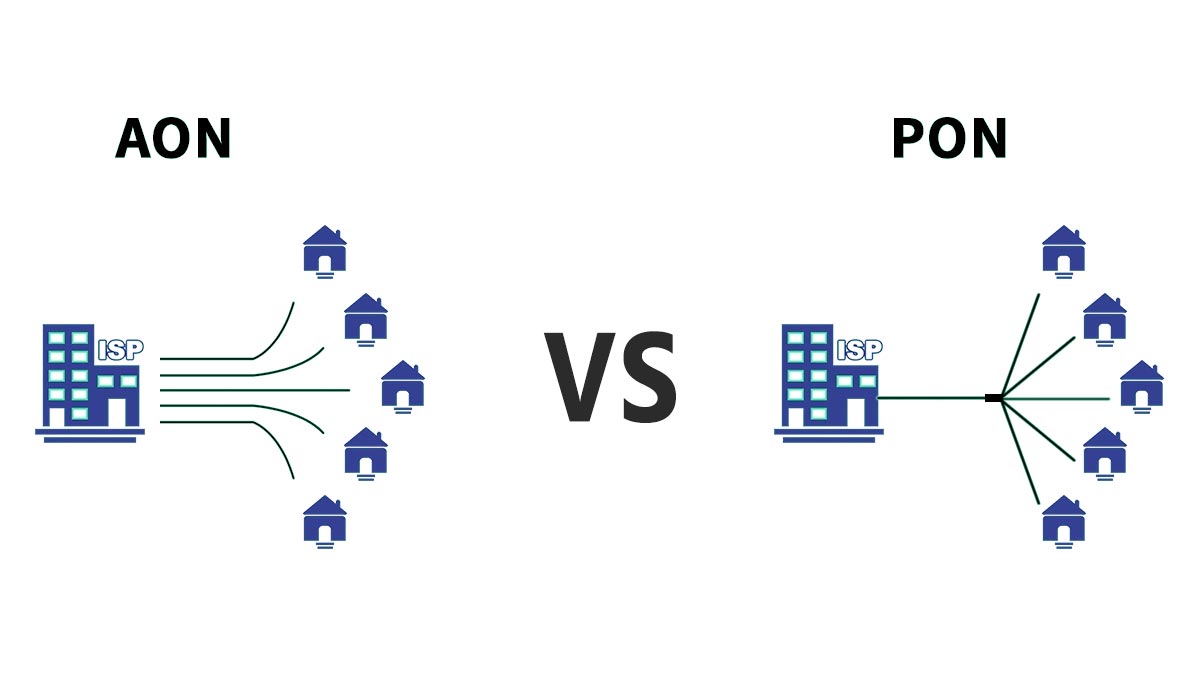
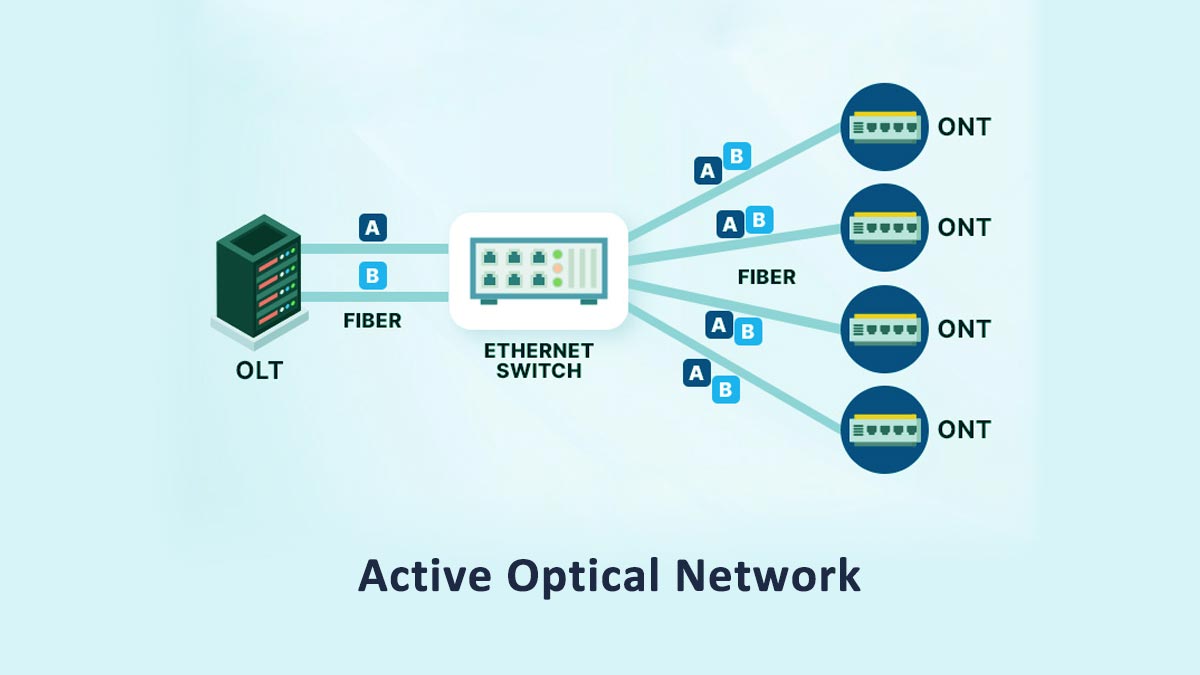
An AON network typically uses a point-to-point (P2P) topology. Each subscriber receives a dedicated fiber connection that links directly to an active Ethernet switch or aggregation node.
In contrast, a PON network uses a point-to-multipoint topology. A single optical fiber from the Optical Line Terminal (OLT) is passively split among multiple users through optical splitters.
Simplified Comparison
|
Feature |
AON (Active Optical Network) |
PON (Passive Optical Network) |
|---|---|---|
|
Network Type |
Active Ethernet-based |
Passive optical splitting |
|
Topology |
Point-to-point |
Point-to-multipoint |
|
Field Electronics |
Required |
Not required |
|
Fiber Usage |
Higher |
Lower |
|
Bandwidth Allocation |
Dedicated per user |
Shared among users |
|
Latency |
Typically lower |
Slightly higher |
|
Power Consumption |
Higher |
Lower |
|
Scalability |
Excellent for enterprise |
Excellent for residential FTTH |
|
Maintenance Complexity |
Higher |
Lower |
|
Deployment Cost |
Usually higher |
Usually lower |
Bandwidth Allocation Differences
One of the biggest reasons organizations choose AON is dedicated bandwidth. Since every user has an individual fiber connection, bandwidth is not shared with neighboring subscribers.
PON systems distribute bandwidth across multiple users connected to the same optical splitter. Although modern GPON and XGS-PON systems still provide very high speeds, total optical capacity is shared among subscribers during peak usage periods.
For example:
-
In AON, a customer may receive a fully dedicated SFP 1G or SFP+ 10G link.
-
In GPON, multiple homes may share downstream bandwidth from a single OLT port.
Active vs. Passive Infrastructure
AON networks rely on powered Ethernet switches or optical access nodes placed within the network infrastructure. These devices actively manage traffic routing and subscriber communication.
PON systems eliminate powered field electronics by using passive splitters that require no electricity. This significantly reduces operational costs and simplifies outside plant maintenance.
Because of this, PON architectures are often preferred for large-scale FTTH deployments where minimizing field power consumption is critical.
Fiber Efficiency
PON is generally more fiber-efficient because multiple users can share one feeder fiber through passive optical splitting.
AON typically requires:
-
More fiber strands
-
More switch ports
-
More active hardware
This can increase deployment costs in very large residential broadband networks.
However, AON provides better traffic isolation and simpler subscriber-level troubleshooting because each connection is physically separated.
Security and Traffic Isolation
AON networks naturally provide stronger physical traffic separation because each subscriber operates on an independent fiber path.
In PON systems, traffic is logically separated through encryption and network management protocols, even though optical bandwidth is shared across the same feeder infrastructure.
For highly sensitive enterprise or industrial applications, dedicated AON links may simplify compliance and security management.
Which Is Better: AON or PON?
There is no universal “best” architecture. The right choice depends on deployment goals.
AON Is Commonly Preferred For:
-
Enterprise campuses
-
Government and military networks
-
Industrial Ethernet
-
Smart buildings
-
Low-latency applications
-
High-bandwidth symmetrical services
PON Is Commonly Preferred For:
-
Residential FTTH broadband
-
Large-scale ISP deployments
-
Cost-sensitive fiber rollouts
-
Networks prioritizing lower power consumption
-
High-density subscriber environments
In modern deployments, many service providers use both architectures together, selecting AON for premium enterprise services and PON for mass-market residential access.
🟨 AON vs. GPON vs. EPON: Standards, Compatibility, and Use Cases
Although AON, GPON, and EPON are all used in fiber-optic access networks, they are based on different transmission models, standards organizations, and deployment strategies. Understanding these differences is essential when selecting equipment, planning FTTH infrastructure, or evaluating network upgrade paths.
One of the most common misconceptions is treating AON, GPON, and EPON as direct equivalents. In reality:
-
AON is an active point-to-point optical architecture
-
GPON and EPON are passive point-to-multipoint optical standards
This means the technologies differ not only in bandwidth delivery, but also in topology, compatibility, and operational design.
What Is GPON?
GPON (Gigabit Passive Optical Network) is a passive optical networking standard defined by the ITU-T (International Telecommunication Union). It is widely used in FTTH broadband deployments around the world.
GPON uses passive optical splitters to allow multiple subscribers to share a single optical fiber from the Optical Line Terminal (OLT).
Typical GPON characteristics include:
-
Shared downstream and upstream bandwidth
-
Point-to-multipoint architecture
-
Passive optical splitting
-
Lower fiber consumption
-
Long-distance transmission capability
-
Strong adoption among telecom carriers and ISPs
GPON is commonly deployed for:
-
Residential FTTH services
-
Triple-play broadband networks
-
IPTV and voice services
-
Large-scale ISP rollouts
What Is EPON?
EPON (Ethernet Passive Optical Network) is an IEEE-based passive optical networking standard that transports native Ethernet traffic over fiber infrastructure.
Compared with GPON, EPON is often viewed as more Ethernet-centric because it integrates more directly with traditional Ethernet networking environments.
EPON is widely used in:
-
Enterprise broadband systems
-
Campus networks
-
Regional FTTH deployments
-
Ethernet-focused service provider networks
Key Difference Between GPON and EPON
|
Feature |
GPON |
EPON |
|---|---|---|
|
Standards Body |
ITU-T |
IEEE |
|
Transport Method |
TDM-based |
Native Ethernet |
|
Efficiency |
Higher bandwidth efficiency |
Simpler Ethernet integration |
|
Typical Deployment |
Telecom FTTH |
Ethernet-oriented networks |
|
Encapsulation |
GEM |
Ethernet frames |
In practice, both technologies are mature and widely deployed. The choice often depends on existing infrastructure, vendor ecosystem, regional market preference, and operational requirements.
How AON Differs From GPON and EPON
Unlike GPON and EPON, AON does not rely on passive splitters or shared optical bandwidth. Instead, AON typically uses Active Ethernet switches and dedicated point-to-point fiber links.
This creates several major differences:
|
Feature |
AON |
GPON / EPON |
|---|---|---|
|
Network Type |
Active |
Passive |
|
Fiber Topology |
Point-to-point |
Point-to-multipoint |
|
Bandwidth Model |
Dedicated |
Shared |
|
Field Power Requirement |
Yes |
No |
|
Traffic Isolation |
Physical separation |
Logical separation |
|
Fiber Efficiency |
Lower |
Higher |
|
Enterprise Flexibility |
Excellent |
Moderate |
Compatibility Considerations
One of the most important operational differences involves equipment compatibility.
In GPON and EPON systems:
-
ONTs/ONUs must match the OLT platform
-
Standards compatibility matters heavily
-
Vendor interoperability may vary
A GPON ONT cannot simply operate on an EPON network unless the equipment explicitly supports both standards.
Similarly, AON infrastructure is fundamentally different from passive optical systems. AON customer devices connect through Ethernet-based active switching rather than PON optical splitters and OLT scheduling systems.
Because of these architectural differences:
-
AON equipment is generally not interchangeable with GPON or EPON hardware
-
Network migration often requires infrastructure redesign
-
Optical transceiver compatibility becomes important during upgrades
Typical Real-World Use Cases
AON Use Cases
AON is commonly selected when organizations need:
-
Dedicated symmetrical bandwidth
-
Low latency
-
Enterprise-grade traffic isolation
-
High-performance campus networking
-
Industrial or mission-critical connectivity
GPON Use Cases
GPON is typically preferred for:
-
Residential FTTH broadband
-
Telecom carrier deployments
-
Large-scale subscriber environments
-
Cost-efficient fiber distribution
EPON Use Cases
EPON is often deployed in:
-
Ethernet-focused broadband systems
-
Municipal fiber networks
-
Campus and regional ISP projects
-
Networks prioritizing Ethernet simplicity
Which Architecture Is Best?
The best architecture depends on deployment priorities.
Choose AON when performance consistency, dedicated bandwidth, and enterprise flexibility are the highest priorities.
Choose GPON or EPON when fiber efficiency, scalability, and lower deployment costs are more important for large subscriber bases.
In many modern fiber networks, operators combine these technologies — using GPON or XGS-PON for residential access while reserving AON or Active Ethernet for premium business services.
🟨 Benefits and Limitations of AON for Modern Fiber Networks
An AON Active Optical Network offers several advantages for high-performance fiber deployments, especially in enterprise, campus, and dedicated-access environments. However, the architecture also introduces higher infrastructure and operational requirements compared with passive optical systems such as GPON or EPON.
Understanding both the strengths and limitations of AON is essential when evaluating long-term network scalability, deployment cost, and operational efficiency.
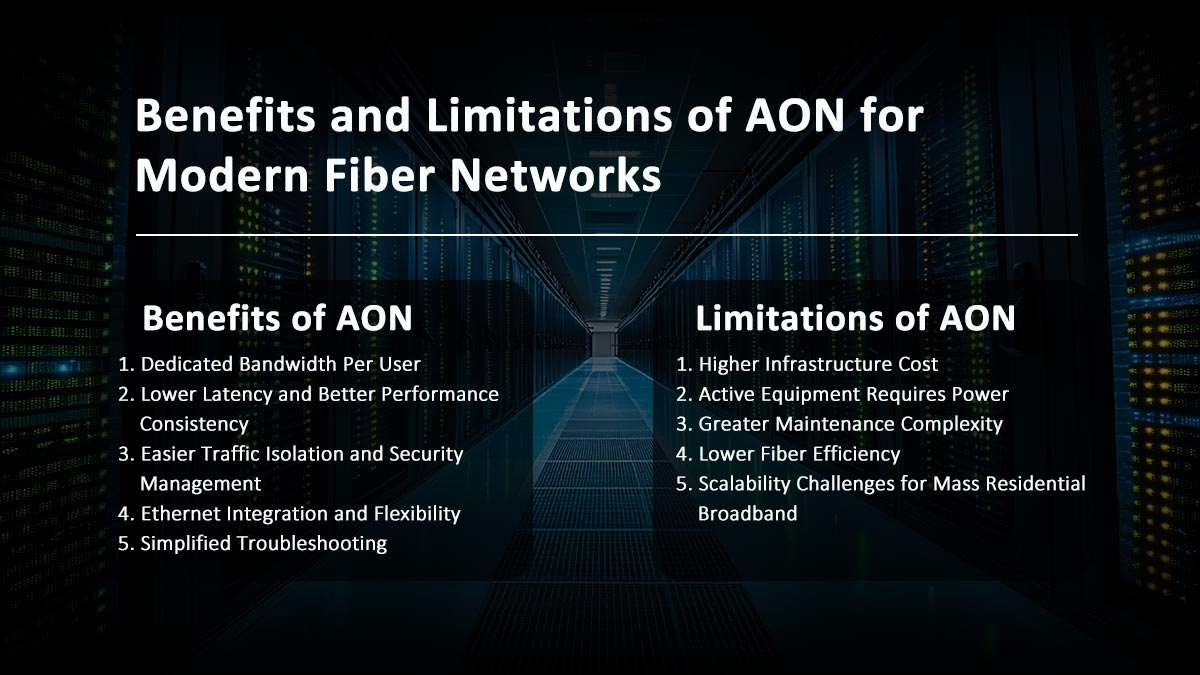
Benefits of AON
1. Dedicated Bandwidth Per User
One of the biggest advantages of AON is its point-to-point fiber architecture. Each subscriber or endpoint typically receives a dedicated optical connection, which helps deliver stable and predictable bandwidth.
This is especially valuable for:
-
Enterprise connectivity
-
Cloud applications
-
Video conferencing
-
Industrial automation
-
High-density data traffic environments
Unlike shared PON bandwidth models, neighboring users do not directly compete for the same optical capacity.
2. Lower Latency and Better Performance Consistency
Because AON uses direct Ethernet switching instead of passive optical splitting, latency is often lower and traffic management is more predictable.
This makes AON attractive for:
-
Real-time applications
-
Financial trading systems
-
Smart manufacturing
-
Campus backbone networks
-
Low-latency enterprise infrastructure
3. Easier Traffic Isolation and Security Management
Each subscriber operates on an independent fiber path, providing stronger physical traffic separation compared with shared PON architectures.
For organizations with strict compliance or security requirements, AON can simplify:
-
VLAN segmentation
-
Subscriber isolation
-
Network monitoring
-
Traffic troubleshooting
-
Access control management
4. Ethernet Integration and Flexibility
AON networks are commonly built around standard Ethernet technologies. This allows network administrators to use familiar Ethernet switching tools, protocols, and management platforms.
Benefits include:
-
Easier integration with existing LAN infrastructure
-
Flexible bandwidth provisioning
-
Simplified upgrades to higher Ethernet speeds
-
Better compatibility with enterprise network policies
5. Simplified Troubleshooting
Since each connection is physically separated, identifying faults is often easier than in shared PON environments.
Technicians can isolate:
-
Fiber failures
-
Subscriber issues
-
Port-level problems
-
Performance bottlenecks
without affecting multiple users connected through a shared optical splitter.
Limitations of AON
1. Higher Infrastructure Cost
AON deployments generally require:
-
More fiber strands
-
More switch ports
-
More optical transceiver modules
-
More active network hardware
This increases both initial deployment cost and long-term expansion expenses, especially in large residential FTTH projects.
2. Active Equipment Requires Power
Unlike passive optical networks, AON depends on powered switching equipment installed throughout the network.
This creates additional requirements for:
-
Electrical power distribution
-
Battery backup systems
-
Cooling and environmental protection
-
Field equipment maintenance
As network scale increases, operational costs can rise significantly.
3. Greater Maintenance Complexity
Because active electronics are deployed within the access network, AON systems usually require more ongoing maintenance than passive optical architectures.
Potential maintenance concerns include:
-
Switch failures
-
Power outages
-
Firmware updates
-
Environmental exposure
-
Hardware replacement cycles
4. Lower Fiber Efficiency
AON networks consume more fiber resources because each endpoint typically requires a dedicated connection.
In very large FTTH deployments, this can create challenges involving:
-
Fiber availability
-
Duct capacity
-
Central office port density
-
Cable management complexity
PON systems are generally more efficient for serving large subscriber populations with limited feeder fiber infrastructure.
5. Scalability Challenges for Mass Residential Broadband
While AON performs extremely well for enterprise and premium services, it is often less cost-effective for high-density residential broadband rollouts.
For this reason, many ISPs prefer:
-
GPON
-
XGS-PON
-
EPON
for large-scale consumer FTTH deployments where minimizing infrastructure cost per subscriber is critical.
Summary: Is AON Still Relevant?
Despite the rise of GPON and XGS-PON, AON remains highly relevant for applications requiring:
-
Dedicated bandwidth
-
High reliability
-
Low latency
-
Enterprise-grade control
-
Advanced traffic management
In many modern fiber networks, AON and PON are not competing technologies but complementary architectures designed for different operational goals.
🟨 When to Choose AON for FTTH, Enterprise, or Campus Networks
An AON Active Optical Network is best suited for environments that require dedicated bandwidth, low latency, and greater traffic control. Unlike shared PON architectures, AON uses point-to-point fiber connections, making it ideal for high-performance and enterprise-grade applications.

♦ Enterprise and Campus Networks
AON is widely used in:
-
Corporate campuses
-
Universities and research centers
-
Hospitals and government facilities
-
Industrial and smart building networks
Because AON closely resembles standard Ethernet infrastructure, administrators can more easily manage VLANs, security policies, and bandwidth allocation across multiple locations.
♦ Premium FTTH and Business Services
Although GPON and XGS-PON dominate large residential FTTH deployments, AON is often chosen for premium broadband services that require:
-
Dedicated symmetrical bandwidth
-
Low-latency connectivity
-
Higher traffic isolation
-
Enterprise-grade SLAs
This is common in business parks, commercial buildings, and carrier Ethernet services.
♦ Industrial and Mission-Critical Applications
AON is also suitable for industrial environments where reliability and predictable performance are critical, including:
-
Manufacturing facilities
-
Transportation systems
-
Security and surveillance networks
-
Utility infrastructure
♦ When PON May Be Better
PON architectures are usually more cost-effective for large-scale residential broadband deployments because they reduce:
-
Fiber usage
-
Power requirements
-
Field maintenance costs
For this reason, many operators use a hybrid strategy — deploying PON for residential users and AON for enterprise or high-performance services.
♦ Key Decision Factors
AON is typically the better choice when networks require:
-
Dedicated bandwidth
-
Low latency
-
Strong traffic isolation
-
Flexible Ethernet management
-
High-performance business connectivity
In modern fiber infrastructure, AON remains an important solution for enterprise, campus, and premium optical access networks.
🟨 FAQs About AON Active Optical Network

1. What is an AON Active Optical Network?
An AON (Active Optical Network) is a fiber-optic network architecture that uses powered switching equipment to deliver dedicated point-to-point optical connections between users and the central network. It is commonly associated with Active Ethernet deployments.
2. What is the difference between AON and PON?
The main difference is that AON uses active powered devices, while PON (Passive Optical Network) uses passive optical splitters without electrical power.
-
AON provides dedicated bandwidth per user
-
PON shares bandwidth among multiple subscribers
AON typically offers better traffic isolation and lower latency, while PON is more fiber-efficient and cost-effective for large FTTH deployments.
3. Is AON better than GPON?
Neither technology is universally better.
-
AON is often preferred for enterprise, campus, and low-latency applications requiring dedicated bandwidth.
-
GPON is commonly used for large-scale residential FTTH networks because it lowers deployment and maintenance costs.
The best choice depends on performance requirements, budget, and network scale.
4. Does AON use dedicated fiber connections?
Yes. Most AON networks use a point-to-point fiber architecture, where each subscriber receives a dedicated optical link connected to active Ethernet switching equipment.
5. Where is AON commonly used?
AON is commonly deployed in:
-
Enterprise campuses
-
Universities and hospitals
-
Industrial Ethernet networks
-
Smart buildings
-
Premium business fiber services
-
Carrier Ethernet infrastructure
6. Can AON and PON coexist in the same network?
Yes. Many service providers use hybrid fiber architectures that combine:
-
PON for residential broadband
-
AON for enterprise or dedicated business services
This allows operators to balance scalability, performance, and deployment cost.
🟨 Final Thoughts: Is AON the Right Fiber Network Architecture?
An AON Active Optical Network remains an important solution for modern fiber infrastructure, especially in environments that require dedicated bandwidth, low latency, flexible Ethernet management, and strong traffic isolation. While PON technologies such as GPON and EPON are highly efficient for large-scale residential FTTH deployments, AON continues to play a critical role in enterprise, campus, industrial, and premium business networking.
The best architecture ultimately depends on your deployment priorities:
-
Choose AON for performance-focused and enterprise-grade connectivity
-
Choose PON for cost-efficient large subscriber deployments
-
Consider hybrid architectures when balancing scalability and service flexibility
As bandwidth demands continue to grow with AI computing, cloud services, edge networking, and smart infrastructure, selecting the right optical access architecture becomes increasingly important for long-term network reliability and scalability.
For businesses and network integrators looking for reliable optical networking components, Ethernet connectivity solutions, and fiber communication products, the LINK-PP Official Store provides a wide range of RJ45 connectors, LAN transformers, SFP optical modules, and integrated networking solutions designed for modern high-speed network infrastructure.







