





























The rapid growth of data-intensive applications such as cloud computing, virtualization, and high-performance storage has significantly increased the demand for reliable 10GbE connectivity. In many enterprise and data center environments, network engineers are seeking cost-effective and flexible solutions to upgrade from legacy Gigabit infrastructure without a complete overhaul. As a result, copper-based SFP+ modules like the 10GBASE-T transceiver have gained attention for their ability to leverage existing twisted-pair cabling while delivering 10Gbps performance.
Among these solutions, the 10Gtek ASF-10G-T has become a widely discussed option due to its compatibility with multiple networking platforms and its practicality in short-range deployments. However, when integrating such modules into heterogeneous network environments, questions often arise regarding cross-referencing with other vendor part numbers, interoperability with different switch brands, and whether alternative technologies such as fiber optic transceivers or DAC cables might offer better performance or efficiency.
This article explores the 10Gtek ASF-10G-T in depth, focusing on its specifications, cross-reference equivalents, and viable alternatives. It also examines performance trade-offs, deployment considerations, and common challenges to help network professionals make informed decisions. By the end, you will have a clear understanding of how to position this module within modern network architectures and how to evaluate the most suitable options for their specific use cases.
? Overview of 10Gtek ASF-10G-T
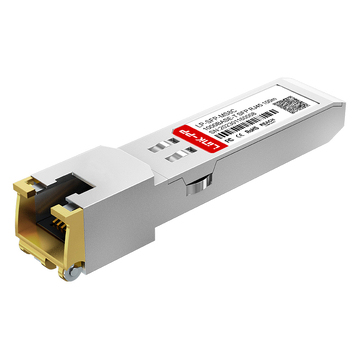
The 10Gtek ASF-10G-T is a 10GBASE-T SFP+ copper module that enables 10Gbps Ethernet transmission over standard RJ45 twisted-pair cabling, making it a practical solution for short-range network links. It is specifically designed for environments that prioritize compatibility with existing copper infrastructure, allowing organizations to upgrade to 10GbE without migrating to fiber. While it delivers the convenience of RJ45 connectivity, it also introduces trade-offs in power consumption and thermal output that must be considered during deployment.

Key Specifications and Features
At its core, the 10Gtek ASF-10G-T functions as a bridge between high-speed SFP+ ports and traditional Ethernet cabling, supporting flexible deployment across multi-vendor networking environments. It adheres to the 10GBASE-T standard, enabling auto-negotiation and backward compatibility with lower speeds, which simplifies integration into mixed-speed networks.
| Parameter | Specification | Technical Implication |
|---|---|---|
| Interface | RJ45 (10GBASE-T) | Compatible with copper cabling |
| Data Rate | 10Gbps / 1Gbps | Supports auto-negotiation |
| Max Distance | Up to 30m | Dependent on Cat6a/Cat7 quality |
| Power Consumption | ~2.5W–3W | Higher thermal output |
| Form Factor | SFP+ | Hot-swappable, plug-and-play |
These specifications indicate that the module is optimized for flexibility rather than efficiency. Compared to optical SFP+ modules or DAC cables, 10GBASE-T transceivers inherently consume more power due to the complexity of signal processing over copper. This additional power draw translates into higher heat generation, which can limit port density on switches and requires careful thermal planning in dense deployments.
From a protocol perspective, the module supports standard Ethernet features such as auto-negotiation and link training, which help maintain stable connections across varying cable qualities. However, achieving consistent 10Gbps performance depends heavily on using high-quality Cat6a or Cat7 cabling, as lower-grade cables may introduce signal degradation or force downshifting to lower speeds.
Typical Use Cases
The primary value of the 10Gtek ASF-10G-T lies in its ability to extend 10GbE connectivity over familiar copper infrastructure, making it particularly suitable for incremental network upgrades and hybrid environments. It is not intended for long-distance transmission but excels in short-reach scenarios where simplicity and compatibility outweigh efficiency concerns.
- Data center top-of-rack (ToR) architectures, where servers connect to switches within the same rack
- Enterprise access and aggregation layers, especially during phased upgrades from 1GbE to 10GbE
- Test labs and development environments that require flexible and reusable connectivity
- Edge deployments where fiber infrastructure is unavailable or impractical
These scenarios highlight a key design philosophy: the module prioritizes operational convenience and infrastructure reuse. By eliminating the need for fiber patching or specialized optical components, it reduces deployment complexity and accelerates installation timelines.
However, this convenience comes with architectural considerations. In high-density switch environments, the cumulative power consumption of multiple 10GBASE-T modules can significantly increase thermal load. Additionally, latency is slightly higher compared to DAC or optical solutions due to the encoding and signal processing required for copper transmission. As a result, while the 10Gtek ASF-10G-T is highly effective in short-range, cost-sensitive deployments, it is typically not the preferred choice for latency-critical or large-scale spine-leaf data center fabrics.
? Understanding Cross-Reference in SFP+ Modules
Cross-referencing in SFP+ modules refers to the process of mapping one vendor’s transceiver part number—such as the 10Gtek ASF-10G-T—to equivalent modules from other manufacturers that offer the same functionality and compatibility. In practical terms, it allows network engineers to identify interchangeable options that can operate reliably across different switch platforms without being restricted to a single vendor ecosystem.

What Does Cross-Reference Mean?
In the context of 10GBASE-T SFP+ modules, cross-reference is essentially a compatibility mapping mechanism that aligns technical specifications, interface standards, and vendor-specific coding. Although many transceivers share the same physical form factor and electrical interface, they may differ in how they are recognized by network equipment due to EEPROM coding and firmware validation.
A typical cross-reference relationship involves matching key attributes across vendors, as shown below:
| Attribute | Purpose | Impact on Compatibility |
|---|---|---|
| Form Factor | SFP+ standard | Ensures physical fit |
| Interface Type | 10GBASE-T (RJ45) | Defines transmission medium |
| Vendor Coding | EEPROM identification | Affects switch recognition |
| Performance Specs | Distance, speed, power | Determines operational behavior |
This mapping ensures that a module labeled for one vendor can function in another vendor’s switch, provided the coding and firmware alignment are appropriate. However, cross-referencing is not purely a hardware comparison—it also involves software-level compatibility, which can vary across platforms.
Why Cross-Referencing Matters
Cross-referencing is essential in modern networks because most environments are no longer single-vendor. It directly impacts procurement flexibility, operational efficiency, and long-term scalability.
- Avoiding vendor lock-in: Organizations can select from multiple suppliers instead of relying on proprietary modules
- Cost optimization: Compatible alternatives often provide similar performance at a lower cost
- Simplified inventory management: Standardized equivalents reduce the need to stock multiple vendor-specific SKUs
- Faster deployment: Readily available alternatives minimize delays caused by supply constraints
These advantages make cross-referencing a critical strategy in both enterprise and data center environments. It enables network teams to maintain flexibility while still meeting technical requirements.
At the same time, it is important to recognize that not all cross-referenced modules behave identically in real-world deployments. Differences in firmware validation, thermal performance, and power consumption can influence stability, especially in high-density or mission-critical environments. Therefore, while cross-reference provides a valuable starting point, it should always be validated through compatibility testing and alignment with the target network hardware.
By understanding how cross-referencing works, engineers can make more informed decisions when selecting alternatives to the 10Gtek ASF-10G-T, ensuring both interoperability and long-term reliability.
? 10Gtek ASF-10G-T Cross-Reference Equivalents
The 10Gtek ASF-10G-T can be cross-referenced with multiple 10GBASE-T SFP+ modules from major networking vendors, provided they share the same electrical interface, performance characteristics, and compatible EEPROM coding. In most enterprise scenarios, equivalent modules are functionally interchangeable, but actual compatibility depends on how strictly the target switch enforces vendor validation and firmware checks.

Compatible Vendor Part Numbers
From a hardware and standards perspective, several well-known vendors offer 10GBASE-T SFP+ modules that align closely with the ASF-10G-T in terms of interface, speed, and reach. These equivalents are commonly used in multi-vendor environments where interoperability is required.
| Vendor | Part Number | Interface | Max Distance |
|---|---|---|---|
| Cisco | SFP-10G-T-X | RJ45 (10GBASE-T) | 30m |
| Juniper | SFPP-10G-T | RJ45 (10GBASE-T) | 80m |
| Arista | SFP-10G-T | RJ45 (10GBASE-T) | 80m |
| Mikrotik | S+RJ10 | RJ45 (10GBASE-T) | 30m |
| LINK-PP | LP-RJ45TG-8YC | RJ45 (10GBASE-T) | 80m |
These modules are built around the same IEEE 802.3an standard, which defines 10GBASE-T operation over twisted-pair copper cabling. As a result, their baseline performance—such as throughput and supported distance—remains consistent across vendors.
However, despite this technical alignment, the actual usability of these modules in a given switch depends on vendor-specific recognition mechanisms. Many network operating systems verify the transceiver’s identity through EEPROM data, which can affect whether a module is accepted, limited, or rejected entirely.
Compatibility Considerations
Although cross-referenced modules may appear identical on paper, several practical factors determine whether they will function reliably in a real deployment. These factors extend beyond specifications and involve both hardware behavior and software validation.
- EEPROM coding and vendor recognition: Switches from vendors like Cisco or Juniper may require specific coding to recognize and fully enable third-party modules
- Firmware and OS restrictions: Some platforms enforce strict compatibility checks, while others allow unsupported transceivers with warning messages
- Power and thermal limits: 10GBASE-T modules typically draw more power, and certain switch ports may restrict their usage in high-density configurations
- Auto-negotiation behavior: Differences in implementation can affect link establishment, especially when mixing vendors or cable types
These considerations highlight that cross-referencing is not purely a specification-matching exercise—it is also about ensuring operational stability. Even when modules are technically equivalent, subtle differences in firmware handling or hardware tuning can lead to variations in performance or reliability.
? Key Alternatives to 10Gtek ASF-10G-T
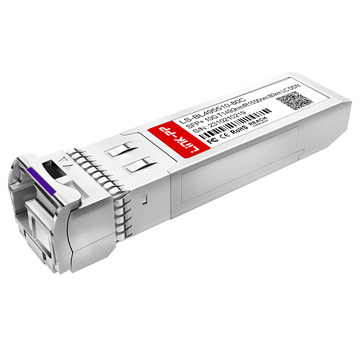
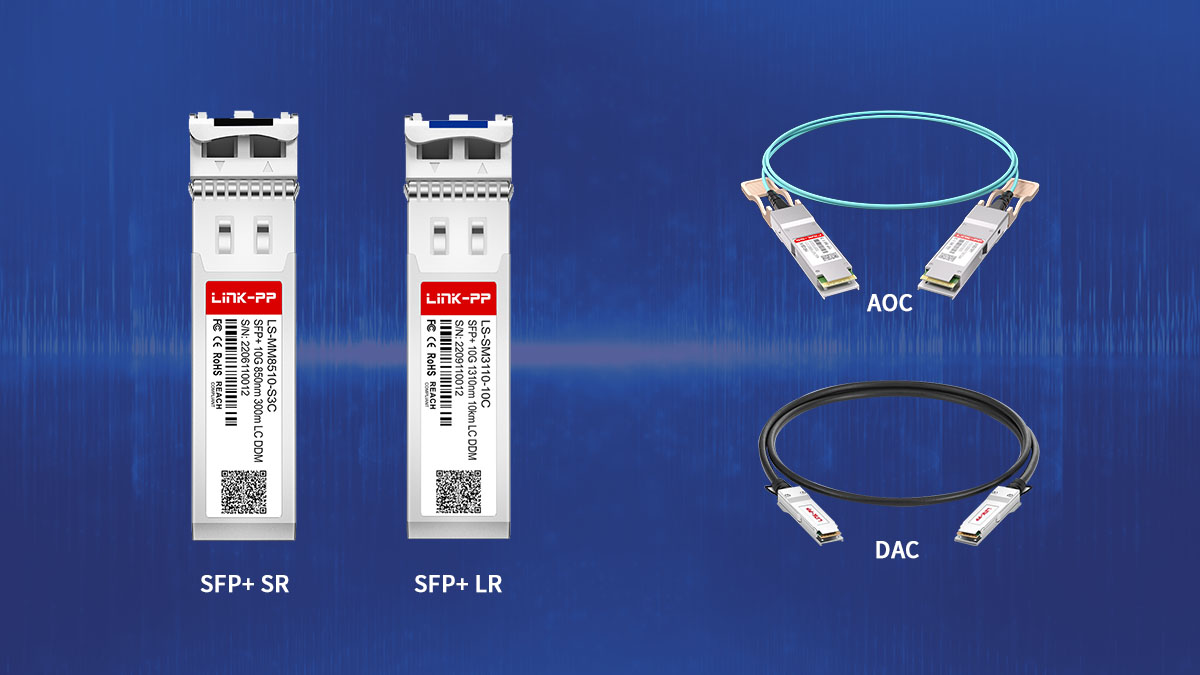
The most relevant alternatives to the 10Gtek ASF-10G-T fall into four categories: SFP+ short-range optics, SFP+ LR optical modules, Direct Attach Cables (DAC), and Active Optical Cables (AOC). Each option provides 10Gbps connectivity but differs significantly in transmission medium, distance capability, power consumption, and deployment complexity. Choosing the right alternative depends on specific network requirements rather than a one-size-fits-all replacement.
Optical vs Copper Alternatives
From a technology perspective, alternatives to 10GBASE-T SFP+ modules primarily involve shifting from copper-based transmission to either fiber optics or integrated cable solutions. These options are generally more efficient in terms of power and latency, though they may require different infrastructure.
| Solution Type | Medium | Typical Distance | Power Consumption |
|---|---|---|---|
| SFP+ SR | Multimode Fiber | Up to 300m | Low |
| SFP+ LR | Single-mode Fiber | Up to 10km | Low |
| DAC | Twinax Copper | Up to 7m | Very Low |
| AOC | Fiber (Integrated) | Up to 100m | Low |
This comparison shows that while the ASF-10G-T focuses on short-range copper connectivity, alternative solutions expand the range of deployment scenarios. Optical modules, for example, are better suited for longer distances and structured cabling systems, while DAC and AOC solutions simplify short-range interconnections with lower power overhead.
It is also important to note that DAC and AOC cables are typically factory-terminated, meaning they reduce installation complexity but limit flexibility compared to modular transceivers.
When to Choose Each Alternative
Selecting the appropriate alternative depends on a combination of technical constraints and operational priorities. The following scenarios outline when each option is most suitable:
- Choose SFP+ SR modules when working within data centers that already use multimode fiber and require distances beyond copper limitations
- Choose SFP+ LR modules for long-distance connections such as campus networks or inter-building links
- Choose DAC cables for ultra-short connections (e.g., within racks) where minimizing latency and power consumption is critical
- Choose AOC cables when longer reach than DAC is needed but with similar plug-and-play simplicity
These decision points highlight that the 10Gtek ASF-10G-T is not a universal solution but rather one option within a broader ecosystem. It excels in environments where RJ45 cabling is already deployed and distances are limited, but alternatives often provide superior efficiency and scalability in more demanding scenarios.
? Performance Comparison Across Alternatives
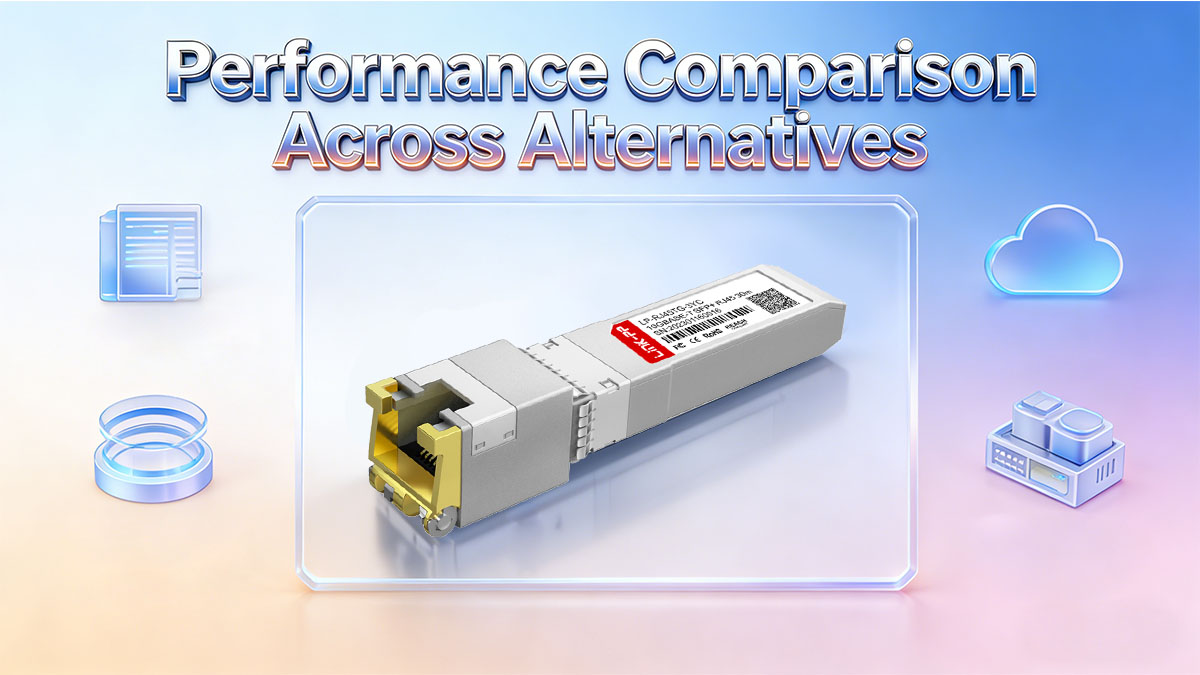
Different 10GbE connectivity options—10GBASE-T modules like the 10Gtek ASF-10G-T, optical transceivers, and DAC/AOC cables—deliver the same nominal data rate but vary significantly in latency, power efficiency, and overall cost profile. In most scenarios, copper-based SFP+ modules offer flexibility and compatibility, while optical and cable-based solutions provide advantages in performance consistency and energy efficiency.
Latency and Throughput
In terms of raw throughput, all 10GbE solutions support line-rate 10Gbps transmission. However, latency varies depending on the underlying technology, with copper-based 10GBASE-T modules introducing additional processing delays due to signal encoding and error correction.
| Solution Type | Latency Level | Throughput Consistency |
|---|---|---|
| 10GBASE-T | Higher | Stable at short range |
| SFP+ SR/LR | Low | Highly consistent |
| DAC | Very Low | Near-zero variation |
| AOC | Low | Highly consistent |
This difference becomes particularly relevant in latency-sensitive environments such as high-frequency trading, real-time analytics, or distributed storage systems. While the latency gap is measured in microseconds, it can accumulate across multiple network hops, making DAC or optical solutions preferable in performance-critical architectures.
At the same time, for general enterprise workloads, the latency introduced by 10GBASE-T is typically negligible, especially when balanced against its deployment flexibility.
Power Consumption
Power efficiency is one of the most significant differentiators among these technologies. Copper-based 10GBASE-T modules require more complex signal processing, which directly increases power draw and heat generation.
| Solution Type | Typical Power Usage | Thermal Impact |
|---|---|---|
| 10GBASE-T | ~2.5W–3W | High |
| SFP+ SR/LR | ~0.8W–1.5W | Moderate |
| DAC | <0.5W | Very Low |
| AOC | ~1W | Low |
Higher power consumption has direct implications for switch design and rack-level cooling. In high-density deployments, using multiple 10GBASE-T modules can significantly increase thermal load, potentially limiting the number of active ports or requiring enhanced cooling strategies.
In contrast, DAC and optical modules are more energy-efficient, making them better suited for large-scale data centers where power and cooling costs are critical factors.
Cost and Total Cost of Ownership
From a cost perspective, the evaluation goes beyond the initial price of the module and includes cabling, infrastructure, and long-term operational expenses.
| Solution Type | Initial Cost | Infrastructure Requirement | Long-Term Cost |
|---|---|---|---|
| 10GBASE-T | Moderate | Existing copper cabling | Higher (power) |
| SFP+ SR | Moderate | Multimode fiber | Moderate |
| SFP+ LR | Higher | Single-mode fiber | Moderate |
| DAC | Low | None (integrated cable) | Low |
| AOC | Moderate | None (integrated cable) | Low |
The 10Gtek ASF-10G-T offers a strong advantage when existing copper infrastructure is already in place, reducing upfront investment. However, its higher power consumption can increase operational costs over time, especially in large deployments.
On the other hand, DAC cables typically provide the lowest total cost for short distances, while optical solutions become more cost-effective as distance requirements increase. This makes the choice highly dependent on deployment scale, distance, and energy considerations.
? Deployment Considerations for 10GBASE-T Modules
Deploying 10GBASE-T SFP+ modules such as the 10Gtek ASF-10G-T requires careful planning around cabling quality, thermal conditions, and compatibility validation. While these modules offer the advantage of using familiar RJ45 infrastructure, their performance and stability are more sensitive to environmental and hardware factors compared to optical or DAC solutions.
Cabling Requirements
Reliable 10Gbps transmission over copper depends heavily on the quality and category of the Ethernet cabling used. Although 10GBASE-T technology is designed to operate over twisted-pair cables, not all cable types can consistently support full 10Gbps speeds.
| Cable Type | Supported Speed | Typical Max Distance | Notes |
|---|---|---|---|
| Cat5e | Up to 1Gbps | 100m | Limited 10Gbps support |
| Cat6 | Up to 10Gbps | ~55m | Distance depends on quality |
| Cat6a | 10Gbps | 100m (standard) | Recommended for stability |
| Cat7 | 10Gbps+ | 100m | Better shielding, higher cost |
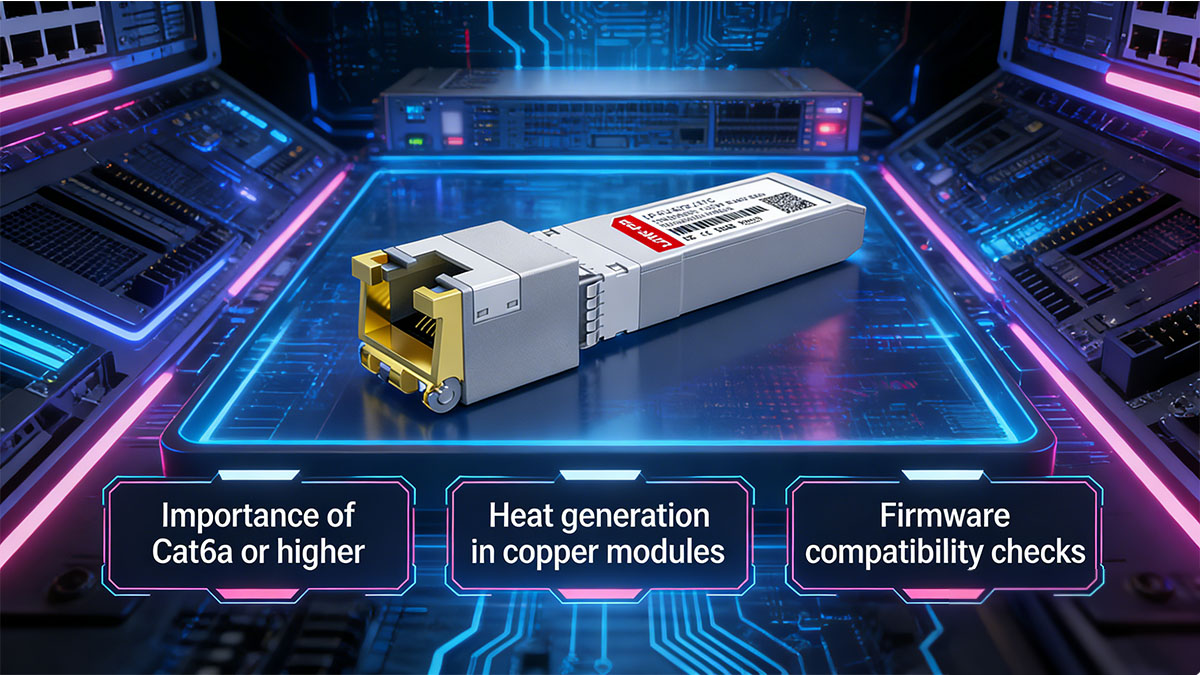
This comparison shows that while lower-category cables may work in some cases, consistent 10Gbps performance typically requires at least Cat6a cabling. Using suboptimal cables can lead to link instability, increased error rates, or automatic downshifting to lower speeds.
In practical deployments, validating cable quality and length is a critical first step, especially in legacy environments where cabling standards may vary.
Thermal Management
10GBASE-T modules inherently consume more power than most other SFP+ options, which leads to increased heat generation. This characteristic directly impacts how many such modules can be deployed within a single switch and how the surrounding environment must be managed.
- Higher per-port power draw increases overall switch thermal load
- Dense port utilization may trigger thermal protection mechanisms
- Some switches limit the number of supported 10GBASE-T modules per line card
- Adequate airflow and cooling design become essential in rack environments
These factors make thermal planning a key consideration, particularly in data centers with high port density. Ignoring thermal constraints can result in degraded performance or unexpected shutdowns of transceiver ports.
To mitigate these risks, it is common practice to distribute copper modules across multiple switches or combine them with lower-power alternatives such as DAC or optical modules.
Compatibility Testing Best Practices
Ensuring compatibility is a critical step when deploying 10GBASE-T modules in multi-vendor environments. Even when specifications align, differences in firmware and vendor validation mechanisms can affect real-world operation.
- Verify switch compatibility lists or vendor documentation before deployment
- Test modules in a controlled environment prior to large-scale rollout
- Check for firmware updates that may affect transceiver support
- Monitor system logs for warnings related to unsupported modules
These practices help identify potential issues early and reduce the risk of deployment failures. In some cases, switches may allow third-party modules but display warning messages, while in stricter environments, unsupported modules may not function at all.
By combining proper cabling, thermal planning, and compatibility validation, network engineers can maximize the reliability and performance of 10GBASE-T modules like the 10Gtek ASF-10G-T, ensuring they operate effectively within modern network infrastructures.
? Common Challenges and Troubleshooting
When deploying 10GBASE-T SFP+ modules such as the 10Gtek ASF-10G-T, most issues stem from cabling limitations, power and thermal constraints, or vendor compatibility restrictions. Unlike optical modules, copper-based transceivers involve more complex signal processing, which increases the likelihood of link instability or performance inconsistencies if the environment is not properly optimized.
Link Establishment Issues
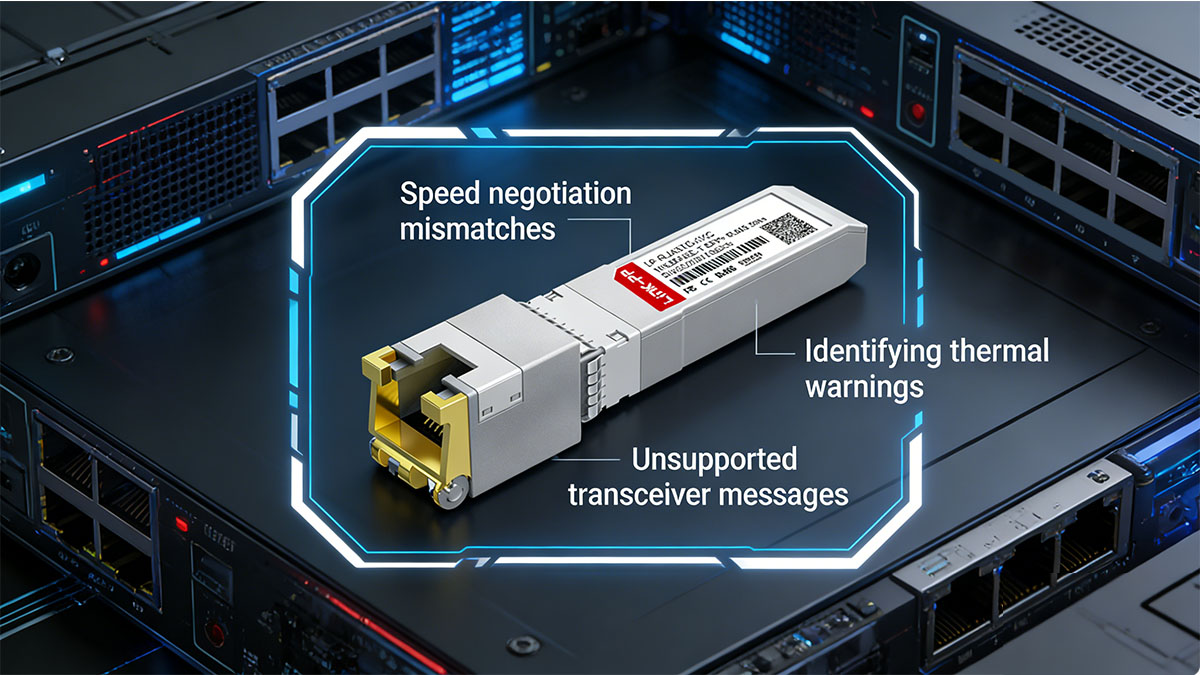
Failure to establish a stable link is one of the most common problems encountered with 10GBASE-T modules. In most cases, the root cause is related to cabling quality or negotiation mismatches rather than hardware defects.
- Cable category below Cat6a leading to insufficient bandwidth
- Excessive cable length exceeding recommended limits
- Auto-negotiation conflicts between connected devices
- Poor cable termination or interference from external sources
These factors can result in no link, intermittent connectivity, or fallback to lower speeds such as 1Gbps. In troubleshooting, the first step is to verify cable specifications and replace questionable cables with certified Cat6a or higher.
Additionally, manually checking or aligning speed and duplex settings on both ends can help resolve negotiation-related issues, especially in mixed-vendor environments.
Overheating Problems
Thermal issues are a known characteristic of 10GBASE-T SFP+ modules due to their relatively high power consumption. Excessive heat can affect both module performance and switch stability.
| Symptom | Possible Cause | Recommended Action |
|---|---|---|
| Port shutdown | Thermal protection | Improve airflow |
| Intermittent link drops | Overheating module | Reduce port density |
| High temperature alerts | Poor ventilation | Optimize rack cooling |
| Reduced lifespan | Sustained high temps | Use lower-power alternatives |
These symptoms often appear in high-density deployments where multiple copper modules are installed in adjacent ports. Proper airflow design, including front-to-back cooling and adequate spacing, is essential to maintaining stable operation.
In some cases, switching to DAC or optical modules for certain links can help reduce overall thermal load and improve system reliability.
Compatibility Errors
Compatibility-related issues typically arise when the host switch enforces strict vendor validation or when EEPROM coding does not match expected values. These issues can prevent the module from functioning or generate persistent system warnings.
- “Unsupported transceiver” error messages on switch interfaces
- Ports remaining disabled despite correct physical connection
- Limited functionality due to restricted firmware support
- Inconsistent behavior across different switch models
To address these problems, it is important to verify whether the module is properly coded for the target platform. Some network devices allow third-party modules but log warnings, while others may require explicitly supported or coded transceivers.
Firmware updates can sometimes improve compatibility, but in stricter environments, using vendor-aligned or properly coded modules is often necessary to ensure full functionality.
? Future Trends in 10G Connectivity
As enterprise and data center networks continue to evolve, the role of 10G connectivity is shifting in response to higher bandwidth demands, energy efficiency concerns, and emerging network architectures. While 10GBASE-T modules like the 10Gtek ASF-10G-T remain widely used for short-range deployments, several trends are shaping how 10GbE networks are deployed, upgraded, and optimized.

Transition Toward Higher Speeds
The first major trend is the gradual migration from 10GbE to higher-speed networks, such as 25G SFP28, 40G QSFP+, and 100G QSFP28, particularly in large-scale data centers and cloud environments. These upgrades are driven by the exponential growth of traffic from AI workloads, virtualization, and high-performance storage applications.
- 25G and 50G interfaces are increasingly used in server uplinks to support spine-leaf topologies
- 100G and beyond are becoming standard for data center interconnects, particularly between aggregation and core layers
- Backward compatibility remains important; many switches support both 10G SFP+ and other high-speed transceivers to facilitate incremental upgrades
Despite this shift, 10G connectivity continues to serve as a cost-effective option for access and aggregation layers, where workloads do not yet require extreme bandwidth. Its role as a stable, short-reach solution ensures that modules like ASF-10G-T remain relevant in hybrid networks.
Evolution of Copper Technologies
While fiber optics and DAC solutions dominate in high-speed, long-distance, and low-latency deployments, copper-based SFP+ modules are also evolving to address their traditional limitations in power and thermal efficiency.
- Newer 10GBASE-T transceivers feature improved encoding algorithms to reduce latency and energy consumption
- Enhanced shielding and cable designs (Cat6a+, Cat7) help mitigate signal interference over longer distances
- Multi-gigabit standards are emerging to support flexible port utilization, allowing devices to scale between 1000BASE, 2.5GBASE, 5GBASE, and 10GBASE speeds over copper
These developments make copper modules more competitive for environments where cost and infrastructure reuse are key considerations. They also enable network operators to extend the life of existing RJ45 cabling while still meeting growing bandwidth requirements.
Role of Hybrid Network Architectures
Modern enterprise and data center designs increasingly favor hybrid architectures that combine copper, fiber, and active cabling solutions to optimize performance, cost, and deployment flexibility.
- Copper modules like ASF-10G-T are used in top-of-rack switches and server connections where distances are short
- DAC and AOC cables provide ultra-low latency links for high-performance server clusters
- Fiber optics are deployed for longer-distance links between aggregation and core layers, enabling scalable, high-bandwidth interconnects
This hybrid approach allows network designers to balance latency, power, and operational costs while accommodating future upgrades to higher-speed networks. It also highlights the continued importance of cross-reference knowledge and alternative selection, ensuring interoperability across different vendors and module types.
? Conclusion
The 10Gtek ASF-10G-T remains a versatile and practical option for short-range 10GbE deployments, offering compatibility with existing copper infrastructure and a straightforward upgrade path from 1GbE networks. Understanding its specifications, cross-reference equivalents, and alternative solutions is essential for network engineers seeking flexibility, reliability, and cost-effective performance. While challenges such as cabling quality, thermal management, and vendor compatibility exist, careful planning and testing can ensure stable operation in both enterprise and data center environments.
For those evaluating deployment options or exploring equivalent modules and high-performance alternatives, the 10Gtek ASF-10G-T serves as a strong baseline for comparison. Its continued relevance highlights the balance between operational convenience and network performance in modern hybrid architectures.
Explore a wide range of compatible and alternative 10GBASE-T solutions at the LINK-PP Official Store, where detailed specifications and cross-reference options are available to support informed network design decisions.