As networks continue to expand across campuses, access networks, and metro infrastructure, efficient use of fiber resources has become increasingly important. 1000BASE-BX10-D SFP modules are designed to address this challenge by enabling Gigabit Ethernet transmission over a single strand of single-mode fiber. By using bidirectional optical technology, these modules allow simultaneous transmission and reception of data on different wavelengths, significantly reducing fiber requirements compared with traditional dual-fiber links.
The 1000BASE-BX10-D SFP represents the downstream side of a bidirectional Gigabit Ethernet pair. It typically transmits at 1490nm and receives at 1310nm, working together with a complementary 1000BASE-BX10-U module installed at the opposite end of the link. This wavelength pairing allows both devices to communicate over the same fiber while keeping transmit and receive signals isolated.
Because of this architecture, BX optics are widely used in environments where fiber infrastructure is limited or where simplified cabling is desirable. Common deployment scenarios include ISP access networks, campus inter-building connections, and enterprise edge links, where distances of up to 10km over single-mode fiber are typical.
This guide explains the key specifications, wavelength characteristics, transmission distance, and deployment considerations of the 1000BASE-BX10-D SFP. It also clarifies how downstream BX modules work within a paired optical link and how they compare with other Gigabit Ethernet transceiver standards.
? What Is a 1000BASE-BX10-D SFP?
A 1000BASE-BX10-D SFP is a Gigabit Ethernet optical transceiver designed for bidirectional communication over a single strand of single-mode fiber. It represents the downstream side of a BX optical pair and operates together with a complementary 1000BASE-BX10-U module installed at the opposite end of the link. By transmitting and receiving signals on different wavelengths, the module enables simultaneous two-way communication over one fiber while maintaining standard 1Gbps Ethernet performance.
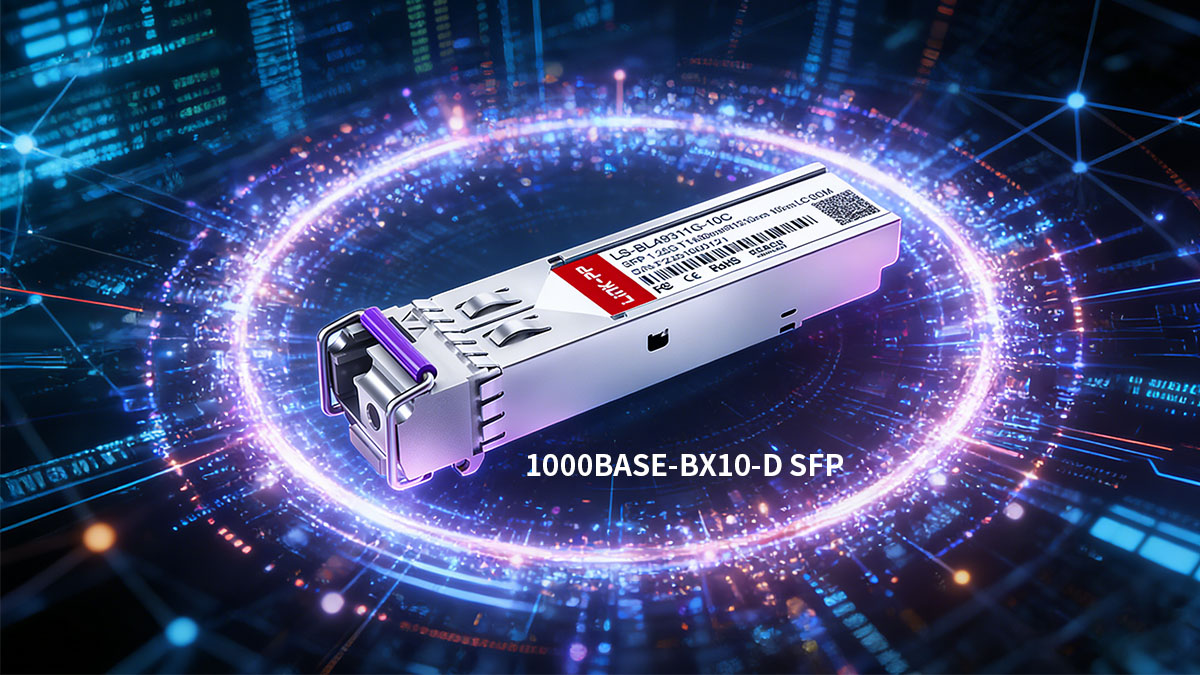
This type of transceiver follows the Small Form-factor Pluggable (SFP) standard and is commonly used in switches, routers, and media converters that support Gigabit Ethernet optical interfaces. Because it uses only one fiber instead of two, it helps reduce fiber infrastructure requirements in environments where fiber availability is limited.
In a typical deployment, the 1000BASE-BX10-D module transmits at 1490nm and receives at 1310nm. The paired 1000BASE-BX10-U module uses the opposite wavelengths, allowing both devices to communicate simultaneously without signal interference.
| Parameter |
Typical Value |
Description |
| Ethernet Standard |
1000BASE-BX10-D |
Single-fiber Gigabit Ethernet downstream optic |
| Data Rate |
1Gbps |
Supports Gigabit Ethernet transmission |
| Fiber Type |
Single-mode fiber (SMF) |
Designed for long-distance optical links |
| Maximum Distance |
10km |
Typical reach under standard link conditions |
These specifications define the operational role of the module in single-fiber Ethernet links. When deployed with the correct upstream counterpart, the transceiver enables stable Gigabit connectivity over distances commonly required in campus, access, and metro edge networks.
Meaning of the “BX” and “10” Designations
The naming convention of 1000BASE-BX10-D reflects key characteristics of the technology, including transmission method and supported distance. Each part of the name provides information about how the module operates within a Gigabit Ethernet link.
| Term |
Meaning |
Technical Context |
| 1000BASE |
Gigabit Ethernet standard |
Indicates 1Gbps optical Ethernet |
| BX |
Bidirectional over single fiber |
Transmit and receive signals share one fiber |
| 10 |
10km reach |
Typical maximum transmission distance |
| D |
Downstream optic |
Works with an upstream BX10-U module |
The BX designation is particularly important because it differentiates these modules from conventional dual-fiber optics such as 1000BASE-LX. Instead of requiring separate transmit and receive fibers, BX modules rely on wavelength division multiplexing to share the same fiber path.
The number 10 indicates the typical maximum transmission distance of the module under standard link conditions using single-mode fiber. While actual reach may vary depending on link loss and connector quality, 10km is the commonly specified design distance.
Downstream vs Upstream Optics
Bidirectional Gigabit Ethernet links rely on two complementary optical modules. One side of the link uses the downstream (D) module, while the other uses the upstream (U) module. These devices use opposite wavelength assignments so that transmitted and received signals do not overlap.
| Module Type |
Transmit Wavelength |
Receive Wavelength |
Role |
| 1000BASE-BX10-D |
1490nm |
1310nm |
Downstream transmission |
| 1000BASE-BX10-U |
1310nm |
1490nm |
Upstream transmission |
This wavelength pairing allows both devices to send and receive data simultaneously over the same fiber strand. Internal optical filters inside each module separate the wavelengths, ensuring that transmitted signals do not interfere with incoming data.
Because of this design, correct module pairing is essential. A BX10-D module must always connect to a BX10-U module to establish a working link. Deploying two modules with the same wavelength configuration would prevent proper communication because the transmit and receive channels would not align.
? Key Specifications of 1000BASE-BX10-D SFP
The key specifications of a 1000BASE-BX10-D SFP define how the module operates in single-fiber Gigabit Ethernet links, including wavelength characteristics, transmission distance, data rate, and optical performance. These parameters determine whether the transceiver can maintain stable communication over a given fiber link and ensure compatibility with the corresponding upstream module.
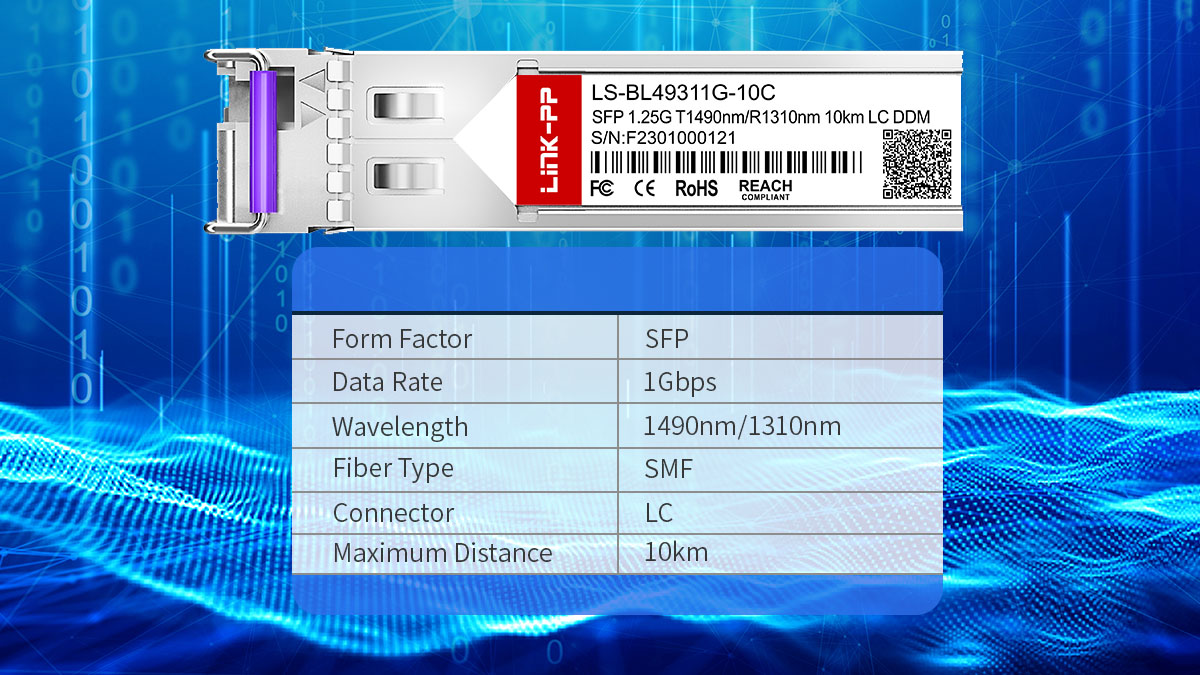
Although specific values may vary slightly between manufacturers, most 1000BASE-BX10-D SFP modules follow a common set of industry specifications based on Gigabit Ethernet standards and typical single-mode fiber link budgets.
| Parameter |
Typical Value |
Description |
| Data Rate |
1Gbps |
Supports standard Gigabit Ethernet transmission |
| TX Wavelength |
1490nm |
Downstream optical signal transmission |
| RX Wavelength |
1310nm |
Receives upstream optical signal |
| Fiber Type |
Single-mode fiber (SMF) |
Designed for long-distance optical links |
| Maximum Reach |
10km |
Typical transmission distance under standard conditions |
These specifications form the baseline requirements for deploying BX10-D modules in access networks, campus infrastructure, and metro edge connections.
Optical Wavelength Characteristics
The wavelength configuration of a 1000BASE-BX10-D SFP is the core element that enables bidirectional communication over a single fiber. The module transmits and receives optical signals on different wavelengths, allowing both directions of traffic to coexist on the same fiber without interference.
| Optical Direction |
Typical Wavelength |
Function |
| Transmit |
1490nm |
Sends downstream optical signal |
| Receive |
1310nm |
Receives upstream optical signal |
The wavelength separation ensures that transmitted signals can be filtered out from received signals using internal wavelength division multiplexing (WDM) components. Inside the transceiver, optical filters isolate the transmit and receive channels, preventing signal overlap while allowing simultaneous communication.
This configuration also enables the module to operate alongside a BX10-U counterpart that uses the opposite wavelength assignment.
Transmission Distance and Fiber Type
The transmission reach of a 1000BASE-BX10-D SFP is typically designed for up to 10km over single-mode fiber. This distance aligns with the “10” designation in the module name and reflects the typical link budget supported by the optical transmitter and receiver.
| Fiber Type |
Maximum Distance |
Typical Use Case |
| Single-mode fiber (SMF) |
10km |
Campus and metro access links |
| Single-mode fiber with low loss |
Up to 10km stable |
High-quality fiber infrastructure |
Single-mode fiber is required because the wavelengths used by BX optics are optimized for long-distance transmission with minimal dispersion. Compared with multimode fiber, SMF provides lower attenuation and supports longer link distances for Gigabit Ethernet connections.
Actual reach may depend on factors such as fiber attenuation, connector loss, and splice quality. Proper link budget evaluation ensures reliable performance over the intended distance.
Data Rate and Interface
A 1000BASE-BX10-D module supports standard Gigabit Ethernet transmission at a data rate of 1Gbps. It follows the widely adopted SFP form factor, allowing the module to be used in networking equipment that provides SFP ports.
| Specification |
Typical Value |
Description |
| Data Rate |
1Gbps |
Gigabit Ethernet optical transmission |
| Form Factor |
SFP |
Hot-pluggable small form-factor module |
| Connector Type |
LC simplex |
Single-fiber optical connection |
| Interface Standard |
IEEE 802.3ah |
Gigabit Ethernet over single fiber |
The LC simplex connector reflects the single-fiber design of BX optics. Unlike duplex connectors used in dual-fiber transceivers, the simplex interface supports both transmit and receive communication through the same fiber strand.
This compact interface also enables flexible deployment in switches, routers, and media converters that support SFP optical modules.
Optical Power and Receiver Sensitivity
Optical power levels and receiver sensitivity determine whether the module can maintain stable signal transmission over long distances. The transmitter must provide sufficient optical output, while the receiver must be able to detect low-level signals after fiber attenuation.
| Optical Parameter |
Typical Range |
Purpose |
| Transmit Optical Power |
−9 to −3dBm |
Output signal strength from the transmitter |
| Receiver Sensitivity |
≤ −20dBm |
Minimum detectable optical signal |
| Optical Budget |
~11–17dB |
Maximum allowable link loss |
These values define the optical link budget, which represents the total signal loss that the link can tolerate while maintaining reliable communication. Loss may occur due to fiber attenuation, connector insertion loss, or splicing.
When designing or troubleshooting a BX optical link, verifying that the total link loss remains within the supported optical budget is essential for ensuring consistent Gigabit Ethernet connectivity.
? How 1000BASE-BX10-D Works in Single-Fiber Ethernet
A 1000BASE-BX10-D BiDi SFP enables Gigabit Ethernet communication over a single strand of single-mode fiber by using bidirectional optical transmission. Instead of dedicating one fiber for transmitting and another for receiving, the module uses different optical wavelengths for each direction of traffic. This approach allows both signals to share the same fiber while remaining electrically and optically separated inside the transceiver.
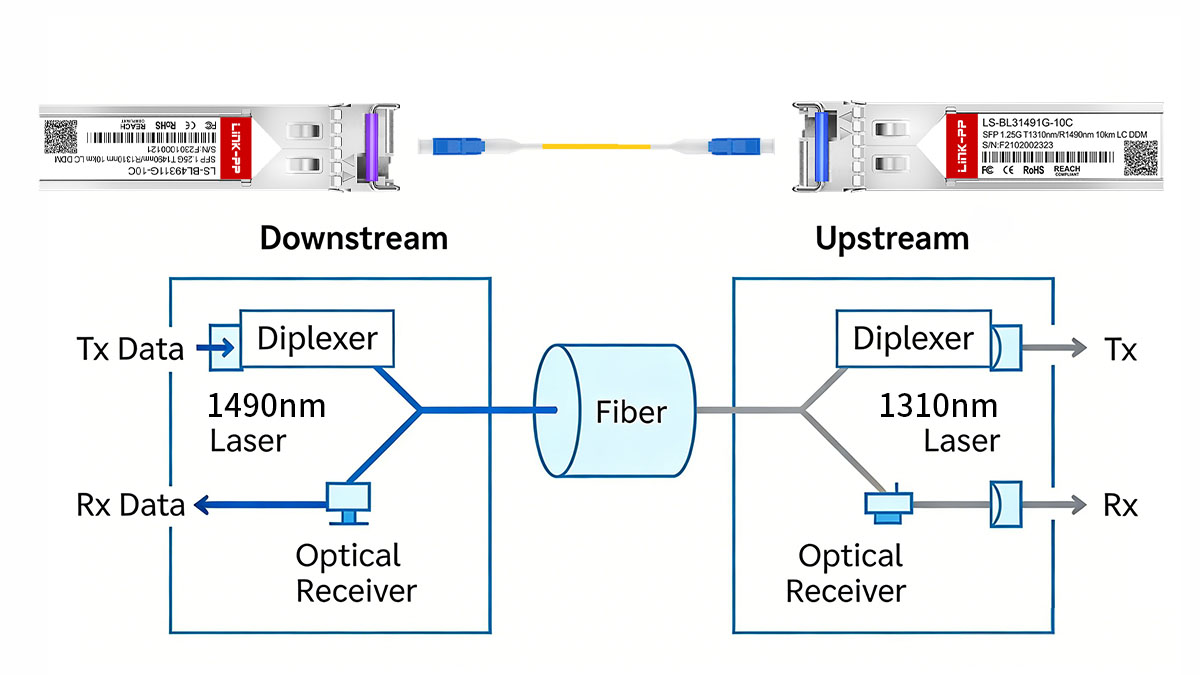
In a typical link, such as 1490/1310nm BiDi SFP module link, the downstream module transmits data at 1490nm while receiving data at 1310nm. The upstream module installed at the opposite end of the link uses the opposite wavelength configuration. Internal wavelength filters ensure that transmitted and received signals remain isolated, enabling full-duplex communication over one fiber.
| Transmission Direction |
Module Type |
Transmit Wavelength |
Receive Wavelength |
| Downstream link |
1000BASE-BX10-D |
1490nm |
1310nm |
| Upstream link |
1000BASE-BX10-U |
1310nm |
1490nm |
This architecture allows the fiber to carry two optical signals simultaneously. Each module filters the incoming light so that it only processes the wavelength assigned to its receiver.
WDM Technology in BX Transceivers
Wavelength division multiplexing (WDM) is the core technology that enables BX optical modules to operate over a single fiber. WDM works by transmitting multiple optical signals at different wavelengths through the same physical fiber while keeping them logically separated.
Inside a 1000BASE-BX10-D SFP, an optical multiplexer/demultiplexer separates transmit and receive wavelengths. This component acts as a filter that directs specific wavelengths toward either the transmitter or receiver.
The simplified operational flow can be understood as follows:
-
The transmitter converts electrical Ethernet signals into optical signals at 1490nm.
-
The optical signal enters the fiber through the LC simplex connector.
-
Incoming optical signals at 1310nm pass through an internal filter to the receiver.
-
Optical signals at the transmit wavelength are blocked from the receiver path.
This filtering mechanism ensures that the module does not detect its own transmitted signal while still receiving the remote device's transmission.
Link Establishment Between BX10-D and BX10-U
A working single-fiber Ethernet link requires correct pairing between the downstream and upstream modules. Because each module uses opposite wavelength assignments, both sides of the connection must be complementary.
A typical link establishment process includes several stages:
-
Optical module initialization
The network device powers the SFP module and initializes the optical interface.
-
Optical signal transmission
Each module begins transmitting its designated wavelength into the fiber.
-
Signal detection
The receiver detects incoming optical power at the expected wavelength.
-
Ethernet link negotiation
Once the optical signal is detected, the Ethernet interface establishes a Gigabit link between the connected devices.
Several factors can prevent successful link establishment:
-
Using two modules with the same wavelength configuration
-
Excessive fiber attenuation exceeding the optical budget
-
Dirty or damaged connectors
-
Fiber polarity or patching errors
When properly paired and installed, BX10-D and BX10-U modules provide stable full-duplex Gigabit Ethernet communication over distances up to 10km using a single fiber strand.
? Typical Applications of 1000BASE-BX10-D SFP Modules
1000BASE-BX10-D BiDi SFP module is widely deployed in environments where efficient use of fiber and simplified cabling are essential. By enabling bidirectional communication over a single fiber strand, these modules reduce infrastructure requirements while supporting standard Gigabit Ethernet connectivity.
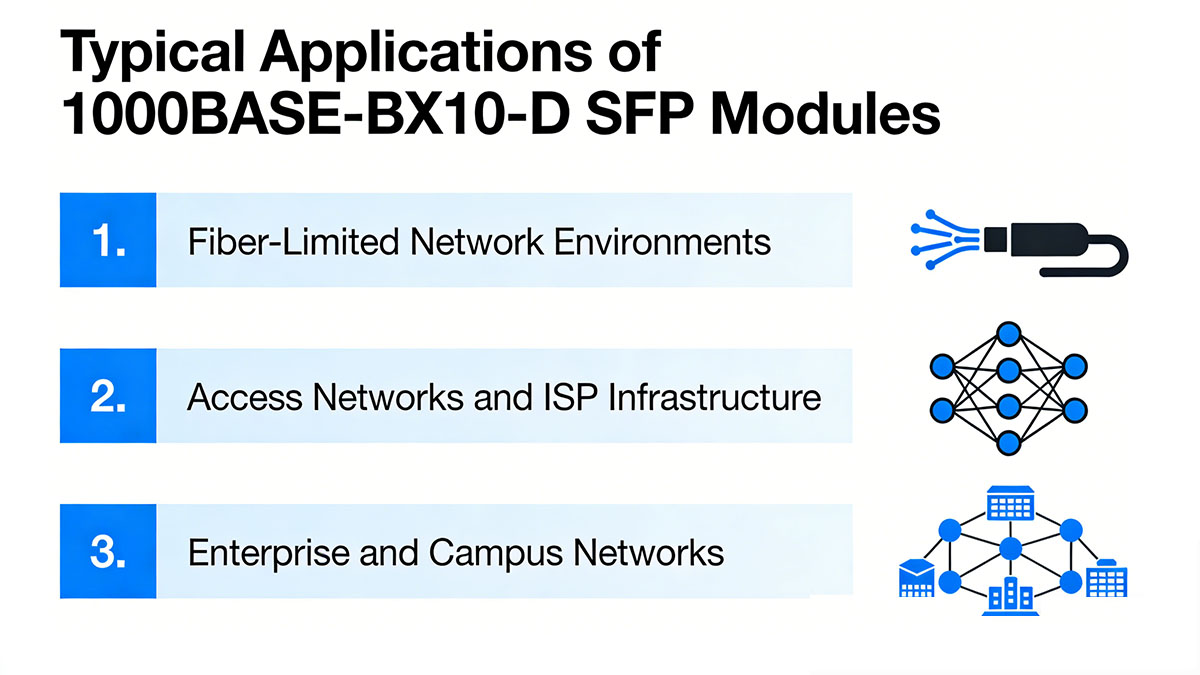
Fiber-Limited Network Environments
In many access and metro networks, fiber resources may be scarce or expensive to deploy. 1000BASE-BX10-D modules are ideal for such scenarios because they allow two-way communication over a single strand instead of two, effectively halving the fiber needed.
Typical use cases include:
-
Extending Gigabit Ethernet links across limited fiber runs
-
Connecting remote network nodes without adding new fiber
-
Retrofitting existing fiber infrastructure for additional Gigabit links
Access Networks and ISP Infrastructure
BX10-D modules are commonly used by internet service providers in metro and access networks. They provide cost-efficient connectivity between central offices, distribution nodes, and customer premises equipment (CPE) where fiber deployment may be limited.
Applications include:
Enterprise and Campus Networks
In campus or enterprise networks, 1000BASE-BX10-D modules can simplify inter-building connectivity without requiring additional fiber strands. They are particularly useful in scenarios where high-speed links are needed between buildings but fiber availability is limited.
Examples of deployment scenarios:
-
Linking network closets in separate buildings
-
Connecting campus edge switches to aggregation layers
-
Establishing cost-effective backup or redundant links
The single-fiber bidirectional design allows these deployments to maintain standard 1Gbps Ethernet performance while reducing cabling complexity. Combined with proper module pairing and link planning, BX10-D SFPs provide a reliable solution for various network topologies, from small campuses to larger metro-access networks.
? 1000BASE-BX10-D vs Other Gigabit Optical Standards
1000BASE-BX10-D bidirectional SFP differs from other Gigabit sfp modules in their fiber utilization, wavelength configuration, and deployment scenarios. Understanding these differences helps network engineers select the appropriate module for a given network topology.
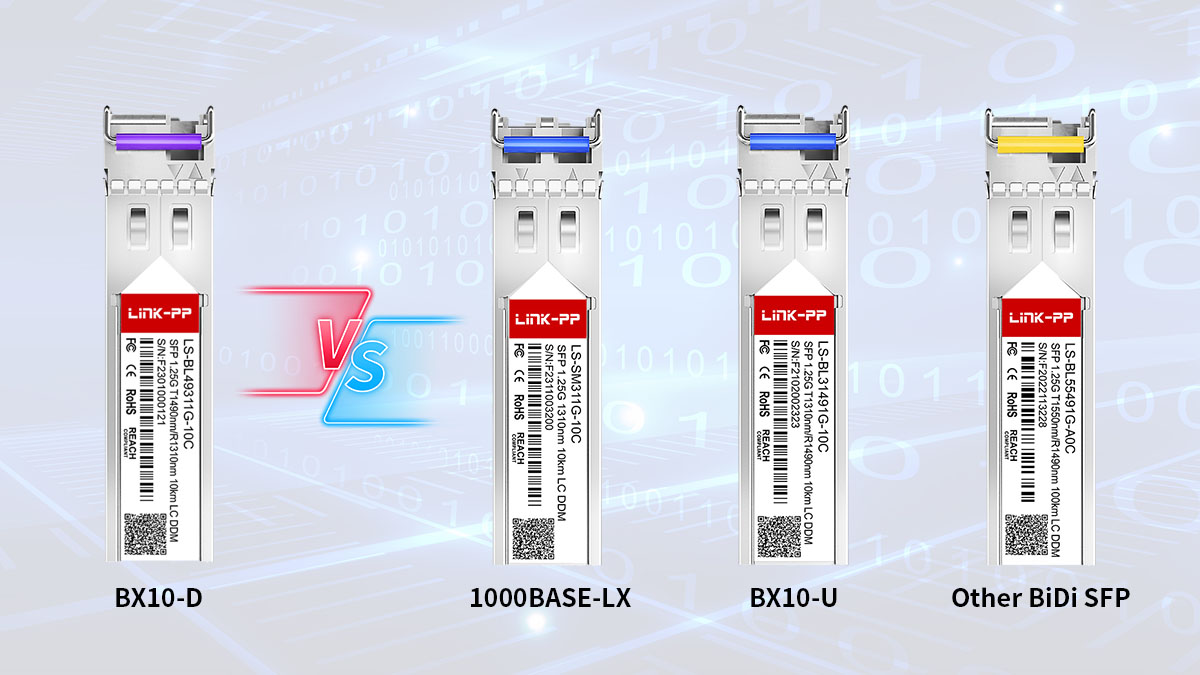
BX10-D vs 1000BASE-LX
1000BASE-LX SFP is dual-fiber transceivers that require separate fibers for transmitting and receiving signals. In contrast, BX10-D uses a single fiber for both directions via bidirectional transmission.
| Feature |
1000BASE-BX10-D |
1000BASE-LX |
| Fiber Requirement |
Single-mode fiber, 1 strand |
Single-mode fiber, 2 strands |
| Wavelengths |
1490nm TX / 1310nm RX |
1310nm TX / 1490nm RX (dual fiber) |
| Maximum Distance |
10km |
10km–15km depending on fiber |
| Advantages |
Reduced fiber use, simpler cabling |
Longer reach possible, standard dual-fiber deployment |
While LX module may provide slightly longer distance under ideal conditions, BX10-D modules are more fiber-efficient and suitable for networks with limited fiber availability.
BX10-D vs BX10-U
BX10-D and BX10-U are complementary modules that operate as a pair. BX10-D is always used on the downstream side, transmitting at 1490nm and receiving at 1310nm, while BX10-U handles the opposite wavelengths.
| Feature |
BX10-D |
BX10-U |
| Transmit Wavelength |
1490nm |
1310nm |
| Receive Wavelength |
1310nm |
1490nm |
| Role |
Downstream module |
Upstream module |
| Deployment Requirement |
Must be paired with BX10-U |
Must be paired with BX10-D |
Proper pairing is essential; using two BX10-D or two BX10-U modules on the same link prevents signal alignment and disables communication.
BX10-D vs Other BiDi SFP Variants
Other BiDi optics also use single-fiber bidirectional transmission but with different wavelength combinations or distances. BX10-D is optimized for 1Gbps transmission over 10km. Other BiDi variants may support higher speeds, different distances, or alternate wavelength assignments, such as 1550nm/1310nm pairs.
Key considerations when comparing BiDi variants:
-
Compatibility with existing fiber infrastructure
-
Required transmission distance
-
Supported data rate
-
Wavelength alignment with paired modules
BX10-D modules are most suitable for standard 1Gbps applications over moderate distances where fiber availability is limited, while other BiDi SFPs may be chosen for specialized higher-speed or longer-distance deployments.
? Deployment Considerations for 1000BASE-BX10-D Links
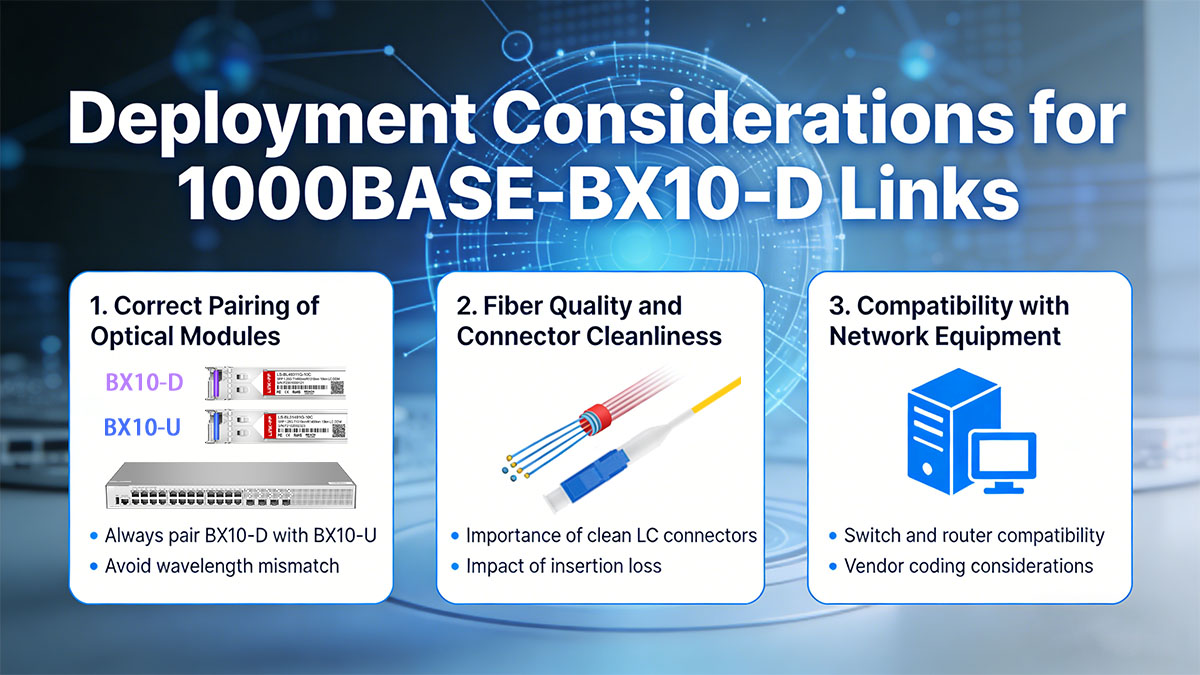
Deploying 1000BASE-BX10-D BiDi SFP transceiver requires careful planning to ensure reliable Gigabit Ethernet performance over single-fiber links. The key considerations include correct module pairing, fiber quality, and compatibility with network equipment.
Correct Pairing of Optical Modules
The most critical factor in BX deployments is pairing a downstream (BX10-D) module with the corresponding upstream (BX10-U) module. Incorrect pairing will prevent the link from establishing because the transmit and receive wavelengths will not match.
Key points for correct pairing:
-
Always use BX10-D with BX10-U on the opposite end of the fiber
-
Verify that module part numbers and wavelength assignments match
-
Avoid mixing modules from incompatible vendors without confirmed interoperability
Proper pairing ensures that transmitted signals at 1490nm are received by the upstream module and vice versa.
Fiber Quality and Connector Cleanliness
Fiber performance directly affects the reach and stability of a BX optical link. Even small amounts of dust or dirt on connectors can increase insertion loss and reduce link reliability.
Deployment best practices:
-
Inspect and clean LC simplex connectors before installation
-
Use low-loss single-mode fiber suitable for distances up to 10km
-
Avoid sharp bends or excessive strain on the fiber
-
Measure link loss to confirm it is within the optical budget (~11–17dB)
Maintaining fiber integrity ensures consistent signal strength and reduces errors caused by attenuation or reflections.
Compatibility with Network Equipment
BX SFPs must be supported by the networking equipment to operate correctly. Some devices enforce vendor coding, which can affect interoperability.
Considerations include:
-
Confirm that switches, routers, or media converters support 1000BASE-BX10-D SFP modules
-
Check for firmware or software compatibility with the SFP standard
-
Verify that the SFP ports accept the specific module without errors or warnings
Following these guidelines helps prevent installation issues and ensures that the link performs as expected in a variety of network environments. Proper planning and adherence to optical and equipment requirements are essential for a stable, long-term deployment.
? Advantages and Limitations of 1000BASE-BX10-D
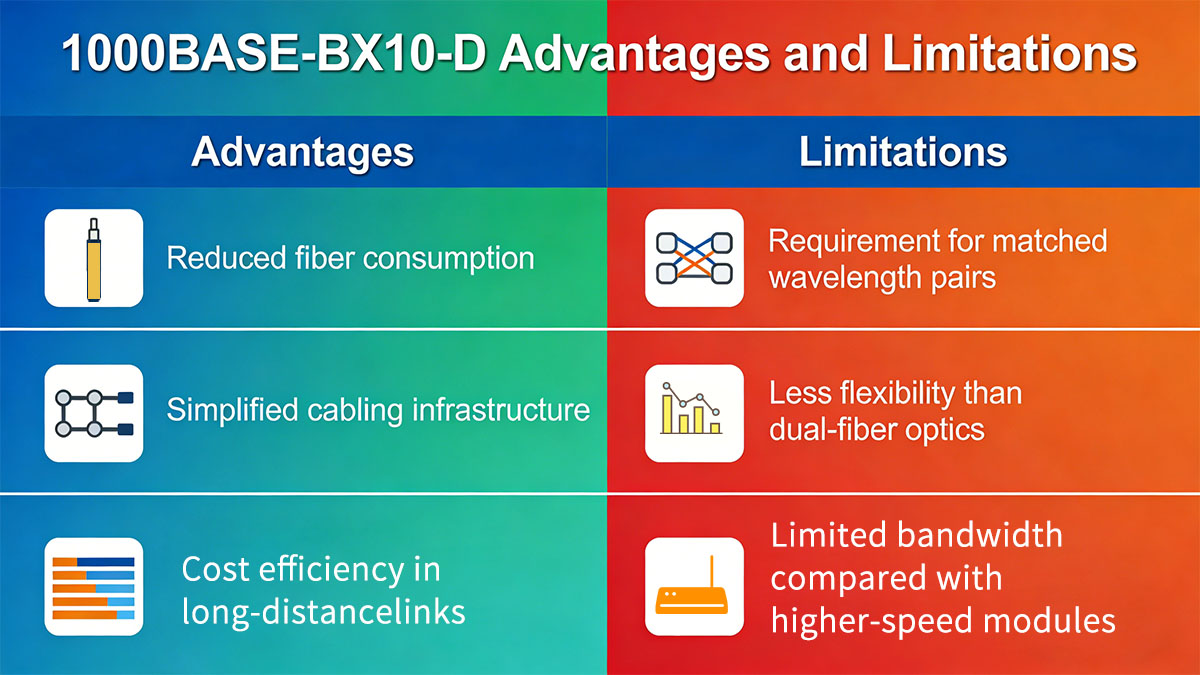
Understanding both the benefits and constraints of 1000BASE-BX10-D single fiber SFP helps network engineers make informed decisions when designing single-fiber Ethernet links. These considerations balance efficiency, performance, and deployment complexity.
Advantages
1000BASE-BX10-D modules offer several advantages that make them attractive in fiber-limited or cost-conscious network environments:
-
Reduced fiber usage: Single-fiber bidirectional transmission cuts fiber requirements in half compared with dual-fiber optics.
-
Simplified cabling: Fewer fibers mean less cabling management, easier installation, and lower maintenance overhead.
-
Cost efficiency: Savings on fiber infrastructure and reduced connector requirements make BX optics more economical for medium-distance links.
-
Standard Gigabit Ethernet performance: Despite using only one fiber, BX10-D modules maintain full 1Gbps transmission rates and compliance with IEEE 802.3 standards.
These advantages are particularly valuable in access networks, campus inter-building links, and metro edge deployments where fiber availability is limited or expansion costs need to be controlled.
Limitations
While BX10-D modules are efficient, they have inherent limitations compared with other optical transceivers:
-
Wavelength pairing requirement: BX10-D must always be paired with a complementary BX10-U module. Mismatched modules prevent link establishment.
-
Less flexibility than dual-fiber optics: Single-fiber links are limited by wavelength allocation and cannot easily support multiple upgrades on the same fiber without additional WDM equipment.
-
Moderate maximum distance: The standard 10km reach may not be sufficient for some long-haul or inter-city connections, where LX or higher-speed transceivers may be more appropriate.
-
Vendor coding considerations: Some switches enforce vendor-specific SFP codes, which may limit interoperability between modules from different manufacturers.
Overall, 1000BASE-BX10-D modules are best suited for scenarios where fiber efficiency, simplified cabling, and standard 1Gbps performance are prioritized, while the limitations should be considered when planning network expansion or integrating with existing infrastructure.
? FAQs About 1000BASE-BX10-D
What is the primary purpose of a 1000BASE-BX10-D SFP?
It enables Gigabit Ethernet transmission over a single fiber strand using bidirectional communication with a paired BX10-U module.
Can BX10-D operate without a BX10-U module?
No, BX10-D must always be paired with a BX10-U module to align transmit and receive wavelengths for proper link operation.
What is the maximum typical distance for BX10-D modules?
The standard maximum transmission distance is 10km over single-mode fiber under normal link conditions.
Which wavelengths does BX10-D use?
BX10-D transmits at 1490nm and receives at 1310nm, complementing the upstream module’s wavelengths.
Is BX10-D compatible with multimode fiber?
No, it is designed for single-mode fiber. Multimode fiber will cause high loss and prevent reliable communication.
Can BX10-D modules be mixed between different vendors?
Some vendors enforce SFP coding, so interoperability should be verified to ensure proper pairing and link establishment.
What are common use cases for 1000BASE-BX10-D?
Typical applications include campus inter-building links, access networks, and metro edge connections where fiber resources are limited.
Does BX10-D support higher speeds than 1Gbps?
No, BX10-D is designed specifically for standard 1Gbps Gigabit Ethernet links.
? Conclusion
1000BASE-BX10-D BiDi transceivers offer an efficient and reliable solution for Gigabit Ethernet links over a single strand of single-mode fiber. By using bidirectional transmission, these modules reduce fiber usage, simplify cabling, and maintain full 1Gbps performance, making them ideal for access networks, campus inter-building connections, and metro edge deployments. Proper pairing with a 1000BASE-BX10-U module, attention to fiber quality, and equipment compatibility are essential for stable link operation.
Looking ahead, single-fiber Gigabit optics like BX10-D will continue to serve environments where fiber expansion is limited or cost-sensitive. Advances in wavelength division multiplexing may further increase the capacity of single-fiber links, allowing BX-style optics to remain relevant alongside higher-speed technologies. Their combination of efficiency, simplicity, and standard compliance ensures that BX modules remain a practical choice for medium-distance connectivity.
For those seeking reliable single-fiber transceivers, the LINK-PP Official Store provides a full range of 1000BASE-BX10-D and compatible modules designed for seamless deployment in modern network infrastructures.