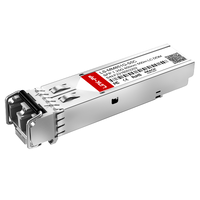


























Are long procurement lead times or high hardware costs making it difficult to source the Mellanox MC3208011-SX transceiver for your data center? As enterprise networks scale, network engineers and IT procurement teams frequently face supply constraints when expanding gigabit optical links. Finding high-quality third-party MC3208011-SX compatible optical modules offers a practical way to maintain deployment schedules without compromising link stability.
Do compatible transceivers truly match the performance and switch recognition of original OEM modules? When engineered to strict Multi-Source Agreement (MSA) standards, third-party compatible alternatives deliver reliable 1000BASE-SX connectivity and full firmware interoperability. Understanding key optical parameters, EEPROM compatibility, and link budget requirements ensures you select a fully dependable MC3208011-SX compatible alternative for your multi-mode fiber infrastructure.
⭐ What Is the Mellanox MC3208011-SX Transceiver
The Mellanox MC3208011-SX is a high-performance optical transceiver module engineered for short-reach Gigabit Ethernet connections within enterprise data centers. It operates as a pluggable Small Form-Factor Pluggable (SFP) component that converts electrical switch signals into optical pulses over multi-mode fiber cabling. Understanding its baseline hardware architecture and operational parameters is essential for evaluating fully compatible third-party alternatives.

Core Optical Parameters and Transmission Distance Limits
The original Mellanox MC3208011-SX optical module operates at a standard wavelength of 850nm over multi-mode fiber (MMF) infrastructure. It delivers a data transfer rate of 1Gbps following the IEEE 802.3z 1000BASE-SX specification, utilizing a Vertical-Cavity Surface-Emitting Laser (VCSEL) transmitter paired with a PIN photodetector. This optical configuration provides low power consumption and high signal reliability across short-distance data center racks.
Transmission reach for the MC3208011-SX transceiver depends directly on the core diameter and modal bandwidth of the connected multi-mode fiber cabling. Legacy 62.5μm/125µm OM1 optical fibers support transmission reaches up to 275m for standard gigabit links. When deploying 50μm/125µm OM2, OM3, or OM4 multi-mode fiber infrastructure, the module reaches its maximum distance limit of up to 550m.
Physical Form Factor and Duplex LC Interface Design
Built upon the industry-standard Small Form-Factor Pluggable (SFP) footprint, the MC3208011-SX optical transceiver features a compact hot-swappable metal enclosure. This enables high-port-density line card configurations across enterprise switches and network interface cards without thermal throttling. The physical mechanical latching mechanism provides secure engagement and quick tool-less removal during maintenance routines.
For optical media attachment, the module incorporates a standard duplex LC receptacle interface designed for precise physical contact. This interface accepts standard duplex LC-to-LC multi-mode patch cords to establish bidirectional transmit (Tx) and receive (Rx) channels. High-precision internal alignment ferrules ensure minimal insertion loss and optimal optical mating with external fiber connectors.
Built-in Digital Diagnostic Monitoring Telemetry Functions
Integrated Digital Diagnostic Monitoring (DDM), also known as Digital Optical Monitoring (DOM), allows system administrators to monitor critical operational parameters of the MC3208011-SX transceiver in real time.
The table below highlights the core telemetry parameters monitored by the internal diagnostics of the MC3208011-SX optical module alongside their operational significance:
| Diagnostic Parameter | Monitoring Function | Operational Significance |
| Optical Output Power (Tx) | Measures real-time laser launch power in dBm | Detects transmitter degradation or laser bias current anomalies before link failure. |
| Optical Input Power (Rx) | Tracks received optical signal strength in dBm | Identifies physical fiber bend losses, dirty connectors, or attenuation along the link. |
| Transceiver Temperature | Monitors internal module operating thermal levels | Prevents thermal damage in high-density switch chassis by triggering system alerts. |
| Laser Bias Current | Tracks drive current supplied to the VCSEL laser | Serves as an early indicator of optical component aging and laser health deterioration. |
| Supply Voltage | Measures internal operational DC power rail levels | Ensures host switch port power delivery remains stable within specified voltage limits. |
Vendor EEPROM Coding and Switch Firmware Recognition
The Mellanox MC3208011-SX transceiver contains an internal EEPROM chip pre-programmed with vendor-specific memory maps adhering to the SFF-8472 standard. This non-volatile memory stores essential metadata, including vendor name, part number, serial number, date code, and factory-calibrated optical parameters. When inserted into a host port, the switch reads this data structure to validate hardware authenticity.
Firmware running on NVIDIA Mellanox Spectrum switches queries this EEPROM data during initial port initialization. If the internal memory signature matches recognized OEM profiles, the switch operating system initializes the link and enables port functionality. Third-party compatible MC3208011-SX modules must replicate this vendor memory mapping accurately to pass firmware checks without generating unsupported transceiver warnings.
⭐ Why Look for Third-Party Alternates to MC3208011-SX
Relying solely on OEM transceivers for every link burns through IT budgets and slows down rollouts. Third-party MC3208011-SX compatible modules offer the same performance and reliability – but only if you source them from MSA-compliant vendors with rigorous testing processes. And they cost far less. Making the switch allows data center managers to save capital while keeping the network fully operational.

Lower Procurement Costs for Network Expansion
Original equipment manufacturer modules often carry premium price markups that significantly inflate the total cost of enterprise network upgrades. Sourcing third-party MC3208011-SX compatible transceivers can reduce optical hardware expenses by up to 40% to 60% without sacrificing link quality. These dramatic cost savings free up crucial capital that can be reallocated toward core switching infrastructure, security tools, or bandwidth expansion.
For high-density deployments requiring hundreds of access ports, the cumulative financial benefit becomes even more pronounced. Lower per-unit costs enable procurement teams to keep spare MC3208011-SX compatible modules on-site for immediate replacement, reducing potential operational downtime. Consequently, organizations achieve a much higher return on investment while expanding their multi-mode gigabit network footprint.
Short Delivery Lead Times for Quick Deployment
OEM optical transceivers are frequently subject to long supply chain backlogs and extended factory lead times that stall critical IT projects. Third-party optic manufacturers maintain larger localized stock inventories and agile production workflows, enabling rapid order fulfillment and same-day dispatch. Sourcing an MC3208011-SX compatible module from an established supplier ensures project timelines stay on track.
Fast turnaround times are especially vital during emergency network repairs or unexpected rack expansion projects. Having immediate access to compatible MC3208011-SX modules prevents costly project delays and eliminates extended maintenance windows. Reliable vendor inventory pipelines allow network operations teams to deploy extra capacity exactly when demand surges.
Flexible Hardware Compatibility Across Multi-Vendor Racks
Enterprise data centers often operate heterogeneous switch architectures that combine devices from multiple hardware manufacturers. OEM optics are typically coded with proprietary vendor ID signatures that restrict port initialization to specific host platforms, creating unnecessary hardware silos across server racks. Utilizing MC3208011-SX compatible alternatives provides multi-vendor interoperability across diverse switching and routing environments.
A single third-party vendor can custom-program the internal EEPROM of an MC3208011-SX module to seamlessly link Mellanox switches with legacy platforms. This flexibility simplifies spare parts management, as technicians no longer need to store separate OEM-branded transceivers for every switch brand. Ultimately, adopting compatible optical modules streamlines network architecture and simplifies ongoing infrastructure maintenance.
⭐ Key Technical Criteria When Choosing an MC3208011-SX Compatible Alternative
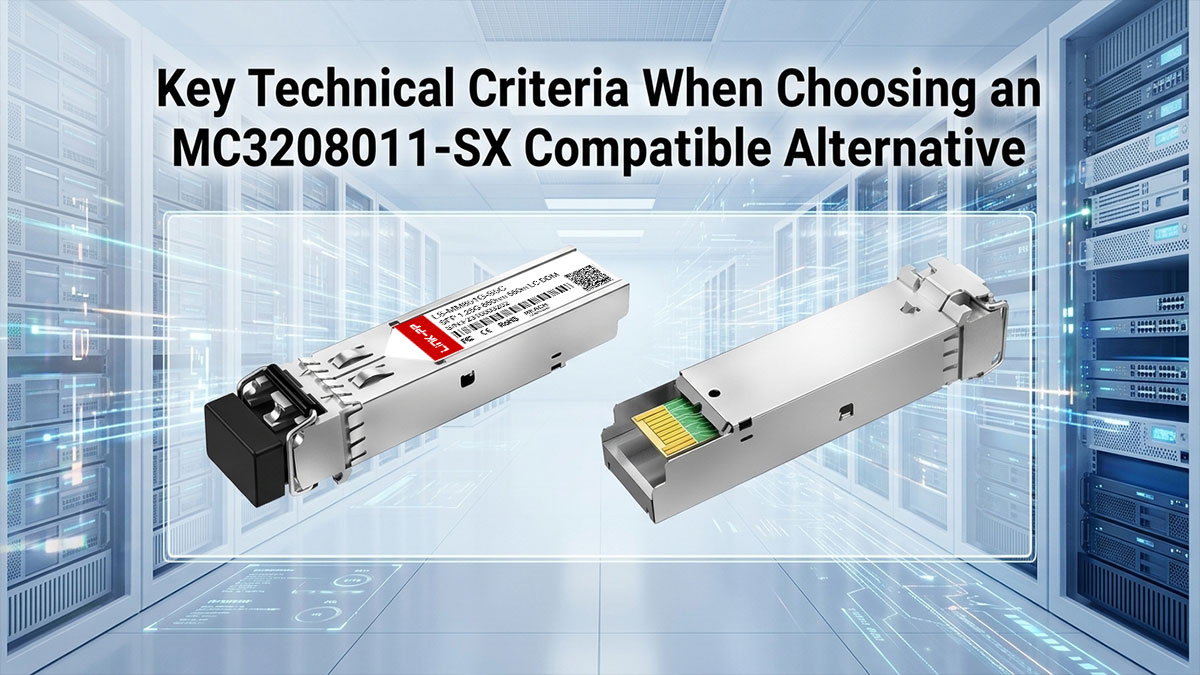
Selecting a high-performance alternative to the Mellanox MC3208011-SX requires a clear evaluation of physical, optical, and firmware specifications. Ensuring that a third-party module meets rigorous engineering standards prevents unexpected link drops and hardware incompatibilities. Evaluating key technical criteria guarantees seamless integration into existing enterprise networking environments.
Strict MSA Compliance for Physical and Electrical Standardization
Multi-Source Agreement (MSA) standards define the fundamental mechanical and electrical specifications for SFP transceivers to ensure cross-vendor interoperability. An MC3208011-SX compatible module must strictly adhere to the INF-8074i and SFF-8472 specifications governing physical dimensions, connector placement, and low-voltage electrical interfaces. Following these universal standards guarantees that the replacement unit physically fits into any standard SFP switch slot without mechanical strain.
Full compliance with MSA guidelines extends to host electrical interface performance, power dissipation limits, and hot-plugging safety protocols. Third-party optics built to these exact parameters draw stable operational power from the host switch backplane while maintaining proper thermal behavior. Adhering to these industry-wide specifications ensures safe operation alongside original OEM hardware in high-density environments.
Fiber Patch Cable Type Matching and Maximum Distance Verification
Deploying an MC3208011-SX compatible module requires precise alignment between the transceiver optics and the installed multi-mode fiber cabling infrastructure. Matching the 850nm wavelength VCSEL laser to the appropriate fiber core diameter ensures that the optical signal propagates efficiently across the network link.
Network administrators should verify the following standard-guaranteed distance thresholds based on the deployed fiber cable grade, as defined by IEEE 802.3z:
- OM1 (62.5/125µm): Supports link distances up to 275m for legacy cabling.
- OM2 (50/125µm): Extends multi-mode transmission reach up to 550m.
- OM3 (50/125µm): Delivers laser-optimized 850nm performance up to 550m.
- OM4 (50/125µm): Provides high modal bandwidth for stable links up to 550m.
Transceiver EEPROM Quality for Error-Free Host Port Recognition
The internal EEPROM memory chip dictates whether a host switch recognizes an MC3208011-SX compatible alternative or flags it as an unsupported module. High-quality third-party suppliers write exact vendor table profiles, serial numbers, and checksum signatures into the non-volatile memory map. This precise memory structure allows switch operating systems to initialize the port seamlessly during bootup.
Poorly coded or generic EEPROM structures often trigger warning messages, port shutdowns, or disabled DDM telemetry readings on enterprise switches. Selecting transceivers with factory-verified vendor profiles eliminates the need for bypass CLI commands on host platforms. Ensuring accurate memory programming protects network stability and guarantees full feature availability on connected ports.
Bit Error Rate Testing Standards for Reliable Data Transmission
Bit Error Rate (BER) testing evaluates the signal integrity and packet transmission accuracy of an MC3208011-SX compatible transceiver under full traffic load. Quality optical components must maintain an end-to-end BER ratio better than 10⁻¹², meaning no more than one bit error occurs per trillion transmitted bits. Meeting this stringent benchmark prevents frame loss, packet retransmissions, and latency spikes across gigabit links.
Reputable vendors perform thorough BER stress testing using optical spectrum analyzers and bit error rate testers prior to shipment. Subjecting optics to thermal cycling and voltage fluctuation tests verifies that signal quality remains stable under real-world data center conditions. Demanding verified BER test results ensures long-term operational reliability for critical enterprise connections.
⭐ Hardware Interoperability for MC3208011-SX Compatible Modules
Ensuring reliable hardware interoperability is essential when deploying third-party MC3208011-SX compatible optical modules across enterprise network racks. A fully compatible transceiver must initialize smoothly without triggering vendor security warnings or port security lockouts on host systems. Evaluating hardware cross-compatibility guarantees that replacement modules function as seamlessly as original OEM transceivers.
Seamless Integration with NVIDIA Mellanox Spectrum Switches
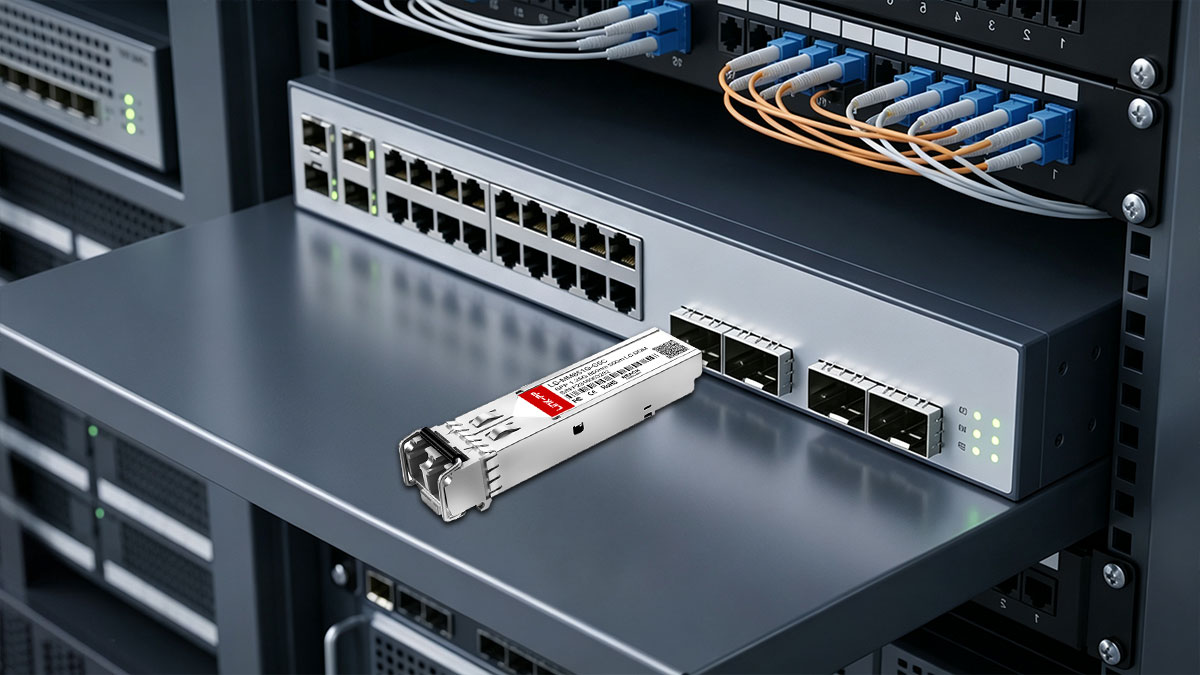
Deploying an MC3208011-SX compatible module on NVIDIA Mellanox Spectrum switches requires precise EEPROM vendor signature matching. The switch operating system, such as Onyx or Cumulus Linux, reads the module's internal memory during physical insertion. When the programmed vendor ID and checksums match expected profiles, the switch initializes the port without requiring manual bypass commands.
Proper firmware recognition allows host switches to enable full Digital Optical Monitoring telemetry alongside native port configuration controls. This seamless integration ensures that link speed, full-duplex operation, and real-time optical power metrics report accurately within network management systems. Maintaining native switch compatibility prevents unexpected port shutdowns and simplifies day-to-day network administration.
Full Support for Host Network Interface Cards and Adapters
Enterprise servers rely on dual-port and quad-port Network Interface Cards (NICs) to maintain high-availability connectivity across data center subnets. An MC3208011-SX compatible transceiver must operate reliably in PCI Express network adapters, including Mellanox ConnectX series cards. Maintaining physical and electrical alignment ensures stable high-density connections without creating localized thermal hotspots inside server chassis.
Server operating systems and driver stacks query the transceiver hardware directly to establish physical layer parameters during boot. A properly coded compatible module communicates its SFF-8472 memory map accurately to host drivers, preventing driver initialization errors or dropped interfaces. This broad adapter compatibility allows organizations to maintain consistent gigabit connectivity from server endpoints to access switches.
Port Speed Configuration and Link Synchronization Logic
Establishing a stable gigabit connection requires precise physical-layer synchronization between the host switch port and the inserted optical module. A compatible MC3208011-SX transceiver must adhere to the deterministic signal timing defined in IEEE 802.3z, enabling immediate link bring-up without negotiation delays.
Key operational mechanisms include:
- Fixed 1Gbps Rate Lock – Forces the host port to 1000BASE-SX parameters for instant initialization.
- Link Fault Signaling – Complies with SFF-8472 remote fault detection to immediately report optical loss.
- Signal Squelch – Suppresses invalid output when received power falls below sensitivity threshold, avoiding false link states.
- Clock Data Recovery – Retimes incoming data to maintain bit-accurate alignment across fiber runs.
⭐ Optical Link Design Considerations for MC3208011-SX Alternates
Designing a resilient multi-mode optical link requires evaluating the physical layer performance parameters beyond basic module compatibility. Factors such as optical power margins, cable attenuation, and physical connector polarity directly impact long-term signal stability. Careful link planning ensures that a third-party module operates within its optimal optical power budget across data center spans.
Transmitter Launch Power and Receiver Sensitivity Margins
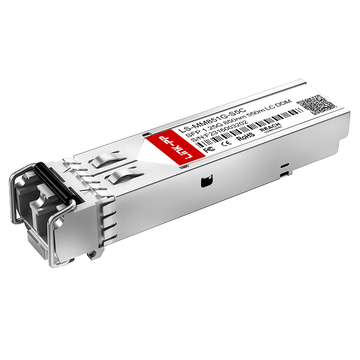
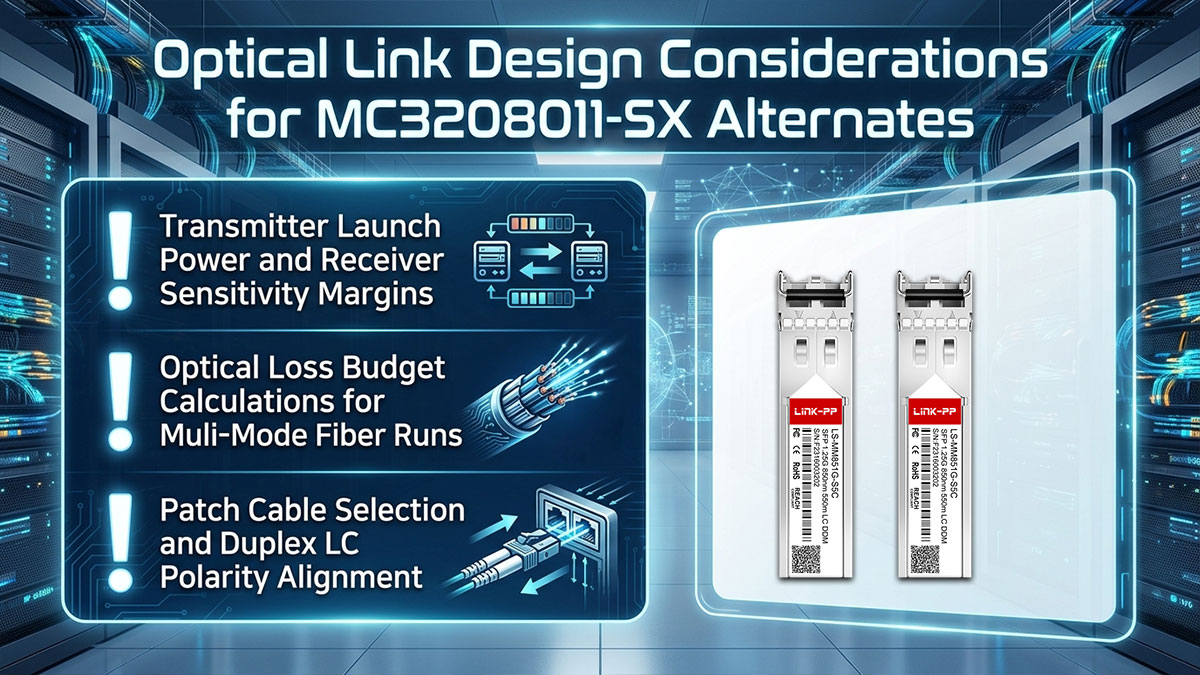
Evaluating the transmitter launch power and receiver sensitivity range is essential when selecting a reliable MC3208011-SX compatible module. A prime example of a fully compatible third-party option is the LINK-PP LS-MM851G-S5C 1000BASE-SX SFP transceiver, which features a transmit (TX) power range of -9 to 0dBm and a receiver (RX) power range of -20 to -1dBm. With a maximum receiver sensitivity rating of -18dBm, this module reliably detects weak optical signals even over extended multi-mode cable runs.
Maintaining an adequate optical margin prevents receiver saturation over extremely short patch cables while ensuring sufficient light reaches the photodetector on longer spans. Because the maximum input power threshold for the LINK-PP LS-MM851G-S5C is -1dBm, the receiver will not be blinded by short-distance back-to-back switch connections. Understanding these transmitter launch and receiver operating windows guarantees error-free signal transmission under varying link lengths.
Optical Loss Budget Calculations for Multi-Mode Fiber Runs
Calculating the total optical insertion loss budget ensures that an MC3208011-SX alternative can overcome all physical attenuations along the fiber path. The available link power budget is calculated as the difference between the minimum transmitter output power and the maximum receiver sensitivity. For the LINK-PP LS-MM851G-S5C, this yields a budget of: -9dBm - (-18dBm) = 9dB. This 9dB budget must accommodate all cumulative losses along the fiber path.
Network designers must account for cumulative channel losses, including fiber attenuation at the 850nm wavelength, patch panel adapter insertions, and inline splices. Standard multi-mode fiber attenuation averages roughly 3.0dB per kilometer at 850nm, while each mated duplex LC connector pair typically adds 0.3 to 0.75dB of insertion loss (with 0.5dB per connector pair serving as a conservative engineering rule of thumb). Subtracting these cumulative physical losses from the 9dB budget ensures that adequate optical signal margin remains for error-free link operation.
Patch Cable Selection and Duplex LC Polarity Alignment
Proper optical cable selection and physical channel polarity alignment are vital for establishing immediate physical layer connectivity with an MC3208011-SX compatible module. Multi-mode patch cords must utilize duplex LC connectors with ceramic ferrules to match the transceiver interface and minimize reflection losses. Matching the optical fiber core diameter — such as 50/125µm for OM2, OM3, or OM4 — prevents modal dispersion penalties across multi-gigabit rack environments.
Maintaining correct A-to-B duplex LC polarity ensures that the transmit (TX) port on one optical transceiver connects directly to the receive (RX) port on the remote end. Polarity inversion caused by improperly pinned fiber patch cords or flipped coupler panels results in total signal loss and persistent link-down statuses. Verifying crossover fiber continuity prior to deployment prevents link synchronization failures and simplifies physical installation.
⭐ How to Test and Verify an MC3208011-SX Alternative Module
Rigorous acceptance testing guarantees that newly deployed optical modules perform reliably in production network environments. Validating a third-party MC3208011-SX compatible transceiver before full-scale deployment mitigates the risk of unexpected link drops or hardware incompatibilities. Following a systematic verification procedure confirms physical integrity, firmware compliance, and long-term transmission stability.

Inspecting Physical Connectors and Optical Cleanliness
Physical verification begins with a thorough inspection of the module enclosure, gold fingers, and optical ferrule end-faces. Microscopic dust particles or oil residue on the duplex LC interface can cause significant optical insertion loss and permanently damage connected fiber patch cables. Utilizing a fiber inspection scope allows technicians to verify surface cleanliness before seating the transceiver into a host slot.
Key physical inspection checkpoints include:
- Gold Finger Condition: Inspect PCB contacts for scratches, oxidation, or missing surface plating.
- Bail Latch Mechanism: Test the mechanical release lever for smooth engagement and secure locking.
- Optical End-Face Surface: Check ceramic ferrules under 200x to 400x magnification for scratches, pits, or dust.
- Dust Cap Protection: Ensure protective covers remain installed until immediately prior to fiber connection.
Verifying EEPROM Data and Port Recognition
Plugging the MC3208011-SX compatible module into a live host switch port tests whether the firmware correctly parses internal memory maps. The host operating system queries the SFF-8472 memory table during insertion to validate vendor signatures and part number fields. Running native CLI commands on NVIDIA Mellanox Spectrum switches confirms whether the module initializes without triggering unsupported transceiver alarms.
Essential CLI verification parameters include:
- Vendor Name and PN: Confirm the memory map reports accurate part numbers and vendor information.
- Port Link State: Verify the physical port status transitions cleanly to an active UP state.
- Serial Number Syntax: Check that individual serial numbers display correctly for asset tracking.
- MSA Compliance Flags: Ensure the switch firmware recognizes standard SFP operational capabilities.
Checking Real-Time Optical Power Metrics via DOM
Checking Digital Optical Monitoring (DOM) telemetry verifies that real-time operating levels remain safely within normal engineering thresholds. Accessing live diagnostic data through host switch commands allows network administrators to continuously assess optical health and signal integrity. Validating these live telemetry metrics confirms that the MC3208011-SX alternative module maintains a healthy optical power margin across active fiber links.
Essential DOM telemetry metrics to inspect on host switches include:
- Tx Launch Power: Confirm transmitted laser output operates consistently within specified operational bounds.
- Rx Input Power: Ensure received optical signal strength remains safely above sensitivity thresholds without saturating the photodetector.
- Operating Temperature: Monitor internal thermal levels to prevent heat buildup inside high-density switch chassis.
- Laser Bias Current: Track VCSEL drive current trends to establish baseline optical health and detect early component aging.
Conducting Link Stability and Stress Tests
Final validation requires subjecting the optical link to extended traffic stress testing under full gigabit throughput conditions. Running pseudo-random binary sequence (PRBS) patterns or RFC 2544 benchmark tests verifies frame transfer consistency and bit error rate performance. Observing port counter statistics over an extended soak test period ensures long-term operational stability before putting the link into production.
Crucial stress test verification steps include:
- Zero Packet Drop Validation: Run 100% line-rate traffic to confirm zero frame loss over prolonged runs.
- CRC and Alignment Error Audit: Monitor interface counters to ensure no cyclic redundancy check errors accumulate.
- Bit Error Rate Benchmark: Verify end-to-end BER performance stays strictly better than 10⁻¹² under full traffic load.
- Thermal Load Endurance: Observe temperature stability during sustained full-load traffic tests inside dense switch racks.
⭐ Conclusion: Final Recommendations for MC3208011-SX Alternates

Sourcing a high-quality MC3208011-SX compatible optical transceiver is a proven, cost-effective strategy for expanding enterprise data center networks without compromising performance. By prioritizing strict MSA compliance, precise link loss budget calculations, accurate EEPROM programming, and thorough physical and DOM validation testing, network teams can ensure seamless interoperability across Mellanox switching platforms. Evaluating these core technical criteria guarantees robust gigabit connectivity, rapid deployment timelines, and optimized network expenditure.
Finding a dependable alternative that delivers rock-solid link stability shouldn't be a trial-and-error process. The LINK-PP LS-MM851G-S5C 1000BASE-SX SFP transceiver serves as a precise drop-in replacement, offering full SFP MSA compliance, reliable 850nm optical performance, and custom EEPROM coding designed to support Mellanox port initialization behavior. To review complete technical specifications, verify multi-mode infrastructure compatibility, or purchase sample units for evaluation testing, visit the LINK-PP Official Store.