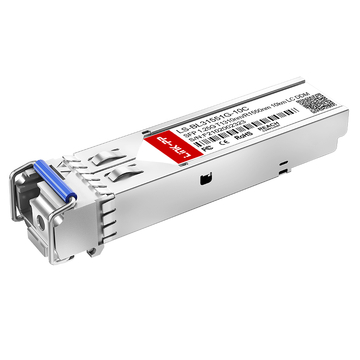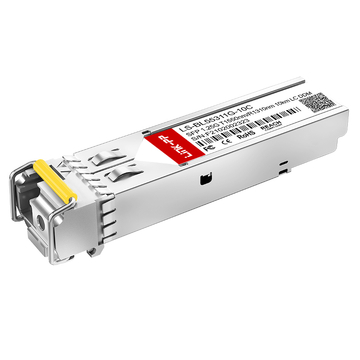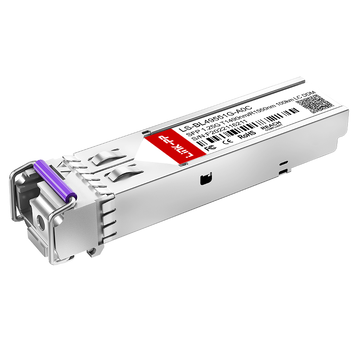
Fiber networks are increasingly challenged by the need to optimize limited infrastructure while maintaining high-speed, reliable communication. Simplex SFP modules address this challenge by enabling bidirectional data transmission over a single fiber strand, effectively reducing cabling requirements without compromising performance. This approach not only maximizes existing fiber resources but also simplifies network expansion and maintenance in enterprise, data center, and metropolitan deployments. In this article, we explore the core concepts, advantages, deployment scenarios, technical considerations, and future trends of Simplex SFP technology to provide a comprehensive understanding for network planners and engineers.
🎡What Is a Simplex SFP?
Simplex SFP modules enable bidirectional communication over a single fiber strand, making them ideal for network environments where fiber availability is limited or infrastructure optimization is a priority. By leveraging complementary wavelength pairing, these modules maintain full-duplex performance while reducing cabling requirements, simplifying deployment, and lowering operational complexity. In practice, Simplex SFPs are commonly deployed in enterprise buildings, data center interconnects, and metropolitan access networks where fiber efficiency and scalability are critical.
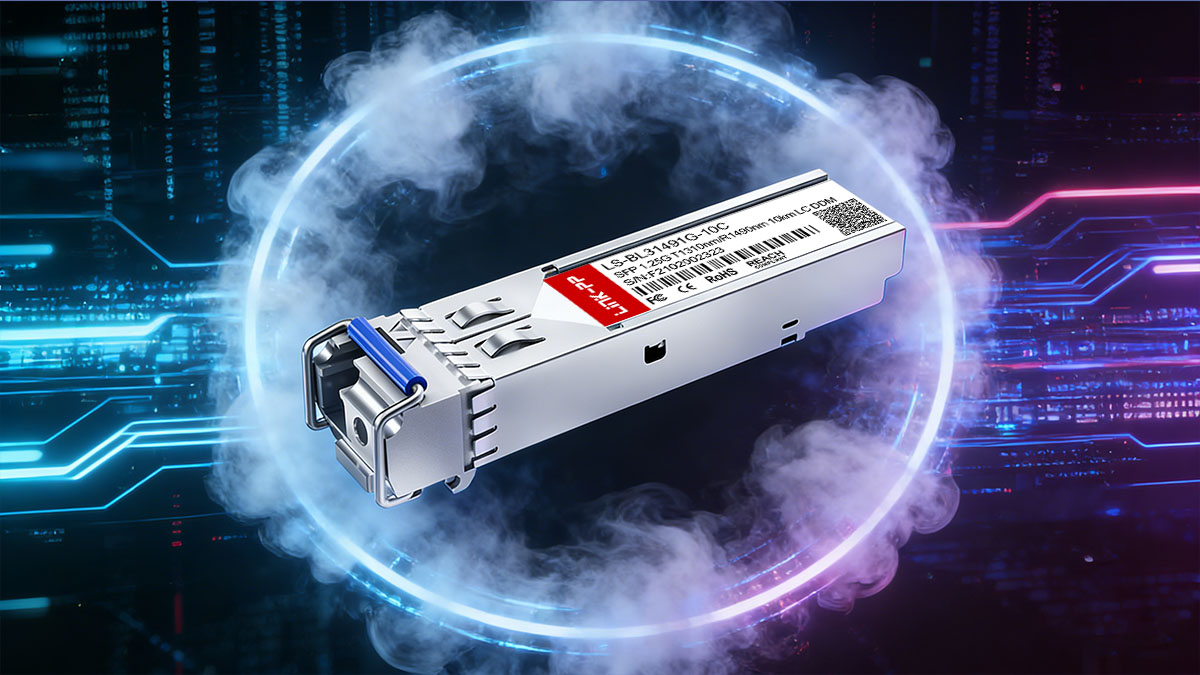
Definition and Core Concept
A Simplex SFP transceiver is a small form-factor pluggable optical transceiver that supports simultaneous transmission and reception over a single fiber. Unlike traditional duplex SFPs requiring two separate fibers for Tx and Rx, Simplex SFPs use bidirectional (BiDi) optics to separate signals by wavelength. This enables single-fiber full-duplex communication, which is especially beneficial in fiber-constrained environments or retrofitting legacy networks.
Key advantages of this approach include:
- Halving fiber infrastructure requirements compared to duplex links
- Maintaining standard SFP port compatibility without specialized hardware
- Facilitating rapid deployment in existing cabling environments
Key Components of Simplex SFP Modules
The effectiveness of Simplex SFP modules depends on several critical components:
- Transmitter (Tx) and Receiver (Rx) Wavelengths: Each module operates with a fixed transmit and receive wavelength (e.g., 1310nm Tx / 1550nm Rx). Proper wavelength pairing ensures error-free bidirectional transmission.
- Wavelength Division Multiplexing (WDM): WDM separates upstream and downstream signals on a single fiber, using different wavelengths to prevent interference.
- Optical Connectors: LC simplex connectors are standard, providing reliable and compact connections for high-density cabling.
| Component | Function | Typical Specification |
|---|---|---|
| Tx/Rx Wavelength | Signal separation | 1310/1550nm or 1490/1550nm |
| WDM Filter | Combines/separates signals | ±20nm tolerance, low insertion loss |
| Connector | Physical interface | LC simplex, high durability |
These components work together to ensure signal integrity and operational reliability, even in fiber-limited or long-distance links.
How Simplex SFP Works
Simplex SFP modules operate in complementary pairs, with one module transmitting on one wavelength and receiving on the other, and the paired module reversing the wavelengths. This configuration allows a single fiber strand to carry full-duplex traffic without crosstalk. Critical technical considerations include:
- Matching Tx/Rx wavelengths to prevent link failure
- Accounting for optical power budgets and attenuation over distance
- Ensuring switch and router compatibility for BiDi SFP modules
By enabling full-duplex communication on a single fiber, Simplex SFPs provide a practical solution for modern networks facing fiber scarcity, high port density requirements, or constrained installation environments.
🎡Advantages of Simplex SFP in Network Deployments
Simplex SFP modules offer significant advantages in network deployments by reducing fiber usage, lowering operational costs, and simplifying expansion. Their ability to transmit bidirectionally over a single fiber strand allows organizations to maximize existing infrastructure while maintaining high-speed, reliable communication. These benefits are particularly pronounced in environments with fiber constraints, high port density requirements, or the need for scalable network growth.

Fiber Infrastructure Optimization
Deploying Simplex SFP modules can dramatically reduce the amount of fiber required, making them ideal for fiber-limited environments. By transmitting and receiving on a single strand, networks can achieve the same connectivity with half the fiber count compared to duplex SFP links.
Key benefits include:
- Reduced need for new fiber installation in existing conduits
- Simplified cabling management in high-density racks
- Efficient use of legacy fiber infrastructure without performance compromise
| Deployment Scenario | Duplex Fiber Requirement | Simplex Fiber Requirement | Fiber Savings |
|---|---|---|---|
| Enterprise Campus | 12 fibers | 6 fibers | 50% |
| Data Center Interconnect (1–2 km) | 24 fibers | 12 fibers | 50% |
| Metropolitan Access Links | 48 fibers | 24 fibers | 50% |
This reduction not only conserves physical resources but also lowers installation complexity, allowing faster deployment and easier maintenance.
Cost Efficiency
Simplex fiber SFP modules contribute to cost savings in both material and operational expenditures. Fewer fibers reduce the need for additional cable runs, ducting, and connector hardware, while the reduced complexity of cable management translates into lower labor costs.
Practical considerations include:
- Less conduit space required for fiber pathways
- Lower fiber procurement and termination expenses
- Reduced long-term maintenance costs due to fewer components
Simplified Network Expansion
Networks using Simplex SFP modules are easier to scale. Adding new links requires fewer fibers, and retrofitting existing infrastructure is less disruptive. This flexibility is crucial in environments where continuous uptime and rapid deployment are priorities.
Advantages in expansion scenarios:
- Plug-and-play installation with existing SFP ports
- Minimal disruption to active links during upgrades
- Scalable architecture for future high-speed or BiDi deployments
By combining fiber optimization, cost efficiency, and simplified expansion, Simplex SFP modules provide a balanced solution for modern networking challenges, particularly in enterprise, data center, and metropolitan access networks.
🎡Common Deployment Scenarios for Simplex SFP
Simplex SFP modules are particularly effective in environments where fiber resources are limited, cabling density is high, or cost and operational efficiency are key concerns. Their ability to transmit bidirectionally over a single fiber strand makes them suitable for a wide range of network deployment scenarios, from enterprise campuses to metropolitan access networks.
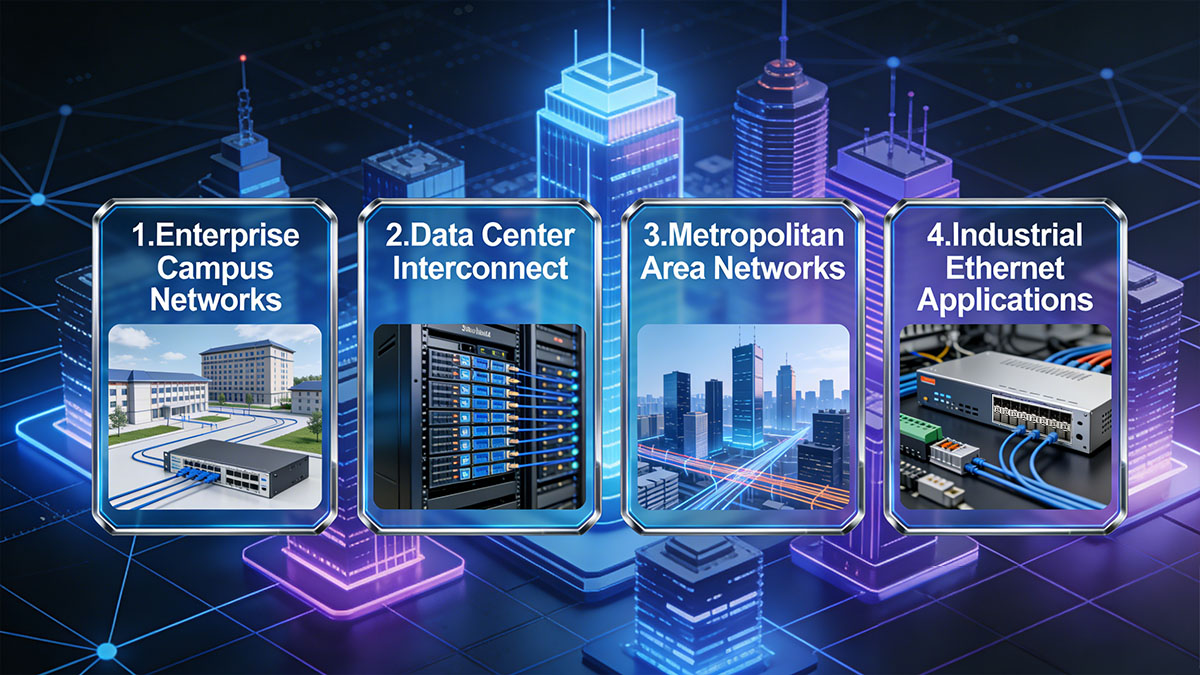
Enterprise Campus Networks
Simplex SFPs are often used in multi-building enterprise campuses where fiber pathways are constrained. By reducing the fiber count required for inter-building links, organizations can achieve high-speed connectivity without laying additional cables.
Typical applications include:
- Inter-building connections in campuses with limited conduit space
- Reducing fiber congestion in existing backbone cabling
- Upgrading legacy 1G SFP or 10G SFP+ links without extensive infrastructure changes
Metropolitan and Access Networks
In urban environments, fiber scarcity and high installation costs make Simplex SFPs a practical choice. They allow ISPs and municipal networks to provide high-speed connections over existing single-fiber runs.
Key benefits include:
- Cost-effective deployment in dense urban areas
- Leveraging existing conduit and fiber infrastructure
- Supporting multiple customer links without additional fiber installation
Data Center Interconnect (DCI)
Data centers often require high-density, medium-distance interconnects between facilities. Simplex SFPs reduce fiber requirements while maintaining full-duplex communication, optimizing port usage in switches and routers.
Advantages for DCI include:
- Lower fiber usage in high-density racks
- Efficient port utilization on top-of-rack and spine switches
- Simplified cabling and maintenance in multi-site interconnects
| Deployment Type | Typical Distance | Fiber Requirement (Duplex vs Simplex) | Key Advantage |
|---|---|---|---|
| Enterprise Campus | 100–500 m | Duplex: 12 fibers, Simplex: 6 fibers | Halved fiber usage |
| Metropolitan Access | 1–5 km | Duplex: 24 fibers, Simplex: 12 fibers | Reduced installation cost |
| Data Center Interconnect | 500 m–2 km | Duplex: 48 fibers, Simplex: 24 fibers | High port density efficiency |
Industrial and Legacy Systems
Simplex SFPs are also useful in industrial facilities or older networks where fiber runs are fixed and conduit space is limited. They allow modernization of communication links without extensive rewiring.
Deployment considerations include:
- Retrofitting legacy fiber with minimal disruption
- Reducing the need for additional conduits in industrial environments
- Supporting high-speed transceivers communication in harsh or constrained spaces
By addressing fiber scarcity, cost efficiency, and deployment flexibility, Simplex SFPs provide an adaptable solution across diverse networking environments, making them a strategic choice for network planners and engineers.
🎡Simplex SFP vs Duplex SFP: Key Differences
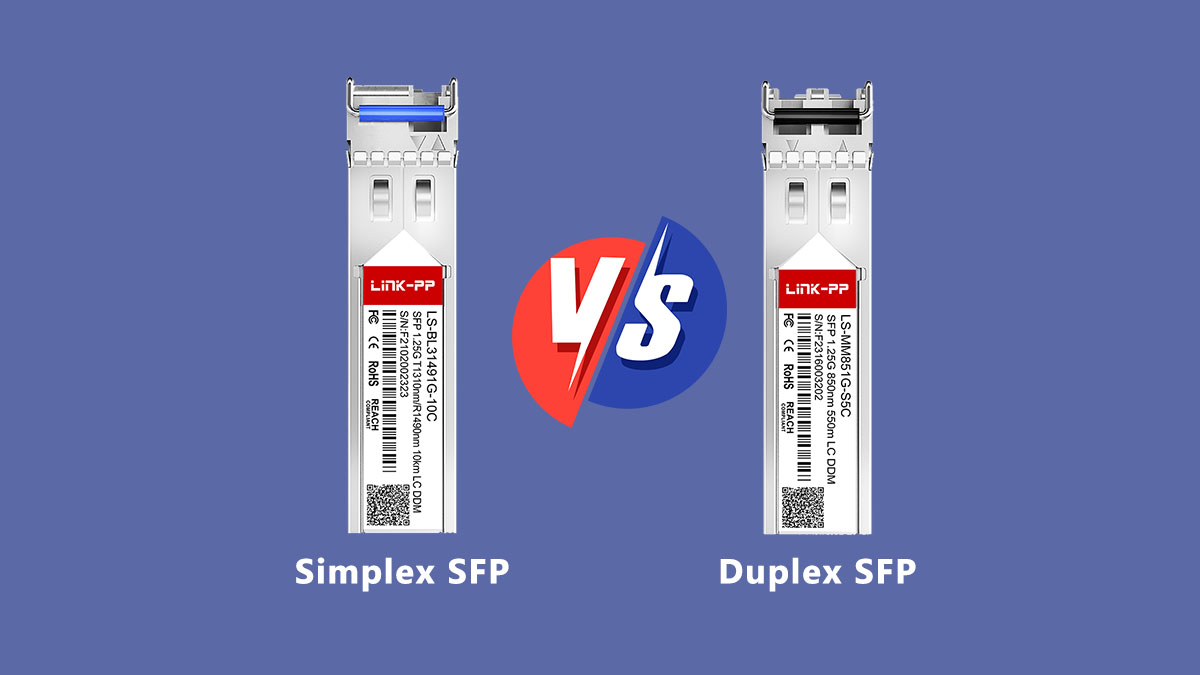
Simplex SFP modules differ from traditional duplex SFPs primarily in their fiber utilization and signal transmission method. While duplex SFPs require two fibers—one for transmitting and one for receiving—Simplex SFPs achieve full-duplex communication over a single fiber using bidirectional (BiDi) optics (like 1G BiDi SFP). This fundamental difference impacts deployment efficiency, cost, and network planning decisions.
Transmission Method Comparison
The main distinction lies in how data signals travel:
- Duplex SFP: Separate fibers are dedicated to transmit (Tx) and receive (Rx) signals, simplifying module pairing and reducing wavelength coordination issues.
- Simplex SFP: A single fiber carries both transmit and receive signals simultaneously using different wavelengths, requiring precise wavelength pairing and complementary module installation.
This design allows Simplex SFP to halve fiber usage without compromising full-duplex communication, but it introduces dependency on correct wavelength alignment and module compatibility.
Performance and Limitations
While both Simplex and Duplex SFPs can deliver comparable speeds, there are differences in operational considerations:
| Feature | Simplex SFP | Duplex SFP |
|---|---|---|
| Fiber Usage | 1 strand per link | 2 strands per link |
| Transmission Type | Bidirectional (BiDi) | Unidirectional per fiber |
| Wavelength Requirements | Must match Tx/Rx pairs | Standardized, less sensitive |
| Distance Limitation | Often slightly shorter due to WDM insertion loss | Typically longer due to single-path fiber per direction |
In practice, Simplex SFPs may experience slightly higher insertion loss because of the WDM filters, which must be considered when planning link budgets for medium to long distances.
Deployment Trade-offs
Network planners must weigh the advantages of reduced fiber usage against the operational constraints:
- Advantages of Simplex SFP:
- Reduced cabling and conduit requirements
- Cost-effective upgrades in fiber-constrained environments
- Simplified port management in high-density deployments
- Limitations:
- Requires careful wavelength pair matching; incompatible modules cause link failure
- Slightly higher sensitivity to optical power budget constraints
- May not be ideal for ultra-long-distance links without amplification
Choosing between Simplex and Duplex SFP depends on project priorities. For fiber-scarce, high-density, or cost-sensitive environments, Simplex SFP is often preferable. In contrast, duplex SFP remains a robust choice for longer links or situations where module interchangeability and straightforward deployment are critical.
🎡Technical Considerations for Simplex SFP Deployment
Successful deployment of Simplex SFP modules requires careful attention to wavelength pairing, optical power budget, and compatibility with existing network hardware. Ignoring these factors can lead to link failures, degraded performance, or reduced network reliability. By addressing these technical considerations upfront, network engineers can ensure optimal performance and longevity of single-fiber links.
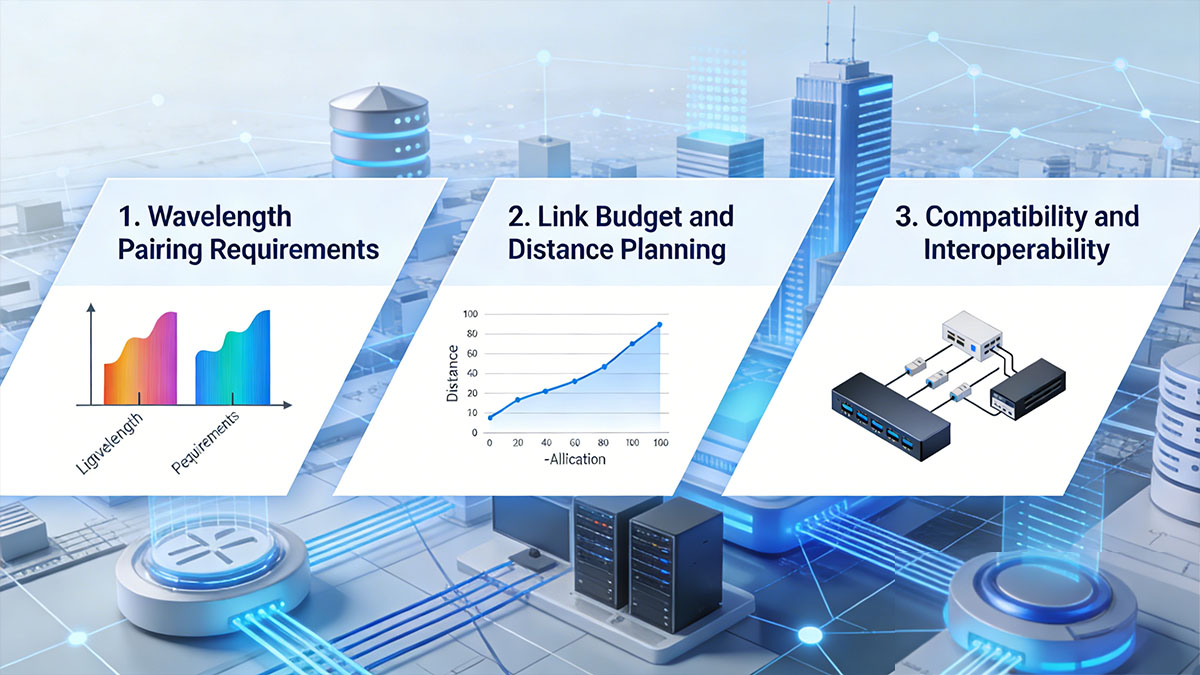
Wavelength Pairing Requirements
Proper wavelength matching is critical for Simplex SFP operation. Each module is designed to transmit on one wavelength and receive on another complementary wavelength. Mismatched modules will prevent bidirectional communication.
Key points include:
- Modules must be paired as complementary sets (e.g., 1310nm Tx ↔ 1550nm Rx)
- Mixing vendors can introduce wavelength tolerance issues; always verify specifications
- BiDi modules typically have labeling indicating Tx and Rx wavelengths to prevent deployment errors
Link Budget and Distance Planning
Link budget calculations are essential to ensure sufficient optical power reaches the receiver over the intended distance. Simplex SFPs introduce additional insertion loss due to WDM filters, so precise planning is necessary.
Considerations:
- Calculate total link loss: fiber attenuation + connector loss + WDM insertion loss
- Verify transmitter output and receiver sensitivity match the calculated loss
- Factor in environmental conditions (temperature, bending radius) that may affect attenuation
| Parameter | Typical Value | Notes |
|---|---|---|
| Fiber Attenuation | 0.35 dB/km (single-mode, 1310nm) | Standard for telecom-grade fiber |
| Connector Loss | 0.3 dB per connection | LC connectors typical |
| WDM Insertion Loss | 1.0 dB per module | Must be included in link budget |
Properly calculating the link budget prevents underpowered signals and ensures reliable communication over the desired distance.
Compatibility and Interoperability
Simplex SFP deployment also requires attention to vendor and hardware compatibility. Modules may differ in MSA compliance, optical power levels, or firmware behavior, affecting network stability.
Checklist for compatibility:
- Verify fiber optic SFP module is supported by the switch/router model
- Confirm MSA compliance to ensure interoperability across vendors
- Test paired modules before full deployment to avoid link downtime
- Check port configuration for BiDi support and disable auto-negotiation conflicts if necessary
By proactively addressing wavelength pairing, link budget, and hardware compatibility, network engineers can maximize the performance and reliability of Simplex SFP deployments while minimizing troubleshooting and maintenance.
🎡Installation and Configuration Best Practices
Proper installation and configuration are essential to ensure Simplex SFP modules deliver reliable, high-performance operation. Even with correctly paired modules, errors during installation or port configuration can lead to signal loss, network downtime, or degraded throughput. Following best practices minimizes these risks and streamlines maintenance.
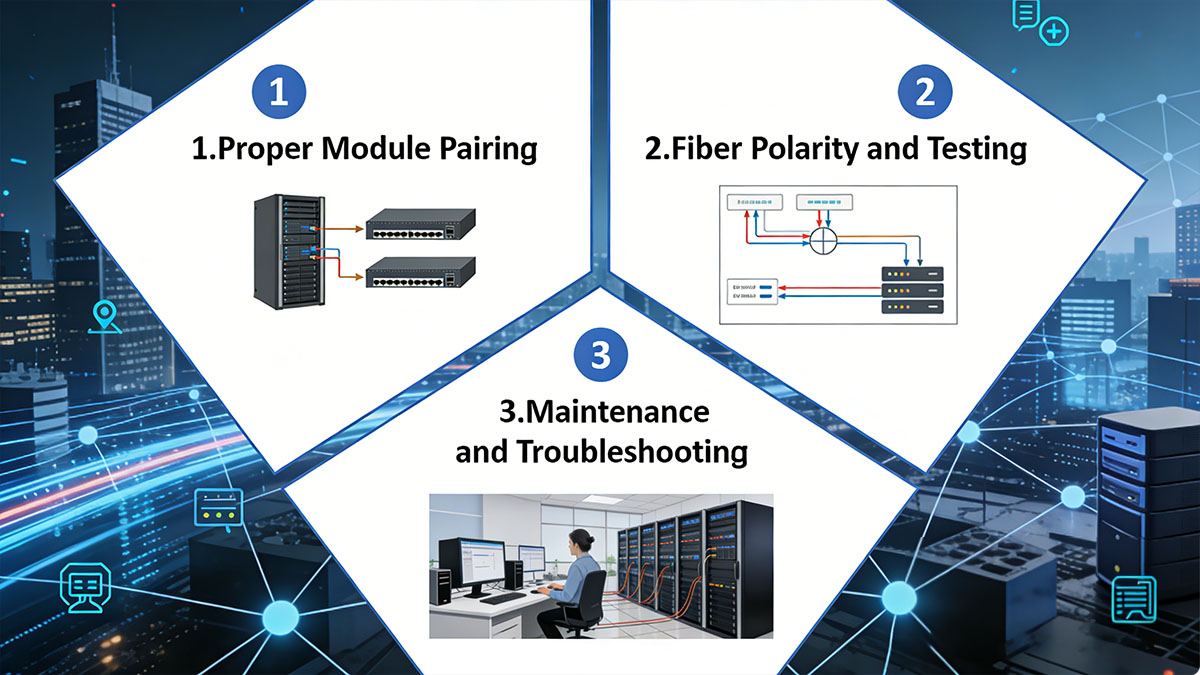
Proper Module Pairing
Simplex SFP modules must always be deployed in complementary pairs, with each module’s transmit wavelength aligned to the paired module’s receive wavelength. Incorrect pairing is the most common cause of link failure.
Best practices include:
- Verify Tx and Rx wavelengths before insertion
- Maintain clear labeling on modules and fiber strands
- Pre-test modules in a controlled environment before live deployment
Fiber Polarity and Testing
Even with correct module pairing, fiber polarity errors can prevent communication. Testing each link ensures proper signal flow.
Key steps:
- Confirm fiber strand orientation matches module Tx/Rx configuration
- Use optical power meters or visual fault locators to validate connectivity
- Document each link’s polarity and module assignment for future troubleshooting
| Test Type | Purpose | Recommended Threshold |
|---|---|---|
| Optical Power Test | Verify sufficient signal at receiver | ≥ -18 dBm for standard 10G BiDi SFP |
| Insertion Loss Test | Identify excessive fiber or connector loss | ≤ 2.5 dB for short links (<2 km) |
| Continuity/Polarity Check | Confirm Tx/Rx mapping is correct | No signal inversion or cross-talk |
Maintenance and Troubleshooting
Routine maintenance and monitoring are important for sustaining performance and avoiding downtime:
- Clean connectors regularly to prevent signal attenuation from dust or debris
- Monitor optical power and link errors to detect early signs of degradation
- Keep spare module pairs available to replace faulty units quickly
- Periodically audit fiber labeling and documentation to prevent configuration mistakes
Following these installation and configuration practices ensures that Simplex SFP deployments operate reliably, with optimized fiber utilization and minimal downtime.
🎡Common Challenges and How to Overcome Them
Deploying Simplex SFP modules introduces certain technical challenges that can impact link reliability if not properly managed. Understanding these issues and implementing preventive strategies ensures stable operation and reduces troubleshooting time.
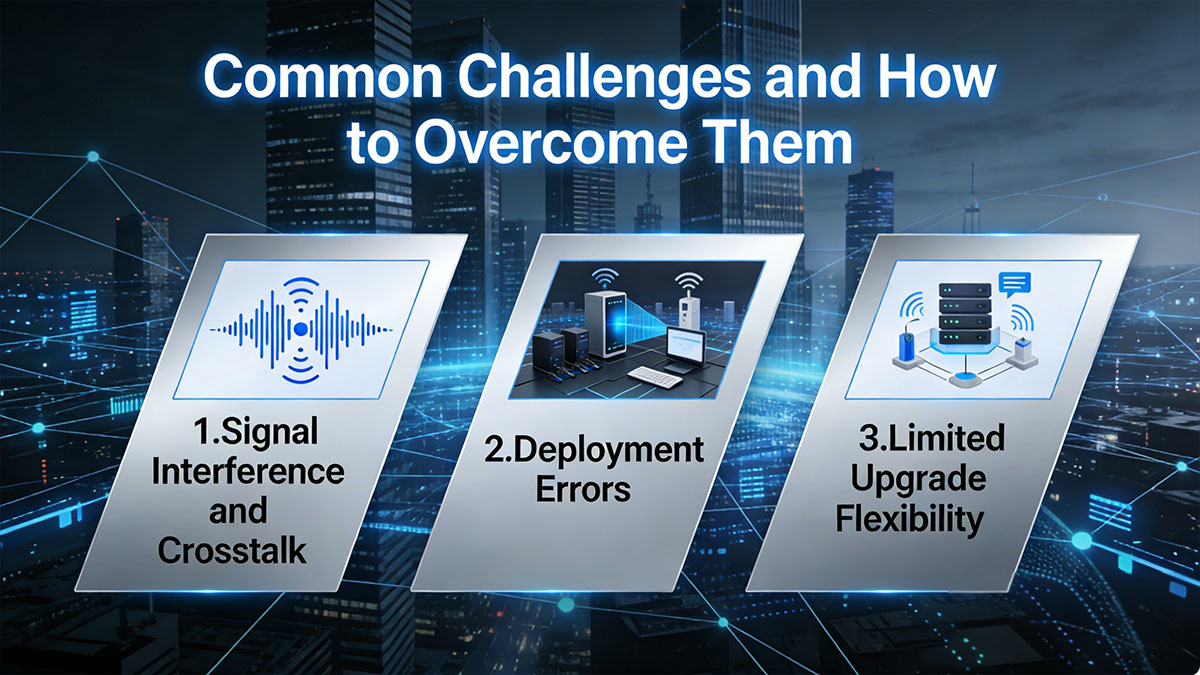
Signal Interference and Crosstalk
Although Simplex SFP modules transmit bidirectionally on a single fiber, improper installation or environmental factors can introduce signal interference or crosstalk.
Mitigation strategies include:
- Ensure correct wavelength pairing between module pairs
- Avoid fiber bends tighter than the specified minimum radius to reduce signal degradation
- Maintain adequate separation from high-power electrical or optical sources
- Use high-quality WDM filters to minimize insertion loss and isolation issues
Deployment Errors
Misconfiguration or module mismatch is a common source of deployment failures. Common mistakes include installing non-complementary BiDi modules or reversing fiber polarity.
Preventive measures:
- Verify Tx/Rx wavelengths before deployment
- Label fiber strands and modules clearly
- Test each link using optical power meters or visual fault locators
- Maintain a deployment checklist to prevent procedural errors
Limited Upgrade Flexibility
Simplex SFP deployments require careful planning for future scalability. Adding additional links or migrating to higher-speed networks may be constrained by wavelength compatibility or available fibers.
Best practices for upgrade planning:
- Maintain spare fibers for future expansion
- Standardize on wavelength pairs to ensure new modules remain compatible
- Consider hybrid deployment strategies, combining simplex and duplex links for flexibility
- Evaluate link budgets and insertion loss before scaling to higher-speed transceivers
| Challenge | Cause | Recommended Solution |
|---|---|---|
| Signal Interference | Incorrect wavelength pairing or fiber bending | Verify module pairs, maintain bend radius |
| Link Failure | Module mismatch or reversed polarity | Pre-test links, label fibers, use checklists |
| Upgrade Limitations | Limited wavelength or fiber availability | Reserve spare fibers, plan hybrid architecture |
By proactively addressing interference, deployment errors, and scalability constraints, network engineers can maintain high performance and reliability while leveraging the fiber efficiency advantages of Simplex SFP technology.
🎡Future Trends of Simplex SFP Technology
Simplex SFP technology is evolving to meet increasing bandwidth demands, higher port density requirements, and sustainability goals in modern networks. By continuing to optimize single-fiber communication, these modules are likely to play a growing role in enterprise, data center, and metropolitan deployments over the next several years.
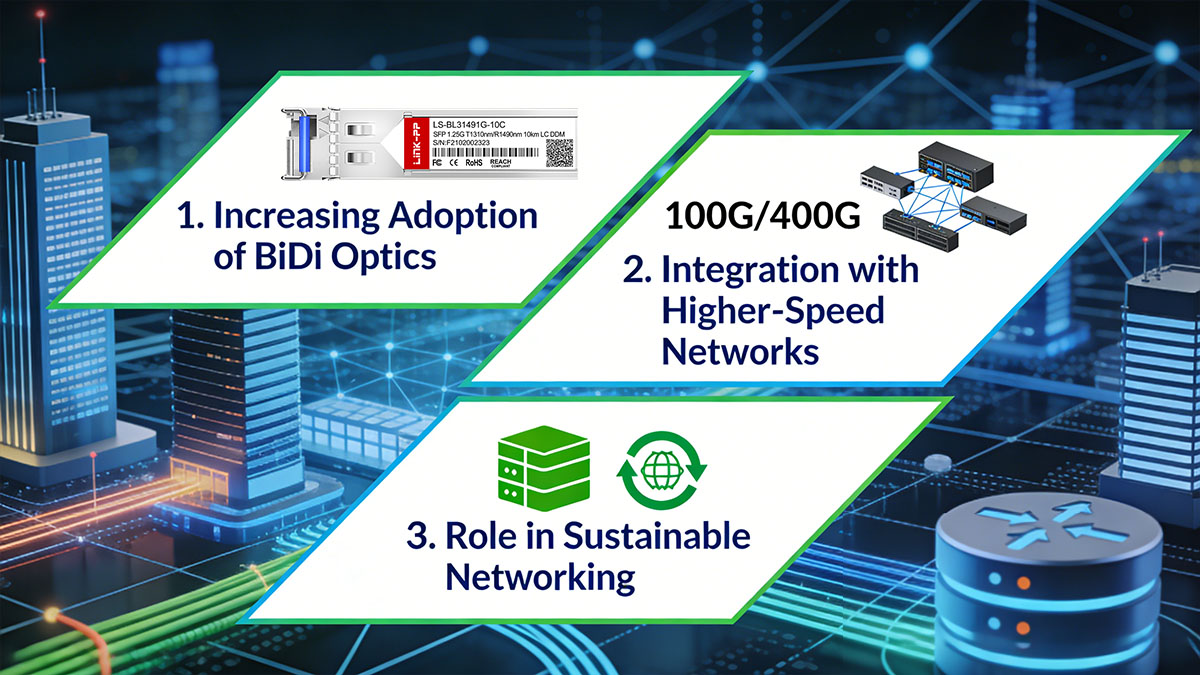
Increasing Adoption of BiDi Optics
Bidirectional optics are becoming more prevalent as fiber resources remain constrained and networks expand rapidly. The simplicity and efficiency of transmitting full-duplex data over a single fiber make Simplex SFPs an attractive solution for high-density deployments.
Key drivers include:
- Rising demand for SFP+ 10G, SFP28 25G, and QSFP+ 40G connections without increasing fiber counts
- Expansion in access networks and fiber-to-the-building (FTTB) scenarios
- Retrofitting legacy fiber with minimal infrastructure changes
Integration with Higher-Speed Networks
Simplex SFPs are being adapted to support higher-speed transceivers, including SFP28 25G and QSFP28 100G BiDi solutions. These developments ensure that single-fiber links remain compatible with next-generation network architectures.
Considerations for high-speed integration:
- Improved WDM filters to minimize insertion loss at higher data rates
- Enhanced transceiver optics to support longer distances at increased speeds
- Compatibility testing across vendors to maintain MSA compliance
| Trend | Impact on Networks | Engineering Considerations |
|---|---|---|
| Higher-Speed BiDi SFPs | Single-fiber links can support 25G/100G | Verify link budget, optical power margin |
| Fiber Optimization | Reduces fiber deployment cost and complexity | Plan for future wavelength expansion |
| Sustainable Networking | Lower material use and energy consumption | Evaluate environmental benefits in design |
Role in Sustainable Networking
With growing emphasis on green IT and energy efficiency, Simplex SFPs contribute to sustainability by reducing fiber and material usage, as well as simplifying cabling infrastructure. These efficiencies help lower both operational costs and the environmental footprint of network deployments.
By adopting these trends, network engineers can leverage Simplex SFP technology to support scalable, high-performance, and sustainable network growth, ensuring that single-fiber solutions remain relevant in increasingly complex networking environments.
🎡FAQs About Simplex SFP
Can Simplex SFP modules be used with standard duplex fiber?
No, Simplex SFP modules require a single fiber strand for bidirectional transmission. Using standard duplex fiber without proper pairing will prevent the link from functioning correctly.
How do I identify the correct Tx/Rx pair for Simplex SFPs?
Check the module label for transmit (Tx) and receive (Rx) wavelengths. Complementary modules must be installed together to ensure proper bidirectional communication.
Are Simplex SFPs compatible with all switch brands?
Compatibility depends on MSA compliance and the switch’s support for BiDi transceivers. Always verify vendor specifications and test modules before deployment.
What is the typical maximum distance for Simplex SFP links?
Distance depends on fiber type, module power, and insertion loss. Short to medium-range links (up to 2–5 km) are common, though higher-spec modules can extend further.
Can Simplex SFPs support higher-speed connections like 25G or 100G?
Yes, next-generation BiDi modules are available for 25G and 100G, but they require careful link budget planning and wavelength matching to maintain reliability.
How do I troubleshoot a non-functioning Simplex SFP link?
- Verify correct Tx/Rx pairing and fiber polarity
- Test optical power levels and insertion loss
- Inspect connectors for dust or damage
- Swap modules with a known working pair if necessary
🎡Conclusion
Simplex SFP modules provide a practical and efficient solution for modern network deployments by enabling bidirectional communication over a single fiber strand. They reduce cabling requirements, lower operational costs, and simplify network expansion, making them ideal for enterprise campuses, data center interconnects, metropolitan access networks, and industrial environments. Proper attention to wavelength pairing, link budget, and module compatibility ensures reliable performance, while adherence to best installation and maintenance practices minimizes downtime and troubleshooting.
As bandwidth demands continue to grow and fiber resources remain constrained, Simplex SFP technology is poised to play an increasingly important role in high-density and sustainable network deployments. For engineers and network planners looking to implement reliable single-fiber solutions, exploring a wide selection of Simplex SFP modules can optimize efficiency and future-proof infrastructure. Visit the LINK-PP Official Store to review compatible Simplex SFP options and find modules suited to your deployment needs.