Campus environments today rely heavily on high-performance wireless connectivity to support teaching, research, administration, and digital collaboration. With the rapid growth of connected devices, cloud applications, and real-time communication tools, traditional network infrastructures are under increasing pressure to deliver stable and high-capacity wireless access across large and complex campus areas.
As Wi-Fi standards continue to evolve, especially with Wi-Fi 6, Wi-Fi 6E, and emerging Wi-Fi 7 deployments, wireless performance is no longer determined only by access points. Instead, the underlying wired infrastructure, particularly fiber backhaul, has become the critical factor that determines whether a campus wireless network can scale efficiently, maintain low latency, and handle high-density traffic without congestion or performance degradation.
This article explores the core elements of campus wireless network solutions with a specific focus on fiber backhaul and its role in modern network architecture. It will help readers understand:
- How campus wireless networks are structured and deployed in real environments
- Why fiber backhaul is essential for supporting high-bandwidth wireless traffic
- What design considerations influence performance, scalability, and reliability
- How evolving wireless standards are reshaping infrastructure requirements
By examining these aspects in detail, the article provides a clear framework for understanding how fiber-based backhaul enables next-generation campus connectivity and supports long-term network evolution in high-density environments.
☑️ Understanding Campus Wireless Network Solutions
Campus wireless network solutions are integrated networking systems designed to deliver seamless, high-density Wi-Fi connectivity across large environments such as universities, corporate campuses, healthcare facilities, and research centers. These solutions combine wireless access points, switching infrastructure, and a high-capacity wired backbone—often fiber-based—to ensure stable, scalable, and secure connectivity for thousands of concurrent users and devices.
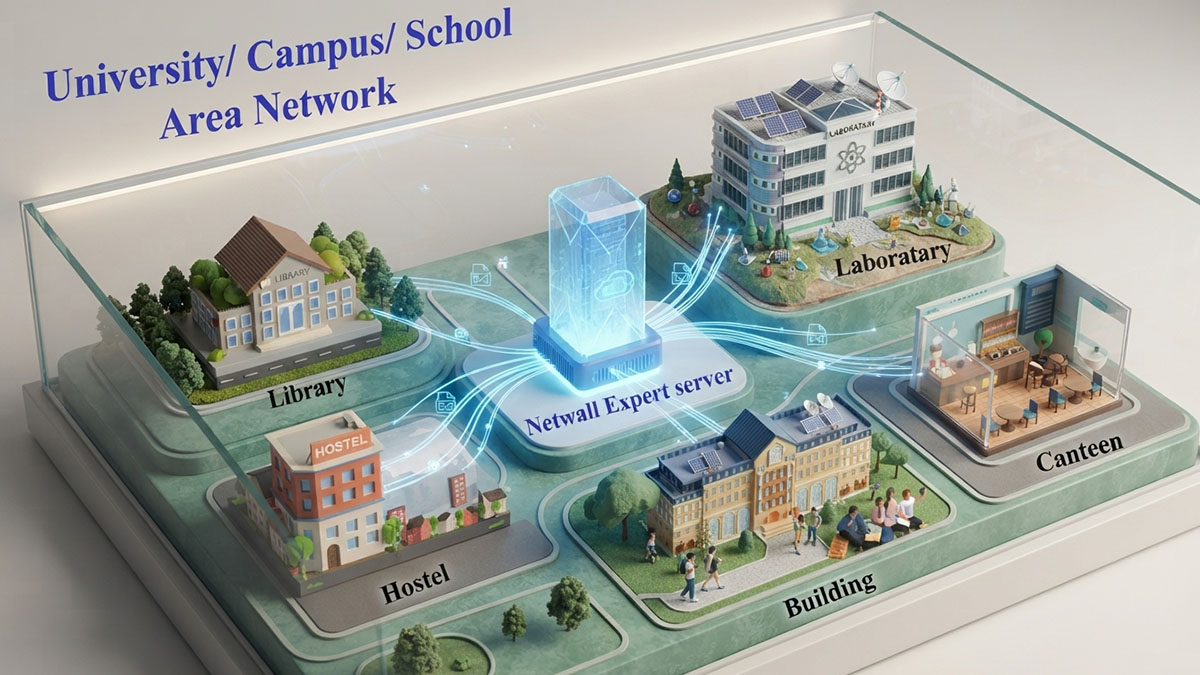
To better understand how these systems are structured and deployed, it is useful to break them down into architecture, core components, and real-world usage scenarios.
What Are Campus Wireless Network Solutions?
Campus wireless network solutions are end-to-end network architectures that provide continuous wireless connectivity across multiple buildings or zones within a defined campus environment. They are designed to support high user density, mobility, and bandwidth-intensive applications while maintaining centralized control and management.
These systems are not just collections of Wi-Fi access points but coordinated infrastructures that integrate wireless and wired layers to ensure performance consistency.
Key characteristics include:
- Seamless roaming between access points across different campus areas
- Centralized or cloud-based network management and monitoring
- High-capacity backhaul (typically fiber) to support aggregated wireless traffic
- Support for security policies, authentication, and segmentation
These elements work together to ensure that wireless access remains stable even under heavy traffic loads and diverse application demands. The result is a scalable network foundation that supports modern digital campus operations.
Key Components of a Campus Wireless Network
A campus wireless network is built from multiple interconnected components that collectively determine performance, reliability, and scalability. Each layer plays a specific role in ensuring wireless traffic is efficiently delivered from end users to the core network.
These components typically include both wireless and wired infrastructure elements, working together as a unified system.
Common core components include:
- Wireless access points (APs) for client connectivity
- Access switches that connect APs to the wired network
- Aggregation and core switches for traffic consolidation
- Network controllers or cloud management platforms
- Fiber backhaul links connecting distribution and core layers
Each component contributes to overall network performance, but the fiber backhaul layer is particularly critical because it carries aggregated traffic from multiple access points and prevents bottlenecks in high-density environments.
Common Campus Deployment Scenarios
Campus wireless network solutions are deployed across a wide range of environments where large-scale, reliable wireless connectivity is required. Each scenario has different performance demands, user densities, and application requirements, but all rely on strong underlying infrastructure such as fiber backhaul.
These deployments are typically tailored to match the operational and spatial complexity of the environment.
Typical deployment scenarios include:
- Universities and higher education campuses supporting hybrid learning and research activities
- K-12 school districts requiring secure, controlled access for students and staff
- Corporate campuses enabling collaboration tools, cloud services, and mobility
- Healthcare campuses supporting critical systems such as patient monitoring and communication tools
- Research facilities handling high-volume data transfers and specialized applications
Across all these environments, the common requirement is stable, high-capacity connectivity that can scale with growing device density and evolving application needs. This makes the integration of wireless access with a robust fiber-based backbone essential for ensuring consistent performance and long-term network adaptability.
☑️ What Is Fiber Backhaul and Why Does It Matter?
Fiber backhaul is the high-capacity wired connection that transports aggregated wireless traffic from access points and access switches to the campus core network. In campus wireless network solutions, it serves as the critical transport layer that ensures all Wi-Fi-generated data is delivered efficiently, reliably, and at scale without creating bottlenecks.
Defining Fiber Backhaul in Campus Networks
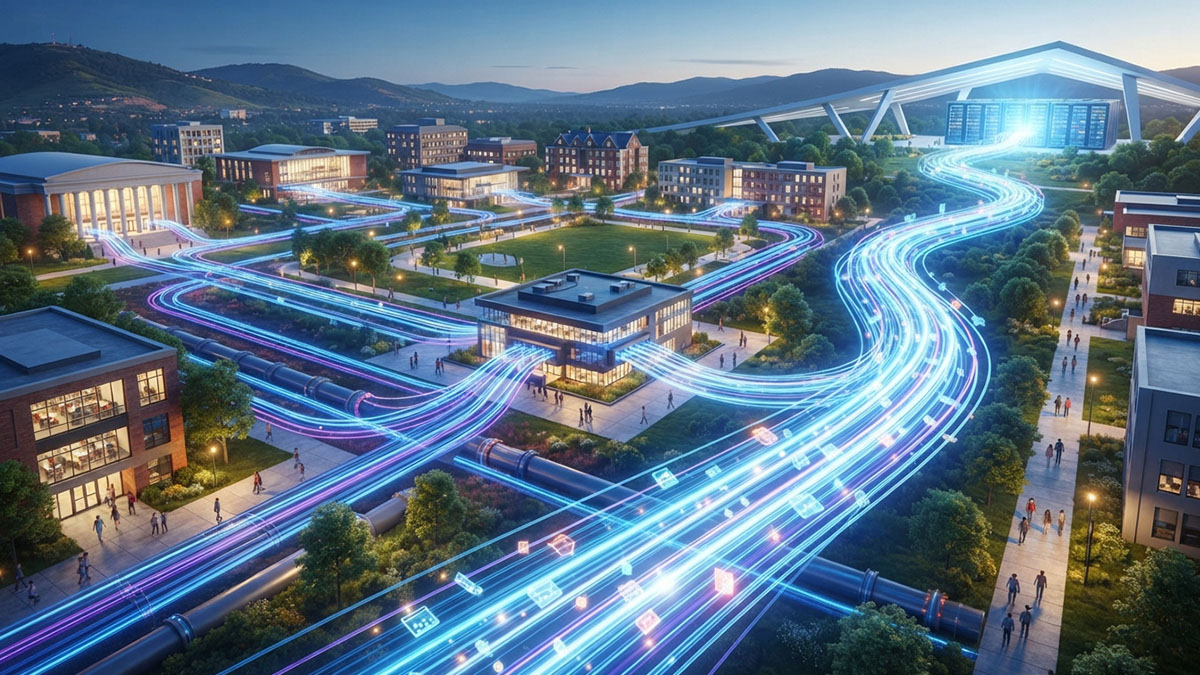
Fiber backhaul refers to the optical fiber links that connect distributed network segments—typically access and aggregation layers—to the central core infrastructure. It acts as the “high-speed highway” that carries all consolidated traffic from multiple wireless access points across buildings or zones.
To understand its role more clearly, it helps to view campus networks as layered systems where each layer has a distinct function:
- The access layer connects end devices via Wi-Fi
- The aggregation layer consolidates traffic from multiple access switches
- The core layer processes and routes all campus-wide data flows
Fiber backhaul sits between these layers, ensuring that traffic moves efficiently upward without congestion or packet loss. Without it, wireless performance would be limited by the constraints of traditional copper links, especially in high-density environments.
How Fiber Backhaul Supports Wireless Data Flow
Fiber backhaul directly determines how effectively wireless traffic can move from users to applications hosted on local or cloud infrastructure. As Wi-Fi speeds increase, the demand placed on backhaul links grows significantly, making fiber essential for maintaining performance consistency.
A typical data flow in a campus network follows this path:
- End user devices connect to Wi-Fi access points
- Access points forward traffic to access switches
- Traffic is aggregated at distribution switches
- Fiber backhaul transports data to the core network or data center
This structure ensures that high volumes of traffic from multiple access points can be consolidated and transmitted without congestion.
Key advantages of fiber in this process include:
- High throughput capacity for multi-gigabit wireless traffic
- Low latency transmission for real-time applications
- Stable performance under heavy device density
- Efficient handling of burst traffic from multiple users
As a result, fiber backhaul enables campus wireless networks to maintain consistent performance even during peak usage periods, such as class transitions, events, or business-critical operations.
Fiber Backhaul vs Traditional Copper Infrastructure
In campus wireless network solutions, comparing fiber backhaul and traditional copper infrastructure is essential for understanding performance limits, scalability, and long-term network design strategy. As wireless traffic continues to increase with high-density Wi-Fi deployments, the backhaul layer becomes a critical bottleneck factor that directly determines overall network efficiency.
The comparison below highlights the most important technical and operational differences between the two technologies.
| Category |
Fiber Backhaul |
Traditional Copper Infrastructure |
| Primary Role in Campus Network |
Core and aggregation backhaul for high-volume wireless traffic |
Short-distance access or edge connectivity |
| Bandwidth Capacity |
10Gbps to 400Gbps+ depending on optical modules |
Up to 1Gbps–10Gbps in limited short-range scenarios |
| Transmission Distance |
10km–80km+ depending on fiber type (single-mode/multimode) |
~30m–100m depending on cable category |
| Signal Quality |
Extremely stable with minimal attenuation |
Degrades with distance and load |
| EMI Resistance |
Fully immune to electromagnetic interference |
Susceptible to electrical noise and interference |
| Latency Performance |
Very low and stable latency |
Higher variability under load |
| Upgrade Flexibility |
Upgrade via transceiver replacement without replacing fiber |
Often requires full cabling replacement for upgrades |
| Scalability for Future Wi-Fi Standards |
Highly scalable for Wi-Fi 6/6E/7 and beyond |
Limited scalability due to physical constraints |
| Deployment Suitability |
Multi-building campus backbone and aggregation layers |
In-room, floor-level, or short-range access connections |
This comparison clearly shows that fiber backhaul is structurally designed for high-capacity, long-distance, and scalable campus deployments, while copper infrastructure remains limited to short-range access scenarios where bandwidth demand is relatively low.
☑️ Bandwidth Demands Driving Fiber Adoption
Bandwidth demand is the primary force accelerating the shift toward fiber backhaul in campus wireless network solutions. As modern campuses adopt higher Wi-Fi standards, cloud-based applications, and dense IoT ecosystems, the volume of aggregated wireless traffic has increased exponentially, pushing traditional copper-based backhaul architectures close to their operational limits.
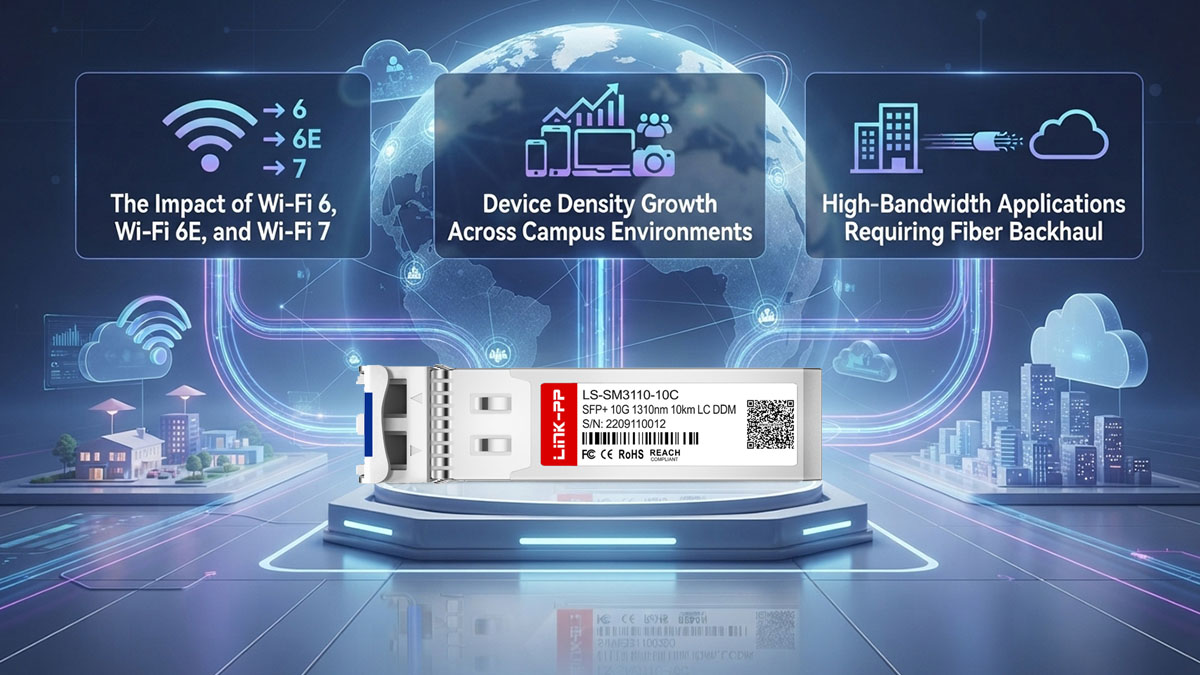
To support stable and scalable connectivity, campuses are increasingly relying on fiber infrastructure to handle multi-gigabit traffic loads, reduce congestion, and ensure consistent user experience across high-density environments.
The Impact of Wi-Fi 6, Wi-Fi 6E, and Wi-Fi 7
The evolution of Wi-Fi standards has significantly increased the pressure on campus backhaul networks. Each generation introduces higher throughput, lower latency, and greater concurrency, which directly translates into higher uplink demands on the wired infrastructure.
Key drivers include:
- Wi-Fi 6 introduces higher spectral efficiency and supports more simultaneous client connections
- Wi-Fi 6E expands available spectrum, increasing potential throughput in dense environments
- Wi-Fi 7 further pushes multi-gigabit performance with extremely low latency requirements
These advancements result in significantly larger uplink traffic from access points, requiring backhaul links capable of sustained multi-gigabit aggregation. Fiber is uniquely suited to meet these requirements due to its scalable bandwidth capacity and stable transmission characteristics.
Device Density Growth Across Campus Environments
Modern campuses are experiencing a rapid increase in connected devices, driven by both user behavior and infrastructure expansion. This growth directly impacts wireless traffic volume and backhaul utilization.
Typical contributing factors include:
- Bring-your-own-device (BYOD) policies increasing per-user device counts
- Expansion of IoT systems such as sensors, cameras, and smart building controls
- Growth of digital learning tools and cloud-based collaboration platforms
- Increased reliance on mobile applications for daily campus operations
As device density increases, access points generate more aggregated traffic, placing continuous pressure on backhaul infrastructure. Fiber provides the necessary headroom to absorb these traffic surges without introducing congestion or performance instability.
High-Bandwidth Applications Requiring Fiber Backhaul
Beyond device growth, the nature of campus applications has also shifted toward bandwidth-intensive and latency-sensitive workloads. These applications require consistent and high-capacity backhaul connectivity to function properly.
Common high-bandwidth applications include:
- Real-time video conferencing and hybrid learning platforms
- Cloud-based productivity suites and file synchronization services
- AR/VR-based training and interactive learning environments
- AI-driven analytics and smart campus management systems
- High-resolution surveillance and security video streaming
These workloads generate sustained and bursty traffic patterns that quickly exceed the capabilities of traditional copper backhaul. Fiber enables smooth delivery of these applications by providing stable high-throughput pathways between wireless access points and core systems.
☑️ Fiber Backhaul Architecture for Campus Wireless Networks
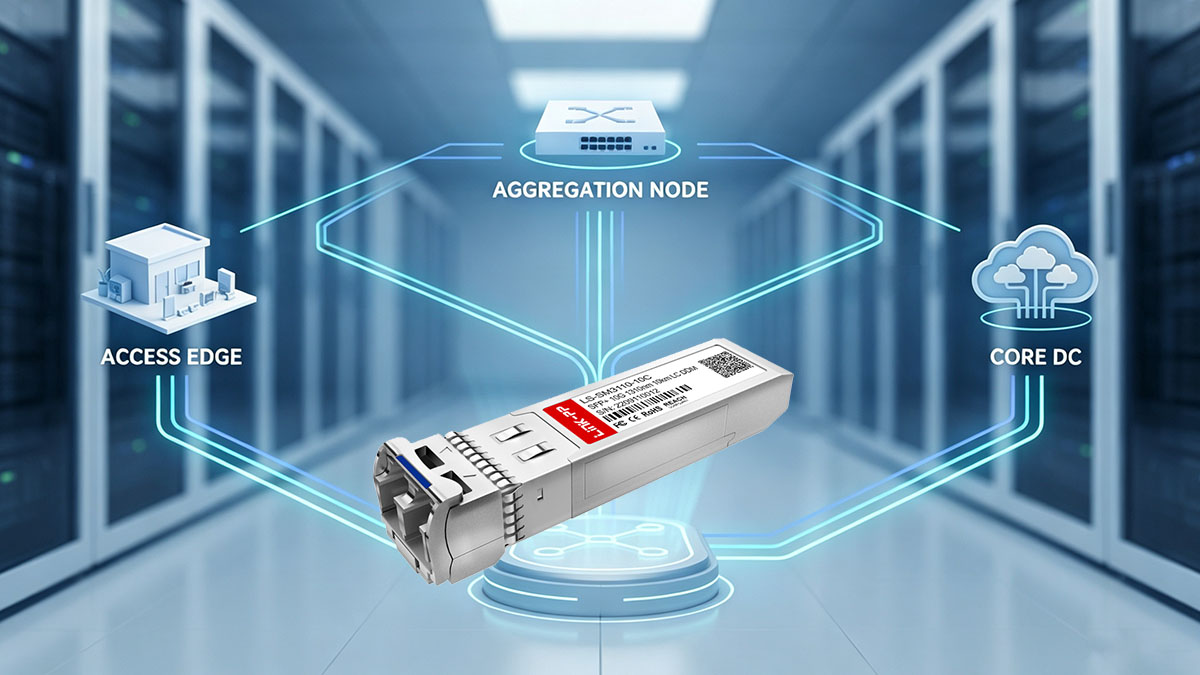
Fiber backhaul architecture in campus wireless network solutions defines how wireless traffic is transported from distributed access points to the core network through a structured, multi-layer design. It ensures that high-density Wi-Fi traffic is efficiently aggregated, routed, and delivered without creating bottlenecks, especially in large multi-building environments.
Access Layer Connectivity Design
The access layer is the entry point of campus wireless traffic, where end-user devices connect to Wi-Fi access points. Fiber backhaul architecture begins by ensuring that these access points are efficiently connected to upstream switching infrastructure.
Key design characteristics include:
- Access points connected to edge or access switches via short-reach Ethernet links
- Power and data delivery often supported through PoE (Power over Ethernet)
- Local traffic forwarding for nearby devices to reduce unnecessary upstream load
- Distribution of access points based on user density and building layout
At this stage, traffic is still localized, but the design ensures that it can be efficiently forwarded into higher network layers without congestion. Fiber does not typically appear directly at this layer but becomes critical immediately upstream.
Aggregation Layer Fiber Infrastructure
The aggregation layer is where fiber backhaul begins to play a dominant role. It collects traffic from multiple access switches and AP clusters and prepares it for transmission to the core network.
This layer is responsible for:
- Consolidating traffic from multiple access domains into high-capacity uplinks
- Connecting distribution switches across different buildings or campus zones using fiber links
- Reducing the number of direct connections required to the core network
- Supporting redundancy through multiple fiber paths for high availability
Fiber is essential here because aggregated traffic from multiple access points can quickly exceed copper capacity, especially in high-density Wi-Fi environments. By using fiber, campuses can ensure stable throughput and avoid congestion at distribution points.
Core Network Integration
The core layer represents the central hub of campus wireless network solutions, where all aggregated traffic is processed, routed, or forwarded to data centers and external networks. Fiber backhaul plays a critical role in ensuring that this layer operates without performance constraints.
Core integration typically includes:
- High-speed fiber connections between aggregation switches and core switches
- Direct links to data centers, internet gateways, and cloud services
- Centralized routing, policy enforcement, and traffic optimization
- Load balancing across multiple high-capacity fiber uplinks
At this level, fiber ensures that the full capacity of the wireless network can be realized without being limited by upstream transport bottlenecks. It enables consistent performance even when large volumes of traffic converge simultaneously from across the campus.
Centralized vs Distributed Fiber Backhaul Models
Campus networks can implement fiber backhaul using either centralized or distributed architectural models, depending on scale, geography, and performance requirements.
A centralized model typically aggregates traffic from all buildings into a single core location, simplifying management but requiring high-capacity fiber uplinks. A distributed model spreads core or aggregation functions across multiple nodes, improving resilience and reducing long-distance traffic loads.
Key considerations include:
- Centralized architectures offer simpler control but higher dependency on core capacity
- Distributed architectures improve fault tolerance and reduce single points of congestion
- Fiber density and routing complexity increase with campus scale in both models
- Hybrid designs are often used in large campuses to balance performance and manageability
Regardless of the model, fiber remains the foundational transport medium that enables scalable interconnection between all layers of the campus wireless network architecture.
☑️ Choosing the Right Fiber Technologies
Selecting the appropriate fiber technologies is a critical step in designing campus wireless network solutions because the choice directly affects bandwidth scalability, transmission distance, and long-term upgrade flexibility. As wireless traffic continues to grow across campus environments, fiber infrastructure must be carefully aligned with both current performance requirements and future expansion plans.
Different campus zones often require different fiber types, optical modules, and deployment strategies depending on distance, density, and application load.
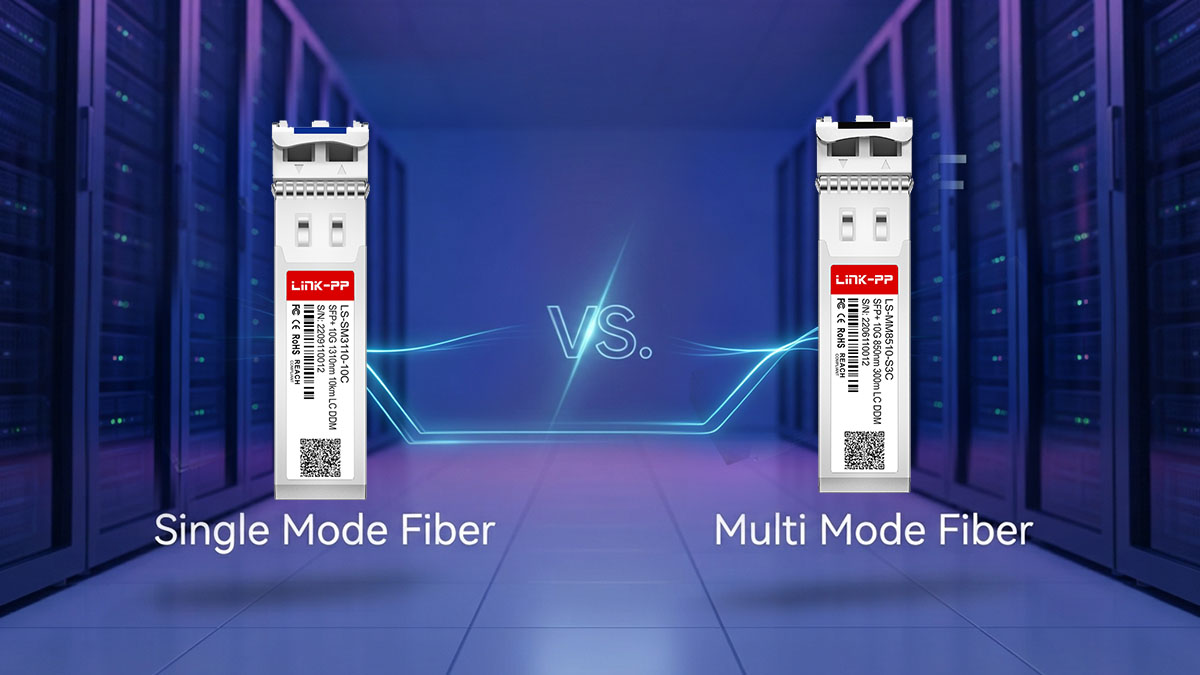
Single-Mode Fiber for Large Campus Deployments
Single-mode fiber is widely used in large campus environments where long-distance transmission and high scalability are required. It is designed to support high-capacity data transmission over extended distances with minimal signal loss, making it ideal for inter-building and backbone connections.
Typical characteristics include:
- Optimized for long-distance transmission across multi-building campuses
- Supports very high bandwidth capacity suitable for future multi-gigabit and 100G+ networks
- Low attenuation ensures stable performance over extended fiber runs
- Commonly used for core-to-aggregation and building-to-building backhaul links
Single-mode fiber is generally the preferred choice for campus backbones because it provides a future-proof foundation that can support evolving wireless standards without requiring major infrastructure changes.
Multimode Fiber for Shorter Campus Links
Multimode fiber is typically used for shorter-distance connections within buildings or between closely located network equipment. It provides a cost-effective solution for high-speed connectivity in controlled environments where transmission distance is limited.
Common usage characteristics include:
- Suitable for intra-building or short inter-building connections
- Supports high-speed transmission over shorter distances
- More cost-efficient for localized deployments compared to single-mode fiber
- Commonly deployed in data closets, floor-level switches, and access aggregation points
While multimode fiber is effective for localized campus segments, its distance limitations make it less suitable for large-scale backhaul across distributed campus environments.
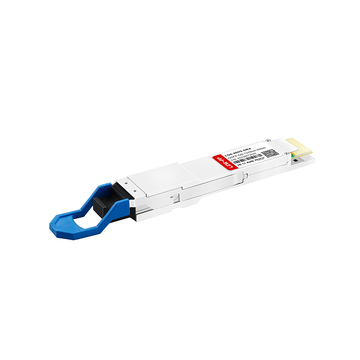
Selecting Appropriate Optical Transceivers
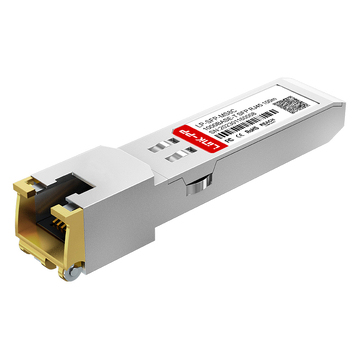
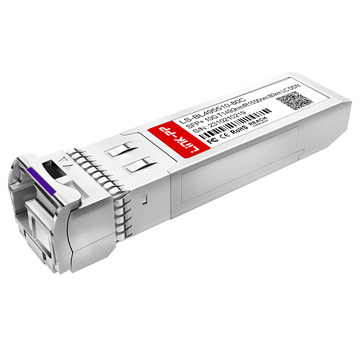
Optical transceivers play a key role in defining the actual performance of fiber backhaul links in campus networks. Even with high-quality fiber cabling, network capacity is ultimately determined by the transceiver modules used at each endpoint.
Key selection considerations include:
- Supported data rates such as 10Gbps, 25Gbps, 40Gbps, 100Gbps, and beyond
- Compatibility with switch hardware and network architecture
- Wavelength selection based on distance and fiber type requirements
- Power consumption and thermal characteristics in dense deployments
- Upgrade flexibility for future bandwidth scaling without replacing fiber infrastructure
By choosing the right transceivers, campuses can incrementally upgrade network capacity while preserving existing fiber infrastructure, significantly improving long-term investment efficiency.
Fiber Cabling Best Practices
Proper fiber cabling design is essential to ensure consistent performance, maintainability, and scalability in campus wireless network solutions. Poor cabling practices can introduce unnecessary loss, complexity, and operational risks.
Recommended best practices include:
- Implementing structured cabling systems for organized and scalable deployments
- Maintaining proper bend radius to avoid signal degradation
- Using clear labeling and documentation for all fiber routes and connections
- Separating fiber paths from high-interference electrical systems
- Planning redundant routes to improve network resilience and uptime
These practices help ensure that fiber infrastructure remains stable and manageable as campus networks grow in size and complexity, supporting long-term wireless performance objectives.
☑️ Reliability and Performance Benefits of Fiber Backhaul
Fiber backhaul significantly improves both reliability and performance in campus wireless network solutions by providing a stable, high-capacity transport layer for aggregated wireless traffic. As campus environments become increasingly dependent on continuous connectivity for learning, operations, and real-time applications, the stability of the backhaul layer directly determines overall network quality.
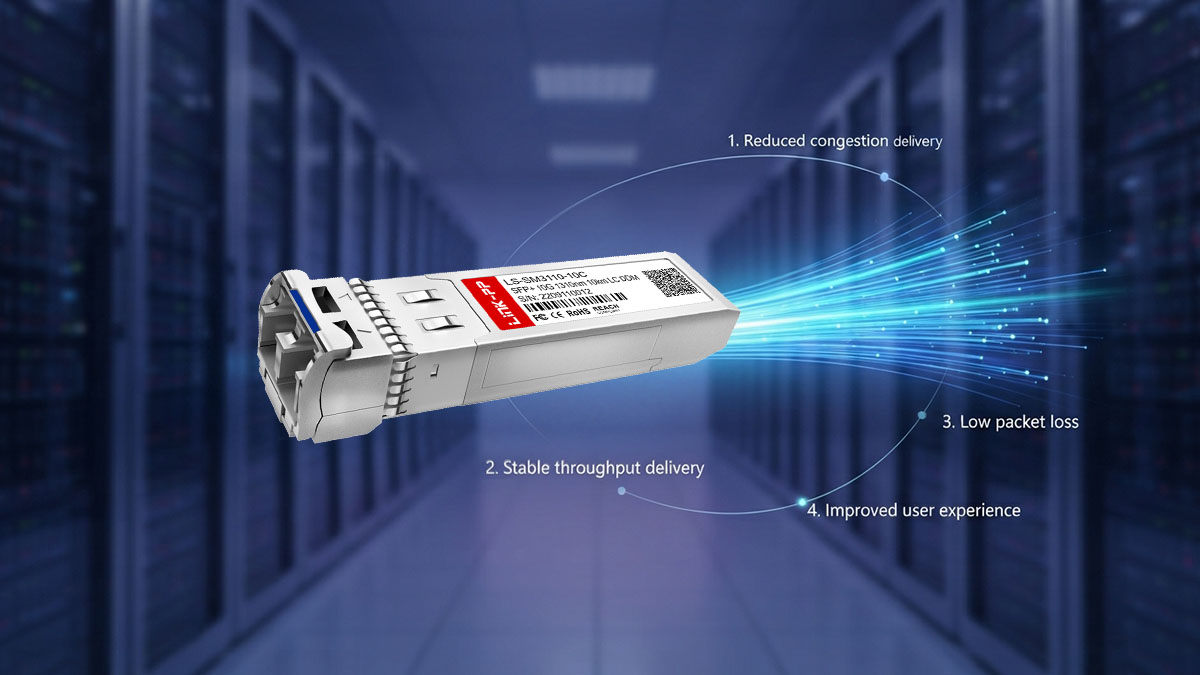
Unlike legacy copper-based systems, fiber offers consistent throughput, low latency, and strong resistance to environmental interference, making it a foundational element for modern high-density wireless deployments.
Achieving Consistent Wireless Performance
Fiber backhaul ensures consistent wireless performance by eliminating bandwidth constraints between access points and the core network. This allows Wi-Fi infrastructure to operate closer to its theoretical performance limits, even under heavy load conditions.
Key performance benefits include:
- Stable throughput across multiple access points during peak usage periods
- Reduced congestion at aggregation points in high-density environments
- Predictable latency performance for time-sensitive applications
- Improved handling of burst traffic from simultaneous user activity
These characteristics are especially important in campuses where network demand fluctuates significantly throughout the day, such as during class transitions or large-scale events.
Supporting Mission-Critical Campus Services
Campus wireless networks increasingly support mission-critical applications that require uninterrupted connectivity and deterministic performance. Fiber backhaul plays a key role in ensuring these services operate reliably across the entire network.
Typical mission-critical use cases include:
- Emergency communication systems and public safety networks
- Healthcare monitoring and patient data transmission in medical campuses
- Secure administrative systems and academic platforms
- Real-time collaboration tools used in teaching and research environments
To support these applications, fiber provides:
- High availability transport paths for uninterrupted data flow
- Low-latency transmission for real-time responsiveness
- Scalable bandwidth for growing service demands
- Stable connectivity across distributed campus locations
This level of reliability is difficult to achieve with copper-based backhaul in large-scale environments.
Reducing Network Downtime Risks
Network downtime in campus environments can disrupt education, research, and operational continuity. Fiber backhaul reduces these risks by offering a more resilient and interference-resistant transmission medium.
Key reliability advantages include:
- Immunity to electromagnetic interference from nearby electrical systems
- Lower failure rates due to passive transmission characteristics
- Support for redundant fiber paths and failover architectures
- Greater physical durability in long-distance campus deployments
These features collectively reduce the likelihood of service interruptions and improve overall network uptime, particularly in environments with high operational dependency on wireless connectivity.
☑️ Security Considerations in Fiber-Backhauled Campus Networks
Security in campus wireless network solutions is not limited to authentication or encryption at the wireless layer; it also depends heavily on the physical and architectural characteristics of the underlying backhaul infrastructure. Fiber backhaul contributes to a more secure campus network by reducing interception risks, improving traffic isolation capabilities, and supporting modern zero-trust security models.
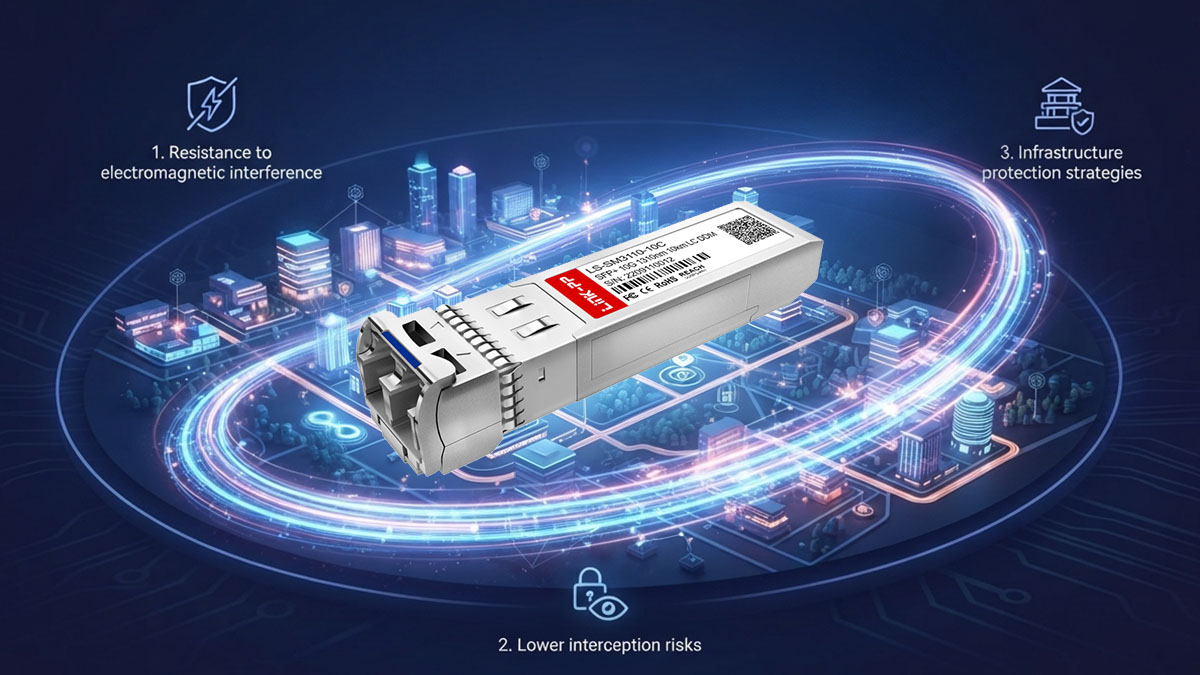
As campus environments handle increasingly sensitive data across education, healthcare, and enterprise systems, the security advantages of fiber become an important factor in network design decisions.
Physical Security Advantages of Fiber Infrastructure
Fiber optic infrastructure provides inherent physical security advantages compared to traditional copper-based networks. Because fiber transmits data using light rather than electrical signals, it is significantly more difficult to intercept or tamper with without detection.
Key physical security benefits include:
- Reduced risk of electromagnetic signal leakage compared to copper cabling
- High resistance to passive tapping without physical disruption of the fiber link
- Immunity to electromagnetic interference that could otherwise be used for signal manipulation
- Improved integrity of long-distance inter-building connections across campus environments
These characteristics make fiber particularly suitable for environments where sensitive data is transmitted, such as research institutions, healthcare campuses, and administrative systems handling confidential information.
Network Segmentation and Traffic Isolation
Beyond physical security, fiber backhaul also supports stronger logical segmentation and traffic isolation within campus networks. This is essential for maintaining secure multi-tenant or multi-department environments.
Common segmentation approaches include:
- Separation of guest, student, and administrative networks
- Dedicated VLANs for different academic or operational departments
- Isolation of research networks handling sensitive or high-value data
- Controlled traffic paths between access, aggregation, and core layers
Fiber’s high capacity enables these segmented traffic streams to coexist without performance degradation, reducing the need for oversimplified network sharing that could introduce security risks. It also supports centralized policy enforcement, ensuring consistent security rules across all campus segments.
Supporting Zero-Trust Campus Architectures
Modern campus networks increasingly adopt zero-trust security principles, where no device or user is automatically trusted, even within internal network boundaries. Fiber backhaul plays a supporting role in enabling these architectures by providing a stable and predictable transport layer for security policy enforcement.
Key contributions include:
- Reliable transport of authentication and authorization traffic between network layers
- Support for continuous identity verification across distributed access points
- Consistent enforcement of access control policies across the entire campus
- Secure communication between distributed security systems and centralized controllers
In a zero-trust model, the network must continuously verify and monitor traffic flows. Fiber ensures that these security operations are not hindered by latency, congestion, or instability at the backhaul layer.
☑️ Conclusion
Campus wireless network solutions increasingly depend on fiber backhaul as the foundational infrastructure that determines overall network performance, scalability, and reliability. As wireless demand continues to grow through Wi-Fi 6, Wi-Fi 6E, and Wi-Fi 7 deployments, fiber backhaul becomes essential for transporting high-density traffic between access points and core networks without congestion or bottlenecks. In modern campus environments, the integration of campus wireless network solutions with robust fiber backhaul architecture ensures long-term support for multi-gigabit connectivity, distributed campus expansion, and next-generation digital applications.
A clear understanding of fiber backhaul highlights several essential principles that define modern campus network design:
- Fiber provides the high-capacity backbone required for aggregated wireless traffic in dense campus environments
- It ensures stable performance for real-time applications, cloud services, and high-device-density usage scenarios
- It enables scalable architecture across multi-building campus deployments without major infrastructure redesign
- It delivers superior reliability and interference resistance compared to traditional copper infrastructure
- It supports future-ready upgrades aligned with evolving Wi-Fi standards and bandwidth growth trends
As campus networks continue to evolve toward higher speeds, greater device density, and more cloud-driven applications, fiber backhaul will remain the core enabler of sustainable network growth. Organizations planning or upgrading campus wireless infrastructure should prioritize scalable fiber-based architectures to ensure long-term performance stability and operational efficiency.
For high-quality optical connectivity components and solutions designed to support modern campus wireless network solutions and fiber backhaul deployments, visit the LINK-PP Official Store to explore reliable and scalable infrastructure options that align with future network demands.