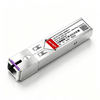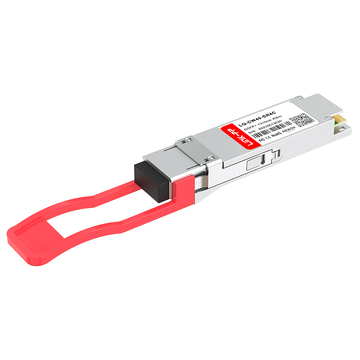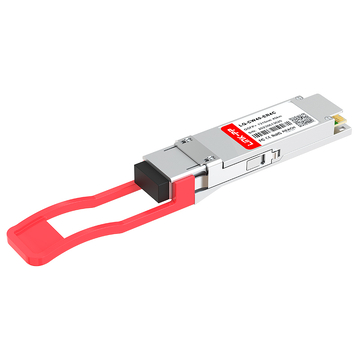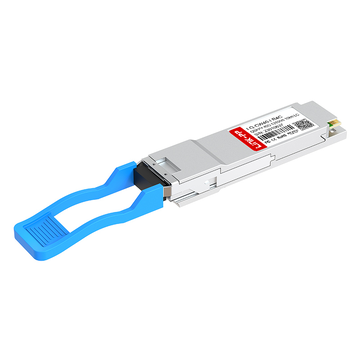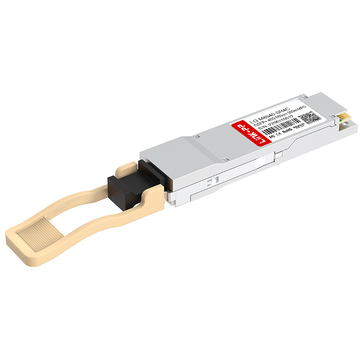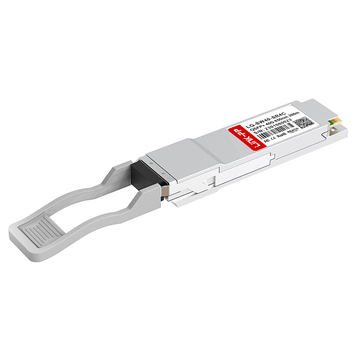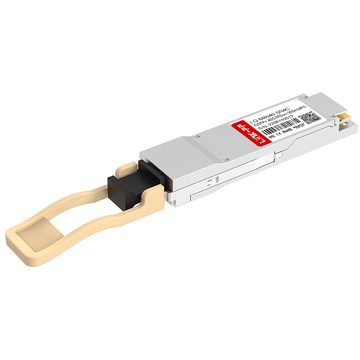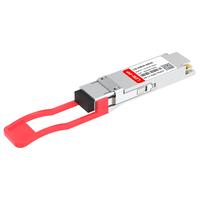
Campus networks are experiencing rapid growth in bandwidth demand due to cloud services, high-density Wi-Fi, video applications, and internal data traffic. As a result, many organizations are transitioning from traditional 10G uplinks to 40G connectivity to support aggregation and core layers more efficiently. In this context, CSR4 optical transceivers have become a practical solution for short- to medium-range high-speed links within campus environments.
CSR4, based on the 40GBASE-CSR4 standard, is designed for parallel transmission over multimode fiber optics using MPO interfaces. It extends the reach of standard short-range optics, making it suitable for building-to-building connections and high-capacity switch interconnects. At the same time, Cisco equivalent CSR4 modules are increasingly adopted as a cost-effective and interoperable alternative for networks built on Cisco infrastructure.
This article explains how CSR4 technology works, what “Cisco equivalent” means in real deployments, and how these modules can be effectively used in campus network architectures. It also covers fiber cabling considerations, performance characteristics, and deployment best practices to help ensure reliable and scalable 40G connectivity.
? Understanding CSR4 Optical Transceivers
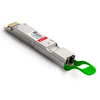
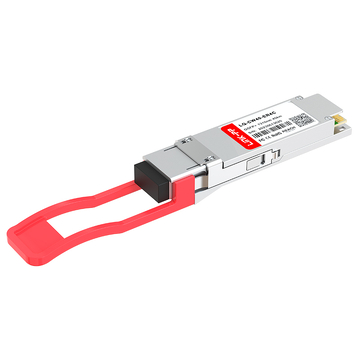
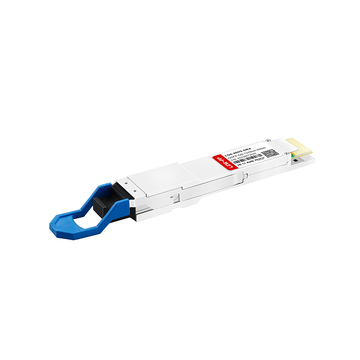
40G QSFP+ optical transceivers are designed to deliver 40Gbps connectivity over multimode fiber using parallel transmission, making them well-suited for campus networks that require higher bandwidth beyond 10G but do not need long-distance single-mode solutions. They extend the usable range of short-reach optics while maintaining compatibility with MPO-based fiber infrastructure commonly deployed in enterprise environments.
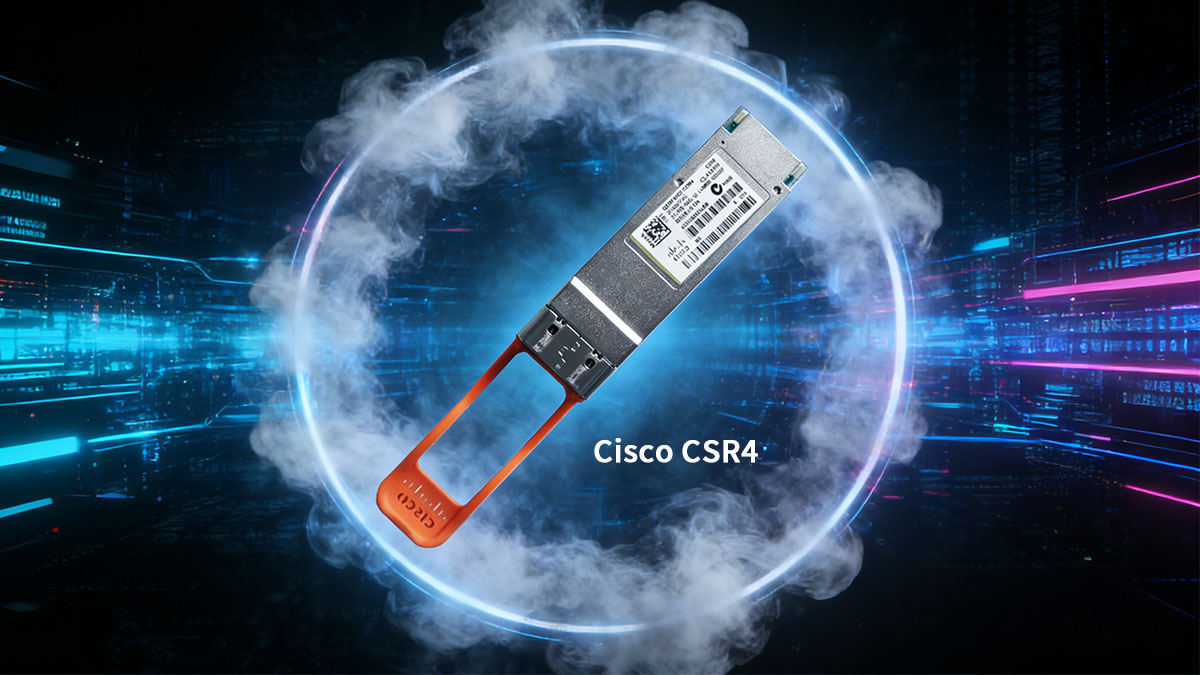
What Is a CSR4 Transceiver
CSR4 is a 40GBASE QSFP+ that uses four parallel optical lanes to transmit data over multimode fiber, enabling efficient high-speed communication within short to medium distances.
CSR4 modules typically operate over OM3 or OM4 multimode fiber and use MPO-12 connectors. Compared to standard SR4 optics, CSR4 increases transmission distance, allowing up to 300m on OM3 fiber and up to 400m on OM4 fiber. This makes it suitable for campus aggregation links, building interconnects, and high-capacity switch uplinks.
Key Technical Characteristics of CSR4 Modules
CSR4 modules rely on parallel optics to achieve 40Gbps throughput, with each lane carrying 10Gbps over multimode fiber.
| Parameter |
Description |
| Data Rate |
40Gbps (4 × 10Gbps) |
| Transmission Type |
Parallel multimode |
| Connector |
MPO-12 |
| Wavelength |
850nm |
| Max Distance |
300m (OM3) / 400m (OM4) |
This design simplifies optical architecture compared to wavelength-division solutions and allows efficient use of existing MPO-based cabling systems. It also supports high-density switch deployments where multiple 40G ports are required.
CSR4 vs Other 40G Optical Standards
CSR4 is most relevant when compared with SR4 and LR4, as these are the primary 40G optical standards used in enterprise and campus networks.
CSR4 extends multimode transmission distance beyond SR4 while avoiding the higher cost and complexity of single-mode LR4 solutions.
| Feature |
CSR4 |
SR4 |
LR4 |
| Fiber Type |
Multimode |
Multimode |
Single-mode |
| Max Distance |
300–400m |
100–150m |
Up to 10km |
| Connector |
MPO-12 |
MPO-12 |
LC Duplex |
| Typical Use |
Campus links |
Rack-level links |
Long-distance links |
In campus deployments, CSR4 is typically selected when link distances exceed SR4 limits but remain within the range of MMF module, offering a balanced approach between performance, cost, and deployment simplicity.
? Cisco Equivalent CSR4 Modules Explained
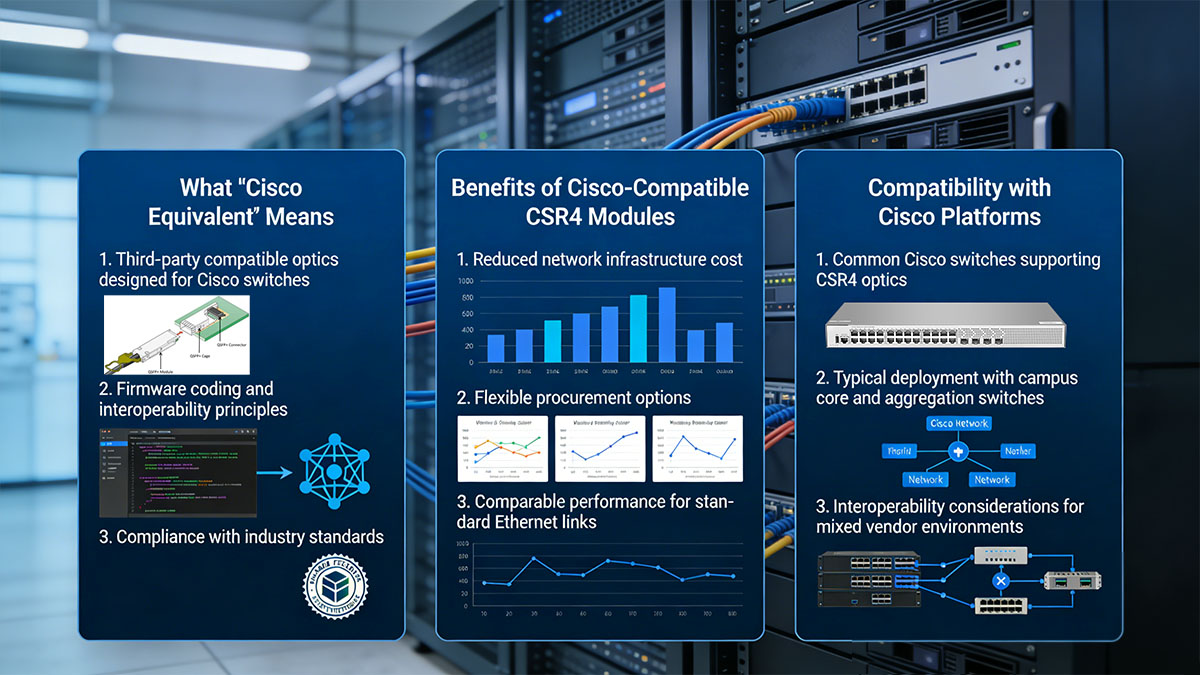
Cisco equivalent CSR4 modules are third-party optical transceivers designed to operate with Cisco networking equipment while complying with the same 40GBASE-CSR4 standards. They provide identical functional performance for standard Ethernet transmission and are commonly used in campus networks to achieve cost efficiency without changing existing infrastructure or architecture.
What “Cisco Equivalent” Means
“Cisco equivalent” refers to optical modules that are engineered to be compatible with Cisco switches through proper coding and adherence to industry standards, allowing them to function as plug-and-play alternatives.
-
Programmed EEPROM to match Cisco interface requirements
-
Compliance with IEEE 40GBASE-CSR4 specifications
-
Support for standard optical signaling and link negotiation
-
Designed for interoperability within Cisco-based environments
These modules are not manufactured by Cisco but are built to operate within the same technical framework, ensuring that network performance and link stability are maintained under standard operating conditions.
Benefits of Cisco-Compatible CSR4 Modules
Cisco-compatible CSR4 modules provide a practical balance between performance and cost, especially in large-scale campus deployments.
| Aspect |
Cisco Original |
Cisco Equivalent |
| Functional Standard |
40GBASE-CSR4 |
40GBASE-CSR4 |
| Compatibility |
Native |
Cisco-compatible |
| Interoperability |
Vendor-specific |
Multi-vendor support |
| Cost Structure |
Higher |
More flexible |
From a deployment perspective, both options deliver the same link performance when used within supported environments. The main difference lies in procurement flexibility and cost optimization, which can be significant in networks with a large number of optical module interfaces.
Compatibility with Cisco Platforms
Cisco equivalent CSR4 modules are widely used across campus network switches, particularly in aggregation and core layers where 40G interfaces are required.
-
Compatible with many Cisco switches supporting QSFP+ 40G ports
-
Commonly deployed in aggregation-to-core uplinks
-
Suitable for mixed environments where multiple vendors are present
-
Supports standard Digital Optical Monitoring (DOM) features
To ensure stable operation, it is important to verify switch compatibility, firmware support, and interface requirements before deployment. In campus networks, this helps avoid issues such as module recognition errors or link initialization failures, especially when integrating with existing Cisco infrastructure.
? Campus Network Architecture and 40G Requirements
Campus networks require higher bandwidth and more efficient traffic handling as applications become increasingly data-intensive. 40G optical transceiver solutions, including CSR4-based links, is commonly deployed at the aggregation and core layers to address growing east-west traffic, improve uplink capacity, and reduce network bottlenecks. In this architecture, CSR4 modules provide a practical solution for short- to medium-distance high-speed interconnections.
Typical Campus Network Topology
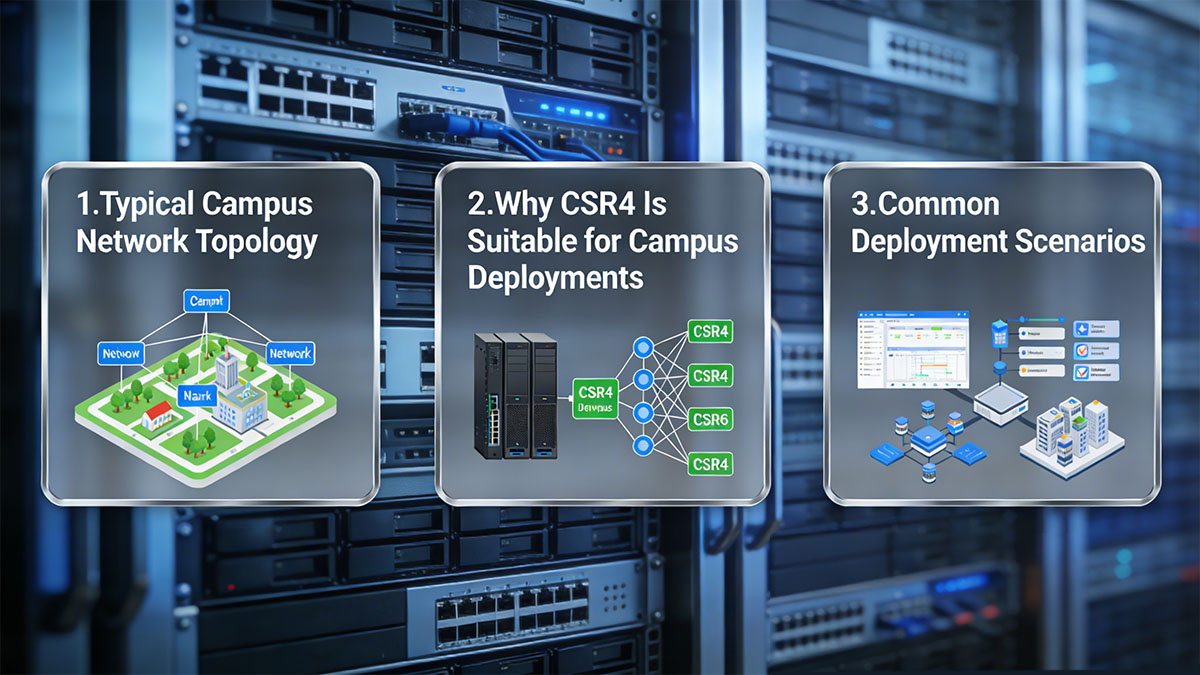
A standard campus network is structured into three hierarchical layers, each serving a distinct role in traffic aggregation and distribution.
-
Access layer: connects end devices such as PCs, wireless access points, and IoT devices
-
Aggregation layer: consolidates traffic from multiple access switches
-
Core layer: provides high-speed backbone connectivity across the campus
As traffic flows between users, applications, and data centers, the aggregation and core layers must handle increasing volumes of internal (east-west) data, making higher-speed links essential.
Why CSR4 Is Suitable for Campus Deployments
CSR4 is well-suited for campus environments because it aligns with both the physical infrastructure and distance requirements commonly found in enterprise networks.
-
Supports multimode fiber already widely deployed in campus cabling systems
-
Provides extended reach beyond SR4 without requiring single-mode optics (LR4/ER4)
-
Enables high-density 40G uplinks between aggregation and core switches
-
Reduces complexity compared to long-reach optical technologies
This makes CSR4 particularly effective for scenarios where buildings or network zones are interconnected within a few hundred meters, which is typical in campus layouts.
Common Deployment Scenarios
CSR4 modules are most often used in specific high-capacity links within campus networks where both bandwidth and moderate distance are required.
-
Aggregation-to-core uplinks supporting multiple access switches
-
Inter-building connections within a campus fiber ring
-
High-capacity switch stacking or virtual chassis configurations
-
Campus data center interconnects over multimode fiber
These scenarios benefit from CSR4’s ability to deliver stable 40G performance while leveraging existing MPO-based multimode infrastructure, helping organizations scale network capacity without major redesign.
? Fiber Cabling Considerations for CSR4
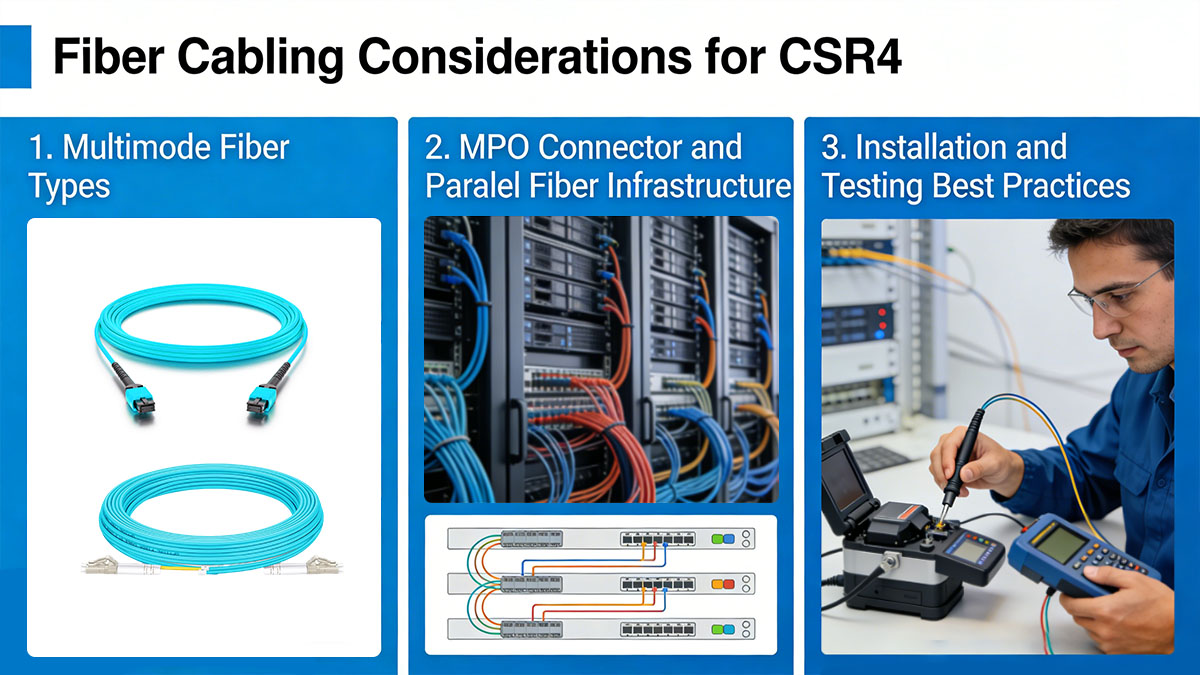
Fiber cabling directly determines whether CSR4 links can achieve expected distance, stability, and performance. Because CSR4 relies on parallel transmission over multimode fiber with MPO interfaces, proper selection of fiber type, connector structure, and installation practices is essential for reliable campus network deployment.
Multimode Fiber Types
CSR4 performance depends heavily on the type of multimode fiber used, with OM3 and OM4 being the most common options in campus environments.
CSR4 supports both OM3 and OM4 fiber, but OM4 enables longer transmission distances and better signal quality, making it more suitable for future scalability.
| Fiber Type |
Maximum Distance (CSR4) |
Bandwidth Performance |
| OM3 |
Up to 300m |
Standard |
| OM4 |
Up to 400m |
Higher |
| OM5 |
Typically not required |
Optimized for SWDM |
In most campus deployments, OM3 is sufficient for shorter aggregation links, while OM4 is preferred when distances approach upper limits or when planning for long-term upgrades.
MPO Connector and Parallel Fiber Infrastructure
CSR4 modules use MPO-12 connectors to support parallel optical transmission, requiring correct fiber mapping and polarity to ensure proper operation.
A typical CSR4 link uses 8 active fibers (4 transmit and 4 receive), while the remaining fibers in the MPO-12 connector are unused.
-
MPO-12 connectors support high-density fiber connections
-
Proper polarity (Type A, B, or C) is required for correct signal alignment
-
Ribbon fiber cables are commonly used for structured cabling systems
-
Pre-terminated MPO trunks simplify large-scale campus deployments
Incorrect polarity or fiber mapping can result in link failures even when all hardware components are functioning properly, making design accuracy critical.
Installation and Testing Best Practices
Accurate installation and validation ensure CSR4 links perform reliably in real-world campus environments.
-
Inspect and clean all MPO connector before installation
-
Verify fiber polarity and end-to-end connectivity
-
Measure optical loss to confirm it is within acceptable limits
-
Use optical test equipment to validate link performance
| Test Item |
Purpose |
Typical Method |
| Insertion Loss |
Verify signal attenuation |
Optical power meter |
| Polarity Check |
Ensure correct TX/RX mapping |
Visual fault locator |
| Connector Inspection |
Detect contamination or damage |
Fiber microscope |
Following these practices reduces the risk of deployment issues and helps maintain consistent 40G link performance across campus network infrastructure.
? Performance and Operational Considerations
CSR4 QSFP+ transceivers are designed to deliver stable 40Gbps performance in campus environments, but actual network efficiency depends on bandwidth utilization, environmental conditions, and operational visibility. Proper evaluation of these factors ensures consistent performance and simplifies long-term network management.

Bandwidth and Latency Advantages
CSR4 enables higher bandwidth aggregation while maintaining low latency, which is critical for modern campus applications such as cloud access, real-time communication, and high-density wireless traffic.
By consolidating multiple 10G links into a single 40G transceiver link, CSR4 reduces link congestion and simplifies network design.
| Metric |
10G Links (4 × 10G) |
40G CSR4 Link |
| Total Bandwidth |
40Gbps |
40Gbps |
| Port Usage |
4 ports |
1 port |
| Latency Overhead |
Higher (aggregation) |
Lower |
| Cable Complexity |
Higher |
Lower |
This consolidation improves overall efficiency by reducing the number of physical interfaces and simplifying cabling, which is particularly beneficial in aggregation and core layers.
Reliability and Environmental Factors
CSR4 modules are generally reliable within standard operating conditions, but environmental factors in campus deployments can affect long-term stability.
-
Temperature variations in equipment rooms may impact optical performance
-
Dust or contamination on MPO connectors can degrade signal quality
-
Fiber bending or improper cable management may introduce signal loss
-
Power stability in switches affects module operation
To maintain reliability, campus networks often implement redundancy at the link or device level, ensuring continuous operation even if a single optical link fails.
Monitoring and Network Management
Effective monitoring allows network operators to detect issues early and maintain optimal CSR4 link performance.
CSR4 modules typically support Digital Optical Monitoring (DOM), providing real-time visibility into key parameters.
| Parameter |
Description |
Operational Value |
| Optical Power TX |
Transmit signal strength |
Detect signal degradation |
| Optical Power RX |
Receive signal strength |
Identify link loss |
| Temperature |
Module operating temperature |
Prevent overheating |
| Voltage |
Power supply status |
Ensure stable operation |
These metrics can be integrated into network management systems to enable proactive maintenance and faster troubleshooting. In campus environments, this helps minimize downtime and ensures that high-capacity 40G links remain stable under varying traffic conditions.
? Power Consumption and Port Density Considerations
Efficient use of power and switch ports is a key advantage of CSR4 in campus networks. By delivering 40Gbps through a single interface, CSR4 reduces the number of required transceivers, switch ports, and cables compared to equivalent 10G deployments, improving both energy efficiency and hardware utilization.

Power Efficiency in High-Density Deployments
CSR4 consumes less total power when replacing multiple lower-speed links, making it suitable for aggregation and core layers with high port density requirements.
| Metric |
4 × 10G Links |
1 × 40G CSR4 |
| Total Power Usage |
Higher (combined) |
Lower |
| Transceiver Count |
4 |
1 |
| Heat Generation |
Higher |
Lower |
| Cooling Requirement |
Increased |
Reduced |
Lower power consumption per 40G link helps reduce overall energy costs and minimizes heat output, which is particularly beneficial in campus equipment rooms with limited cooling capacity.
Port Density Optimization
CSR4 enables higher bandwidth per port, allowing switches to support more high-speed links within the same physical footprint.
-
Consolidates multiple 10G connections into a single 40G interface
-
Frees up switch ports for additional network expansion
-
Reduces the need for additional line cards or chassis upgrades
-
Improves scalability in aggregation and core layers
This optimization is especially important in campus networks where switch capacity must scale efficiently without increasing rack space or infrastructure complexity.
Impact on Cable Management and Infrastructure
Using CSR4 simplifies cabling by replacing multiple duplex fiber connections with a single MPO-based link.
-
Reduces cable volume in racks and pathways
-
Simplifies cable routing and labeling
-
Lowers risk of misconnection during installation
-
Supports cleaner and more organized network layouts
Improved cable management not only enhances operational efficiency but also reduces maintenance time and the likelihood of human error in complex campus network environments.
? CSR4 vs Alternative Campus Connectivity Options
CSR4 is one of several options available for high-speed campus connectivity, and its suitability depends on distance, cost, and future scalability requirements. Compared with 10G and 100G alternatives, CSR4 provides a balanced solution for medium-distance, high-capacity links over multimode fiber.
40G vs 10G Aggregation Links
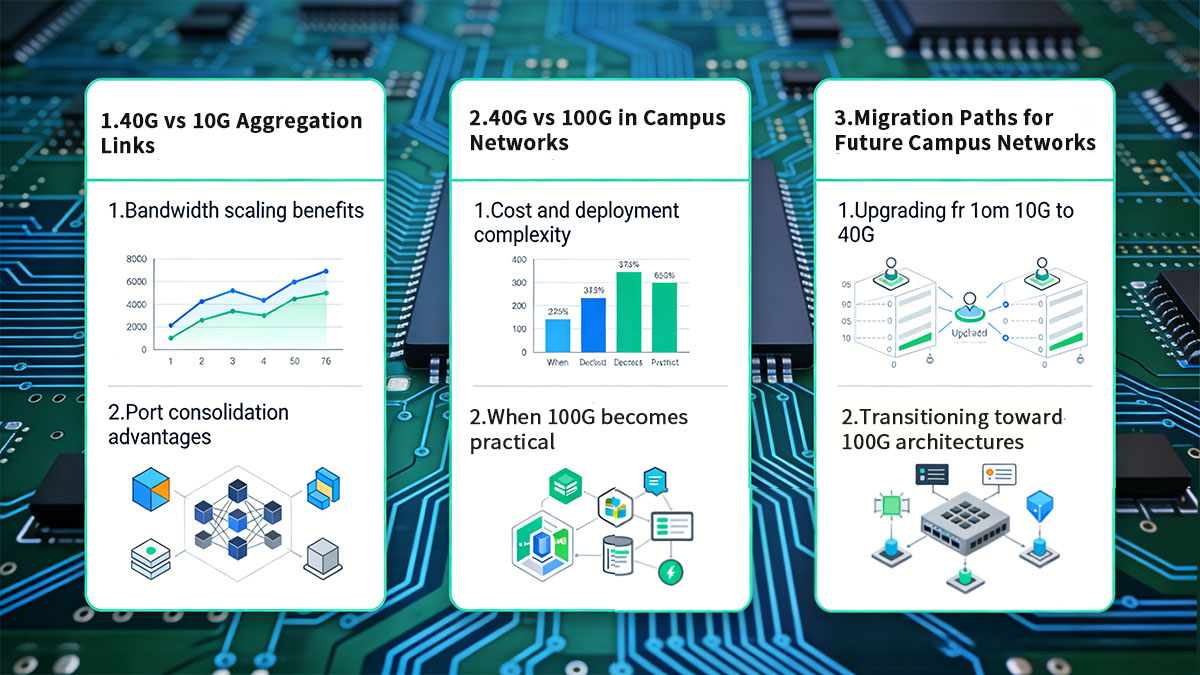
40G CSR4 is generally preferred over multiple 10G links when higher bandwidth and simplified infrastructure are required.
| Aspect |
10G Aggregation |
40G CSR4 |
| Bandwidth Scaling |
Incremental (per link) |
Consolidated (single link) |
| Port Consumption |
High |
Lower |
| Cabling Complexity |
More fibers and ports |
Fewer connections |
| Management |
More interfaces to manage |
Simplified |
Using CSR4 reduces the number of physical links and switch ports, which simplifies network design and improves operational efficiency, especially in aggregation layers.
40G vs 100G in Campus Networks
CSR4 remains relevant in many campus environments where 100G QSFP28 deployment may not yet be necessary or cost-effective.
| Aspect |
40G CSR4 |
100G (e.g., SR4/LR4) |
| Typical Use |
Aggregation / Core |
Core / Data center |
| Cost Level |
Moderate |
Higher |
| Power Consumption |
Lower |
Higher |
| Deployment |
Simpler (MMF-based) |
More complex |
While 100G transceivers provide higher capacity, it often requires more advanced infrastructure and higher investment. CSR4 is suitable when 40G bandwidth meets current and near-term requirements.
Migration Paths for Future Campus Networks
CSR4 can serve as a transitional technology in campus networks evolving from 10G to higher-speed architectures.
This staged approach allows organizations to balance performance improvements with cost control, while maintaining compatibility with existing campus network designs.
? Deployment Best Practices for CSR4 Cisco Equivalent Modules
Effective deployment of CSR4 Cisco equivalent modules requires careful planning, accurate fiber infrastructure alignment, and validation of compatibility across network devices. Following best practices helps ensure stable 40G performance, reduces troubleshooting complexity, and supports long-term scalability in campus networks.
Network Planning Recommendations
A successful CSR4 deployment starts with aligning link requirements, fiber infrastructure, and switch capabilities.
-
Evaluate link distances to confirm they fall within CSR4 limits (OM3 or OM4)
-
Identify existing fiber types and MPO cabling availability
-
Verify that switches support QSFP+ 40G interfaces
-
Ensure port density and topology match bandwidth requirements
| Planning Factor |
Key Consideration |
Impact on Deployment |
| Link Distance |
Within 300–400m |
Determines feasibility |
| Fiber Type |
OM3 or OM4 |
Affects signal quality |
| Switch Interface |
QSFP+ support |
Ensures compatibility |
| Topology Design |
Aggregation/Core alignment |
Impacts scalability |
Accurate planning reduces the risk of mismatched components and ensures that CSR4 links operate within optimal conditions.
Avoiding Common Deployment Issues
Most CSR4 deployment problems are related to fiber connectivity or compatibility mismatches rather than hardware defects.
-
MPO polarity mismatch leading to failed links
-
Incorrect fiber type limiting achievable distance
-
Dirty or damaged connectors causing signal loss
-
Incompatible firmware or unsupported modules
| Issue Type |
Root Cause |
Prevention Method |
| Link Failure |
MPO polarity error |
Verify polarity before install |
| Short Reach |
Wrong fiber type |
Confirm OM3/OM4 usage |
| Signal Loss |
Contaminated connectors |
Clean and inspect fibers |
| Module Rejection |
Compatibility mismatch |
Validate switch support |
Addressing these factors during installation significantly reduces deployment delays and improves overall network reliability.
Ensuring Long-Term Network Scalability
CSR4 deployments should be designed with future expansion in mind, especially as campus networks continue to evolve toward higher bandwidth requirements.
-
Use structured MPO cabling to support future upgrades
-
Standardize on compatible optical module types across the network
-
Maintain spare modules for rapid replacement
-
Design aggregation layers to accommodate future 100G migration
Planning for scalability ensures that current CSR4 deployments remain relevant as network demands grow, while minimizing the need for major infrastructure changes in the future.
? FAQs
What is the main advantage of CSR4 over other 40G multimode optics?
CSR4 provides longer transmission distance over multimode fiber compared to standard SR4 transceiver, making it more suitable for campus links that extend beyond typical data center ranges.
Do CSR4 modules require special fiber infrastructure?
CSR4 requires MPO-based multimode fiber infrastructure, typically using OM3 or OM4 fiber with proper polarity and parallel fiber alignment.
Can CSR4 modules be used for switch stacking?
Yes. CSR4 is commonly used for high-bandwidth switch stacking or virtual chassis links where low latency and high throughput are required.
Are Cisco equivalent CSR4 modules hot-swappable?
Most CSR4 modules, including Cisco-compatible versions, support hot-swapping, allowing installation or replacement without shutting down the switch.
How many fibers are used in a CSR4 connection?
CSR4 40G transceiver typically uses 8 active fibers (4 transmit and 4 receive) within an MPO-12 connector, while the remaining fibers are unused.
Is CSR4 suitable for long-distance campus links?
CSR4 is designed for short- to medium-distance links. For distances beyond 400m, single-mode solutions such as LR4 are generally more appropriate.
? Conclusion
CSR4 pluggable optical modules provide a practical and efficient solution for delivering 40Gbps connectivity across campus networks, especially where multimode fiber infrastructure is already in place. By extending the reach beyond standard SR4 while avoiding the complexity of single-mode solutions, CSR4 enables stable, high-capacity links for aggregation and core layers. Cisco equivalent CSR4 modules further enhance this value by offering interoperability with Cisco platforms while maintaining flexibility in deployment and cost control.
When combined with proper fiber planning, compatibility validation, and structured deployment practices, CSR4 technology can support both current bandwidth demands and future network evolution. For organizations looking to optimize their campus network infrastructure with reliable and scalable 40G solutions, exploring compatible CSR4 modules through the LINK-PP Official Store can provide a practical starting point for evaluation and deployment.