





























10GBASE-X is one of the foundational physical layer (PHY) standards defined for 10 Gigabit Ethernet. Although it has been largely superseded by 10GBASE-R in modern optical networks, 10GBASE-X remains relevant in certain backplane, ASIC, and legacy system applications. Understanding its architecture, encoding, and deployment scenarios provides valuable context for network engineers managing hybrid-speed infrastructures or maintaining existing 10GbE links.
This article explores the technical structure, standards, and real-world uses of 10GBASE-X. It compares 10GBASE-X with other 10GbE PHY types, highlights performance and reliability considerations, and outlines how the standard continues to influence network design. By examining these aspects, readers will gain a comprehensive understanding of where 10GBASE-X fits in today’s optical networking landscape.
? Introduction to 10GBASE-X
10GBASE-X is an early 10 Gigabit Ethernet PHY standard defined under IEEE 802.3, designed to extend the principles of 1000BASE-X into the 10Gbps domain. Its architecture reflects a balance between leveraging proven multi-lane parallel signaling techniques and meeting the high-speed requirements of early 10GbE networks. While modern optical networks predominantly use 10GBASE-R, understanding 10GBASE-X provides essential insight into the evolution of high-speed Ethernet PHYs, especially in backplane, ASIC, and legacy environments.

What is 10GBASE-X
10GBASE-X uses 8b/10b encoding to ensure DC balance and reliable data transmission across multi-lane interfaces. Each lane operates at approximately 3.125Gbps, typically aggregated through a four-lane XAUI (10 Gigabit Attachment Unit Interface) configuration to achieve the full 10Gbps throughput. This multi-lane approach simplifies clock recovery and signal alignment while maintaining error detection capabilities at the physical layer.
The key characteristics of 10GBASE-X include:
- Multi-lane parallel transmission via XAUI
- 8b/10b encoding with roughly 25% overhead
- Deterministic signaling that supports DC balance and error detection
These features make 10GBASE-X well-suited for early high-speed network backplanes and internal system connections, though they limit efficiency compared with modern serial PHYs.
Role in the 10GbE PHY Family
10GBASE-X is part of the broader 10GbE PHY family, which also includes 10GBASE-R and 10GBASE-W. While 10GBASE-R introduced 64b/66b serial encoding to improve efficiency and reduce overhead, 10GBASE-X remained relevant for internal system connections that leveraged existing parallel architectures. 10GBASE-W, in contrast, adapted the serial PHY for WAN compatibility, adding SONET/SDH framing.
| PHY Type | Encoding | Architecture | Primary Use Case |
|---|---|---|---|
| 10GBASE-X | 8b/10b | Multi-lane (XAUI) | Backplanes, ASICs, legacy systems |
| 10GBASE-R | 64b/66b | Serial | Modern SFP+ optical networks |
| 10GBASE-W | 64b/66b + WAN framing | Serial | Telecom WAN links |
This comparison clarifies the technical distinctions and illustrates why 10GBASE-X, while largely superseded, remains relevant in certain specialized scenarios.
Why 10GBASE-X Still Matters
Even though contemporary optical modules (SR optics, LR optics, ER optics) are based on 10GBASE-R, 10GBASE-X continues to influence network design decisions. Its multi-lane parallel architecture forms the foundation for understanding lane alignment, clock recovery, and error detection in high-speed Ethernet. For engineers maintaining legacy infrastructure or integrating hybrid-speed networks, knowledge of 10GBASE-X ensures proper module selection, compatibility assessment, and troubleshooting.
10GBASE-X’s historical significance and continued presence in backplanes, ASICs, and hybrid network links make it an essential component in understanding the evolution of 10GbE PHY standards and their practical applications.
? Core Architecture of 10GBASE-X PHY
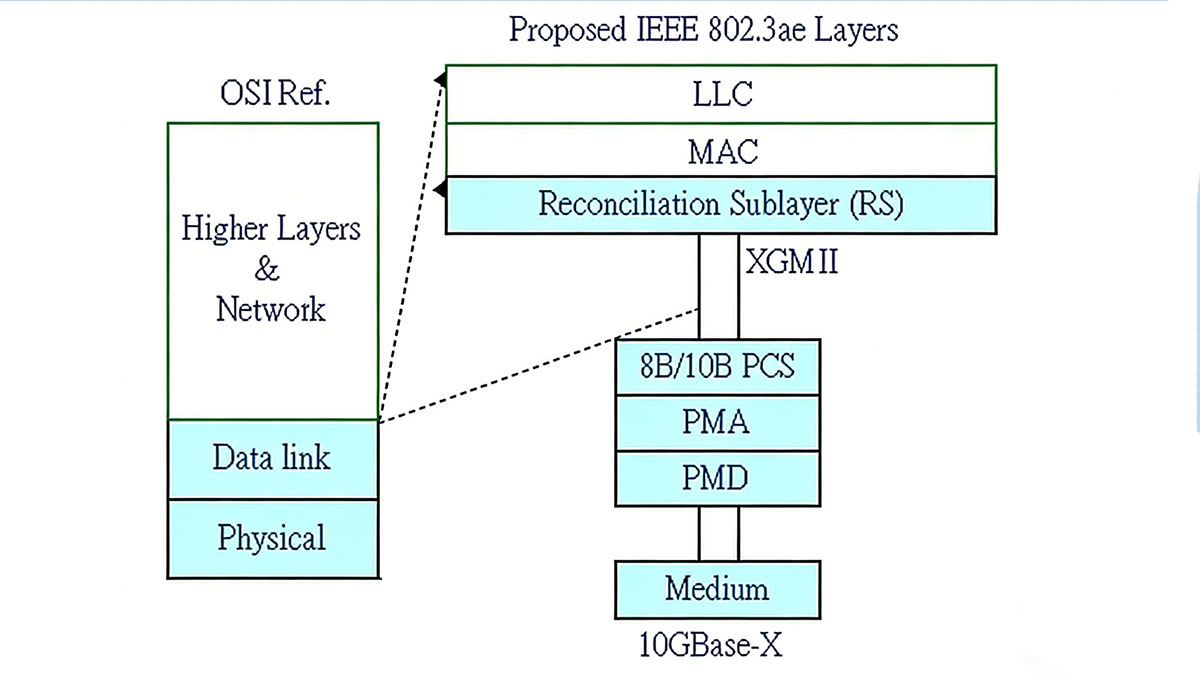
The 10GBASE-X PHY architecture is designed to deliver 10Gbps data rates over parallel lanes while maintaining signal integrity and error detection. Its layered structure divides responsibilities across the Physical Coding Sublayer (PCS), Physical Medium Attachment (PMA), and Physical Medium Dependent (PMD) layer, enabling predictable performance in early 10GbE deployments.
PCS Layer and 8b/10b Encoding
At the PCS layer, 10GBASE-X employs 8b/10b encoding, which maps 8-bit data blocks into 10-bit transmission characters. This encoding scheme ensures a balanced number of ones and zeros, providing DC balance and sufficient transitions for clock recovery.
The main benefits include:
- Reliable error detection at the physical layer
- Simplified clock alignment across multiple lanes
- Deterministic signal behavior for backplane and short-reach optical links
The primary limitation is efficiency. With 25% overhead, effective throughput is lower than newer 64b/66b serial PHYs, which have only 3% overhead.
PMA Layer and Multi-Lane Alignment
The PMA layer manages the physical transmission across four parallel lanes, each operating at roughly 3.125Gbps. XAUI serves as the interface, aggregating these lanes into the full 10Gbps throughput.
Key considerations in PMA design:
- Lane-to-lane skew must be minimized to prevent timing mismatches
- Clock recovery relies on consistent transitions provided by 8b/10b encoding
- Alignment markers are used to synchronize the aggregated lanes
This multi-lane approach allows early 10GbE links to be implemented with existing technology while providing robust error detection, although it increases hardware complexity compared to single-lane serial PHYs.
PMD Layer and Physical Medium Interaction
The PMD layer defines the actual transmission medium, whether electrical traces on a backplane or short-reach optical links. In 10GBASE-X, PMD supports both copper backplane connections and optical fibers, typically over short distances.
Considerations at the PMD layer include:
- Signal attenuation and crosstalk management in multi-lane systems
- Connector quality and optical alignment for short-reach fiber
- Compliance with reach specifications to maintain error-free operation
By clearly separating PCS, PMA, and PMD responsibilities, 10GBASE-X achieves reliable 10Gbps operation in early Ethernet networks, laying the groundwork for later improvements in serial PHYs and higher-speed standards.
? Hardware Interfaces and Module Compatibility of 10GBASE-X
10GBASE-X links rely on specific hardware interfaces and connectors that ensure reliable data transmission across backplanes, ASICs, and short-reach optical systems. Understanding these interfaces and their compatibility with modern optical and copper module is critical for maintaining performance and avoiding integration issues in hybrid networks.

Common Connectors and Backplane Interfaces
10GBASE-X commonly uses XAUI multi-lane interfaces, often implemented over copper backplane traces or CX4 connectors for short-reach links. These interfaces provide four parallel lanes, each operating at approximately 3.125Gbps, to achieve the aggregate 10Gbps throughput.
Key considerations for connectors and backplanes:
- CX4 and direct backplane traces are optimized for short-reach electrical signaling.
- Connector quality directly affects lane-to-lane skew, crosstalk, and attenuation.
- Careful design of PCB trace length and impedance is essential to maintain signal integrity across all four lanes.
Compatibility with Optical and Copper Modules
10GBASE-X can interface with early SR (short-reach) and LR (long-reach) optical transceiver, but bridging between multi-lane XAUI interfaces and modern SFP+ modules requires careful adaptation.
Compatibility factors include:
- Ensuring that PMD specifications match the intended medium (copper vs fiber).
- Using media converters or bridging modules to connect XAUI-based backplanes with serial optical SFP+ links.
- Recognizing that electrical multi-lane signals cannot always be directly connected to single-lane serial PHYs without conversion.
Integration Challenges in Modern Networks
As networks evolve, integrating legacy 10GBASE-X links with 10GBASE-R serial links or higher-speed optical modules presents practical challenges.
Common integration issues:
- Mismatched signaling protocols between multi-lane XAUI and single-lane serial interfaces.
- Cable length and power budget limitations when adapting electrical backplanes to optical links.
- Need for lane alignment verification and error monitoring when bridging mixed-speed systems.
Practical Guidelines for Engineers
To ensure reliable deployment and long-term operation of 10GBASE-X links, engineers should follow structured practices.
Recommended steps:
- Verify the PHY and PMD specifications of both the legacy XAUI interface and the optical or copper modules.
- Test lane alignment and monitor error counters on multi-lane links before production deployment.
- Maintain connector cleanliness, check PCB trace quality, and perform periodic operational testing to prevent signal degradation.
- When integrating with modern serial PHYs, plan for media converters or bridging solutions to handle electrical-to-optical adaptation.
By carefully considering hardware interfaces and module compatibility, network engineers can maintain reliable 10GBASE-X links, bridge legacy and modern systems effectively, and support hybrid network architectures with minimal disruptions.
? Comparison with Other 10GbE PHYs
10GBASE-X represents an early approach to 10 Gigabit Ethernet, but understanding its differences from other 10GbE PHYs is essential for network planning and compatibility assessment. By comparing 10GBASE-X with 10GBASE-R and 10GBASE-W, engineers can better anticipate performance, deployment scenarios, and hardware requirements.
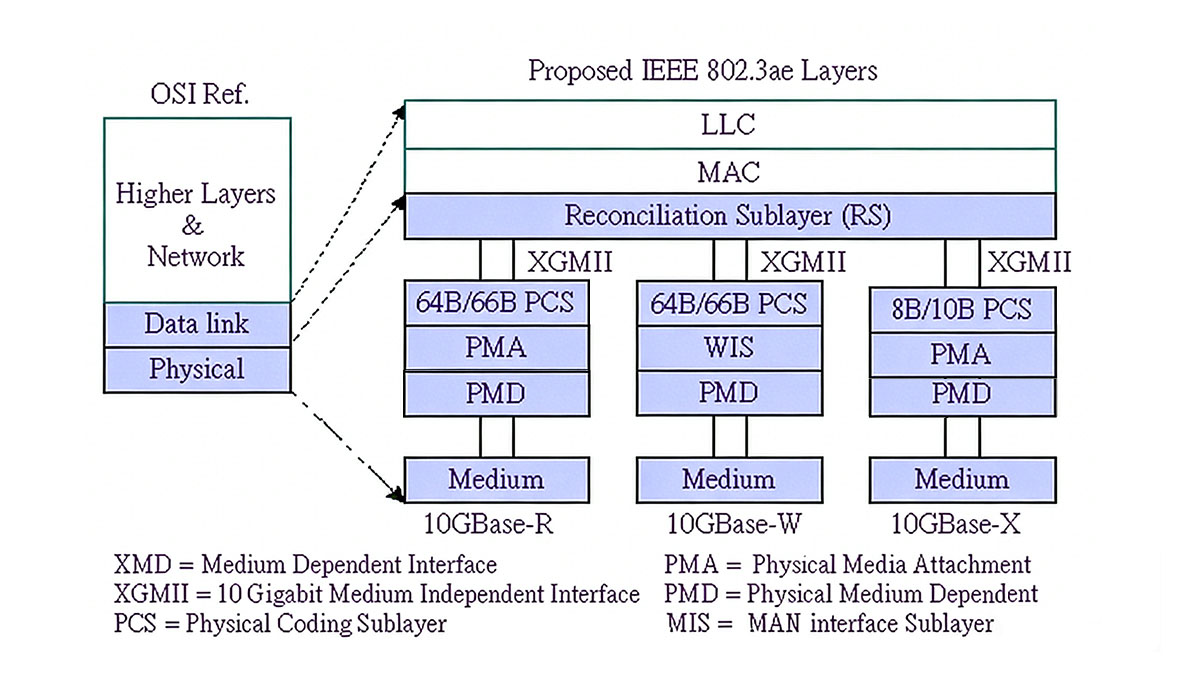
10GBASE-R vs 10GBASE-X
10GBASE-R was introduced to overcome the limitations of multi-lane parallel transmission and 8b/10b encoding used in 10GBASE-X. It uses a serial 64b/66b encoding scheme, significantly reducing overhead and increasing efficiency.
Key distinctions include:
- 10GBASE-X: Multi-lane XAUI interface, 8b/10b encoding, ~25% overhead
- 10GBASE-R: Single-lane serial interface, 64b/66b encoding, ~3% overhead
- 10GBASE-R simplifies hardware design, reduces power consumption, and enables longer optical reach in modern SFP+ deployments
10GBASE-W Overview
10GBASE-W adapts the serial PHY concept for WAN compatibility by adding SONET/SDH framing to the 64b/66b serial encoding. This enables 10GbE to operate over telecom networks while maintaining interoperability with standard Ethernet.
Characteristics of 10GBASE-W:
- WAN framing for long-distance telecom links
- Serial architecture similar to 10GBASE-R
- Higher latency due to framing overhead compared with LAN PHYs
Practical Differences for Network Engineers
| PHY Type | Encoding | Architecture | Typical Deployment | Efficiency |
|---|---|---|---|---|
| 10GBASE-X | 8b/10b | Multi-lane (XAUI) | Backplanes, ASICs, legacy systems | ~75% |
| 10GBASE-R | 64b/66b | Serial | Modern SFP+ optical networks | ~97% |
| 10GBASE-W | 64b/66b + WAN framing | Serial | Telecom WAN links | ~95% |
From this comparison, it is clear that 10GBASE-X excels in internal system connections and legacy deployments, while 10GBASE-R dominates modern optical networks due to higher efficiency and simplified serial architecture. 10GBASE-W provides specialized WAN functionality but is less common in enterprise and data center deployments.
Understanding these differences helps network engineers select the appropriate PHY type, anticipate compatibility issues, and plan gradual migration from legacy XAUI-based systems to modern serial optical infrastructures.
? Deployment Scenarios of 10GBASE-X
10GBASE-X continues to have relevance in specific network environments, particularly where multi-lane parallel transmission and backplane connectivity are required. While modern optical networks generally use 10GBASE-R, 10GBASE-X remains suitable for legacy systems, specialized backplane designs, and hybrid networks.
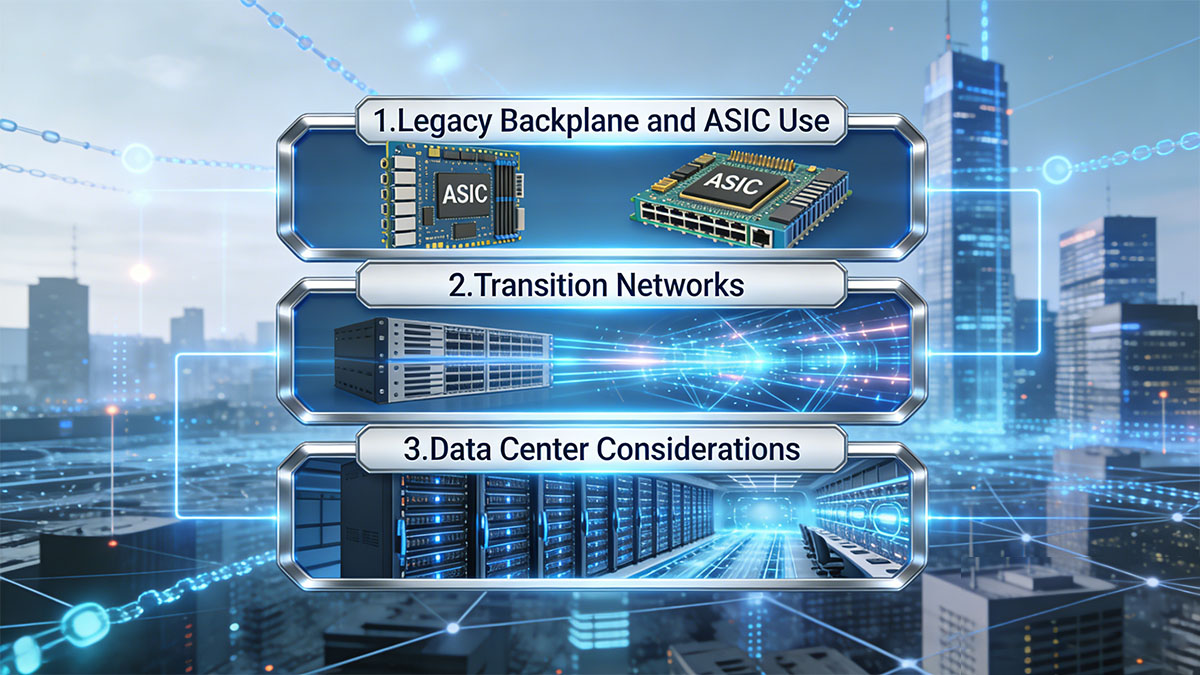
Legacy Backplane and ASIC Use
10GBASE-X is widely used in internal system connections within switches, routers, and network interface cards. Its multi-lane XAUI interface allows early 10GbE backplanes to achieve full 10Gbps throughput without relying on high-speed serial lanes.
Key points for backplane deployment:
- Four-lane XAUI interfaces aggregate to 10Gbps
- 8b/10b encoding provides DC balance and error detection
- Common in legacy ASIC and switch designs where SFP+ optics are not used
These deployments prioritize reliability and compatibility with existing hardware over raw efficiency, making 10GBASE-X a stable choice for older network infrastructures.
Transition Networks
In networks undergoing gradual upgrades, 10GBASE-X often coexists with 10GBASE-R links. Hybrid environments may include a mix of backplane XAUI connections and serial SFP+ optical links.
Best practices for hybrid deployments:
- Use media converters or bridging modules to interface XAUI-based backplanes with serial optical links
- Maintain consistent lane alignment and clock recovery for multi-lane XAUI connections
- Upgrade spine or core links first with 10GBASE-R while retaining 10GBASE-X at the access layer
This strategy allows incremental network improvements without requiring a complete overhaul of legacy hardware.
Data Center Considerations
Although modern data centers rely primarily on 10GBASE-R for SR/LR links, 10GBASE-X may still appear in short-reach optical connections or internal switch fabrics.
- Short-reach optical PMDs for intra-rack connectivity
- Edge aggregation or specialized backplane pathways
- Situations where existing multi-lane XAUI designs are already deployed
By understanding where 10GBASE-X fits in data center topologies, network engineers can optimize link placement, plan upgrades, and ensure reliable performance while minimizing disruption.
This deployment-focused perspective highlights the scenarios where 10GBASE-X remains practical, particularly in legacy, hybrid, and internal backplane environments.
? Performance and Reliability Considerations
10GBASE-X delivers robust performance in legacy and backplane network environments, but its multi-lane architecture and 8b/10b encoding introduce specific considerations for throughput, signal integrity, and operational reliability. Understanding these factors is essential for maintaining stable network performance.
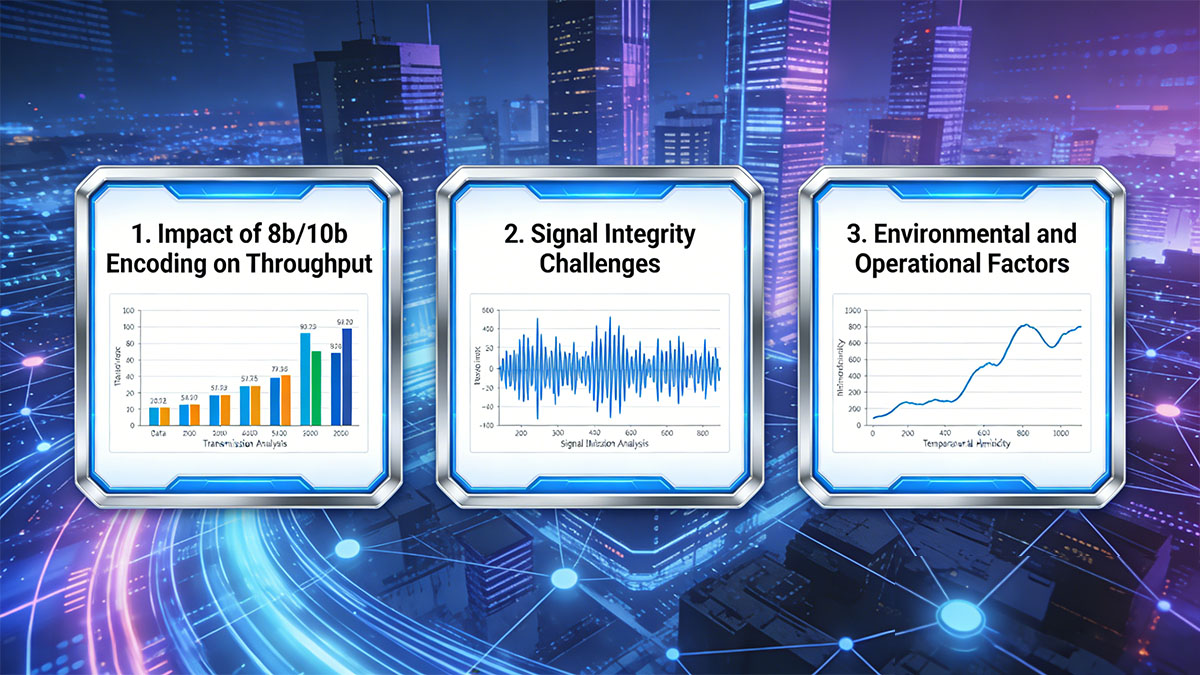
Impact of 8b/10b Encoding on Throughput
10GBASE-X uses 8b/10b encoding, which introduces approximately 25% overhead. This reduces the effective throughput compared to modern 10GBASE-R serial PHYs using 64b/66b encoding.
Key implications:
- Maximum effective data rate is about 7.5Gbps per 10Gbps aggregate link
- Network designers must account for reduced bandwidth when planning high-throughput backplanes or internal system connections
- High-efficiency applications may benefit from transitioning to 10GBASE-R in critical paths
While the overhead limits raw efficiency, 8b/10b encoding provides deterministic signaling and strong error detection, supporting reliable long-term operation in legacy systems.
Signal Integrity and Multi-Lane Challenges
The XAUI interface in 10GBASE-X aggregates four parallel lanes, each operating at 3.125Gbps. Maintaining signal integrity across these lanes is critical.
Common factors affecting reliability:
- Lane-to-lane skew can cause timing mismatches and errors
- Crosstalk between parallel lanes may degrade signal quality
- Connector quality, PCB design, and trace length influence attenuation and distortion
Proper lane alignment, controlled impedance, and high-quality materials mitigate these issues, ensuring stable operation across backplane and short-reach optical links.
Environmental and Operational Considerations
10GBASE-X links are sensitive to environmental factors due to multi-lane transmission and parallel signaling requirements.
Operational best practices include:
- Maintaining optimal operating temperature to prevent signal drift
- Ensuring adequate power supply stability for consistent lane operation
- Regular inspection of connectors and fiber for contamination or misalignment
By addressing these performance and reliability considerations, network engineers can maximize the lifespan and efficiency of 10GBASE-X links while minimizing maintenance challenges in legacy and hybrid deployments.
This analysis underscores that while 10GBASE-X is less efficient than modern serial PHYs, careful design and operational management allow it to remain a dependable choice in specialized scenarios.
? Common Challenges and Troubleshooting
Despite its robustness, 10GBASE-X presents several technical challenges that can affect performance and network reliability. Addressing these issues requires understanding the PHY’s multi-lane architecture, encoding method, and deployment constraints.
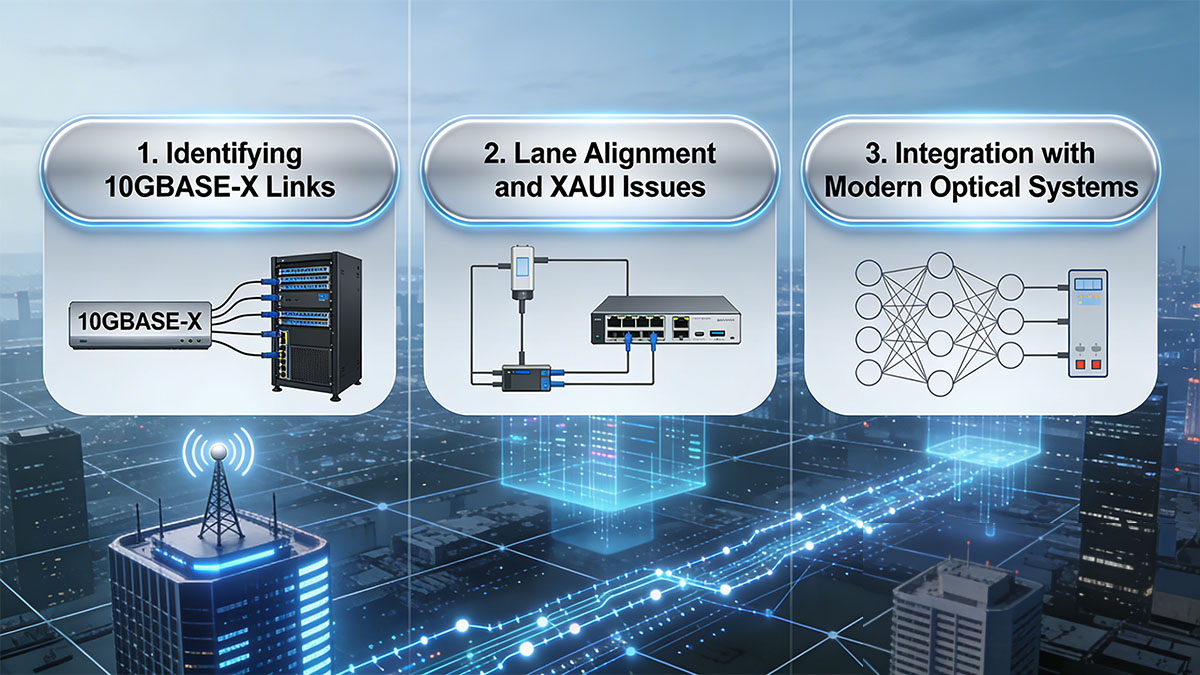
Identifying 10GBASE-X Links
A common challenge is distinguishing 10GBASE-X links from 10GBASE-R in hybrid networks, especially when older backplane connections coexist with modern SFP+ optical modules.
Indicators of 10GBASE-X deployment:
- Presence of XAUI interfaces aggregating four lanes
- Use of 8b/10b encoding instead of 64b/66b
- Short-reach optical or backplane connections typical in legacy systems
Accurate identification ensures correct fiber optic SFP module selection, avoids compatibility issues, and prevents misconfiguration that could lead to link errors.
Lane Alignment and XAUI Issues
Multi-lane aggregation can introduce skew or misalignment, causing data errors and link instability.
Troubleshooting steps:
- Check lane-to-lane skew and adjust alignment markers if supported
- Verify PCB trace lengths and signal integrity parameters
- Ensure consistent clock recovery across all four XAUI lanes
These actions help maintain stable throughput and reduce intermittent errors on parallel 10GBASE-X links.
Integration with Modern Optical Systems
Interfacing 10GBASE-X backplanes with modern 10GBASE-R SFP+ optical links may introduce compatibility challenges.
Common integration issues:
- Mismatch between multi-lane XAUI and single-lane serial interfaces
- Connector or fiber type incompatibilities for short-reach optical links
- Power budget limitations when bridging legacy and modern PHYs
Best practices for troubleshooting:
- Use media converters or bridging modules for XAUI-to-serial adaptation
- Confirm PMD specifications and fiber types match link requirements
- Monitor error counters and link stability metrics during transition or hybrid deployments
By understanding these common challenges and applying structured troubleshooting techniques, network engineers can maintain reliable 10GBASE-X links and ensure smooth integration within mixed-speed or legacy network environments.
? Future Trends of 10GBASE-X in Optical Networks
Although 10GBASE-X has largely been replaced by 10GBASE-R in modern optical networks, it continues to play a role in specific environments and informs future network design considerations. Its legacy in multi-lane backplanes, encoding schemes, and system integration provides insight into hybrid and edge network evolution.
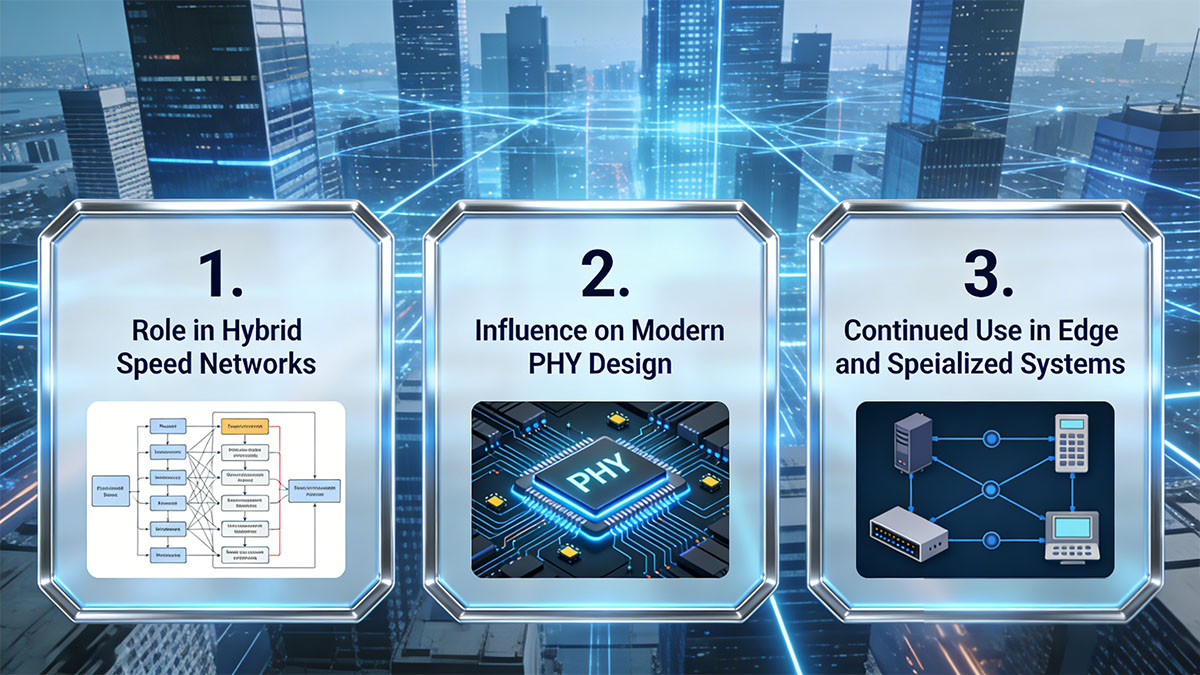
Role in Hybrid Speed Networks
10GBASE-X often coexists with higher-speed technologies such as 25GBASE, 40GBASE, and 100GBASE in hybrid network deployments.
Key trends include:
- Maintaining legacy XAUI backplanes while upgrading core links to 10GBASE-R or higher
- Gradual migration strategies where 10GBASE-X remains at access or edge layers
- Hybrid topologies that combine multi-lane and serial PHYs for incremental upgrades
This coexistence allows enterprises and data centers to optimize capital expenditure while transitioning to modern serial-based architectures.
Influence on Modern PHY Design and Efficiency
The principles of 10GBASE-X continue to inform next-generation PHY and network design.
Areas of influence:
- Multi-lane alignment and error detection methods inspire current high-speed designs
- Lessons from 8b/10b encoding support efficient clock recovery and DC balance in new encoding schemes
- Energy-efficient Ethernet developments draw from operational experience in legacy PHYs
While 10GBASE-X itself is less efficient than serial PHYs, its design legacy contributes to the evolution of high-speed, low-power optical networking solutions.
Continued Use in Edge and Specialized Systems
10GBASE-X maintains relevance in edge, backplane, and specialized environments.
Reasons for continued use:
- Cost-performance balance for legacy systems where upgrades are not immediately required
- Long lifecycle in enterprise or industrial deployments that prioritize stability over maximum throughput
- Support for backplane and ASIC designs where XAUI multi-lane architecture remains standard
In summary, 10GBASE-X will persist in niche applications and legacy infrastructures, while providing foundational knowledge for hybrid-speed networks and the design of next-generation optical PHYs. Its continued presence underscores the importance of understanding legacy architectures when planning network evolution.
? FAQs About 10GBASE-X
What is 10GBASE-X and where is it used?
10GBASE-X is an early 10 Gigabit Ethernet PHY standard using 8b/10b encoding and a multi-lane XAUI interface. It is primarily used in backplanes, ASICs, and legacy network systems.
How does 10GBASE-X differ from 10GBASE-R?
10GBASE-X uses parallel lanes with 8b/10b encoding, while 10GBASE-R employs a single-lane serial interface with 64b/66b encoding for higher efficiency and lower overhead.
Can 10GBASE-X coexist with modern optical links?
Yes, it can operate in hybrid networks, often using media converters or bridging modules to interface with SFP+ or serial optical links.
What are the main limitations of 10GBASE-X?
The primary limitations are 25% encoding overhead, multi-lane complexity, and shorter reach compared to modern serial PHYs like 10GBASE-R.
Is 10GBASE-X still relevant today?
While largely replaced by 10GBASE-R in modern optical networks, 10GBASE-X remains relevant for legacy backplane, edge systems, and specialized multi-lane applications.
Which network components typically support 10GBASE-X?
Switch backplanes, router ASICs, and some legacy NICs commonly implement 10GBASE-X for internal high-speed connections.
How does 10GBASE-X handle error detection?
8b/10b encoding provides DC balance and allows detection of single-bit and certain multi-bit errors at the physical layer.
What factors should be considered when maintaining 10GBASE-X links?
Engineers should monitor lane alignment, signal integrity, connector and fiber quality, and environmental conditions such as temperature and power stability.
? Conclusion
10GBASE-X remains an important part of the 10 Gigabit Ethernet landscape, particularly in legacy backplane, ASIC, and specialized network deployments. Its multi-lane XAUI architecture and 8b/10b encoding provide reliable error detection and deterministic signaling, making it suitable for internal system connections and short-reach optical links. While modern networks largely rely on 10GBASE-R for higher efficiency and serial transmission, understanding 10GBASE-X is essential for managing hybrid-speed networks, maintaining legacy systems, and planning incremental infrastructure upgrades.
For engineers and network designers seeking compatible SFP modules, technical specifications, or guidance for integrating 10GBASE-X with modern optical networks, the LINK-PP Official Store offers a wide selection of reliable solutions to support both legacy and hybrid network environments.