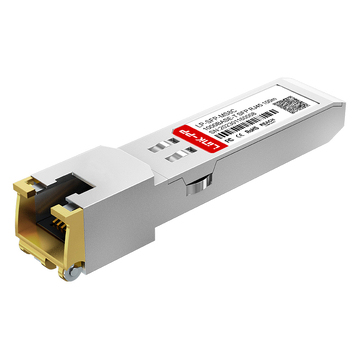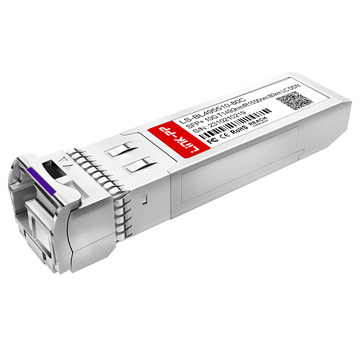
The demand for higher-speed data transmission continues to grow as enterprises and data centers expand their networks. Traditional dual-fiber solutions often require additional cabling and infrastructure, which can increase costs and complicate deployment. To address these challenges, single-fiber bidirectional (BiDi) transceivers have become increasingly popular for optimizing fiber usage while maintaining reliable 10G connectivity.
Among these solutions, the SFP-10G-BXD-I stands out as a Cisco-compatible 10G BiDi module designed for single-mode fiber. It operates using complementary wavelengths—1330nm for transmit and 1270nm for receive—allowing data to flow in both directions over a single fiber. Understanding the correct pairing and deployment of these modules is crucial for network stability and performance, especially in environments with dense fiber infrastructure.
This article provides a comprehensive guide to SFP-10G-BXD-I, covering its technical specifications, 1330/1270nm BiDi pairing logic, Cisco compatibility, deployment scenarios, cabling considerations, performance factors, and troubleshooting tips. By the end of this guide, you will gain practical insights into selecting, implementing, and maintaining SFP-10G-BXD-I modules for reliable 10G single-fiber links.
? Understanding SFP-10G-BXD-I Technology
The SFP-10G-BXD-I is a high-performance 10G bidirectional optical transceiver designed for single-fiber networks. Its primary advantage lies in enabling two-way data transmission over a single optical fiber, reducing cabling complexity and infrastructure costs while maintaining 10Gbps speeds. These modules are particularly suited for enterprise networks, campus backbones, and data center interconnects where fiber availability may be limited.
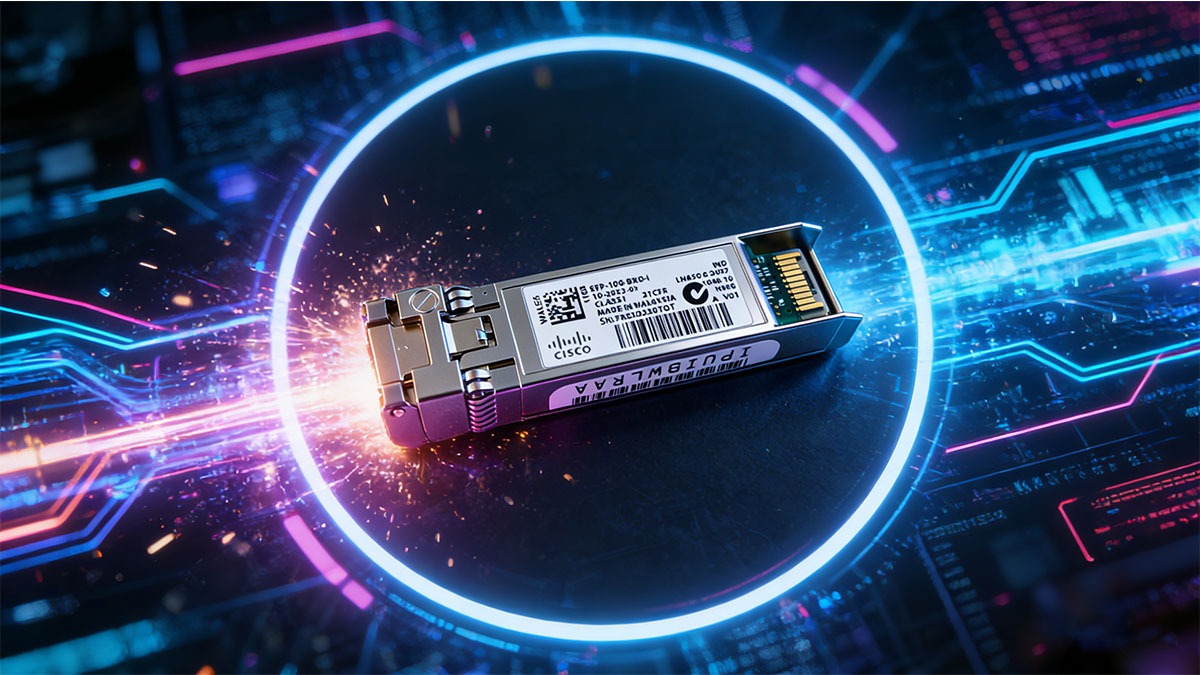
What Is SFP-10G-BXD-I?
SFP-10G-BXD-I is a small form-factor pluggable (SFP+) transceiver that supports 10Gbps data rates on single-mode fiber. It uses bidirectional transmission, meaning that one fiber carries signals in both directions simultaneously. This is achieved through two complementary wavelengths: typically, 1330nm for transmission (TX) and 1270nm for reception (RX).
Key specifications include:
| Specification | Value |
|---|---|
| Data Rate | 10Gbps |
| Fiber Type | Single-mode (SMF) |
| Maximum Reach | 10km |
| Wavelengths | 1330nm TX / 1270nm RX |
| Connector | LC duplex |
| Operating Temp | 0°C to 70°C (commercial) / -40°C to 85°C (industrial) |
These specifications make SFP-10G-BXD-I suitable for medium-distance single-fiber deployments without requiring dual fibers, which simplifies network cabling and reduces fiber management challenges.
How BiDi Transmission Works
Bidirectional (BiDi) transmission relies on Wavelength Division Multiplexing (WDM) technology. Each transceiver transmits and receives signals simultaneously but on different wavelengths. This allows a single fiber to handle traffic in both directions, effectively doubling the utility of existing fiber infrastructure.
The core concept is:
- TX (transmit) wavelength of one module matches RX (receive) wavelength of the opposite module.
- RX wavelength of one module corresponds to TX wavelength on the other end.
- Optical signals are combined and separated using WDM filters inside the module, ensuring minimal interference.
This mechanism allows SFP-10G-BXD-I to maintain full-duplex 10Gbps communication over a single fiber, making it highly efficient in environments where fiber quantity is constrained.
Advantages Over Traditional Dual-Fiber Optics
Compared to conventional dual-fiber SFP+ modules, SFP-10G-BXD-I offers several benefits:
- Reduced fiber usage: Only one fiber is required for bidirectional communication.
- Simplified cabling infrastructure: Less physical cabling means easier installation, management, and troubleshooting.
- Enhanced scalability: Networks can expand without adding extra fiber, saving on both space and cost.
In practice, these advantages make SFP-10G-BXD-I ideal for network upgrades where existing fiber is limited or in high-density switch environments where reducing cable congestion is critical.
? 1330/1270nm BiDi Pairing Explained
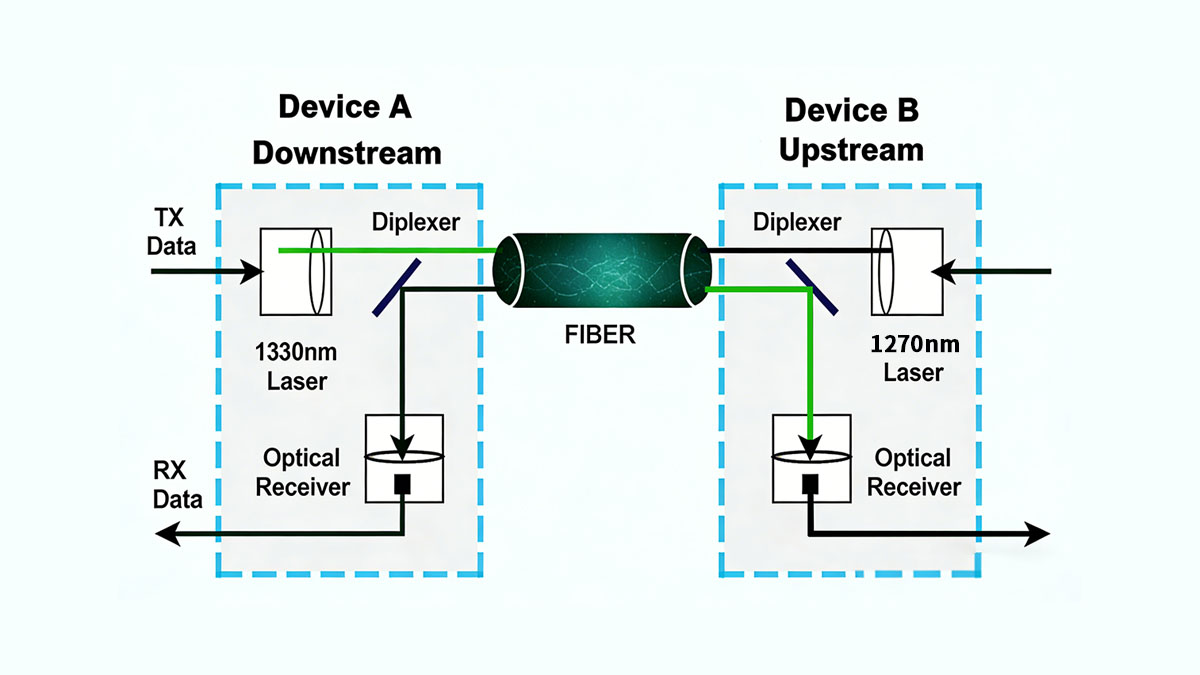
For reliable single-fiber 10G communication, correct wavelength pairing is essential. The SFP-10G-BXD-I operates at 1330nm for transmission (TX) and 1270nm for reception (RX). To establish a stable link, it must be paired with a complementary module that transmits at 1270nm and receives at 1330nm, commonly referred to as SFP-10G-BXU-I. Incorrect pairing can result in link failures, data errors, or poor signal integrity.
The Role of Complementary Wavelengths
The fundamental principle behind BiDi pairing is that each module’s transmit wavelength must match the receive wavelength of its counterpart. This ensures proper signal flow over a single fiber while avoiding collisions or interference. The 1330/1270nm wavelength split is standard in many BiDi 10G deployments, balancing performance and component availability.
Key points include:
- One fiber carries bidirectional traffic using two distinct wavelengths.
- WDM technology inside the modules separates incoming and outgoing signals.
- Complementary pairing ensures full-duplex 10Gbps communication over a single strand of fiber.
Pairing Logic in Real Deployments
To illustrate, a typical SFP-10G-BXD-I link setup consists of:
- Side A: SFP-10G-BXD-I module (1330nm TX / 1270nm RX)
- Side B: SFP-10G-BXU-I module (1270nm TX / 1330nm RX)
The diagrammatic flow can be summarized as follows:
| Module | TX Wavelength | RX Wavelength | Fiber Role |
|---|---|---|---|
| SFP-10G-BXD-I | 1330nm | 1270nm | Single fiber TX/RX |
| SFP-10G-BXU-I | 1270nm | 1330nm | Single fiber TX/RX |
By following this complementary pairing logic, the optical signals are properly transmitted and received without interference, ensuring a stable 10G link.
Common Pairing Mistakes to Avoid
Even minor misconfigurations can disrupt single-fiber BiDi links. Common errors include:
- Using two identical SFP-10G-BXD-I modules on opposite ends, resulting in both ends transmitting at 1330nm.
- Ignoring wavelength specifications when mixing modules from different vendors.
- Overlooking firmware or hardware compatibility, leading to recognition issues in Cisco switches or other networking devices.
To prevent these issues, it is critical to verify module types, wavelength assignments, and compatibility before deployment. Proper labeling and documentation of fiber optic transceivers and cables can further reduce pairing mistakes.
? Cisco Compatibility and Interoperability
SFP-10G-BXD-I modules are designed to be Cisco-compatible, meaning they can operate reliably in Cisco network environments without triggering errors or disabling ports. Ensuring compatibility is crucial for maintaining network stability and minimizing downtime, especially in enterprise and data center networks where Cisco equipment is widely deployed.

What “Cisco Compatible” Means
Being Cisco-compatible involves more than just fitting into a switch slot. The module must meet specific hardware and firmware standards:
- It should adhere to Multi-Source Agreement (MSA) standards for electrical and optical interfaces.
- EEPROM (electronic memory) coding must be recognized by Cisco devices to enable proper functionality.
- Support for Cisco-specific features like Digital Optical Monitoring (DOM) ensures that performance metrics (TX/RX power, temperature, voltage) are accurately reported.
These requirements ensure that the SFP-10G-BXD-I functions as a plug-and-play transceiver within Cisco environments while maintaining network reliability and observability.
Supported Cisco Platforms
SFP-10G-BXD-I modules are compatible with a wide range of Cisco switches and routers, particularly in enterprise and data center deployments. Typical supported platforms include:
| Platform Type | Example Models | Notes |
|---|---|---|
| Enterprise Switches | Catalyst 9300, 9400 series | Campus and branch connectivity |
| Data Center Switches | Nexus 3000, 9000 series | High-density 10GBASE/40GBASE uplinks |
| Routers | ISR 4000, ASR 1000 series | WAN or campus aggregation links |
These platforms benefit from the module’s bidirectional single-fiber design, reducing cabling complexity while enabling 10G connectivity in fiber-constrained environments.
Multi-Vendor Interoperability Considerations
While SFP-10G-BXD-I is Cisco-compatible, real-world networks often include devices from multiple vendors. To ensure reliable operation:
- Verify vendor interoperability certifications or test the module in a controlled lab environment.
- Be aware that firmware versions and DOM support can differ across platforms, potentially affecting monitoring and alerting capabilities.
- Avoid mixing modules with similar but non-identical wavelengths from different manufacturers, which can lead to link instability.
By following these best practices, network administrators can deploy SFP-10G-BXD-I in mixed-vendor environments while maintaining high performance and reliability.
? Deployment Scenarios for SFP-10G-BXD-I
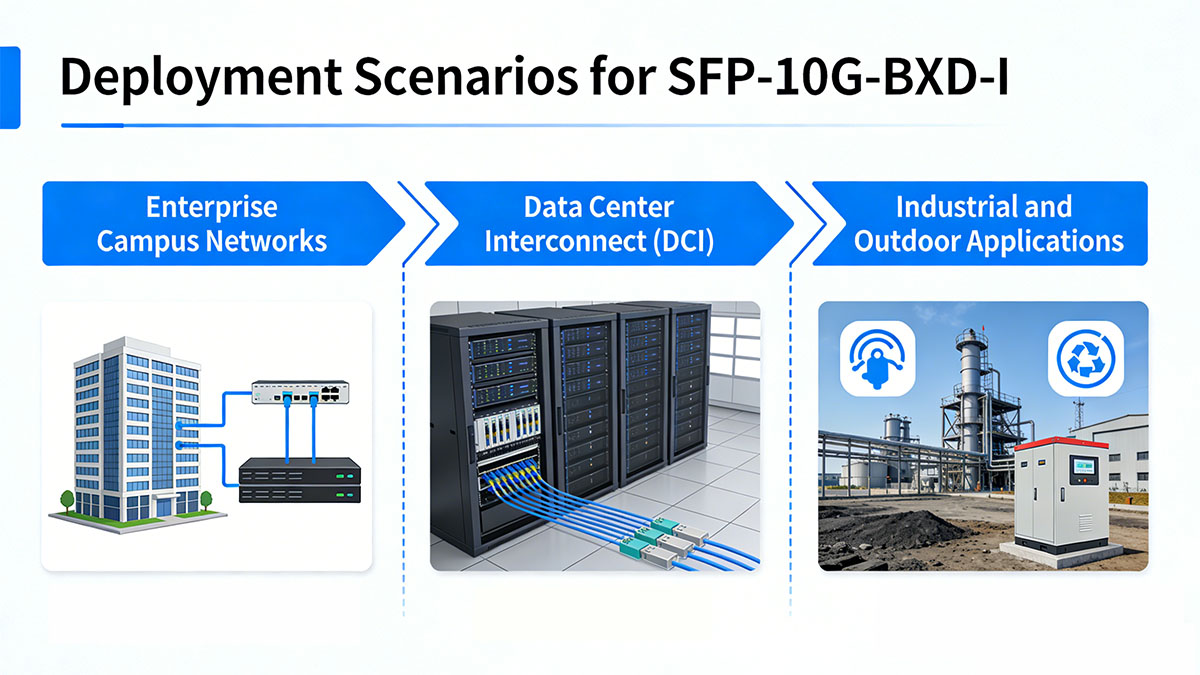
SFP-10G-BXD-I modules are highly versatile and can be deployed in various network scenarios where single-fiber connectivity and 10G bandwidth are required. Their bidirectional design and compatibility with Cisco and other networking equipment make them particularly suitable for environments with limited fiber infrastructure or high-density switch deployments.
Enterprise Campus Networks
In enterprise campus networks, SFP-10G-BXD-I modules help reduce fiber usage between buildings and network closets. Using a single fiber strand for bidirectional 10G communication simplifies cabling management and reduces the cost of fiber installation. Typical use cases include:
- Building-to-building links within a campus
- Interconnecting access and aggregation switches
- Upgrading existing fiber infrastructure without adding extra cables
These modules allow IT teams to expand network capacity while minimizing disruption to existing infrastructure.
Data Center Interconnect (DCI)
Data center environments benefit from SFP-10G-BXD-I modules due to their high-density, single-fiber deployment capabilities. They are particularly effective in scenarios such as:
- Rack-to-rack connections where fiber count is constrained
- Connecting top-of-rack (ToR) switches to aggregation layers
- Linking geographically close data centers with minimal cabling
The single-fiber BiDi design allows data centers to optimize space in cable trays and reduce management complexity.
Industrial and Outdoor Applications
SFP-10G-BXD-I modules are also suitable for industrial environments or outdoor deployments where environmental factors may challenge network stability. Key considerations include:
- Operation in industrial temperature ranges for outdoor or harsh environments
- Long-distance single-fiber links for facilities separated by several kilometers
- Stable performance in applications such as factory automation, transportation networks, and campus surveillance
Their reliability and simplicity make them a preferred choice when deploying 10G connectivity in challenging conditions.
? Cabling and Infrastructure Considerations
Effective deployment of SFP-10G-BXD-I modules depends not only on the transceivers themselves but also on the supporting fiber infrastructure. Selecting the appropriate fiber type, connectors, and planning the optical link ensures optimal performance and reliability of 10G bidirectional communication.
Fiber Type Requirements
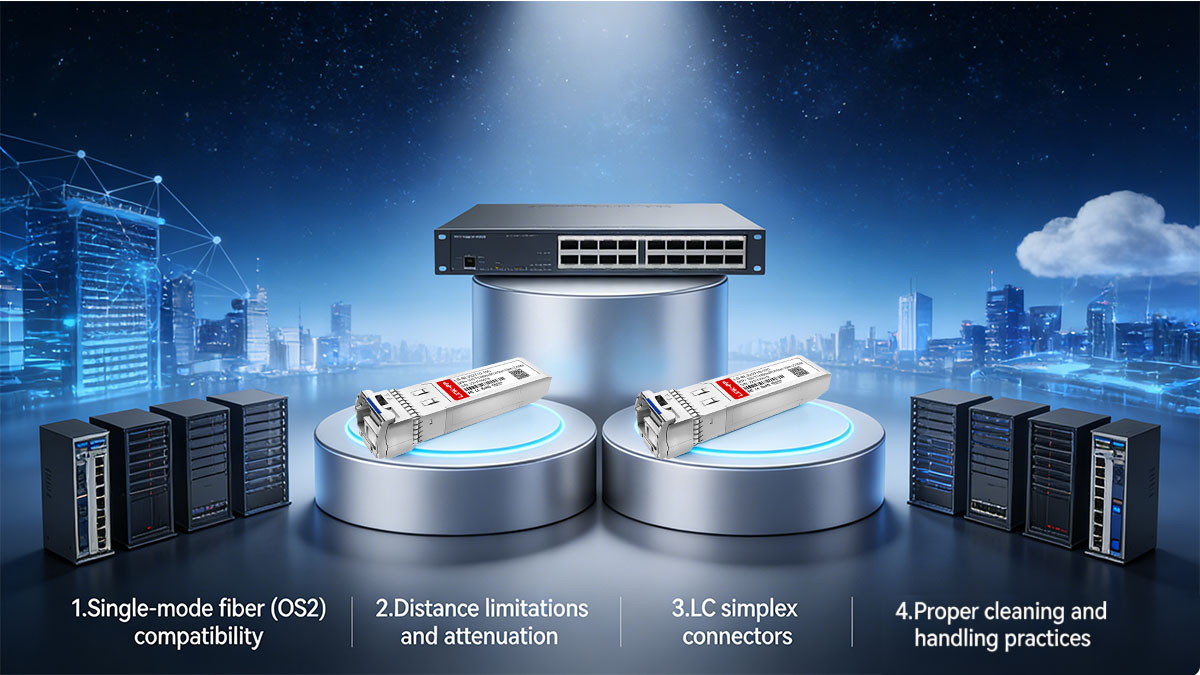
SFP-10G-BXD-I modules are designed for single-mode fiber (SMF). Using the correct fiber type is essential for achieving the specified reach and minimizing signal loss. Key considerations include:
- Fiber Standard: OS2 single-mode fiber is recommended for optimal performance.
- Maximum Reach: Typical maximum reach is 10km, but attenuation from splices, connectors, and fiber quality must be considered.
- Wavelength Compatibility: Ensure that the fiber supports 1270/1330nm wavelengths used by the bidirectional modules.
By adhering to these standards, networks can maintain low bit error rates and stable 10G links over single-fiber deployments.
Connector Types and Installation
The SFP-10G-BXD-I modules use LC duplex connectors, which are compact and widely supported in data center and enterprise environments. Proper handling and installation practices are critical:
- Clean connectors before installation to prevent signal degradation.
- Avoid bending fibers beyond their minimum bend radius to reduce loss.
- Use cable management systems to prevent physical stress and tangling.
Well-maintained connectors and proper fiber routing contribute to long-term stability and reduce maintenance issues.
Optical Budget and Link Planning
Calculating the optical power budget ensures that the transceiver can reliably transmit and receive signals across the entire link. Important factors include:
| Parameter | Consideration |
|---|---|
| Transmitter Power (TX) | Must be sufficient to overcome fiber attenuation over link distance |
| Receiver Sensitivity (RX) | Determines minimum signal strength required for error-free communication |
| Fiber Loss | Includes splice, connector, and inherent fiber attenuation |
| Safety Margin | Typically 2–3 dB to account for future fiber degradation or additional connectors |
When planning a link, engineers should sum the expected fiber loss and compare it against the optical budget of the SFP-10G-BXD-I modules. Maintaining a positive margin ensures reliable communication and reduces the risk of intermittent errors.
? Performance and Reliability Factors
SFP-10G-BXD-I modules provide reliable 10G single-fiber connectivity, but performance depends on multiple factors including module health, environmental conditions, and signal integrity. Understanding these factors ensures that the network operates consistently at high speeds and minimizes downtime.
Digital Optical Monitoring (DOM)
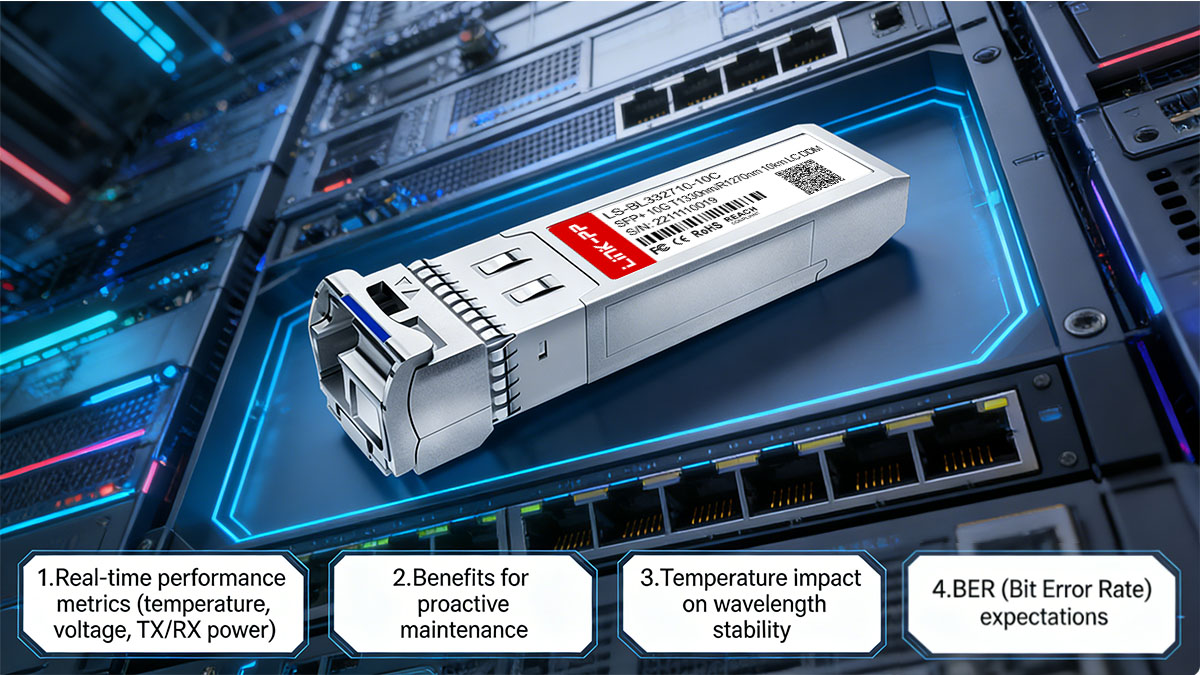
Digital Optical Monitoring (DOM) allows network administrators to track real-time performance metrics of SFP-10G-BXD-I modules. Modules with DOM support can report:
- Transmit power (TX)
- Receive power (RX)
- Module temperature
- Supply voltage
The ability to monitor these metrics helps proactively identify potential issues before they affect the link. For example, a declining RX power could indicate fiber degradation, misalignment, or dirty connectors. Regular monitoring ensures high reliability in critical enterprise and data center environments.
Environmental and Thermal Stability
SFP-10G-BXD-I modules are designed to maintain performance across a range of temperatures. Environmental considerations include:
- Commercial-grade modules typically operate between 0°C and 70°C.
- Industrial-grade modules can function between -40°C and 85°C, suitable for outdoor or harsh environments.
- Thermal fluctuations can affect wavelength stability; selecting modules rated for the deployment environment prevents signal drift and link errors.
Proper environmental planning, including adequate airflow in data centers and protection from extreme temperatures outdoors, enhances module reliability and lifespan.
Signal Integrity and Error Rates
Maintaining low bit error rates (BER) is critical for 10G single-fiber links. Factors affecting signal integrity include:
- Fiber quality, length, and splices
- Connector cleanliness and alignment
- Proper wavelength pairing (1330/1270nm)
Engineers should verify that link budget calculations account for all losses and maintain a safety margin to prevent intermittent errors. Routine testing with optical power meters and BER testers ensures that SFP-10G-BXD-I modules perform within specifications.
| Factor | Impact on Performance | Recommended Action |
|---|---|---|
| TX/RX Power | Low signal strength reduces reliability | Monitor DOM, clean connectors |
| Temperature | Excessive heat or cold can shift wavelengths | Use industrial-grade modules if needed |
| Fiber Attenuation | Excessive loss causes errors | Check splices, maintain proper fiber routing |
| Connector Quality | Dirty or misaligned connectors degrade signal | Regular cleaning and inspection |
By understanding and managing these factors, network administrators can maintain stable, high-speed 10G connectivity over single-fiber links.
? Common Challenges and Troubleshooting
SFP-10G-BXD-I modules provide efficient single-fiber 10G connectivity, but practical deployments can encounter several challenges. Understanding these issues and how to address them ensures stable network operation and minimizes downtime.
Link Failure Due to Incorrect Pairing
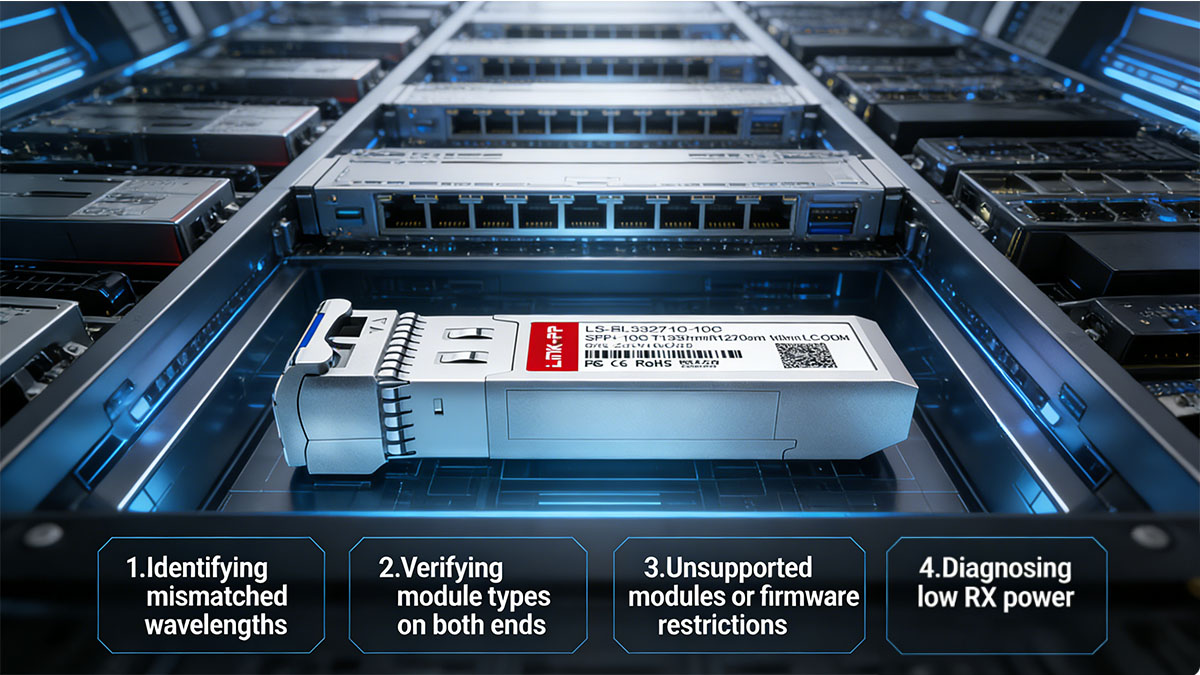
The most frequent cause of a link failure is incorrect wavelength pairing. If two identical modules are installed on opposite ends of a fiber link, both ends transmit at the same wavelength, preventing successful communication.
To prevent this, network engineers should:
- Verify that each end of the link has complementary modules (SFP-10G-BXD-I paired with SFP-10G-BXU-I).
- Ensure TX and RX wavelengths match correctly.
- Label modules and fiber strands to avoid confusion during maintenance or upgrades.
These checks ensure that bidirectional communication is established and maintained over a single fiber.
Compatibility and Recognition Issues
Even modules labeled as Cisco-compatible can face recognition problems if firmware or EEPROM settings are mismatched. Symptoms may include ports remaining inactive or the switch reporting an unsupported transceiver.
To address these issues:
- Confirm the switch firmware supports the SFP-10G-BXD-I module.
- Test modules in a lab or non-critical environment before production deployment.
- Use network management tools to verify proper module detection and DOM reporting.
Implementing these steps reduces the risk of operational disruptions caused by compatibility problems.
Optical Power and Distance Problems
Low optical power or excessive link length can degrade signal integrity, causing intermittent errors or dropped connections. Common contributing factors include fiber attenuation, dirty or misaligned connectors, and excessive distance.
Before presenting structured solutions, it is important to summarize the key parameters affecting signal reliability. The following table provides a concise overview of the main challenges, their possible causes, and recommended solutions for SFP-10G-BXD-I deployments:
| Challenge | Possible Cause | Recommended Solution |
|---|---|---|
| Link failure | Incorrect wavelength pairing | Verify complementary modules and document setup |
| Port not recognizing module | EEPROM/firmware mismatch | Update firmware, test in lab |
| Low RX power / intermittent errors | Fiber loss, dirty connectors, excessive distance | Measure optical power, clean connectors, recalculate budget |
| Environmental instability | Temperature fluctuations affecting module | Use industrial-grade modules and ensure proper airflow |
This table serves as a practical reference for network engineers, providing clear guidance on troubleshooting and maintaining SFP-10G-BXD-I links. By following these recommendations, administrators can minimize downtime and ensure reliable 10G connectivity over single-fiber deployments.
? Best Practices for Selecting and Using SFP-10G-BXD-I
Proper selection, deployment, and maintenance of SFP-10G-BXD-I modules are critical to ensure reliable single-fiber 10G performance. Following best practices helps avoid common issues, maximize link stability, and extend module lifespan.
Ensuring Correct Pairing Before Deployment
Correct wavelength pairing is fundamental for successful bidirectional communication. Deploying mismatched modules can result in link failure, data errors, or inconsistent connectivity.
Key strategies include:
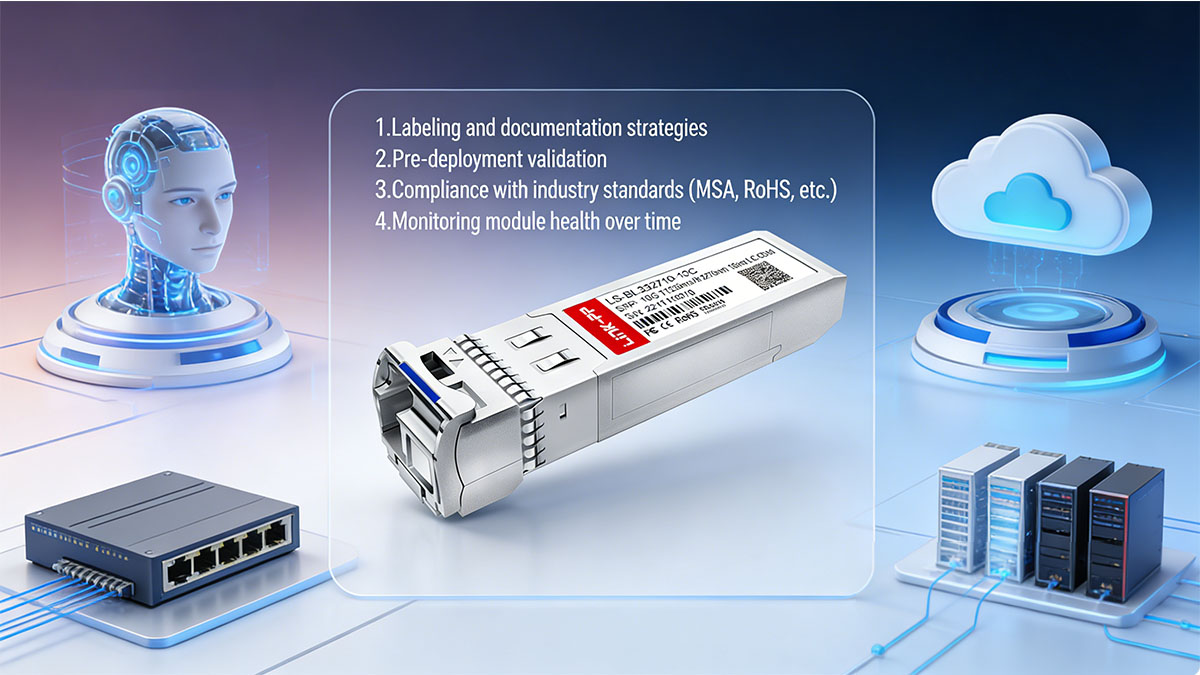
- Labeling and documentation strategies to clearly identify TX and RX wavelengths on each fiber strand.
- Pre-deployment validation by testing each module pair in a controlled environment to ensure proper communication before production deployment.
To provide a more structured overview, the following table summarizes practical steps to ensure correct pairing:
| Task | Recommended Action | Benefit |
|---|---|---|
| Labeling | Mark TX/RX wavelengths on each module and fiber | Reduces misconnection errors |
| Documentation | Maintain deployment records with module types and link locations | Simplifies maintenance and troubleshooting |
| Pre-deployment Testing | Verify link performance in lab setup | Ensures stable 10G operation |
Adhering to these practices ensures that bidirectional links function correctly from the outset, reducing the risk of deployment-related failures.
Choosing Reliable Compatible Modules
Selecting high-quality, compatible SFP-10G-BXD-I modules is essential for network reliability. Modules must meet Cisco compatibility requirements while conforming to industry standards.
Considerations include:
- Importance of quality assurance and testing: Choose modules from vendors with rigorous QA processes to minimize defects and ensure long-term reliability.
- Compliance with industry standards such as Multi-Source Agreement (MSA), RoHS, and relevant optical standards, which ensures interoperability and environmental compliance.
These practices prevent recognition issues, link instability, and potential regulatory non-compliance, supporting smooth integration into enterprise and data center networks.
Maintenance and Lifecycle Management
Maintaining the health of SFP-10G-BXD-I modules over time is crucial for consistent 10G performance. Proactive lifecycle management helps anticipate failures and plan replacements effectively.
Key practices include:
- Monitoring module health over time using Digital Optical Monitoring (DOM) to track transmit/receive power, temperature, and voltage, enabling early detection of issues.
- Replacement planning and inventory control to ensure that spare modules are available for rapid swap-out in case of failure, minimizing downtime.
The following table consolidates maintenance and lifecycle recommendations:
| Maintenance Aspect | Recommended Action | Benefit |
|---|---|---|
| Health Monitoring | Use DOM to track TX/RX power, temperature, voltage | Early detection of performance degradation |
| Replacement Planning | Maintain inventory of spare modules | Minimizes downtime during failures |
| Lifecycle Management | Schedule periodic inspection and cleaning | Extends module lifespan and maintains signal integrity |
By combining careful selection, deployment validation, and structured lifecycle management, organizations can maximize the performance and reliability of SFP-10G-BXD-I modules across single-fiber 10G networks.
? Future Trends in BiDi Optical Technology
BiDi optical technology is set to play an increasingly important role in modern network deployments. Its ability to deliver high-speed single-fiber links efficiently aligns with the growing demands for bandwidth, network density, and sustainability. Understanding the emerging trends allows network planners to optimize infrastructure for future-ready operations.
Evolution Toward Higher Speeds
The demand for higher bandwidth is driving the evolution of BiDi modules beyond the current 10G standard.
Key trends include:
- Transition from 10GBASE to 25GBASE and 100GBASE BiDi solutions, enabling higher throughput without increasing fiber usage.
- Increasing adoption in modern enterprise and data center networks, particularly where fiber count is limited or rack density is high.
These developments ensure that BiDi technology remains a practical choice for scaling networks efficiently while maintaining compatibility with existing fiber infrastructure.
To illustrate the progression:
| Generation | Typical Speeds | Key Benefits |
|---|---|---|
| 10G BiDi | 10Gbps per wavelength | Efficient single-fiber links, widely deployed |
| 25G BiDi | 25Gbps per wavelength | Higher bandwidth without additional fiber |
| 100G BiDi | 4×25Gbps per fiber strand | Ultra-high density for data centers and campus backbones |
This table highlights how BiDi technology scales to meet increasing network demands while optimizing fiber usage.
Integration with Smart Network Monitoring
Future BiDi deployments will increasingly integrate intelligent network monitoring and management to improve reliability and reduce operational risk.
Key features include:
- AI-driven diagnostics and predictive maintenance, allowing proactive identification of potential failures before they impact the network.
- Enhanced Digital Optical Monitoring (DOM) analytics, providing more granular insights into TX/RX power, temperature fluctuations, and link performance trends.
By leveraging smart monitoring, organizations can ensure long-term link stability, minimize downtime, and reduce manual troubleshooting efforts.
Sustainability and Fiber Optimization
BiDi technology contributes to greener and more efficient network design by reducing infrastructure requirements.
Key benefits include:
- Reducing fiber infrastructure requirements, lowering installation costs and simplifying cabling management.
- Supporting greener data center initiatives by minimizing material usage and lowering power consumption through energy-efficient module designs.
These factors make BiDi modules an attractive solution for organizations looking to optimize both operational costs and environmental impact, particularly in large-scale or high-density deployments.
? Conclusion
SFP-10G-BXD-I modules offer a highly efficient solution for single-fiber 10G connectivity, combining Cisco compatibility, bidirectional 1330/1270nm pairing, and robust performance across diverse network environments. From enterprise campus networks to data centers and industrial applications, these modules simplify fiber management, reduce cabling costs, and maintain high-speed reliability.
Understanding the technology, deployment scenarios, cabling requirements, and performance considerations ensures that network administrators can optimize link stability and longevity. Adhering to best practices for module selection, pairing validation, and proactive maintenance further enhances network reliability and reduces operational risks.
Looking ahead, BiDi optical technology continues to evolve toward higher speeds, smarter network monitoring, and more sustainable fiber usage, making it a strategic choice for modern and future-ready networks. Organizations that leverage these advancements will benefit from optimized infrastructure, improved energy efficiency, and simplified network scaling.
For professionals seeking reliable, Cisco-compatible SFP-10G-BXD-I modules and comprehensive support, the LINK-PP Official Store provides a trusted source for high-quality optical transceivers that meet industry standards and performance requirements.