The rapid growth of cloud computing, 5G backhaul, AI-driven workloads, and hyperscale data center interconnection has significantly increased global demand for high-capacity optical transport networks. Modern carriers and service providers are under constant pressure to deliver higher bandwidth, lower latency, and more efficient fiber utilization while maintaining long-distance transmission stability across metro and backbone infrastructures.
In this context, CFP2 Optics have become a critical building block in coherent optical systems, enabling scalable 100G-class transport and supporting dense wavelength division multiplexing (DWDM) architectures. As network traffic continues to expand, understanding how CFP2-based systems operate within high-capacity transport environments is essential for designing efficient and future-ready optical networks.
This article explains the architecture and functional principles of CFP2 Optics in high-capacity transport systems, focusing on their role in modern optical networks and real-world deployment scenarios. It will cover:
- The structural design and internal signal processing of CFP2 Optics
- Coherent transmission technologies and DSP mechanisms used for long-distance transport
- Integration with DWDM and optical transport network (OTN) infrastructures
- Network architecture models that enable scalable capacity expansion
- End-to-end data transport workflows from client input to optical signal recovery
Together, these sections provide a structured understanding of how CFP2 Optics support efficient, scalable, and high-performance optical transport systems in modern carrier and data-driven networks.
🔳 Understanding CFP2 Optics and Their Role in Optical Transport
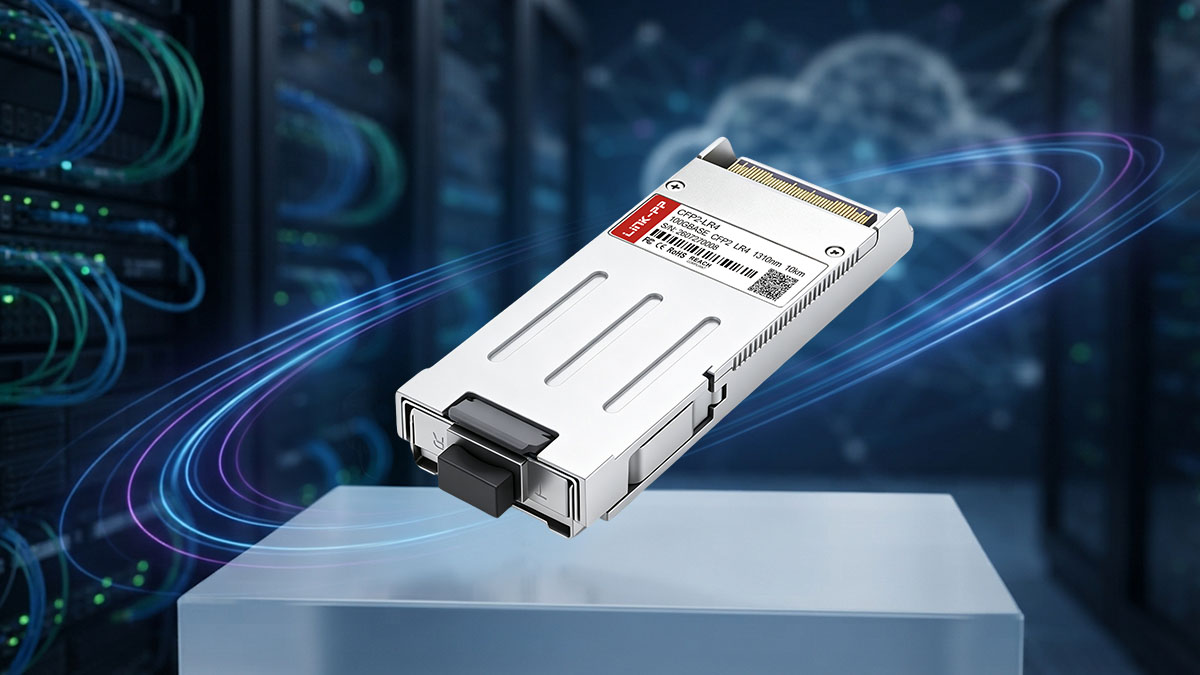
CFP2 Optics are pluggable coherent optical transceiver modules designed to support high-capacity optical transport, primarily in 100G-class carrier and metro networks. They provide a standardized interface for converting electrical signals into high-performance optical signals, enabling long-distance transmission over fiber infrastructure with strong spectral efficiency and scalability.
What Are CFP2 Optics?
CFP2 Optics are compact form-factor optical modules defined under the CFP Multi-Source Agreement (MSA) and optimized for coherent transmission in modern transport networks. They are widely used to support high-speed data transmission across backbone, metro, and data center interconnect (DCI) environments.
CFP2 modules are important because they balance performance and density in optical systems where space, power, and capacity must be optimized simultaneously.
Key characteristics include:
- Standardized pluggable form factor for carrier-grade equipment
- Support for 100G coherent optical transmission
- Integration of DSP-based signal processing for long-haul reach
- Compatibility with DWDM-based transport systems
These features make CFP2 a practical solution for operators needing scalable optical transport without redesigning core infrastructure.
Evolution from CFP to CFP2
The evolution from CFP to CFP2 represents a major step in optical transport module design, driven by the need for higher port density, improved power efficiency, and better support for coherent 100G transport systems. CFP2 was introduced to overcome the physical and architectural limitations of the original CFP form factor while aligning with modern DWDM-based high-capacity networks.
To clearly understand this transition, the comparison below highlights the key architectural and operational differences.
| Feature | CFP | CFP2 |
|---|---|---|
| Form Factor Size | Large, early-generation design | Compact, reduced footprint |
| Port Density | Low density per chassis | Significantly higher density |
| Power Efficiency | Higher power consumption | Improved power efficiency |
| Integration Level | Limited integration of DSP/coherent components | Higher integration with coherent DSP systems |
| Thermal Performance | Heavier cooling requirements | Optimized thermal design |
| Typical Applications | Early 100G transport systems | Modern coherent DWDM transport networks |
| Scalability | Limited in dense deployments | Designed for scalable high-capacity systems |
| Network Fit | Early backbone upgrades | Metro, backbone, and DCI convergence |
CFP-to-CFP2 evolution directly reflects the shift in optical transport networks from low-density, hardware-heavy architectures toward compact, DSP-driven coherent systems. This transition enables operators to scale capacity more efficiently within existing infrastructure while supporting the growing demands of modern high-capacity transport environments.
Why CFP2 Became Important for High-Capacity Transport
CFP2 Optics became essential in high-capacity transport networks due to the exponential increase in bandwidth demand across global communication infrastructures. Traditional optical modules could not efficiently support the combination of long reach, high data rates, and dense wavelength utilization required by modern networks.
CFP2 addresses these challenges by enabling:
- Scalable 100G transport services across metro and long-haul networks
- Efficient use of fiber through coherent transmission and DWDM compatibility
- Flexible deployment in both new and existing optical transport systems
- Improved balance between reach, capacity, and network density
In high-capacity transport environments, CFP2 plays a central role in enabling operators to expand bandwidth without proportional increases in physical infrastructure. It effectively bridges the gap between legacy transport architectures and next-generation optical networks, supporting the continuous evolution of carrier-grade connectivity systems.
🔳 CFP2 Optics Architecture Overview
CFP2 Optics architecture is built around a tightly integrated coherent transmission system that combines digital signal processing, optical modulation, and high-speed electrical interfaces to enable efficient high-capacity optical transport. Its internal design focuses on converting client-side electrical signals into robust optical signals that can travel long distances over DWDM fiber networks with minimal degradation.
Key Components of CFP2 Architecture
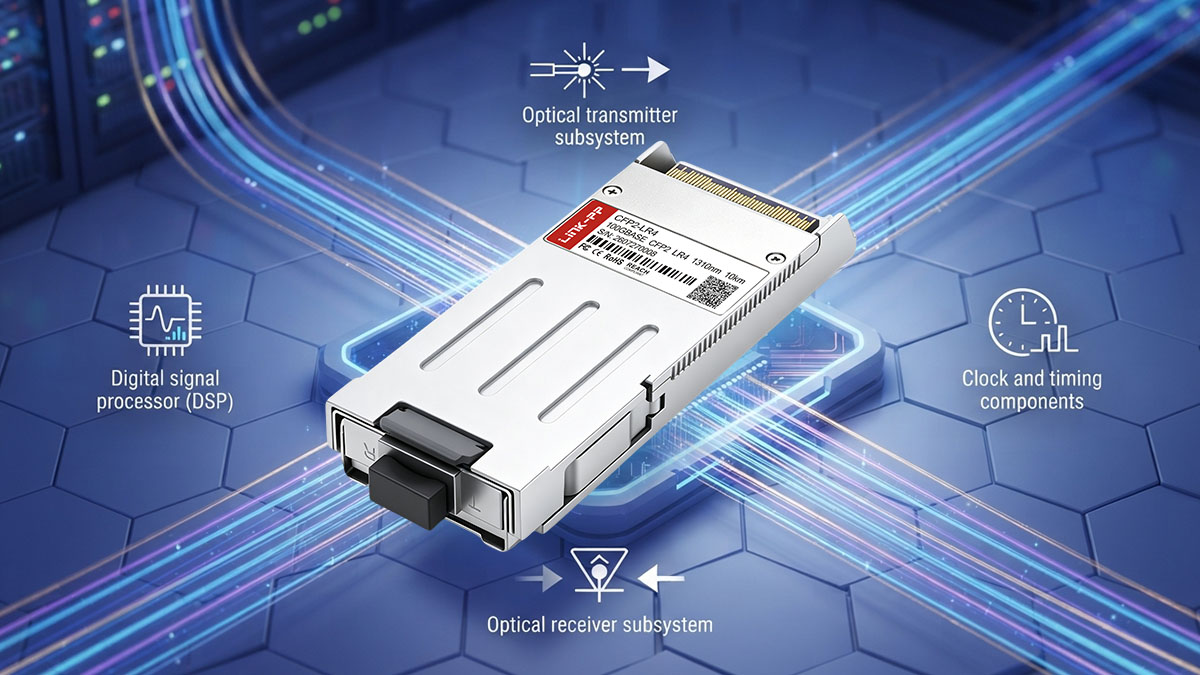
CFP2 Optics rely on a set of tightly coupled internal components that work together to enable stable 100G-class coherent transmission in optical transport networks.
The architecture is primarily composed of electrical, digital, and optical subsystems that ensure signal integrity from input to output.
Key components include:
- Digital Signal Processor (DSP) for signal encoding, compensation, and recovery
- Optical transmitter subsystem responsible for laser generation and modulation
- Optical receiver subsystem for coherent signal detection and demodulation
- Clock and data recovery (CDR) unit for timing synchronization
- High-speed electrical host interface for router and switch connectivity
These components collectively enable CFP2 modules to support high-performance transmission across metro and long-haul transport environments.
The integration of these subsystems ensures that CFP2 operates as a complete optical transport engine rather than a simple transceiver module.
Internal Signal Processing Workflow
CFP2 Optics architecture processes data through a structured end-to-end signal flow that transforms electrical input signals into coherent optical transmission and back again at the receiving end.
The workflow ensures that data remains stable and recoverable even under long-distance transmission and fiber impairments.
Key processing stages include:
- Electrical signal reception from the host system
- DSP-based signal encoding and modulation formatting
- Conversion of electrical signals into optical waveforms using a laser source
- Transmission of modulated optical signals over fiber via DWDM channels
- Coherent optical detection at the receiving end
- DSP-based signal reconstruction and error correction
Each stage plays a critical role in maintaining signal integrity, especially in environments where chromatic dispersion, polarization effects, and noise are present.
CFP2 Coherent Optical Engine Architecture
The coherent optical engine is the core of CFP2 Optics architecture and is responsible for enabling long-distance, high-capacity optical transport using advanced digital and optical technologies.
This engine combines laser technology, modulation systems, and DSP-driven compensation mechanisms to optimize signal quality across complex fiber environments.
Key architectural elements include:
- Coherent laser source for stable optical carrier generation
- High-speed modulators for encoding data onto optical signals
- Polarization multiplexing components to increase spectral efficiency
- Integrated DSP engine for real-time signal correction and optimization
- Forward Error Correction (FEC) subsystem for transmission reliability
Together, these elements allow CFP2 modules to support high-capacity transport by maximizing both reach and bandwidth efficiency.
🔳 Transmission Technologies Used in CFP2 Optics
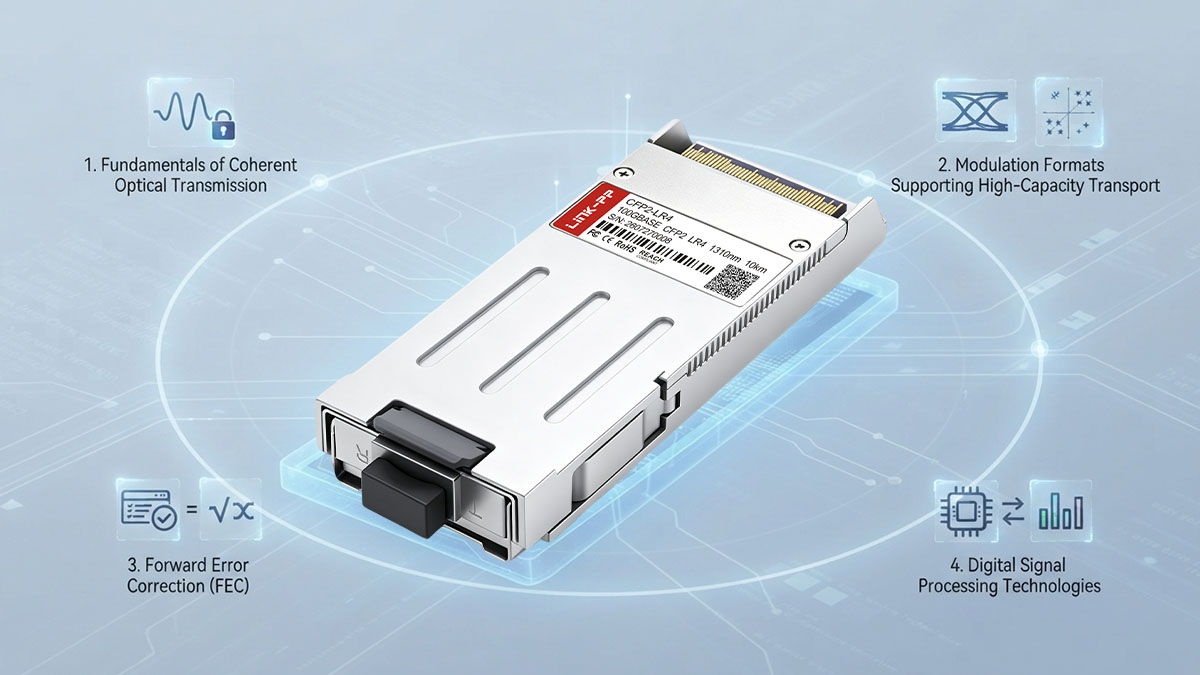
CFP2 Optics rely on advanced transmission technologies centered on coherent detection, digital signal processing, and sophisticated modulation schemes. These technologies are essential for enabling stable high-capacity optical transport over long distances and across dense DWDM networks, where signal degradation and spectral constraints must be carefully managed.
Fundamentals of Coherent Optical Transmission
Coherent optical transmission is the core technology behind CFP2 Optics, enabling high-capacity data transport by utilizing both amplitude and phase information of the optical signal.
This approach significantly improves transmission performance compared to traditional direct-detection systems.
Key principles include:
- Use of local oscillator lasers for coherent signal detection
- Extraction of phase, amplitude, and polarization information
- Enhanced tolerance to fiber impairments such as dispersion and noise
- Support for long-haul and ultra-long-haul transmission scenarios
By leveraging coherent detection, CFP2 Optics can maintain signal integrity over extended fiber spans, making them highly suitable for backbone and metro transport networks.
Modulation Formats Supporting High-Capacity Transport
CFP2 Optics use advanced modulation formats to increase spectral efficiency and maximize data throughput within limited optical bandwidth.
These modulation techniques directly impact the balance between transmission reach and capacity.
Common modulation formats include:
- DP-QPSK (Dual Polarization Quadrature Phase Shift Keying) for long-distance stability
- Higher-order modulation schemes for increased data density
- Polarization multiplexing to double channel capacity
- Adaptive modulation strategies based on link conditions
Each modulation format is selected based on network requirements such as reach, capacity, and fiber quality, allowing flexible deployment across different transport environments.
These techniques enable CFP2 systems to efficiently support 100G-class transport while optimizing spectrum usage in DWDM networks.
Forward Error Correction (FEC)
Forward Error Correction (FEC) is a critical enabling technology in CFP2 Optics that enhances transmission reliability by detecting and correcting errors introduced during optical signal propagation.
FEC is especially important in high-capacity transport systems where long distances and fiber impairments can significantly degrade signal quality.
Key functions of FEC include:
- Detection of bit-level transmission errors
- Correction of corrupted data without retransmission
- Extension of effective transmission reach
- Improvement of overall system margin and reliability
By integrating FEC into the transmission pipeline, CFP2 Optics can maintain stable performance even under challenging optical conditions, supporting robust carrier-grade transport services.
Digital Signal Processing Technologies
Digital Signal Processing (DSP) is a foundational technology in CFP2 Optics that enables real-time signal compensation, optimization, and recovery across complex optical networks.
DSP plays a central role in ensuring that high-capacity transport remains stable and efficient over long-distance fiber links.
Key DSP functions include:
- Chromatic dispersion compensation across long fiber spans
- Polarization mode dispersion mitigation for signal stability
- Nonlinear impairment correction in high-power transmission scenarios
- Signal equalization and noise reduction
- Real-time performance optimization for adaptive transmission
These DSP capabilities allow CFP2 Optics to dynamically adapt to varying network conditions, ensuring consistent performance in DWDM-based high-capacity transport systems.
🔳 High-Capacity Transport Capabilities of CFP2 Optics
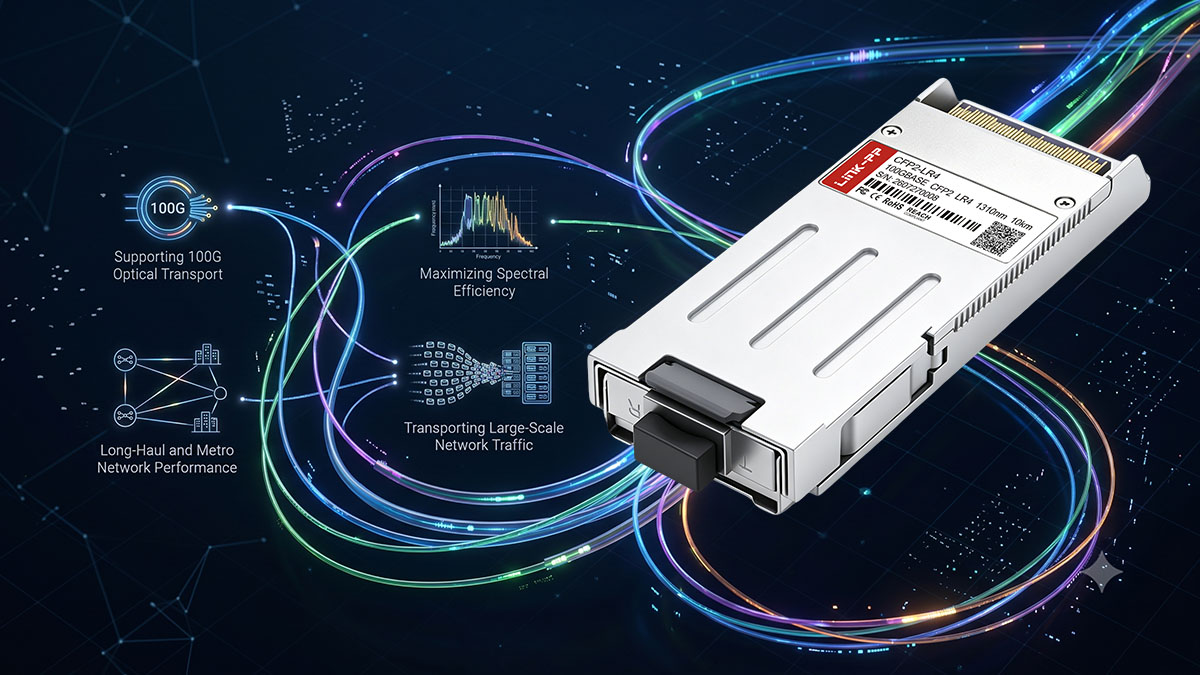
CFP2 Optics are specifically designed to enable high-capacity optical transport by supporting 100G-class data transmission with strong spectral efficiency, long-reach capability, and seamless integration into DWDM-based backbone and metro networks. Their architecture combines coherent transmission, DSP, and advanced modulation to deliver scalable bandwidth across complex carrier infrastructures.
Supporting 100G Optical Transport
CFP2 Optics provide a stable and widely deployed platform for 100G optical transport in modern carrier networks, enabling efficient data delivery across metro, regional, and backbone environments.
This capability is critical for operators managing large-scale traffic growth driven by cloud services, video distribution, and enterprise connectivity.
Key characteristics include:
- Native support for 100G coherent transmission services
- High-bandwidth data delivery over long-distance fiber links
- Compatibility with existing transport infrastructure upgrades
- Scalable deployment across multiple network layers
By supporting 100G transport in a compact form factor, CFP2 enables operators to expand capacity without fundamentally redesigning network architecture.
Long-Haul and Metro Network Performance
CFP2 Optics are optimized for both metro and long-haul transport scenarios, where signal integrity and reach are essential performance requirements.
Their coherent transmission architecture allows stable operation across varying distances while maintaining consistent signal quality.
Key performance aspects include:
- Long-distance transmission capability over metro and backbone networks
- Robust tolerance to fiber impairments such as dispersion and attenuation
- Stable signal performance across multi-span optical links
- Efficient operation in both regional and national transport systems
These capabilities make CFP2 suitable for multi-tier network architectures that require flexible deployment across different geographic scales.
Maximizing Spectral Efficiency
Spectral efficiency is a core advantage of CFP2 Optics, enabling operators to transmit more data over existing fiber infrastructure by optimizing wavelength utilization in DWDM systems.
This efficiency directly translates into higher network capacity without proportional increases in physical resources.
Key mechanisms include:
- Dense wavelength utilization in DWDM environments
- Advanced modulation and polarization techniques
- DSP-based signal optimization for reduced spectral waste
- Efficient allocation of optical channels per fiber pair
By improving spectral efficiency, CFP2 supports scalable network expansion while minimizing the need for new fiber deployment.
Transporting Large-Scale Network Traffic
CFP2 Optics are widely used in high-capacity transport environments that handle large-scale and diverse traffic types across global networks.
Their ability to support high-throughput and stable transmission makes them essential for modern digital infrastructure.
Key application areas include:
- Cloud data center interconnect (DCI) traffic aggregation
- Carrier backbone networks supporting internet-scale routing
- Metro aggregation networks for enterprise and residential services
- High-bandwidth transport for media, storage, and cloud applications
In these environments, CFP2 Optics act as a foundational transport layer, ensuring that large volumes of data can be transmitted reliably and efficiently across geographically distributed network systems.
🔳 CFP2 Optics in DWDM and Transport Networks
CFP2 Optics play a central role in DWDM-based optical transport networks by enabling multiple high-capacity wavelengths to be transmitted over a single fiber pair. Their coherent transmission capability allows them to integrate efficiently into modern optical transport architectures, supporting scalable bandwidth expansion across metro, regional, and backbone networks.
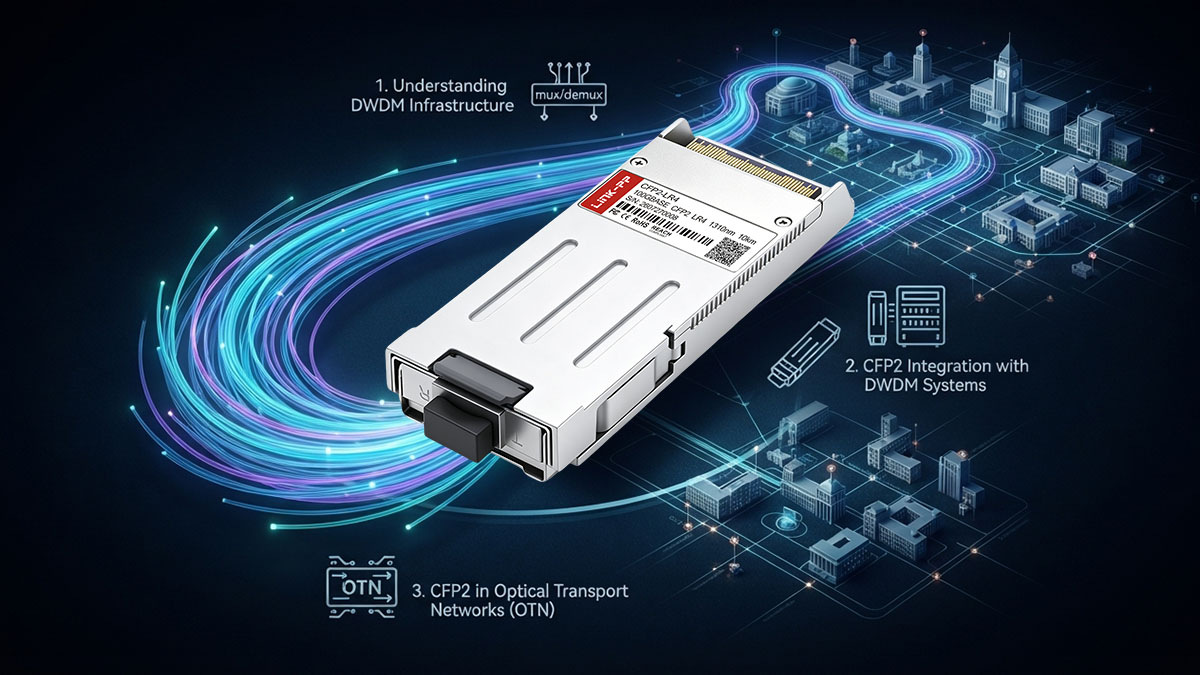
Understanding DWDM Infrastructure
DWDM (Dense Wavelength Division Multiplexing) infrastructure enables multiple optical signals to be transmitted simultaneously over a single fiber by assigning each signal a unique wavelength.
This technology is fundamental to high-capacity transport because it multiplies fiber bandwidth without requiring new physical infrastructure.
Key characteristics include:
- Transmission of multiple independent optical channels over a single fiber pair
- Use of tightly spaced wavelength grids for maximum fiber utilization
- Scalability through addition of new wavelength channels
- Support for long-distance transmission with optical amplification
DWDM forms the backbone of modern carrier transport networks, where capacity demands continuously increase.
CFP2 Integration with DWDM Systems
CFP2 Optics integrate seamlessly into DWDM systems by generating coherent optical signals that can be assigned to specific wavelengths within the DWDM grid.
This integration enables efficient scaling of network capacity while maintaining signal quality across long distances.
Key integration features include:
- Tunable wavelength operation for flexible channel assignment
- Compatibility with standard DWDM channel spacing
- Coherent transmission support for high spectral efficiency
- Ability to operate across multiple optical bands depending on system design
By working within DWDM environments, CFP2 enables operators to expand network capacity without redesigning the underlying fiber infrastructure.
CFP2 in Optical Transport Networks (OTN)
CFP2 Optics are widely deployed in Optical Transport Networks (OTN), where they serve as the physical layer interface for high-capacity data transmission across structured transport hierarchies.
OTN provides a standardized framework for transporting, multiplexing, and managing optical traffic efficiently.
Key roles of CFP2 in OTN include:
- Mapping client signals into structured optical transport frames
- Enabling efficient aggregation of multiple services
- Supporting error correction and performance monitoring functions
- Ensuring compatibility with carrier-grade transport standards
This integration allows CFP2 to function as a key enabler of deterministic and scalable transport services in large-scale optical networks.
Multi-Service Transport Support
CFP2 Optics support the transport of diverse service types within unified optical infrastructure, making them highly suitable for converged network environments.
This capability allows operators to consolidate multiple traffic types onto a single high-capacity transport layer.
Key supported services include:
- Ethernet-based enterprise and data center traffic
- IP/MPLS backbone routing services
- Storage and cloud connectivity traffic
- Mixed-service carrier aggregation environments
By enabling multi-service transport over DWDM infrastructure, CFP2 contributes to more efficient network utilization and simplified transport architecture across modern optical networks.
🔳 Network Architecture Design for High-Capacity CFP2 Transport
CFP2 Optics-based high-capacity transport networks are designed around scalable optical architectures that efficiently distribute large volumes of traffic across metro, regional, and backbone layers. These architectures combine coherent transmission, DWDM technology, and intelligent topology design to ensure high bandwidth utilization, low latency, and strong network resilience.
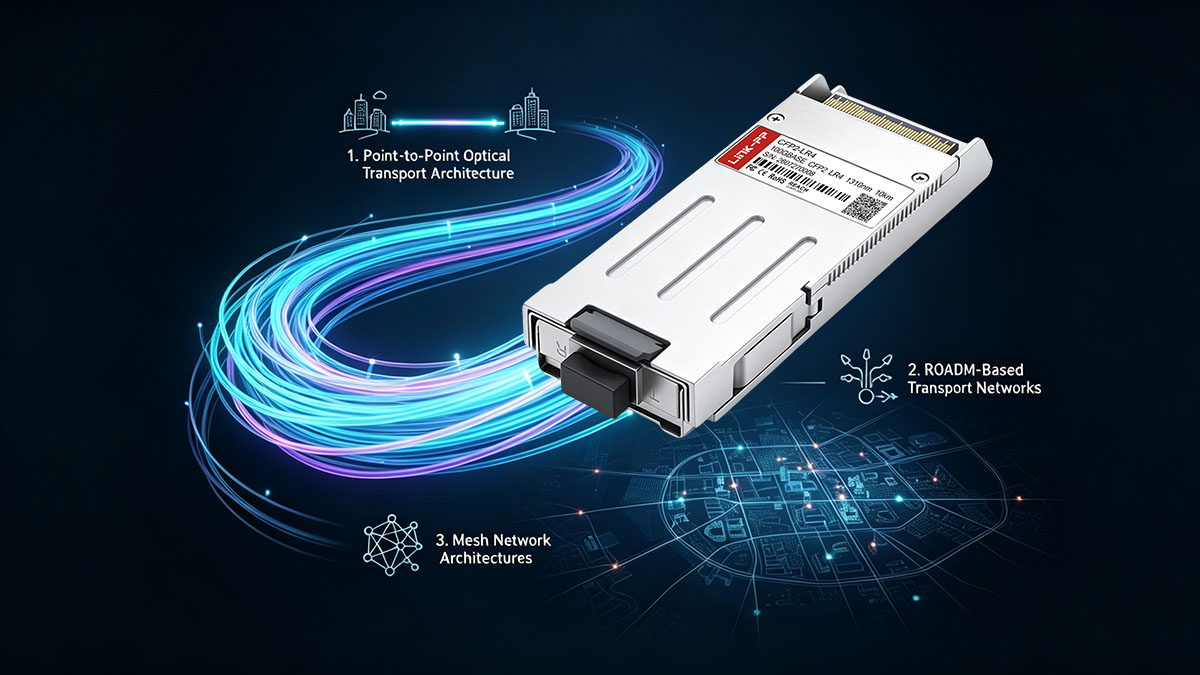
Point-to-Point Optical Transport Architecture
Point-to-point architecture is the most fundamental deployment model for CFP2 Optics in high-capacity transport networks, where two endpoints are directly connected through a dedicated optical path.
This design is widely used for predictable, high-bandwidth connections such as data center interconnect (DCI) and backbone links.
Key characteristics include:
- Direct optical wavelength transmission between two nodes
- Simplified network design with minimal intermediate processing
- High performance and low latency for dedicated traffic paths
- Easy scalability by adding parallel wavelength channels
This architecture is often the foundation for initial high-capacity transport deployments due to its simplicity and efficiency.
ROADM-Based Transport Networks
ROADM (Reconfigurable Optical Add-Drop Multiplexer) networks introduce dynamic wavelength routing capabilities, enabling CFP2 Optics to operate within flexible and adaptive transport environments.
This architecture is essential for modern carrier networks requiring agility and service flexibility.
Key characteristics include:
- Dynamic allocation and rerouting of optical wavelengths
- Remote configuration of add/drop channels without physical intervention
- Improved network flexibility and service provisioning speed
- Support for multi-node optical transport topologies
By integrating CFP2 Optics into ROADM systems, operators can scale capacity dynamically while maintaining efficient use of optical spectrum resources.
Mesh Network Architectures
Mesh network architectures provide highly resilient and scalable CFP2-based transport environments where multiple interconnected nodes form a flexible routing structure.
This topology is commonly used in national backbone networks and large-scale carrier infrastructures.
Key characteristics include:
- Multiple redundant paths between network nodes
- Intelligent traffic engineering and load balancing
- High fault tolerance with automatic rerouting capabilities
- Efficient utilization of network-wide capacity resources
Mesh architectures ensure that CFP2-based transport systems maintain service continuity even under node or fiber failures.
Ring Network Architectures
Ring architectures are widely deployed in metro and regional CFP2 transport networks due to their balance of simplicity, resilience, and cost efficiency.
In this model, nodes are connected in a closed-loop structure that enables fast protection switching.
Key characteristics include:
- Circular topology enabling dual-path protection
- Rapid failover in case of link or node failure
- Efficient bandwidth sharing across metro regions
- Simplified operational and maintenance procedures
Ring-based CFP2 deployments are particularly effective in metro aggregation networks where reliability and cost control are critical requirements.
🔳 Capacity Scaling Strategies with CFP2 Optics
CFP2 Optics enable flexible and efficient capacity scaling in high-capacity transport networks by leveraging coherent transmission, DWDM expansion, and spectral efficiency improvements. These strategies allow operators to increase bandwidth significantly without requiring proportional upgrades to physical fiber infrastructure.
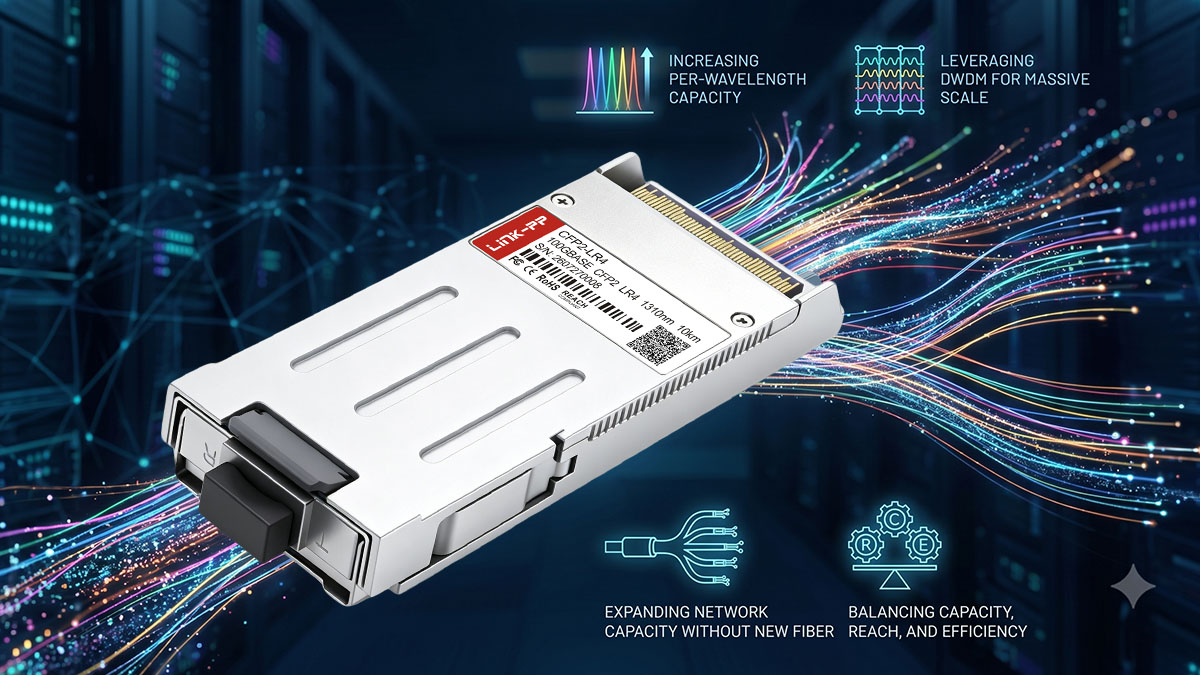
Increasing Per-Wavelength Capacity
Per-wavelength capacity expansion is one of the primary methods used in CFP2-based transport systems to meet rising bandwidth demands.
This approach focuses on maximizing the data carried on each optical channel while maintaining signal integrity over long distances.
Key characteristics include:
- Evolution from lower-rate optical services to 100G-class transport
- Higher-order modulation techniques to increase bits per symbol
- DSP-based optimization for improved signal efficiency
- Balanced trade-off between transmission reach and data rate
By increasing per-wavelength capacity, CFP2 Optics allow networks to scale performance while maintaining a stable optical transport foundation.
Leveraging DWDM for Massive Scale
DWDM technology plays a critical role in scaling CFP2-based transport networks by enabling multiple high-capacity channels to coexist on a single fiber pair.
This method significantly increases total network throughput without requiring additional fiber deployment.
Key characteristics include:
- Multiplication of fiber capacity through wavelength stacking
- Expansion of available channels within the DWDM grid
- Efficient utilization of existing optical infrastructure
- Scalable architecture for long-term bandwidth growth
When combined with CFP2 coherent transmission, DWDM becomes a powerful mechanism for achieving massive transport capacity across carrier networks.
Expanding Network Capacity Without New Fiber
One of the most important advantages of CFP2 Optics is the ability to significantly increase network capacity without deploying new physical fiber infrastructure.
This capability reduces both operational complexity and long-term expansion costs.
Key characteristics include:
- Reuse of existing fiber plant for new high-capacity services
- Upgrades achieved through transceiver and wavelength enhancements
- Reduced need for civil engineering or physical expansion work
- Faster deployment cycles for capacity upgrades
This approach is widely adopted in modern optical transport networks where fiber resources are limited or expensive to expand.
Balancing Capacity, Reach, and Efficiency
Capacity scaling in CFP2 Optics must carefully balance multiple performance factors, including transmission distance, bandwidth, and spectral efficiency.
Optimizing these trade-offs is essential for maintaining stable and cost-effective transport performance across different network scenarios.
Key characteristics include:
- Trade-off management between modulation complexity and transmission reach
- Optimization of spectral efficiency for maximum fiber utilization
- Adaptation of system parameters based on network topology
- Alignment of performance targets with service requirements
By balancing these factors, CFP2-based systems can deliver scalable transport performance across diverse deployment environments, from metro aggregation to long-haul backbone networks.
🔳 Future Trends in CFP2 Optics and High-Capacity Transport
CFP2 Optics continue to evolve within high-capacity transport networks as global bandwidth demand accelerates across cloud computing, AI infrastructure, and hyperscale data centers. While newer form factors are emerging, CFP2 remains a strategically important platform in coherent optical transport due to its maturity, installed base, and strong DWDM compatibility.
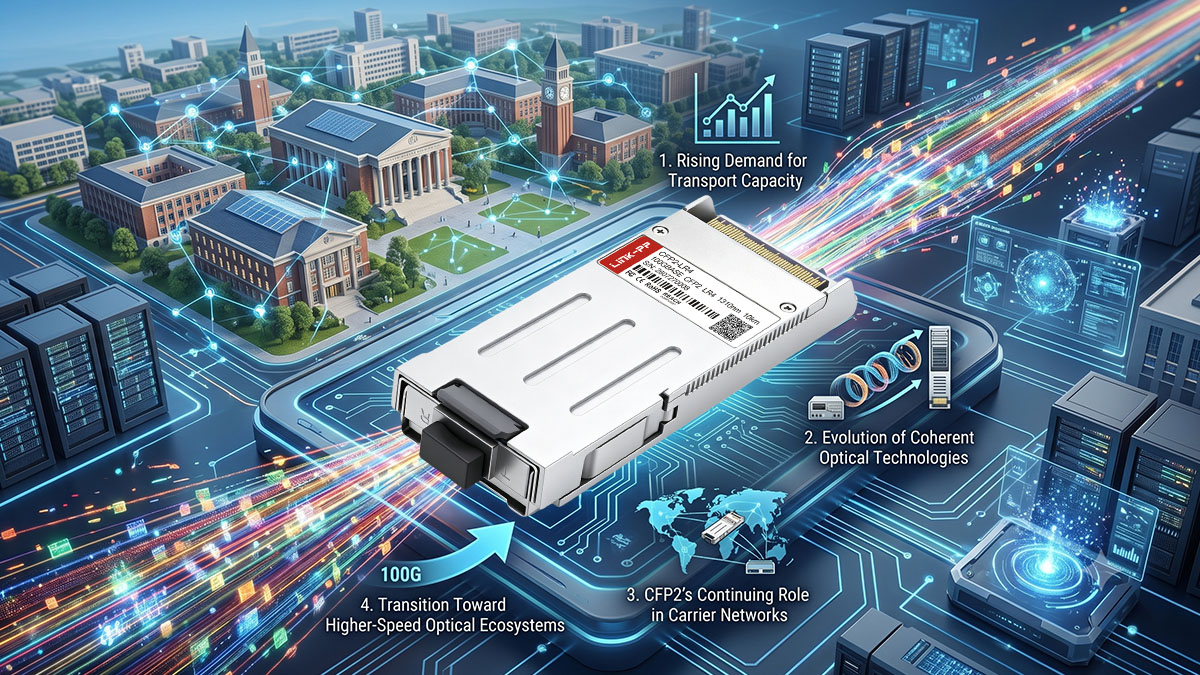
Rising Demand for Transport Capacity
Future optical transport networks will be primarily driven by exponential traffic growth from cloud services, AI training workloads, and global content distribution platforms.
This demand directly increases pressure on backbone and metro networks to deliver higher capacity with lower latency.
Key characteristics include:
- Rapid growth in inter-data-center traffic
- Increasing reliance on cloud-native applications
- Expansion of edge computing and distributed architectures
- Continuous upgrade cycles for backbone bandwidth
CFP2 Optics remain relevant in this environment by supporting scalable 100G transport that can be incrementally expanded within existing fiber infrastructure.
Evolution of Coherent Optical Technologies
Coherent optics technology is continuously advancing, enabling higher performance, improved efficiency, and greater transmission flexibility in high-capacity transport systems.
These advancements directly enhance the capabilities of CFP2-based architectures.
Key characteristics include:
- More powerful and efficient DSP algorithms
- Improved spectral efficiency through advanced modulation techniques
- Enhanced tolerance to fiber impairments and nonlinear effects
- Extended reach for metro and long-haul applications
As coherent technology evolves, CFP2-based systems benefit from improved performance without requiring fundamental changes in network architecture.
CFP2's Continuing Role in Carrier Networks
Despite the emergence of newer optical form factors, CFP2 Optics continue to play a significant role in carrier-grade transport networks due to their established deployment base and compatibility with existing infrastructure.
This ensures long-term relevance in many operational environments.
Key characteristics include:
- Strong compatibility with deployed DWDM systems
- Long lifecycle in carrier and metro transport networks
- Cost-efficient upgrade path for existing infrastructure
- Stable performance in high-capacity 100G transport scenarios
CFP2 remains a practical choice for operators seeking to extend the lifecycle of their optical transport investments while gradually evolving toward higher-capacity systems.
Transition Toward Higher-Speed Optical Ecosystems
The optical transport industry is steadily moving toward higher-speed transmission technologies, including 200G, 400G, and beyond, driven by continuous traffic growth and infrastructure modernization.
This transition is shaping the future positioning of CFP2 within broader network architectures.
Key characteristics include:
- Gradual migration from 100G to higher-speed coherent platforms
- Increased use of advanced modulation and DSP technologies
- Coexistence of multiple optical generations in hybrid networks
- Evolution of transport architectures toward higher density and efficiency
In this evolving ecosystem, CFP2 Optics serve as a foundational technology that bridges existing infrastructure with next-generation optical transport systems, ensuring continuity and scalability during long-term network evolution.
🔳 Conclusion
CFP2 Optics play a foundational role in modern high-capacity optical transport networks by enabling efficient, scalable, and reliable 100G coherent transmission across DWDM-based infrastructure. As a key enabling technology in CFP2 Optics architecture, they bridge the gap between increasing global bandwidth demand and the physical limitations of fiber networks, supporting metro, regional, and long-haul transport applications with strong spectral efficiency and system scalability.
The role of CFP2 Optics in high-capacity transport can be summarized through several essential technical and architectural insights:
- CFP2 enables compact and efficient 100G coherent optical transmission
- DWDM integration allows massive fiber capacity expansion without new fiber deployment
- DSP and coherent technologies improve reach, stability, and signal integrity
- Network architectures such as ROADM, mesh, and point-to-point optimize scalability and resilience
- Capacity scaling strategies ensure long-term adaptability to growing traffic demands
Together, these points highlight how CFP2-based systems form a critical layer in modern optical transport ecosystems, supporting continuous network evolution.
As global networks continue to evolve toward higher-speed optical systems and more complex traffic patterns, understanding CFP2 Optics architecture remains essential for designing efficient and future-ready transport infrastructure. Their long-term relevance in DWDM and coherent transport environments ensures they will continue to serve as a stable and widely deployed technology within carrier networks.
For professionals and organizations exploring optical transport solutions and related technologies, the LINK-PP Official Store provides access to industry insights and connectivity solutions that align with evolving high-capacity networking requirements, supporting the ongoing development of modern optical communication systems.