When engineers search for OM4 100G distance, they are usually not looking for theory—they need a clear, deployment-ready answer: how far can 100G actually run on OM4 fiber, and will it work in my network?
The short answer is straightforward: in standard data center environments, OM4 fiber supports 100GBASE-SR4 up to 100 meters. However, the reality behind this number is more nuanced. You may have seen references to 150 meters, heard conflicting advice about OM3 vs OM4, or encountered recommendations pushing you toward single-mode fiber (SMF) instead. These differences are not mistakes—they reflect variations in transceiver types, link design, and real-world deployment conditions.
This is exactly where confusion begins. Many network designers assume that OM4 can reliably stretch to 150m for 100G, while others insist that anything beyond 100m requires SMF. In practice, the correct answer depends on several critical factors: the specific QSFP28 100G optical module (such as QSFP 100G SR4 or SR10), the MPO cabling architecture, and the total link loss budget across connectors and patch panels.
In this guide, we move beyond simple specifications and focus on what actually matters in production networks. You will learn the true reach limits of OM4 at 100G, how different optics affect distance, and when it makes sense to stay with multimode—or upgrade to single-mode for better scalability.
By the end of this article, you will be able to confidently answer a key question for your infrastructure planning:
Is OM4 enough for your 100G link—or is it time to go further?
🟩 What OM4 100G Distance Really Means
If you only remember one thing about OM4 100G distance, it should be this:
Standard 100GBASE-SR4 runs up to 100 meters on OM4 fiber.
This is the most widely deployed 100G multimode solution in data centers today, using parallel optics over MPO/MTP cabling. It is the baseline answer expected by network engineers, vendors, and compatibility guides.
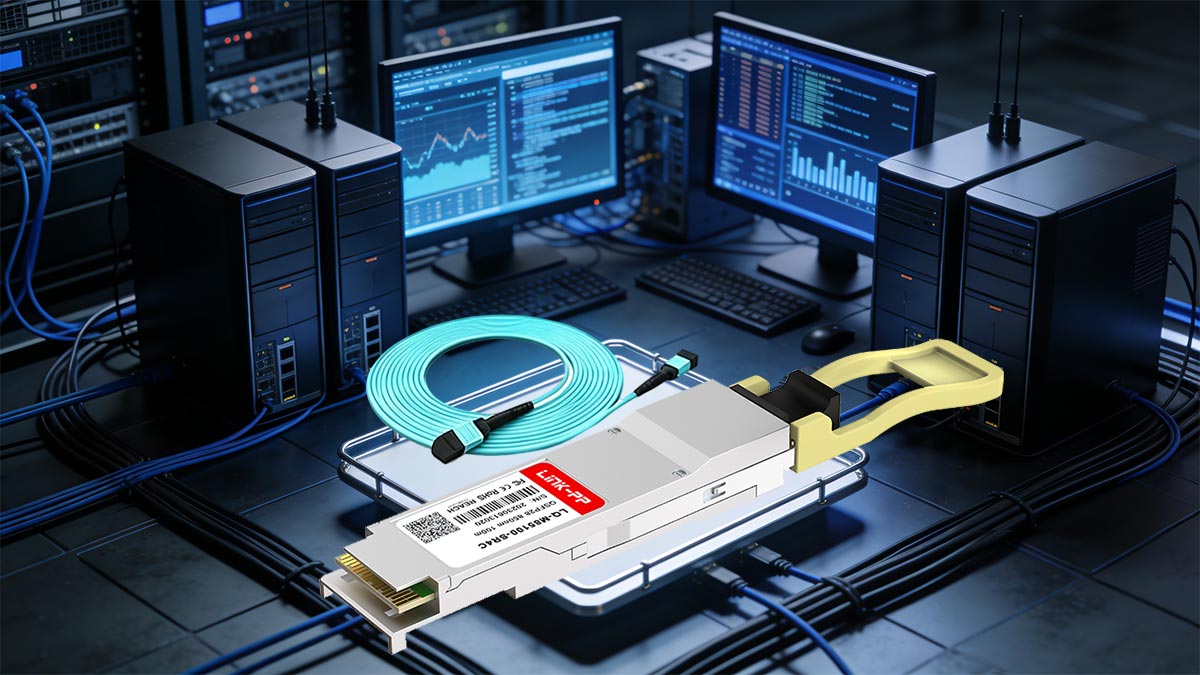
Why Do Some Sources Say 150 Meters?
The confusion comes from mixing different optical standards and use cases.
- 100GBASE-SR4 (current mainstream)
→ OM4 distance: up to 100 meters
→ Uses 8 fibers (MPO-12), parallel transmission
→ Dominant choice for modern 100G deployments - 100GBASE-SR10 (older / less common today)
→ OM4 distance: up to 150 meters (in some planning tables)
→ Uses 20 fibers (MPO-24)
→ Rarely used in new deployments due to higher complexity and cost
In other words, when users search for “OM4 100G 150m”, they are often referencing SR10-era specifications or legacy documentation—not the standard SR4 optical transceiver modules used in most current networks.
Don’t Mix Optic Types
A major source of misconfiguration in real deployments is assuming all 100G multimode optics behave the same. They do not.
- SR4 ≠ SR10
- Different optics = different reach, fiber count, and design rules
This matters because choosing the wrong assumption can lead to:
- Link failures at longer distances
- Insufficient optical budget
- Costly re-cabling or unexpected upgrades to single-mode
Why 100 Meters Is The Practical Design Limit
Even though OM4 fiber is high-performance multimode (with 4700 MHz·km bandwidth), the 100-meter limit for SR4 is not arbitrary. It reflects real-world constraints:
- Modal dispersion at high speeds (100G parallel lanes)
- Loss introduced by MPO connectors and patch panels
- Alignment sensitivity in parallel optics
Because of these factors, 100 meters is not just a theoretical maximum—it is a safe, design-validated limit for consistent performance.
Where OM4 Still Makes Sense For 100G
Despite the distance limitation, OM4 remains highly effective in scenarios such as:
- Top-of-rack to leaf/spine connections
- Intra-data-center links within a single room
- High-density MPO-based cabling environments
For anything beyond 100–150 meters, however, the conversation naturally shifts toward single-mode fiber (SMF)—not because OM4 fails, but because the economics and scalability begin to favor SMF.
Bottom line: When evaluating OM4 100G distance, always anchor your design to the optic type. For modern deployments, 100GBASE-SR4 on OM4 = 100 meters. Anything beyond that requires careful validation—or a different fiber strategy altogether.
🟩 Which 100G Optics Work on OM4?
Understanding OM4 100G distance is only half the equation—the other half is choosing the right optical transceiver. Not all 100G optics are designed for multimode fiber, and even among those that are, performance, distance, and cabling requirements can vary significantly.
In real deployments, most confusion comes from assuming that any “100G module” will work the same way on OM4. In reality, your achievable distance and link stability depend heavily on the optic type, connector format, and transmission method.
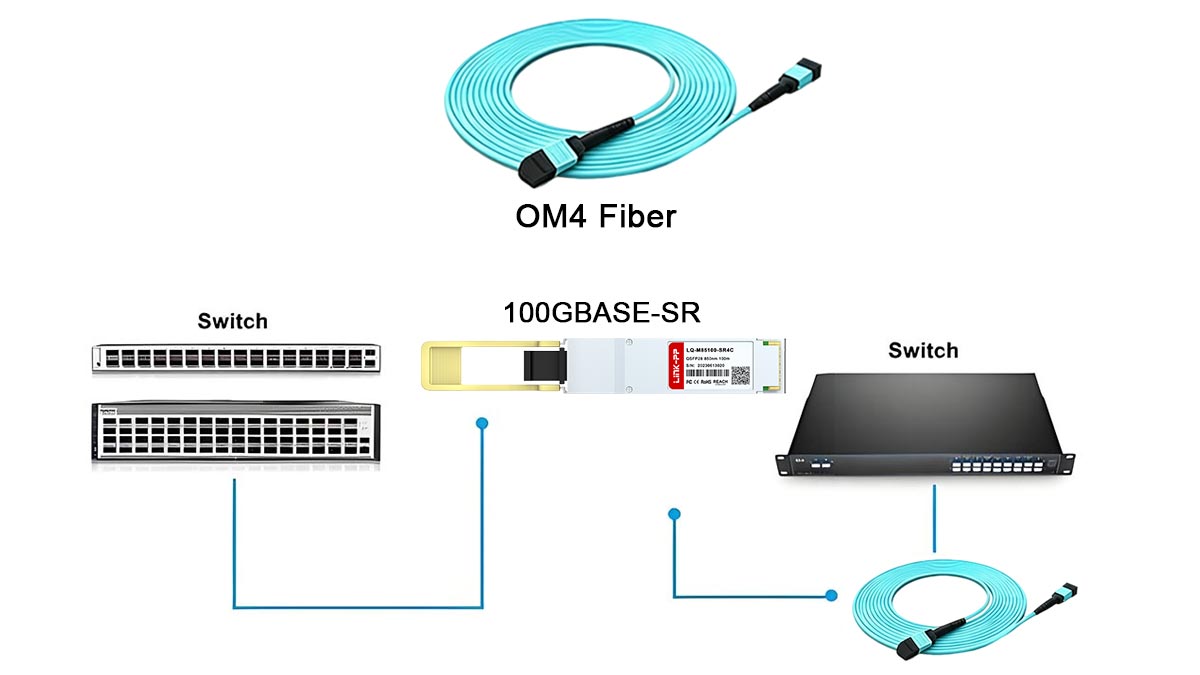
100GBASE-SR4 on OM4
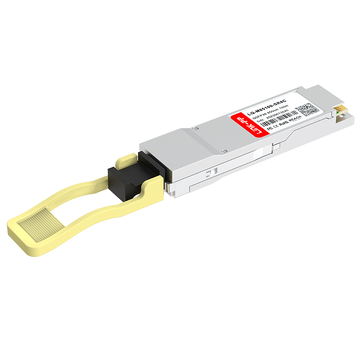
100GBASE-SR4 is the default and most widely used 100G multimode optic for OM4 fiber.
- Reach: up to 100 meters on OM4
- Connector: MPO-12 (8 fibers used: 4 Tx + 4 Rx)
- Wavelength: 850 nm (VCSEL-based)
- Use case: Data center short-reach interconnects
This is the standard most users are referring to when they search for “OM4 100G distance.” It offers the best balance of cost, density, and simplicity for high-speed links within racks or between nearby switches.
From a design perspective, SR4 is reliable because it is:
- Widely supported across switch vendors
- Optimized for parallel multimode transmission
- Mature in terms of ecosystem and interoperability
If your link is within 100 meters, SR4 on OM4 is almost always the first-choice solution.
MPO-Based Multimode Optics
Most 100G multimode solutions—including SR4—are built around MPO/MTP cabling systems. These high-density connectors enable parallel transmission but also introduce additional design considerations.
Common characteristics of MPO-based 100G optics:
- Require multi-fiber ribbon cables (typically 12 or 24 fibers)
- Depend on polarity and fiber mapping correctness
- Introduce insertion loss per connector, which affects total link budget
Other multimode variants (less common today) include:
- 100GBASE-SR10
Uses 20 fibers (MPO-24), historically allowed longer reach (up to ~150m on OM4), but is largely obsolete in modern deployments - BiDi / SWDM-based optics (vendor-specific)
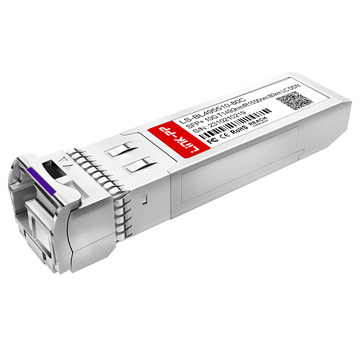
Use duplex LC instead of MPO, enabling reuse of existing fiber infrastructure, sometimes reaching 100–150m on OM4, depending on implementation
While these alternatives exist, SR4 remains dominant due to its simplicity and cost efficiency at scale.
When To Avoid Overfitting The Optic To The Cable Plant
A common mistake in real-world networks is trying to force a specific optic to match existing cabling, rather than selecting the best overall solution.
Examples of overfitting include:
- Using BiDi optics just to avoid upgrading from LC to MPO
- Pushing OM4 beyond 100m with non-standard configurations
- Selecting legacy SR10 transceiver modules to achieve longer reach
While these approaches may work in limited scenarios, they often introduce:
- Higher transceiver costs
- Reduced interoperability
- More complex troubleshooting
- Limited scalability for future upgrades (e.g., QSFP56 200G/QSFP-DD 400G)
In many cases, it is more practical to:
- Stay within SR4 + OM4 design limits (≤100m)
- Or transition to single-mode fiber (SMF) for longer distances
Practical Selection Guidance
When choosing a 100G optic for OM4, follow this simplified decision logic:
- ≤ 100m:
→ Use 100GBASE-SR4 with MPO (best practice) - 100–150m (edge cases):
→ Consider BiDi/SWDM optics or validate link budget carefully - >150m:
→ Move to single-mode (e.g., 100GBASE-LR4) for reliability and scalability
Key takeaway: The effectiveness of OM4 at 100G is not just about the fiber—it is about pairing it with the right optical module. In most modern networks, 100GBASE-SR4 is the standard match for OM4, delivering predictable performance within its 100-meter design envelope.
🟩 OM4 vs. OM3 vs. OM5 vs. SMF for 100G
Choosing the right fiber type is just as important as selecting the correct optic when evaluating OM4 100G distance. While OM4 is often the default for short-reach 100G, it is not the only option—and in some cases, it may not be the best one.
This section provides a practical decision framework based on three key factors:
- Distance requirements
- Budget (both cable and transceivers)
- Future scalability (200G/400G and beyond)
Quick Comparison Table
| Fiber Type | Typical 100G Distance | Connector Type | Cost (Cable vs Optics) | Best Use Case |
|---|---|---|---|---|
| OM3 | ~70 meters | MPO / LC | Lower cable, higher optics | Legacy or very short links |
| OM4 | ~100 meters | MPO / LC | Balanced | Standard short-reach 100G |
| OM5 | ~100–150 meters* | LC (SWDM) / MPO | Higher cable cost | Specialized multimode (SWDM/BiDi) |
| SMF (OS2) | 10 km+ | LC duplex | Lower cable, higher optics (but decreasing) | Long distance & future-proof |
*Depends on optic type (e.g., SWDM/BiDi), not standard SR4.
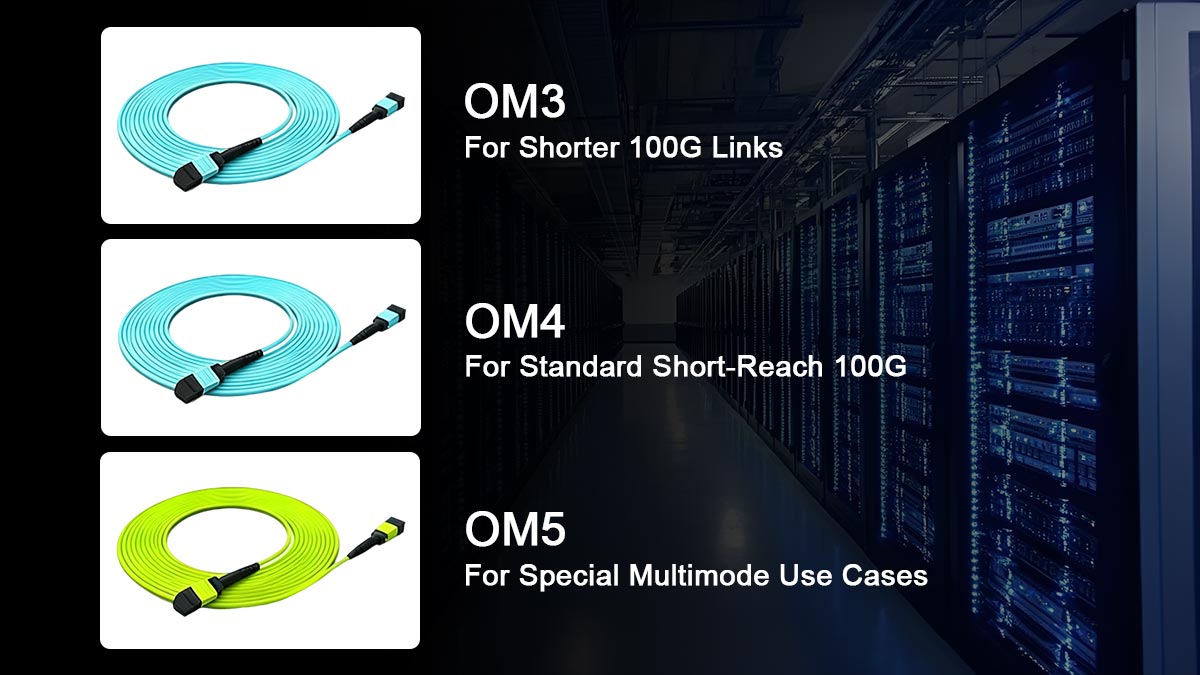
OM3 For Shorter 100G Links
OM3 is the earlier generation of laser-optimized multimode fiber and still exists in many legacy data centers.
- 100G Distance: typically up to 70 meters (SR4)
- Advantage: lower upfront cabling cost if already deployed
- Limitation: shorter reach and less headroom for high-speed upgrades
OM3 is suitable when:
- You are upgrading an existing infrastructure
- Link distances are well under 70m
- Budget constraints prevent re-cabling
However, for new deployments, OM3 is generally not recommended due to its limited scalability.
OM4 For Standard Short-Reach 100G
OM4 is the current standard choice for multimode 100G deployments.
- 100G Distance: up to 100 meters (SR4)
- Bandwidth: 4700 MHz·km
- Strength: optimal balance between cost and performance
OM4 is ideal for:
- Data center spine-leaf architectures
- High-density MPO environments
- Predictable, standards-based deployments
This is why most searches for “OM4 100G distance” are effectively asking:
“Is OM4 enough for my 100G link?”
For distances within 100 meters, the answer is yes—reliably and cost-effectively.
OM5 For Special Multimode Use Cases
OM5 is designed for wideband multimode applications, enabling multiple wavelengths over a single fiber pair.
- 100G Distance: typically 100–150 meters (with SWDM/BiDi optics)
- Connector: usually LC duplex
- Advantage: supports wavelength multiplexing
OM5 is useful when:
- You want to reuse duplex LC infrastructure
- You plan to deploy SWDM or BiDi optics
- Fiber count reduction is important
However, OM5 adoption is still limited because:
- It requires specific (often more expensive) optics
- The cost-benefit is not always better than SMF
SMF For Longer Or More Future-Proof Links
Single-mode fiber (SMF, typically OS2) is increasingly the strategic choice for modern networks.
- 100G Distance: from hundreds of meters to 10 km+ (e.g., LR4)
- Connector: LC duplex
- Key advantage: virtually unlimited scalability
SMF is recommended when:
- Distance exceeds 100–150 meters
- You want a future-proof infrastructure (200G/400G/800G)
- You want to simplify cabling (duplex instead of MPO)
Although transceivers may cost more upfront, the gap is shrinking, and many real-world deployments find that:
- SMF can be more cost-effective long-term
- It eliminates the need to redesign the network later
Practical Decision Path
To simplify your choice:
- ≤ 70m:
→ OM3 (only if already installed) - ≤ 100m:
→ OM4 + SR4 (best practice) - 100–150m:
→ OM4/OM5 with specialized optics (validate carefully) - >150m or future expansion required:
→ SMF (recommended)
Key takeaway: While OM4 defines the standard for short-reach 100G, it is not always the best long-term solution. The right choice depends on your distance, budget, and upgrade roadmap. In many modern designs, the decision is no longer just OM4 vs. OM3—but increasingly OM4 vs. SMF.
🟩 Link Budget, Connector Count, and MPO Design
When evaluating OM4 100G distance, many engineers focus only on the “100 meters” specification. In reality, that number assumes a well-designed optical channel. Your actual performance depends on more than fiber type—it is determined by the total link budget, the number of connectors in the path, and how your MPO/MTP system is implemented.
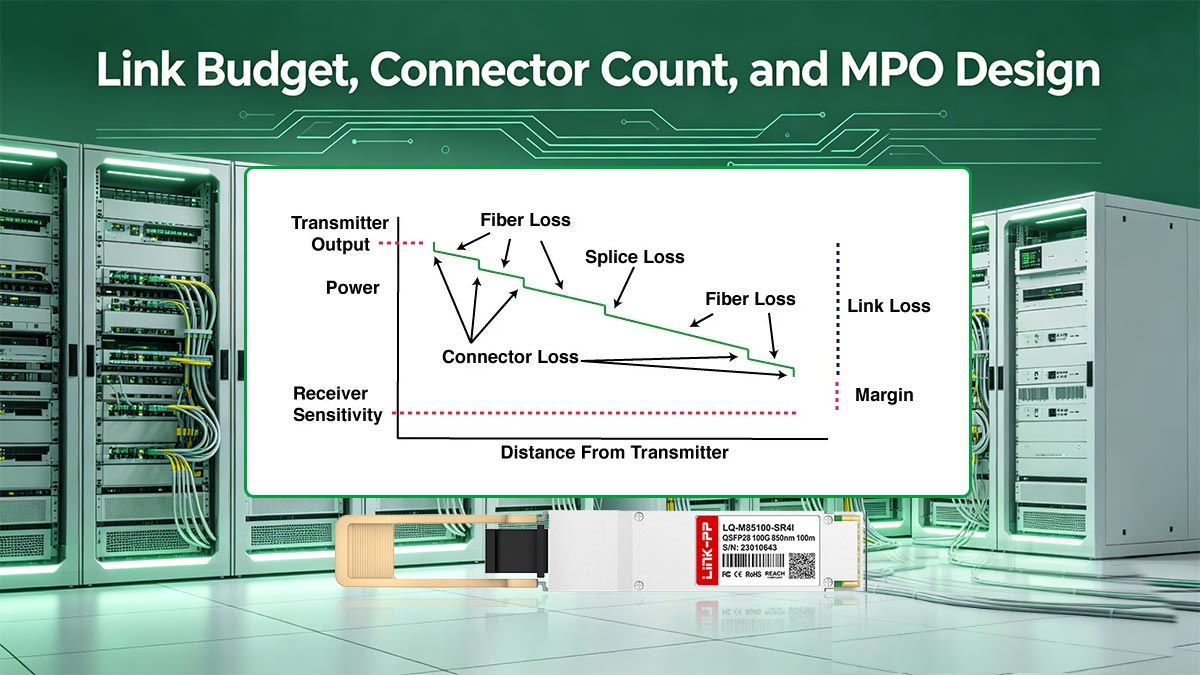
In other words, OM4 does not fail at 100G because of distance alone—it fails when the optical signal runs out of margin.
What Loss Budget Means In Plain English
The loss budget (or optical budget) is the total amount of signal loss a transceiver can tolerate before the link becomes unstable.
Think of it like this:
- The transmitter sends light at a certain power
- Every fiber segment and connector reduces that power
- The receiver needs a minimum signal level to operate correctly
If total loss exceeds the allowed budget, the link fails—even if the distance is within 100 meters.
For a typical 100GBASE-SR4 on OM4 link, the available loss budget is limited, so every component matters:
- Fiber attenuation (per meter)
- Connector insertion loss (per mating pair)
- Patch panels and cross-connects
This is why two “100m OM4 links” can behave very differently depending on how they are built.
Why MPO Matters In 100G Parallel Optics
Unlike duplex LC links, most 100G multimode systems use MPO/MTP connectors to support parallel transmission.
A typical SR4 link uses:
- 4 transmit fibers
- 4 receive fibers
- 1 MPO-12 connector (with 8 active fibers)
This architecture introduces several design sensitivities:
- Polarity (Type A/B/C): Incorrect polarity leads to Tx/Rx mismatch
- Fiber alignment: Parallel optics require precise lane alignment
- Insertion loss: Each MPO connection adds measurable loss
- Cleanliness: MPO connectors are more sensitive to dust and contamination
Because of these factors, MPO-based systems require more disciplined installation and testing than traditional LC links.
Common Reasons An OM4 Link Fails Margin
In real deployments, most OM4 100G issues are not caused by exceeding 100 meters—they are caused by margin loss within the channel.
Here are the most common failure points:
- Too many connectors in the path
Each additional MPO or patch panel increases insertion loss - Poor-quality or contaminated connectors
Dirty MPO end faces can dramatically reduce signal quality - Incorrect polarity or fiber mapping
A logical error that results in no link or unstable performance - Mixed components (fiber, patch cords, cassettes)
Inconsistent quality or mismatched specifications reduce predictability - Over-extended designs
Trying to push OM4 beyond 100m without validating the full link budget
Design Best Practices For Reliable OM4 100G Links
To ensure your OM4 deployment performs as expected:
- Minimize the number of MPO connection points
- Use high-quality, low-loss components
- Keep the channel design simple and consistent
- Always test and validate link loss before deployment
- Stay within standard distance limits unless fully engineered
Key takeaway: OM4 100G performance is not defined by fiber alone—it is defined by the entire optical channel. Even within 100 meters, poor MPO design or excessive connector loss can break the link. A well-engineered link, however, will deliver stable and predictable 100G performance on OM4 every time.
🟩 Real-World Deployment Scenarios
Understanding specs is useful—but most readers searching OM4 100G distance are really asking a practical question:
“What should I actually deploy in my network?”
The answer depends on how your links are used in real environments. Below are the most common deployment scenarios, along with clear guidance on when OM4 + 100GBASE-SR4 makes sense—and when it doesn’t.
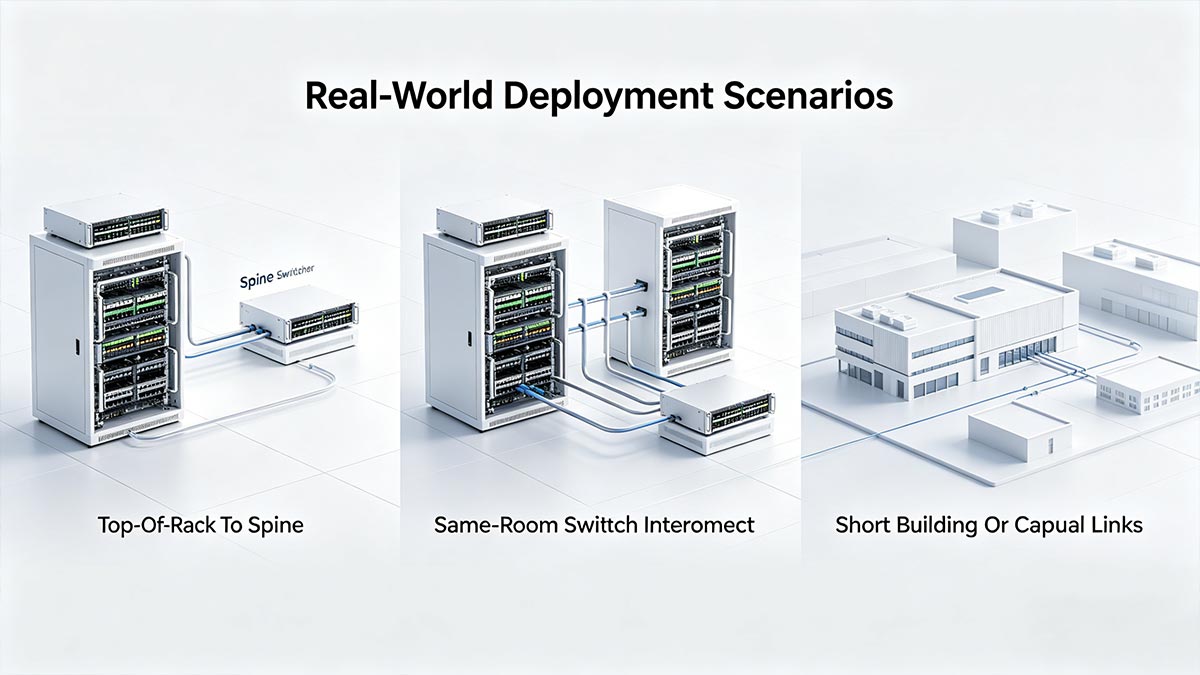
Top-Of-Rack To Spine
This is the most typical 100G use case in modern data centers.
- Distance: usually 5–50 meters
- Topology: leaf–spine architecture
- Cabling: high-density MPO
Recommended solution: → OM4 + 100GBASE-SR4
Why it works:
- Well within the 100m OM4 limit
- Optimized for short, high-bandwidth links
- Cost-effective for large-scale deployments
This is where OM4 delivers its best value—high performance with predictable cost and simple scaling.
Same-Room Switch Interconnect
This includes connections such as:
- Spine-to-spine
- Aggregation-to-core within the same row or room
- High-capacity east-west traffic links
- Distance: typically 30–100 meters
- Challenge: multiple patch panels or cross-connects
Recommended solution: → OM4 + SR4 (with careful link budget control)
Key considerations:
- Keep connector count low
- Validate total insertion loss
- Ensure proper MPO polarity and cleanliness
OM4 still works well here, but this is the range where poor design can break the link, even if you are under 100 meters.
Short Building Or Campus Links
This is where many deployment decisions become less obvious.
- Distance: 80–150 meters (sometimes slightly more)
- Environment: between rooms, floors, or nearby buildings
- Constraint: existing infrastructure vs new design
Recommended approach:
- ≤100m:
→ OM4 + SR4 is still a solid choice - 100–150m:
→ Carefully evaluate:- Link budget
- Connector count
- Whether specialized optics (e.g., BiDi/SWDM) are justified
- >150m or uncertain growth: → Switch to SMF (strongly recommended)
This is the decision boundary zone where many engineers reconsider OM4. While it may technically work in edge cases, SMF often becomes the more practical and future-proof option.
What About Short Metro Or Inter-Building Spans?
Some users attempt to extend OM4 into short metro or campus backbone links. While OM4 can work over very short external spans, it is generally not the preferred solution.
Why?
- Limited distance headroom
- Sensitivity to loss and environmental variation
- Lack of scalability beyond 100–150m
Recommended strategy: → Use single-mode fiber (SMF) for any structured backbone or metro-style deployment
Even if OM4 works initially, it creates long-term constraints for upgrades and expansion.
Practical Deployment Decision Summary
To simplify real-world choices:
- Inside racks / rows (≤50m): → OM4 + SR4 (ideal)
- Same room (≤100m): → OM4 + SR4 (with proper design)
- Between rooms/buildings (100–150m): → Conditional—validate carefully or consider SMF
- Campus / metro / future expansion: → SMF (best long-term solution)
Key takeaway: OM4 is excellent for short-reach, high-density 100G links, especially inside data centers. But as soon as distance, complexity, or future scalability comes into play, the decision often shifts toward single-mode fiber. The smartest deployments are not based on maximum distance—they are based on predictable performance and long-term flexibility.
🟩 Common Questions About OM4 100G Distance
1. How Far Can You Run OM4 Fiber?
For 100G Ethernet, the standard answer is:
- OM4 + 100GBASE-SR4: up to 100 meters
This is the most widely accepted and deployed configuration in modern data centers.
Some sources mention 150 meters, but this typically refers to:
- Older SR10 optics, or
- Specialized multimode solutions (e.g., BiDi/SWDM under specific conditions)
Practical answer: → Design for 100 meters to ensure reliable, standards-compliant performance.
2. Can OM4 Support 100G?
Yes—OM4 fully supports 100G Ethernet, and it is one of the most common fiber types used for short-reach 100G links.
Typical configuration:
- Optic: 100GBASE-SR4
- Connector: MPO/MTP
- Distance: up to 100 meters
OM4 is specifically optimized for high-speed multimode transmission, making it ideal for:
- Data center interconnects
- Leaf–spine architectures
- High-density cabling systems
3. What Is The Distance Of 100G Multimode?
The distance depends on the fiber type:
- OM3: up to 70 meters
- OM4: up to 100 meters
- OM5: typically 100–150 meters (with SWDM/BiDi optics)
These values apply to standard 100G short-range optics (SR4) unless otherwise specified.
Key insight: Multimode fiber is designed for short-distance, high-speed links. Beyond ~100–150 meters, single-mode fiber becomes the preferred solution.
4. Can OM3 Do 100G?
Yes, but with limitations.
- OM3 + 100GBASE-SR4: up to 70 meters
OM3 can support 100G, but:
- It has shorter reach than OM4
- It provides less margin for high-speed upgrades
- It is generally considered a legacy option for new deployments
Best practice:
→ Use OM3 only if it is already installed and the link distance is short.
→ For new designs, OM4 or SMF is recommended.
🟩 Conclusion: When OM4 Is Enough and When to Choose SMF
After analyzing OM4 100G distance from both a standards and real-world deployment perspective, the decision ultimately comes down to a simple question:
Does your link fit comfortably within OM4’s design limits—or are you pushing beyond them?
When OM4 Is Enough
OM4 remains an excellent choice for short-reach 100G deployments, especially when:
- Link distance is ≤ 100 meters
- You are using 100GBASE-SR4 optics
- The link budget is well-controlled (minimal connectors, low loss)
- The environment is a data center or high-density MPO system
In these scenarios, OM4 delivers:
- Reliable, standards-based performance
- Lower overall system cost for short links
- High-density scalability within the same environment
For most intra-data-center connections, OM4 is not just sufficient—it is optimal.
When To Choose SMF Instead
The moment your requirements move beyond OM4’s comfort zone, single-mode fiber (SMF) becomes the smarter choice.
You should strongly consider SMF when:
- Distance exceeds 100–150 meters
- The link includes multiple patch panels or complex routing
- You need higher reliability with more margin
- Future upgrades to QSFP56 200G / QSFP-DD 400G / OSFP 800G are planned
- You want to simplify cabling using duplex LC instead of MPO
SMF eliminates many of the constraints associated with multimode fiber:
- Greater distance flexibility (hundreds of meters to kilometers)
- Lower sensitivity to link loss and connector count
- Better long-term ROI for evolving network demands
A Practical Decision Rule
To simplify your design:
- Stay with OM4
→ If your link is short, simple, and clearly within 100m - Move to SMF
→ If you are near the limit, unsure about future growth, or designing beyond a single room
This approach avoids over-engineering while ensuring your network remains stable, scalable, and cost-efficient.
Ready To Choose The Right 100G Solution?
Whether you need OM4-based SR4 modules for short-reach links or SMF transceivers for long-distance scalability, selecting the right components is critical to network performance.
👉 Explore high-quality, fully compatible 100G optics and fiber solutions at the LINK-PP Official Store to match your exact deployment needs.
Choosing the right fiber is not just about distance—it is about building a network that works today and tomorrow.