


































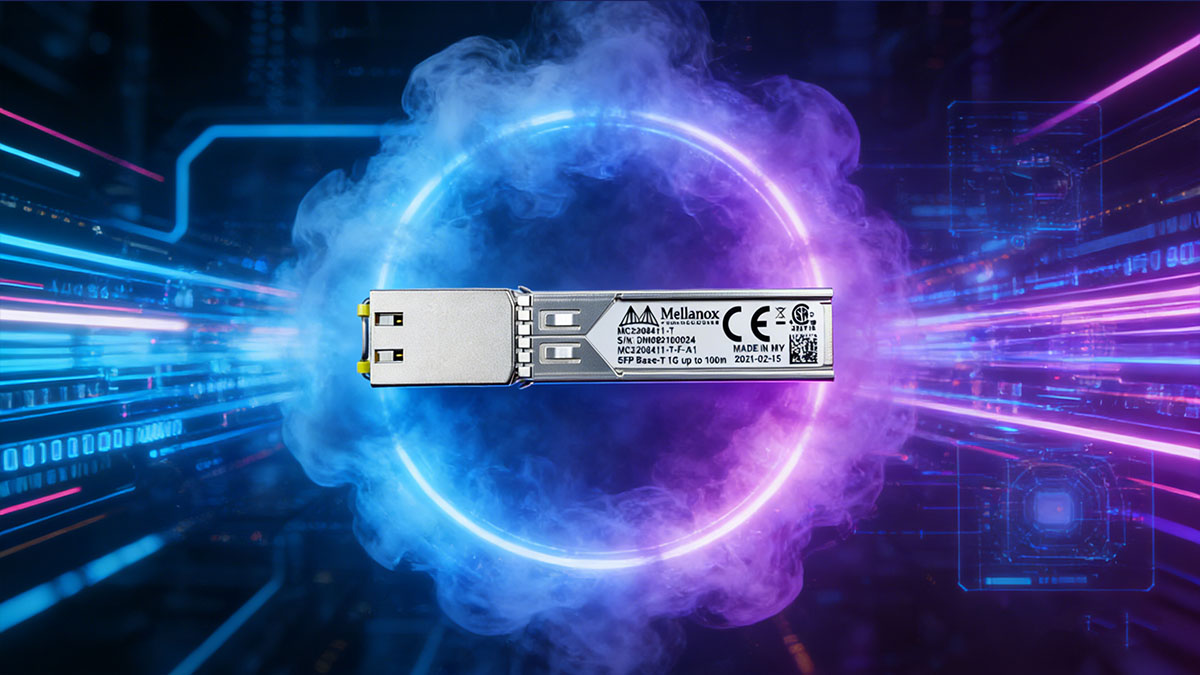
MC3208411-T is a 1000BASE-T copper transceiver module designed for reliable Gigabit Ethernet connectivity over standard twisted-pair cabling. As enterprises and data centers continue to balance performance, cost, and deployment flexibility, RJ45-based modules like MC3208411-T remain a practical solution for short-range connections where fiber is not always necessary.
Understanding how this module fits into a broader network environment is essential, especially when working across multi-vendor infrastructures. Compatibility, equivalent models, and deployment considerations can directly impact network stability and scalability. This is where a structured cross-reference approach becomes valuable, helping engineers identify interchangeable modules and avoid common interoperability issues.
This guide provides a detailed breakdown of MC3208411-T, including its specifications, compatibility with Mellanox and other platforms, and equivalent alternatives across different vendors. It also explores real-world use cases and key considerations to support efficient and flexible network design.
? Introduction to MC3208411-T
MC3208411-T is a Mellanox copper transceiver used to enable 1Gbps Ethernet connectivity over standard twisted-pair cabling, making it ideal for short-range links within 100 meters. It is commonly deployed to bridge SFP-based network equipment with existing copper infrastructure in enterprise and data center environments.
Overview of MC3208411-T
MC3208411-T is a 1000BASE-T RJ45 copper transceiver designed to deliver 1Gbps Ethernet connectivity over standard twisted-pair cabling, making it a practical choice for short-range network links up to 100 meters. It enables network devices with SFP ports to connect directly to copper-based infrastructure without requiring optical modules.
This module operates over widely deployed cabling systems such as Cat5e, Cat6, and Cat6a, which makes it highly suitable for environments where copper cabling is already in place. By converting SFP interfaces into RJ45 Ethernet ports, it bridges the gap between modern switching hardware and traditional structured cabling systems.
From a deployment perspective, MC3208411-T is commonly used in scenarios where cost efficiency, ease of installation, and flexibility are more important than ultra-high bandwidth. It is particularly relevant in access-layer networks, legacy infrastructure integration, and edge environments.
Importance of Cross-Reference Guides
A cross-reference guide helps identify compatible and equivalent modules across different vendors, ensuring that MC3208411-T can be deployed in diverse network environments without compatibility risks. This is especially important in multi-vendor infrastructures where interoperability is a key requirement.
In practical terms, using a cross-reference approach provides several benefits:
- Simplifies module selection when original vendor SKUs are unavailable
- Enables consistent network performance across mixed hardware environments
- Reduces operational complexity in large-scale deployments
- Helps avoid vendor lock-in by supporting broader compatibility
For network engineers and planners, having a clear mapping between MC3208411-T and its equivalents allows for more flexible design decisions and easier maintenance. It also ensures that performance expectations are met while maintaining interoperability across switches, routers, and network interface cards from different manufacturers.
? Key Specifications of MC3208411-T
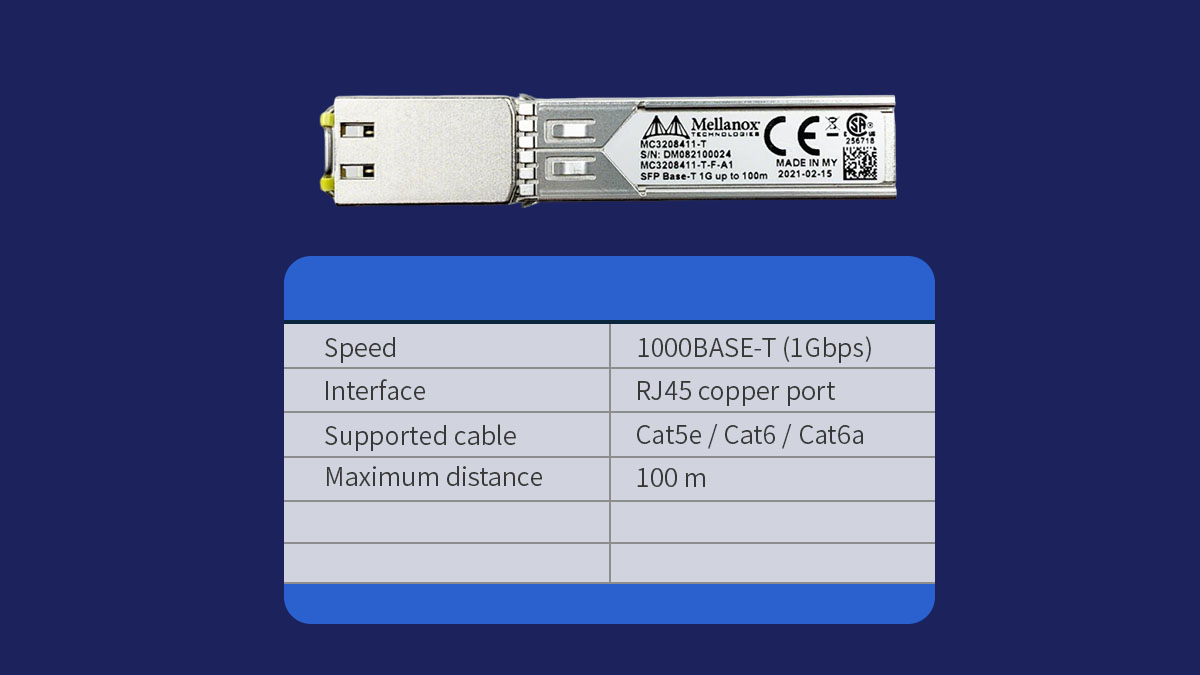
MC3208411-T is a 1000BASE-T copper SFP transceiver that delivers 1Gbps Ethernet over RJ45 interfaces, supporting up to 100 meters using standard Cat5e/6/6a cables. Its specifications are optimized for short-range, cost-efficient, and widely compatible network deployments.
Core Technical Parameters
MC3208411-T operates as a Gigabit copper transceiver with standard RJ45 connectivity, making it fully compatible with structured cabling systems commonly used in enterprise networks.
The key technical parameters can be summarized as follows:
| Parameter | Value | Description |
|---|---|---|
| Data Rate | 1Gbps | Supports 1000BASE-T Ethernet |
| Connector Type | RJ45 | Standard copper Ethernet interface |
| Cable Type | Cat5e / Cat6 / Cat6a | Twisted-pair copper cabling |
| Max Distance | 100 meters | Maximum reach over copper cable |
These specifications confirm that MC3208411-T is designed for short-distance communication using existing copper infrastructure, eliminating the need for fiber deployment in many scenarios.
Performance Characteristics
MC3208411-T provides stable Gigabit Ethernet performance with low latency and consistent throughput, making it suitable for access-layer and edge network environments.
From a performance perspective, several factors define its behavior:
- Latency: Slightly higher than fiber SFP modules due to electrical signal processing, but negligible for most enterprise applications
- Throughput: Full 1Gbps line-rate performance under standard conditions
- Power Consumption: Typically higher than optical transceiver due to PHY and signal processing requirements
- Thermal Output: Requires proper airflow in high-density switch deployments
These characteristics make it a reliable option where ultra-low latency is not critical but stability and compatibility are essential.
Compliance and Standards
MC3208411-T complies with the IEEE 802.3ab standard, ensuring interoperability with Gigabit Ethernet networks and consistent behavior across compliant devices.
Key compliance aspects include:
- IEEE 802.3ab: Defines 1000BASE-T Gigabit Ethernet over copper
- SFP MSA: Ensures mechanical and electrical compatibility with SFP ports
- RoHS Compliance: Meets environmental and safety regulations
Adhering to these standards ensures that the module can function correctly across a wide range of networking equipment while maintaining industry-recognized performance and safety requirements.
? MC3208411-T Compatibility Overview
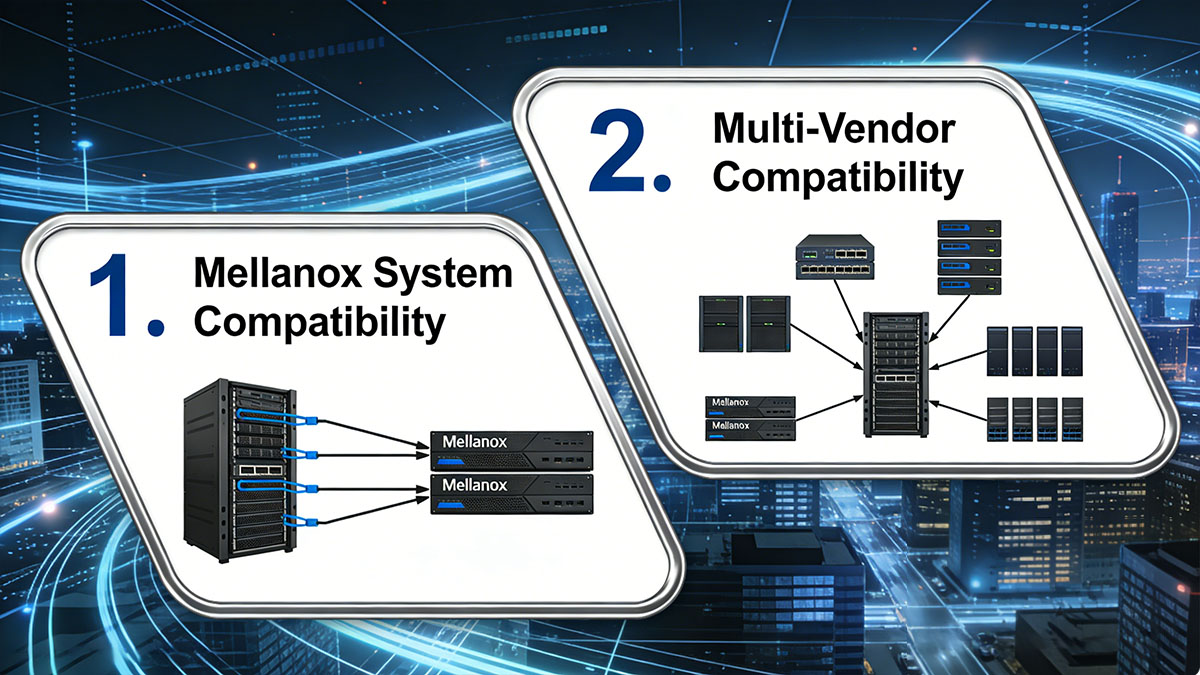
MC3208411-T is designed to work seamlessly with Mellanox devices while also supporting interoperability with many third-party platforms when properly coded, making it suitable for multi-vendor network environments. Its compatibility depends on firmware recognition, EEPROM configuration, and adherence to 1000BASE-T standards.
Mellanox System Compatibility
MC3208411-T is fully compatible with Mellanox switches and network interface cards, providing plug-and-play Gigabit Ethernet connectivity over RJ45 without additional configuration in most cases.
In Mellanox environments, compatibility is typically straightforward:
- Native support in Mellanox switches and NICs with SFP ports
- Automatic link negotiation for 10/100/1000Mbps speeds
- Stable operation with Mellanox firmware and OS environments
- Minimal risk of module rejection when using properly coded units
This makes MC3208411-T a reliable option for maintaining consistent performance within Mellanox-based infrastructures.
Multi-Vendor Compatibility
MC3208411-T can interoperate with devices from other vendors such as Cisco, Arista, Juniper, and HPE, provided the module is encoded to match the target platform requirements. This enables broader deployment flexibility beyond Mellanox ecosystems.
Compatibility across vendors depends on several key factors:
- EEPROM coding that aligns with the target vendor’s identification requirements
- Switch firmware policies regarding third-party modules
- Support for standard 1000BASE-T auto-negotiation
The following table highlights general compatibility considerations across common platforms:
| Vendor | Compatibility Level | Notes |
|---|---|---|
| Cisco | Conditional | May require Cisco-compatible coding |
| Arista | High | Generally open to third-party modules |
| Juniper | Conditional | Firmware-dependent behavior |
| HPE | Conditional | May enforce vendor checks |
In multi-vendor environments, selecting properly coded compatible transceivers is essential to avoid issues such as port shutdowns or warning messages.
Firmware and Interoperability Considerations
Compatibility is not only hardware-based but also influenced by firmware behavior, which can affect whether a module is accepted or rejected by a device.
Key considerations include:
- Some vendors implement strict validation checks that may block unsupported modules
- Firmware updates can change compatibility behavior over time
- Diagnostic monitoring (DDM) may vary between vendors
- Interoperability testing is recommended before large-scale deployment
To ensure stable operation, it is important to verify compatibility through vendor documentation, lab validation, or trusted compatibility matrices.
? Cross-Reference Equivalents for MC3208411-T
MC3208411-T can be mapped to equivalent 1000BASE-T RJ45 SFP modules from multiple vendors, enabling flexible deployment across different network platforms. These equivalents provide similar functionality, including 1Gbps speed, copper cabling support, and up to 100m transmission distance.
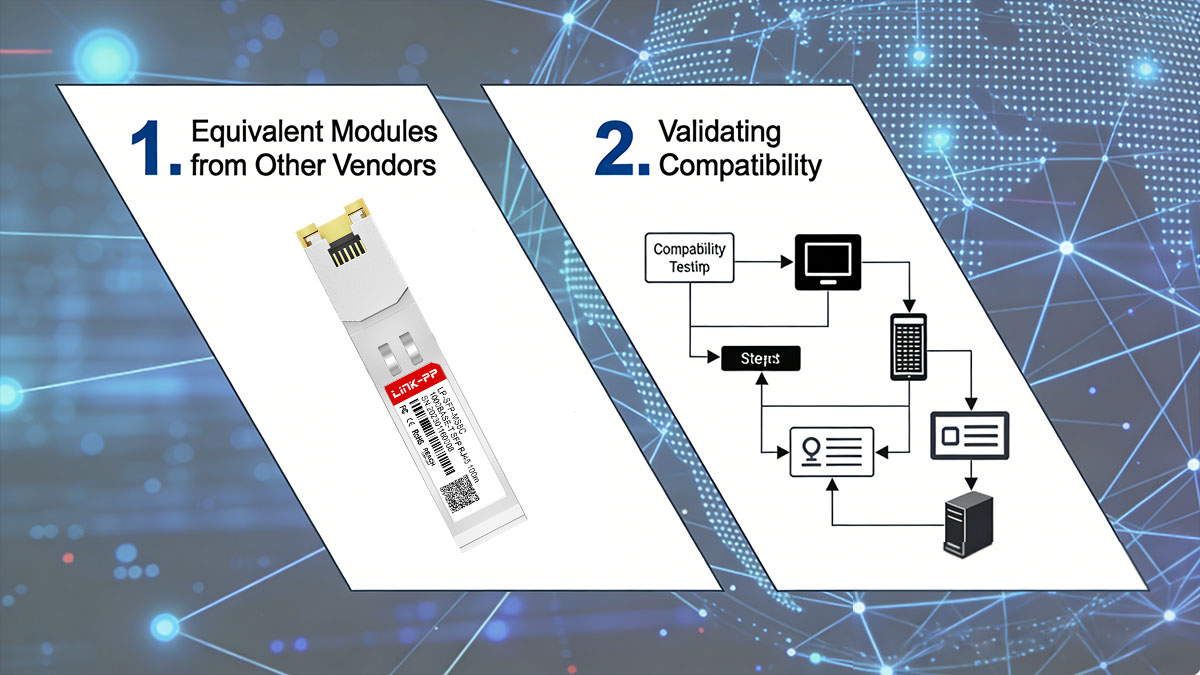
Equivalent Modules from Other Vendors
Several major networking vendors offer 1000BASE-T copper SFP modules that serve as functional equivalents to MC3208411-T, with similar specifications and use cases.
The following table outlines commonly referenced equivalents:
| Vendor | Model | Interface | Max Distance |
|---|---|---|---|
| Cisco | GLC-T | RJ45 | 100m |
| Arista | SFP-1G-T | RJ45 | 100m |
| Juniper | EX-SFP-1GE-T | RJ45 | 100m |
| Aruba | SFP-TX | RJ45 | 100m |
These modules are built around the same IEEE 802.3ab standard, which ensures consistent Gigabit Ethernet performance across platforms when compatibility requirements are met.
While the hardware capabilities are similar, differences may exist in vendor-specific firmware behavior, monitoring features, and compatibility enforcement.
Third-Party Compatible Alternatives
Third-party (like LINK-PP) compatible modules provide equivalent functionality to MC3208411-T while offering broader interoperability across different vendor systems through customized EEPROM coding.
These alternatives are typically characterized by:
- Multi-vendor compatibility through programmable identification
- Support for standard 1000BASE-T operation over RJ45
- Availability in versions tailored for specific platforms (e.g., Cisco-compatible, Arista-compatible)
The main advantage of third-party modules is their ability to function across multiple environments without requiring separate OEM-specific inventory. This is particularly beneficial in large-scale or mixed-vendor networks.
However, quality and compatibility can vary depending on the supplier, so selecting modules that undergo rigorous testing is important for ensuring consistent performance.
How to Validate Cross-Compatibility
Cross-compatibility should always be verified before deployment to ensure that equivalent modules function correctly within the target network environment.
A reliable validation process typically includes:
- Checking technical specifications
- Confirm 1000BASE-T support, RJ45 interface, and 100m distance
- Ensure compatibility with existing cabling (Cat5e or higher)
- Verifying vendor compatibility
- Review switch or NIC documentation for supported modules
- Confirm EEPROM coding matches the target platform
- Performing lab testing
- Test link establishment and auto-negotiation
- Monitor for errors, drops, or instability
- Reviewing firmware behavior
- Check for warning messages or port restrictions
- Validate performance under real traffic conditions
By following these steps, network engineers can confidently deploy alternatives to MC3208411-T while maintaining stable and predictable network performance.
? Use Cases of MC3208411-T and Its Alternatives
MC3208411-T and its equivalent 1000BASE-T modules are primarily used for short-range Ethernet connectivity over copper cabling, making them ideal for access-layer networks, enterprise environments, and edge deployments where fiber is not required. Their flexibility and compatibility allow them to support a wide range of practical networking scenarios.

Data Center Access Layer
MC3208411-T is commonly deployed in data center access layers to connect servers and switches using existing copper infrastructure, especially in top-of-rack (ToR) architectures.
Typical use cases in this layer include:
- Server-to-switch connections within the same rack or adjacent racks
- Management network interfaces (out-of-band management ports)
- Temporary or fallback links when fiber ports are limited
The following table summarizes its suitability in access-layer environments:
| Scenario | Suitability | Reason |
|---|---|---|
| Top-of-Rack (ToR) links | High | Short distance and easy deployment |
| Server management ports | High | Low bandwidth requirements |
| Spine layer connections | Low | Limited to 1Gbps bandwidth |
These use cases highlight that MC3208411-T is best suited for short-distance, moderate-bandwidth connections rather than high-capacity backbone links.
Enterprise Network Infrastructure
In enterprise networks, MC3208411-T enables seamless integration with structured cabling systems, allowing switches and routers to connect using standard RJ45 Ethernet.
Common enterprise scenarios include:
- Access layer connectivity in office LAN environments
- Uplink connections between access switches and aggregation switches (where 1Gbps is sufficient)
- Integration with legacy systems that rely on copper Ethernet ports
Its ability to leverage existing cabling infrastructure reduces the need for additional fiber deployment, simplifying installation and minimizing disruption.
Small-Scale or Edge Deployments
MC3208411-T is particularly effective in edge environments and small-scale networks where simplicity, cost efficiency, and ease of maintenance are priorities.
Typical edge deployment scenarios include:
- Branch offices and remote sites with limited infrastructure
- Retail locations and campus edge networks
- Industrial or IoT environments requiring stable Ethernet connectivity
In these scenarios, copper-based modules offer several practical advantages:
- Easier installation without specialized fiber handling
- Greater tolerance for frequent changes or reconfigurations
- Lower overall infrastructure complexity
As a result, MC3208411-T and its alternatives remain a reliable choice for extending network connectivity in environments where fiber deployment is unnecessary or impractical.
? Advantages of Using Compatible Modules
Compatible modules provide the same 1000BASE-T functionality as MC3208411-T while enabling greater flexibility across different vendors, making them a practical choice for scalable and cost-conscious network deployments. When properly validated, they can deliver comparable performance and interoperability in most environments.

Cost Efficiency
Compatible modules significantly reduce overall networking costs while maintaining standard Gigabit Ethernet performance, especially in large-scale deployments.
The cost advantage becomes more evident when comparing typical options:
| Module Types | Relative Cost | Deployment Impact |
|---|---|---|
| OEM Module | High | Higher capital expenditure |
| Compatible Module | Lower | More scalable deployments |
| Mixed Deployment | Moderate | Balanced cost and flexibility |
Lower per-unit cost allows organizations to scale their networks more efficiently without compromising on essential functionality such as 1Gbps connectivity and 100m copper reach.
Flexibility and Availability
Compatible modules offer greater deployment flexibility by supporting multiple vendor platforms and reducing dependency on a single supplier.
Key flexibility benefits include:
- Multi-vendor interoperability with proper EEPROM coding
- Easier sourcing due to broader market availability
- Reduced lead times compared to vendor-specific modules
- Simplified inventory management across different network environments
This flexibility is particularly valuable in dynamic environments where hardware diversity and rapid deployment are common.
Performance Reliability
Compatible modules can deliver stable and consistent performance comparable to OEM modules when they adhere to industry standards such as IEEE 802.3ab.
From a performance standpoint:
- Full support for 1Gbps Ethernet over RJ45
- Stable link establishment with auto-negotiation
- Consistent operation over standard Cat5e/6 cabling
- Reliable performance in typical enterprise temperature ranges
While performance parity is generally achievable, ensuring module quality and compatibility testing remains essential to avoid potential issues in critical network environments.
? Deployment Considerations
Deploying MC3208411-T and its compatible modules requires careful validation of compatibility, cabling, and network design to ensure stable 1Gbps connectivity over copper. Proper planning helps prevent common issues such as link instability, module rejection, or performance degradation.

Pre-Deployment Testing
Before deploying MC3208411-T in a production network, it is essential to verify compatibility and link performance under controlled conditions to avoid unexpected failures.
A structured testing approach typically includes:
- Hardware compatibility check
- Confirm the target switch or NIC supports 1000BASE-T SFP modules
- Verify the module is correctly coded for the target vendor
- Link establishment validation
- Ensure successful auto-negotiation (10/100/1000Mbps)
- Confirm stable link without intermittent drops
- Performance verification
- Test throughput close to 1Gbps line rate
- Monitor latency and packet loss under load
- Diagnostics and monitoring
- Check interface statistics (CRC errors, drops)
- Validate LED indicators and system logs
This pre-deployment process minimizes risks and ensures predictable behavior once the module is introduced into a live environment.
Network Design Implications
MC3208411-T should be deployed in scenarios that align with its 1Gbps bandwidth and 100m copper distance limitations to ensure optimal network performance.
The following table highlights key design considerations:
| Design Factor | Recommendation | Impact on Network |
|---|---|---|
| Link Distance | ≤100 meters | Ensures stable signal quality |
| Cable Type | Cat5e or higher | Reduces interference and loss |
| Port Speed Match | 1Gbps ports | Avoids speed mismatch issues |
| Network Layer | Access / Edge | Suitable for moderate traffic |
These factors indicate that MC3208411-T is best suited for access-layer or edge connectivity rather than high-throughput aggregation or core layers.
In addition, network planners should consider future scalability. While 1Gbps is sufficient for many use cases, higher bandwidth demands may require migration to 10GBASE-T (like SFP-10G-T-X) or fiber-based solutions.
Maintenance and Lifecycle Management
Ongoing monitoring and proper lifecycle management are essential to maintain stable operation and extend the usability of MC3208411-T modules.
Key maintenance practices include:
- Monitoring interface statistics regularly
- Detect early signs of degradation such as increasing error rates
- Ensuring cable integrity
- Replace damaged or low-quality cables to maintain signal quality
- Tracking firmware updates
- Be aware of changes that may affect third-party module compatibility
- Planning for upgrades
- Identify links approaching bandwidth limits
- Prepare migration paths to higher-speed technologies
By combining proactive monitoring with strategic planning, organizations can ensure long-term reliability while maintaining flexibility for future network evolution.
? Common Challenges and Troubleshooting
While MC3208411-T and its compatible modules are generally reliable, several challenges can arise during deployment and operation. Understanding these issues and knowing how to troubleshoot them ensures stable 1Gbps Ethernet connectivity over copper infrastructure.
Connectivity Issues
The most common challenges involve establishing or maintaining a stable link between the module and the network device.
Typical causes and solutions include:
- Cable-related problems
- Damaged or low-quality Cat5e/6 cables can cause intermittent connectivity or signal loss
- Solution: Inspect cables, replace with certified high-quality twisted-pair cabling
- Port mismatches
- Connecting to a non-Gigabit port can result in speed negotiation failures
- Solution: Ensure the connected ports are 1Gbps capable and configured for auto-negotiation
- Distance limitations
- Exceeding 100 meters can degrade signal quality
- Solution: Use fiber or shorter copper runs for longer distances
By addressing these physical and configuration-related issues first, most connectivity problems can be resolved quickly.
Compatibility Errors
Modules may occasionally be rejected or produce warning messages due to vendor-specific firmware restrictions.
Common causes include:
- EEPROM coding mismatch
- Third-party modules may require proper vendor-specific EEPROM coding
- Solution: Use modules certified for the specific switch or NIC platform
- Firmware restrictions
- Some vendors enforce strict validation that blocks unrecognized modules
- Solution: Verify module compatibility in vendor documentation or perform lab testing
Regular compatibility checks and proper module selection help avoid disruptions in multi-vendor environments.
Performance Optimization
Even when the module is recognized and the link is active, performance issues such as latency spikes, errors, or reduced throughput can occur.
Key optimization steps:
- Inspect cabling and connectors
- Loose connectors or poor-quality terminations can introduce errors
- Maintain proper cable management to minimize crosstalk
- Monitor error statistics
- Check interface counters for CRC errors, collisions, or dropped packets
- Use network monitoring tools to identify trends and address issues proactively
- Environmental considerations
- Ensure adequate airflow and ambient temperature control in switch racks
- Electrical interference from nearby equipment can affect copper links
By proactively addressing these factors, network engineers can maintain consistent performance and extend the operational life of MC3208411-T modules and their compatible alternatives.
? Future Trends in Copper Ethernet Modules
Copper-based 1G SFP modules like MC3208411-T will continue to play a role in enterprise and data center networks, especially for short-range connectivity, though trends are gradually shifting toward higher speeds and hybrid deployments. Understanding these trends helps plan for both current deployments and future network scalability.

Increasing Copper-to-Fiber Transition
While 1Gbps copper modules remain widely used, many networks are gradually adopting fiber solutions for higher bandwidth and longer-distance links.
Key trends include:
- Migration to 10GBASE-T or 25GBASE-T copper for upgraded access-layer performance
- Hybrid deployments combining fiber for core/spine layers and copper for access layers
- Legacy networks retaining 1Gbps copper for cost-effective short-range connectivity
Despite this shift, 1Gbps copper modules remain relevant in edge deployments, branch offices, and management networks where fiber may not be necessary.
Intelligent Module Monitoring
Future copper modules are increasingly integrating advanced monitoring capabilities, enabling better diagnostics and network management.
Emerging features include:
- Enhanced diagnostic monitoring (DDM/DOM) for link quality, temperature, and voltage
- Integration with software-defined networking (SDN) for real-time visibility
- Predictive alerts for degraded links before failures occur
These improvements make copper modules more manageable and help ensure network reliability, even in multi-vendor environments.
Cost-Effective Network Scaling
Copper modules continue to provide a cost-efficient way to expand or maintain networks without extensive infrastructure upgrades.
Trends in this area include:
- Wider adoption of compatible or multi-vendor modules to reduce dependency on OEM SKUs
- Flexible deployment strategies that allow incremental upgrades to other high-speed transceivers when needed
- Optimized inventory management by standardizing on modules that support multiple platforms
By leveraging these trends, organizations can balance performance, cost, and flexibility while preparing their networks for future demands.
Copper modules like MC3208411-T will remain a practical option for short-range Gigabit Ethernet connections, even as higher-speed and fiber-based solutions become more prevalent.
? Conclusion
MC3208411-T is a reliable 1000BASE-T copper SFP module that provides stable Gigabit Ethernet connectivity over standard RJ45 cabling. Its compatibility with Mellanox switches and NICs, along with equivalent modules from other vendors, makes it a flexible choice for access-layer, enterprise, and edge network deployments. By understanding its specifications, deployment considerations, and potential challenges, network engineers can ensure stable performance and efficient integration into multi-vendor environments.
For organizations seeking cost-effective and compatible 1000BASE-T modules, exploring the range of tested options at the LINK-PP Official Store can help streamline network planning and deployment while maintaining consistent Gigabit performance.







