


























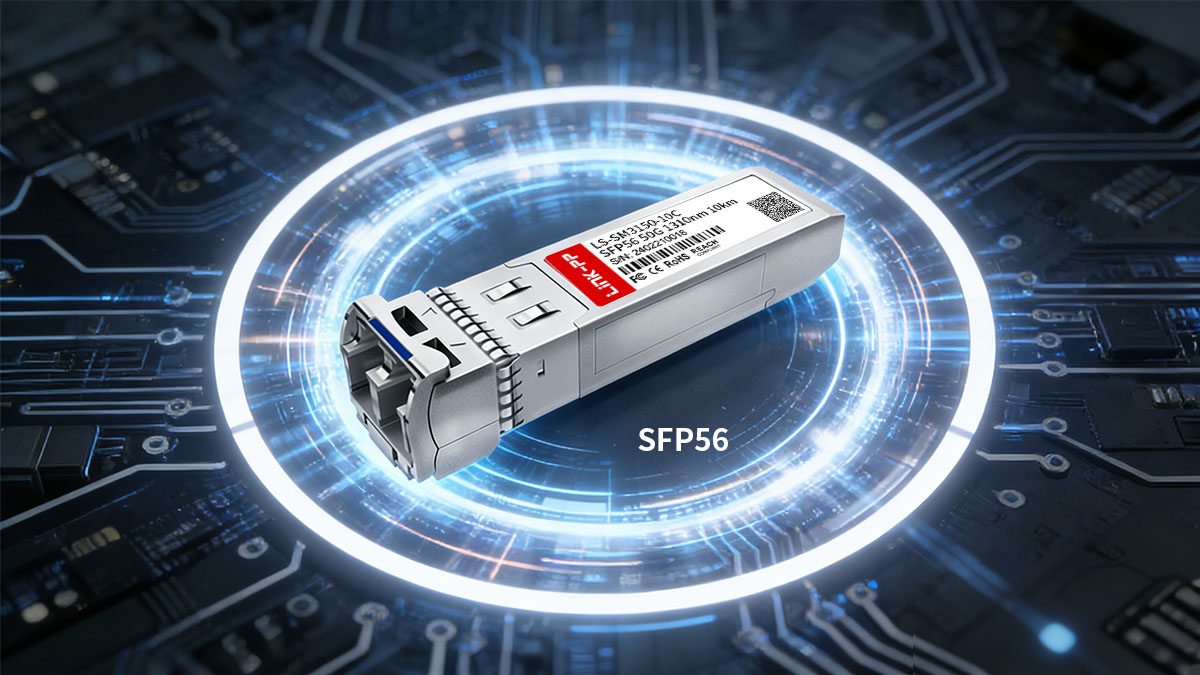
✅ SFP56 vs SFP28: Key Differences Explained
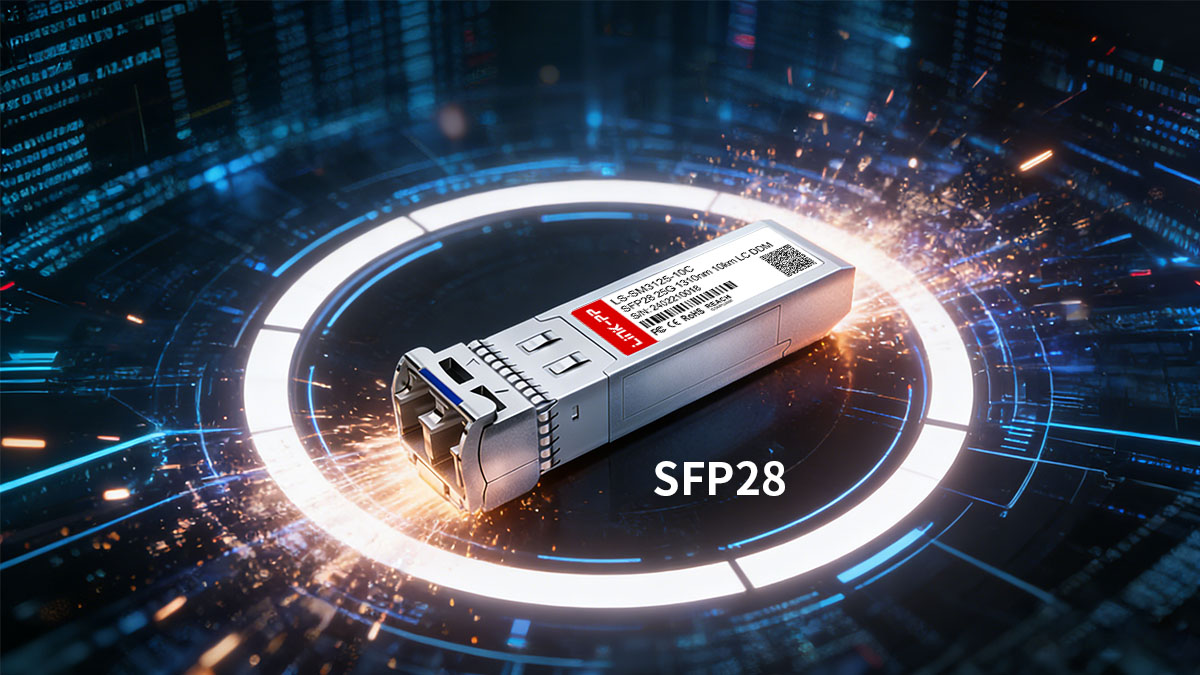
SFP56 and SFP28 share the same compact form factor, but they differ significantly in transmission speed, signaling technology, power consumption, and signal processing requirements. In practical deployments, SFP28 is optimized for 25GbE networks, while SFP56 is designed for higher-bandwidth 50GbE environments.
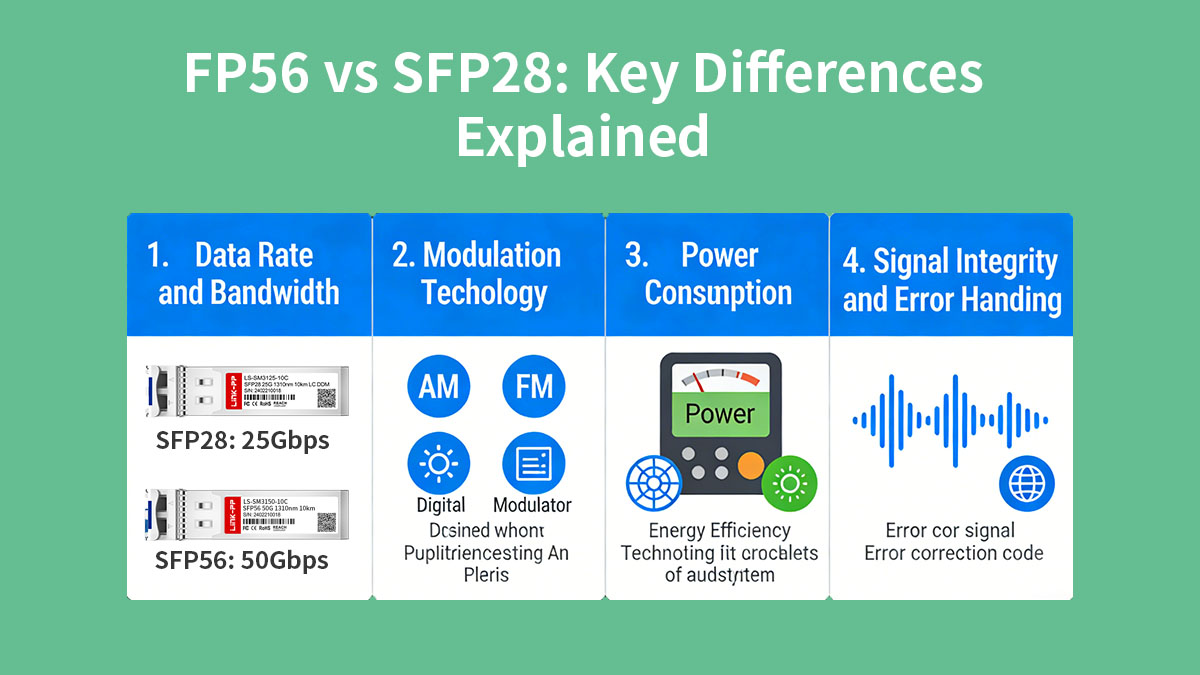
The sections below explain the main technical differences that influence performance and deployment decisions.
Data Rate and Bandwidth
The most direct difference between SFP56 and SFP28 is the supported data rate. SFP56 delivers twice the bandwidth of SFP28 over a single lane, making it suitable for networks that require higher throughput.
| Module Type | Maximum Data Rate | Typical Ethernet Standard |
|---|---|---|
| SFP28 | 25Gbps | 25GbE |
| SFP56 | 50Gbps | 50GbE |
Because SFP56 provides double the bandwidth per port, network architects can reduce the number of physical links required to support high-traffic workloads. This can simplify cabling and improve overall switch port utilization in large data center deployments.
Modulation Technology
The difference in signaling technology is what enables SFP56 to achieve higher bandwidth.
NRZ signaling uses two voltage levels to represent binary data, transmitting one bit per symbol. PAM4 uses four voltage levels, allowing two bits per symbol and effectively doubling the amount of data transmitted over the same electrical lane.
However, PAM4 signals are more sensitive to noise and distortion, which requires additional error correction and signal processing.
Power Consumption
Because of the additional digital signal processing and forward error correction required by PAM4 transmission, SFP56 modules typically consume more power than SFP28 modules.
| Module | Typical Power Consumption | Impact |
|---|---|---|
| SFP28 | ~1W–1.5W | Lower thermal load |
| SFP56 | ~2W–3W | Higher cooling requirements |
Higher power consumption may affect switch thermal design, especially in high-density environments where dozens of modules operate simultaneously.
For many enterprise networks where bandwidth demand is moderate, the lower power profile of SFP28 can still be advantageous.
Signal Integrity and Error Handling
SFP56 requires stronger error correction mechanisms to maintain reliable transmission due to the nature of PAM4 signaling.
| Feature | SFP28 | SFP56 |
|---|---|---|
| Signal Type | NRZ | PAM4 |
| Error Sensitivity | Lower | Higher |
| FEC Requirement | Optional in some cases | Typically required |
Forward Error Correction (FEC) is commonly used with SFP56 links to detect and correct transmission errors caused by signal degradation. While this improves reliability, it also introduces additional processing overhead within the network hardware.
In contrast, 25G SFP28 links are generally simpler to manage because NRZ signaling is more tolerant of noise and requires less complex signal processing.
Together, these differences explain why SFP28 remains widely used in many existing 25GbE infrastructures, while SFP56 is increasingly adopted in networks that demand higher throughput and scalability.
✅ Compatibility Between SFP56 and SFP28
SFP56 and SFP28 share the same physical form factor, but compatibility depends on the capabilities of the switch port and the supported data rates. In many modern networking platforms, SFP56 ports can operate at 25Gbps, allowing them to work with SFP28 modules. However, the reverse is generally not supported.
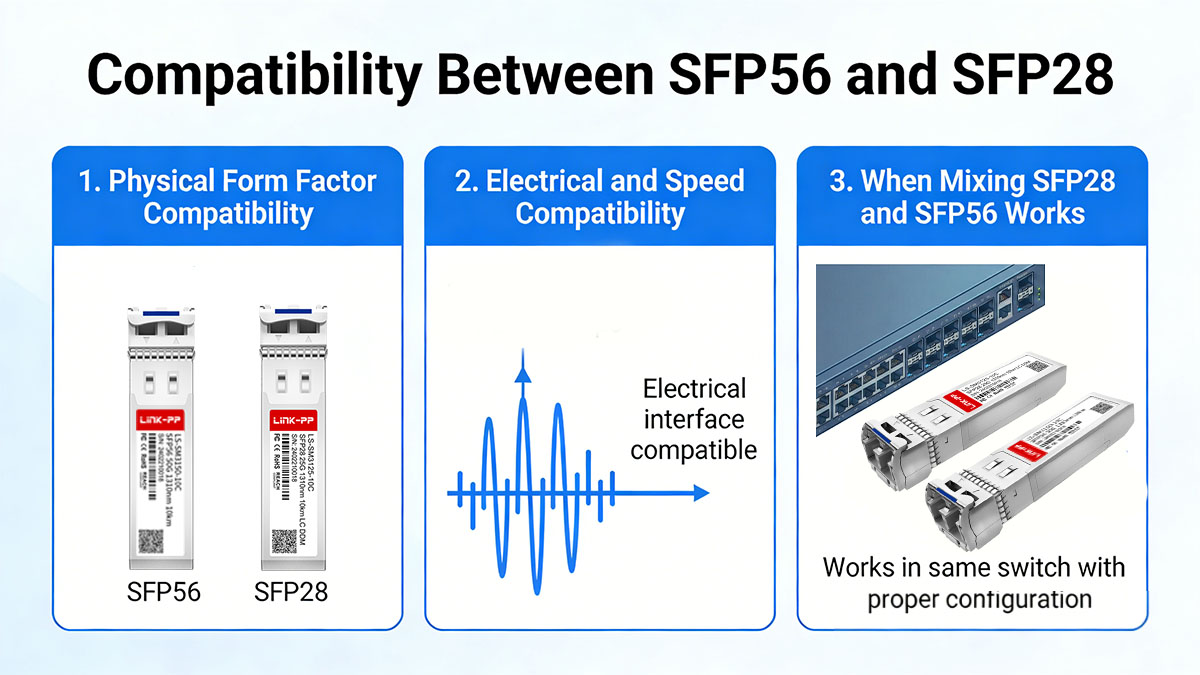
Understanding these compatibility rules is important when upgrading network infrastructure or mixing different module types in the same environment.
Physical Form Factor Compatibility
SFP56 and SFP28 modules use the same mechanical design, which means they fit into the same SFP-style ports on switches and network interface cards.
| Feature | SFP28 | SFP56 |
|---|---|---|
| Form Factor | SFP | SFP |
| Connector Type | LC | LC |
| Port Compatibility | SFP28 ports | SFP56 ports |
Because the physical dimensions and connector interfaces are identical, the modules can be inserted into the same port type without mechanical issues. This design allows hardware vendors to maintain high port density while supporting different Ethernet speeds.
However, physical compatibility does not always guarantee operational compatibility, which depends on the electrical interface and supported data rates.
Electrical and Speed Compatibility
Operational compatibility is primarily determined by whether the switch port supports multiple data rates.
| Port Type | Supports SFP28 Module | Supports SFP56 Module |
|---|---|---|
| SFP28 Port | Yes | No |
| SFP56 Port | Yes (25Gbps mode) | Yes |
An SFP56-capable port typically supports both 50Gbps and 25Gbps operation. In these cases, an SFP28 module can run at 25Gbps without issue.
In contrast, an SFP28 port is designed only for 25Gbps signaling and usually cannot support the PAM4 modulation required for SFP56 modules.
When Mixing SFP28 and SFP56 Works
Mixed deployments are common during network upgrades, especially when organizations transition from 25GbE to 50GbE infrastructure.
Typical situations where the modules can operate together include:
-
A switch with SFP56 ports running in 25Gbps mode
-
Gradual migration from 25GbE to 50GbE networks
-
Data center upgrades where legacy servers still use 25GbE NICs
However, compatibility ultimately depends on the switch chipset, firmware support, and port configuration. Before deploying mixed modules, it is recommended to verify:
-
Supported port speeds on the switch
-
Required Forward Error Correction (FEC) settings
-
Vendor compatibility guidelines for the specific hardware platform
By confirming these factors, network administrators can ensure stable operation when combining SFP28 and SFP56 modules in the same network environment.
✅ SFP56 vs SFP28: Performance Comparison Table
SFP56 and SFP28 are built on the same compact form factor, but they differ in several core performance characteristics such as data rate, modulation method, transmission reach, and power consumption. The following comparison highlights the most relevant technical differences that affect network design and deployment decisions.
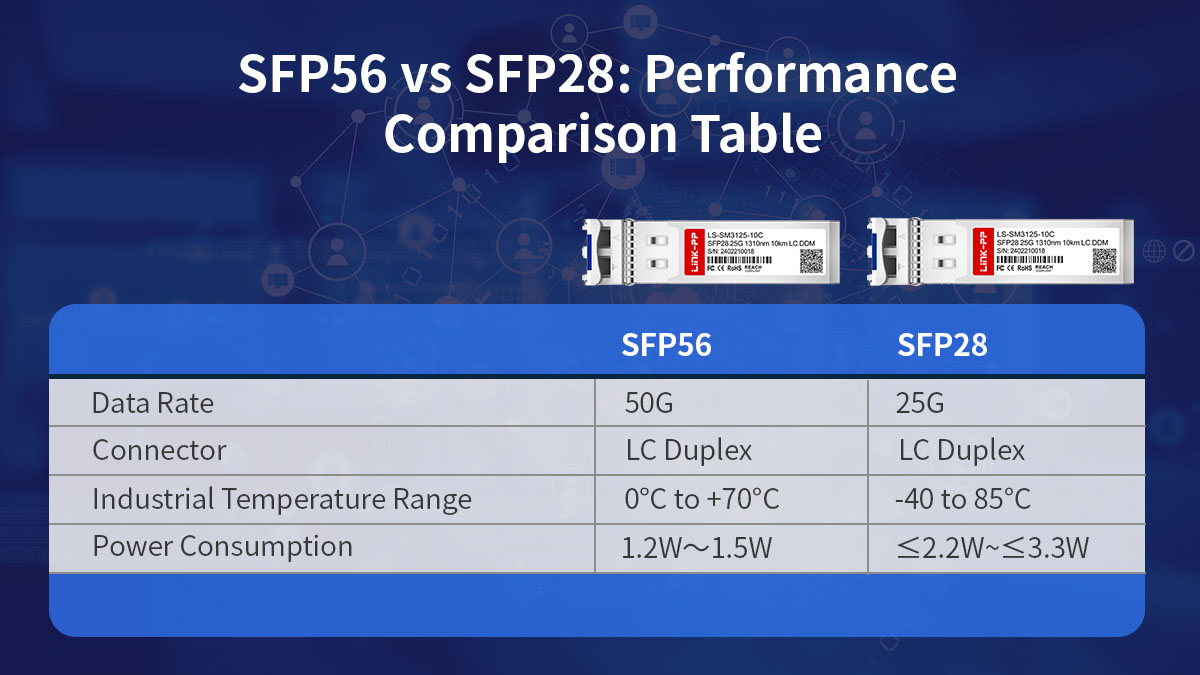
Side-by-Side Technical Comparison
The table below summarizes the main specifications of SFP56 and SFP28 modules.
| Parameter | SFP28 | SFP56 |
|---|---|---|
| Maximum Data Rate | 25Gbps | 50Gbps |
| Modulation | NRZ | PAM4 |
| Typical Reach | 100m–10km (depending on optics) | 100m–2km+ (depending on optics) |
| Typical Power Consumption | ~1W–1.5W | ~2W–3W |
| FEC Requirement | Optional in some cases | Typically required |
| Typical Applications | 25GbE data center networks | 50GbE high-performance networks |
From a performance perspective, SFP56 primarily improves bandwidth efficiency by doubling the data rate per lane compared with SFP28. This allows network operators to increase link capacity without increasing port density.
However, the use of PAM4 signaling in SFP56 also introduces additional complexity in signal processing and error correction. As a result, SFP28 modules generally offer lower power consumption and simpler deployment, which is why they remain widely used in many existing 25GbE infrastructures.
In practice, the choice between SFP28 and SFP56 often depends on whether the network prioritizes higher throughput or power-efficient, mature 25GbE connectivity.
✅ When Should You Choose SFP28?
SFP28 is the preferred choice when a network requires reliable 25Gbps connectivity with lower power consumption, mature ecosystem support, and cost efficiency. It is widely deployed in enterprise and data center environments where 25GbE provides sufficient bandwidth for most workloads.
Although newer technologies such as SFP56 provide higher speeds, SFP28 remains a practical solution for many infrastructures due to its stability and broad hardware compatibility.
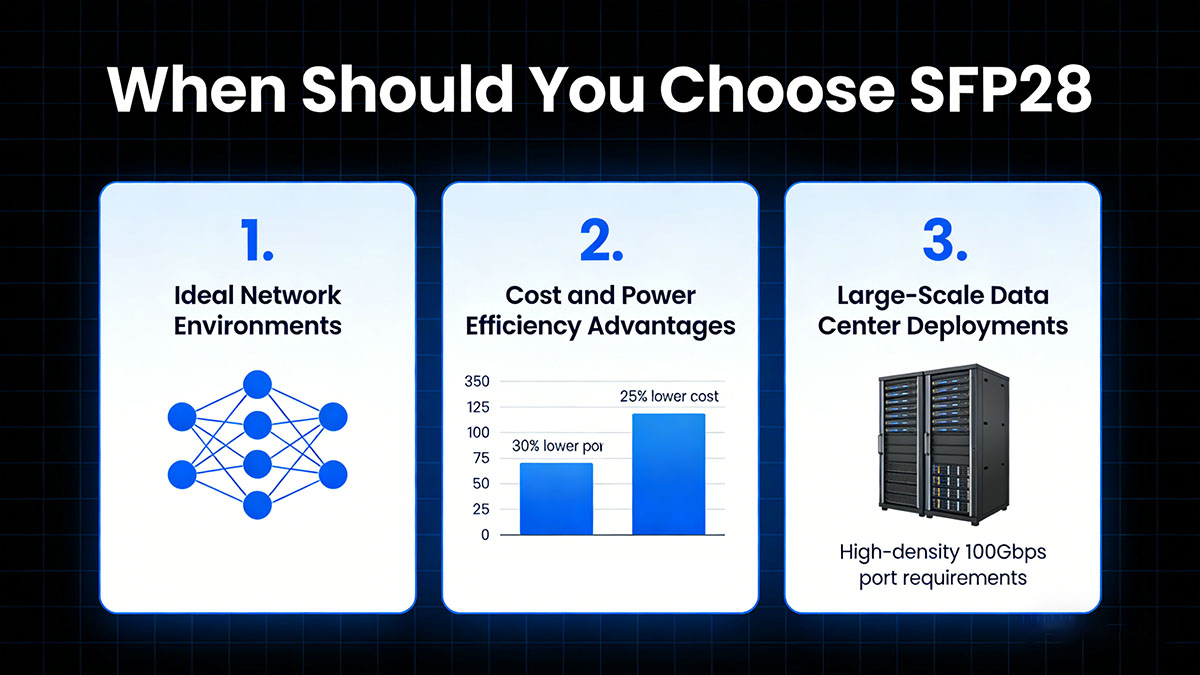
Ideal Network Environments
SFP28 is commonly used in network environments where 25GbE offers the right balance between performance and infrastructure efficiency.
Typical deployment environments include:
-
Data center top-of-rack switches connecting to servers
-
Leaf–spine architecture built around 25GbE links
-
Enterprise networks upgrading from 10GbE
-
Storage networks that require higher throughput than 10GbE but do not require 50GbE
In these scenarios, 25GbE connectivity is often sufficient to support application workloads while maintaining predictable performance.
Cost and Power Efficiency Advantages
One of the main reasons organizations continue to deploy SFP28 modules is their favorable balance between performance and operational cost.
| Factor | SFP28 Advantage | Impact |
|---|---|---|
| Module Cost | Generally lower | Reduces hardware investment |
| Power Consumption | Lower than SFP56 | Less thermal load on switches |
| Technology Maturity | Widely deployed | Stable ecosystem and support |
Because SFP28 modules typically consume less power and generate less heat, they are well suited for high-density switch environments where thermal management is an important consideration.
Large-Scale Data Center Deployments
SFP28 is widely adopted in large-scale data centers where predictable performance and operational efficiency are critical.
Several factors contribute to its popularity in these environments:
-
Mature 25GbE infrastructure across servers, switches, and NIC
-
High port density enabled by the compact SFP form factor
-
Broad compatibility across networking vendors
-
Proven reliability in production environments
For many organizations, continuing to use SFP28 modules allows them to maintain a stable network architecture while supporting gradual infrastructure upgrades when higher bandwidth becomes necessary.
✅ When Should You Choose SFP56?
SFP56 is the better choice when a network requires higher bandwidth per port and improved scalability beyond 25GbE. By supporting 50Gbps transmission on a single lane, SFP56 allows network operators to increase capacity without increasing the number of physical connections.
This makes SFP56 particularly suitable for modern data center environments where traffic growth, distributed computing, and high-performance workloads place increasing demands on network infrastructure.
High-Bandwidth Workloads
SFP56 is commonly deployed in environments where network traffic volumes exceed what 25GbE links can efficiently handle.
Typical high-bandwidth workloads include:
-
AI and machine learning training clusters
-
High-performance computing (HPC) environments
-
Large-scale cloud platforms handling heavy east–west traffic
-
Distributed storage systems requiring faster node-to-node communication
In these scenarios, doubling the link bandwidth from 25Gbps to 50Gbps can significantly improve data transfer efficiency and reduce network congestion.
Future-Proof Network Design
Organizations planning long-term infrastructure upgrades often adopt SFP56 to support future bandwidth growth while maintaining the same compact form factor.
Key advantages in forward-looking network designs include:
-
Higher throughput per port without increasing hardware footprint
-
Reduced number of required links for the same bandwidth capacity
-
Improved scalability for growing application workloads
These characteristics make SFP56 a practical option for networks that anticipate increasing traffic demands over the coming years.
Migration Toward Higher-Speed Architectures
SFP56 can also serve as a transitional step toward higher-speed networking architectures.
| Network Stage | Typical Link Speed | Role of SFP56 |
|---|---|---|
| Legacy data center | 10GbE | Upgrade path to 25GbE or higher |
| Modern infrastructure | 25GbE | Higher-capacity alternative |
| Next-generation networks | 50GbE / 100GbE | Supports higher throughput per lane |
Because SFP56 maintains the same physical interface as other SFP modules while increasing bandwidth, it can help simplify network upgrades while preserving port density and hardware compatibility.
For organizations planning to support faster data-intensive applications, deploying SFP56 modules can provide the additional capacity needed to maintain consistent network performance.
✅ Cost Considerations: SFP56 vs SFP28
When comparing SFP56 and SFP28 modules, cost is an important factor in network planning. While SFP56 provides higher bandwidth, SFP28 often offers a lower initial investment and lower operational costs. The overall cost difference depends not only on the module price but also on infrastructure compatibility, power consumption, and long-term scalability.
Understanding these factors helps organizations evaluate the total cost of ownership when choosing between 25GbE and 50GbE connectivity.
Module Pricing Differences
In general, SFP56 modules are more expensive than SFP28 modules because they support higher data rates and require more advanced signal processing technology.
| Module Type | Typical Relative Price | Reason |
|---|---|---|
| SFP28 | Lower | Mature 25GbE ecosystem |
| SFP56 | Higher | Newer technology and PAM4 signaling |
The pricing gap may vary depending on the module type (SR, LR, DAC, or AOC), but SFP28 typically remains the more economical option for networks that do not require 50Gbps bandwidth.
Because SFP28 has been widely deployed for several years, its manufacturing process and supply chain are also more mature, which helps keep prices stable.
Infrastructure Upgrade Costs
The cost impact of choosing SFP56 instead of SFP28 can also depend on whether existing networking hardware supports 50GbE connectivity.
Key infrastructure considerations include:
-
Switch ports must support SFP56 and 50Gbps signaling
-
Network interface card (NICs) must support 50GbE speeds
-
Firmware and chipset support may be required for PAM4 signaling
-
Forward Error Correction (FEC) configuration may need to be enabled
If an existing network is built around 25GbE equipment, upgrading to SFP56 may require replacing switches or NICs, which can significantly increase deployment costs.
Total Cost of Ownership
Beyond initial hardware pricing, long-term operational factors also influence the overall cost of a network deployment.
| Cost Factor | SFP28 | SFP56 |
|---|---|---|
| Module Cost | Lower | Higher |
| Power Consumption | Lower | Higher |
| Bandwidth per Port | 25Gbps | 50Gbps |
| Scalability | Moderate | Higher |
Although SFP56 modules typically cost more, they can deliver twice the bandwidth per port. In environments where bandwidth demand is growing rapidly, this increased capacity may reduce the number of required links and improve overall network efficiency.
As a result, organizations often evaluate both short-term hardware cost and long-term scalability before deciding whether SFP28 or SFP56 is the more suitable option.
✅ Future Trends in SFP Optical Modules
The development of SFP optical modules closely follows the evolution of Ethernet speeds in modern networks. As data centers process increasing volumes of east–west traffic, network architectures are gradually moving from 25GbE toward 50GbE and higher-speed connectivity.
Technologies such as PAM4 signaling and incremental upgrade strategies are helping organizations expand bandwidth while maintaining existing infrastructure where possible.
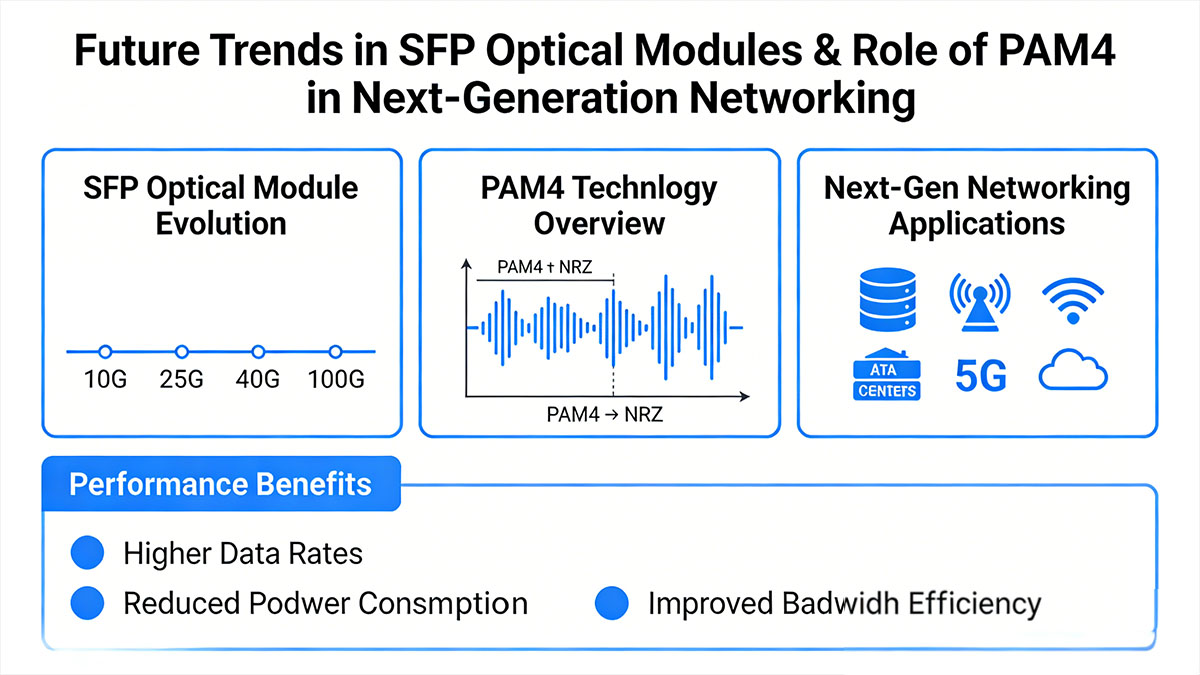
Growth of 50GbE and 100GbE Architectures
50GbE and 100GbE architectures are becoming more common in large-scale data centers, particularly in hyperscale and cloud environments where traffic volumes grow rapidly.
Several factors are driving this shift:
-
Hyperscale data centers require higher bandwidth between servers and switches
-
Cloud platforms generate large volumes of east–west traffic
-
AI workloads and distributed storage systems demand faster interconnects
-
Higher-speed links reduce the number of physical connections required
| Deployment Environment | Typical Server Link | Aggregation Link |
|---|---|---|
| Traditional enterprise | 10GbE | 40GbE |
| Modern data center | 25GbE | 100GbE |
| Hyperscale / cloud | 50GbE | 100GbE / 200GbE |
In many hyperscale environments, 50GbE links based on SFP56 modules are increasingly used for server connectivity, while higher-speed QSFP-based modules support aggregation and backbone layers.
Role of PAM4 in Next-Generation Networking
PAM4 signaling plays a key role in enabling higher data rates without increasing the number of physical lanes. By transmitting two bits of data per symbol, PAM4 effectively doubles bandwidth compared with traditional NRZ signaling.
| Signaling Method | Voltage Levels | Data per Symbol |
|---|---|---|
| NRZ | 2 | 1 bit |
| PAM4 | 4 | 2 bits |
This signaling technology is widely used in modern Ethernet standards such as 50GbE, 100GbE, and beyond. By increasing bandwidth per lane, PAM4 allows optical modules like SFP56 to deliver higher throughput while maintaining compact form factors.
Although PAM4 requires stronger error correction and more advanced signal processing, it enables scalable network architectures capable of supporting rapidly growing traffic demands.
Migration Path from 25G to 50G
Many organizations adopt a gradual migration strategy when moving from 25GbE infrastructure to higher-speed networks. Because SFP28 and SFP56 share the same physical form factor, upgrading can often be performed incrementally.
Common upgrade strategies include:
-
Deploying switches with ports that support both 25GbE and 50GbE
-
Continuing to use SFP28 modules while introducing SFP56 in high-traffic links
-
Upgrading server NICs to support 50GbE in performance-critical environments
-
Expanding bandwidth gradually without replacing the entire network
| Upgrade Stage | Server Connection | Typical Module |
|---|---|---|
| Existing deployment | 25GbE | SFP28 |
| Mixed environment | 25GbE / 50GbE | SFP28 + SFP56 |
| Future architecture | 50GbE | SFP56 |
This incremental approach allows network operators to scale bandwidth based on real workload demands while controlling infrastructure costs and minimizing operational disruption.
✅ FAQs About SFP56 vs SFP28
Can an SFP56 port run an SFP28 module?
Yes. Many switches with SFP56 ports support multiple data rates, including 25Gbps. In these cases, an SFP28 module can operate normally in a port configured for 25GbE.
Can an SFP28 port support an SFP56 module?
No. SFP28 ports are designed for 25Gbps NRZ signaling and typically cannot support the PAM4 modulation required by 50Gbps SFP56 modules.
Is SFP56 always better than SFP28?
Not necessarily. SFP56 provides higher bandwidth, but SFP28 may be more suitable for networks that prioritize lower power consumption, lower cost, and established 25GbE infrastructure.
What type of fiber is used with SFP28 and SFP56 modules?
Both module types can operate with multimode fiber for short distances and single-mode fiber for longer links, depending on the optical standard such as SR, LR, or FR.
Are SFP56 modules compatible with existing SFP ports?
SFP56 modules share the same physical form factor as SFP and SFP28, but they require switch ports that support 50Gbps signaling. Physical fit does not guarantee functional compatibility.
Which environments benefit most from SFP56?
SFP56 is commonly used in high-bandwidth environments such as AI clusters, cloud data centers, and high-performance computing networks where 50Gbps connectivity improves data transfer efficiency.
✅ Conclusion
SFP28 and SFP56 are both designed to deliver high-speed connectivity within the compact SFP form factor, but they serve different stages of network evolution. SFP28 remains a widely deployed solution for 25GbE networks, offering lower power consumption, mature ecosystem support, and cost efficiency. In contrast, SFP56 doubles the bandwidth per lane to 50Gbps through PAM4 signaling, making it well suited for environments that require higher throughput, such as AI clusters, hyperscale data centers, and high-performance computing infrastructures.
When choosing between SFP56 vs SFP28, the decision typically depends on several factors, including current bandwidth requirements, infrastructure compatibility, and long-term scalability plans. Networks that already rely on 25GbE often continue to benefit from the stability and efficiency of SFP28, while organizations planning higher-capacity architectures may adopt SFP56 to support future growth.
For organizations evaluating optical transceivers for 25GbE or 50GbE deployments, selecting reliable and fully compatible modules is essential for maintaining stable network performance. The LINK-PP Official Store offers a wide range of compatible SFP28 and SFP56 optical modules designed for enterprise and data center environments, helping businesses build scalable and cost-efficient network infrastructure.