



































In modern data environments, the SFP LC-LC fiber link has emerged as the foundational architecture for high-speed connectivity. By pairing the versatile SFP transceiver with the compact footprint of the LC duplex connector, network engineers can achieve the high port density required by today’s enterprise switches and routers. This combination not only maximizes rack space but also provides the modular flexibility needed to scale bandwidth from 1G to 25G and beyond without overhauling physical infrastructure.
Beyond simple space-saving, the fiber SFP LC-LC interface is synonymous with industrial-grade reliability. As data centers migrate toward complex spine-leaf architectures and low-latency storage area networks (SAN), the precision of the LC connector’s ceramic ferrule ensures minimal insertion loss and robust signal integrity. Whether linking distribution layers in a campus network or managing top-of-rack cabling, understanding the technical nuances of these links is critical for building a resilient, future-proof fiber backbone.
💥 Introduction to SFP LC-LC Connectivity in Modern Networks
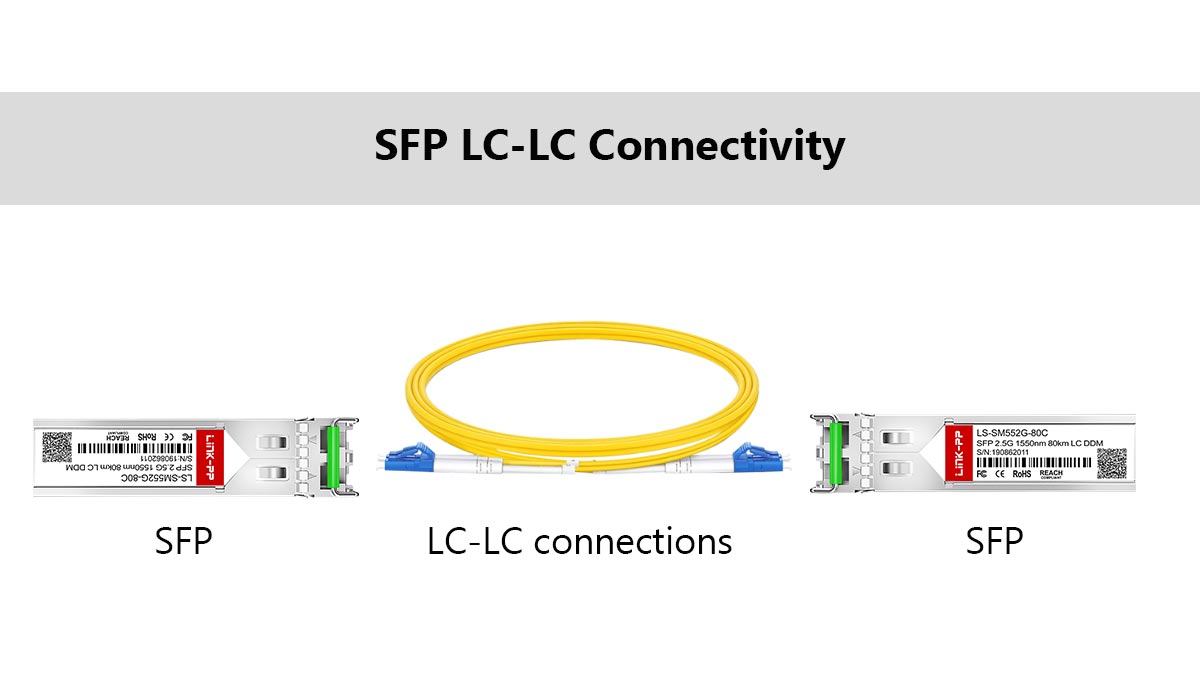
In the rapidly evolving landscape of telecommunications, SFP LC-LC connectivity serves as the essential bridge between active networking hardware and the passive fiber infrastructure. This architecture leverages the modularity of pluggable optics transceivers and the precision of small-form-factor connectors to support the rigorous bandwidth demands of modern data centers and enterprise environments.
Understanding the Role of SFP Transceiver Modules
Small Form-factor Pluggable (SFP) transceiver modules are hot-swappable, compact optical transceivers that convert electrical signals from switches or routers into optical signals for fiber transmission. Their primary value lies in their flexibility; they allow network administrators to upgrade or change fiber types (such as moving from multimode to single-mode) simply by swapping the module rather than replacing the entire networking line card.
These optical modules act as the "brain" of the SFP LC-LC link, determining the transmission speed, distance capability, and operational wavelength. By standardizing the interface, SFP modules enable a highly customizable hardware environment where different brands and types of equipment can communicate seamlessly across a unified fiber plant.
Why LC-LC Duplex Connectors are the Industry Standard
The LC (Lucent Connector) duplex connector has become the definitive choice for high-speed fiber links due to its "small form factor" design, which is roughly half the size of older SC or ST connectors. Its pull-proof design and familiar RJ-45 style latching mechanism ensure a secure, tactile connection that resists accidental disconnects, making it ideal for the high-vibration environments of busy server rooms.
In an SFP LC-LC configuration, the duplex LC connector facilitates two-way communication — one fiber for transmitting (TX) and one for receiving (RX). This symmetry is crucial for duplex data flow, and the connector’s 1.25mm ceramic ferrule provides the precision alignment necessary to maintain low optical loss, which is vital for maintaining signal integrity at higher data rates.
The Evolution of High-Density Fiber Patching
As the demand for data grows, the physical space within server racks has become premium real estate. The evolution toward high-density patching was driven by the need to pack more ports into the same 1U or 2U footprint. The transition to SFP LC-LC connectivity allowed for a dramatic increase in port density, enabling up to 144 fibers in a single rack unit compared to the bulky legacy systems of the past.
Modern high-density patching isn't just about shrinking components; it's about smarter cable management. Today's LC-LC solutions often incorporate "push-pull" tabs and ultra-slim uniboot cables, which alleviate cable congestion and improve airflow within the rack. This evolution ensures that as networks scale toward 400G and beyond, the physical layer remains manageable, organized, and thermally efficient.
💥 Core Technical Specifications of SFP LC-LC Interfaces
The performance and compatibility of SFP LC-LC links are governed by strict physical and optical parameters that ensure data integrity over varying distances. Understanding these core specifications — ranging from light wavelengths to signal attenuation standards — is essential for designing a stable and efficient fiber optic plant.
Matching Wave-lengths: 850nm, 1310nm, and 1550nm
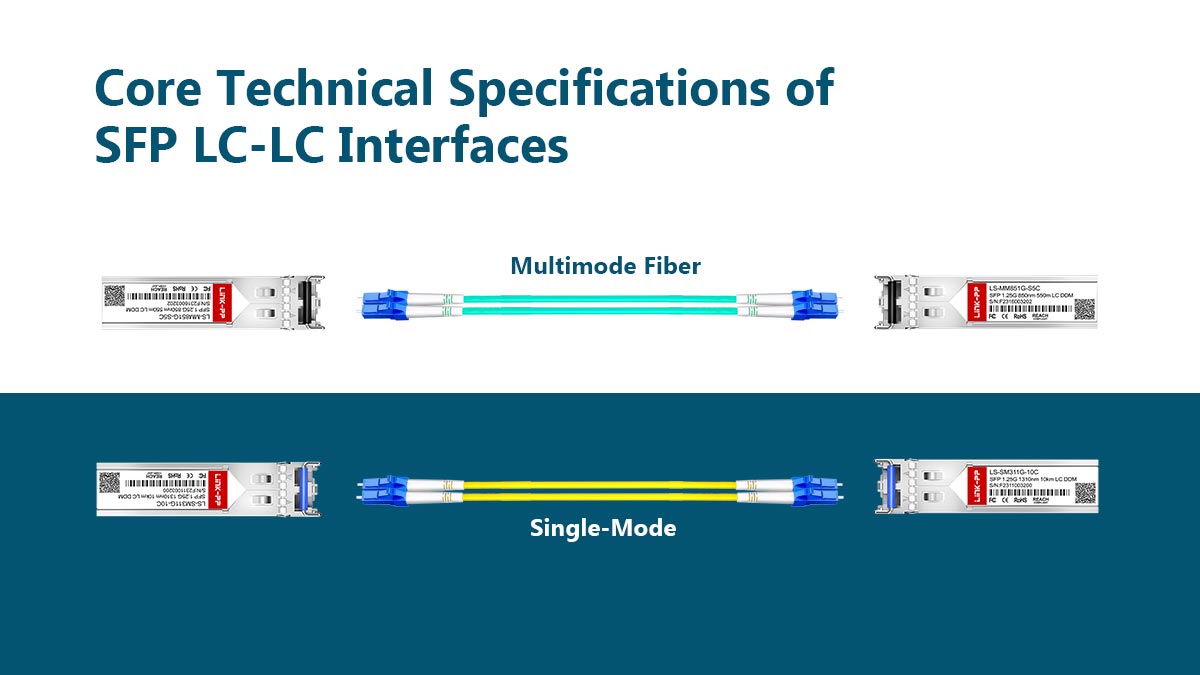
Optical transmission in SFP LC-LC systems relies on specific "windows" of the light spectrum where fiber attenuation is at its lowest. The 850nm wavelength is the standard for short-reach applications, typically utilizing Vertical-Cavity Surface-Emitting Lasers (VCSELs) over multimode fiber. This is the most cost-effective solution for intra-rack or intra-room connectivity in data centers.
For longer distances, 1310nm and 1550nm wavelengths are employed using single-mode fiber. The 1310nm window offers a balance of high speed and medium distance, while 1550nm provides the lowest possible attenuation, making it the preferred choice for long-haul backbones and metropolitan area networks. Precise matching of these wavelengths between the SFP modules at both ends of the LC-LC link is mandatory to establish a signal.
Distance Limitations Across Single-Mode and Multimode Fiber
The maximum reach of an SFP LC-LC connection is determined by the interplay between the fiber core type and the optical power of the transceiver. Multimode fiber (MMF) uses a wider core (50μm or 62.5μm), which causes modal dispersion, effectively limiting its high-speed reach. In contrast, Single-mode fiber (SMF) features a much narrower core (approx. 9μm), allowing light to travel in a single path, which minimizes signal distortion over vast distances.
To ensure network reliability, it is vital to match the specific fiber optic SFP module to the corresponding fiber grade, as each generation of fiber offers different bandwidth-distance products. The following table provides a comprehensive breakdown of the typical distance limitations for the most common fiber standards used in SFP LC-LC deployments:
| Fiber Category | Type | Core Diameter | Typical Wavelength | Max Distance (at 10G) | Common Usage |
| OM1 | Multimode | 62.5μm | 850nm | 33m | Legacy LAN Systems |
| OM2 | Multimode | 50μm | 850nm | 82m | Internal Building Links |
| OM3 | Multimode | 50μm | 850nm | 300m | Standard Data Centers |
| OM4 | Multimode | 50μm | 850nm | 550m | High-Speed SAN/LAN |
| OM5 | Multimode | 50μm | 850nm - 953nm | 550m | SWDM4 Applications |
| OS1 | Single-Mode | 9μm | 1310nm / 1550nm | 2km - 10km | Indoor/Campus Cabling |
| OS2 | Single-Mode | 9μm | 1310nm / 1550nm | 10km - 80km+ | Outdoor/Long-Haul |
Deciphering Insertion Loss and Return Loss Standards
In any SFP LC-LC interface, signal quality is measured by two critical metrics: Insertion Loss and Return Loss. Insertion Loss refers to the amount of light lost as the signal passes through the LC connectors and splices. Industry standards typically require an insertion loss of less than 0.75dB per connection, though high-performance "Ultra-Low Loss" connectors can push this below 0.25dB to provide more "headroom" for complex link budgets.
Return Loss, conversely, measures the amount of light reflected back toward the source due to imperfections in the LC ferrule mating. High reflections can cause laser instability and increase bit-error rates. For high-speed SFP links, a higher Return Loss value (measured in dB as a positive number) is desired, signifying that very little light is being reflected, thus ensuring a cleaner and more reliable data stream.
💥 Designing for High-Density with SFP LC-LC Architecture
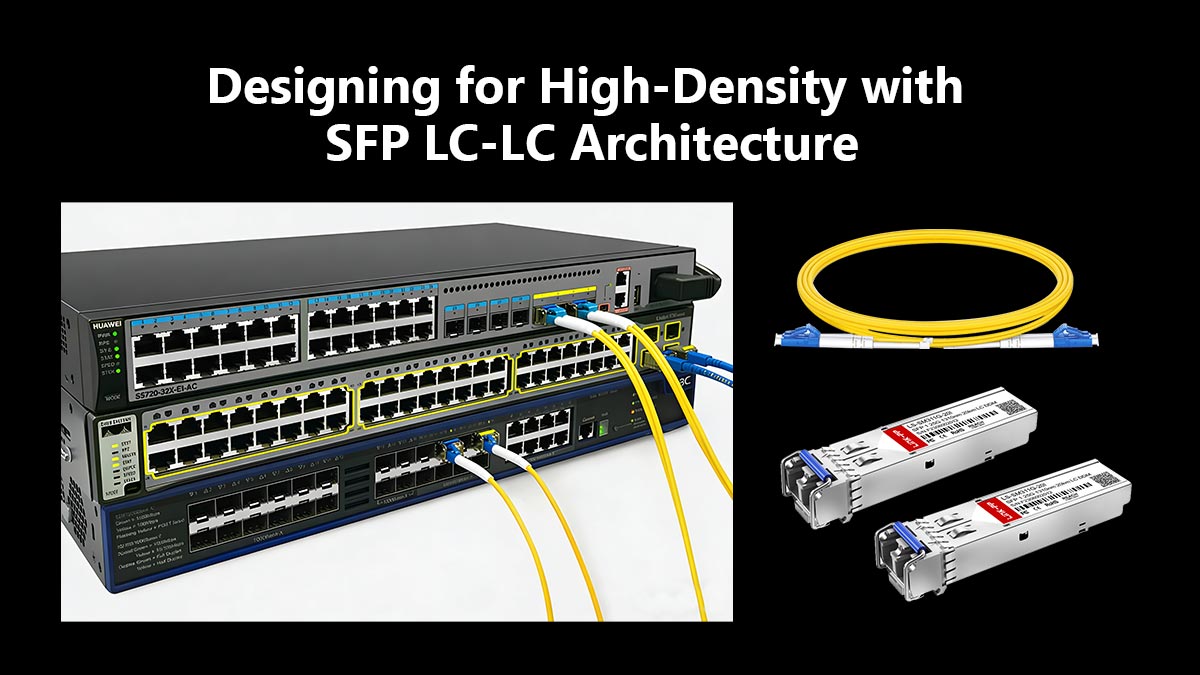
Designing a high-density network requires a strategic approach to physical layer management to ensure that performance is not sacrificed for port count. By leveraging the compact nature of the SFP LC-LC interface, engineers can maximize rack utilization while maintaining the thermal efficiency and accessibility necessary for long-term operational success.
Utilizing Ultra-Low Loss Connectors for Maximum Headroom
In a high-density environment, the cumulative loss from multiple patch points can quickly exceed the optical power budget of a standard SFP module. To combat this, the use of Ultra-Low Loss (ULL) LC connectors has become a best practice for mission-critical links. These specialized connectors are manufactured with tighter tolerances for ferrule concentricity, significantly reducing signal attenuation.
- Improved Link Budgets: By utilizing ULL connectors, designers gain "headroom," allowing for more intermediate connection points or longer cable runs without risking bit errors.
- Future-Proofing: Low-loss components ensure that the current fiber plant can transition from SFP 1G or SFP+ 10G to higher speeds (like QSFP+ 40G or QSFP28 100G via breakout) where the loss tolerances are much stricter.
Managing Cable Congestion in 1U and 2U Patch Panels
As port density increases, the sheer volume of fiber patch cords can lead to "cable spaghetti," which obstructs airflow and makes maintenance nearly impossible. Transitioning to an SFP LC-LC architecture allows for the use of advanced cable designs specifically engineered to alleviate this congestion within the confined space of 1U and 2U patch panels.
- Uniboot LC Cables: These cables house two fibers within a single 2.0mm or 3.0mm jacket, effectively halving the cable volume compared to traditional zip-cord duplex cables.
- Angled Patch Panels: Using angled panels in conjunction with LC-LC links directs cables toward the vertical managers, eliminating the need for horizontal cable management bars and freeing up valuable rack units.
- Push-Pull Tabs: High-density LC connectors often feature extended tabs that allow technicians to plug or unplug cables in crowded panels without needing special tools or risking the disturbance of adjacent links.
Strategies for Port Mapping and Identification
Efficient port mapping is essential in high-density setups to prevent "cable chaos" and reduce troubleshooting time. A common strategy involves using a consistent labeling system that mirrors the switch port numbering on the patch panel, ensuring every SFP LC-LC link is easily traceable. Many administrators also use color-coded connectors to provide an instant visual guide for cable types and network layers.
To further simplify management, organizations often implement structured cabling with dedicated zones for different types of traffic. Instead of running long individual patch cords, engineers use high-density trunk cables to connect main distribution areas to local racks. This creates a clean "one-to-one" relationship between the SFP ports and the patch panel, making it much simpler to identify, move, or change connections without disrupting the rest of the network.
💥 Key Performance Benefits of SFP LC-LC Fiber Links
The adoption of SFP LC-LC fiber links provides a significant performance boost over traditional copper or legacy optical connections. By combining modular transceiver technology with precision fiber optics, these links deliver the high speed, low latency, and environmental resilience required for mission-critical digital infrastructure.
Achieving Ultra-Low Latency for Real-Time Data Transmission
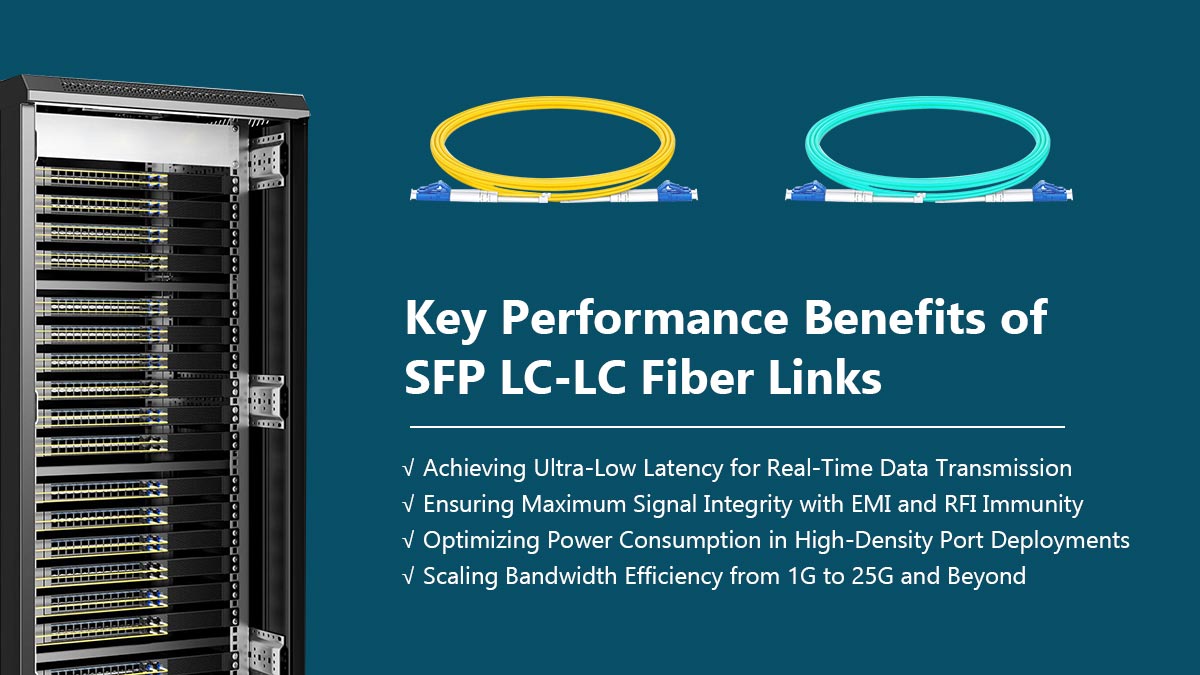
In the world of high-frequency trading, cloud computing, and real-time AI processing, every microsecond counts. SFP LC-LC fiber links provide a distinct advantage by transmitting data at the speed of light through a glass medium, which inherently offers lower latency than electrical signals traveling over copper. This is primarily because optical signals do not require the complex encoding and decoding "overhead" (PHY-layer processing) often found in high-speed copper SFP alternatives like 10GBASE-T.
Furthermore, the physical precision of the LC duplex connector ensures a stable, consistent path for light. By minimizing signal reflections and retransmissions at the physical layer, SFP-based optical links maintain a predictable and ultra-low latency profile even under heavy network loads. This makes them the preferred choice for synchronized data center environments where timing and speed are non-negotiable.
Ensuring Maximum Signal Integrity with EMI and RFI Immunity
One of the most powerful benefits of the SFP LC-LC interface is its total immunity to Electromagnetic Interference (EMI) and Radio Frequency Interference (RFI). Because fiber optic cables carry photons instead of electrons, they are not affected by the proximity of high-voltage power lines, fluorescent lighting, or heavy machinery. This allows network engineers to run LC-LC patch cords alongside power cables in congested trays without worrying about signal degradation or crosstalk.
This immunity also eliminates the risk of ground loops and electrical surges between connected devices. Since the glass fiber provides total galvanic isolation, an electrical fault in one switch won't travel through the LC-LC link to damage another piece of equipment. This inherent safety and stability ensure that the data stream remains "clean" and free from the bit-error rate spikes that often plague copper-based systems in industrial or high-density environments.
Optimizing Power Consumption in High-Density Port Deployments
Power efficiency is a top priority for modern data centers looking to reduce operational costs and carbon footprints. SFP LC-LC optical solutions are significantly more power-efficient than their copper counterparts. A standard 10G SFP+ transceiver typically consumes less than 1W of power, whereas a 10GBASE-T copper port can consume up to 2.5W to 5W depending on the distance.
When multiplied by hundreds or thousands of ports in a high-density deployment, the power savings from choosing SFP-based fiber links are substantial. Not only does this lower the direct electricity bill for the networking gear, but it also reduces the heat output within the rack. Lower heat generation means the cooling system doesn't have to work as hard, creating a "green" ripple effect that improves the overall power usage effectiveness of the facility.
Scaling Bandwidth Efficiency from 1G to 25G and Beyond
The SFP LC-LC architecture is designed with long-term scalability in mind. The physical LC-LC cabling infrastructure you install today for 1G or 10G applications is often compatible with higher speeds as your needs grow. Because the LC connector is a universal standard, you can simply swap out an older SFP module for a newer SFP28 (25G) or SFP56 (50G) module without needing to replace the existing fiber patch panels or trunks.
This "pay-as-you-grow" modularity allows organizations to scale their bandwidth efficiency without a massive "rip-and-replace" overhaul of the physical layer. By investing in high-quality OS2 or OM4 LC-LC fiber links now, you create a future-proof foundation that can handle multiple generations of hardware upgrades, ensuring that your network can keep pace with the increasing demands of modern data traffic.
💥 Deployment Use Cases for SFP LC-LC in Data Centers
Within the data center, SFP LC-LC fiber links serve as the vital nervous system connecting servers, storage, and switches. Their small footprint and high reliability make them the preferred choice for various architectural layouts, ensuring that data moves seamlessly across the facility with minimal physical footprint.
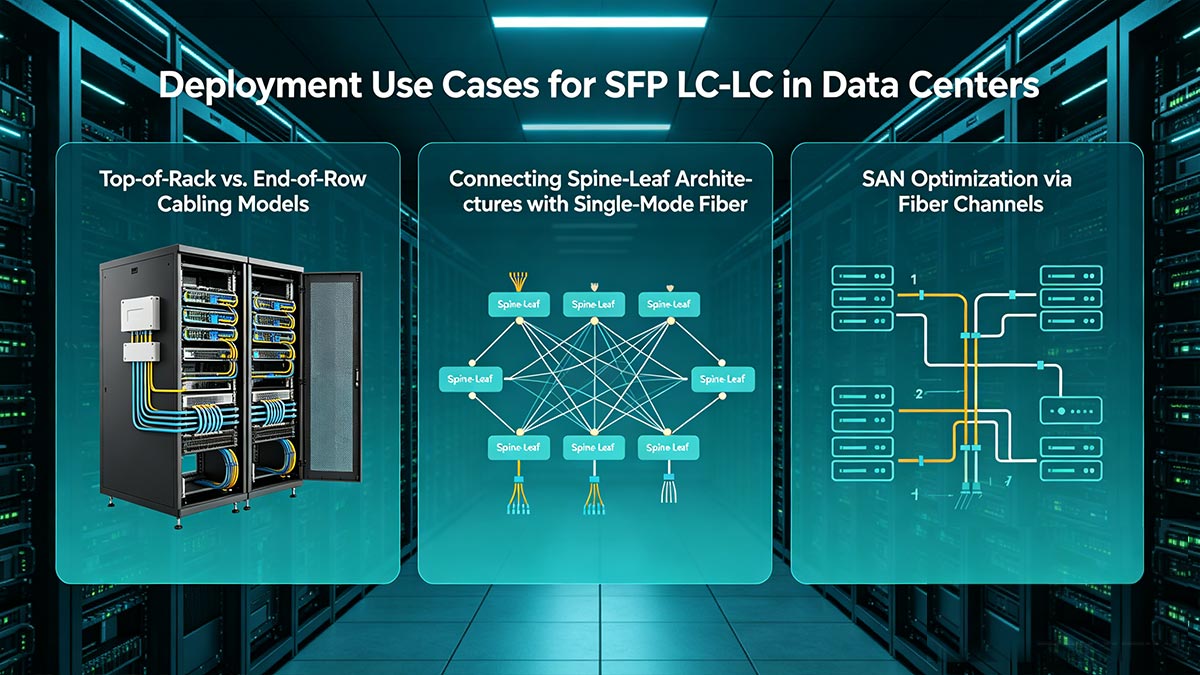
Top-of-Rack (ToR) vs. End-of-Row (EoR) Cabling Models
In a Top-of-Rack (ToR) deployment, SFP LC-LC patch cords provide short, direct connections between servers and a switch located within the same cabinet. This model minimizes the length of fiber runs and simplifies cable management within the rack. By using LC-LC duplex jumpers, technicians can quickly deploy high-speed links that are easy to organize, reducing the risk of airflow obstruction around critical server components.
Conversely, the End-of-Row (EoR) model utilizes SFP LC-LC connectivity to link multiple racks to a centralized switch at the end of a row. This approach often involves longer LC-LC trunks or patch leads that run through overhead trays or underfloor plenums. While it requires more structured cable management, the use of LC connectors allows for higher port density at the central switch, consolidating hardware and making it easier to manage the network's core from a single location.
Connecting Spine-Leaf Architectures with Single-Mode Fiber
Modern data centers have largely transitioned to spine-leaf architectures to handle massive "east-west" traffic. In this setup, SFP LC-LC links using single-mode fiber (OS2) are used to connect every leaf switch to every spine switch. This creates a non-blocking, high-speed fabric that ensures low-latency communication across the entire data center, regardless of where the data originates.
The choice of single-mode SFP LC-LC interfaces for these uplinks is strategic; it provides the necessary bandwidth and distance flexibility to span across large data center halls. As these facilities scale, the LC-LC interface allows for easy upgrades to higher speeds — such as 25G or 100G (via breakout) — simply by swapping the transceivers, ensuring the underlying fiber plant remains a long-term asset.
SAN (Storage Area Network) Optimization via Fiber Channels
In Storage Area Networks (SAN), the integrity of data transmission is paramount, and SFP LC-LC fiber links are the industry standard for Fiber Channel (FC) connectivity. The precision-engineered LC connectors ensure the extremely low signal loss required for high-speed storage traffic. This prevents data retransmissions and ensures that high-performance flash storage arrays can be accessed at peak speeds by connected servers.
Optimizing a SAN with SFP LC-LC connectivity also involves taking advantage of the "hot-swappable" nature of SFP modules. Administrators can scale storage capacity and performance incrementally, adding new LC-LC paths as storage demands grow. This modularity, combined with the space-saving benefits of LC duplex connectors, allows for massive storage density in a highly organized and maintainable environment.
💥 SFP LC-LC Solutions for Enterprise Campus Networking
In enterprise environments, SFP LC-LC solutions provide the critical infrastructure needed to bridge the gap between centralized data rooms and dispersed user endpoints. These links offer the extended reach and high-speed throughput necessary to support a modern workforce across diverse office layouts and multi-building campuses.
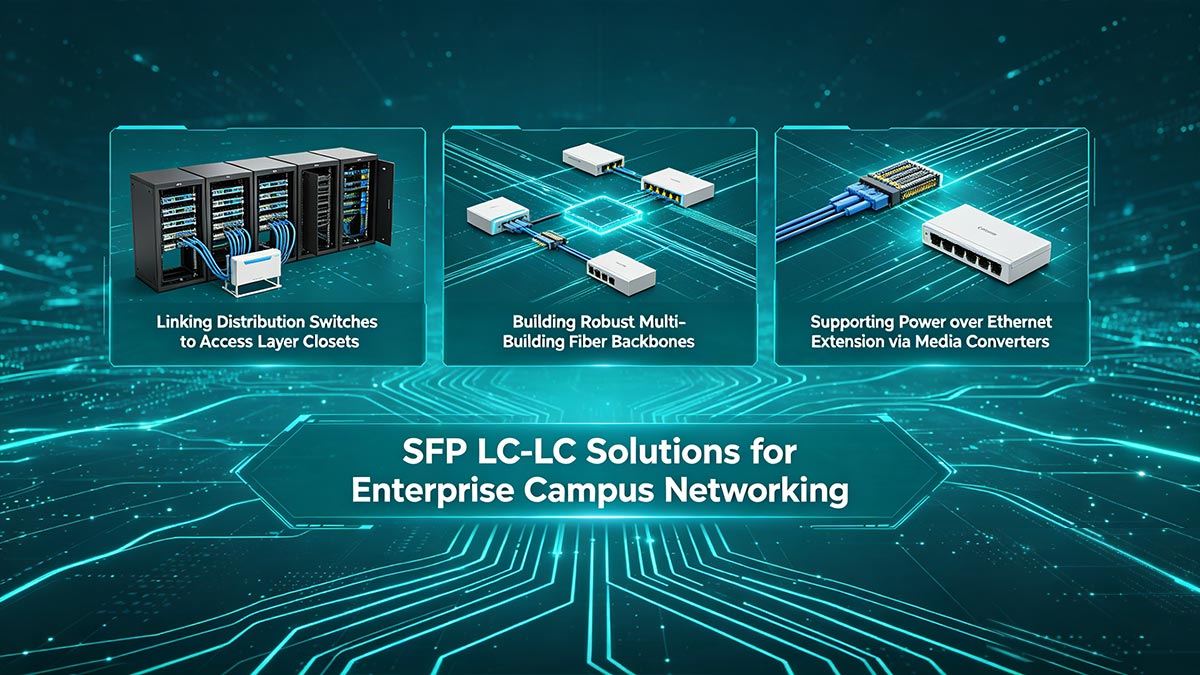
Linking Distribution Switches to Access Layer Closets
The connection between the distribution layer and the access layer is the backbone of any internal office network. By utilizing SFP LC-LC fiber links, IT departments can move beyond the 100-meter limitation of traditional copper cabling. This allows switches in remote telecommunications closets to maintain high-speed 1G or 10G uplinks to the core network, ensuring that users at the edge experience the same performance as those located near the main data center.
Using LC-LC duplex jumpers in these closets also helps manage the high density of connections typically found in access layer racks. The small form factor of the LC connector allows for more fiber ports in a smaller footprint, which is essential when space in wall-mount cabinets or small utility closets is at a premium. This setup ensures a clean, organized handoff that is easy to service during routine network maintenance.
Building Robust Multi-Building Fiber Backbones
For enterprise campuses with multiple buildings, SFP LC-LC links using single-mode fiber are the gold standard for connecting different sites. Since these buildings are often far apart, optical fiber is the only reliable way to send data over long distances without losing signal strength. By plugging the right SFP module into the switch and using LC-LC patch cords, a company can link a headquarters to a warehouse or a satellite office tens of kilometers away.
This setup creates a "backbone" that makes the entire campus feel like one single, fast network. Because LC connectors are small and sturdy, they fit easily into the protective boxes where outdoor cables enter a building. This ensures that important services, like shared files and internet access, stay fast and stable for every employee, no matter which building they are working in.
Supporting Power over Ethernet (PoE) Extension via Media Converters
While fiber optic cables carry light instead of electricity, SFP LC-LC links are often used to bring Power over Ethernet (PoE) to distant locations. Standard copper cables can only reach 100m, which is often too short for outdoor security cameras or Wi-Fi access points. By using a media converter, you can run a long LC-LC fiber line from your main switch and then convert that signal back to copper at the very end to power your device.
This "fiber-to-PoE" solution is perfect for large areas like parking lots or expansive warehouses. The SFP LC-LC connection handles the long-distance data transport, while the media converter adds the necessary electrical power for the camera or sensor at the destination. This allows you to place smart devices exactly where they are needed most, without being limited by the short reach of traditional network cables.
💥 Installation Best Practices for SFP LC-LC Connections
The long-term reliability of an SFP LC-LC link depends heavily on the quality of the initial installation. Following industry-standard physical layer protocols ensures that the network achieves its rated speed and prevents costly downtime caused by signal degradation or physical damage to the optical interfaces.
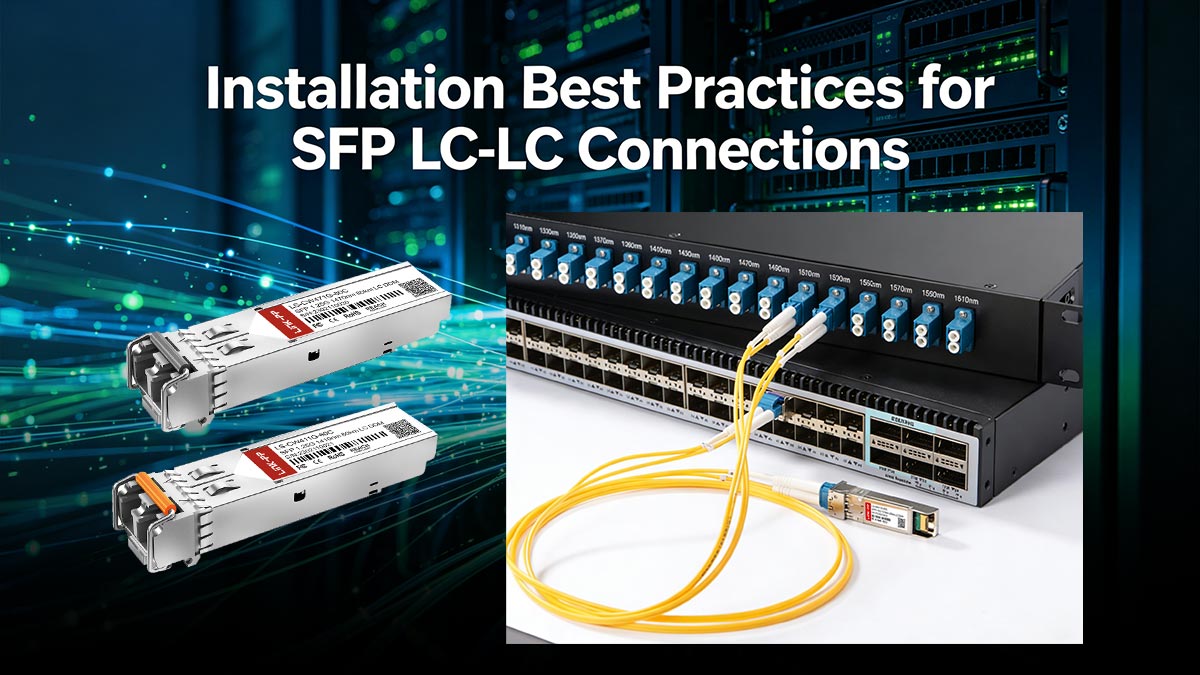
Essential Cleaning Protocols for LC Ferrule Faces
Contamination is the number one cause of failure in fiber optic networks. Even a microscopic speck of dust or oil from a fingertip on the 1.25mm LC ferrule can block the light path or cause permanent damage to the SFP transceiver's optical sub-assembly. To maintain a "clean" connection, technicians must follow a strict "Inspect, Clean, Inspect" workflow.
- Dry Cleaning: Use specialized "one-click" cleaners or lint-free wipes designed specifically for LC connectors to remove dry contaminants.
- Wet-to-Dry Cleaning: For stubborn oils, a small amount of optical-grade solvent is applied to a wipe, followed immediately by a dry wipe to ensure no residue remains.
- Port Cleaning: Never forget to clean the internal bore of the SFP module itself using a dedicated cleaning swab before inserting the LC connector.
Proper Bend Radius Management to Prevent Signal Attenuation
Fiber optic cables are glass-based and have a physical limit to how much they can bend before the light begins to leak out of the core — a phenomenon known as macrobending. In high-density SFP LC-LC environments, keeping cables organized must never come at the expense of the cable's structural integrity.
Proper management involves ensuring that the bend radius is never less than 10 times the outer diameter of the cable (typically around 30mm for standard patch cords). Utilizing "Bend-Insensitive" Fiber (BIF) can provide extra protection in tight spaces, but installers should still use horizontal and vertical managers to support the weight of the cable bundles, preventing "micro-stress" at the point where the LC connector meets the SFP module.
Validating Links with OTDR and Light Source Power Meters
Once the SFP LC-LC hardware is physically installed, the link must be validated to prove it meets the required performance specifications. Testing provides a "birth certificate" for the link, ensuring that the total loss stays within the system’s optical budget.
- Light Source and Power Meter (LSPM): This "Tier 1" test measures the exact amount of light lost across the link. It is the most accurate way to confirm that the LC-LC connection is operating within the decibel (dB) loss limits defined during the design phase.
- Optical Time Domain Reflectometer (OTDR): For longer campus backbones, an OTDR test is essential. It provides a visual trace of the fiber's entire length, identifying the specific location of any high-loss events, such as a bad splice or a stressed LC connector.
- Visual Fault Locator (VFL): A simple but effective tool, the VFL shines a red laser through the fiber to help technicians quickly identify polarity flips or broken fibers within the patch panel.
💥 Troubleshooting Common SFP LC-LC Link Failures
Even with high-quality components, SFP LC-LC links can occasionally fail due to configuration errors or physical environmental factors. Rapidly identifying whether a problem is rooted in the optical hardware, the fiber cable, or the physical connection is the key to minimizing network downtime and maintaining high-density reliability.
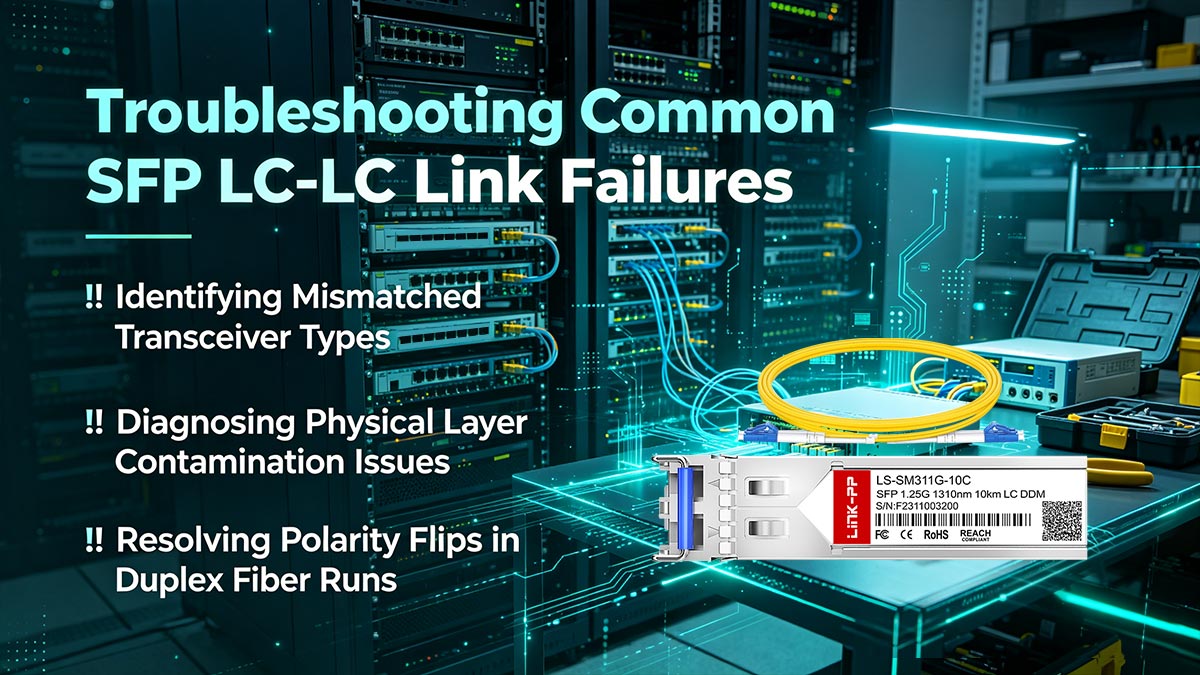
Identifying Mismatched Transceiver Types
One of the most frequent causes of link failure is a mismatch between the SFP transceivers at either end of the fiber run. For a successful SFP LC-LC connection, both modules must share identical wavelengths (e.g., both must be 850nm) and use compatible transmission standards (e.g., both 1000BASE-SX). If you attempt to connect a long-haul 1310nm SFP to a short-reach 850nm SFP, the link will fail to initialize.
Furthermore, modern switches often utilize Digital Optical Monitoring (DOM) to flag these mismatches in the system logs, allowing administrators to verify if the TX/RX power levels are within the operational range for that specific transceiver type.
Diagnosing Physical Layer Contamination Issues
If a link is experiencing intermittent flapping or a high bit-error rate (BER), the culprit is almost always dust or oils on the LC connector ferrule. Because the core of an optical fiber is so small, even a tiny particle can block a significant portion of the light, leading to high insertion loss.
Troubleshooting this requires using a fiber inspection microscope to check the end-face of the LC connector; a "dirty" connector can often be fixed with a simple one-click cleaner. If cleaning the patch cord doesn't resolve the issue, the internal optics of the SFP transceiver itself may be contaminated and should be inspected or replaced.
Resolving Polarity Flips in Duplex Fiber Runs
A complete "link down" status where both devices show no signal often indicates a polarity issue — essentially, the "Transmit" (TX) side of one SFP is connected to the "Transmit" side of the other, rather than the "Receive" (RX) side.
In an SFP LC-LC duplex setup, the fibers must cross at some point in the link (A-to-B polarity) to ensure the light path is correctly routed. This is easily diagnosed using a Visual Fault Locator (VFL); if the red light does not appear on the correct side of the duplex LC connector at the far end, the technician must swap the positions of the two LC fibers within the duplex clip to restore the proper data flow.
💥 Conclusion: Selecting the Right SFP LC-LC Solutions for Your High-Density Deployment
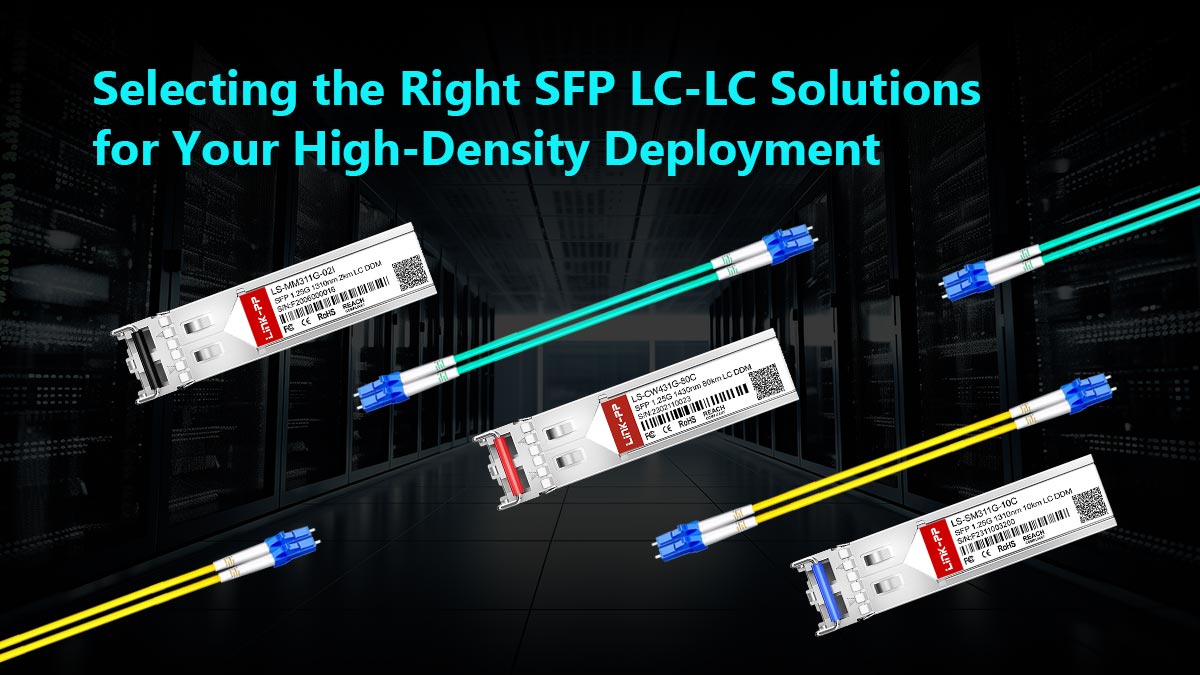
In summary, the SFP LC-LC fiber link remains the most effective architecture for achieving high-density reliability in modern networks. By understanding the critical balance between transceiver specifications, fiber grades, and proper installation practices, you can build a network that is both high-performing and easy to maintain. Whether you are upgrading a local enterprise closet or architecting a massive spine-leaf data center, choosing high-quality components is the key to minimizing signal loss and ensuring long-term scalability.
Ready to optimize your infrastructure with an industry-leading optics transceiver? To ensure your network benefits from maximum compatibility and superior signal integrity, explore the comprehensive range of high-performance transceivers available at the LINK-PP Official Store. From 1G to 100G solutions, our SFP modules are engineered to provide the precision and durability your high-density deployment deserves.







