



































Modern data centers are rapidly evolving toward high-density, scalable architectures that can support ever-increasing traffic demands. In this context, 1310nm single-mode optics transceiver modules have emerged as a key enabler for reliable and efficient connectivity. Compared to short-reach transceiver solutions, 1310nm wavelengths offer superior transmission performance over longer distances, making them particularly well-suited for spine-leaf and ToR-to-leaf network designs.
As enterprises and cloud providers continue to scale their infrastructure, the need for low-latency, high-bandwidth interconnects becomes critical. 1310nm single-mode modules address these challenges by delivering reduced signal attenuation, improved stability, and greater flexibility for future expansion. This makes them an ideal choice for modern data center environments where high port density, performance consistency, and long-term scalability are essential.
🔶 Why The 1310nm Single-Mode Module Is Ideal for Modern Data Centers
As data centers continue to scale in size and complexity, the demand for high-performance, long-reach, and reliable connectivity has become critical. 1310nm single-mode modules address these needs by enabling efficient data transmission across extended distances with minimal signal loss. They provide a solid foundation for modern architectures that prioritize scalability, density, and consistent performance.
In addition, the adoption of 1310nm single-mode optics aligns with the shift toward spine-leaf topologies and high-speed interconnects. Their ability to support higher bandwidth over longer links makes them a practical and future-ready choice for today’s data center environments.
Evolution of Data Center Architectures
Data centers have shifted from simple three-tier models to agile spine-leaf topologies that deliver low latency and massive scalability. This evolution supports AI, cloud services, and edge deployments, with ToR switches linking dense server clusters to leaf and spine layers via efficient cabling.
Contemporary designs emphasize horizontal scaling and non-blocking fabrics, relying on optics resilient to dispersion over rack-spanning distances. 1310nm single-mode fits this paradigm, enabling robust connectivity in hyperscale setups without compromising efficiency or footprint.
Limitations of Legacy Short-Reach Solutions
Legacy short-reach solutions, such as 850nm multimode transceivers, are typically designed for shorter distances within limited rack or row-level deployments. While cost-effective in smaller setups, they struggle to meet the demands of larger, distributed data center environments where links often extend beyond their optimal range.
Moreover, multimode fiber systems are more susceptible to modal dispersion and signal degradation as speeds increase. This can lead to higher error rates and reduced performance consistency, making them less suitable for high-speed, high-density deployments compared to 1310nm single-mode SFP modules.
Advantages of Single-Mode SFP at 1310nm
Single-mode SFP modules operating at 1310nm offer clear advantages in terms of transmission distance and signal integrity. They enable reliable data transfer over tens of kilometers rather than hundreds of meters, making them ideal for inter-rack and inter-row connections in large-scale data centers.
In addition, 1310nm single-mode SFP transceivers experience lower attenuation and reduced dispersion compared to shorter wavelengths. This results in more stable performance, lower bit error rates, and better support for high-speed applications such as 25G, 40G, 100G, and beyond.
Role in High-Density Network Environments
High-density data centers require efficient use of space, power, and cabling while maintaining performance. 1310nm single-mode modules support higher port densities by enabling longer links without the need for additional signal conditioning or repeaters.
They also simplify cabling infrastructure by allowing standardized single-mode fiber deployments across the entire data center. This not only reduces complexity but also improves scalability, making it easier to expand network capacity while maintaining consistent performance in dense environments.
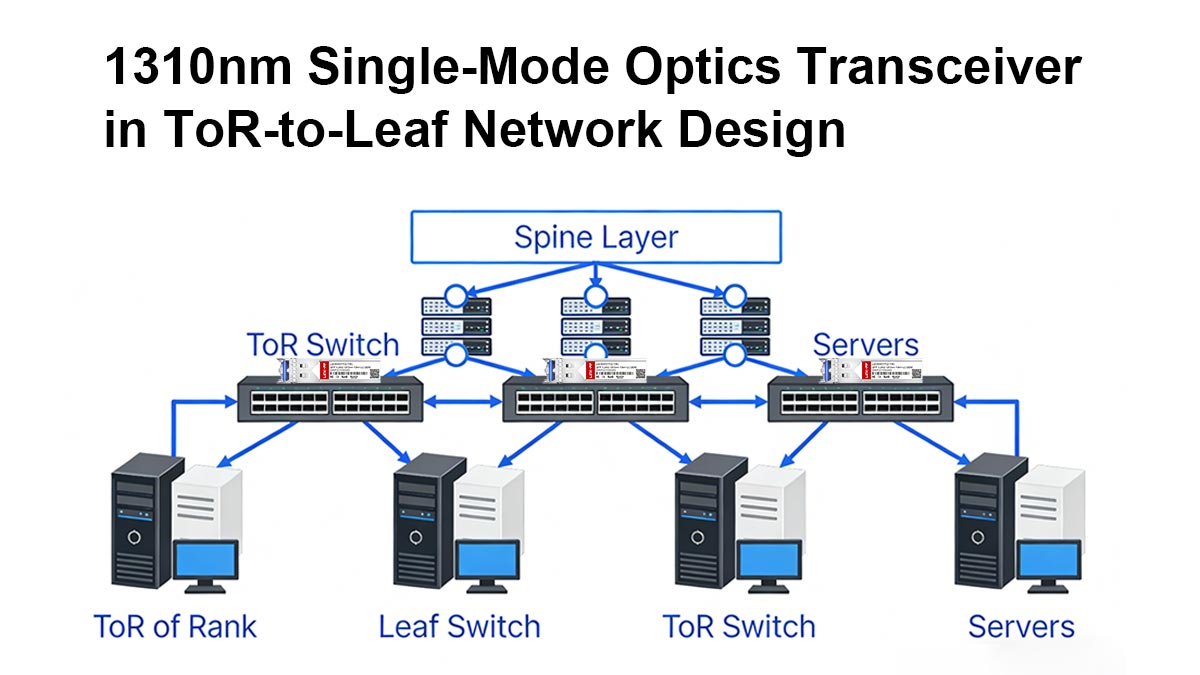
🔶 1310nm Single-Mode Optics Transceiver in ToR-to-Leaf Network Design
In modern data center networks, ToR-to-leaf connectivity plays a critical role in ensuring low-latency and high-bandwidth communication between servers and aggregation layers. 1310nm single-mode optical transceivers provide the performance and reach needed to support these connections efficiently. Their ability to maintain signal integrity over longer distances makes them a key component in scalable spine-leaf architectures.
Understanding ToR-to-Leaf Topologies
In a ToR-to-leaf topology, each server rack houses a ToR switch that uplinks to one or more leaf switches. This approach simplifies management and prevents oversubscription by segmenting workloads into manageable pods.
1310nm transceivers play a key role by ensuring these uplinks remain reliable across varying distances and environmental conditions.
Common design characteristics include:
- Distributed Connection Model: ToR switches serve local servers, while leaf switches handle cross-rack coordination.
- Optimized Fiber Routing: Single-mode fibers minimize clutter and signal crosstalk, aiding airflow and maintenance.
- High Scalability: The design supports flexible expansion without reorganizing cabling or switch layers.
Distance and Performance Requirements
ToR-to-leaf links often extend beyond the limitations of short-range optics transceivers, especially in medium to large-scale data centers. As rack distribution increases, maintaining signal quality over longer distances becomes a key requirement.
1310nm single-mode optics meet these requirements by offering:
- Extended Reach: Typically supports distances of tens of kilometers.
- Low Attenuation: Ensures signal strength is preserved over longer fiber runs.
- High-speed Compatibility: Supports 10G, 25G, 40G, 100G, and higher data rates.
This combination allows network designers to deploy flexible layouts without being constrained by distance. It also ensures consistent throughput and low latency across all ToR-to-leaf connections.
How 1310nm Supports Spine-Leaf Scaling
As data centers scale horizontally, the number of ToR and leaf switches increases significantly. This requires optical solutions that can maintain performance across a growing number of interconnections.
1310nm single-mode optics support this scaling by:
- Providing uniform link performance across short and long distances.
- Reducing the need for intermediate equipment, such as signal boosters or repeaters.
- Enabling modular expansion, where additional racks and switches can be integrated seamlessly.
Furthermore, single-mode infrastructure simplifies long-term scaling strategies. With a 1310nm fiber optic SFP module, networks can expand without needing major changes to the underlying fiber plant, making it a future-proof solution for spine-leaf growth.
Typical Deployment Scenarios
1310nm single-mode transceivers are widely used in various ToR-to-leaf deployment scenarios, particularly where distance and reliability are critical. They are suitable for both intra-data center and inter-building connections.
Common deployment scenarios include:
- Cross-row Connections: Linking ToR switches to leaf switches across multiple rows.
- Large Data Halls: Supporting extended cable runs in hyperscale environments.
- Inter-building Links: Connecting separate data center facilities within a campus.
- High-density Racks: Enabling consistent performance in tightly packed server environments.
In these scenarios, 1310nm optics transceivers provide a balance of performance, scalability, and reliability. Their versatility makes them an essential component in modern ToR-to-leaf network design.
🔶 Key Benefits of 1310nm Single-Mode SFP Connectivity
The 1310nm single-mode fiber SFP provides a compelling combination of reach, signal integrity, and reliability for modern ToR-to-leaf links. By leveraging the intrinsic low-loss and low-dispersion characteristics of single-mode fiber at this wavelength, data center operators can overcome the physical limitations of legacy multimode solutions while simplifying network architecture.

Longer Transmission Distance
Unlike multimode SFP modules that typically support only 300m at 10G SFP+ or 25G SFP28, 1310nm single-mode SFP modules can reliably transmit data up to 10km or more over OS2 fiber. This extended reach allows ToR switches to connect directly to leaf or spine switches even when racks are distributed across multiple data center halls, building floors, or separate buildings within a campus environment.
In high-density ToR-to-leaf deployments, longer transmission distances eliminate the need for intermediate aggregation switches or signal repeaters, which reduces both capital expenditure and latency. Network architects can thus design flatter, more scalable topologies where leaf switches serve a larger number of ToR switches without worrying about distance constraints.
Reduced Signal Attenuation
At the 1310nm wavelength, single-mode fiber exhibits an attenuation coefficient of approximately 0.35 - 0.4dB per kilometer, significantly lower than the 2.5 - 3dB per kilometer typical for 850nm multimode systems. This lower loss means that optical power decays more slowly along the fiber, preserving signal strength over longer physical runs and allowing more flexible placement of networking equipment.
Lower attenuation also provides a larger link power budget, accommodating multiple connector pairs, patch panels, and cross-connects without risking signal degradation. In complex ToR-to-leaf cabling infrastructures where fibers often traverse several intermediate distribution frames, this margin is essential to maintain consistent performance across all links.
Improved Network Reliability
Single-mode 1310nm transceivers are inherently immune to modal dispersion — a major source of signal distortion in multimode fiber caused by multiple propagation paths. This immunity results in more stable signal transmission over time, temperature variations, and different cable bending conditions, which directly reduces the probability of link flapping or unexpected outages.
For high-density data centers operating thousands of ToR-to-leaf links simultaneously, improved reliability translates into fewer maintenance interventions and lower operational overhead. When each link consistently meets its performance specifications, application uptime increases, and the risk of cascading failures in leaf-spine fabrics is substantially mitigated.
Lower Bit Error Rates
The combination of low attenuation, negligible modal dispersion, and low chromatic dispersion enables 1310nm single-mode SFP modules to consistently achieve a bit error rate (BER) below 10⁻¹² across typical ToR-to-leaf distances. This level of data integrity is essential for loss-sensitive workloads such as storage area network traffic, remote direct memory access (RDMA), and high-frequency trading applications, where even rare bit errors can trigger retransmissions or application-level disruptions.
In leaf-spine architectures, maintaining a BER below 10⁻¹² on every link ensures that upper-layer protocols like TCP or RoCE (RDMA over Converged Ethernet) operate efficiently without frequent packet recovery events. Lower BER also reduces the burden on forward error correction (FEC) circuits, which translates to lower transceiver power consumption and latency — a critical advantage when deploying thousands of 1310nm SFP transceivers in high-density ToR-to-leaf environments.
🔶 1310nm vs 850nm SFP: Which Wavelength Should You Choose
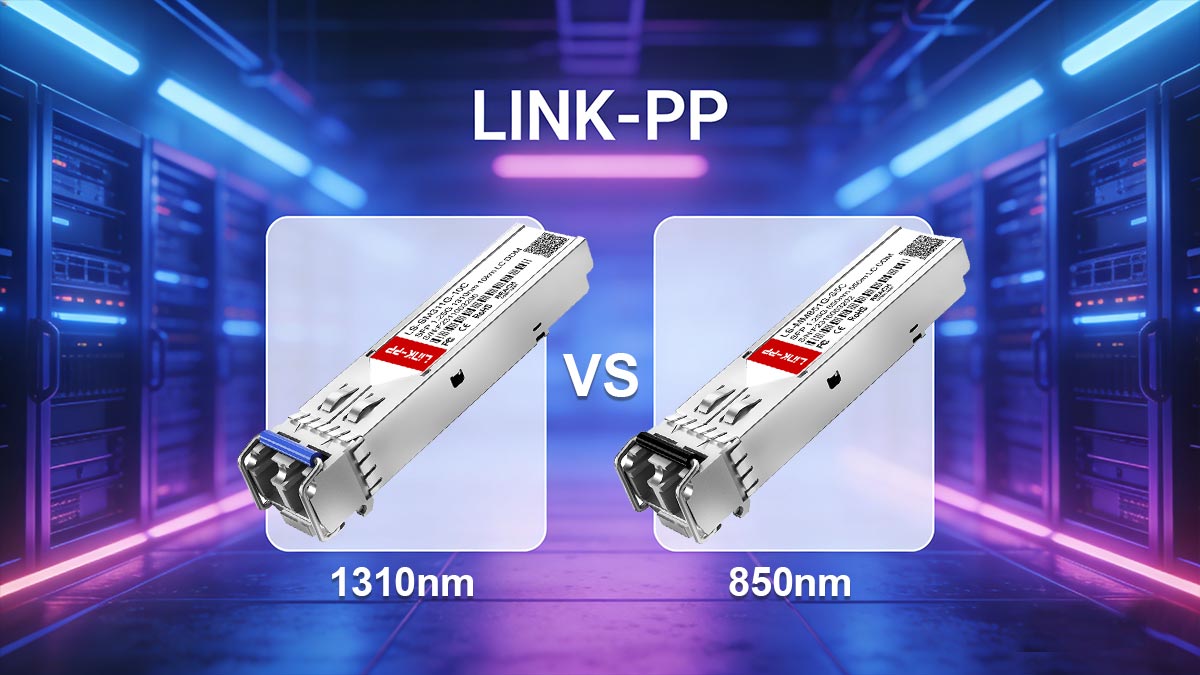
When designing ToR-to-leaf links, network architects must choose between an 850nm multimode and a 1310nm single-mode SFP transceiver. While 850nm SFP transceivers offer lower upfront costs for very short reaches, 1310nm single-mode solutions provide superior distance, signal integrity, and long-term scalability. As data center speeds increase from 10G to 400G and beyond, the limitations of multimode fiber become increasingly pronounced, making 1310nm SFP the more future-proof investment.
The following table highlights key differences between the two wavelengths.
| Parameter | 1310nm SFP | 850nm SFP |
| Fiber Type | Single-mode (OS1/OS2) | Multimode (OM3/OM4) |
| Typical Reach | Up to 10km | 100m - 300m (depending on OM grade) |
| Attenuation | 0.35 - 0.4dB/km | 2.5 - 3.0dB/km |
| Dispersion Performance | Excellent (Low Chromatic Dispersion) | Limited by Modal Dispersion |
| Connector Size | Smaller Core (9μm) | Larger Core (50μm or 62.5μm) |
| Cost per Link (Initial) | Higher | Lower |
| Long-Term Cost Efficiency | Better (Scalable for Future Upgrades) | Limited (Fiber Repulling Required for Longer Links) |
| Application Focus | ToR-to-Leaf, Spine-Leaf, Inter-Pod Links | Short Intra-rack or Patch Connections |
Differences in Fiber Type Compatibility
The most fundamental difference lies in fiber compatibility. 1310nm optics transceivers operate over single-mode fiber (SMF), which uses a smaller core to transmit light directly with minimal dispersion. This enables precise signal propagation over long distances with high stability.
In contrast, 850nm optics transceivers are designed for multimode fiber (MMF), which has a larger core and allows multiple light paths. While this reduces initial costs, it introduces modal dispersion, especially at higher speeds. As a result:
- SMF is better suited for long-distance and high-speed applications.
- MMF is typically limited to short-reach, intra-rack or row-level links.
Cost Considerations Over Time
At first glance, 850nm multimode solutions appear more cost-effective, primarily due to lower transceiver and cabling costs. This makes them attractive for small-scale or legacy deployments with limited distance requirements.
However, over time, the cost dynamics can shift:
- Multimode infrastructure may require upgrades or parallel fibers for higher speeds.
- Distance limitations can lead to additional equipment or redesigns.
- Single-mode fiber, once deployed, supports multiple generations of speed upgrades.
As a result, 1310nm single-mode solutions often provide better long-term value, especially in growing data centers where scalability and upgrade flexibility are critical.
Performance in High-Speed Applications
As network speeds increase to 25G, 40G, 100G, and beyond, performance differences between the two wavelengths become more pronounced. 1310nm optics maintain signal integrity over longer distances, even at higher data rates.
On the other hand, 850nm multimode SFP transceivers face challenges such as:
- Increased modal dispersion at higher speeds.
- Reduced effective transmission distance.
- Greater sensitivity to fiber quality and alignment.
This makes 1310nm single-mode SFP transceivers more reliable for high-speed interconnects, particularly in spine-leaf architectures where consistent performance is essential.
Scalability for Future Upgrades
Scalability is a key consideration in modern data center design. 1310nm single-mode SFP infrastructure offers a clear advantage, as it supports a wide range of current and future transmission technologies without requiring major changes to the fiber plant.
Key scalability benefits include:
- Support for higher data rates without reducing distance.
- Compatibility with advanced modulation techniques.
- Simplified migration paths for future upgrades.
In contrast, 850nm multimode SFP modules often reach their limits quickly, requiring additional fibers or complete infrastructure replacement as bandwidth demands grow. This makes 1310nm single-mode SFP modules a more future-proof solution for evolving data center environments.
🔶 1310nm Single-Mode Module Types for ToR-to-Leaf Links
In ToR-to-leaf network design, selecting the appropriate 1310nm single-mode module type is essential to ensure optimal performance, reach, and cost efficiency. Different transceiver form factors and technologies are designed to meet varying bandwidth and distance requirements. Understanding these options helps network designers build scalable and reliable data center interconnects.
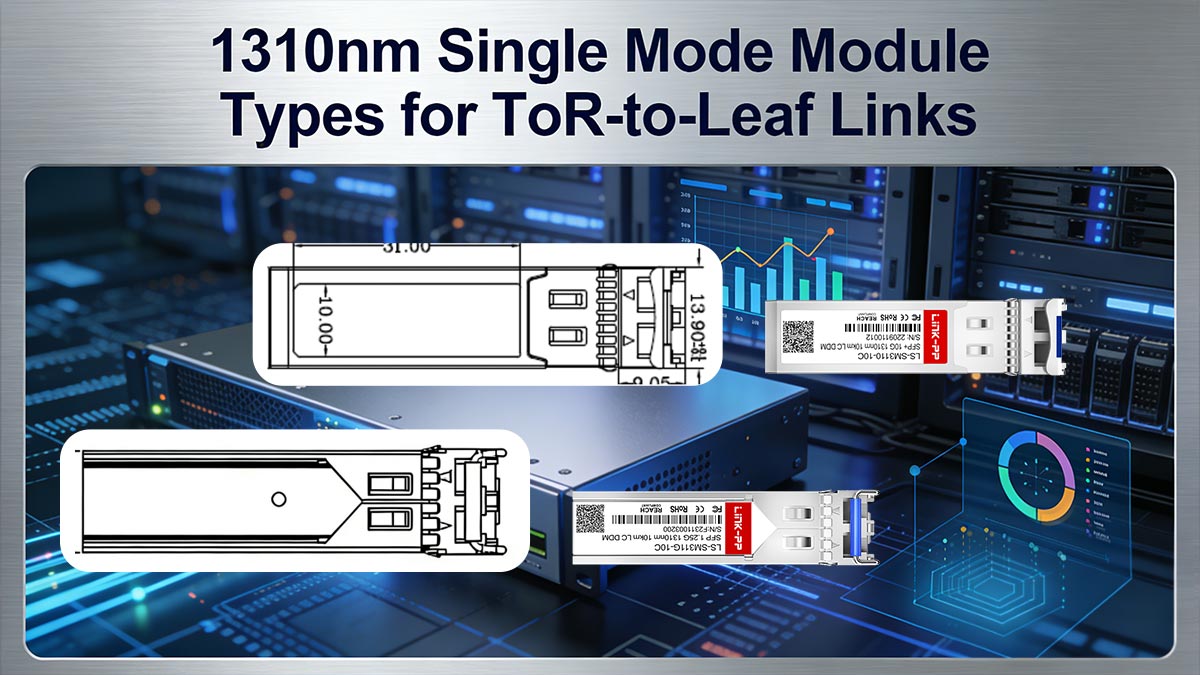
Overview of 1310nm Single-Mode Transceiver Form Factors
1310nm single-mode transceivers are available in multiple form factors to support different data rates and interface standards. The most common include SFP, SFP+, SFP28, QSFP+, and QSFP28, each designed for specific speed requirements ranging from 1G to 100G and beyond.
Key form factor characteristics include:
- SFP 1G/SFP+ 10G: Typically used for 1G and 10G applications, suitable for basic ToR uplinks.
- SFP28 25G: Designed for 25G connections, widely used in modern leaf switches.
- QSFP+ 40G/QSFP28 100G: Support 40G and 100G, ideal for high-density spine-leaf interconnects.
These form factors provide flexibility in deployment, allowing data centers to mix and match modules based on port density and bandwidth needs. Their standardized designs also ensure compatibility across a wide range of networking equipment.
Comparing 1310nm LR4, CWDM4, and PSM4 Modules
Among 1310nm SFP solutions, LR4, CWDM4, and PSM4 are commonly used for high-speed ToR-to-leaf links, particularly in 100G environments. Each technology uses a different method to transmit multiple lanes of data over single-mode fiber.
Key differences include:
LR4 (such as 100GBASE-LR4)
- Uses wavelength division multiplexing (WDM) with four wavelengths around 1310nm.
- Supports distances up to 10km.
- Higher cost, but ideal for long-reach applications.
CWDM4 (such as QSFP-100G-CWDM4)
- Uses four CWDM wavelengths near 1310nm.
- Typically supports up to 2km.
- Balanced option between cost and performance.
PSM4 (such as LQ-M31100-LR4C)
- Uses four parallel fibers instead of multiplexing.
- Supports distances up to 2km (typically 500m).
- Lower cost but requires more fiber strands.
In practice, CWDM4 is often preferred for typical data center interconnects, while LR4 is used for longer campus links, and PSM4 is suitable for short-reach, high-density environments with available fiber resources.
🔶 1310nm Single-Mode SFP Fiber Infrastructure Requirements
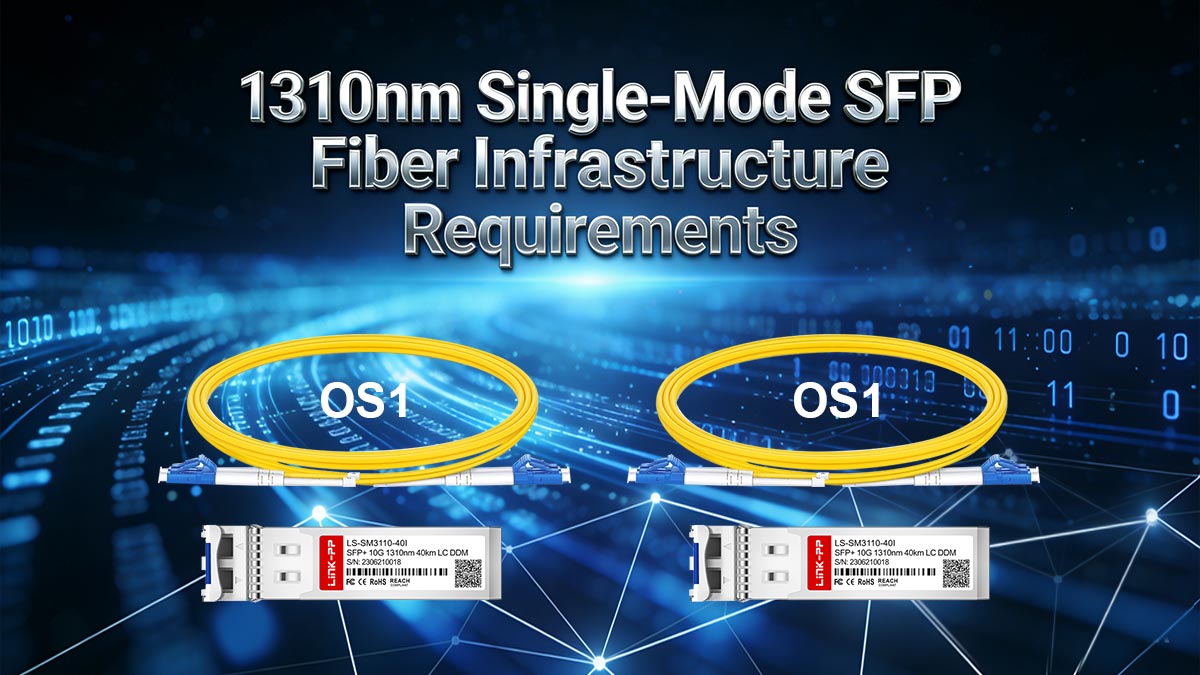
To fully leverage 1310nm single‑mode SFP modules, the underlying fiber infrastructure must be designed with consistent quality, proper standards, and long‑term maintainability in mind. The choice of single‑mode cable type, connector style, and installation practices directly affects signal integrity, power budget margin, and the ability to scale over time.
Single-Mode Fiber Cable (OS1 vs OS2)
Single-mode fiber used with 1310nm optics transceiver is typically categorized as OS1 or OS2, each suited for different environments. OS1 is generally used for indoor applications with shorter distances, while OS2 is optimized for longer distances and outdoor or campus deployments.
In modern data centers, OS2 fiber is often preferred due to its lower attenuation and better performance over extended distances. This makes it more suitable for scalable architectures where links may span large data halls or multiple buildings.
Connector Types and Standards
Connector selection plays a key role in maintaining signal quality and ensuring compatibility across network devices. Common connectors for 1310nm single-mode systems include LC, SC, and MPO, with LC being the most widely used in high-density environments.
Standardization is critical to avoid mismatches and insertion loss. Using industry-standard connectors and ensuring proper polishing (such as UPC or APC) helps maintain low return loss and stable optical performance.
Cable Management in High-Density Racks
As port density increases, effective cable management becomes essential to maintain airflow, accessibility, and signal integrity. Poor cable organization can lead to physical stress on fibers, increased attenuation, and operational complexity.
Implementing structured cable routing, using cable trays, and maintaining proper bend radius are key practices. These measures help ensure reliable connections while simplifying maintenance in high-density rack environments.
Installation Best Practices
Proper installation is crucial to achieving optimal performance from 1310nm single-mode infrastructure. This includes careful handling of fiber cables, precise connector cleaning, and accurate testing of optical links.
Best practices such as avoiding excessive bending, minimizing contamination, and verifying link performance with optical testing tools help prevent signal degradation. Following these guidelines ensures long-term stability and reduces the risk of network issues.
🔶 1310nm Single-Mode Solutions for High-Density Environments
1310nm single‑mode SFP solutions are particularly well‑suited for high‑density environments, where space, port count, airflow, and cable clutter are critical constraints. By leveraging compact modules, standardized fiber, and efficient routing, 1310nm optics transceivers help maximize the useful density of ToR and leaf switches without sacrificing reach or reliability.

Space Optimization in Rack Design
In high-density environments, optimizing rack space is essential to accommodate increasing numbers of devices and connections. 1310nm single-mode solutions help reduce the need for additional equipment, such as repeaters, by supporting longer direct links.
This allows for cleaner rack layouts and more efficient use of available space, enabling higher equipment density without sacrificing performance or manageability.
High Port Density Switches
Modern switches are designed to support a large number of high-speed ports, which requires compatible optical modules that can operate reliably in dense configurations. 1310nm SFP and QSFP modules are widely used in these switches due to their compact form factors and consistent performance.
Their ability to deliver high bandwidth over longer distances makes them ideal for high port density deployments, supporting scalable spine-leaf architectures.
Efficient Cable Routing Strategies
Efficient cable routing is critical in dense environments to reduce congestion and maintain airflow. Single-mode fiber, used with 1310nm optics, typically requires fewer parallel fibers compared to multimode solutions, simplifying routing.
This results in cleaner cable layouts, easier troubleshooting, and improved overall system organization, especially in large-scale data center deployments.
Thermal Management Considerations
Thermal management is a key factor in maintaining performance and longevity in high-density setups. High port density and increased data rates can generate significant heat, which must be effectively managed.
1310nm optical modules are generally designed for efficient power consumption, helping reduce heat output. Combined with proper airflow design and cooling strategies, this ensures stable operation even in demanding high-density environments.
🔶 Achieving Efficient ToR-to-Leaf Connectivity with 1310nm Single-Mode SFP

Achieving efficient ToR‑to‑leaf connectivity in modern data centers increasingly comes down to choosing the right optical foundation, and 1310nm single‑mode SFP modules provide that balance of reach, reliability, and density. By supporting longer transmission distances, lower attenuation, and simpler fiber management, 1310nm optics streamline spine‑leaf scaling, reduce infrastructure complexity, and create a more future‑proof ToR‑to‑leaf layer across high‑density environments.
To put these benefits into practice, operators can select from a range of standardized 1310nm SFP modules that match their distance and port‑density requirements while leveraging existing single‑mode fiber infrastructure. For a broad portfolio of interoperable, high‑quality 1310nm single‑mode transceivers, visit the LINK-PP Official Store and explore solutions designed specifically for efficient, high‑density ToR‑to‑leaf connectivity.







