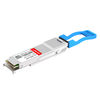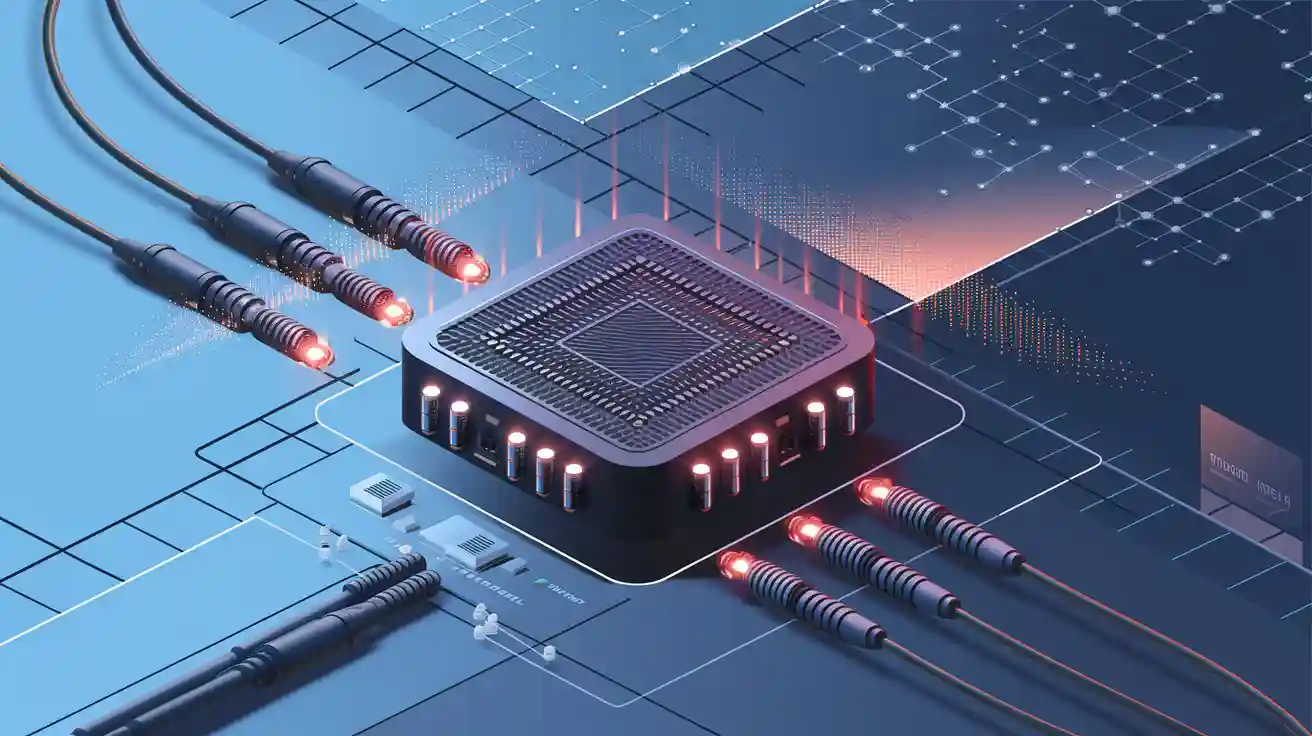
The Juniper SFPP-10G-SR-C is a 10Gbps SFP+ short-range optical transceiver designed for high-speed data transmission over multimode fiber (MMF) networks. It is widely deployed in enterprise switching, data center interconnects, and high-density server environments where stable 10G connectivity over short distances is required.
From a practical networking perspective, this module is primarily used to enable reliable 10GBASE-SR links, typically supporting distances up to 300m on OM3 fiber and up to 400m on OM4 fiber. Its 850nm VCSEL-based optical design ensures efficient short-reach transmission with low power consumption, making it suitable for modern energy-conscious network architectures.
In real-world deployments, the Juniper SFPP-10G-SR-C is valued for its compatibility with Juniper switching and routing platforms, hot-swappable design, and consistent performance under dense traffic conditions. It is commonly selected for top-of-rack switching, server access connectivity, and intra-data center aggregation where predictable low-latency performance is critical.
This guide provides a structured breakdown of the Juniper SFPP-10G-SR-C datasheet, covering its specifications, standards compliance, performance behavior, and deployment considerations to support informed technical evaluation and network planning.
➡️ What Is Juniper SFPP-10G-SR-C?
The Juniper SFPP-10G-SR-C is a 10Gbps SFP+ optical transceiver designed for short-range data transmission over multimode fiber, and it serves as a standard building block for 10GbE connectivity in Juniper-based networks. Its primary role is to enable reliable high-speed optical links between switches, routers, and servers within data center and enterprise environments.
In practical terms, this module is optimized for 10GBASE-SR applications, meaning it is intended for short-distance transmission where high bandwidth and low latency are required rather than long-haul connectivity. It operates using an 850nm wavelength and is designed to work with VCSEL laser technology, which is commonly used for cost-efficient multimode fiber transmission.
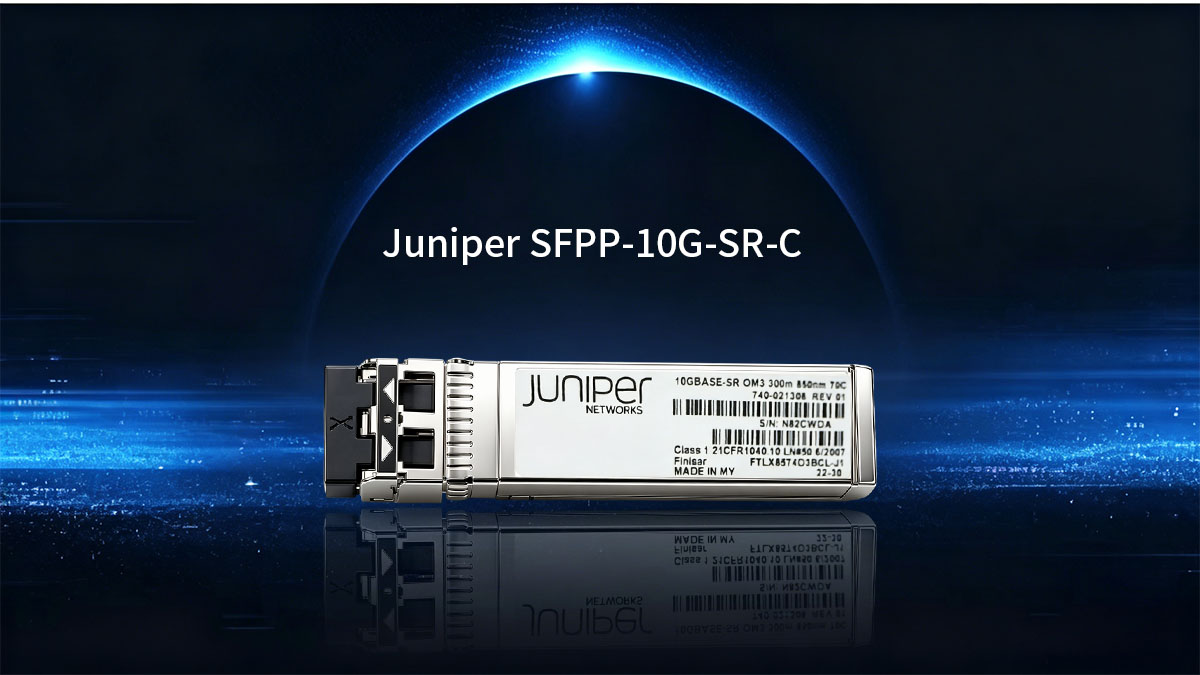
Product Definition and Role
The SFPP-10G-SR-C is best understood as a hot-pluggable optical interface module that converts electrical signals into optical signals for 10Gbps transmission. It is widely used to simplify high-speed network design by providing a standardized and interchangeable interface.
Key functional characteristics include:
- Converts 10GbE electrical signals into optical signals for fiber transmission
- Supports multimode fiber infrastructure for short-range links
- Enables modular and scalable network port expansion
- Designed for compatibility with Juniper networking hardware ecosystems
From a deployment perspective, its role is to provide flexible and reliable 10G connectivity without requiring changes to the underlying switch or router hardware.
Typical Use Cases
The Juniper SFPP-10G-SR-C is commonly deployed in environments where high-speed data transfer is required over relatively short distances, especially within structured network architectures.
Typical application scenarios include:
- Data center server-to-switch connectivity in top-of-rack (ToR) designs
- Aggregation layer links between access and distribution switches
- High-bandwidth interconnects within server clusters or virtualization environments
- Short-reach uplinks in enterprise campus networks
In these scenarios, the module is favored because it balances performance, power efficiency, and cost-effectiveness while maintaining stable 10Gbps throughput.
Operational Position in Network Architecture
In modern network topologies, the SFPP-10G-SR-C typically operates at the access or aggregation layer, where dense 10G connections are required.
Its functional placement is characterized by:
- High port density deployment in switches
- Short-reach optical links within racks or adjacent racks
- Integration into leaf-spine or hierarchical switching architectures
This positioning makes it a foundational component in scalable 10G infrastructure, particularly in environments transitioning from 1G to 10G Ethernet.
➡️ Juniper SFPP-10G-SR-C Datasheet Key Specifications
The Juniper SFPP-10G-SR-C is defined by a set of standardized optical and electrical specifications that determine its performance in 10GbE multimode fiber networks. These datasheet parameters directly influence transmission distance, compatibility, and signal stability in real-world deployments.
From a technical perspective, this module follows the 10GBASE-SR standard and is optimized for short-range, high-density optical connectivity in data centers and enterprise switching environments.
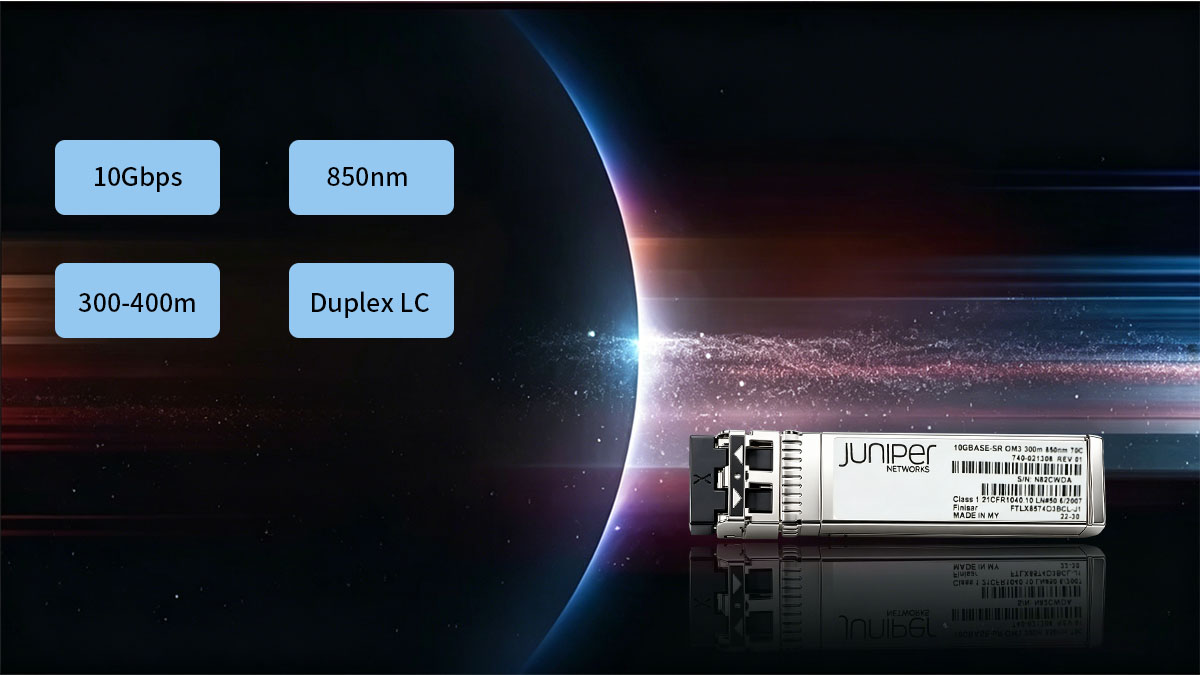
Core Technical Parameters
The most important datasheet specifications describe the fundamental operating limits and transmission capabilities of the module. These parameters define how the transceiver performs in standard multimode fiber environments.
Key technical characteristics include:
- Data rate: 10Gbps (10 Gigabit Ethernet)
- Wavelength: 850nm
- Transmission distance: up to 300m on OM3 fiber, up to 400m on OM4 fiber
- Connector type: Duplex LC interface
- Fiber type support: Multimode fiber (MMF)
These values confirm that the SFPP-10G-SR-C is strictly designed for short-range optical links, where multimode fiber infrastructure is already deployed.
Optical Performance Metrics
Beyond basic transmission specifications, optical performance defines signal quality and link reliability. These parameters are critical for ensuring stable 10G connectivity under varying network loads.
Important optical characteristics include:
- Transmit optical power range (ensures sufficient signal strength)
- Receiver sensitivity (determines minimum detectable signal level)
- Optical budget (difference between transmit power and receiver sensitivity)
- Link loss tolerance (supports stable operation under real-world fiber attenuation)
These factors collectively determine whether a link remains stable across connectors, patch panels, and fiber runs in dense deployment environments.
Physical and Environmental Specifications
The physical design and environmental operating conditions of the SFPP-10G-SR-C ensure compatibility with high-density networking hardware and typical data center conditions.
Key physical and environmental attributes include:
- Form factor: SFP+ hot-pluggable module
- Power consumption: low-power design suitable for dense switch environments
- Operating temperature range: defined for enterprise-grade deployment stability
- Hot-swappable capability: supports live insertion and removal without system shutdown
These characteristics make the module suitable for large-scale deployment scenarios where uptime and flexibility are critical requirements.
Technical Specification Summary
To provide a clearer overview of the most critical datasheet values, the core parameters can be summarized in a structured format. This helps quickly compare its capabilities against other 10G optical modules.
| Parameter |
Specification |
| Data Rate |
10Gbps |
| Wavelength |
850nm |
| Max Distance |
300m (OM3), 400m (OM4) |
| Connector Type |
Duplex LC |
| Fiber Type |
Multimode Fiber (MMF) |
| Form Factor |
SFP+ |
These specifications highlight that the SFPP-10G-SR-C is optimized specifically for short-range multimode fiber environments rather than long-distance single-mode applications.
➡️ Standards and Protocol Compliance
The Juniper SFPP-10G-SR-C complies with key IEEE and multi-source optical standards, ensuring interoperability, predictable performance, and seamless integration across compliant 10GbE network infrastructures. Its design alignment with industry specifications is a core reason it is widely deployed in heterogeneous data center environments.
From a practical standpoint, these standards ensure that the module can operate reliably across different vendors’ switches and routers, as long as they follow the same 10G optical interface definitions.
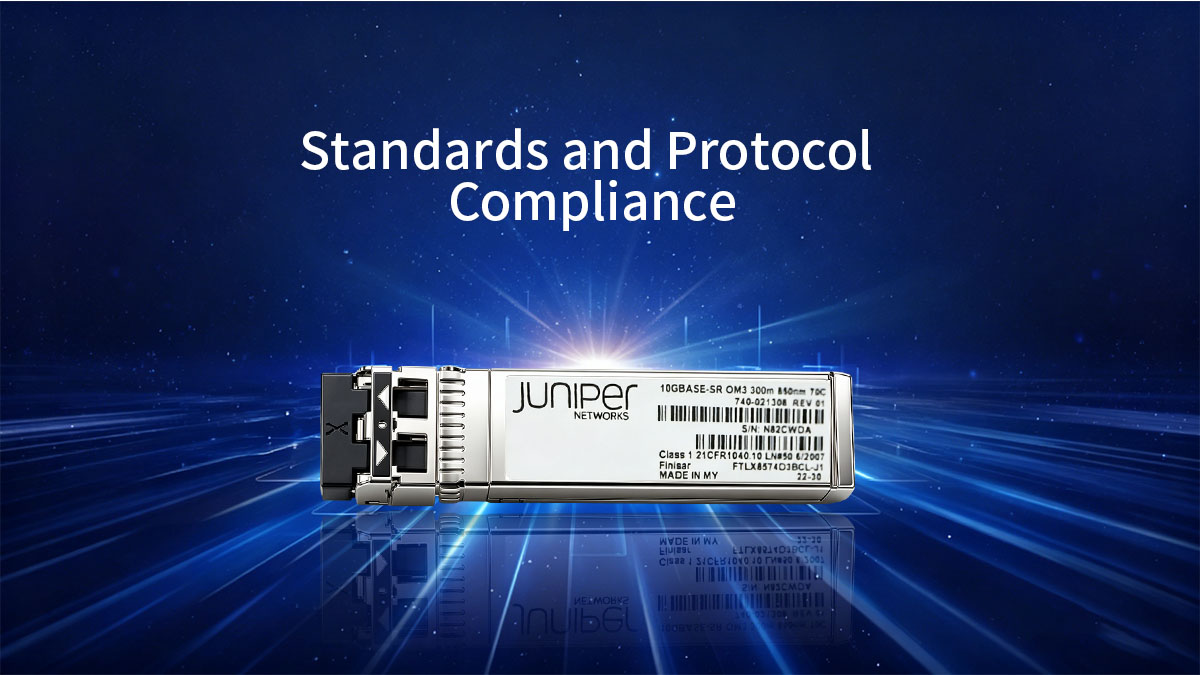
Industry Standards Support
The SFPP-10G-SR-C is built in accordance with globally recognized Ethernet and optical transceiver standards, which define how 10Gbps short-range optical communication should function across multimode fiber links.
Key standards compliance includes:
- IEEE 802.3ae (10GBASE-SR Ethernet standard)
- SFP+ Multi-Source Agreement (MSA) compliance
- RoHS environmental compliance for restricted substances
- Standard 850nm VCSEL-based multimode optical operation
These standards ensure that the module behaves consistently in 10GbE environments, particularly in short-reach multimode fiber deployments where signal integrity and interoperability are critical.
To better understand its role, these standards collectively guarantee:
- Consistent 10Gbps data transmission behavior
- Cross-vendor compatibility in compliant hardware ecosystems
- Predictable optical performance across structured cabling systems
- Environmental safety and regulatory adherence
In practical network design, this means engineers can deploy the module without needing custom optical tuning, as long as the infrastructure follows IEEE 10GBASE-SR requirements.
Compatibility with Juniper Platforms
Beyond general industry standards, the SFPP-10G-SR-C is specifically validated for use within Juniper networking equipment, ensuring stable operation and seamless integration at the system level.
Its compatibility profile includes:
- Support across Juniper switches and routers that accept SFP+ 10G modules
- Integration with Junos OS for interface recognition and diagnostics
- Firmware-level validation for optical transceiver monitoring
- Plug-and-play operation without manual configuration in most deployments
This tight integration provides operational advantages such as:
- Reduced configuration complexity during deployment
- Reliable optical link detection and status reporting
- Simplified lifecycle management within Juniper environments
- Stable performance under enterprise-grade traffic conditions
In real-world scenarios, this compatibility ensures that the SFPP-10G-SR-C can be deployed as a standard 10G building block within Juniper-based architectures, supporting both legacy upgrades and new high-density deployments without introducing interoperability concerns.
➡️ Performance Characteristics and Advantages
The Juniper SFPP-10G-SR-C delivers stable 10Gbps short-range optical performance designed for dense, high-throughput network environments. Its value comes from a combination of predictable signal quality, low power consumption, and efficient multimode fiber operation, making it a practical choice for modern data center architectures.
From a technical standpoint, its performance profile is optimized for short-distance links where reliability and port density matter more than long-haul transmission capability.
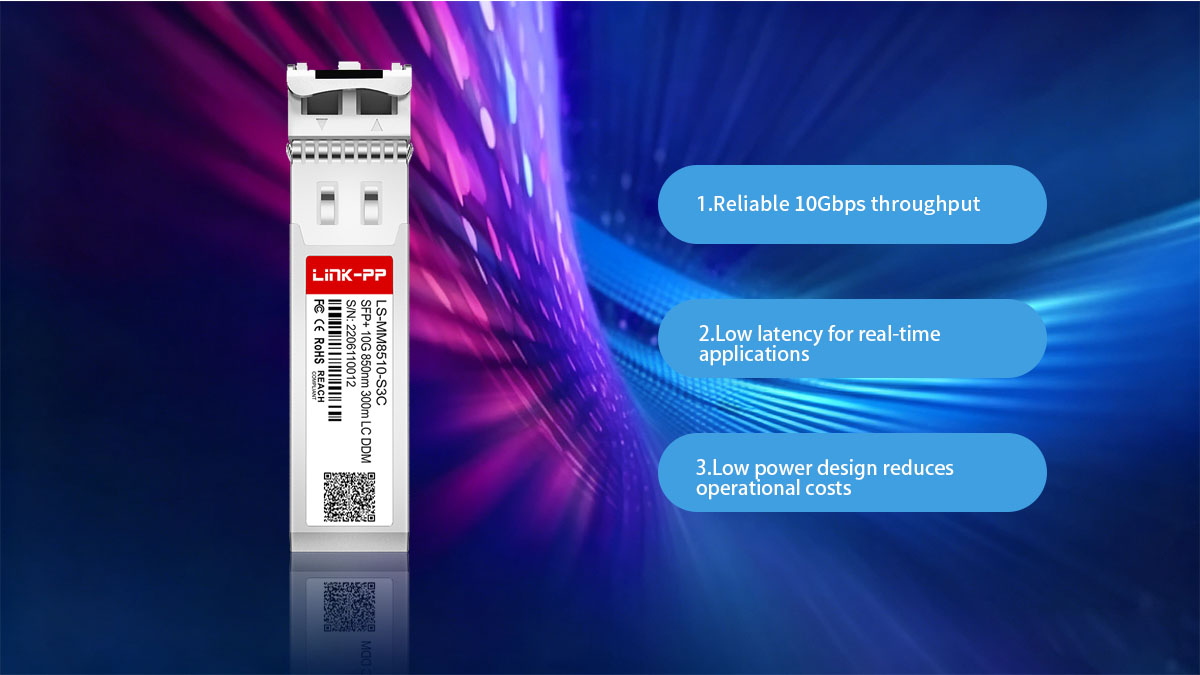
High-Speed Data Transmission
The SFPP-10G-SR-C is engineered to maintain consistent 10Gbps throughput across multimode fiber links, ensuring stable performance under continuous network load.
Key performance advantages include:
- Full-duplex 10Gbps transmission for high-bandwidth applications
- Low latency signal propagation suitable for real-time traffic
- Stable operation under burst-heavy data center workloads
- Reliable short-range optical transmission with minimal signal degradation
These characteristics make it suitable for environments where traffic is primarily east-west, such as server-to-server communication in virtualized infrastructures.
Signal Stability and Link Reliability
Reliable optical performance is a critical requirement in dense switching environments, and this module is designed to minimize link instability caused by optical attenuation or connector loss.
Key stability-related features include:
- Consistent optical output within defined power ranges
- Strong receiver sensitivity for improved signal detection
- Tolerance to standard multimode fiber attenuation levels
- Stable operation across patch panels and structured cabling systems
In practical deployments, this translates into fewer link drops, reduced troubleshooting overhead, and more predictable network behavior in high-density racks.
Power Efficiency and Thermal Performance
One of the key advantages of the SFPP-10G-SR-C is its low power consumption, which is especially important in environments with large numbers of active optical ports.
Key efficiency benefits include:
- Low power design suitable for high-density switch deployments
- Reduced heat generation compared to higher-power optical modules
- Improved energy efficiency in large-scale data center environments
- Lower cooling requirements in densely populated racks
This efficiency helps reduce operational overhead while maintaining stable 10Gbps performance across many simultaneous connections.
Scalability and Network Flexibility
The SFPP-10G-SR-C supports flexible network expansion strategies, making it suitable for evolving infrastructure requirements where scalability is a priority.
Key scalability advantages include:
- Hot-swappable SFP+ form factor enables fast port upgrades
- Easy integration into existing 10G switching infrastructure
- Supports modular growth in leaf-spine and hierarchical architectures
- Enables gradual migration from lower-speed Ethernet deployments
In real-world scenarios, this flexibility allows network architects to scale bandwidth incrementally without redesigning the entire physical layer.
Operational Advantages in Real Deployments
Beyond technical specifications, the SFPP-10G-SR-C provides practical operational benefits that improve overall network manageability.
Key real-world advantages include:
- Simplified deployment in standardized multimode fiber environments
- Reduced configuration complexity due to plug-and-play design
- Consistent performance across Juniper-supported platforms
- Predictable behavior in high-density switching environments
These advantages make it a dependable component for enterprise and data center networks that require stable and repeatable 10GbE connectivity.
➡️ Deployment Considerations
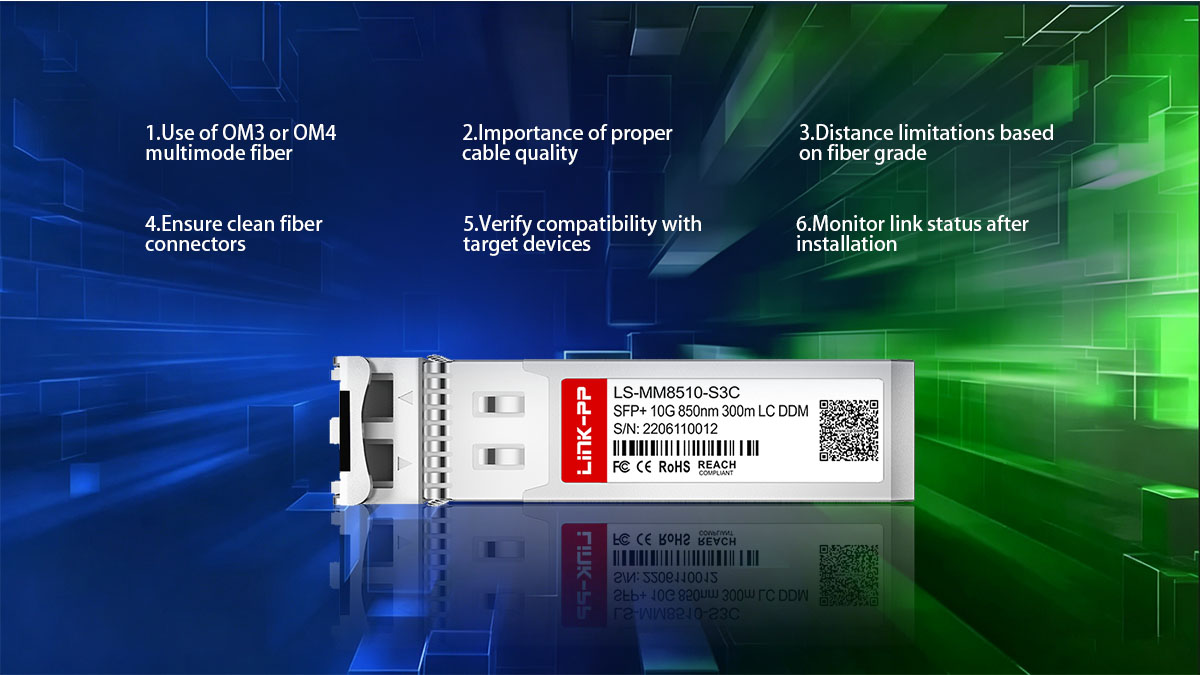
The Juniper SFPP-10G-SR-C is designed for straightforward integration into 10GbE multimode fiber networks, but achieving stable performance depends heavily on proper cabling, installation practices, and environmental conditions. Careful deployment planning ensures that its full optical and electrical capabilities are consistently realized in production environments.
From a network engineering perspective, most performance issues in short-range SFP+ links are not caused by the module itself but by fiber quality, connector handling, and distance planning.
Fiber Cabling Requirements
The SFPP-10G-SR-C operates exclusively over multimode fiber, and selecting the correct fiber type is essential for meeting distance and performance expectations.
Key cabling requirements include:
- OM3 or OM4 multimode fiber recommended for optimal performance
- OM3 supports up to 300m at 10Gbps
- OM4 extends reach up to 400m under ideal conditions
- Duplex LC connectors required for proper interface alignment
- Low-loss patch cords preferred in high-density environments
In practical deployments, OM4 fiber is often preferred in new installations due to its improved modal bandwidth and better scalability for future upgrades.
Installation Best Practices
Proper installation is critical to maintaining signal integrity and ensuring stable long-term operation of the optical link.
Recommended best practices include:
- Clean all fiber connectors before insertion to prevent signal degradation
- Ensure secure LC connector seating to avoid intermittent link issues
- Avoid excessive bending of fiber cables to maintain optical performance
- Verify correct port and module alignment before powering traffic
These steps help prevent common issues such as high insertion loss, unstable links, or degraded throughput in dense switching environments.
Link Validation and Testing
After installation, validating the optical link ensures that the deployment meets expected performance standards before production traffic is introduced.
Key validation steps include:
- Checking link status via switch or router interface
- Verifying optical power levels within acceptable ranges
- Performing end-to-end connectivity tests under load conditions
- Monitoring error rates and retransmissions during initial operation
This process helps identify potential cabling or configuration issues early, reducing long-term operational disruptions.
Environmental and Operational Factors
Although the SFPP-10G-SR-C is designed for enterprise environments, external conditions can still influence performance stability and lifespan.
Important environmental considerations include:
- Maintaining proper airflow in high-density switch racks
- Avoiding excessive dust accumulation around optical ports
- Ensuring operating temperature remains within specification limits
- Managing port density to prevent localized heat buildup
In real-world data center deployments, thermal management is particularly important, as high port density can increase heat concentration around SFP+ modules.
Common Deployment Issues and Mitigation
Even in well-designed networks, certain issues may arise if deployment guidelines are not followed carefully.
Typical issues and mitigation strategies include:
- Link not established → verify module seating and compatibility
- Intermittent connectivity → inspect fiber cleanliness and bend radius
- Reduced performance → check optical power budget and fiber quality
- Unexpected errors → validate switch configuration and firmware support
Addressing these factors proactively ensures that the SFPP-10G-SR-C operates at its intended performance level in production environments.
➡️ Comparing SFPP-10G-SR-C with Other 10G Modules
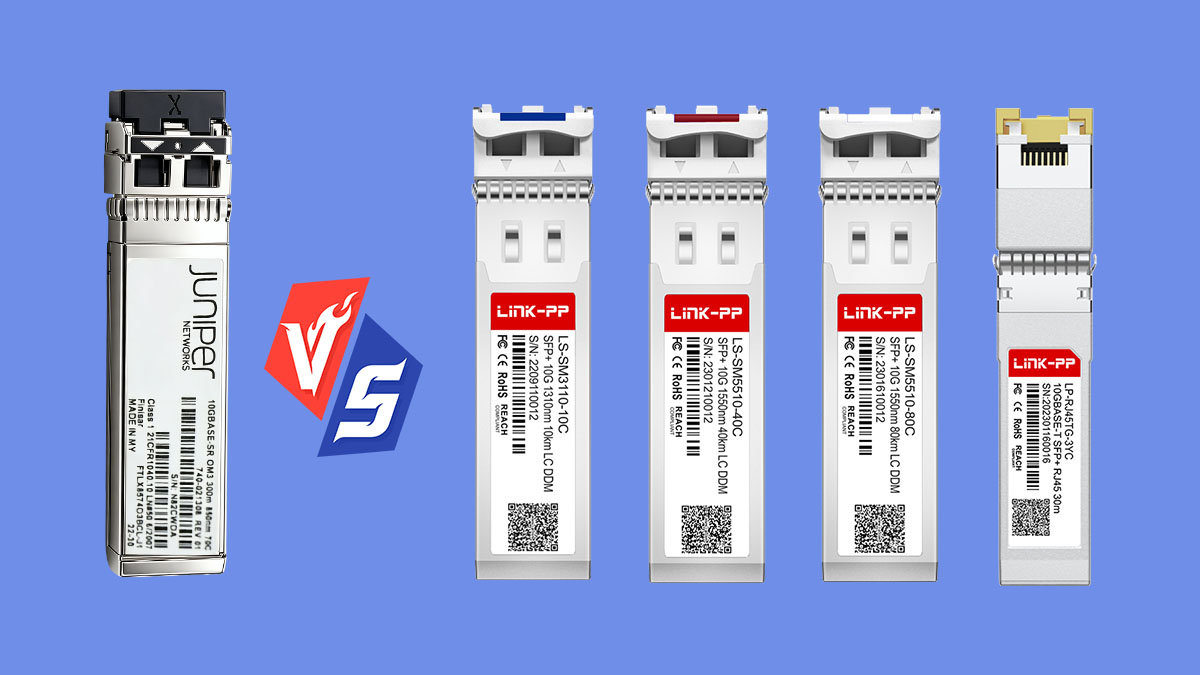
The Juniper SFPP-10G-SR-C is part of the broader 10GbE SFP+ ecosystem, where different modules are optimized for specific transmission distances, fiber types, and deployment scenarios. While it is designed for short-range multimode fiber connectivity, other 10G modules such as LR, ER, and copper-based variants serve different roles in network architecture.
From a technical perspective, understanding these differences is essential because all 10G SFP+ modules share the same form factor but are not interchangeable due to differences in wavelength, optical design, and transmission medium.
SR vs LR Transceivers
The most common comparison is between SR (Short Range) and LR (Long Range) modules, as they are widely used in enterprise and data center environments.
Key differences include:
- SR operates over multimode fiber (MMF), while LR uses single-mode fiber (SMF)
- SR uses an 850nm VCSEL laser, while LR uses a 1310nm DFB laser
- SR supports up to 300m–400m, while LR supports up to 10km
- SR is optimized for intra-data center links, while LR is used for campus or inter-building connectivity
In practical deployments, SR is typically chosen for rack-level or intra-data center connections, while LR is used when longer reach is required across buildings or network segments.
SR vs ER and ZR Modules
Beyond LR, there are extended-reach modules such as ER (Extended Reach) and ZR (Zoned Reach), which further extend transmission distance but at higher cost and stricter fiber requirements.
Key distinctions include:
- ER modules support distances up to ~40km using single-mode fiber
- ZR modules can extend up to ~80km in specialized deployments
- Both use higher-power optical components compared to SR
- These modules are typically used in metropolitan or backbone networks
Compared to these, the SFPP-10G-SR-C is significantly more cost-efficient and simpler to deploy but limited to short-distance environments.
SR vs Copper (10GBASE-T) Modules
Another important comparison is between optical SR modules and copper-based 10GBASE-T SFP+ transceivers.
Key differences include:
- SR uses fiber optics, while 10GBASE-T uses copper twisted pair cabling
- Copper modules typically support up to 30–100m depending on cable type
- Copper modules consume more power and generate more heat
- Fiber SR provides better signal stability and lower latency
In real-world data centers, SR is preferred for high-density switching environments due to lower power consumption and better thermal efficiency, while copper is used for short, cost-sensitive copper-based infrastructure.
Practical Selection Guidelines
Choosing between SR and other 10G modules depends on deployment requirements rather than performance superiority.
Key decision factors include:
- Distance: SR for ≤400m, LR for km-scale links
- Fiber type: MMF for SR, SMF for LR/ER/ZR
- Power budget: SR for lower power environments
- Network layer role: SR for access layer, LR+ for backbone links
This makes the SFPP-10G-SR-C the default choice for most short-range 10GbE deployments where multimode fiber infrastructure is already in place.
➡️ Application Scenarios in Modern Networks
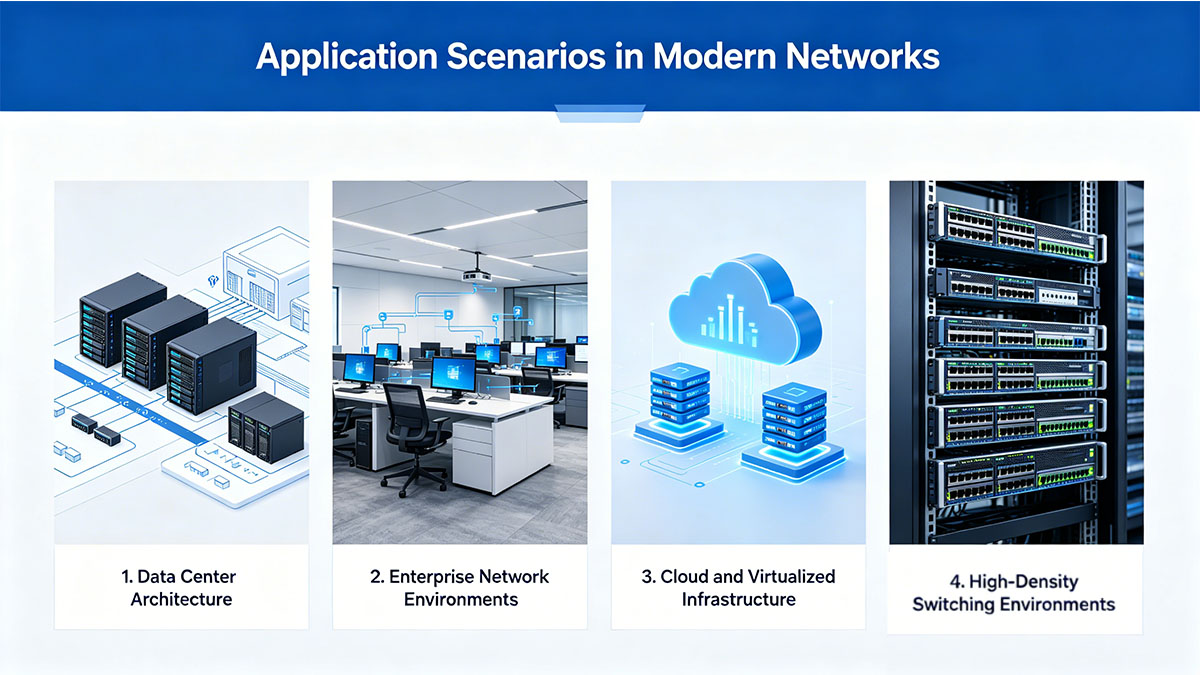
The Juniper SFPP-10G-SR-C is widely used in modern network infrastructures where short-range, high-bandwidth 10GbE connectivity is required. Its role is most prominent in environments that rely on dense switching, high server-to-switch traffic, and scalable data center architectures.
From a practical deployment perspective, this module is not limited to a single use case. Instead, it serves as a flexible interconnect component across multiple layers of enterprise and cloud-scale networks.
Data Center Architecture
The SFPP-10G-SR-C is most commonly deployed in data center environments, where it supports high-speed east-west traffic between servers and switches.
Typical applications include:
- Top-of-rack (ToR) switch to server connectivity
- Leaf-to-spine interconnections in leaf-spine architectures
- High-density server cluster networking
- Virtualized infrastructure requiring consistent low-latency links
In these scenarios, the module enables stable 10Gbps performance over short multimode fiber runs, which is essential for minimizing latency and maximizing throughput in modern distributed computing environments.
Enterprise Network Environments
Beyond data centers, the SFPP-10G-SR-C is also widely used in enterprise campus and corporate network infrastructures where high-speed aggregation is required.
Common enterprise use cases include:
- Access layer uplinks to distribution switches
- Aggregation of departmental network traffic
- High-performance office backbone connections
- Data-intensive application environments such as ERP or database systems
In enterprise networks, this module helps ensure smooth traffic flow between network layers while maintaining cost-effective 10G scalability.
Cloud and Virtualized Infrastructure
Modern cloud and virtualization platforms rely heavily on predictable high-bandwidth interconnects, making short-range 10G modules essential building blocks.
Key applications include:
- Hypervisor host connectivity in virtualized clusters
- Storage network traffic (iSCSI or NAS over Ethernet)
- High-performance computing (HPC) clusters
- Private cloud infrastructure interconnects
In these environments, the SFPP-10G-SR-C supports consistent data transfer rates, which is critical for maintaining performance stability across distributed workloads.
High-Density Switching Environments
One of the defining use cases for the SFPP-10G-SR-C is deployment in high-density switch environments, where space, power, and thermal efficiency are key considerations.
Key deployment characteristics include:
- Large-scale SFP+ port utilization in compact switch chassis
- High port density in data center racks
- Efficient power usage per 10G link
- Reduced cabling complexity using structured multimode fiber
These factors make it especially suitable for modern network designs where hundreds or thousands of 10G connections must be managed efficiently within limited physical space.
➡️ Key Factors to Evaluate Before Deployment
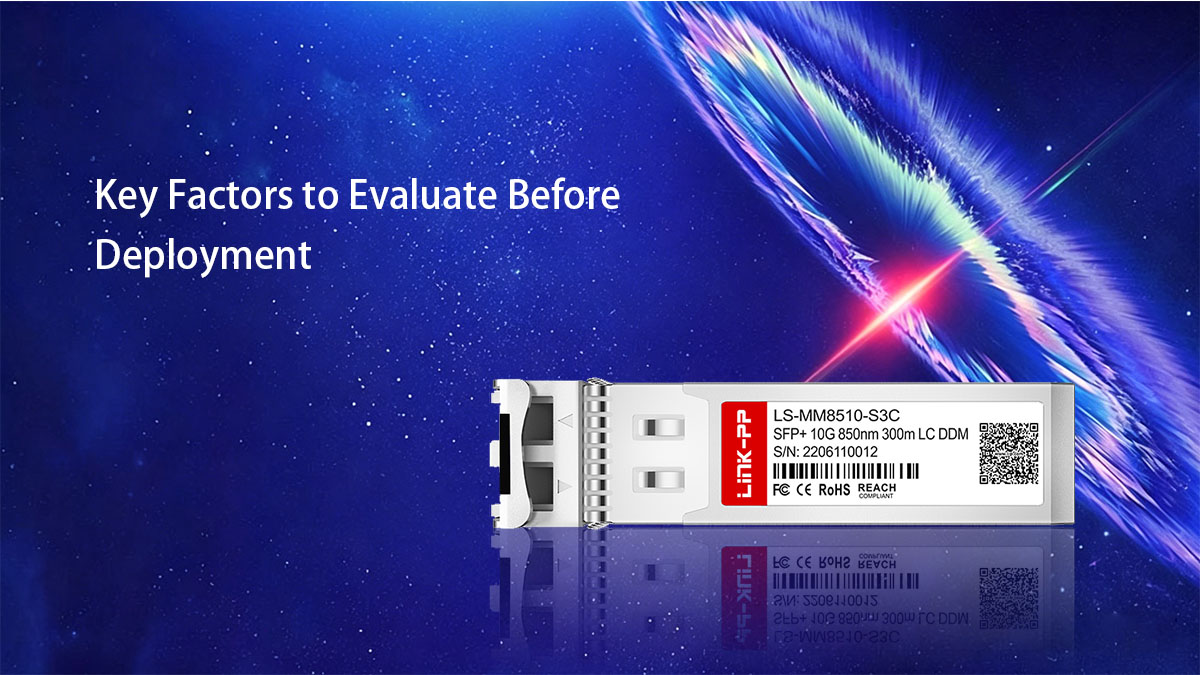
The Juniper SFPP-10G-SR-C is straightforward to integrate into 10GbE networks, but achieving stable and efficient operation depends on evaluating several technical and architectural factors before deployment. These considerations help ensure that the module aligns with both current infrastructure and future scalability requirements.
From a network design perspective, most deployment issues arise not from the transceiver itself but from mismatches in fiber type, distance planning, and compatibility assumptions.
Compatibility and Interoperability
The first factor to evaluate is whether the module is fully compatible with the intended networking environment, especially when mixed-vendor equipment is involved.
Key considerations include:
- Support for SFP+ ports on Juniper switches and routers
- Compliance with 10GBASE-SR optical standards for interoperability
- Potential vendor-specific coding or firmware restrictions
- Cross-platform operation in multi-vendor network environments
In practical deployments, verifying compatibility early helps avoid link detection issues, unexpected error logs, or disabled ports due to transceiver validation policies.
Fiber Infrastructure Readiness
Since the SFPP-10G-SR-C operates exclusively over multimode fiber, the existing cabling infrastructure must meet appropriate specifications.
Key evaluation points include:
- Availability of OM3 or OM4 multimode fiber infrastructure
- Maximum supported link distance within physical layout constraints
- Quality of patch cords, connectors, and termination points
- Presence of structured cabling systems in rack environments
In real-world scenarios, underestimating fiber quality or distance limitations is one of the most common causes of degraded 10G performance.
Power and Thermal Planning
Although SR modules are generally low power, large-scale deployments can still introduce significant cumulative thermal load.
Important factors to assess include:
- Total number of active SFP+ ports per switch chassis
- Heat dissipation capacity of network racks
- Airflow design in high-density switching environments
- Power budget allocation per switch or line card
Proper thermal planning ensures that dense deployments remain stable under sustained traffic conditions without overheating or performance throttling.
Network Architecture and Scalability
The SFPP-10G-SR-C should be evaluated within the context of overall network design, especially in environments expected to scale over time.
Key architectural considerations include:
- Placement within leaf-spine or hierarchical topologies
- Availability of spare SFP+ ports for future expansion
- Alignment with current and future bandwidth requirements
- Migration path from 1G or 10G to higher-speed networks
In practice, this ensures that the deployment is not only suitable for current needs but also adaptable to future infrastructure upgrades.
Optical Budget and Distance Planning
Accurate distance and optical budget planning is essential for maintaining stable signal quality across all links.
Key planning factors include:
- Maximum link distance based on OM3 vs OM4 fiber
- Total insertion loss across connectors and patch panels
- Margin between transmitter power and receiver sensitivity
- Environmental factors affecting fiber attenuation
When these parameters are not properly calculated, issues such as intermittent connectivity or high bit error rates may occur even within nominal distance limits.
Operational Monitoring and Maintenance Strategy
Before deployment, it is also important to define how the module will be monitored and maintained over time.
Key operational considerations include:
- Support for optical diagnostics and monitoring via switch OS
- Availability of link status and power level reporting
- Maintenance procedures for fiber cleaning and inspection
- Replacement strategy for high-density environments
A well-defined operational strategy ensures long-term stability and reduces troubleshooting complexity in large-scale deployments.
➡️ Conclusion
The Juniper SFPP-10G-SR-C is a 10Gbps SFP+ short-range optical transceiver designed for high-performance multimode fiber connectivity in modern data center and enterprise networks. As a 10GBASE-SR compliant module, it delivers stable, low-latency transmission over OM3 and OM4 fiber, making it a foundational component in scalable 10G network architectures where reliable short-distance interconnects are required.
To consolidate the most important insights from this guide, the essential points can be summarized as follows:
- Optimized for 10Gbps short-range transmission over multimode fiber (OM3/OM4)
- Supports up to 300m–400m reach depending on fiber grade and deployment quality
- Fully compliant with IEEE 802.3ae 10GBASE-SR standards for interoperability
- Designed for high-density, low-power, and scalable data center environments
- Widely used in server-to-switch, leaf-spine, and enterprise aggregation networks
- Performance depends heavily on fiber quality, optical budget, and proper installation practices
These points highlight its role as a reliable and efficient solution for short-range 10G optical networking.
In modern network infrastructures, the SFPP-10G-SR-C continues to be a widely adopted choice for organizations upgrading or maintaining 10GbE connectivity. Its balance of performance, efficiency, and standard-based compatibility ensures long-term usability across evolving network architectures.
For organizations planning new deployments or optimizing existing fiber networks, selecting compatible and well-validated optical transceivers is critical for maintaining stability and scalability. Reliable sourcing and consistent product quality can significantly impact long-term network performance and operational efficiency.
For more compatible optical transceivers and network interconnect solutions, you may explore the LINK-PP Official Store for additional options aligned with enterprise networking requirements.