



































Modern networks are experiencing rapid growth in data traffic driven by cloud computing, AI workloads, virtualization, and large-scale digital services. As a result, data centers and enterprise infrastructures are under increasing pressure to deliver higher bandwidth while maintaining efficient use of physical space, power, and cooling resources. This shift toward denser and more scalable network architectures has made optical connectivity a foundational component of modern IT infrastructure.
Within this evolving landscape, the Single Mode Fiber Transceiver plays a critical role in enabling long-distance, high-capacity optical communication. Unlike multimode solutions that are typically limited to shorter reach, single mode optics are designed to support extended transmission distances with minimal signal loss, making them essential for backbone, interconnect, and high-density deployment scenarios. As network operators push toward higher port densities and faster speeds such as 100G, 400G, and beyond, these optical transceivers have become a key enabling technology for scalable fiber infrastructure design.
This article explores how Single Mode Fiber Transceivers support high-density deployment strategies and why they are essential in modern optical network planning. It breaks down the core technical concepts, deployment considerations, and real-world use cases to provide a comprehensive understanding of their role in scalable network design. The key areas covered include:
- Fundamental architecture and working principles of single mode fiber transceivers
- The importance of high-density deployment in data centers and telecom networks
- Key advantages such as long reach, scalability, and port efficiency
- Critical design factors including power, space, and fiber infrastructure planning
- Enabling technologies like CWDM transceivers, DWDM transceivers, and next-generation high-speed optics
- Practical deployment scenarios across enterprise, cloud, and service provider environments
Together, these insights will help clarify how single mode optical technology supports the growing demands of modern high-density networking environments and why it remains a core building block for future-ready infrastructure.
🔵 Understanding Single Mode Fiber Transceivers
A Single Mode Fiber Transceiver is an optical communication module designed to transmit and receive data over single mode fiber using laser-based light signals. It is widely used in high-speed networking environments because it supports long-distance transmission with low attenuation and high signal integrity. In modern infrastructure, it serves as a fundamental building block for data center interconnects, telecom backbones, and enterprise core networks where scalability and reliability are essential.
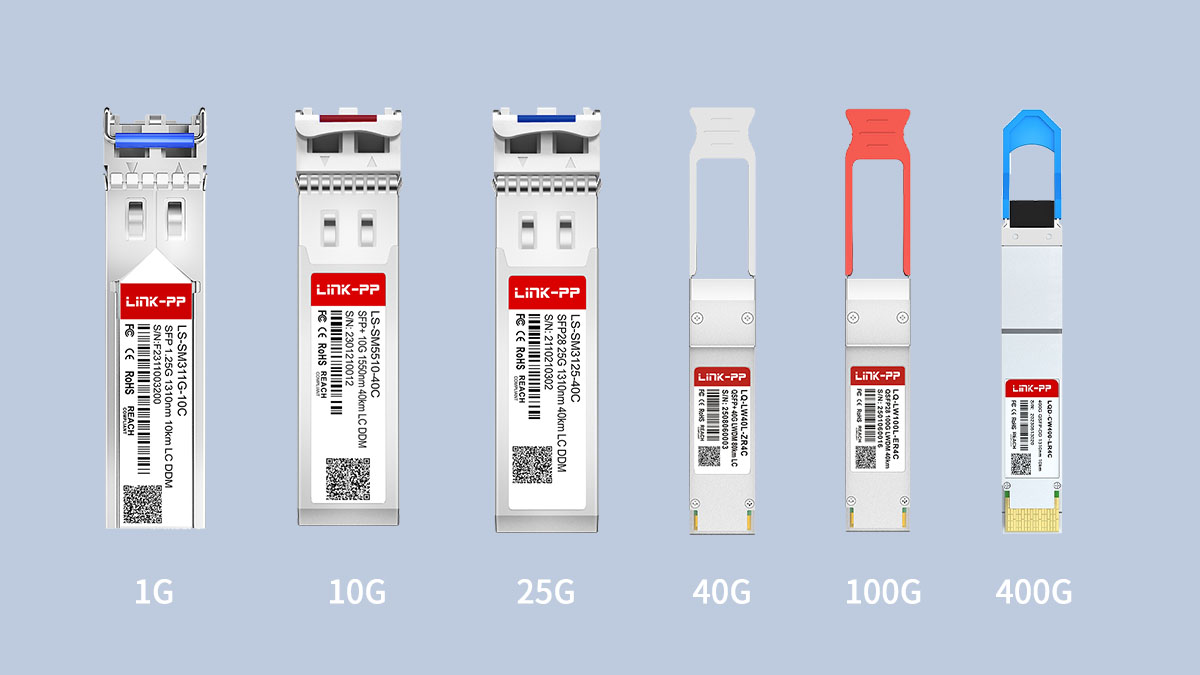
What Is a Single Mode Fiber Transceiver?
A Single Mode Fiber Transceiver is an optical module that enables data transmission over a single optical path within a fiber core. It is specifically optimized for long-distance and high-bandwidth communication scenarios.
To better understand its role, it is useful to highlight its core function in networking environments:
- Converts electrical signals from networking equipment into optical signals
- Transmits data using laser light through single mode fiber
- Receives incoming optical signals and converts them back into electrical signals
- Enables stable communication over distances ranging from kilometers to tens of kilometers or more
These characteristics make it especially suitable for backbone networks, campus interconnects, and high-density data center architectures where signal quality and reach are critical requirements.
Main Components of a Single Mode Fiber Transceiver
A Single Mode Fiber Transceiver is built from multiple optical and electronic components that work together to ensure accurate signal transmission and reception. Each component plays a specific role in maintaining performance and reliability.
The key internal components typically include:
- Laser Transmitter (Optical Emitter): Generates a narrow, coherent light signal optimized for single mode fiber transmission
- Photodetector (Receiver): Converts incoming optical signals back into electrical signals for processing
- Driver and Amplifier Circuits: Control signal strength and ensure stable modulation and detection
- Control and Monitoring Chip (DSP or IC): Manages signal processing, diagnostics, and performance optimization
- Digital Diagnostic Monitoring (DDM/DOM) Interface: Provides real-time information such as temperature, voltage, optical power, and bias current
These components collectively ensure that the transceiver maintains signal integrity even in long-distance and high-speed deployments, which is critical for modern high-density network environments.
Common Form Factors Used Today
Single Mode Fiber Transceivers are available in multiple standardized form factors, each designed to support different speed levels, port densities, and network architectures. These form factors directly influence how efficiently network equipment can scale.
The most commonly used form factors include:
- SFP (Small Form-factor Pluggable): Used for 1G SFP networks and entry-level optical links
- SFP+: Supports 10G Ethernet applications with improved density over SFP
- SFP28: Designed for 25G SFP28 networks, commonly used in modern access and aggregation layers
- QSFP28: Supports 100G connectivity and is widely deployed in data center spine-leaf architectures
- QSFP-DD (Double Density): Enables 400G and higher speeds with significantly increased port density
- OSFP (Octal Small Form-factor Pluggable): Another high-speed form factor optimized for next-generation 400G/800G systems
Each form factor represents a step forward in balancing bandwidth, power efficiency, and physical density. As network demands continue to increase, newer form factors are increasingly focused on maximizing port density while maintaining backward compatibility and thermal efficiency.
🔵 Why High-Density Deployment Matters in Modern Networks
High-density deployment has become a core requirement in modern network design because data traffic is growing faster than physical infrastructure can easily expand. Organizations are no longer only scaling bandwidth; they are also trying to maximize port utilization, reduce rack space consumption, and improve overall operational efficiency. In this context, high-density optical networking allows more connectivity to be achieved within the same physical footprint, making it essential for data centers, cloud platforms, and telecom environments.
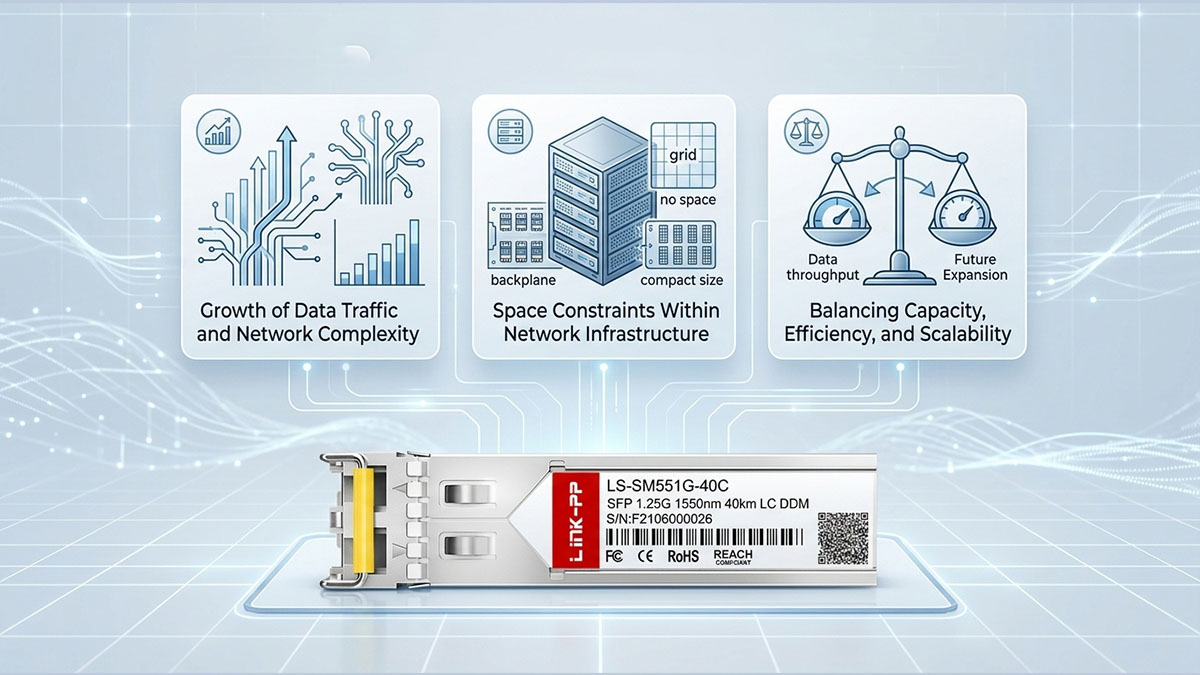
Growth of Data Traffic and Network Complexity
High-density deployment is primarily driven by the exponential increase in data traffic and the growing complexity of network workloads.
Modern applications such as cloud computing, AI training, video streaming, and distributed storage generate continuous east-west traffic within data centers. This creates a need for significantly more interconnect bandwidth between servers, switches, and storage systems.
Key drivers of traffic growth include:
- Expansion of cloud-native applications and microservices architectures
- Increased adoption of AI and machine learning workloads requiring high-throughput data exchange
- Rapid growth of real-time services such as video conferencing and streaming platforms
- Distributed computing models that rely heavily on internal data center communication
As a result, networks must support not only higher speeds but also a larger number of simultaneous connections, making density as important as bandwidth itself.
Space Constraints Within Network Infrastructure
High-density deployment is also essential because physical space inside modern network facilities is limited and increasingly expensive to scale.
Data centers and enterprise server rooms face strict constraints on rack space, cabling pathways, and cooling capacity. As equipment density increases, inefficient use of space can quickly become a bottleneck for expansion.
Typical space-related challenges include:
- Limited rack unit (U-space) availability in existing infrastructure
- Increasing number of switches and transceivers required for higher bandwidth
- Cable congestion leading to reduced airflow and maintenance difficulty
- Constraints in structured cabling pathways and patch panel capacity
To address these challenges, high-density optical solutions enable more ports per switch and more connections per rack, allowing operators to scale capacity without proportionally increasing physical footprint.
Balancing Capacity, Efficiency, and Scalability
Modern network design must carefully balance three critical factors: capacity, operational efficiency, and long-term scalability. High-density deployment plays a central role in achieving this balance.
Increasing capacity alone is no longer sufficient if it results in excessive power consumption, space inefficiency, or complex management overhead. Instead, networks must be designed to scale gracefully while maintaining operational simplicity.
Key considerations in this balance include:
- Capacity expansion: Supporting higher aggregate throughput without redesigning the entire infrastructure
- Operational efficiency: Reducing the number of physical devices and simplifying interconnect complexity
- Scalability planning: Ensuring that future upgrades (such as 400G or 800G migration) can be integrated smoothly
High-density optical architectures help achieve this balance by allowing more bandwidth per rack unit, reducing cabling overhead, and supporting modular growth models that align with evolving network demands.
🔵 Key Advantages of Single Mode Fiber Transceivers in High-Density Environments
Single Mode Fiber Transceivers provide several critical advantages in high-density network environments, especially where scalability, long-distance connectivity, and space optimization are essential. Their ability to deliver high bandwidth over extended distances while maintaining low signal loss makes them a preferred choice for modern data center and telecom architectures. In dense deployments, these advantages directly translate into improved efficiency and reduced infrastructure complexity.
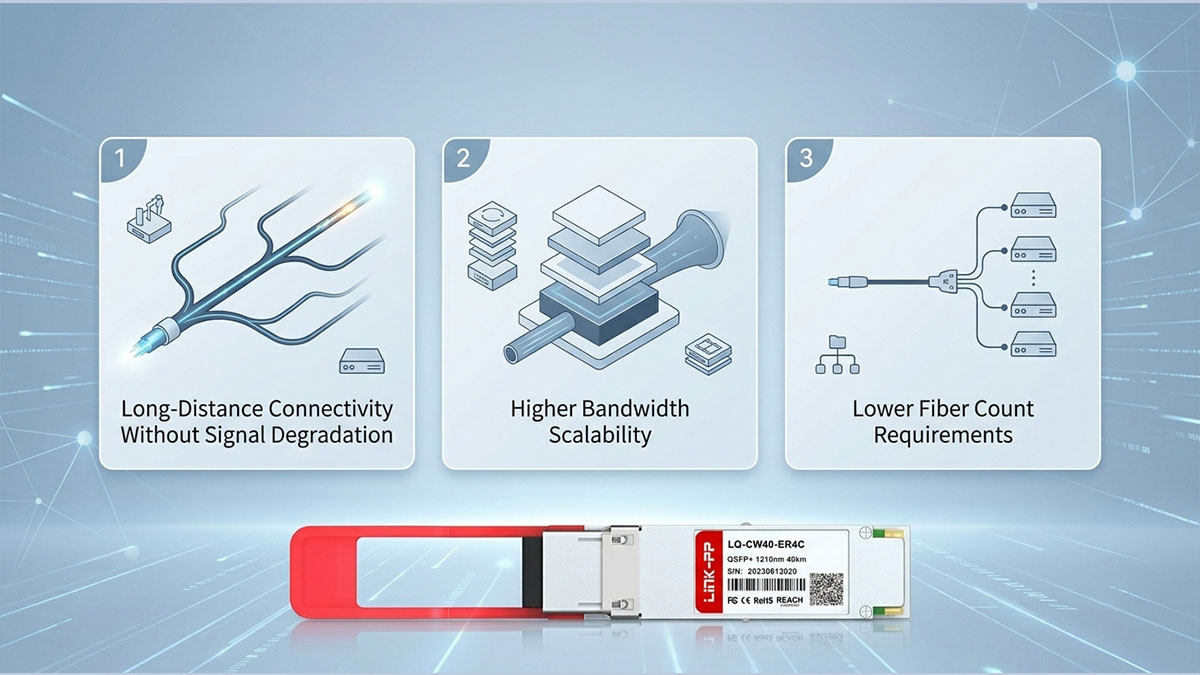
Long-Distance Connectivity Without Signal Degradation
Single Mode Fiber Transceivers are specifically designed to maintain strong signal integrity over long distances, which is a key requirement in distributed network environments.
Unlike short-reach optical solutions, single mode transmission uses a narrow laser beam that minimizes dispersion and attenuation. This enables stable communication across campus networks, metro links, and inter-building connections.
Key benefits include:
- Reliable transmission over several kilometers to tens of kilometers
- Reduced need for signal regeneration or intermediate amplification
- Stable performance even under high data rates such as 100G and 400G
- Ideal for backbone and interconnect layers in large-scale networks
This long-reach capability is especially valuable in high-density deployments where network nodes are physically separated but require high-speed interconnection.
Higher Bandwidth Scalability
High-density environments require not only more connections but also continuous bandwidth scaling. Single Mode Fiber Transceivers support this requirement by enabling smooth upgrades across multiple generations of Ethernet speeds.
The scalability advantage is particularly important in environments that must evolve without major infrastructure replacement.
Typical scalability characteristics include:
- Support for a wide range of data rates from 1G up to 800G
- Clear upgrade paths from SFP/SFP+ to QSFP+/QSFP28 and QSFP-DD platforms
- Compatibility with advanced modulation technologies for higher throughput
- Efficient support for evolving cloud and AI-driven workloads
This scalability allows network operators to extend system lifespan while gradually increasing capacity in line with traffic growth.
Lower Fiber Count Requirements
One of the key efficiency advantages of Single Mode Fiber Transceivers is their ability to reduce overall fiber usage in high-density deployments.
Because single mode fiber supports long-distance, high-bandwidth transmission over a single optical path, fewer fibers are needed compared to alternative architectures. This simplifies infrastructure design and reduces physical cabling complexity.
Key advantages include:
- Reduced number of fiber strands required for high-capacity links
- More efficient use of existing cabling infrastructure
- Simplified patch panel and cross-connect design
- Lower risk of cable congestion in high-density racks
This reduction in fiber count directly improves manageability and helps maintain cleaner, more scalable network layouts.
Improved Rack and Port Density
High-density deployment relies heavily on maximizing the number of network connections within limited physical space, and Single Mode Fiber Transceivers support this goal through compact and efficient form factors.
Modern optical modules are designed to increase port density while reducing power and thermal impact per connection.
Key improvements include:
- Higher port counts per switch chassis
- Compact form factors such as QSFP28 and QSFP-DD enabling dense layouts
- Reduced per-port power consumption compared to older technologies
- Improved airflow and thermal efficiency in dense rack environments
As a result, network operators can achieve significantly higher connectivity per rack unit, which is essential for scaling modern data center architectures without expanding physical footprint.
🔵 Critical Factors Affecting High-Density Deployment Design
Designing a high-density network using Single Mode Fiber Transceivers requires careful consideration of multiple technical and physical constraints. As port counts increase and bandwidth scales to 100G, 400G, and beyond, factors such as space, power, reach, and infrastructure compatibility become critical. A well-planned design ensures stable performance, simplified maintenance, and long-term scalability without excessive operational overhead.
Port Density Planning
High-density deployment begins with a clear understanding of how many ports are required and how they will be distributed across the network architecture. Poor planning at this stage can lead to congestion, inefficient scaling, or unnecessary hardware expansion.
Effective port density planning focuses on:
- Evaluating current and future bandwidth demand across access, aggregation, and core layers
- Aligning switch selection with required port speeds (e.g., 10G, 25G, 100G, 400G)
- Designing spine-leaf or Clos architectures for predictable scaling
- Ensuring sufficient uplink capacity to avoid oversubscription bottlenecks
By optimizing port distribution early, network designers can reduce reconfiguration needs and ensure smooth scalability as traffic grows.
Optical Reach Requirements
Optical reach is a fundamental design parameter that determines whether a Single Mode Fiber Transceiver is suitable for a given deployment scenario. Different network segments require different transmission distances, and mismatched specifications can lead to performance degradation or unnecessary cost.
Key considerations include:
- Short-reach vs long-reach requirements based on physical layout
- Data center interconnect distances between buildings or campuses
- Metro or regional connectivity for service provider networks
- Selection of appropriate optical specifications (e.g., 10km, 40km, 80km ranges)
Proper alignment between reach requirements and transceiver specifications ensures signal integrity and avoids over-engineering or under-provisioning.
Power Consumption Considerations
As network density increases, power consumption becomes a significant constraint that directly impacts both operational cost and thermal design.
High-density optical environments require careful power planning to maintain system stability.
Key factors include:
- Per-module power consumption across different form factors (SFP+, QSFP28, QSFP-DD)
- Aggregate power load per switch and rack
- Cooling system capacity to handle heat output
- Energy efficiency per transmitted bit as a performance metric
Efficient power management not only reduces operational costs but also improves system reliability by minimizing thermal stress on densely packed equipment.
Fiber Infrastructure Readiness
Existing fiber infrastructure plays a decisive role in determining how smoothly a high-density deployment can be implemented. Even advanced transceivers cannot perform effectively without a properly prepared physical layer.
Important infrastructure considerations include:
- Availability and condition of existing single mode fiber cabling
- Connector types and compatibility (LC, MPO, etc.)
- Patch panel capacity and cable routing design
- Documentation and labeling for large-scale fiber management
- Scalability of existing pathways for future expansion
Ensuring infrastructure readiness helps avoid deployment delays, reduces troubleshooting complexity, and supports long-term network growth without major physical redesigns.
🔵 Single Mode Fiber Transceiver Technologies Supporting High-Density Networks
High-density optical networks rely heavily on advancements in transceiver technologies that increase bandwidth, improve spectral efficiency, and reduce per-bit cost and power consumption. Single Mode Fiber Transceivers have evolved significantly, incorporating multiplexing techniques and advanced modulation methods to support modern data center, cloud, and telecom requirements. These technologies are essential for scaling beyond traditional 10G SFP+ and 40G QSFP+ architectures into 100G QSFP28, 400G QSFP-DD, and emerging OSFP 800G environments.
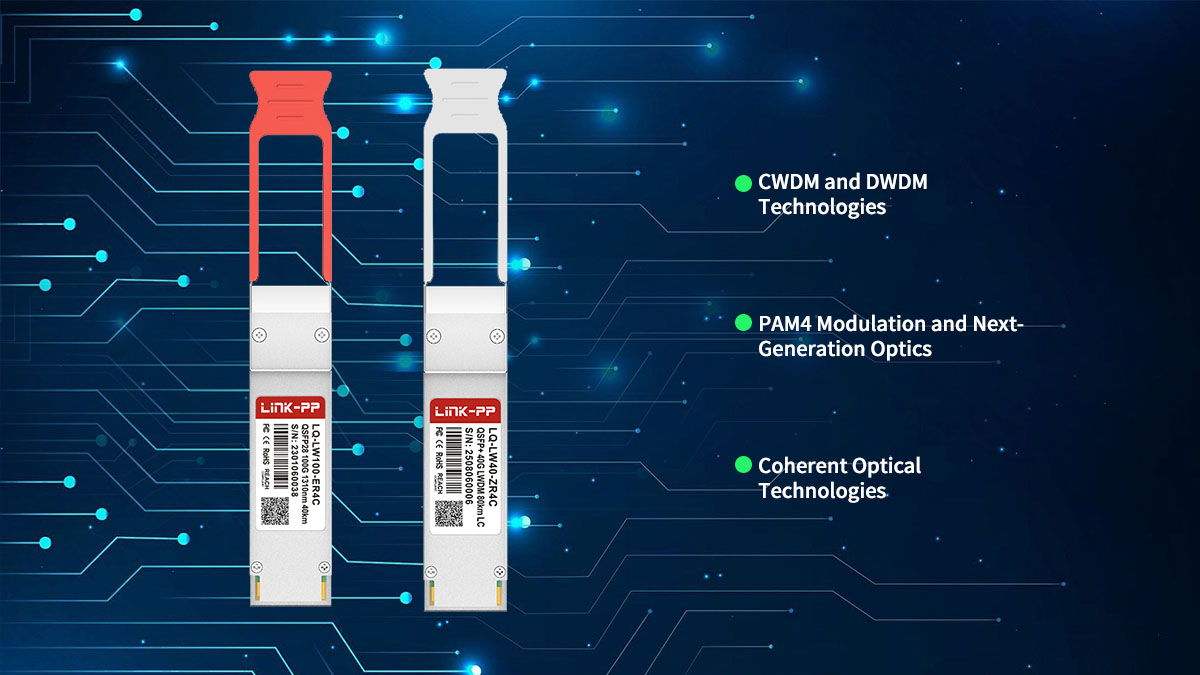
CWDM and DWDM Technologies
Coarse Wavelength Division Multiplexing (CWDM) and Dense Wavelength Division Multiplexing (DWDM) are key technologies that significantly increase the capacity of single mode fiber by transmitting multiple signals over different wavelengths.
These technologies are widely used in high-density environments where fiber availability is limited but bandwidth demand is rapidly increasing.
Key characteristics include:
- CWDM: Uses wider channel spacing, typically supporting fewer wavelengths over shorter to medium distances
- DWDM: Uses tighter wavelength spacing, enabling a much higher number of channels over long distances
- Both technologies allow multiple independent data streams over a single fiber pair
- Ideal for metro networks, data center interconnects, and backbone aggregation layers
To better understand their functional differences, the following comparison highlights key technical parameters:
| Technology | Channel Density | Typical Reach | Use Case Focus |
|---|---|---|---|
| CWDM | Lower (up to ~18 channels) | Short to medium distance | Cost-efficient metro and enterprise links |
| DWDM | High (40+ channels possible) | Long distance (tens to hundreds of km) | Carrier networks and high-capacity backbones |
CWDM is often selected for simpler deployments, while DWDM is preferred for ultra-high-capacity and long-haul environments where fiber efficiency is critical.
PAM4 Modulation and Next-Generation Optics
PAM4 (Pulse Amplitude Modulation with 4 levels) is a key enabling technology for modern high-speed Single Mode Fiber Transceivers, especially in 100G and above systems. It allows more bits to be transmitted per symbol, effectively doubling data rate efficiency compared to traditional NRZ signaling.
The adoption of PAM4 is essential for scaling network speeds without proportionally increasing lane counts or power consumption.
Key benefits include:
- Higher data throughput per optical lane
- Reduced requirement for additional physical fiber lanes
- Improved scalability for QSFP28 100G, QSFP56 200G, QSFP-DD 400G, and OSFP 800G transceiver designs
- Efficient use of existing optical infrastructure
However, PAM4 also introduces greater signal complexity and requires advanced digital signal processing (DSP) to maintain signal integrity in high-density environments.
Coherent Optical Technologies
Coherent optics represents one of the most advanced transmission technologies used in high-capacity Single Mode Fiber networks. It enables extremely high data rates and long-distance transmission by using both amplitude and phase information of the optical signal.
This technology is increasingly relevant in high-density deployments that require maximum bandwidth efficiency and long-haul performance.
Key advantages include:
- Extremely high spectral efficiency for maximizing fiber capacity
- Long-distance transmission capability without frequent signal regeneration
- Advanced modulation formats such as QPSK and QAM
- Strong resilience to signal distortion and dispersion
Coherent optical systems are commonly used in metro aggregation, inter-data center connectivity, and large-scale backbone networks where both capacity and reach are critical.
🔵 Deployment Scenarios for High-Density Single Mode Fiber Networks
High-density Single Mode Fiber Transceiver deployments are widely adopted across multiple network environments where scalability, long reach, and high bandwidth are essential. Different industries apply these technologies in distinct ways depending on traffic patterns, physical infrastructure, and growth requirements. Understanding these scenarios helps clarify how single mode optics enable modern network architectures at scale.
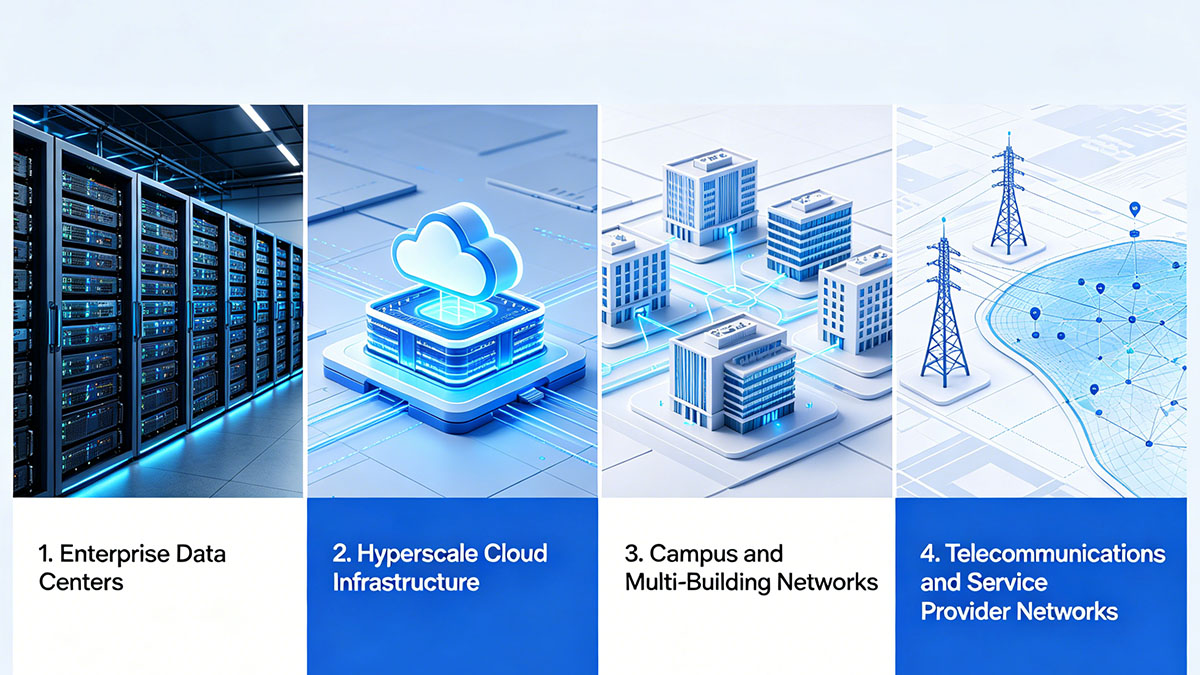
Enterprise Data Centers
High-density deployment in enterprise data centers is primarily used to support core switching, server aggregation, and internal backbone connectivity. As application workloads become more distributed and latency-sensitive, enterprises require faster and more efficient optical interconnects.
Typical use cases include:
- Connecting top-of-rack (ToR) switches to aggregation or spine layers
- Enabling high-speed server-to-switch connectivity (25G, 100G)
- Supporting storage networks and virtualization traffic
- Building resilient core networks with redundant optical paths
These deployments prioritize balanced performance, cost efficiency, and ease of expansion, making Single Mode Fiber Transceivers a key enabler for scalable enterprise infrastructure.
Hyperscale Cloud Infrastructure
Hyperscale cloud environments represent one of the most demanding use cases for high-density optical networks due to extreme traffic volumes and rapid infrastructure expansion cycles.
In these environments, Single Mode Fiber Transceivers are used to support:
- Massive east-west traffic between distributed compute clusters
- Highly automated and software-defined networking architectures
- Rapid scaling of data center capacity across global regions
- High-speed interconnects supporting AI and machine learning workloads
Key characteristics of hyperscale deployments include:
- Extremely high port density per rack
- Standardized optical platforms for simplified operations
- Continuous infrastructure expansion without service disruption
- Heavy reliance on 100G, 400G, and emerging 800G optics
These environments prioritize scalability and automation over manual network management complexity.
Campus and Multi-Building Networks
Campus and multi-building networks rely on Single Mode Fiber Transceivers to connect geographically separated facilities within a unified network architecture. High-density deployment in these environments focuses on long-distance connectivity and centralized management.
Common applications include:
- Linking office buildings, campuses, or industrial zones
- Providing high-speed backbone connectivity between network hubs
- Supporting unified communication, security, and cloud access systems
- Enabling centralized data center extensions across multiple sites
Key advantages in these scenarios include:
- Long-reach connectivity without performance degradation
- Reduced need for intermediate active networking equipment
- Simplified infrastructure management across multiple locations
- Efficient use of existing fiber backbone infrastructure
This makes single mode optics particularly suitable for scalable campus-wide network design.
Telecommunications and Service Provider Networks
Telecom and service provider networks represent one of the most traditional yet demanding application areas for high-density Single Mode Fiber deployments. These networks require extremely high capacity, reliability, and long-distance transmission capabilities.
Key deployment areas include:
- Metro aggregation and core transport networks
- Backhaul connectivity between base stations and core infrastructure
- Inter-city and regional backbone links
- High-capacity data transport between service nodes
Service providers typically prioritize:
- Maximum fiber utilization efficiency through DWDM and advanced multiplexing
- Long-haul transmission stability across large geographic areas
- High availability and redundancy for mission-critical services
- Seamless scalability to support increasing subscriber demand
In these environments, Single Mode Fiber Transceivers form the backbone of national and regional communication infrastructure, enabling continuous growth of broadband and mobile services.
🔵 Best Practices for Deploying Single Mode Fiber Transceivers at Scale
Deploying Single Mode Fiber Transceivers at scale requires more than selecting the right optical modules. Large-scale environments introduce complexity in inventory management, cabling, monitoring, and long-term expansion planning. Following established best practices helps ensure stable performance, simplified operations, and predictable scalability across high-density network infrastructures.
Standardize Transceiver Platforms
Standardization is a foundational practice for large-scale optical deployments because it reduces operational complexity and improves consistency across the network.
When transceiver platforms are standardized, network teams can manage deployments more efficiently and avoid compatibility issues.
Key standardization practices include:
- Using a limited set of form factors (such as SFP+, QSFP28, QSFP-DD) aligned with network architecture
- Aligning optical specifications across vendors and device generations
- Maintaining consistent wavelength and reach configurations within similar network layers
- Reducing unnecessary variation in module types across similar use cases
Standardization improves spare part management, simplifies troubleshooting, and ensures predictable performance across distributed infrastructure.
Implement Structured Cable Management
In high-density optical environments, fiber cabling complexity can quickly become a major operational challenge if not properly managed. Structured cable management is essential for maintaining clarity, airflow, and maintainability.
Effective practices include:
- Organizing fiber routes using clear labeling and color coding systems
- Separating high-speed and legacy links to reduce congestion
- Using patch panels and fiber trays to maintain orderly cable routing
- Planning cable paths to avoid excessive bending or tension
Proper cable management reduces the risk of accidental disconnections, simplifies upgrades, and ensures that physical infrastructure can support future scaling without redesign.
Utilize Optical Monitoring and Diagnostics
Modern Single Mode Fiber Transceivers often include Digital Diagnostic Monitoring (DDM/DOM) capabilities, which provide real-time insights into optical performance. Leveraging these features is critical for maintaining reliability in large-scale deployments.
Key monitoring parameters include:
- Optical transmit and receive power levels
- Module temperature and operating conditions
- Laser bias current and voltage stability
- Link quality and signal degradation indicators
Using these diagnostics enables:
- Early detection of failing or degraded transceivers
- Proactive maintenance before service disruption occurs
- Performance trend analysis across the network
- Faster troubleshooting in high-density environments
This visibility is especially important when managing thousands of optical links across distributed infrastructure.
Plan for Future Bandwidth Growth
High-density networks must be designed with future expansion in mind, as bandwidth requirements continue to grow rapidly due to cloud computing, AI workloads, and data-intensive applications.
Future-ready planning focuses on:
- Designing architectures that support smooth upgrades from 100G to 400G and beyond
- Ensuring fiber infrastructure can accommodate higher-capacity optics without replacement
- Selecting modular switch platforms that allow incremental scaling
- Reserving physical and logical capacity for future expansion needs
A forward-looking design approach helps avoid costly infrastructure overhauls and ensures that network investments remain viable over extended lifecycle periods.
🔵 Conclusion
High-density network environments are rapidly becoming the standard across data centers, cloud platforms, and telecom infrastructures, and Single Mode Fiber Transceivers sit at the center of this transformation. Their ability to deliver long-distance, high-bandwidth, and scalable optical connectivity makes them essential for supporting modern workloads such as cloud computing, AI processing, and large-scale distributed systems. As network demand continues to grow, the importance of efficient optical design and deployment strategies becomes even more critical.
A well-planned high-density architecture is not defined by transceiver selection alone, but by how effectively multiple factors are aligned within the overall network design. These include physical space optimization, power efficiency, fiber infrastructure readiness, and long-term scalability planning. When these elements are properly coordinated, single mode optical systems can deliver consistent performance while supporting continuous capacity expansion.
Key takeaways from high-density Single Mode Fiber Transceiver deployment include:
- High-density design enables more bandwidth per rack unit while minimizing physical footprint
- Single mode optics provide long-reach connectivity essential for modern distributed networks
- Technologies such as PAM4, DWDM, and coherent optics significantly enhance scalability
- Proper planning of power, thermal conditions, and cabling is critical for stable operation
- Future-ready architectures must support continuous upgrades toward 400G, 800G, and beyond
As networks evolve toward higher speeds and greater complexity, organizations must prioritize both performance and operational efficiency when designing optical infrastructure. Careful planning and adherence to best practices ensure that high-density deployments remain sustainable, scalable, and resilient over time.
In this context, sourcing reliable optical components and maintaining consistent deployment quality becomes increasingly important. Providers such as the LINK-PP Official Store play a role in supporting infrastructure needs for single mode optical connectivity, helping ensure compatibility and availability across different network deployment scenarios.







