High-speed data traffic continues to increase across modern digital infrastructure, driven by cloud computing, AI workloads, virtualization, and large-scale distributed systems. As networks scale, operators face growing pressure to deliver higher bandwidth while maintaining efficiency, power control, and deployment flexibility within dense data center environments.
In this environment, the SFP28 module has become a key solution for 25GbE connectivity. It provides a practical upgrade path beyond 10G Ethernet while avoiding the complexity and higher cost of multi-lane 40G or 100G architectures. With its compact form factor and optimized electrical design, it supports high-density switching systems where performance and space efficiency are both critical.
This article breaks down the SFP28 module from a technical and application perspective, including:
- Its internal architecture and optical/electrical design principles
- 25Gbps data throughput behavior and signal performance characteristics
- Compatibility with Ethernet standards, switch systems, and fiber types
- Typical deployment scenarios across data centers and enterprise networks
- Its positioning compared with SFP+ and QSFP28 solutions in network evolution
By analyzing these areas, the article helps build a clear understanding of how SFP28 fits into modern high-speed networking design and where it delivers the most practical value in real-world deployments.
📝 What is an SFP28 Module?
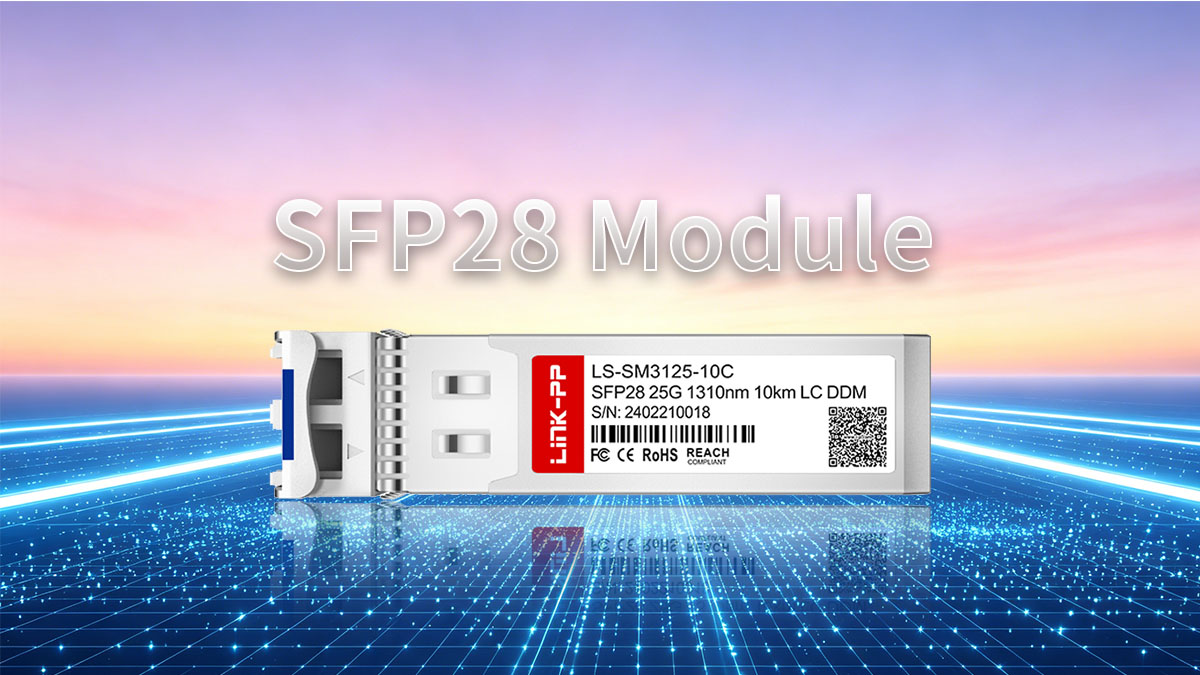
An SFP28 module is a compact optical transceiver designed to support 25Gbps Ethernet transmission over a single lane. It is an evolution of the SFP+ form factor, built to meet the requirements of modern high-speed networks while maintaining physical compatibility with existing SFP-based infrastructure.
At its core, the SFP28 module is defined by standardized electrical and optical specifications that enable reliable 25G data transmission. It is based on the IEEE 802.3by 25G Ethernet standard and is widely deployed in data center and enterprise environments where bandwidth demand exceeds traditional 10G links but does not yet require full 100G aggregation.
Definition and Standards Background
The SFP28 module is defined as a Small Form-factor Pluggable transceiver supporting 28Gbps signaling, with practical Ethernet throughput standardized at 25.78Gbps. It follows the IEEE 802.3by specification, which introduced 25GbE as a cost-efficient intermediate speed tier between 10GbE and 40/100GbE systems.
This standardization ensures:
- Consistent interoperability across compliant networking equipment
- A clear upgrade path from 10GbE infrastructures
- Efficient use of existing cabling and switch architecture
Physical and Electrical Characteristics
SFP28 maintains the same physical cage and dimensions as SFP+ modules, allowing reuse of existing port designs in many switching platforms. However, internally it is engineered for significantly higher signal integrity and bandwidth efficiency.
Key characteristics include:
- Single-lane electrical interface supporting ~25.78Gbps signaling
- Enhanced signal conditioning for reduced jitter and improved stability
- Backward-compatible mechanical form factor with SFP+ slots (in many cases, depending on host capability)
- Optimized impedance design for high-speed signal transmission
These characteristics make SFP28 particularly suitable for high-density environments where space efficiency and predictable performance are both critical.
Key Design Objectives
The development of SFP28 modules is driven by the need to balance performance growth with infrastructure efficiency. Rather than increasing lane count like QSFP-based solutions, SFP28 focuses on improving single-lane speed while preserving deployment simplicity.
Its main design goals include:
- Increasing per-lane bandwidth without changing physical port density models
- Reducing overall power consumption compared to multi-lane 40G/100G solutions
- Supporting gradual network upgrades from 10G to 25G architectures
- Maintaining compatibility with existing fiber and cabling ecosystems where possible
Through this approach, SFP28 serves as a transitional yet foundational technology in modern Ethernet evolution, enabling scalable upgrades without requiring a complete redesign of network hardware.
📝 SFP28 Architecture and Internal Components
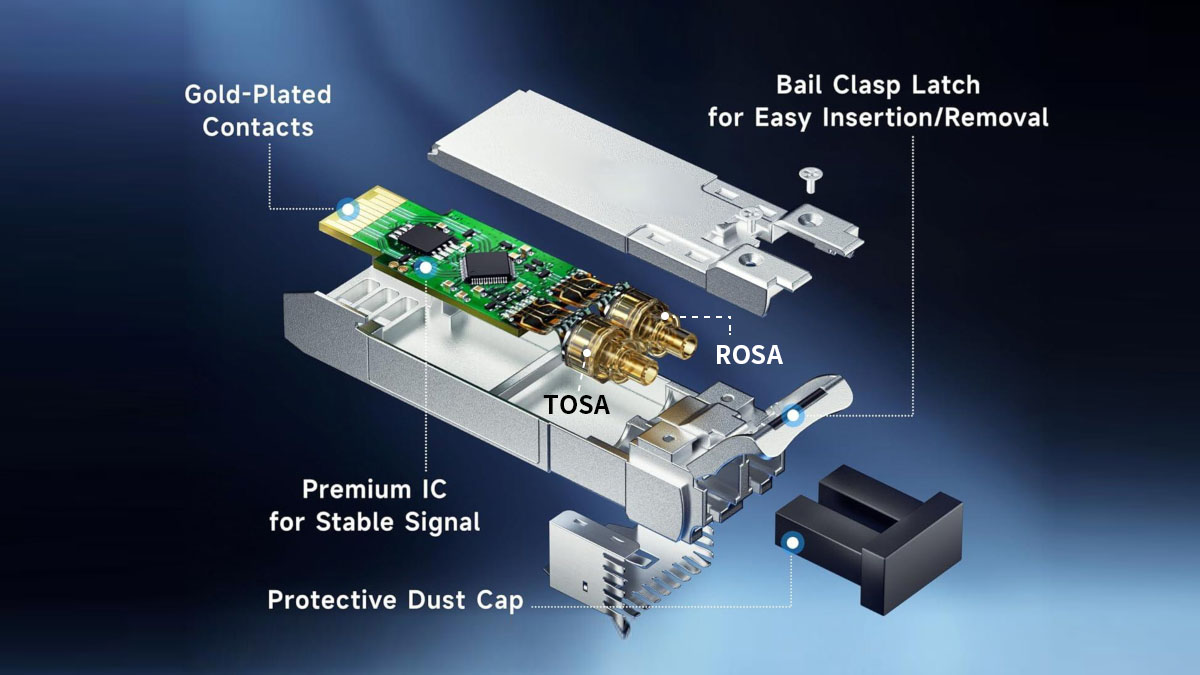
The SFP28 module is built around a tightly integrated optical and electrical architecture designed to support stable 25Gbps transmission over a single lane. Its internal components work together to ensure signal integrity, low latency, and reliable performance in high-density networking environments.
Unlike lower-speed transceivers, SFP28 modules require more advanced signal conditioning and tighter tolerance control. This makes their internal design more complex, especially in areas related to modulation, reception sensitivity, and jitter management.
Optical Transmitter System
The optical transmitter is responsible for converting electrical signals into high-speed optical pulses. It is engineered to maintain signal clarity at 25Gbps while minimizing distortion over varying distances and fiber types.
Typical components include:
- VCSEL (Vertical Cavity Surface Emitting Laser) used in short-reach multimode applications
- DFB (Distributed Feedback Laser) used in single-mode long-reach transmissions
- Laser driver circuits that regulate modulation strength and signal stability
- Bias control systems to maintain consistent optical output across temperature changes
This combination ensures that the transmitted signal maintains integrity whether used in short data center links or longer campus interconnects.
Receiver Module Design
The receiver section is designed to accurately convert incoming optical signals back into electrical data streams with minimal noise and error.
Core components include:
- High-sensitivity photodiodes (PIN or APD depending on reach requirements)
- Transimpedance amplifiers (TIA) that convert weak optical currents into usable electrical signals
- Signal filtering circuits to reduce noise interference
- Limiting amplifiers to restore clean digital signal levels
These elements are optimized to maintain a low bit error rate even in environments with high electromagnetic interference or signal attenuation.
Signal Processing and Control Layer
Beyond optical conversion, SFP28 modules rely on internal signal management and monitoring systems to ensure consistent performance across operating conditions.
Key elements include:
- Clock and Data Recovery (CDR) circuits that reduce jitter and synchronize signal timing
- EEPROM storage for module identification, configuration data, and compatibility parameters
- Digital Diagnostics Monitoring (DOM) functionality for real-time tracking of temperature, voltage, and optical power levels
- Control logic that manages initialization, error handling, and interface communication with the host system
This control layer plays a critical role in ensuring interoperability across different switch vendors and maintaining stable operation in dynamic network environments.
📝 Data Throughput and Performance Characteristics
The SFP28 module is designed to deliver stable 25Gbps-class performance with low latency and strong signal integrity, making it a key technology for high-efficiency Ethernet scaling in modern data centers.
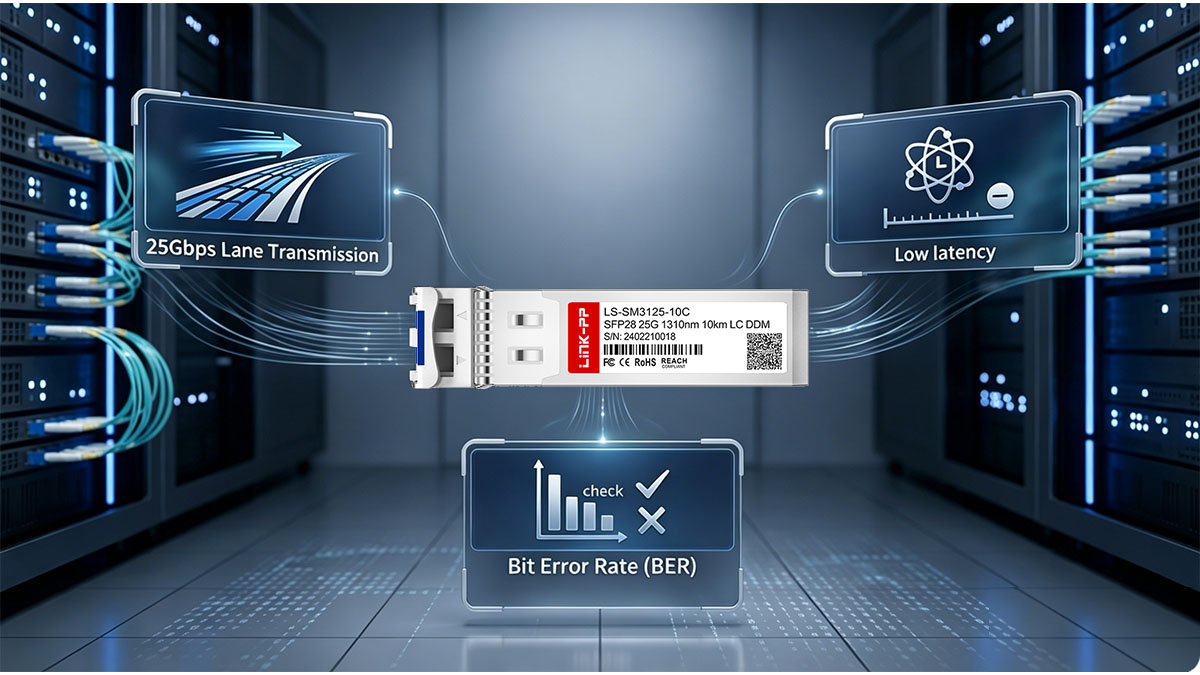
25Gbps Lane Transmission
The core performance of SFP28 is based on a single-lane electrical interface operating at 25G-class signaling rates. This enables high throughput without requiring multi-lane aggregation, simplifying both hardware design and switching logic.
Key characteristics of this transmission model include:
- Single-channel NRZ (Non-Return-to-Zero) signaling
- Reduced complexity compared to 40G multi-lane architectures
- Lower serialization overhead in switching ASIC processing
- Efficient bandwidth utilization per physical port
This architecture allows SFP28 to achieve a balance between performance and simplicity, especially in dense switching environments.
Latency and Signal Integrity
SFP28 modules are optimized to minimize transmission delay while maintaining stable signal quality across varying network conditions. This makes them suitable for latency-sensitive workloads such as cloud computing and real-time data processing.
Important performance traits include:
- Very low serialization/deserialization delay due to single-lane design
- Reduced processing overhead in network switch ASICs
- Tight jitter tolerance requirements to maintain signal stability at high speed
- High signal integrity across short and medium-reach optical links
These factors collectively ensure predictable and consistent performance, even under heavy network utilization.
Error Performance Metrics
Maintaining extremely low error rates is critical for 25Gbps transmission reliability, especially in high-density deployments where multiple optical links operate in parallel.
Typical performance expectations include:
- Bit Error Rate (BER) commonly targeted at 10⁻¹² or lower
- Strong dependence on optical power budget and fiber quality
- Sensitivity to connector cleanliness and insertion loss conditions
- Requirement for proper link margin to ensure long-term stability
These metrics highlight the importance of proper optical design and deployment practices, as even minor signal degradation can significantly impact high-speed transmission reliability.
📝 Protocols and Compatibility
The SFP28 module is designed to support standardized 25GbE transmission while maintaining compatibility with a wide range of networking equipment. Its protocol alignment and interoperability characteristics make it suitable for both modern cloud infrastructures and incremental upgrades from 10GbE systems.

Ethernet Standards Support
SFP28 modules are primarily built around the 25 Gigabit Ethernet standard, ensuring consistent performance across compliant network devices. This standard defines both the electrical and optical behavior required for stable high-speed communication.
Key protocol characteristics include:
- Native support for IEEE 802.3by 25GbE standard
- Operation at 25.78Gbps signaling rate for Ethernet framing
- Compatibility with server-to-switch and switch-to-switch links
- Support for full-duplex point-to-point transmission
This standardized foundation ensures predictable behavior across multi-vendor environments where interoperability is essential.
Backward and Forward Compatibility Considerations
Although SFP28 shares the same physical form factor as SFP+, compatibility depends heavily on host device capability rather than mechanical fit alone. Electrical and firmware-level support determines actual interoperability.
Important considerations include:
- Physical compatibility with SFP+ cages in many switch platforms
- Electrical limitation: SFP+ ports may not always support 25G operation
- Requirement for host ASIC support to enable full 25GbE functionality
- Potential need for firmware updates or configuration changes in managed systems
This means deployment planning must evaluate both hardware and software support layers before integrating SFP28 modules into existing infrastructure.
Interoperability Factors
In real-world deployments, compatibility is influenced by multiple technical and operational factors beyond basic protocol support. These determine whether an SFP28 module will function correctly in a given network environment.
Key interoperability factors include:
- Vendor coding or EEPROM programming restrictions in certain switches
- ASIC capability limits that define maximum supported transceiver speeds
- Firmware "whitelisting" policies used in enterprise-grade networking equipment
- Optical specification alignment (wavelength, power budget, and reach class)
Because of these variables, SFP28 deployment is often evaluated at both the hardware compatibility level and the optical layer design level to ensure stable and predictable network performance.
📝 Fiber Types and Transmission Distance
The SFP28 module supports multiple optical transmission options depending on fiber type, wavelength, and optical power budget. These factors directly determine how far a 25GbE signal can travel while maintaining stable performance and acceptable error rates. In practical deployments, fiber selection is one of the most important design decisions for ensuring reliable SFP28 connectivity.
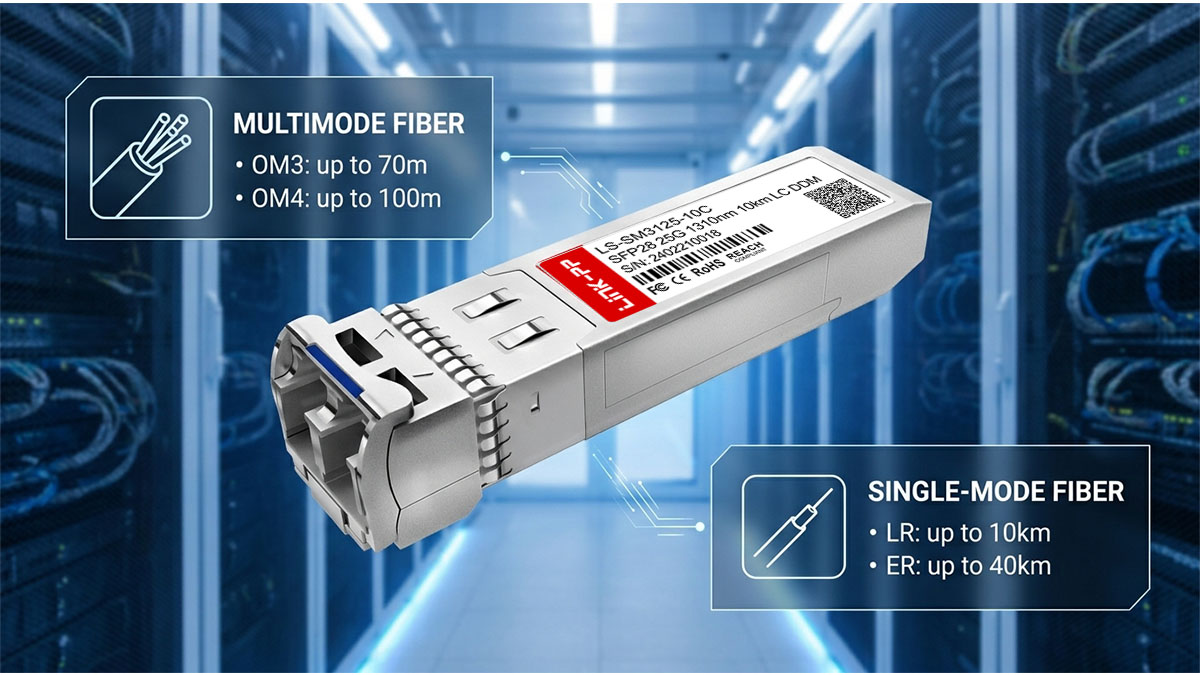
To understand how SFP28 modules are applied across different environments, it is useful to separate them into multimode and single-mode fiber categories, each optimized for different distance and cost requirements.
Multimode Fiber (SR Applications)
Multimode fiber is commonly used for short-range SFP28 deployments within data centers, especially in high-density switching environments where links remain within the same rack or between adjacent racks.
Key characteristics include:
- Optimized for short-reach 25GbE transmission (SR)
- Uses VCSEL-based optics for cost-efficient signaling
- Typically deployed in structured cabling environments
- Best suited for intra-data-center connectivity
These properties make multimode fiber the default choice for many server-to-switch and top-of-rack connections where distance is limited but port density is high.
Single-Mode Fiber (LR and ER Applications)
Single-mode fiber is designed for longer transmission distances and is widely used in campus, metropolitan, and inter-data-center connectivity scenarios.
Key characteristics include:
- Supports long-reach (LR) and extended-reach (ER) SFP28 variants
- Uses laser-based DFB optical sources for higher precision transmission
- Lower attenuation compared to multimode fiber
- Suitable for high-performance backbone links and external connections
Single-mode deployments are typically chosen when link stability over distance is more important than cost or short-range density optimization.
SFP28 Transmission Distance Overview
Different SFP28 optical types support different ranges depending on wavelength and fiber characteristics. The table below summarizes typical deployment parameters.
| SFP28 Type | Wavelength | Fiber Type | Typical Transmission Distance | Common Use Case |
|---|---|---|---|---|
| SR | 850nm | OM3/OM4 MMF | 70m–100m | Data center short-reach links |
| LR | 1310nm | SMF | Up to 10km | Campus and enterprise backbone |
| ER | 1310nm | SMF | Up to 40km | Metro and long-distance interconnects |
This comparison shows how SFP28 modules scale from short-range high-density environments to long-distance carrier-grade deployments while maintaining the same 25Gbps per-lane architecture.
Key Optical Parameters Affecting Distance
Beyond fiber type, several optical factors directly influence achievable transmission distance and link reliability in SFP28 networks.
These include:
- Optical power budget (difference between transmit power and receiver sensitivity)
- Connector insertion loss and splice quality
- Fiber attenuation rate per kilometer
- Wavelength stability and dispersion characteristics
Together, these parameters define the practical limits of SFP28 transmission in real-world network designs, making proper optical planning essential for stable long-term performance.
📝 Electrical and Power Characteristics
The SFP28 module is engineered to deliver high-speed 25Gbps transmission while maintaining controlled power consumption and stable electrical behavior. In dense networking environments, these electrical characteristics directly influence system thermal design, port density planning, and long-term operational reliability.
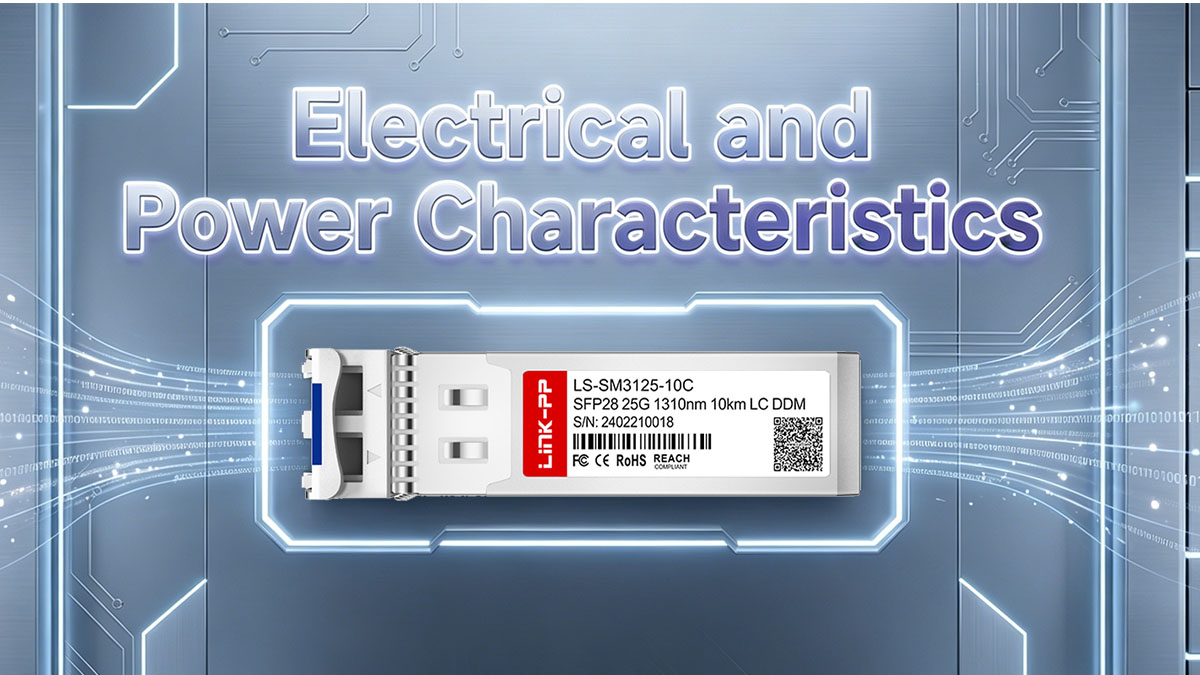
Power Consumption Profile
SFP28 modules are optimized to achieve higher bandwidth without proportionally increasing power usage, which is essential for large-scale data center deployments where thousands of ports may be active simultaneously.
Key power characteristics include:
- Typical power consumption ranges from approximately 0.8W to 1.5W depending on optical type
- SR (multimode) variants generally consume less power than long-reach single-mode versions
- Power usage is influenced by laser type, modulation circuitry, and DSP requirements
- Lower per-port power compared to multi-lane 40G solutions in many deployment scenarios
This efficient power profile helps reduce overall energy costs while supporting higher aggregate bandwidth per rack.
Thermal Considerations
As port density increases in modern switches, thermal management becomes a critical factor in SFP28 deployment planning. Even small increases in per-module power can significantly impact system airflow and cooling requirements.
Important thermal considerations include:
- Heat accumulation in high-density switch chassis with multiple active SFP28 ports
- Dependence on chassis airflow design for maintaining stable operating temperature
- Increased thermal load in environments where both optical and electrical switching components are tightly packed
- Requirement for proper spacing and airflow channels in cable management design
Effective thermal control ensures that SFP28 modules maintain stable optical output and avoid performance degradation due to overheating.
Signal Interface Design
The electrical interface of SFP28 is designed to support high-speed differential signaling with strict impedance and timing requirements. This ensures accurate data transmission at 25Gbps without excessive signal loss or distortion.
Key design elements include:
- High-speed differential pairs with controlled impedance routing (typically 100Ω differential)
- Low-skew PCB design requirements between transmit and receive lanes
- Tight tolerance for signal rise/fall times to reduce jitter
- Integration with host ASICs that support 25G SerDes interfaces
These electrical design constraints ensure that SFP28 modules can maintain signal integrity across short and medium-reach deployments while supporting consistent performance in high-density networking environments.
📝 Use Cases in Modern Networks
The SFP28 module is widely deployed in modern high-speed networks because it provides a practical balance between bandwidth, cost efficiency, and port density. Its 25Gbps single-lane design makes it especially suitable for environments that require predictable performance upgrades from 10GbE without moving directly to more complex 100GbE architectures.
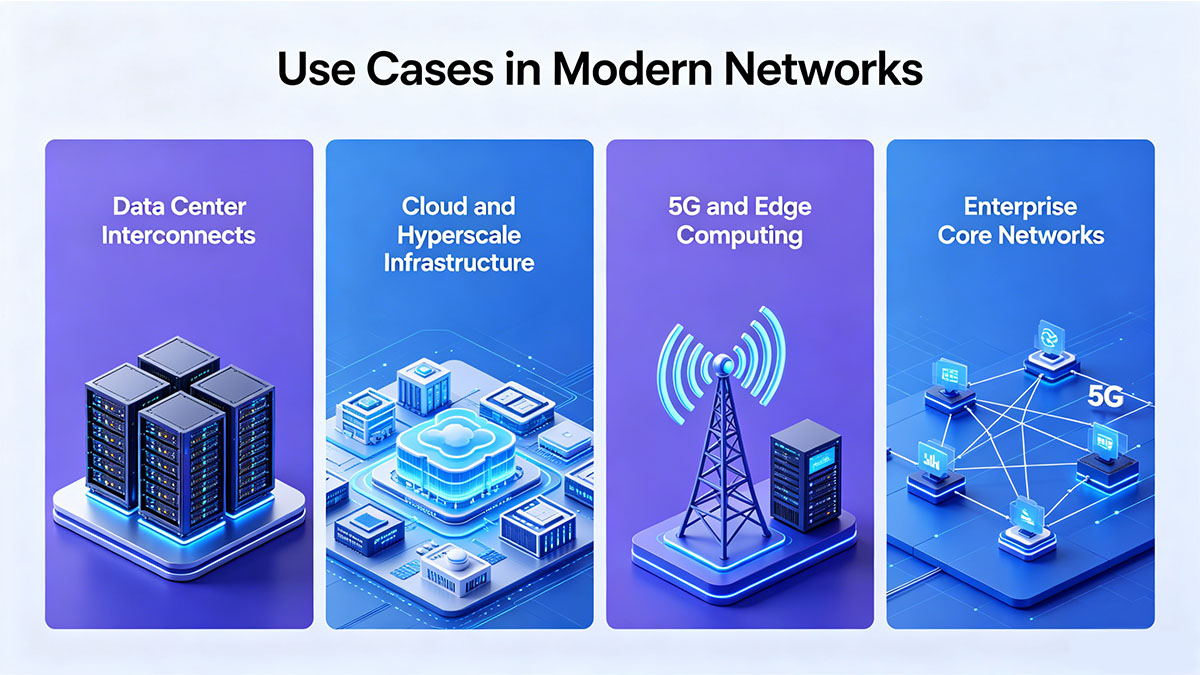
Data Center Interconnects
SFP28 modules are heavily used in data center environments where east-west traffic between servers and switches dominates network load. Their high per-port efficiency makes them ideal for scaling leaf-spine architectures.
Key application scenarios include:
- Server-to-top-of-rack (ToR) switch connections
- Leaf-to-spine uplinks in modular data center fabrics
- High-density rack-level aggregation links
- Virtualized environment traffic handling between compute nodes
These use cases benefit from the single-lane simplicity of SFP28, which reduces switching complexity while increasing available bandwidth per port.
Cloud and Hyperscale Infrastructure
In cloud and hyperscale environments, SFP28 plays a critical role in supporting massive, distributed workloads that require low-latency and high-throughput connectivity.
Typical deployment patterns include:
- High-volume east-west traffic optimization across distributed clusters
- Scalable upgrade paths from existing 10GbE infrastructures
- Integration into software-defined networking (SDN) architectures
- Efficient bandwidth scaling in multi-tenant cloud platforms
These environments rely on SFP28 to incrementally increase network capacity without requiring immediate migration to higher-cost 100G systems.
5G and Edge Computing
SFP28 modules are increasingly used in 5G transport networks and edge computing environments where latency, reliability, and compact infrastructure design are essential.
Common applications include:
- Fronthaul and midhaul transport links between radio units and core networks
- Edge data aggregation points supporting distributed processing
- Low-latency packet forwarding for real-time applications
- Compact networking equipment deployed in constrained physical spaces
These deployments benefit from SFP28's ability to deliver high throughput in compact, power-efficient form factors.
Enterprise Core Networks
In enterprise environments, SFP28 is often used as an upgrade path for core and aggregation layers that have outgrown 10GbE but do not yet require full 100GbE backbone infrastructure.
Key use cases include:
- Upgrading legacy 10G aggregation switches to 25G capacity
- Supporting high-bandwidth applications such as video conferencing and data analytics
- Enhancing internal backbone links between network core devices
- Improving performance in large campus or multi-building networks
This makes SFP28 a practical choice for enterprises seeking performance improvements without a full architectural overhaul.
📝 SFP28 vs SFP+ vs QSFP28 Comparison
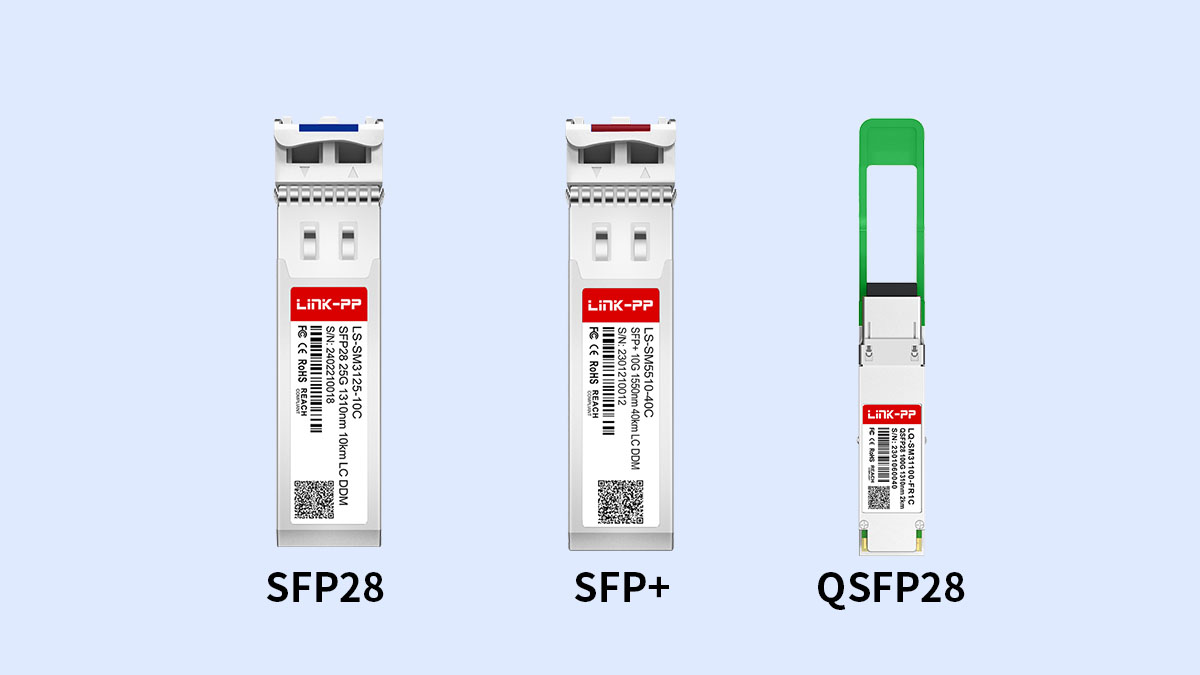
The SFP28 module is often evaluated alongside SFP+ and QSFP28 because these three transceiver types represent successive stages of Ethernet evolution. Understanding their differences is essential for selecting the right solution based on bandwidth requirements, port density, and network architecture goals.
SFP+ is widely used for 10GbE, SFP28 extends this concept to 25GbE on a single lane, while QSFP28 is designed for 100GbE using multiple aggregated lanes. These differences significantly impact how each module fits into modern network designs.
Bandwidth and Architecture Differences
The most fundamental distinction between these modules is how they handle data transmission speed and lane structure. SFP+ and SFP28 both use a single-lane design, while QSFP28 aggregates multiple lanes to achieve higher throughput.
| Module Type | Ethernet Speed | Lane Structure | Typical Use Case |
|---|---|---|---|
| SFP+ | 10Gbps | Single-lane | Legacy 10GbE networks |
| SFP28 | 25Gbps | Single-lane | Modern data center access layer |
| QSFP28 | 100Gbps | 4 × 25Gbps | Backbone and aggregation layers |
This comparison highlights how SFP28 serves as a mid-tier performance solution between legacy 10G systems and high-capacity 100G architectures.
Port Density Considerations
Port density plays a critical role in data center design, especially in environments where space and power efficiency are tightly constrained.
Key differences include:
- SFP28 and SFP+ offer similar physical density due to identical form factor size
- QSFP28 provides higher aggregate bandwidth per port but fewer ports per switch panel
- SFP28 enables more granular scaling compared to QSFP28's bundled lane design
- Switch selection often depends on whether flexibility (SFP28) or aggregation efficiency (QSFP28) is prioritized
This makes SFP28 particularly suitable for environments that require a balance between scalability and physical port availability.
Deployment Trade-offs
Each module type is optimized for different layers of network architecture, and selecting between them depends on performance targets and infrastructure strategy.
Key trade-offs include:
- SFP+ focuses on cost-effective 10GbE continuity in existing networks
- SFP28 provides a natural upgrade path with improved bandwidth efficiency per port
- QSFP28 is optimized for high-capacity uplinks and core network aggregation
- Higher-speed solutions typically require more careful power and thermal planning
In practice, many modern networks combine all three technologies, using SFP28 at the access layer and QSFP28 at the aggregation layer to achieve both flexibility and scalability in overall network design.
📝 Deployment Considerations
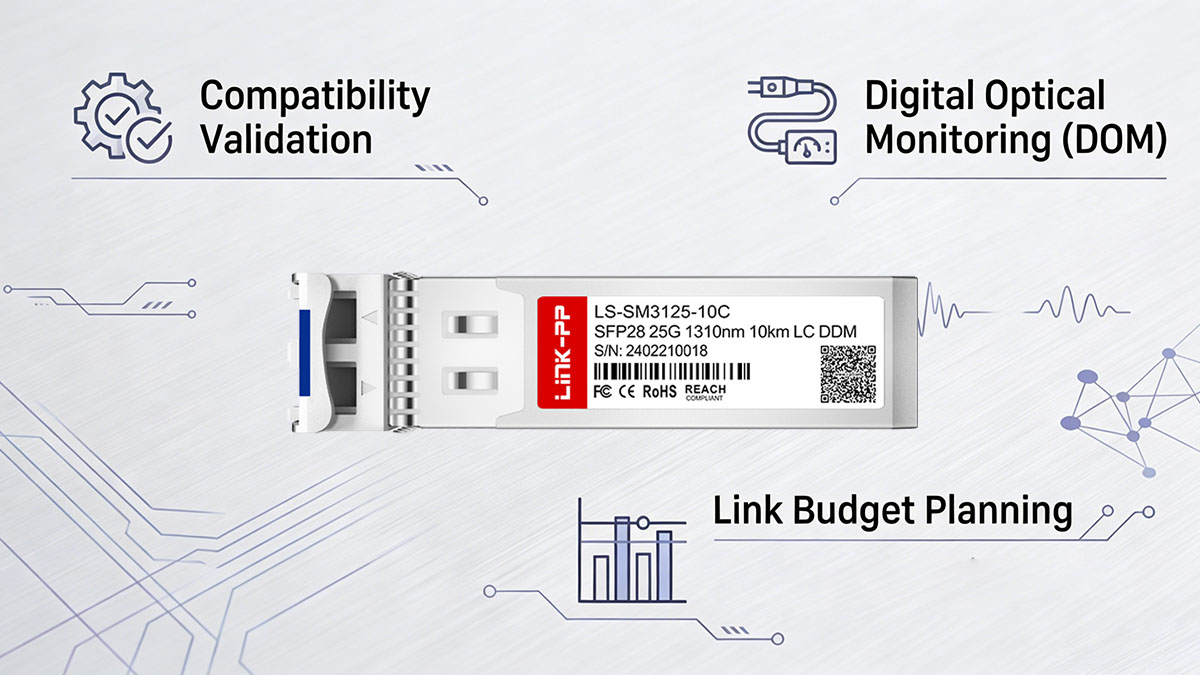
Deploying SFP28 modules in real-world networks requires careful planning across hardware compatibility, optical design, and operational monitoring. Although the modules are physically similar to SFP+ transceivers, their 25Gbps performance introduces stricter requirements on switch support, signal integrity, and configuration alignment.
Compatibility Validation
Before integrating SFP28 modules into a network, it is essential to confirm that both the hardware platform and software environment support 25Gbps operation. Physical compatibility alone is not sufficient for functional deployment.
Key validation points include:
- Switch ASIC support for 25GbE SerDes operation
- Port capability confirmation (SFP28 vs SFP+ only ports)
- Firmware or OS-level support for 25G optical transceivers
- Vendor-specific transceiver recognition policies or restrictions
These factors determine whether an SFP28 module will operate at full speed, fallback to lower rates, or be rejected entirely by the system.
Digital Optical Monitoring (DOM)
Modern SFP28 modules often include Digital Optical Monitoring functionality, which provides real-time visibility into optical and electrical performance. This capability is critical for maintaining network stability in high-density deployments.
DOM typically tracks:
- Optical transmit and receive power levels
- Module temperature under operating conditions
- Supply voltage stability
- Laser bias current and health indicators
By continuously monitoring these parameters, network operators can detect early signs of degradation and prevent unexpected link failures in production environments.
Link Budget Planning
Proper link budget calculation is essential for ensuring reliable SFP28 transmission over the intended distance. Since optical signals degrade due to attenuation, dispersion, and connector loss, careful planning is required to maintain sufficient margin.
Key elements of link budget planning include:
- Total fiber attenuation based on distance and fiber type
- Connector and splice insertion losses
- Transmitter output power and receiver sensitivity range
- Safety margin to account for aging and environmental variation
When these factors are correctly balanced, SFP28 links can maintain stable 25Gbps performance even in demanding enterprise or data center environments.
📝 Troubleshooting and Performance Optimization
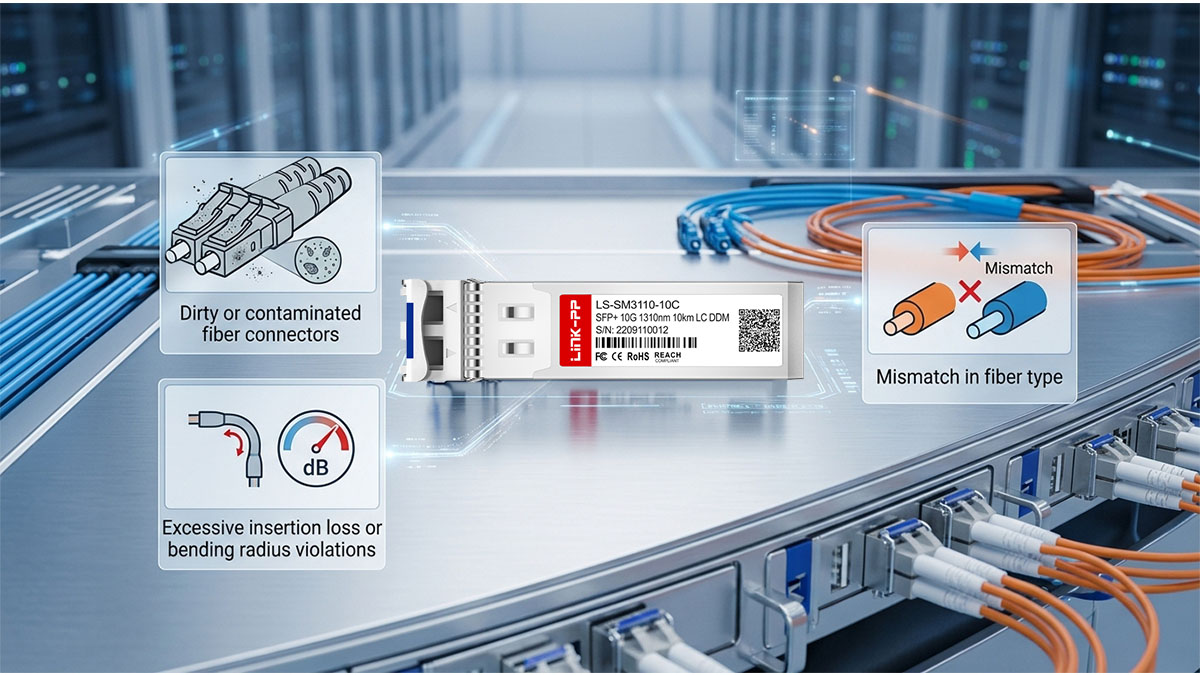
SFP28 networks can deliver stable 25Gbps performance, but issues may still arise due to optical impairments, configuration mismatches, or physical layer degradation. Effective troubleshooting focuses on identifying whether problems originate from the transceiver, fiber infrastructure, or host system configuration, followed by targeted optimization to restore stable link performance.
Because SFP28 operates at higher speeds than legacy 10GbE systems, even minor physical or optical imperfections can have a noticeable impact on stability and throughput.
Common Signal Issues
Most SFP28 performance problems are caused by physical layer conditions rather than protocol-level failures. Identifying these early helps prevent long-term instability in production environments.
Typical issues include:
- Contaminated or dirty fiber connectors causing signal attenuation
- Excessive fiber bending beyond minimum bend radius specifications
- Mismatch between multimode and single-mode fiber types
- High insertion loss from poor-quality connectors or patch panels
These issues often lead to increased bit error rates, intermittent link drops, or reduced effective throughput under load.
Diagnostic Techniques
To isolate and diagnose SFP28 issues, network operators typically rely on both built-in diagnostics and external testing tools. These methods help determine whether degradation is optical, electrical, or system-related.
Common diagnostic approaches include:
- Digital Optical Monitoring (DOM) analysis for transmit/receive power imbalance
- Loopback testing to isolate host-side versus fiber-side faults
- Bit Error Rate (BER) testing under sustained traffic conditions
- Port log analysis to detect link flapping or negotiation failures
These techniques provide a structured way to pinpoint root causes rather than relying on trial-and-error replacement.
Optimization Practices
Once issues are identified, performance optimization focuses on improving signal integrity, reducing loss, and ensuring consistent operating conditions across the network.
Key optimization practices include:
- Regular cleaning and inspection of optical connectors using approved tools
- Proper cable management to avoid excessive stress and bending
- Ensuring correct fiber type selection for SR, LR, or ER applications
- Maintaining adequate cooling and airflow in high-density switch environments
- Verifying firmware and configuration consistency across network devices
By applying these practices, SFP28 deployments can maintain stable low-latency performance and reduce the risk of long-term degradation in high-speed network environments.
📝 Conclusion
The SFP28 module plays a central role in the evolution of high-speed Ethernet networks, offering a balanced combination of bandwidth efficiency, compact design, and scalable deployment flexibility. By delivering 25Gbps performance over a single lane, it effectively bridges the gap between legacy 10GbE systems and higher-capacity 100GbE architectures, making it a practical choice for modern network expansion.
Across different network environments, its value is reflected in several key aspects:
- Provides a smooth upgrade path from existing 10G infrastructure without requiring full architectural redesign
- Supports flexible deployment across data centers, enterprise networks, and edge computing environments
- Enables high-density switching with improved per-port bandwidth efficiency
- Maintains compatibility with established fiber ecosystems while supporting multiple reach options
As network demands continue to grow, selecting reliable optical components becomes increasingly important for maintaining long-term performance and stability. In this context, suppliers such as LINK-PP Official Store provide a wide range of SFP28-compatible solutions designed to support different deployment requirements, from short-reach data center links to longer-distance interconnect scenarios.