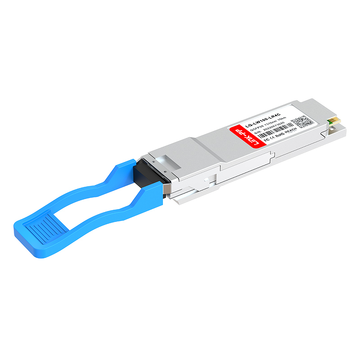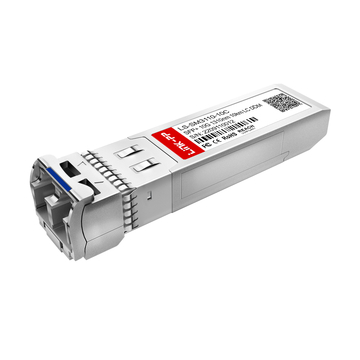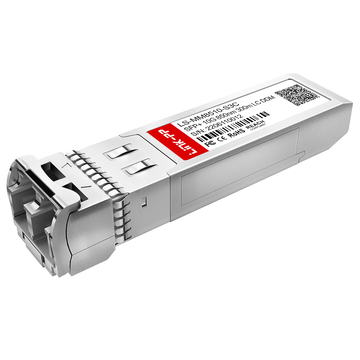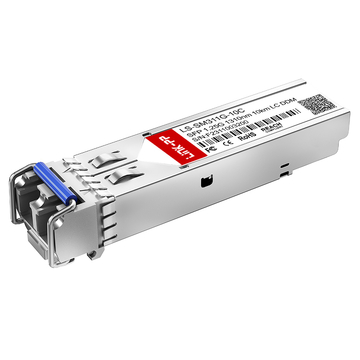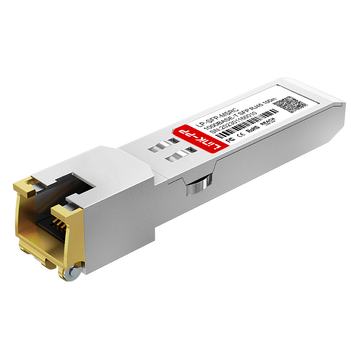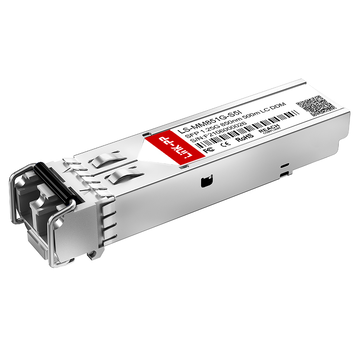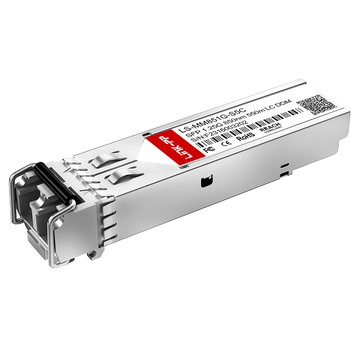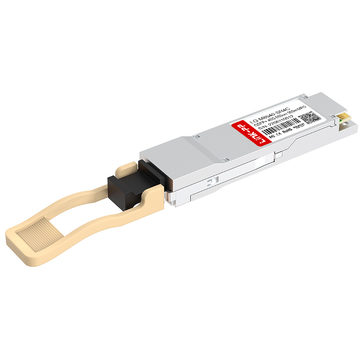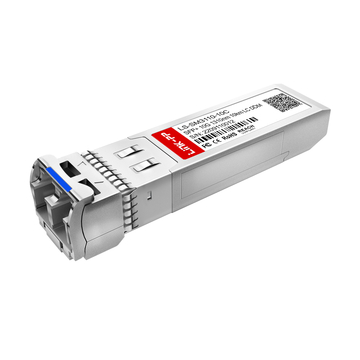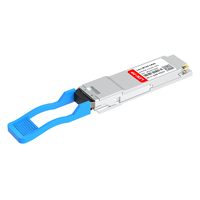
Modern network infrastructure relies heavily on pluggable optical transceivers to deliver scalable bandwidth and flexible connectivity. Among the most widely deployed form factors are SFP, SFP+, SFP28, QSFP+, and QSFP28, which together support Ethernet speeds ranging from 1Gbps to 100Gbps. These optical module standards have evolved alongside the rapid growth of cloud computing, data centers, and high-capacity enterprise networks.
Each form factor represents a different stage in the evolution of optical networking. SFP modules were originally designed for Gigabit Ethernet, while SFP+ extended the same compact design to 10Gbps connections. As data center bandwidth requirements increased, SFP28 emerged to support 25GbE server links. Meanwhile, QSFP+ and QSFP28 introduced multi-lane architectures that enable much higher bandwidth, commonly used for 40GbE and 100GbE uplinks.
Understanding the differences between these optical modules form factors is essential when designing or upgrading network infrastructure. The choice of transceiver packaging affects port density, network scalability, power consumption, and compatibility with switching hardware. Selecting the appropriate form factor can help organizations build networks that meet current bandwidth demands while remaining adaptable for future expansion.
This guide explains the key characteristics, speed capabilities, physical designs, and typical deployment scenarios of SFP, SFP+, SFP28, QSFP+, and QSFP28 optical modules. By examining how these form factors compare and where they are commonly used, network engineers and IT planners can better understand how modern optical connectivity is structured across enterprise and data center environments.
☑️ What Are Optical Module Form Factors?
Form factors refer to the standardized physical packaging and interface design of pluggable optical transceivers used in networking equipment. These standards define the size, electrical interface, connector type, and mechanical structure of a module, ensuring it can be installed in compatible switches, routers, or network interface cards. Well-known examples include SFP, SFP+, SFP28, QSFP+, and QSFP28, each designed to support different data rates and port densities.
Form factor standards are typically defined by Multi-Source Agreement (MSA), which allow multiple manufacturers to produce interoperable modules based on the same specifications. This ecosystem enables flexible network deployment, as organizations can select optical modules that match their infrastructure requirements without being tied to a single vendor.
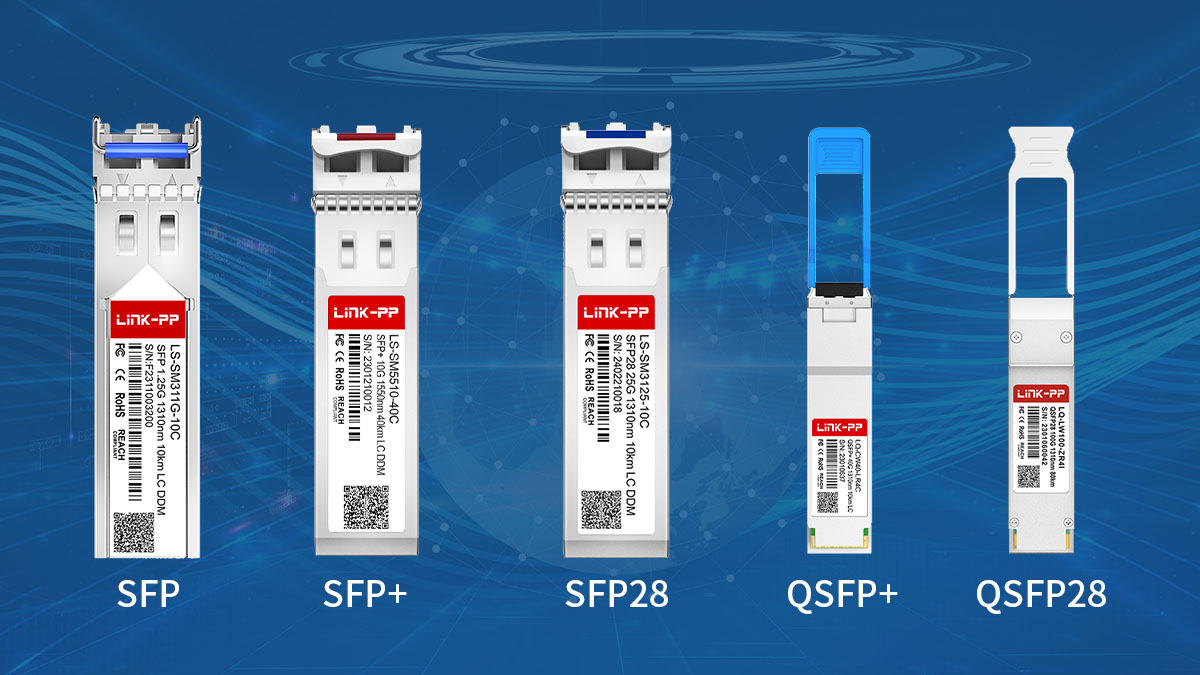
Definition of Optical Transceiver Form Factors
An optical transceiver form factor specifies the physical and electrical characteristics of a pluggable optical modules, allowing it to transmit and receive data through fiber or copper interfaces. These specifications ensure consistent compatibility between networking hardware and optical modules.
Key characteristics defined by a form factor typically include:
- Module dimensions and mechanical design
- Electrical interface and lane architecture
- Connector type (such as LC or MPO)
- Power consumption and thermal limits
- Supported data rates
The following table summarizes several widely used optical module form factors and their general characteristics.
| Form Factor | Typical Speed | Lane Design | Common Connector |
|---|---|---|---|
| SFP | 1Gbps | 1 lane | LC |
| SFP+ | 10Gbps | 1 lane | LC |
| SFP28 | 25Gbps | 1 lane | LC |
| QSFP+ | 40Gbps | 4 lanes | MPO / LC |
| QSFP28 | 100Gbps | 4 lanes | MPO / LC |
While these modules vary in speed and architecture, they all follow standardized packaging designs that allow hot-swappable installation into compatible network ports.
Why Form Factors Matter in Network Design
The choice of form factor directly influences how a network is designed, scaled, and maintained. Different form factors determine how many ports can fit on a switch, how much bandwidth each port can deliver, and how efficiently a system manages power and heat.
Several important factors make form factor selection significant in network planning:
- Port Density
Smaller modules like SFP and SFP28 allow a higher number of ports on a switch, increasing total bandwidth within a limited rack space. - Bandwidth Scalability
Higher-capacity form factors such as QSFP+ and QSFP28 provide significantly more bandwidth per port, making them suitable for aggregation and backbone connections. - Power and Thermal Efficiency
Modern optical modules are designed to deliver higher speeds while keeping power consumption within the thermal limits of network equipment. - Network Flexibility
Pluggable transceivers allow networks to adapt to changing requirements by replacing modules instead of upgrading entire devices.
Because of these factors, selecting the appropriate optical module form factor is a fundamental step in designing efficient enterprise networks, scalable data centers, and high-capacity telecommunications infrastructure.
☑️ Overview of the SFP Family of Optical Modules
The SFP family of optical modules represents one of the most widely used categories of pluggable transceivers in modern networking. Beginning with Gigabit Ethernet connectivity, the SFP platform has evolved to support higher data rates while maintaining a compact physical design. This evolution has produced several related form factors, including SFP, SFP+, and SFP28, which together cover speeds from 1Gbps to 25Gbps.
One of the main advantages of the SFP ecosystem is that successive generations retain a similar mechanical footprint. This design approach allows network equipment manufacturers to deliver higher performance without dramatically increasing port size, enabling switches and servers to maintain high port density.
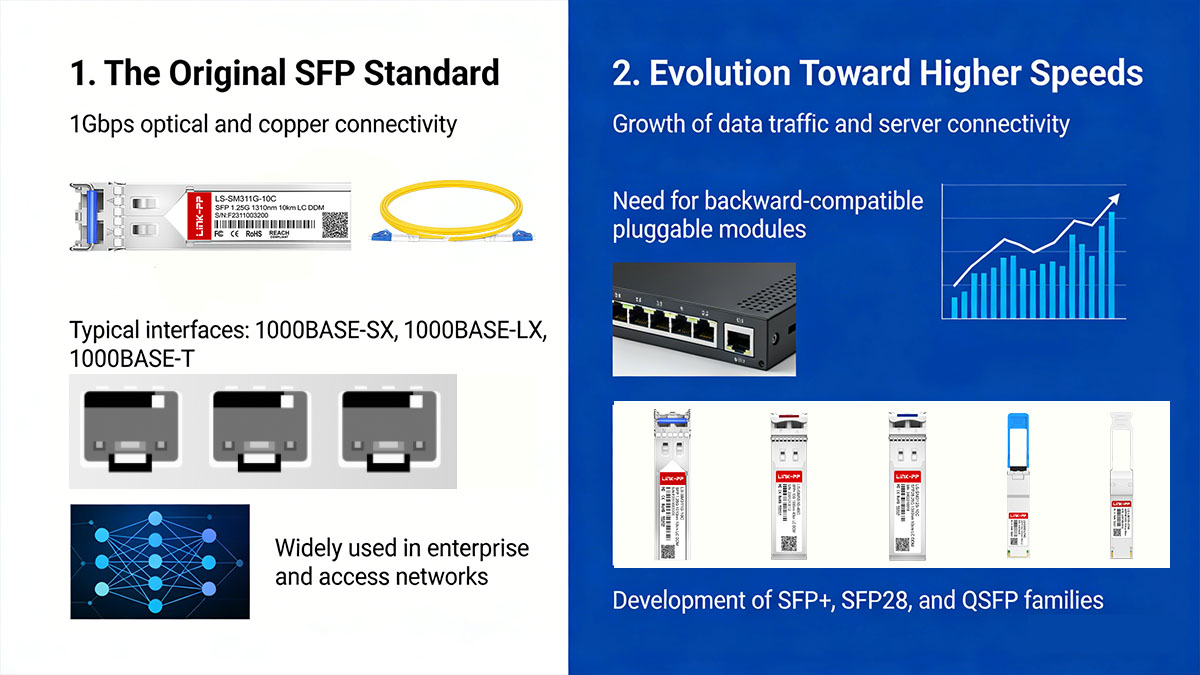
The Original SFP Standard
SFP (Small Form-factor Pluggable) modules were originally developed to support Gigabit Ethernet and Fibre Channel connectivity. They replaced the earlier GBIC transceivers by offering a smaller footprint and improved port density, which allowed network switches to support more interfaces within the same hardware space.
SFP modules typically support 1Gbps data transmission and can operate over either optical fiber or copper connections. The modular design allows administrators to select different transmission types depending on the network environment.
Common interface types include:
- 1000BASE-SX for short-distance multimode fiber links
- 1000BASE-LX for longer single-mode fiber connections
- 1000BASE-T for copper Ethernet cable
The following table summarizes several typical characteristics of standard SFP modules.
| Module Type | Typical Speed | Transmission Media | Typical Distance |
|---|---|---|---|
| 1000BASE-SX | 1Gbps | Multimode fiber | up to 550m |
| 1000BASE-LX | 1Gbps | Single-mode fiber | up to 10km |
| 1000BASE-T | 1Gbps | Copper Ethernet | up to 100m |
Because of their flexibility and wide compatibility, SFP modules remain common in enterprise access switches, campus networks, and legacy Gigabit infrastructure.
Evolution Toward Higher Speeds
As network traffic increased due to virtualization, cloud computing, and high-performance applications, Gigabit Ethernet gradually became insufficient for many environments. Network designers needed higher bandwidth links while maintaining the advantages of pluggable optics and compact port design.
This demand led to the development of newer modules within the same family:
- SFP+ to support 10Gbps Ethernet links
- SFP28 to support 25Gbps data center connectivity
- QSFP-based modules for multi-lane high-speed aggregation
These newer modules maintain a similar physical size to the original SFP design but incorporate improved electrical interfaces and signal integrity technologies to support faster data transmission.
As a result, the SFP ecosystem has become a scalable platform that can support multiple generations of network speeds while preserving the operational flexibility of pluggable transceivers.
☑️ SFP vs SFP+ vs SFP28: Small Form-Factor Evolution
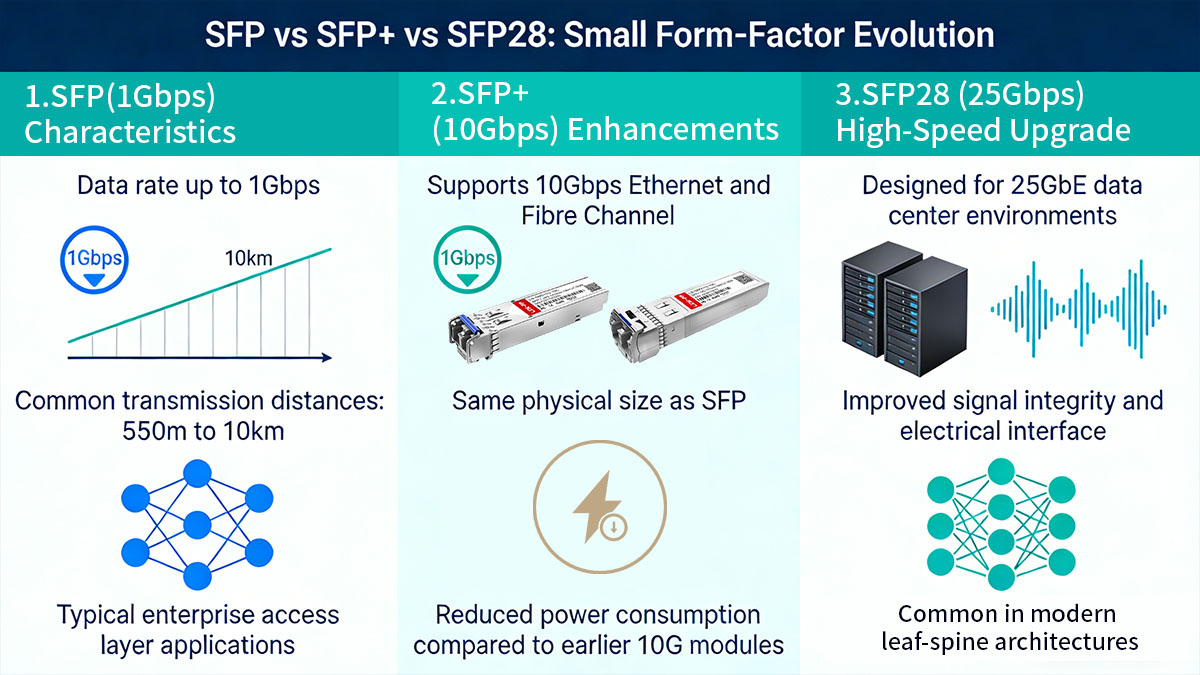
SFP, SFP+, and SFP28 belong to the same small form-factor pluggable transceiver family, but they support different generations of Ethernet speeds. While all three share nearly identical physical dimensions, their electrical interfaces and signal capabilities are designed for progressively higher data rates. This evolution allows network equipment to increase bandwidth without significantly changing port size or hardware design.
In practical deployments, these modules are commonly used for server connectivity, access layer switching, and short- to medium-distance optical links in enterprise and data center networks.
SFP (1Gbps) Characteristics
SFP transceivers were designed for Gigabit Ethernet and remain widely deployed in many enterprise and campus networks. They support both fiber and copper interfaces and are commonly used for short-distance access connections or legacy infrastructure upgrades.
Typical characteristics of SFP modules include:
- Data rate up to 1Gbps
- Support for both multimode and single-mode fiber
- LC optical connectors for fiber links
- Copper variants for Ethernet cabling
The table below highlights common technical characteristics of standard SFP modules.
| Feature | SFP |
|---|---|
| Maximum Data Rate | 1Gbps |
| Electrical Lanes | 1 |
| Typical Connectors | LC (fiber), RJ45 (copper) |
| Typical Applications | Enterprise access networks |
Because of their reliability and widespread support, SFP modules are still commonly found in enterprise switches, routers, and network interface cards.
SFP+ (10Gbps) Enhancements
SFP+ optical transceiver was introduced to support 10Gbps Ethernet while maintaining the same physical size as standard SFP modules. Instead of significantly altering the mechanical design, improvements were made to the electrical interface and signal processing capabilities.
Compared with SFP, SFP+ modules reduce internal signal conditioning and rely more on the host device for signal integrity. This design helps achieve higher data rates while maintaining compact size and relatively low power consumption.
Typical advantages of SFP+ include:
- Support for 10GbE networking
- Same form factor as SFP modules
- Lower latency compared with earlier 10Gbps optical modules
- Higher port density compared with larger transceiver types
SFP+ is commonly used in server uplinks, aggregation switches, and storage networking environments.
SFP28 (25Gbps) High-Speed Upgrade
SFP28 module extends the SFP form factor to support 25Gbps Ethernet links. Although the physical size remains nearly identical to SFP and SFP+, the internal electronics and electrical interface are optimized for higher signaling speeds.
The move from 10GbE to 25GbE allows data centers to increase bandwidth per port without increasing the number of cables or switch ports. As a result, SFP28 has become widely adopted in modern leaf-spine data center architectures.
The main differences between the three modules can be summarized as follows.
| Module Type | Typical Speed | Electrical Lanes | Common Deployment |
|---|---|---|---|
| SFP | 1Gbps | 1 | Enterprise access |
| SFP+ | 10Gbps | 1 | Server uplinks |
| SFP28 | 25Gbps | 1 | Data center servers |
Because all three modules share similar mechanical dimensions, network hardware can often support multiple generations of these transceivers, allowing infrastructure to evolve gradually as bandwidth requirements increase.
☑️ QSFP+ vs QSFP28: High-Density Transceiver Platforms
QSFP+ and QSFP28 belong to the quad small form-factor pluggable family, designed to deliver significantly higher bandwidth than single-lane modules such as SFP or SFP+. These transceivers use a multi-lane architecture that combines several electrical channels within a single module, allowing switches and routers to provide much greater throughput per port.
Both QSFP+ and QSFP28 maintain the same physical form factor, but they support different signaling speeds. QSFP+ typically enables 40GbE connectivity, while QSFP28 is designed for 100GbE networking. Because of their high bandwidth and compact size, these modules are widely used in data center spine switches, aggregation layers, and high-speed uplinks.
QSFP+ (40Gbps) Architecture
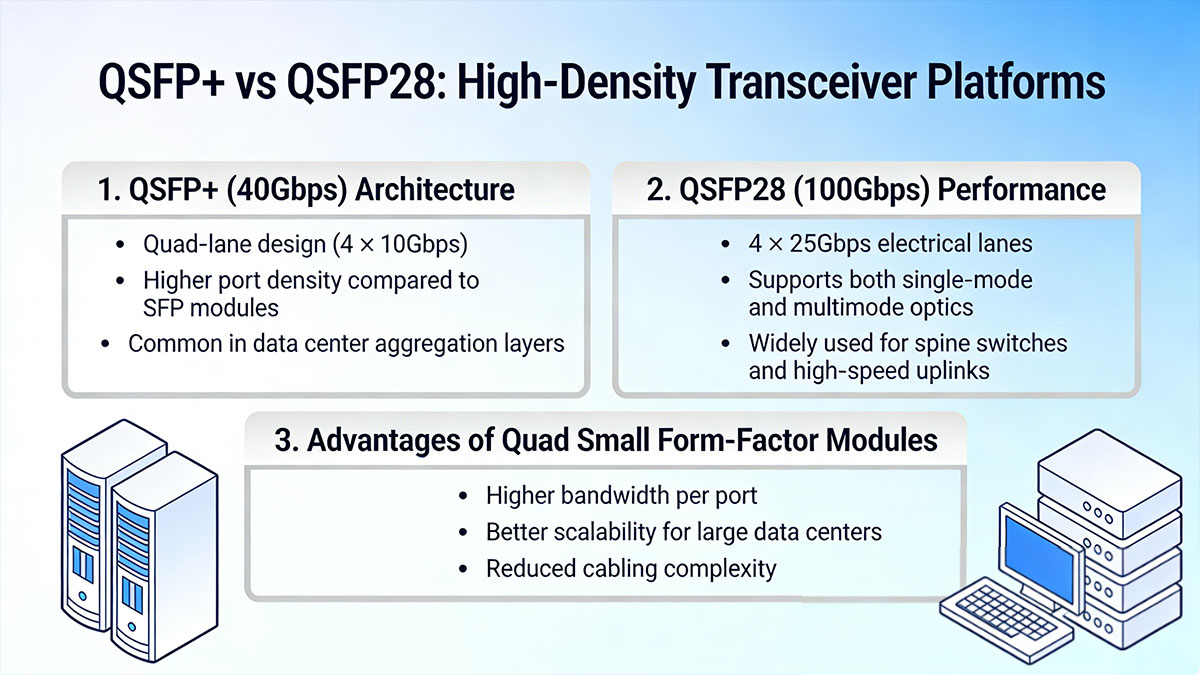
QSFP+ modules were developed to support 40Gbps Ethernet connections by combining four parallel 10Gbps electrical lanes. This design allows a single port to transmit significantly more data than traditional SFP-based modules while still maintaining a compact transceiver size.
Typical QSFP+ characteristics include:
- Four independent electrical channels
- 4 × 10Gbps lane architecture
- Support for both multimode and single-mode fiber
- High-density switch deployment
The table below summarizes typical QSFP+ technical characteristics.
| Parameter | QSFP+ |
|---|---|
| Total Data Rate | 40Gbps |
| Electrical Lanes | 4 × 10Gbps |
| Common Connectors | MPO or LC |
| Typical Applications | Data center aggregation |
QSFP+ modules are often used for switch uplinks, spine-layer interconnections, and other high-capacity links where multiple 10Gbps channels are combined into a single interface.
QSFP28 (100Gbps) Performance
QSFP28 transceivers extend the QSFP platform to support 100Gbps networking by increasing the per-lane data rate from 10Gbps to 25Gbps. Instead of redesigning the module size, engineers improved the electrical interface and signal integrity to accommodate faster transmission speeds.
This design allows data centers to achieve higher bandwidth without increasing the number of ports or the physical size of the hardware.
Typical features of QSFP28 include:
- Four electrical lanes operating at 25Gbps
- Total bandwidth of 100Gbps per module
- Compatibility with modern 100GbE switching platforms
- Support for both short-reach and long-distance optical connections
QSFP28 module is commonly deployed in spine-leaf architecture, high-speed switch uplinks, and data center backbone connections.
Advantages of Quad Small Form-Factor Modules
Quad-lane transceivers such as QSFP+ and QSFP28 provide several architectural advantages compared with single-lane modules. By combining multiple data channels in one compact interface, they help increase overall network capacity while simplifying cabling and hardware design.
Typical benefits include:
- Higher bandwidth per port compared with SFP-based modules
- Improved port density on high-performance switches
- Reduced cable management complexity through multi-lane aggregation
- Flexible breakout options that connect to multiple lower-speed interfaces
These characteristics make QSFP-family modules a key component in modern high-capacity networks, particularly in environments that require scalable bandwidth such as cloud data centers and large enterprise infrastructures.
☑️ Key Differences Between SFP, SFP+, SFP28, QSFP+, and QSFP28
SFP, SFP+, SFP28, QSFP+, and QSFP28 differ primarily in data rate capability, lane architecture, and the types of network environments they are designed to support. Although these modules belong to the same ecosystem of pluggable sfp, their performance characteristics and physical configurations make them suitable for different layers of modern network infrastructure.
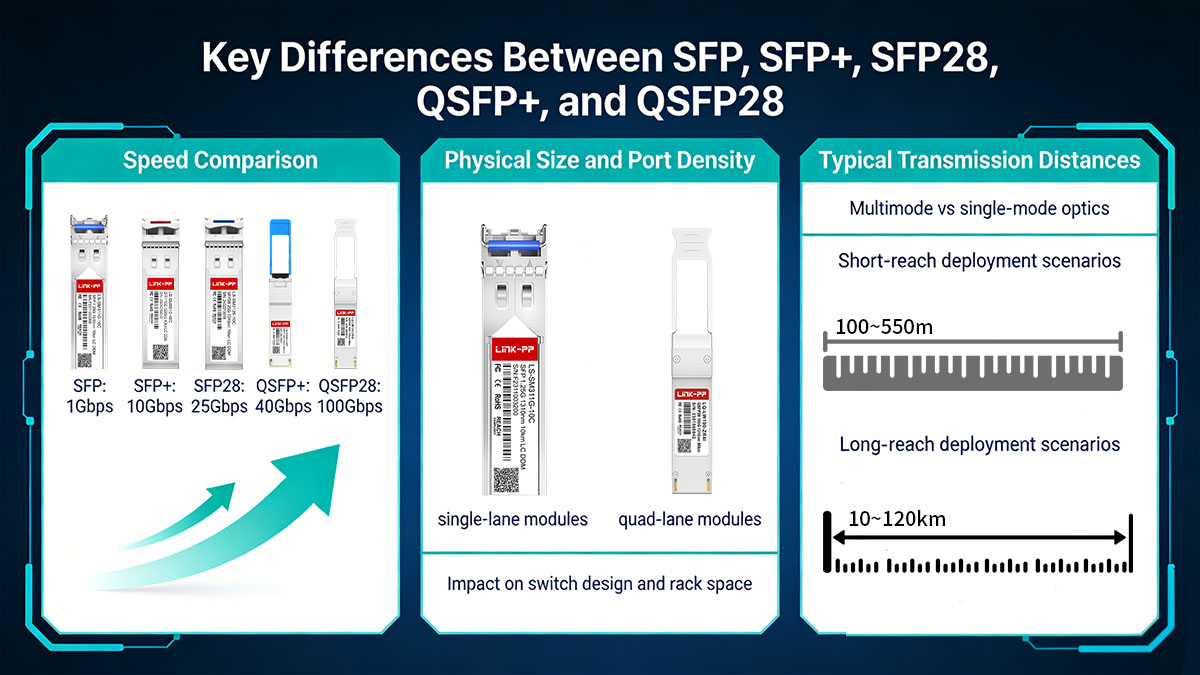
Understanding these differences helps network planners determine which module type best fits specific bandwidth requirements, hardware platforms, and deployment scenarios.
Speed Comparison
The most noticeable difference between these form factors is the maximum data rate each module supports. As Ethernet standards evolved, new transceiver generations were developed to meet growing bandwidth demands while maintaining manageable module sizes.
The following table shows a simplified comparison of the typical speeds supported by each form factor.
| Form Factor | Typical Ethernet Speed | Lane Structure |
|---|---|---|
| SFP | 1Gbps | 1 lane |
| SFP+ | 10Gbps | 1 lane |
| SFP28 | 25Gbps | 1 lane |
| QSFP+ | 40Gbps | 4 × 10Gbps |
| QSFP28 | 100Gbps | 4 × 25Gbps |
Single-lane modules such as SFP, SFP+, and SFP28 are typically used for direct server or access connections, while QSFP-based modules aggregate multiple lanes to provide much higher throughput per port.
Physical Size and Port Density
Another major distinction lies in module size and how it affects switch port density. SFP-based modules are smaller and designed for single-channel connections, allowing switches to support a large number of ports within a limited space.
QSFP modules are physically larger because they contain four electrical lanes, but they deliver much higher bandwidth per port.
| Module Family | Relative Size | Typical Port Role |
|---|---|---|
| SFP / SFP+ / SFP28 | Small | Access and server connectivity |
| QSFP+ | Medium | Aggregation links |
| QSFP28 | Medium | High-speed uplinks and spine connections |
Because of these characteristics, data center switches often include both SFP-type ports for server connections and QSFP-type ports for uplinks between network layers.
Typical Transmission Distances
Transmission distance varies depending on the optical standard used with each form factor. Both SFP and QSFP families support a wide range of optical technologies designed for short, medium, or long-distance communication.
The following table illustrates common deployment ranges based on typical optical variants.
| Module Type | Fiber Type | Typical Distance |
|---|---|---|
| SFP / SFP+ SR | Multimode fiber | up to 300m |
| SFP / SFP+ LR | Single-mode fiber | up to 10km |
| QSFP+ SR4 | Multimode fiber | up to 150m |
| QSFP28 LR4 | Single-mode fiber | up to 10km |
Actual transmission distance depends on several factors, including fiber type, wavelength, and optical design. However, these modules provide flexible options that allow the same form factor family to support both short data center links and longer campus or metropolitan connections.
☑️ Typical Deployment Scenarios for Different Form Factors
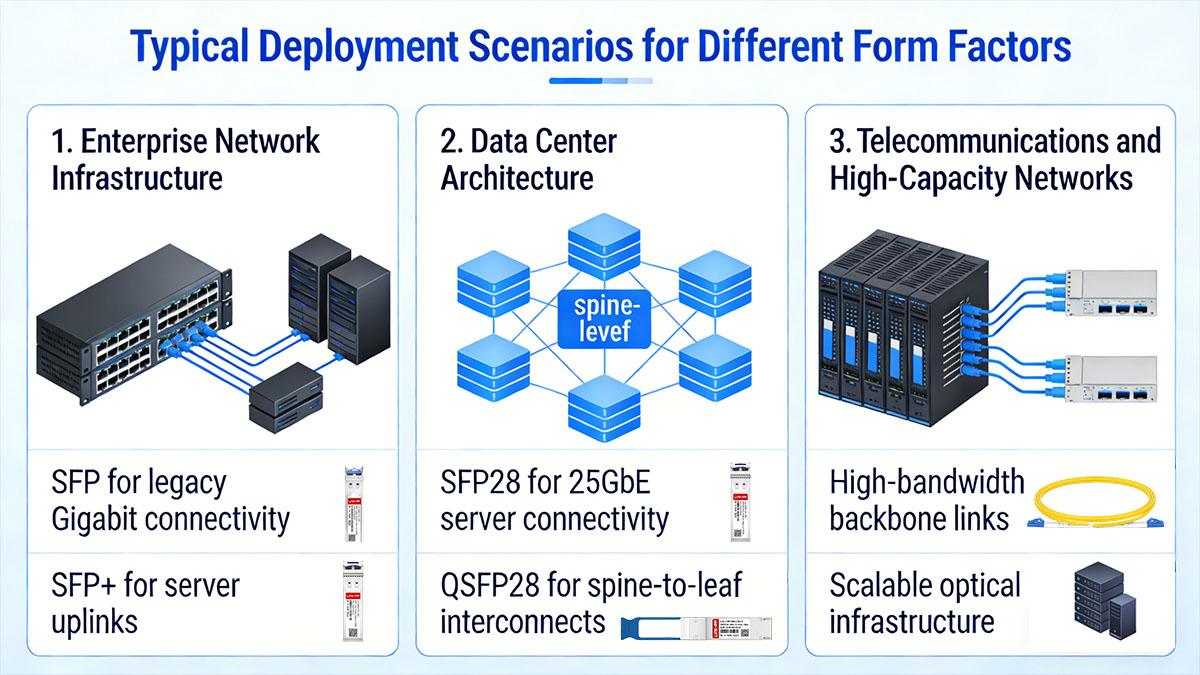
Different optical module form factors are typically deployed at specific layers of a network architecture. The selection of SFP, SFP+, SFP28, QSFP+, or QSFP28 often depends on factors such as bandwidth demand, switch port design, and the role of the connection within the overall network topology.
In many infrastructures, these modules are used together to support different layers of connectivity, ranging from access switches and server links to high-capacity aggregation and backbone connections.
Enterprise Network Infrastructure
In enterprise and campus networks, SFP and SFP+ modules are commonly used for access-layer connectivity and device uplinks. These modules provide sufficient bandwidth for office networks, wireless access points, and internal application servers while maintaining efficient port density.
Typical enterprise deployments include:
- SFP modules used for Gigabit Ethernet connections between access switches and distribution switches
- SFP modules connecting routers, firewalls, and network appliances
- SFP+ modules used for 10GbE uplinks from access switches to aggregation switches
- SFP+ links for high-performance storage networks or virtualization clusters
Because many enterprise environments still operate mixed-speed infrastructure, SFP and SFP+ modules allow gradual upgrades without replacing entire switching platforms.
Data Center Architecture
Modern data centers often rely on SFP28 and QSFP28 modules to support higher bandwidth requirements. These modules are commonly deployed within leaf-spine network architectures where servers connect to leaf switches and high-speed uplinks connect leaf switches to spine switches.
Typical data center deployments include:
- SFP28 modules used for 25GbE server-to-switch connections
- SFP+ modules used in legacy 10GbE server environments
- QSFP28 module used for 100GbE links between leaf and spine switches
- Breakout configurations where a QSFP28 port connects to multiple SFP28 interfaces
The table below illustrates how these form factors are commonly used within a data center network hierarchy.
| Network Layer | Common Form Factor | Typical Speed |
|---|---|---|
| Server Access | SFP+ / SFP28 | 10Gbps / 25Gbps |
| Leaf Switch Uplink | QSFP+ / QSFP28 | 40Gbps / 100Gbps |
| Spine Interconnect | QSFP28 | 100Gbps |
This layered deployment model allows data centers to scale bandwidth efficiently while maintaining manageable cabling and switch port utilization.
Telecommunications and High-Capacity Networks
Telecommunications providers and large-scale network operators frequently deploy higher-capacity optical modules to support backbone connectivity and large traffic volumes. In these environments, QSFP+ and QSFP28 modules are commonly used to aggregate multiple lower-speed links into a single high-bandwidth connection.
Typical use cases include:
- High-capacity switch-to-switch connections in metro networks
- Backbone aggregation links between core routers
- Data center interconnect (DCI) links connecting geographically distributed facilities
- Edge aggregation points that collect traffic from multiple access networks
These deployment scenarios often require optical modules capable of long-distance transmission and stable performance under heavy traffic loads, making high-speed QSFP-based modules particularly suitable for large-scale network infrastructure.
☑️ Compatibility and Interoperability Considerations
Compatibility and interoperability are important factors when deploying optical transceivers in multi-vendor network environments. Although SFP, SFP+, SFP28, QSFP+, and QSFP28 follow widely adopted industry standards, actual compatibility can depend on switch hardware design, firmware support, and interface configuration.
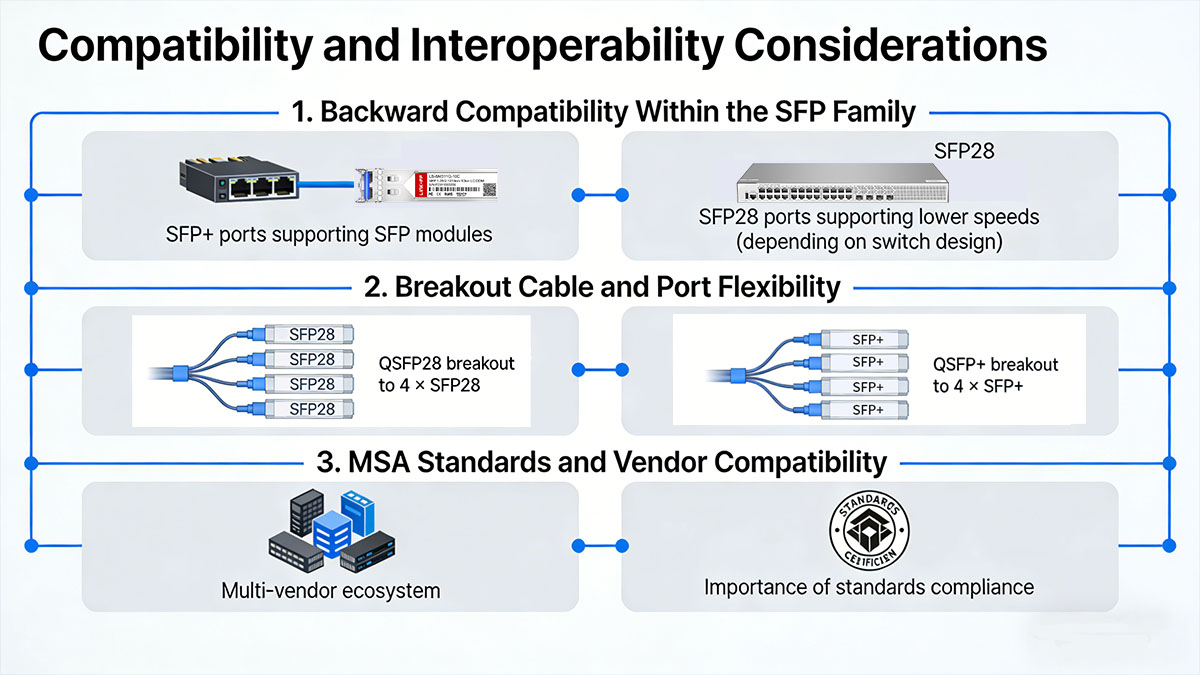
Understanding how these fiber optic transceiver interact with network equipment helps ensure stable connectivity and simplifies infrastructure upgrades.
Backward Compatibility Within the SFP Family
One advantage of the SFP ecosystem is that newer ports are often designed to support earlier module generations. Because SFP, SFP+, and SFP28 share nearly identical physical dimensions, some network devices allow lower-speed modules to operate in higher-speed ports.
The following table summarizes typical compatibility relationships.
| Port Type | Compatible Modules | Typical Operation Speed |
|---|---|---|
| SFP port | SFP | 1Gbps |
| SFP+ port | SFP, SFP+ | 1Gbps or 10Gbps |
| SFP28 port | SFP+, SFP28 | 10Gbps or 25Gbps |
However, compatibility is not universal. Support for lower-speed modules depends on the switch chipset and firmware, so network administrators usually verify compatibility through hardware documentation before deployment.
Breakout Cable and Port Flexibility
QSFP-family modules provide additional flexibility through breakout configurations. A breakout cable allows a single high-bandwidth port to connect to multiple lower-speed interfaces, which can improve port utilization in certain network designs.
Common breakout configurations include:
- QSFP+ port splitting into 4 × SFP+ 10GbE connections
- QSFP28 port splitting into 4 × SFP28 25GbE connections
- High-density switch uplinks connecting to multiple server-facing ports
These configurations are widely used in data center environments where high-capacity switches need to connect to large numbers of lower-speed devices.
MSA Standards and Vendor Compatibility
Most optical transceivers are built according to Multi-Source Agreement (MSA) specifications, which define the mechanical dimensions, electrical interfaces, and communication protocols for pluggable modules. This standardization enables multiple manufacturers to produce interoperable transceivers that operate within the same hardware platforms.
Typical benefits of MSA-based design include:
- standardized mechanical interfaces for pluggable modules
- consistent electrical signaling between devices and transceivers
- interoperability across different networking vendors
- broader availability of optical module options
Despite these common standards, some networking platforms implement additional compatibility checks or firmware validation. For this reason, compatibility testing and verification remain an important step when integrating optical modules into existing network infrastructure.
☑️ Future Trends in Optical Transceiver Form Factors
Optical transceiver form factors continue to evolve as network traffic grows and new applications demand higher bandwidth. While SFP, SFP+, SFP28, QSFP+, and QSFP28 remain widely deployed, the networking industry is gradually moving toward higher speeds, improved efficiency, and greater port density. These trends are shaping the development of next-generation optical modules used in data centers, telecommunications networks, and cloud infrastructure.
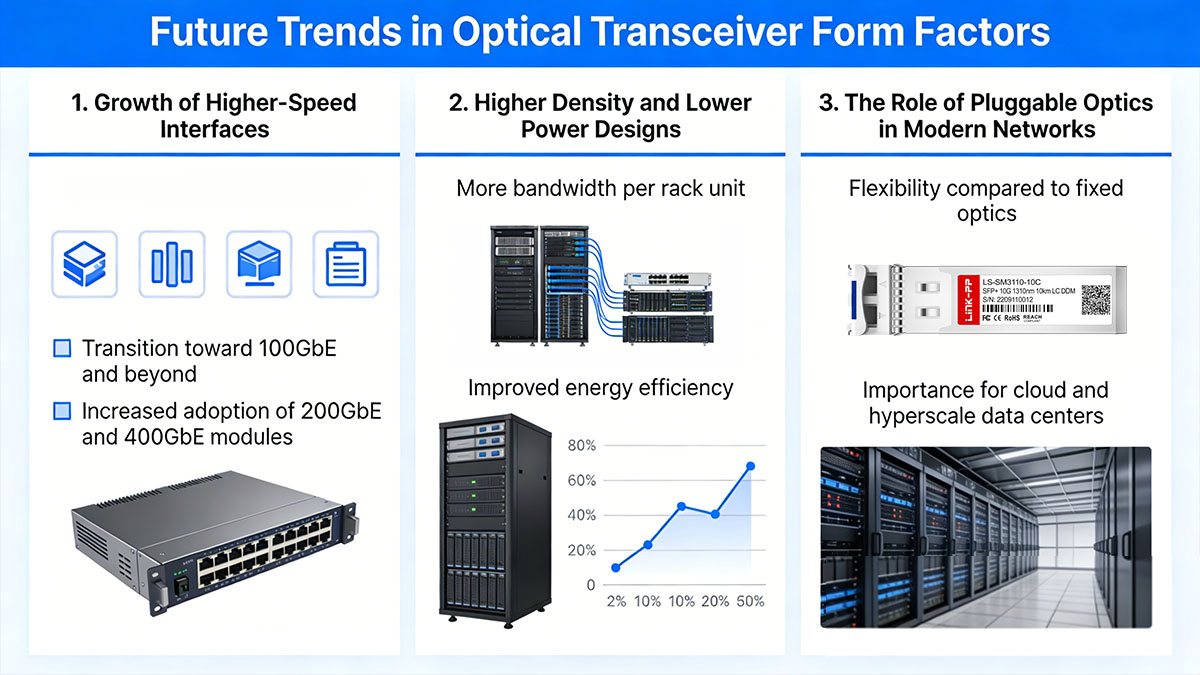
Understanding these trends helps network architects anticipate future infrastructure requirements and design systems that can scale as bandwidth demands increase.
Growth of Higher-Speed Interfaces
The transition from Gigabit Ethernet to multi-100GbE networks has driven the development of faster optical module standards. Data centers and hyperscale environments now require links capable of supporting significantly higher throughput while maintaining efficient hardware utilization.
The evolution of common Ethernet interface speeds is summarized below.
| Generation | Typical Interface | Common Form Factor |
|---|---|---|
| Early enterprise networks | 1GbE | SFP |
| High-performance enterprise | 10GbE | SFP+ |
| Modern server connectivity | 25GbE | SFP28 |
| Data center aggregation | 40GbE | QSFP+ |
| High-speed switching fabrics | 100GbE | QSFP28 |
Beyond these widely deployed interfaces, newer technologies such as 200GbE and 400GbE are increasingly used in hyperscale data centers and large cloud environments. These higher-speed interfaces typically rely on advanced QSFP-based modules that support more complex signaling technologies.
Higher Density and Lower Power Designs
As switching hardware becomes more powerful, maintaining efficient power consumption and thermal performance has become a critical design goal. Modern optical modules aim to deliver higher bandwidth without significantly increasing power requirements.
Several design trends are shaping next-generation transceivers:
- improved signal processing to support faster data rates
- optimized thermal management within compact module designs
- reduced power consumption per transmitted gigabit
- higher switch port density within the same rack space
These improvements allow network operators to scale bandwidth while keeping energy usage and cooling demands manageable.
The Role of Pluggable Optics in Modern Networks
Pluggable optics remain a key component of flexible network infrastructure. Unlike fixed optical interfaces integrated directly into hardware, pluggable modules allow network operators to adapt connectivity by replacing individual transceivers instead of entire devices.
This modular approach provides several operational advantages:
- the ability to support multiple transmission distances on the same switch platform
- flexible migration between different network speeds
- simplified hardware upgrades and maintenance
- easier inventory management for large network deployments
Because of these advantages, pluggable optical modules will likely continue to play an important role in enterprise networking, cloud computing infrastructure, and large-scale telecommunications systems as new speed standards emerge.
☑️ FAQs About SFP, SFP+, SFP28, QSFP+, and QSFP28
What does SFP stand for in optical networking?
SFP stands for Small Form-factor Pluggable. It is a compact, hot-swappable transceiver format used in network switches, routers, and network interface cards to provide fiber or copper connectivity.
Why do QSFP modules provide higher bandwidth than SFP modules?
QSFP modules use multiple electrical lanes within a single transceiver. For example, QSFP28 combines four 25Gbps lanes to deliver 100Gbps total bandwidth, while SFP-based modules typically use a single lane.
Can QSFP ports connect to SFP-based devices?
Yes, but this usually requires breakout cables or adapters. For instance, a QSFP28 port can be split into four SFP28 interfaces, allowing one high-speed port to connect to multiple lower-speed links.
What fiber connectors are commonly used with these modules?
Most SFP, SFP+, and SFP28 optical modules use LC duplex connectors, while many QSFP modules—especially short-reach versions—use MPO/MTP connectors to support multi-fiber transmission.
Which form factor is typically used for server connections in modern data centers?
Many modern data centers use SFP28 modules for 25GbE server connectivity because they provide higher bandwidth than 10GbE while maintaining similar cabling and port density.
Are optical modules hot-swappable?
Yes. Most SFP and QSFP family modules support hot-swappable installation, meaning they can be inserted or removed from compatible network ports without powering down the device.
☑️ Conclusion
SFP, SFP+, SFP28, QSFP+, and QSFP28 optical modules represent key stages in the evolution of pluggable transceiver technology. From 1Gbps enterprise connections to 100Gbps data center uplinks, these form factors enable networks to scale bandwidth while maintaining compact hardware designs and flexible deployment options. Their standardized packaging, defined through industry MSAs, allows network equipment from different vendors to support interchangeable modules across a wide range of networking environments.
Understanding the differences between these transceiver types—such as speed capability, lane architecture, and typical deployment scenarios—helps network architects select the most suitable connectivity solutions for access networks, server links, aggregation layers, and high-capacity backbone connections. As network traffic continues to grow, these modular optical interfaces will remain essential for building scalable and adaptable infrastructure.
For readers exploring reliable optical transceiver options compatible with major networking platforms, the LINK-PP Official Store provides a wide range of SFP, SFP+, SFP28, QSFP+, and QSFP28 modules designed for stable performance across enterprise and data center environments.