



































Modern enterprise networks are evolving toward multi-tier architectures to support growing demands for bandwidth, scalability, and low latency. In this context, SFP/SFP+/QSFP port types have become fundamental building blocks, enabling flexible and high-speed connectivity across different network layers. From access switches to core backbones, these modular interfaces provide the adaptability required to meet diverse transmission needs while optimizing space and cost efficiency.
Understanding how SFP/SFP+/QSFP ports function within multi-tier networking is essential for designing robust and future-ready infrastructures. Each port type offers distinct advantages in terms of data rate, distance, and form factor, making them suitable for specific roles across the network hierarchy. By selecting the right combination of SFP, SFP+, and QSFP ports, organizations can achieve seamless performance scaling, improved traffic flow, and enhanced overall network reliability.
↪️ Understanding SFP/SFP+/QSFP Port Types in Multi-Tier Networking
SFP/SFP+/QSFP port types form the foundation of scalable and flexible connectivity in multi-tier network architectures. Each serves a distinct role by balancing bandwidth, distance, and density requirements across access, distribution, and core layers. Understanding their characteristics helps ensure efficient network design and seamless data flow between tiers.
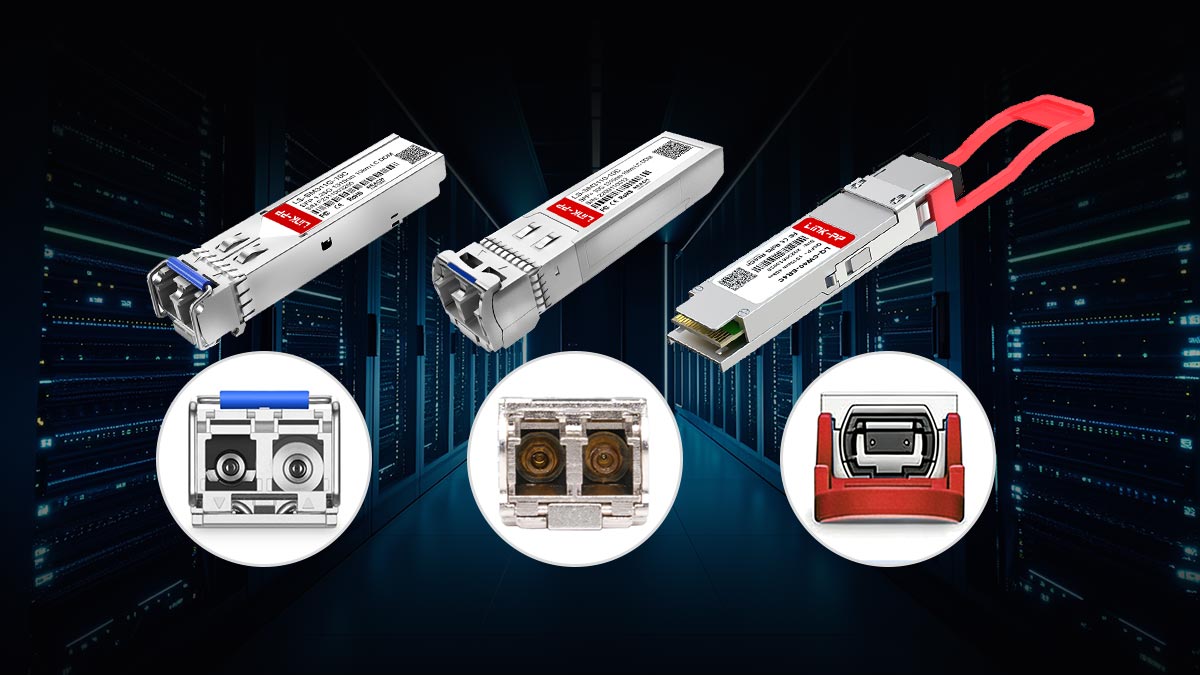
Definition of SFP, SFP+, and QSFP Ports
The SFP (Small Form-factor Pluggable) is a compact, hot-swappable optical transceiver used for both telecommunication and data communications applications. It was designed to support various communication standards like Gigabit Ethernet and Fibre Channel. As demands for speed increased, the SFP+ emerged as an enhanced version, maintaining the same physical size but supporting data rates up to 10Gbps and beyond.
The QSFP (Quad Small Form-factor Pluggable) represents a significant jump in density and throughput. Unlike the single-channel SFP series, QSFP utilizes four independent channels to transmit data, allowing for significantly higher speeds such as 40Gbps (QSFP+) and 100Gbps (QSFP28). This "quad" design makes it the industry standard for high-bandwidth uplinks and data center backbones.
How Port Types Fit into Multi-tier Designs
In a classic three-tier network (access, distribution, and core), these port types are deployed strategically based on their throughput capabilities. Standard SFP ports are typically found in the access layer, connecting end-user devices or low-bandwidth switches. Their cost-effectiveness makes them ideal for high-density deployments where individual link speed is less critical than overall connectivity.
As traffic moves up toward the distribution and core layers, SFP+ and QSFP ports take over. SFP+ is the workhorse for aggregating access layer traffic, providing the 10G speeds necessary for distribution switches. At the core, QSFP ports provide the massive "highways" required to move data between data centers or major network segments, ensuring that the backbone does not become a bottleneck.
Key Differences in Form Factor and Capacity
The most immediate difference lies in the physical width and the internal lane configuration. SFP and SFP+ share an identical footprint, which often allows for backwards compatibility in hardware design. However, they are fundamentally single-lane interfaces. In contrast, the QSFP form factor is slightly larger to accommodate the circuitry needed for four lanes, effectively quadrupling the potential bandwidth within a single module.
Capacity is the primary differentiator for network planners. While an SFP port is generally capped at 155Mbps to 4Gbps and an SFP+ at 6Gbps to 16Gbps, QSFP ports are designed for high-velocity environments. By grouping lanes together, a single QSFP28 port can handle 100Gbps, providing a much higher "bandwidth-per-rack-unit" ratio than the smaller SFP variants.
Why Port Selection Matters in Layered Networks
Selecting the wrong port type can lead to severe performance imbalances or unnecessary capital expenditure. Utilizing high-cost QSFP modules where a simple SFP+ would suffice wastes budget, while under-provisioning a core link with SFP+ can lead to packet loss and high latency during peak traffic periods. Correct selection ensures that each tier of the network is "right-sized" for its specific role.
Beyond just speed, port selection impacts the physical scalability and thermal management of the network rack. Different port types have varying power requirements and heat profiles; managing these factors is crucial for maintaining long-term hardware reliability in a multi-tier environment. Proper mapping of ports to network layers ensures a balanced architecture that is both cost-efficient and future-proof.
↪️ Distinguishing Performance Metrics of SFP/SFP+/QSFP Ports
Beyond physical shapes, the true distinction between SFP/SFP+/QSFP port types lies in their technical specifications and performance thresholds. To maintain a stable multi-tier network, engineers must evaluate data rates, transmission distances, and thermal impacts to ensure each module operates within its optimal parameters.
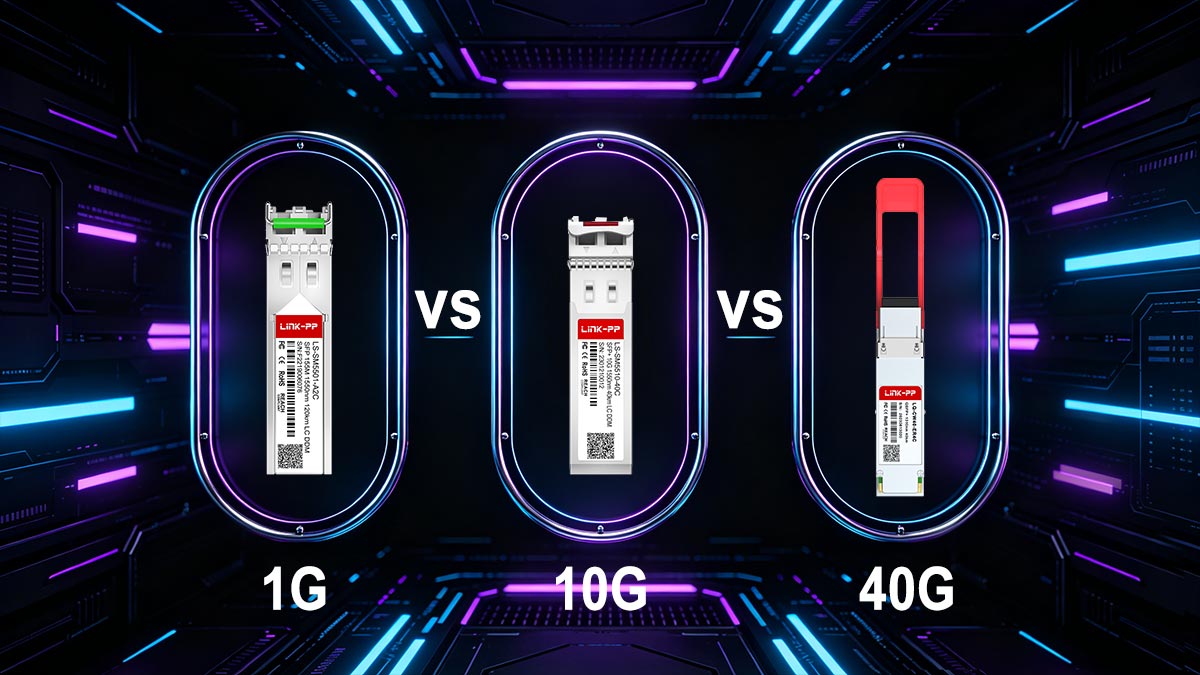
Data Rate Capabilities: 1G vs. 10G vs. 40G/100G
The most fundamental metric for any transceiver is its throughput. SFP modules were designed for the Gigabit era, primarily supporting 1Gbps, whereas SFP+ represents a significant leap by utilizing improved clock speeds to hit 10Gbps within the same footprint. QSFP modules break the single-lane barrier by using parallel transmission (four lanes) to reach speeds of 40Gbps and 100Gbps.
| Port Type | Standard Data Rate | Typical Application |
| SFP | 1Gbps | Access layer, legacy enterprise links |
| SFP+ | 10Gbps | Distribution layer, server uplinks |
| QSFP+ | 40Gbps | Core backbone, leaf-spine fabric |
| QSFP28 | 100Gbps | High-performance computing, hyperscale data center |
Choosing the appropriate data rate ensures that the network tiers remain balanced. A mismatch — such as using a 1G SFP to feed a 10G SFP+ distribution switch — can create severe "choke points" that degrade the user experience across the entire segment.
Distance Limitations for Copper vs. Fiber Connections
Transmission distance varies depending on the medium. Copper SFP/SFP+ modules typically reach up to 100m, while fiber optic transceiver modules can span several tens of kilometers depending on single-mode or multimode fiber types. QSFP modules also rely on fiber for long-distance connections, supporting tens of kilometers with single-mode fiber.
| Medium | Typical Max Distance | Notes |
| Copper Cable(Cat5e/6/6a) | 100m | Limited by signal loss |
| Multimode Fiber | 550m - 2km | Cost-effective for short runs |
| Single-mode Fiber | 10km - 80km+ | Suitable for core and inter-building links |
Power Consumption and Heat Dissipation Considerations
Every active transceiver generates heat, and as data rates increase, so does power consumption. Standard SFP and SFP+ modules are relatively efficient, typically drawing less than 1.5W per port. However, QSFP modules (especially 100G variants) can draw significantly more power (3.5W to 5W), which requires more sophisticated cooling solutions within the switch chassis.
High-density switches filled with QSFP modules can reach high temperatures quickly. If heat is not managed through proper airflow and thermal padding, the modules may experience "thermal throttling," leading to increased bit-error rates or even hardware failure. Monitoring the power budget of a switch is critical when fully populating it with high-performance transceivers.
Signal Integrity in High-Speed Port Transmissions
As data rates climb from 1G to 100G, the "bit period" (the time allowed for a single bit of data) shrinks, making the signal more susceptible to noise and interference. In SFP+ and QSFP links, electromagnetic interference (EMI) and signal crosstalk become major hurdles. Quality shielding in the port housing and the use of high-grade components are essential to prevent packet loss.
To combat signal degradation, modern QSFP ports often utilize forward error correction (FEC). FEC adds redundant data to the transmission, allowing the receiving port to detect and fix errors without needing to re-send the packet. This is a crucial metric for 100G links, as it ensures high reliability despite the extreme speeds and potential for signal jitter.
↪️ Multi-Tier Network Architecture with SFP/SFP+/QSFP Ports
A well-structured multi-tier architecture ensures that data flows efficiently from the network edge to its high-speed core. By strategically deploying SFP/SFP+/QSFP ports, administrators can align hardware capabilities with the specific bandwidth and distance requirements of each functional layer.
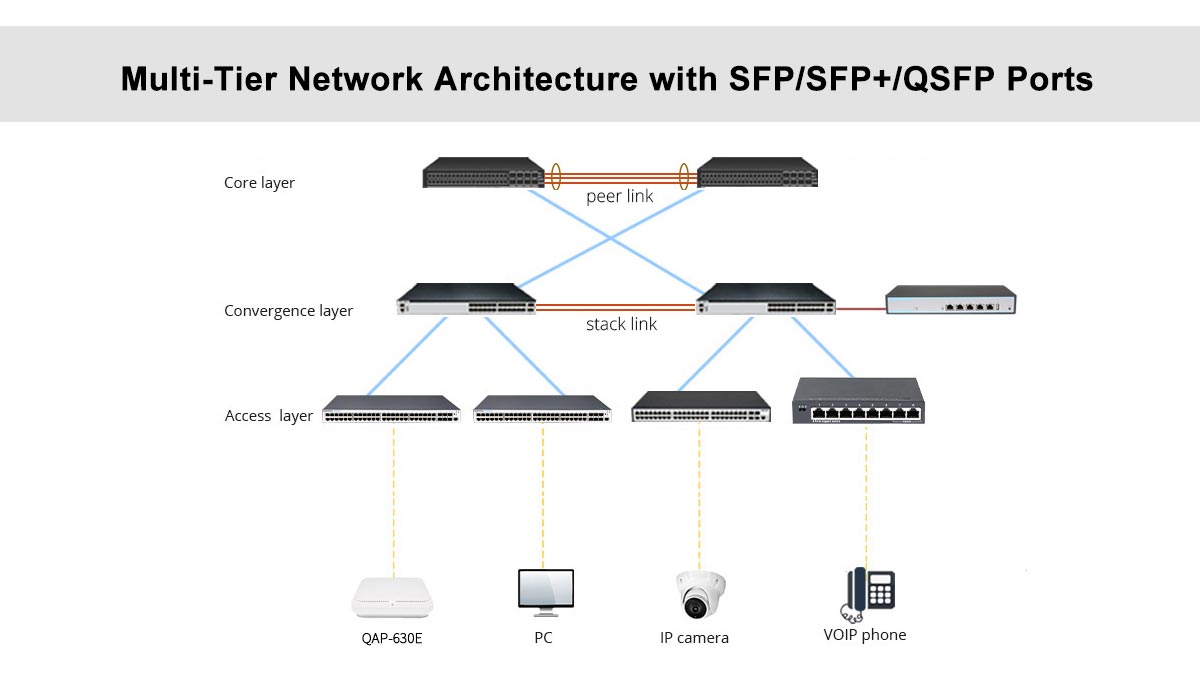
Designing the Access Layer with Standard SFP
The access layer is the primary entry point for end-user devices and peripheral hardware into the network. At this level, high port density and cost-efficiency are prioritized over raw throughput, making the standard SFP transceiver the ideal choice for connecting a vast array of lower-bandwidth endpoints.
- Endpoint Connectivity: Standard 1G SFP ports are used to link desktop workstations, wireless access points, and IP cameras to the network switches, providing stable and sufficient bandwidth for everyday business applications.
- Cost Management: Since the access layer often requires hundreds of active ports, using SFP modules helps keep the total cost of ownership low without sacrificing the flexibility of hot-swappable fiber or copper interfaces.
Using SFP+ for High-Bandwidth Distribution Layers
The distribution layer acts as the bridge between the access points and the network core, performing critical functions like routing, filtering, and traffic aggregation. To prevent congestion when multiple access switches funnel data upward, the increased 10G capacity of SFP+ becomes the standard requirement.
In this tier, SFP+ modules provide the necessary "fat pipes" to handle aggregated traffic. Using 10Gbps links ensures that high-demand services — such as video conferencing and large file transfers — do not suffer from bottlenecking as they move deeper into the network infrastructure. Furthermore, SFP+ ports offer the versatility needed for inter-VLAN routing and applying security policies at line rate, maintaining a smooth transition between the network edge and the backbone.
Implementing QSFP at the Core Backbone
The core layer is the high-speed "highway" of the network, responsible for transporting massive amounts of data between different distribution blocks and the data center. Because the core must handle the cumulative load of the entire organization, the multi-lane capabilities of QSFP ports are indispensable.
- Massive Throughput: By utilizing QSFP+ (40G) or QSFP28 (100G) modules, the core backbone can support ultra-high-speed switching fabrics that prevent any single point of congestion during peak traffic periods.
- Backbone Efficiency: The use of QSFP interfaces reduces the physical footprint and complexity of the core; a single 100G QSFP28 link can replace ten individual 10G SFP+ links, significantly simplifying cable management and improving the airflow within core switch chassis.
- Scalability: Implementing QSFP at the core provides a future-proof foundation, allowing the network to absorb future increases in data demand as more devices and higher-bandwidth applications are added to the access layer.
↪️ Use Cases for SFP/SFP+/QSFP Ports in Enterprise Data Centers
SFP/SFP+/QSFP ports are widely deployed across enterprise data centers to support diverse connectivity needs, from server access to high-speed backbone links. Their flexibility allows network architects to tailor performance based on workload requirements and traffic patterns. By leveraging the right port type in each scenario, organizations can achieve efficient, scalable, and high-performance data center operations.
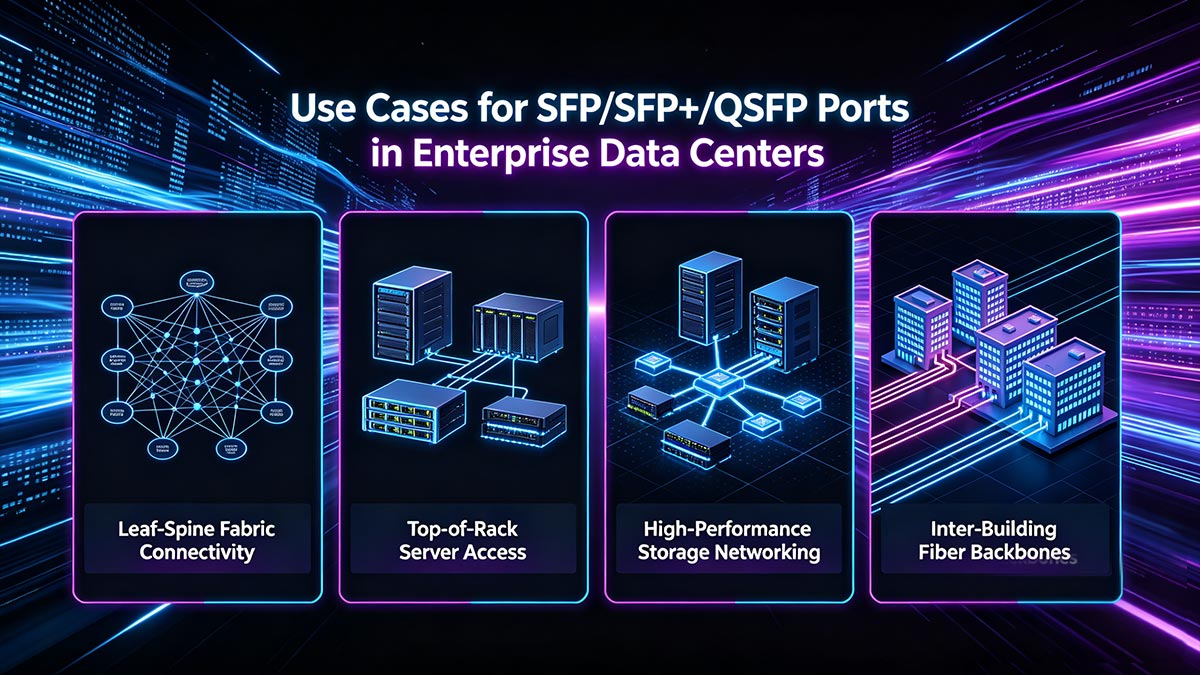
Leaf-Spine Fabric Connectivity
In modern leaf-spine architectures, SFP+ and QSFP ports play a critical role in enabling high-speed, low-latency east-west traffic. SFP+ is often used for 10G links between leaf switches and servers, while QSFP supports 40G or 100G uplinks between leaf and spine layers.
This combination ensures predictable performance and non-blocking throughput across the fabric. QSFP’s high bandwidth is particularly valuable in spine switches, where multiple leaf connections must be aggregated without creating bottlenecks.
Top-of-Rack (ToR) Server Access
Top-of-Rack switches typically use SFP or SFP+ ports to connect directly to servers within the same rack. SFP modules are suitable for legacy or low-bandwidth workloads, while SFP+ is preferred for modern applications requiring 10G connectivity.
This deployment provides short-distance, high-density connections with minimal latency. It also simplifies cabling and improves manageability by keeping server connections localized within each rack.
High-Performance Storage Networking
Storage networks, such as SAN or NVMe-over-Fabrics environments, demand high throughput and low latency. SFP+ and QSFP ports are commonly used to meet these requirements, supporting fast data transfer between storage arrays and compute resources.
QSFP ports, in particular, enable high-capacity links for data-intensive applications like real-time analytics and large-scale backups. Their ability to handle large volumes of traffic ensures consistent storage performance under heavy workloads.
Inter-Building Fiber Backbones
For campus or multi-building data centers, QSFP and long-range SFP+/SFP modules are used to establish high-speed fiber connections over extended distances. Single mode transceivers combined with these ports can support links spanning several kilometers.
This use case ensures reliable, high-bandwidth communication between geographically separated facilities. It is especially important for disaster recovery, data replication, and centralized resource sharing across multiple sites.
↪️ Connectivity Solutions: Mapping SFP/SFP+/QSFP Cabling
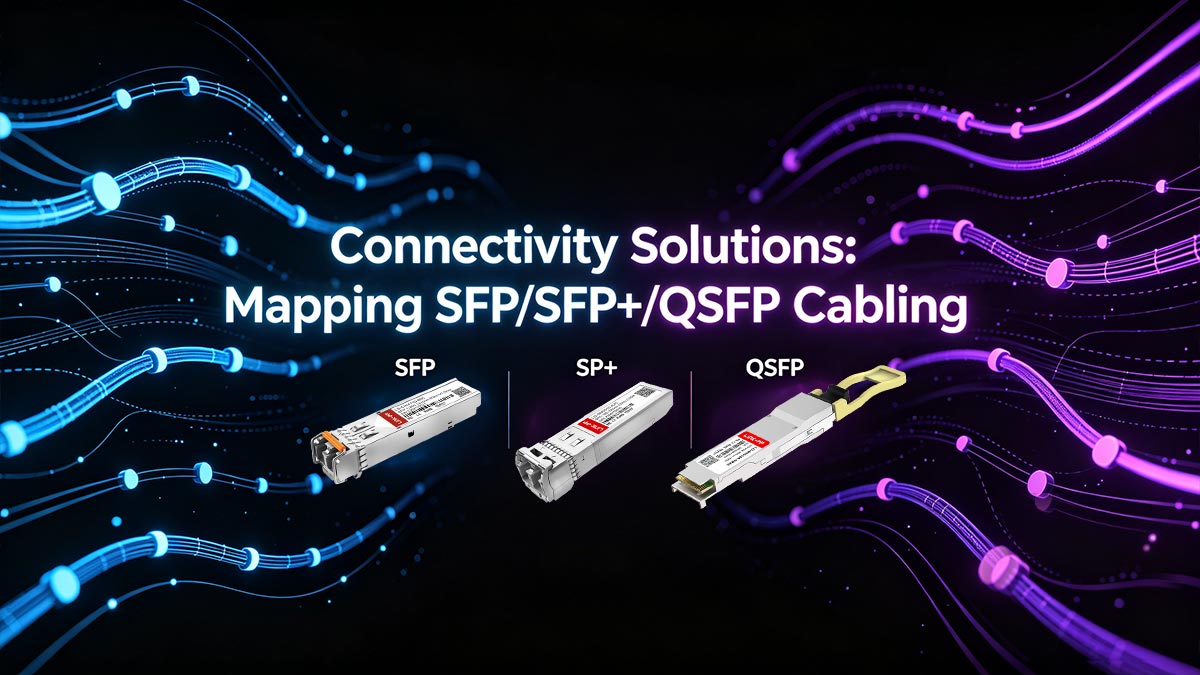
Mapping the right cabling solutions to SFP/SFP+/QSFP ports is crucial for ensuring the network’s performance, efficiency, and reliability. The choice of cabling — whether multimode fiber, single-mode fiber, or copper — directly impacts the bandwidth, distance, and cost of the deployment. By understanding the various cabling options, network architects can optimize connectivity and avoid common pitfalls.
Short-Reach Multimode Fiber Mapping
For short-distance connections, multimode fiber is typically used with SFP and SFP+ ports, offering high throughput within data centers and server farms. Multimode fiber is ideal for short-range applications because of its cost-effectiveness and efficient transmission over distances of up to 550m.
The use of OM3 and OM4 fiber cables provides high performance, making them well-suited for server rack interconnections and intra-building links, where cost and bandwidth are critical factors.
Long-Haul Single-Mode Fiber Integration
Single-mode fiber is essential for long-distance connections, especially for links exceeding 2km. SFP+ and QSFP modules support single-mode fiber, enabling long-haul connectivity between buildings or campuses.
This fiber type is ideal for connecting distant data centers or for inter-building backbones, providing the necessary bandwidth and minimal signal loss over large distances, typically up to 80km or more with proper transceivers.
MPO/MTP Trunking for QSFP Ports
MPO (Multi-fiber Push On) and MTP (Multi-fiber Termination Push-on) trunk cables are designed to handle high-density connections, especially for QSFP ports that require multiple fibers. These high-performance cables are used in data centers to aggregate large amounts of traffic over short distances with minimal cable clutter.
MPO/MTP trunking solutions streamline the deployment of high-speed, multi-lane connections (e.g., 40G and 100G) by allowing efficient cabling and quick port upgrades, making them essential for scalable network expansion.
LC Duplex Patching for SFP+ Densities
LC duplex cables are commonly used with SFP+ ports in high-density environments due to their compact size and reliable performance. These cables are ideal for connecting servers to switches or within network racks, providing 10G speeds over relatively short distances.
This solution ensures that the network remains organized while supporting high data rates, especially in environments where space is at a premium, such as in top-of-rack or access layer configurations.
Optical Breakout Solutions for Port Splitting
Optical breakout cables allow a single QSFP port to be split into multiple lower-speed SFP+ or even SFP connections, optimizing the utilization of high-capacity ports. These breakout solutions are especially useful in networks where the need for high-bandwidth core links exceeds the available lower-speed connections.
By enabling multiple connections from a single port, optical breakout solutions reduce the number of ports required on network switches, maximizing equipment utilization and reducing overall cabling complexity.
↪️ Compatibility and Interoperability of SFP/SFP+/QSFP Ports
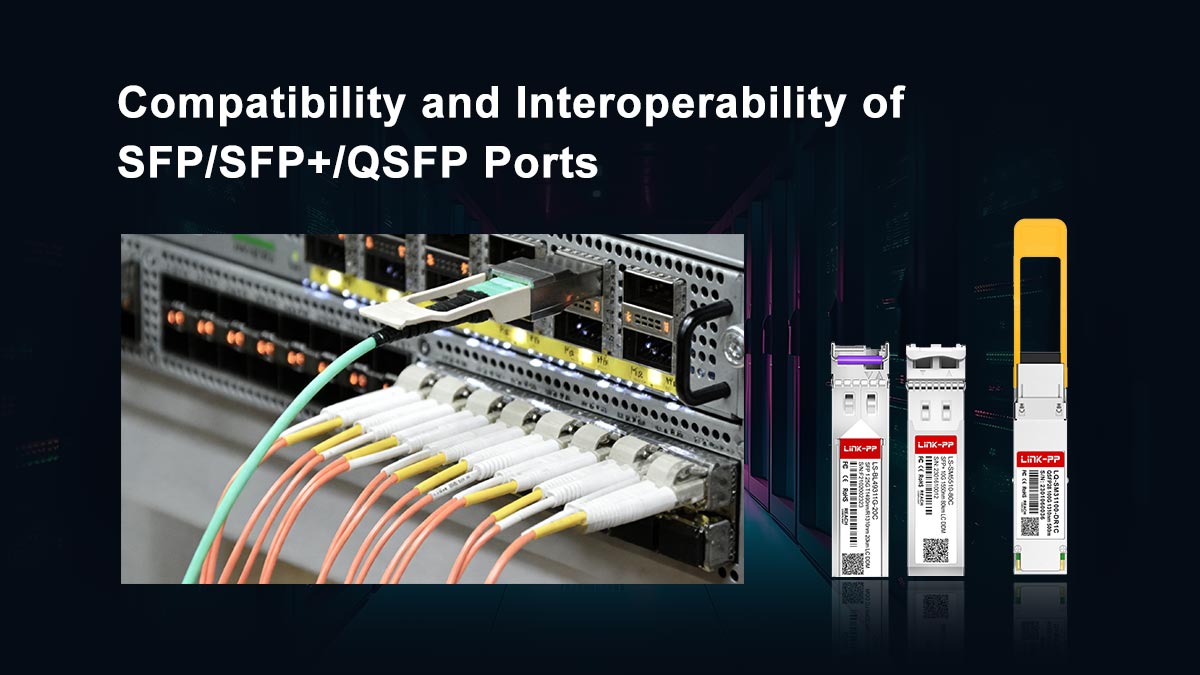
Ensuring compatibility and interoperability between various SFP/SFP+/QSFP ports is essential for maintaining a seamless network environment. Different vendors and modules may offer slight variations in design, which can impact their ability to work together. A strong understanding of these factors helps prevent link failures and ensures network stability.
Backwards Compatibility: Will an SFP work in an SFP+ Port?
In most scenarios, an SFP+ port is designed to be backwards compatible with a standard 1G SFP module, as they share the same physical dimensions. When a 1G module is inserted into a 10G SFP+ port, the switch typically auto-negotiates the speed down to 1Gbps. However, it is important to note that this does not work in reverse; an SFP+ module will not function in a legacy 1G SFP port because the hardware lacks the necessary clock speeds and electrical signaling to support the higher bandwidth.
While physical fit is rarely an issue, firmware limitations can sometimes prevent an SFP module from being recognized in an SFP+ slot. Always verify the manufacturer's specification sheet, as some high-density switches may disable 1G support on specific ports to optimize system resources for 10G or 40G throughput.
Multi-Vendor Coding and DOM/DDM Support
Many network equipment manufacturers implement "vendor locking," where the switch port is programmed to only accept transceivers with a specific vendor code. To navigate this, many high-quality third-party modules are now "coded" to mimic original equipment manufacturer (OEM) signatures, ensuring seamless interoperability across different hardware brands like Cisco, Arista, or Juniper.
Beyond simple recognition, digital optical monitoring (DOM) or digital diagnostic monitoring (DDM) is a critical industry-standard feature. It allows network admins to monitor real-time parameters such as optical output power, receive power, temperature, and supply voltage. Without robust DDM support, troubleshooting a failing link becomes a guessing game, as the system cannot report if a "port down" issue is caused by a dirty fiber or a failing laser.
Identifying Genuine vs. Third-Party Modules
Distinguishing between genuine OEM modules and third-party alternatives often comes down to cost and verified reliability. While OEM modules offer guaranteed compatibility and support, they often come at a significant price premium. Third-party modules, when sourced from reputable vendors, provide identical performance levels and are often manufactured in the same facilities as the branded versions, making them a popular choice for scaling multi-tier networks on a budget.
When evaluating modules, look for certifications and testing reports that prove the transceiver has been validated in the specific switch models you intend to use. Genuine modules typically feature holographic labels or unique serial numbers that can be verified through the manufacturer’s database, whereas high-quality third-party optics rely on transparent coding practices and comprehensive warranties to establish trust.
Troubleshooting Common "Port Down" Link Issues
When a port goes down, the root cause can often be traced to a few key areas: improper cable connections, incompatible transceivers, or faulty modules. SFP/SFP+/QSFP port issues can also arise from mismatch between the module type and the network equipment's specifications.
To troubleshoot "port down" issues, start by checking the module compatibility, inspecting the cables for damage, and ensuring the proper optical or electrical signal is being transmitted. Replacing modules with known, tested units can help confirm if the issue lies with the transceiver or other network components.
↪️ Optimizing Multi-Tier Networking with SFP/SFP+/QSFP Ports
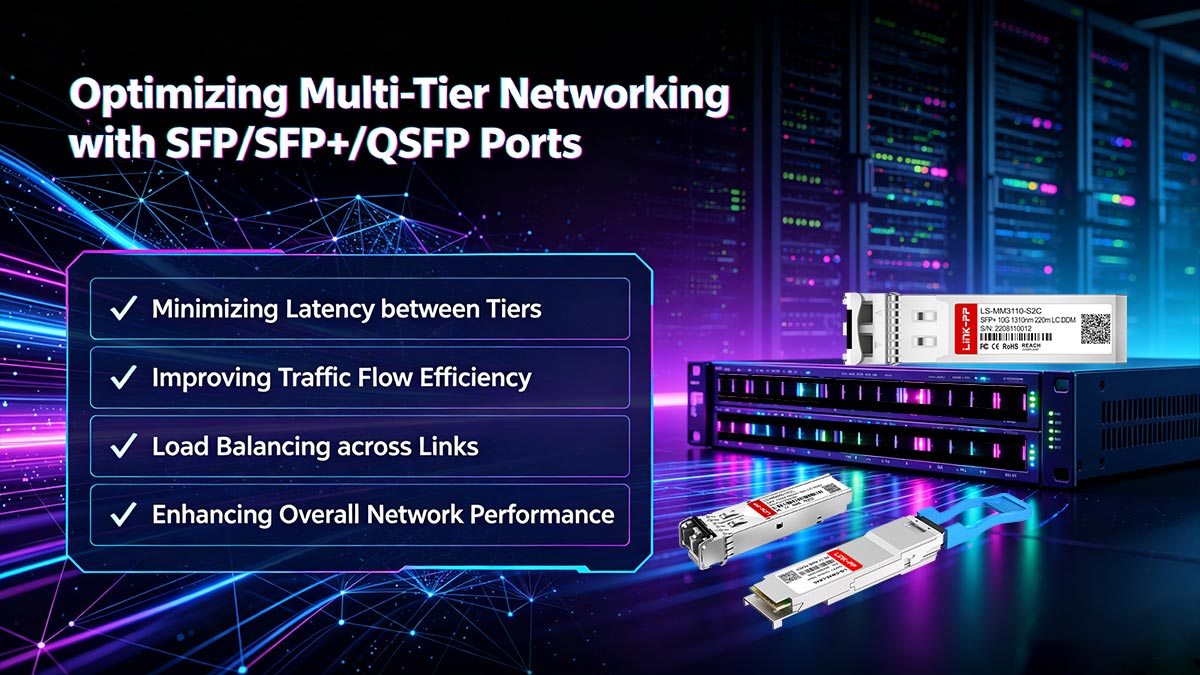
Optimizing a multi-tier network requires careful alignment of SFP/SFP+/QSFP ports to reduce bottlenecks and maximize efficiency. By leveraging the strengths of each port type, organizations can improve data flow, scalability, and responsiveness across all network layers. Proper optimization ensures that the infrastructure can handle increasing workloads while maintaining consistent performance.
Minimizing Latency between Tiers
Reducing latency between access, distribution, and core layers is critical for real-time applications and high-speed data processing. Using higher-speed links such as SFP+ and QSFP for uplinks minimizes transmission delays, while shorter and well-structured cabling paths further enhance responsiveness. Efficient port placement and avoiding unnecessary hops help maintain low-latency communication across the network.
Improving Traffic Flow Efficiency
Efficient traffic flow depends on matching port capacity to network demand at each tier. Deploying SFP for edge connections and scaling up to SFP+ and QSFP for aggregation and core layers ensures that traffic moves smoothly without congestion. Proper segmentation and bandwidth allocation also prevent oversubscription, allowing consistent and predictable network performance.
Load Balancing across Links
Load balancing distributes traffic across multiple links to prevent any single connection from becoming overloaded. By combining multiple SFP+ or QSFP links using techniques like link aggregation (LAG) or ECMP (Equal-Cost Multi-Path), networks can achieve higher throughput and redundancy. This approach improves both performance and resilience, especially in high-density environments.
Enhancing Overall Network Performance
Overall performance is improved by strategically integrating SFP/SFP+/QSFP ports with optimized cabling, balanced bandwidth, and scalable architecture. Regular monitoring of port utilization, power, and signal quality ensures that the network operates at peak efficiency. With proper planning and ongoing optimization, organizations can achieve a high-performance, future-ready multi-tier network.
↪️ Key Takeaways on SFP/SFP+/QSFP Port Types in Multi-Tier Networks
SFP/SFP+/QSFP port types are essential components in building efficient, scalable, and high-performance multi-tier networks. Each port type serves a specific role — from cost-effective access connectivity with SFP, to high-bandwidth aggregation with SFP+, and ultra-fast backbone transmission with QSFP — ensuring that every network layer operates at optimal capacity. By understanding their differences in speed, distance, power, and compatibility, network designers can make informed decisions that align with both current demands and future growth.
In modern enterprise environments, the right combination of these port types not only improves traffic flow and reduces latency but also enhances flexibility through modular upgrades and diverse cabling options. Whether deploying leaf-spine architectures, high-performance storage networks, or long-distance fiber backbones, SFP/SFP+/QSFP solutions provide the foundation for reliable and scalable connectivity.
To fully leverage these benefits, choosing high-quality and compatible optical transceiver modules is critical. For dependable performance and a wide range of SFP, SFP+, and QSFP solutions, explore the LINK-PP Official Store to find transceivers designed to meet the evolving needs of multi-tier networking infrastructures.







