In the rapidly evolving landscape of high-speed networking, the QSFP transceiver has emerged as the essential building block for modern data centers. These high-density, hot-pluggable optical transceiver modules are critical for supporting the massive bandwidth requirements of 40GBASE and 100GBASE Ethernet. As network architectures become more complex, selecting the right interface is no longer just about speed, but about optimizing for efficiency, distance, and infrastructure costs.
Choosing the ideal QSFP transceiver requires a deep understanding of the key optical module types: SR4, PSM4, and LR4. While all three modules facilitate high-speed data transmission, they differ significantly in terms of fiber requirements, transmission distance, and power consumption. This performance review article breaks down the distinctions between these modules, providing the insights necessary to help you make the right choice for your specific network deployment.
? QSFP Transceiver Overview and Key Differences
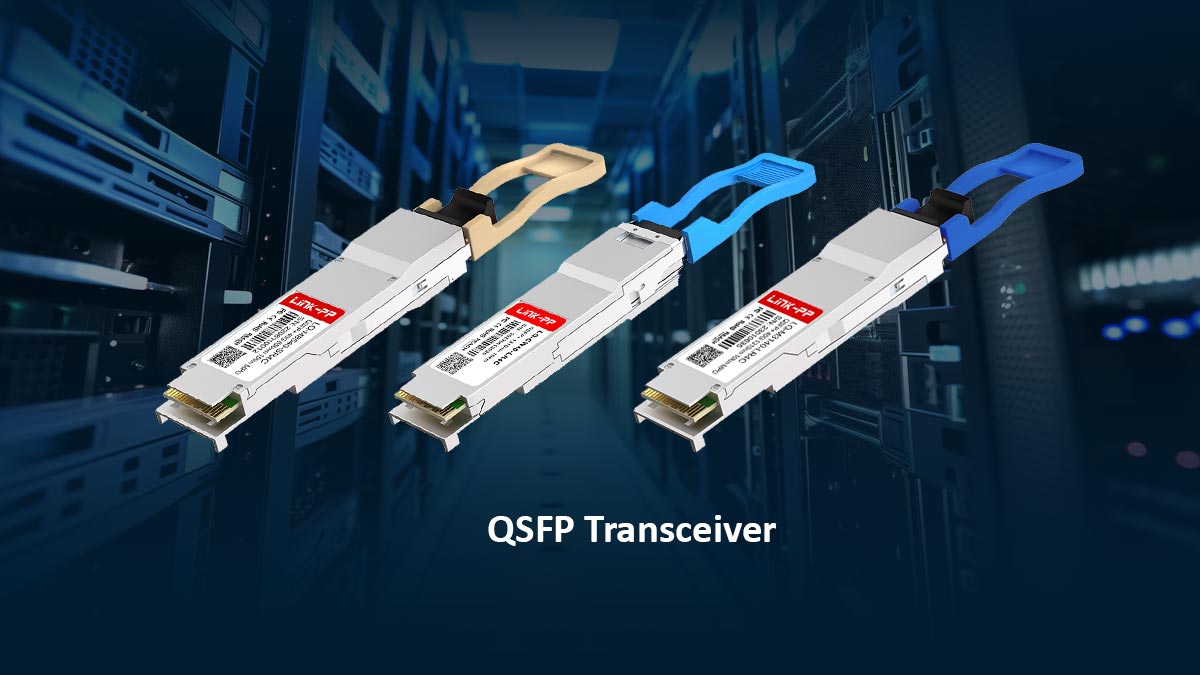
Understanding the different types of QSFP transceiver module types is fundamental to building a scalable and cost-effective network. While these optical modules share the same compact form factor, their internal architectures and optical specifications are engineered to meet distinct transmission distance and cabling requirements.
What is a QSFP Transceiver
A QSFP transceiver (Quad Small Form-factor Pluggable) is a compact, hot-swappable optical module used for high-speed transceivers communications. The "Quad" designation refers to its four independent transmit and receive channels, which allow it to aggregate bandwidth. Originally designed to support 40G and 100G Ethernet, these modules are the industry standard for high-density networking in data centers, high-performance computing clusters, and enterprise core layers.
Overview of SR4, PSM4, and LR4 Standards
The industry categorizes QSFP transceiver modules primarily by their reach and the type of fiber they utilize.
Key Technical Distinctions at a Glance
The main technical differences between these QSFP transceiver module types lie in the light source, the connector type, and how the data is multiplexed across the fiber. While SR4 and PSM4 rely on parallel ribbon cables (MPO/MTP), LR4 multiplexes signals onto a single fiber pair, significantly reducing fiber strand counts over long distances.
| Feature |
SR4 |
PSM4 |
LR4 |
| Fiber Type |
Multimode (OM3/OM4) |
Single-mode (OS2) |
Single-mode (OS2) |
| Connector Type |
MTP/MPO-12 |
MTP/MPO-12 |
Duplex LC |
| Wavelength |
850nm |
1310nm (Parallel Lanes) |
1310nm (WDM Lanes) |
| Max Distance |
70m (OM3) / 100m (OM4) |
2km / 10km |
10km |
| Light Source |
VCSEL |
DFB |
DFB or EML |
Typical Use Cases for Each Module Type
Each QSFP transceiver is optimized for specific layers of the network hierarchy:
- QSFP SR4: Ideally suited for intra-rack connections (top-of-rack switch to server) and short-span switch-to-switch links within a single data hall.
- QSFP PSM4: Perfect for medium-distance leaf-to-spine architectures in large-scale data centers where Single-mode fiber is preferred but cost-control is essential.
- QSFP LR4: The standard choice for long-haul campus backbones, inter-building connectivity, and metro-area networking where fiber resources are limited and distance is the primary concern.
? SR4 QSFP Transceiver Performance Analysis
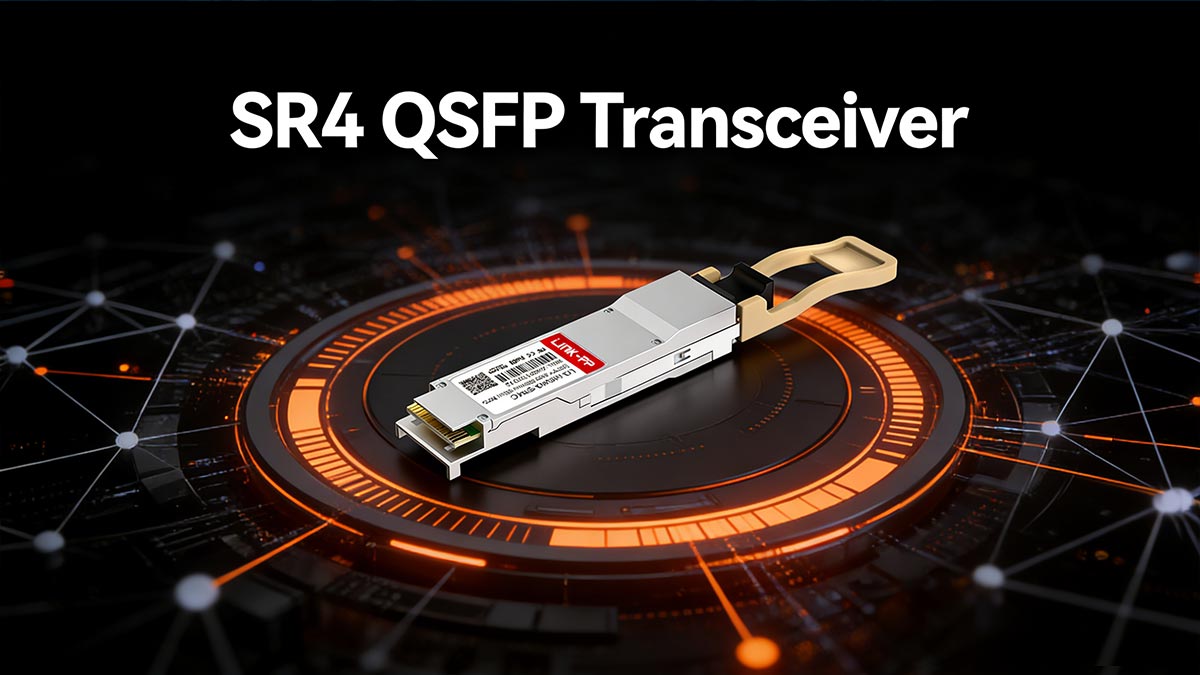
The SR4 QSFP transceiver is the industry’s primary solution for short-range high-speed interconnects. Utilizing 850nm VCSEL (Vertical-Cavity Surface-Emitting Laser) technology, it provides a highly cost-effective method for connecting servers and switches within the same rack or adjacent rows.
Transmission Distance and Wavelength Details
SR4 QSFP transceiver operates at a center wavelength of 850nm, utilizing the short-wave infrared spectrum. This wavelength is specifically chosen because it aligns with the optimal performance window of multimode fiber. By using four parallel lanes, each operating at 10G or 25G, the transceiver module can achieve total throughputs of 40G or 100G, corresponding to the 40GBASE-SR4 and 100GBASE-SR4 standards, respectively.
In terms of reach, the transmission distance is heavily dependent on the grade of multimode fiber used. Over OM3 multimode fiber, the SR4 typically supports distances up to 70m, while on high-bandwidth OM4 fiber, it can reach up to 100m or 150m. These transmission distances are perfectly suited for top-of-rack (ToR) and end-of-row (EoR) cabling designs where the majority of links are within a 150-meter range.
Fiber Type Requirements
This specific QSFP transceiver is designed exclusively for multimode fiber (MMF). Unlike single mode transceivers that use a tiny 9-micron core, QSFP SR4 optics utilize a larger 50-micron or 62.5-micron core, which makes the alignment of the laser light much easier and reduces the manufacturing precision required. The interface typically uses an MPO/MTP-12 connector, which houses 12 fiber strands, though only 8 are active — 4 for transmitting and 4 for receiving.
The reliance on MPO-style parallel cabling is a defining feature of the SR4 standard. While MMF cable is generally cheaper than single-mode fiber, the requirement for multi-fiber ribbon cables means that the physical cable itself is thicker and requires specialized management. However, for short-range data center applications, the significantly lower cost of the SR4 QSFP transceiver compared to single-mode alternatives makes this choice the most economical.
Power Consumption Characteristics
One of the primary advantages of the SR4 QSFP transceiver is its low power consumption and thermal efficiency. Because VCSEL lasers require very low threshold currents to operate, these modules typically consume between 1.5W and 2.5W. This low power draw is a critical factor for high-density data centers where hundreds of transceivers may be plugged into a single core switch, creating significant heat management challenges.
Furthermore, lower power consumption translates directly to lower operational expenses (OPEX). By minimizing the energy required for both the optical transmission and the subsequent cooling of the network equipment, the SR4 module helps data center managers maintain a better Power Usage Effectiveness (PUE) rating. This makes SR4 the most energy-efficient choice for high-speed short-range links.
Advantages and Limitations of SR4
The biggest advantage of the SR4 QSFP transceiver is its price-to-performance ratio. It offers the lowest entry cost for 40G/100G networking because the optical components are simpler to manufacture. Additionally, its ability to support breakout configurations — where one 100G SR4 port is split into four 25G SR links — provides immense flexibility for connecting high-speed switches to lower-speed server ports.
However, the SR4 has clear limitations, most notably its distance. It cannot support links beyond 150m, making it unsuitable for campus-wide connectivity or large-scale data center halls. Furthermore, the use of MPO cabling can lead to higher "cable-per-port" costs and higher insertion loss if the connectors are not kept perfectly clean, requiring more rigorous maintenance than standard duplex LC connections.
? PSM4 QSFP Transceiver Performance Analysis
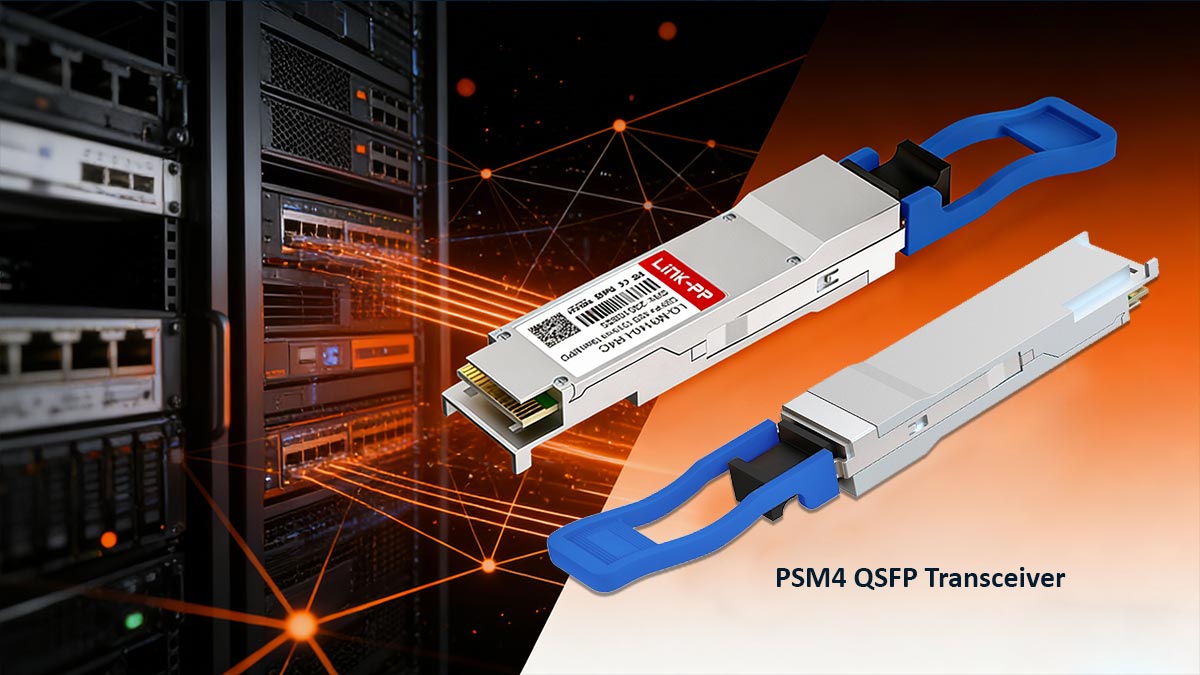
The PSM4 QSFP transceiver was developed to fill the gap between short-range multimode and long-range single-mode applications. It offers a parallel transmission architecture over single-mode fiber, providing a mid-reach solution, often categorized under QSFP-100G-CWDM4 related architectures, that is more affordable than WDM-based long-reach modules.
Parallel Single-mode Transmission Explained
PSM4 QSFP transceiver operates differently from traditional single-mode optics. Instead of multiplexing multiple signals onto a single fiber pair, it uses a parallel design that mirrors the SR4 architecture but applies it to single-mode fiber. It utilizes four independent 1310nm channels, each traveling over its own dedicated fiber strand within a single-mode MPO ribbon cable.
This design avoids the need for expensive and complex optical multiplexers and demultiplexers (MUX/DEMUX). By using a simpler uncooled DFB laser array or Silicon Photonics, the QSFP PSM4 module can provide single-mode performance at a price point significantly lower than that of a QSFP LR4 module. This makes it a popular choice for modern leaf-spine architectures that require single-mode fiber's stability without the high cost of long-haul optics.
Distance Capabilities and Deployment Scenarios
The PSM4 QSFP transceiver is engineered for a maximum reach of 2km or 10km over OS2 single-mode fiber, depending on the variant used. This extended reach is specifically designed for hyperscale data centers where the physical distance between switch layers often exceeds the 150m limit of multimode SR4, and in some cases even surpasses the 2km reach, making the 10km option a flexible choice for longer interconnects.
In real-world deployment, PSM4 is frequently used for interconnecting switches across different data halls, campus buildings, or within very large facility footprints. It is also an excellent choice for organizations that have standardized on single-mode fiber infrastructure to future-proof their cabling, as it allows them to use the same fiber type for both medium and long-range connections.
Cost Considerations and Cabling Complexity
The financial logic of the PSM4 QSFP transceiver is a trade-off between the module cost and the cabling cost. While the PSM4 transceiver itself is much cheaper than an LR4 module, it requires 8 strands of single-mode fiber for every link. In contrast, an LR4 module only requires 2 strands. Consequently, if fiber plant resources are scarce or if you are paying for fiber by the strand, PSM4 can become expensive.
Cabling complexity is also a factor, as QSFP PSM4 requires MPO-12 single-mode connectors and patch panels. These are more complex to install and test than standard LC duplex connectors. However, for many large data centers, the savings gained by buying hundreds of lower-cost PSM4 transceivers far outweigh the added investment in high-count ribbon fiber cabling.
Pros and Cons of PSM4 Modules
The primary pro of the PSM4 QSFP transceiver is its support for breakout applications. Just like 100G SR4, a 100G PSM4 port can be split into four 25G single-mode streams using a breakout cable. This is a massive advantage for high-density environments where a single switch port needs to communicate with four different 25G servers or switches.
The primary con is the lack of interoperability with other standards. A PSM4 module cannot talk to an SR4 module (due to different fiber types) or an LR4 module (due to different transmission technologies). Furthermore, the high fiber strand consumption makes it less efficient for long-distance runs where the cost of laying or leasing 8 fibers per link would be prohibitive.
? LR4 QSFP Transceiver Performance Analysis

The LR4 QSFP transceiver is the powerhouse of long-distance networking, designed to carry high-speed data over several kilometers. It is the standard choice for campus backbones and inter-facility links where maximizing distance over a minimum number of fiber strands is the priority.
Long-range Transmission Capabilities
LR4 QSFP transceiver is designed to provide robust connectivity over distances up to 10km using standard OS2 single-mode fiber. This makes it the primary solution for connecting geographically separated buildings on a corporate campus, linking data centers across a city, or serving as the backbone for Metropolitan Area Networks (MANs).
Because it uses single-mode fiber, the LR4 is virtually immune to the modal dispersion that limits multimode fiber. This ensures that the signal remains clean and readable even after traveling miles of fiber. For any network link that leaves the confines of a single data hall and travels through a campus duct or over a leased dark fiber line, the LR4 is the industry-standard selection.
CWDM Technology and Wavelength Multiplexing
The defining technology inside a 40G LR4 QSFP transceiver is CWDM (Coarse Wavelength Division Multiplexing). Instead of using parallel fibers like SR4 or PSM4, the 40G LR4 multiplexes four different wavelengths — 1271, 1291, 1311, and 1331nm — onto a single pair of single-mode fibers. Internal optical MUX/DEMUX components combine these four 10G signals at the transmit end and separate them at the receive end.
This multiplexing allows the LR4 to use a standard LC Duplex connector (one fiber for TX, one for RX). The ability to provide 40G of throughput over just two strands of fiber is a massive advantage for long-haul infrastructure, where the cost of installing new fiber or leasing additional strands is extremely high. It maximizes the utility of existing fiber plants more than any other QSFP standard.
Power Efficiency and Signal Stability
Due to the complexity of the internal WDM components and the need for high-power DFB lasers to push the signal over 10km, the LR4 QSFP transceiver has the highest power consumption of the three types. These modules typically draw between 3.5W and 4.5W. Many LR4 modules also incorporate internal TOSA/ROSA cooling or sophisticated signal processing to ensure stability across the 10km range.
Despite the higher power draw, LR4 modules offer superior signal stability and a very low Bit Error Rate (BER). They are designed to operate reliably in environments with varying temperatures, which is common in outdoor fiber enclosures or telco rooms. The stability provided by WDM technology ensures that the four channels do not interfere with one another, even over maximum distances.
Strengths and Weaknesses of LR4
The greatest strength of the LR4 QSFP transceiver is fiber conservation. By requiring only two strands of fiber for a full 40G or 100G link, it is the most efficient choice for long-distance runs where fiber is a precious resource. Furthermore, its use of the common LC duplex connector makes it compatible with most existing patch panels and fiber infrastructure without needing MPO adapters.
The primary weakness is the unit cost. Because of the precision required for CWDM multiplexing and the high-grade lasers needed for 10km reach, the LR4 is significantly more expensive than SR4 or PSM4 modules. Additionally, while LR4 modules do support breakout applications (splitting a 40G or 100G link into four lower‑speed channels), this typically requires external wavelength demultiplexing equipment rather than a simple breakout cable, adding complexity and cost to such deployments.
? QSFP Transceiver Selection: Which One Should You Choose
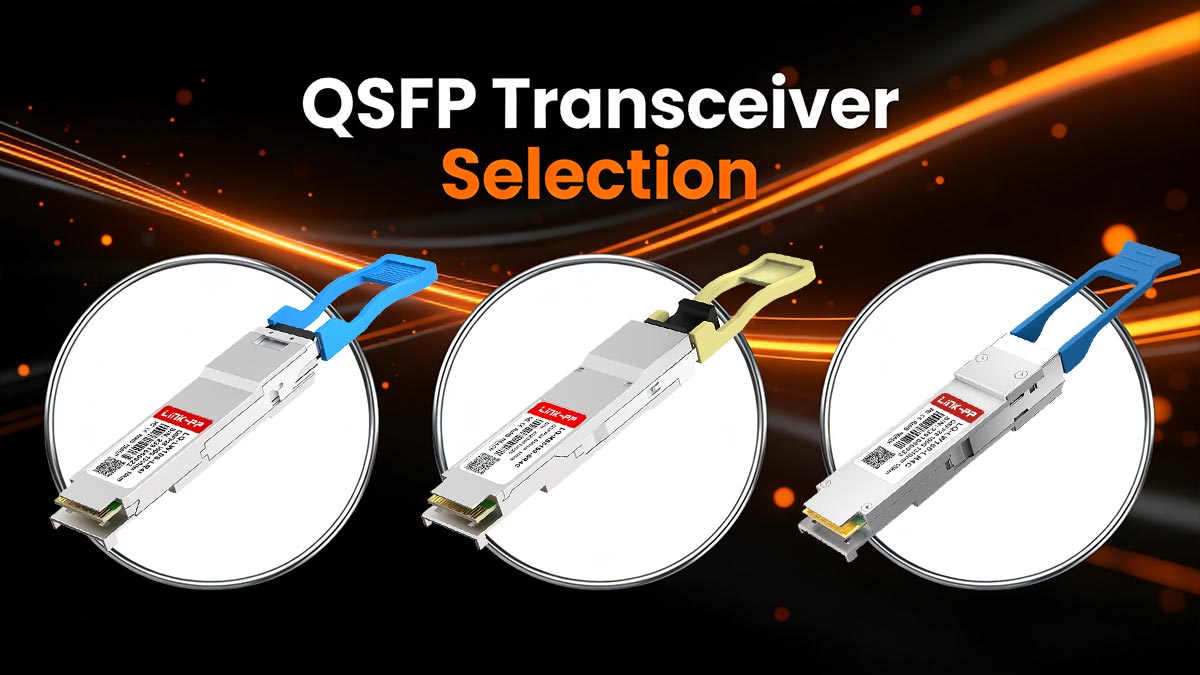
Selecting the right QSFP transceiver is not just a technical choice; it’s a strategic network design decision that can determine your system’s performance, scalability, and cost efficiency. Each QSFP transceiver module type — SR4, PSM4, and LR4 — excels under specific conditions. Your ideal option depends on how far you need to transmit data, the fiber infrastructure at hand, and your operational priorities regarding cost and maintenance.
Decision Factors to Consider
When assessing QSFP transceiver modules, three main aspects should guide your choice: transmission distance, fiber infrastructure, and network architecture compatibility.
? Distance Requirements
The primary difference between SR4, PSM4, and LR4 lies in their optical reach. SR4 modules are designed for short-range, high-speed connections, typically up to 100m or 150m over multimode fiber. PSM4 extends that range to around 2km or even 10km using parallel single-mode fiber, while LR4 supports up to 10km using duplex single-mode links. Understanding your network’s physical layout — the distance between switches, servers, and distribution points — is critical before choosing.
? Fiber Infrastructure
Next, evaluate the type of fiber currently deployed. If your facility is already wired extensively with Multimode Fiber (OM3 or OM4), deploying SR4 modules is the path of least resistance. Conversely, if you are working with a Single-mode Fiber (SMF) plant, you must choose between PSM4 and LR4. Transitioning between these types requires expensive media converters or switch upgrades, so it is vital to select a QSFP transceiver that aligns with your current cabling investment while allowing for future migration.
?Network Scale and Design Philosophy
If your network environment involves high-density top-of-rack (ToR) connections or short aggregation layers, SR4 fits well due to its economical multimode cabling and simple MPO connectors. Conversely, leaf-spine or core-layer topologies covering longer paths benefit from LR4. PSM4 modules sit between these two extremes — useful for mid-range connectivity within large facilities that require a balance of reach and cost.
You should also consider practical criteria such as power consumption, port density, and thermal limits. QSFP LR4 modules, for example, typically draw more power than SR4s, but their single fiber-pair design simplifies cable management in large-scale deployments.
Performance vs Cost Balance
When evaluating a QSFP transceiver, cost is rarely just the purchase price of the module; it is the Total Cost of Ownership (TCO). The SR4 module offers the lowest CapEx for both the transceiver and the patch cables. However, as distances increase, the cost dynamic shifts.
While the PSM4 QSFP Transceiver is moderately priced, the requirement for 8-strand MPO single-mode cabling can make the total link cost higher than expected if you are installing new fiber. On the other hand, the LR4 transceiver carries a significant price premium due to its complex internal WDM lasers. Yet, because it only requires two strands of single-mode fiber (LC duplex), it is often the most cost-effective choice for long-distance runs where the cost of the fiber cable itself — or the cost of leasing fiber strands — far outweighs the cost of the hardware.
Common Mistakes to Avoid
Even experienced professionals can encounter pitfalls when deploying a QSFP transceiver in a complex environment. Awareness of these common errors can prevent costly downtime.
? Ignoring Power and Cooling Constraints
A frequent mistake is overlooking the power consumption and heat dissipation of different QSFP transceiver types. Plugging LR4 modules into a single high-density switch can consume significantly more power and generate substantially more heat than a similar configuration of SR4 modules. If your data center’s cooling capacity is near its limit, the higher wattage of LR4 or extended-range PSM4 modules could lead to thermal throttling or equipment failure. Always verify that your switch chassis has the power budget to support the specific transceiver mix you intend to deploy.
?Connector and Polarity Mismatches
Another common error involves the physical interface. SR4 and PSM4 QSFP transceiver modules use MPO/MTP connectors, which come in different polarities (Type A, B, or C) and different pin configurations (male vs. female). Using the wrong polarity cable will result in a "link down" status even if all hardware is functional. Additionally, confusing an MPO connector meant for Multimode with one meant for Single-mode (typically distinguished by color, such as aqua vs. yellow or green) can cause permanent damage to the delicate optical faces of the QSFP transceiver.
?Overlooking Future Scalability
Many organizations choose the cheapest SR4 QSFP transceiver for today’s needs without considering tomorrow’s growth. If you expect your data center to expand geographically, installing Single-mode fiber and using PSM4 or LR4 optics transceivers from the start may be more economical in the long run. Swapping out a multimode infrastructure for a single-mode one years later is far more expensive than investing in a single-mode QSFP transceiver system today. Always aim for a solution that provides a clear migration path toward 200G QSFP-DD, 400G QSFP-DD, and beyond.
? Making the Right QSFP Transceiver Among SR4, PSM4, and LR4

Selecting the right QSFP transceiver ultimately depends on finding the best balance between performance, distance, and budget. SR4 suits short-range data center links, PSM4 fits medium-range campus or aggregation networks, and LR4 is ideal for long-distance connections requiring maximum stability and minimal signal loss. Understanding your network layout and growth plans ensures that each module delivers optimal value.
To achieve consistent performance and long-term reliability, it’s best to invest in trusted optical transceiver modules. You can explore our full range of 40G QSFP+ and 100G QSFP28 optical module solutions and find the ideal high-performance QSFP transceiver at the LINK-PP Official Store.